Kingdom Fungi: Structure, Classification and Importance
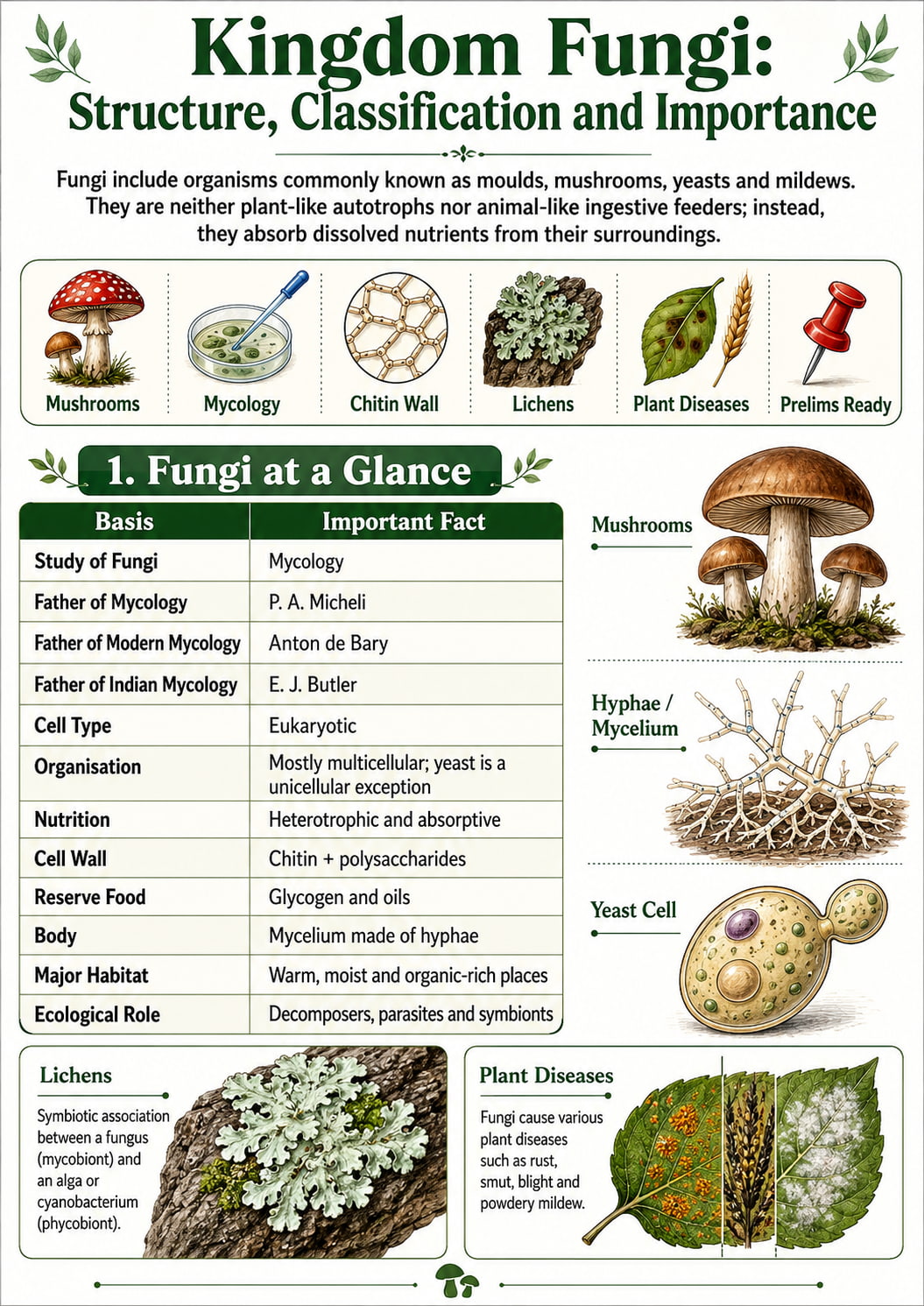
Fungi include organisms commonly known as moulds, mushrooms, yeasts and mildews. They are neither plant-like autotrophs nor animal-like ingestive feeders; instead, they absorb dissolved nutrients from their surroundings.
1 Fungi at a Glance
| Basis | Important Fact |
|---|---|
| Study of Fungi | Mycology |
| Father of Mycology | P. A. Micheli |
| Father of Modern Mycology | Anton de Bary |
| Father of Indian Mycology | E. J. Butler |
| Cell Type | Eukaryotic |
| Organisation | Mostly multicellular; yeast is a unicellular exception |
| Nutrition | Heterotrophic and absorptive |
| Cell Wall | Chitin + polysaccharides |
| Reserve Food | Glycogen and oils |
| Body | Mycelium made of hyphae |
| Major Habitat | Warm, moist and organic-rich places |
| Ecological Role | Decomposers, parasites and symbionts |
2 Key Characteristics of Fungi

Cell Type and Body Organisation
- Fungi are eukaryotic organisms.
- Most fungi are filamentous.
- The body is made of thread-like structures called hyphae.
- The network of hyphae is called mycelium.
- Yeast is an important unicellular fungus.
Cell Wall
The fungal cell wall is not made of cellulose. It is mainly made of chitin and polysaccharides.
Nutrition
- Fungi lack chlorophyll.
- They cannot perform photosynthesis.
- Their nutrition is absorptive and heterotrophic.
- They may be saprophytic, parasitic or symbiotic.
Reserve Food
Fungi store food in the form of glycogen and oils. This makes them different from plants and somewhat similar to animals in food storage.
Exam Point
Plants have a cellulose cell wall, fungi have a chitinous cell wall, while animals do not have a cell wall.
3 Hyphae and Mycelium

Hyphae are thin, thread-like structures that form the main body of fungi. A mass or network of hyphae is called mycelium. Mycelium is the main vegetative body of a fungus.
| Type | Feature | Examples/Association |
|---|---|---|
| Septate Hyphae | Cross walls or septa are present | Ascomycetes, Basidiomycetes |
| Aseptate / Coenocytic Hyphae | Septa absent; multinucleate cytoplasm | Phycomycetes such as Rhizopus and Mucor |
4 Reproduction in Fungi
Vegetative Reproduction
- Fragmentation
- Budding
- Fission
- Yeast commonly reproduces by budding.
Asexual Reproduction
- Occurs through spores.
- Zoospores are motile.
- Sporangiospores are formed inside sporangia.
- Conidia are formed externally on conidiophores.
Sexual Reproduction
- Plasmogamy: fusion of cytoplasm.
- Karyogamy: fusion of nuclei.
- Meiosis: formation of haploid spores.
Prelims Trap: Dikaryotic Stage
In Ascomycetes and Basidiomycetes, a long gap may occur between plasmogamy and karyogamy. During this stage, each cell contains two nuclei. This is called the dikaryotic stage (n + n), not 2n.
5 Classification of Fungi
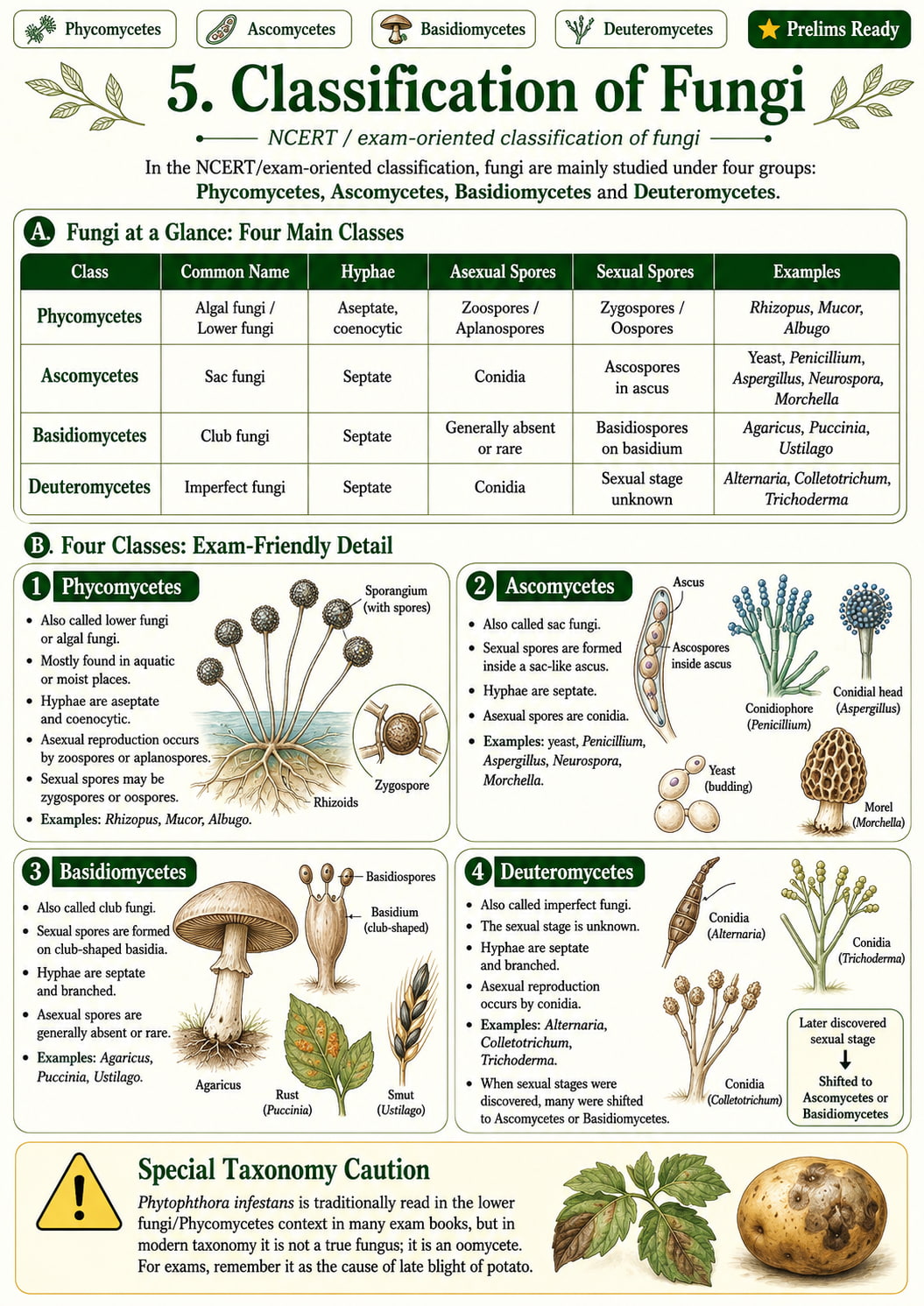
In the NCERT/exam-oriented classification, fungi are mainly studied under four groups: Phycomycetes, Ascomycetes, Basidiomycetes and Deuteromycetes.
| Class | Common Name | Hyphae | Asexual Spores | Sexual Spores | Examples |
|---|---|---|---|---|---|
| Phycomycetes | Algal fungi / Lower fungi | Aseptate, coenocytic | Zoospores / Aplanospores | Zygospores / Oospores | Rhizopus, Mucor, Albugo |
| Ascomycetes | Sac fungi | Septate | Conidia | Ascospores in ascus | Yeast, Penicillium, Aspergillus, Neurospora, Morchella |
| Basidiomycetes | Club fungi | Septate | Generally absent or rare | Basidiospores on basidium | Agaricus, Puccinia, Ustilago |
| Deuteromycetes | Imperfect fungi | Septate | Conidia | Sexual stage unknown | Alternaria, Colletotrichum, Trichoderma |
6 Four Classes: Exam-Friendly Detail
Phycomycetes
- Also called lower fungi or algal fungi.
- Mostly found in aquatic or moist places.
- Hyphae are aseptate and coenocytic.
- Asexual reproduction occurs by zoospores or aplanospores.
- Sexual spores may be zygospores or oospores.
- Examples: Rhizopus, Mucor, Albugo.
Ascomycetes
- Also called sac fungi.
- Sexual spores are formed inside a sac-like ascus.
- Hyphae are septate.
- Asexual spores are conidia.
- Examples: yeast, Penicillium, Aspergillus, Neurospora, Morchella.
Basidiomycetes
- Also called club fungi.
- Sexual spores are formed on club-shaped basidia.
- Hyphae are septate and branched.
- Asexual spores are generally absent or rare.
- Examples: Agaricus, Puccinia, Ustilago.
Deuteromycetes
- Also called imperfect fungi.
- The sexual stage is unknown.
- Hyphae are septate and branched.
- Asexual reproduction occurs by conidia.
- Examples: Alternaria, Colletotrichum, Trichoderma.
- When sexual stages were discovered, many were shifted to Ascomycetes or Basidiomycetes.
Special Taxonomy Caution
Phytophthora infestans is traditionally read in the lower fungi/Phycomycetes context in many exam books, but in modern taxonomy it is not a true fungus; it is an oomycete. For exams, remember it as the cause of late blight of potato.
7 Lichens
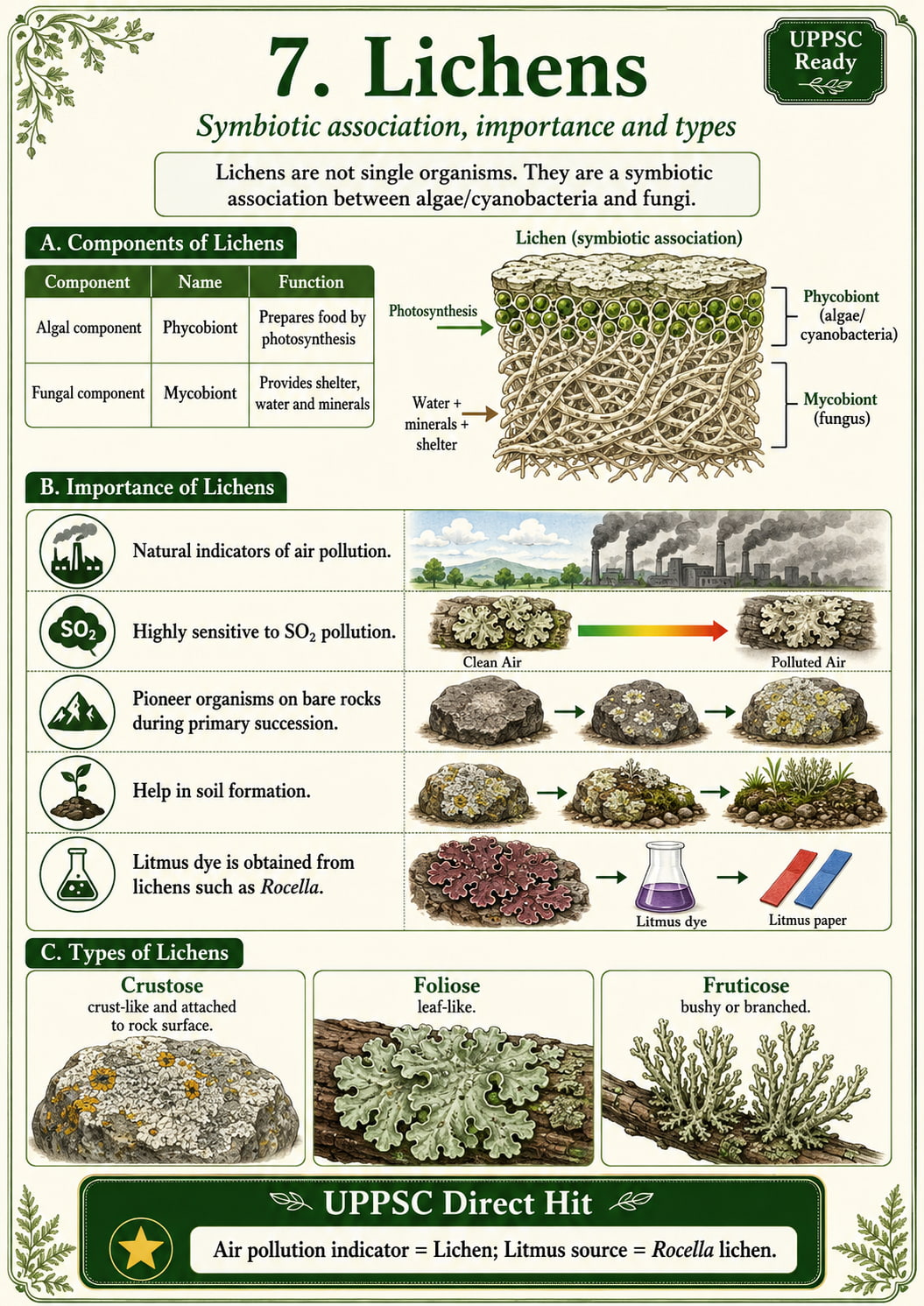
Lichens are not single organisms. They are a symbiotic association between algae/cyanobacteria and fungi.
| Component | Name | Function |
|---|---|---|
| Algal component | Phycobiont | Prepares food by photosynthesis |
| Fungal component | Mycobiont | Provides shelter, water and minerals |
Importance of Lichens
- Natural indicators of air pollution.
- Highly sensitive to SO₂ pollution.
- Pioneer organisms on bare rocks during primary succession.
- Help in soil formation.
- Litmus dye is obtained from lichens such as Rocella.
Types of Lichens
- Crustose: crust-like and attached to rock surface.
- Foliose: leaf-like.
- Fruticose: bushy or branched.
UPPSC Direct Hit
Air pollution indicator = Lichen; Litmus source = Rocella lichen.
8 Mycorrhiza
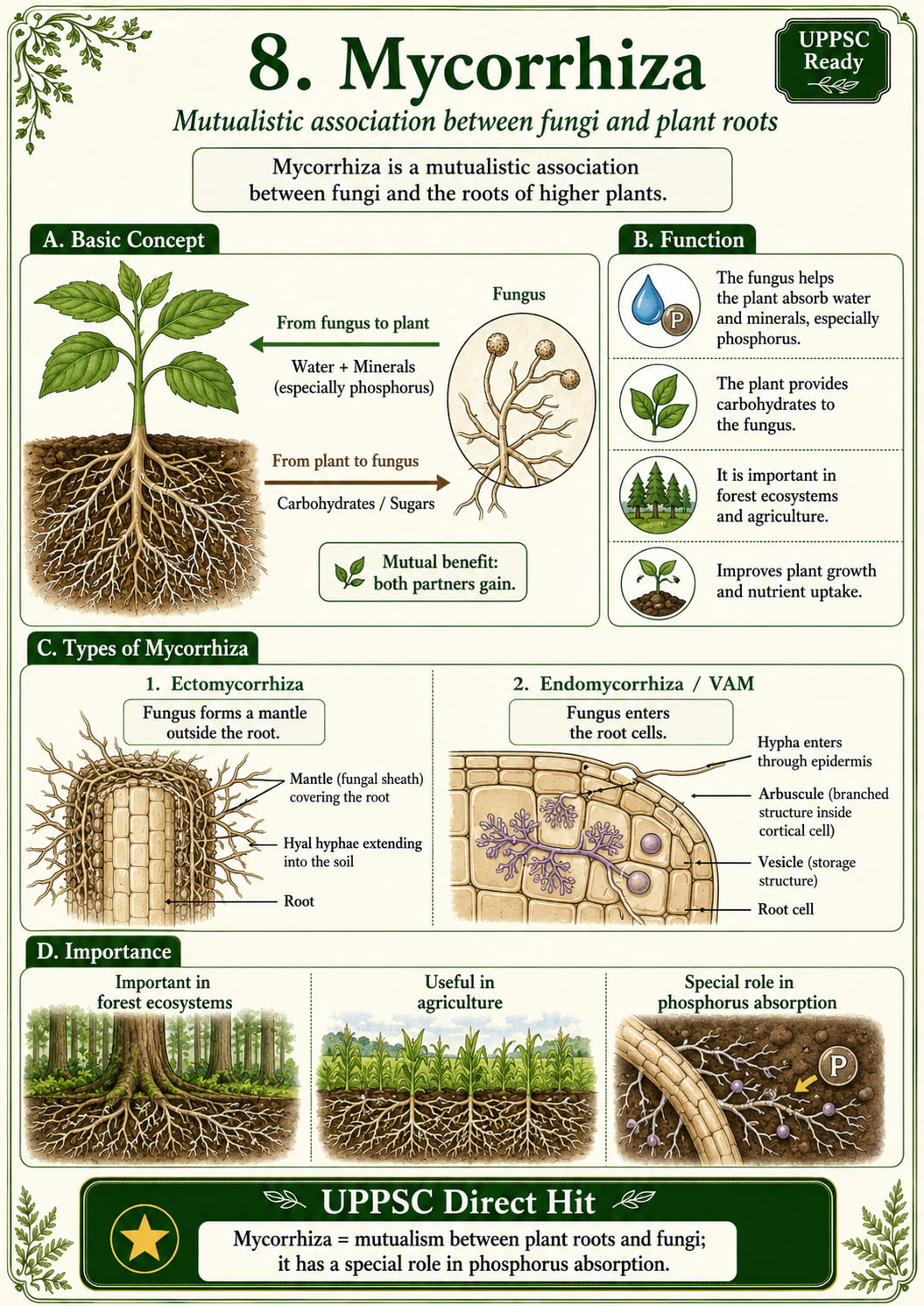
Mycorrhiza is a mutualistic association between fungi and the roots of higher plants.
Function
- The fungus helps the plant absorb water and minerals, especially phosphorus.
- The plant provides carbohydrates to the fungus.
- It is important in forest ecosystems and agriculture.
Types
- Ectomycorrhiza: fungus forms a mantle outside the root.
- Endomycorrhiza / VAM: fungus enters the root cells.
Exam Line
Mycorrhiza = mutualism between plant roots and fungi; it has a special role in phosphorus absorption.
9 Economic Importance of Fungi
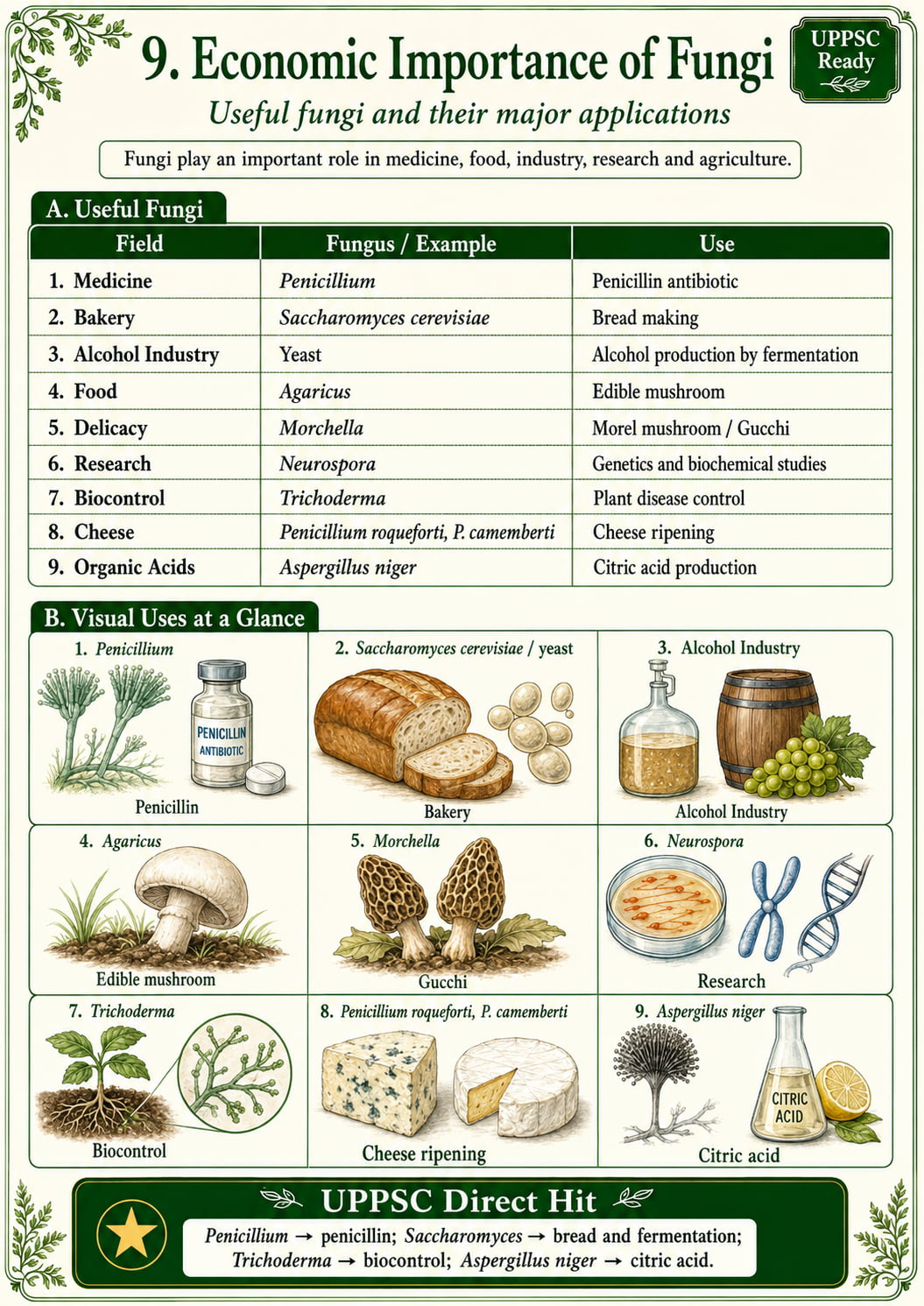
Useful Fungi
| Field | Fungus/Example | Use |
|---|---|---|
| Medicine | Penicillium | Penicillin antibiotic |
| Bakery | Saccharomyces cerevisiae | Bread making |
| Alcohol Industry | Yeast | Alcohol production by fermentation |
| Food | Agaricus | Edible mushroom |
| Delicacy | Morchella | Morel mushroom / Gucchi |
| Research | Neurospora | Genetics and biochemical studies |
| Biocontrol | Trichoderma | Plant disease control |
| Cheese | Penicillium roqueforti, P. camemberti | Cheese ripening |
| Organic Acids | Aspergillus niger | Citric acid production |
10 Harmful Fungi

A. Plant Diseases
| Disease | Crop/Plant | Causal Organism |
|---|---|---|
| Rust of wheat | Wheat | Puccinia graminis |
| Smut disease | Cereals | Ustilago |
| Red rot of sugarcane | Sugarcane | Colletotrichum falcatum |
| Tikka disease | Groundnut | Cercospora |
| Early blight | Potato/Tomato | Alternaria solani |
| Late blight | Potato | Phytophthora infestans |
| White rust | Mustard | Albugo candida |
| Ergot disease | Rye/Bajra | Claviceps |
B. Human Diseases
| Disease | Causal Fungus/Group | Key Point |
|---|---|---|
| Ringworm | Trichophyton, Microsporum, Epidermophyton | Skin infection |
| Athlete’s foot | Tinea pedis | Toes/feet infection |
| Candidiasis | Candida albicans | Opportunistic infection |
| Mucormycosis | Mucorales, often Rhizopus | Serious infection in immunocompromised persons and diabetics |
| Aspergillosis | Aspergillus | Lung infection/allergy |
| Histoplasmosis | Histoplasma | Fungal lung disease |
C. Fungal Toxins
| Toxin | Produced By | Effect |
|---|---|---|
| Aflatoxin | Aspergillus flavus, A. parasiticus | Liver cancer risk |
| Ergot alkaloids | Claviceps | Ergotism |
| Patulin | Penicillium expansum | Spoiled fruits, especially apple products |
11 Fungi vs Plants vs Animals
| Feature | Fungi | Plants | Animals |
|---|---|---|---|
| Nutrition | Heterotrophic, absorptive | Autotrophic | Heterotrophic, ingestive |
| Cell Wall | Chitin | Cellulose | Absent |
| Reserve Food | Glycogen and oils | Starch | Glycogen and fat |
| Chlorophyll | Absent | Present | Absent |
| Body Organisation | Hyphae and mycelium | Tissues/organs | Tissues/organs |
| Ecosystem Role | Decomposer, parasite, symbiont | Producer | Consumer |
12 Most Important One-Liners for Prelims
13 UPPSC/UPSC/UGC-NET Prelims Traps
| Wrong Statement | Correct Fact |
|---|---|
| Fungi are autotrophic like plants. | Fungi are heterotrophic. |
| Fungi ingest food. | Fungi absorb food. |
| Fungal cell wall is made of cellulose. | Fungal cell wall is made of chitin and polysaccharides. |
| All fungi are multicellular. | Yeast is a unicellular fungus. |
| All fungi are saprophytes. | Fungi may be saprophytic, parasitic or symbiotic. |
| Ascospores are formed externally. | Ascospores are formed inside the ascus. |
| Basidiospores are formed inside the ascus. | Basidiospores are formed externally on the basidium. |
| Sexual reproduction is known in Deuteromycetes. | The sexual stage is unknown in Deuteromycetes. |
| Mucormycosis is caused only by Mucor. | It is associated with the Mucorales group, often Rhizopus. |
| Lichen is a single organism. | It is an association between algae/cyanobacteria and fungi. |
| Mycorrhiza is found in leaves. | It is an association between plant roots and fungi. |
14 Direct-Hit MCQs: Must Remember
Q1. What is the fungal cell wall made of?
Answer: Chitin and polysaccharides.
Q2. Yeast belongs to which kingdom?
Answer: Kingdom Fungi.
Q3. What is the major use of yeast?
Answer: Bread-making and alcohol fermentation.
Q4. Why are Ascomycetes called sac fungi?
Answer: Because their ascospores are formed inside a sac-like ascus.
Q5. Why are Basidiomycetes called club fungi?
Answer: Because their basidiospores are formed on a club-shaped basidium.
Q6. Wheat rust is caused by which fungus?
Answer: Puccinia.
Q7. Red rot of sugarcane is caused by which fungus?
Answer: Colletotrichum falcatum.
Q8. Tikka disease of groundnut is caused by which fungus?
Answer: Cercospora.
Q9. Aflatoxin is produced by which fungus?
Answer: Mainly Aspergillus flavus and Aspergillus parasiticus.
Q10. What is the algal component of lichen called?
Answer: Phycobiont.
Q11. What is the fungal component of lichen called?
Answer: Mycobiont.
Q12. Which organism is a natural indicator of air pollution?
Answer: Lichen.
Q13. Mycorrhiza is an association between which organisms?
Answer: Plant roots and fungi.
Q14. Penicillin was obtained from which fungus?
Answer: Penicillium.
Q15. Which fungi are called imperfect fungi?
Answer: Deuteromycetes.
One-Line Revision
Fungi = Eukaryotic + heterotrophic + absorptive nutrition + chitinous cell wall + glycogen reserve + hyphae-mycelium body + spores + decomposer/pathogen/symbiont roles.
कवक जगत: संरचना, वर्गीकरण और महत्व
कवक में वे जीव शामिल हैं जिन्हें सामान्य भाषा में फफूंदी, कुकुरमुत्ता, मशरूम, यीस्ट और मोल्ड कहा जाता है। ये न तो पौधों की तरह autotrophic होते हैं और न ही जंतुओं की तरह ingestive feeders; बल्कि ये अपने आसपास से घुलित पोषक पदार्थों को absorb करते हैं।
१ कवक: एक दृष्टि में
| आधार | महत्वपूर्ण तथ्य |
|---|---|
| कवकों का अध्ययन | Mycology |
| Father of Mycology | P. A. Micheli |
| Father of Modern Mycology | Anton de Bary |
| Father of Indian Mycology | E. J. Butler |
| कोशिका प्रकार | Eukaryotic |
| संगठन | अधिकांश multicellular; yeast एक unicellular अपवाद है |
| पोषण | Heterotrophic और absorptive |
| कोशिका भित्ति | Chitin + polysaccharides |
| संचित भोजन | Glycogen और oils |
| शरीर | Hyphae से बना mycelium |
| मुख्य आवास | गर्म, नम और organic-rich स्थान |
| पारिस्थितिक भूमिका | Decomposers, parasites और symbionts |
२ कवकों की मुख्य विशेषताएँ
Cell Type and Body Organisation
- कवक eukaryotic organisms हैं।
- अधिकांश fungi filamentous होते हैं।
- इनका शरीर धागेनुमा structures से बनता है, जिन्हें hyphae कहते हैं।
- Hyphae का network mycelium कहलाता है।
- Yeast एक महत्वपूर्ण unicellular fungus है।
Cell Wall
कवकों की cell wall cellulose की नहीं बनी होती। यह मुख्यतः chitin और polysaccharides की बनी होती है।
Nutrition
- कवकों में chlorophyll नहीं होता।
- ये photosynthesis नहीं कर सकते।
- इनका पोषण absorptive और heterotrophic होता है।
- ये saprophytic, parasitic या symbiotic हो सकते हैं।
Reserve Food
कवक भोजन को glycogen और oils के रूप में store करते हैं। इस कारण ये भोजन-संचय के आधार पर पौधों से अलग और जंतुओं से कुछ हद तक समान दिखते हैं।
Exam Point
पौधों की cell wall cellulose की होती है, कवकों की cell wall chitinous होती है, जबकि जंतुओं में cell wall अनुपस्थित होती है।
३ Hyphae और Mycelium
Hyphae पतले, धागेनुमा structures होते हैं जो कवक का मुख्य शरीर बनाते हैं। Hyphae के समूह या network को mycelium कहा जाता है। Mycelium fungus का मुख्य vegetative body होता है।
| प्रकार | विशेषता | उदाहरण/सम्बंध |
|---|---|---|
| Septate Hyphae | Cross walls या septa उपस्थित होते हैं | Ascomycetes, Basidiomycetes |
| Aseptate / Coenocytic Hyphae | Septa अनुपस्थित; multinucleate cytoplasm | Phycomycetes जैसे Rhizopus और Mucor |
४ कवकों में प्रजनन
Vegetative Reproduction
- Fragmentation
- Budding
- Fission
- Yeast सामान्यतः budding द्वारा reproduce करता है।
Asexual Reproduction
- यह spores द्वारा होता है।
- Zoospores motile होते हैं।
- Sporangiospores sporangia के अंदर बनते हैं।
- Conidia, conidiophores पर externally बनते हैं।
Sexual Reproduction
- Plasmogamy: cytoplasm का fusion।
- Karyogamy: nuclei का fusion।
- Meiosis: haploid spores का निर्माण।
Prelims Trap: Dikaryotic Stage
Ascomycetes और Basidiomycetes में plasmogamy और karyogamy के बीच लंबा अंतर हो सकता है। इस अवस्था में प्रत्येक cell में दो nuclei होते हैं। इसे dikaryotic stage (n + n) कहा जाता है, 2n नहीं।
५ कवकों का वर्गीकरण
NCERT/exam-oriented classification में fungi को मुख्य रूप से चार groups में पढ़ा जाता है: Phycomycetes, Ascomycetes, Basidiomycetes और Deuteromycetes।
| वर्ग | सामान्य नाम | Hyphae | Asexual Spores | Sexual Spores | उदाहरण |
|---|---|---|---|---|---|
| Phycomycetes | Algal fungi / Lower fungi | Aseptate, coenocytic | Zoospores / Aplanospores | Zygospores / Oospores | Rhizopus, Mucor, Albugo |
| Ascomycetes | Sac fungi | Septate | Conidia | Ascospores in ascus | Yeast, Penicillium, Aspergillus, Neurospora, Morchella |
| Basidiomycetes | Club fungi | Septate | Generally absent or rare | Basidiospores on basidium | Agaricus, Puccinia, Ustilago |
| Deuteromycetes | Imperfect fungi | Septate | Conidia | Sexual stage unknown | Alternaria, Colletotrichum, Trichoderma |
६ चार वर्ग: Exam-Friendly Detail
Phycomycetes
- इन्हें lower fungi या algal fungi भी कहा जाता है।
- ये अधिकतर aquatic या moist places में पाए जाते हैं।
- Hyphae aseptate और coenocytic होते हैं।
- Asexual reproduction zoospores या aplanospores से होता है।
- Sexual spores zygospores या oospores हो सकते हैं।
- उदाहरण: Rhizopus, Mucor, Albugo।
Ascomycetes
- इन्हें sac fungi कहा जाता है।
- Sexual spores sac-like ascus के अंदर बनते हैं।
- Hyphae septate होते हैं।
- Asexual spores conidia होते हैं।
- उदाहरण: yeast, Penicillium, Aspergillus, Neurospora, Morchella।
Basidiomycetes
- इन्हें club fungi कहा जाता है।
- Sexual spores club-shaped basidia पर बनते हैं।
- Hyphae septate और branched होते हैं।
- Asexual spores सामान्यतः absent या rare होते हैं।
- उदाहरण: Agaricus, Puccinia, Ustilago।
Deuteromycetes
- इन्हें imperfect fungi कहा जाता है।
- इनका sexual stage unknown होता है।
- Hyphae septate और branched होते हैं।
- Asexual reproduction conidia द्वारा होता है।
- उदाहरण: Alternaria, Colletotrichum, Trichoderma।
- जब sexual stages discover हुए, तो कई members को Ascomycetes या Basidiomycetes में shift कर दिया गया।
Special Taxonomy Caution
Phytophthora infestans को कई exam books में lower fungi/Phycomycetes context में पढ़ाया जाता है, लेकिन modern taxonomy में यह true fungus नहीं, बल्कि oomycete है। परीक्षा के लिए इसे potato के late blight के कारण के रूप में याद रखें।
७ Lichens
Lichens single organisms नहीं हैं। ये algae/cyanobacteria और fungi के बीच symbiotic association हैं।
| Component | नाम | कार्य |
|---|---|---|
| Algal component | Phycobiont | Photosynthesis द्वारा भोजन बनाता है |
| Fungal component | Mycobiont | Shelter, water और minerals उपलब्ध कराता है |
Lichens का महत्व
- ये air pollution के natural indicators हैं।
- ये SO₂ pollution के प्रति अत्यधिक sensitive होते हैं।
- Primary succession में bare rocks पर pioneer organisms की भूमिका निभाते हैं।
- Soil formation में सहायक होते हैं।
- Litmus dye, Rocella जैसे lichens से प्राप्त होती है।
Lichens के प्रकार
- Crustose: crust-like और rock surface से चिपके हुए।
- Foliose: leaf-like।
- Fruticose: bushy या branched।
UPPSC Direct Hit
Air pollution indicator = Lichen; Litmus source = Rocella lichen.
८ Mycorrhiza
Mycorrhiza fungi और higher plants की roots के बीच mutualistic association है।
कार्य
- Fungus पौधे को water और minerals, विशेषकर phosphorus, absorb करने में मदद करता है।
- Plant fungus को carbohydrates उपलब्ध कराता है।
- यह forest ecosystems और agriculture में महत्वपूर्ण है।
प्रकार
- Ectomycorrhiza: fungus root के बाहर mantle बनाता है।
- Endomycorrhiza / VAM: fungus root cells के अंदर प्रवेश करता है।
Exam Line
Mycorrhiza = plant roots और fungi के बीच mutualism; phosphorus absorption में इसकी विशेष भूमिका होती है।
९ कवकों का आर्थिक महत्व
Useful Fungi
| क्षेत्र | Fungus/Example | उपयोग |
|---|---|---|
| Medicine | Penicillium | Penicillin antibiotic |
| Bakery | Saccharomyces cerevisiae | Bread making |
| Alcohol Industry | Yeast | Fermentation द्वारा alcohol production |
| Food | Agaricus | Edible mushroom |
| Delicacy | Morchella | Morel mushroom / गुच्छी |
| Research | Neurospora | Genetics और biochemical studies |
| Biocontrol | Trichoderma | Plant disease control |
| Cheese | Penicillium roqueforti, P. camemberti | Cheese ripening |
| Organic Acids | Aspergillus niger | Citric acid production |
१० हानिकारक कवक
A. पौधों के रोग
| रोग | फसल/पौधा | कारक जीव |
|---|---|---|
| Rust of wheat | Wheat | Puccinia graminis |
| Smut disease | Cereals | Ustilago |
| Red rot of sugarcane | Sugarcane | Colletotrichum falcatum |
| Tikka disease | Groundnut | Cercospora |
| Early blight | Potato/Tomato | Alternaria solani |
| Late blight | Potato | Phytophthora infestans |
| White rust | Mustard | Albugo candida |
| Ergot disease | Rye/Bajra | Claviceps |
B. मानव रोग
| रोग | कारक कवक/Group | मुख्य तथ्य |
|---|---|---|
| Ringworm / दाद | Trichophyton, Microsporum, Epidermophyton | Skin infection |
| Athlete’s foot | Tinea pedis | Toes/feet infection |
| Candidiasis | Candida albicans | Opportunistic infection |
| Mucormycosis | Mucorales, often Rhizopus | Immunocompromised persons और diabetics में गंभीर infection |
| Aspergillosis | Aspergillus | Lung infection/allergy |
| Histoplasmosis | Histoplasma | Fungal lung disease |
C. Fungal Toxins
| Toxin | Produced By | Effect |
|---|---|---|
| Aflatoxin | Aspergillus flavus, A. parasiticus | Liver cancer risk |
| Ergot alkaloids | Claviceps | Ergotism |
| Patulin | Penicillium expansum | Spoiled fruits, especially apple products |
११ Fungi vs Plants vs Animals
| Feature | Fungi | Plants | Animals |
|---|---|---|---|
| Nutrition | Heterotrophic, absorptive | Autotrophic | Heterotrophic, ingestive |
| Cell Wall | Chitin | Cellulose | Absent |
| Reserve Food | Glycogen and oils | Starch | Glycogen and fat |
| Chlorophyll | Absent | Present | Absent |
| Body Organisation | Hyphae and mycelium | Tissues/organs | Tissues/organs |
| Ecosystem Role | Decomposer, parasite, symbiont | Producer | Consumer |
१२ Prelims के लिए सबसे महत्वपूर्ण One-Liners
१३ UPPSC/UPSC/UGC-NET Prelims Traps
| गलत कथन | सही तथ्य |
|---|---|
| कवक पौधों की तरह autotrophic होते हैं। | कवक heterotrophic होते हैं। |
| कवक भोजन ingest करते हैं। | कवक भोजन absorb करते हैं। |
| Fungal cell wall cellulose की होती है। | Fungal cell wall chitin और polysaccharides की होती है। |
| सभी fungi multicellular होते हैं। | Yeast एक unicellular fungus है। |
| सभी fungi saprophytes होते हैं। | Fungi saprophytic, parasitic या symbiotic हो सकते हैं। |
| Ascospores externally बनते हैं। | Ascospores ascus के अंदर बनते हैं। |
| Basidiospores ascus के अंदर बनते हैं। | Basidiospores basidium पर externally बनते हैं। |
| Deuteromycetes में sexual reproduction known होता है। | Deuteromycetes में sexual stage unknown होता है। |
| Mucormycosis केवल Mucor से होता है। | यह Mucorales group, often Rhizopus, से जुड़ा है। |
| Lichen एक single organism है। | यह algae/cyanobacteria और fungi का association है। |
| Mycorrhiza leaves में पाया जाता है। | यह plant roots और fungi का association है। |
१४ Direct-Hit MCQs: Must Remember
Q1. कवकों की cell wall किसकी बनी होती है?
Answer: Chitin and polysaccharides.
Q2. Yeast किस kingdom से संबंधित है?
Answer: Kingdom Fungi.
Q3. Yeast का प्रमुख उपयोग क्या है?
Answer: Bread-making और alcohol fermentation.
Q4. Ascomycetes को sac fungi क्यों कहते हैं?
Answer: क्योंकि इनके ascospores sac-like ascus के अंदर बनते हैं।
Q5. Basidiomycetes को club fungi क्यों कहते हैं?
Answer: क्योंकि इनके basidiospores club-shaped basidium पर बनते हैं।
Q6. Wheat rust किस fungus से होता है?
Answer: Puccinia.
Q7. Red rot of sugarcane किस fungus से होता है?
Answer: Colletotrichum falcatum.
Q8. Tikka disease of groundnut किस fungus से होता है?
Answer: Cercospora.
Q9. Aflatoxin किस fungus से बनता है?
Answer: Mainly Aspergillus flavus and Aspergillus parasiticus.
Q10. Lichen का algal component क्या कहलाता है?
Answer: Phycobiont.
Q11. Lichen का fungal component क्या कहलाता है?
Answer: Mycobiont.
Q12. Air pollution का natural indicator कौन है?
Answer: Lichen.
Q13. Mycorrhiza किनके बीच association है?
Answer: Plant roots and fungi.
Q14. Penicillin किस fungus से प्राप्त हुई?
Answer: Penicillium.
Q15. Imperfect fungi किसे कहते हैं?
Answer: Deuteromycetes.
१५ Final Exam Summary
Summary
कवक जगत eukaryotic, heterotrophic और absorptive organisms का समूह है। इनकी cell wall chitin और polysaccharides से बनी होती है तथा reserve food glycogen और oils के रूप में stored रहता है। इनका शरीर hyphae और mycelium से बना होता है। Fungi ecological decomposers, plant pathogens, human pathogens, symbionts और industrially useful organisms—सभी भूमिकाएँ निभाते हैं। परीक्षा के लिए fungal classification, spores, lichens, mycorrhiza, penicillin, aflatoxin और fungal diseases सबसे महत्वपूर्ण areas हैं।
One-Line Revision
Fungi = Eukaryotic + heterotrophic + absorptive nutrition + chitinous cell wall + glycogen reserve + hyphae-mycelium body + spores + decomposer/pathogen/symbiont roles.