A regional branch of the Nagara (North Indian) style.
1. The Core Philosophy: The Temple as a Human Body
In Kalinga tradition, the temple is a microcosm of the Divine. It is built to mimic the parts of a standing human body:
Bada (The Foot): The lower wall and base.
Gandi (The Trunk): The main body of the spire (Shikhara).
Mastaka (The Head): The crowning portion at the very top.
2. Layout: The Four Halls of a Mature Temple
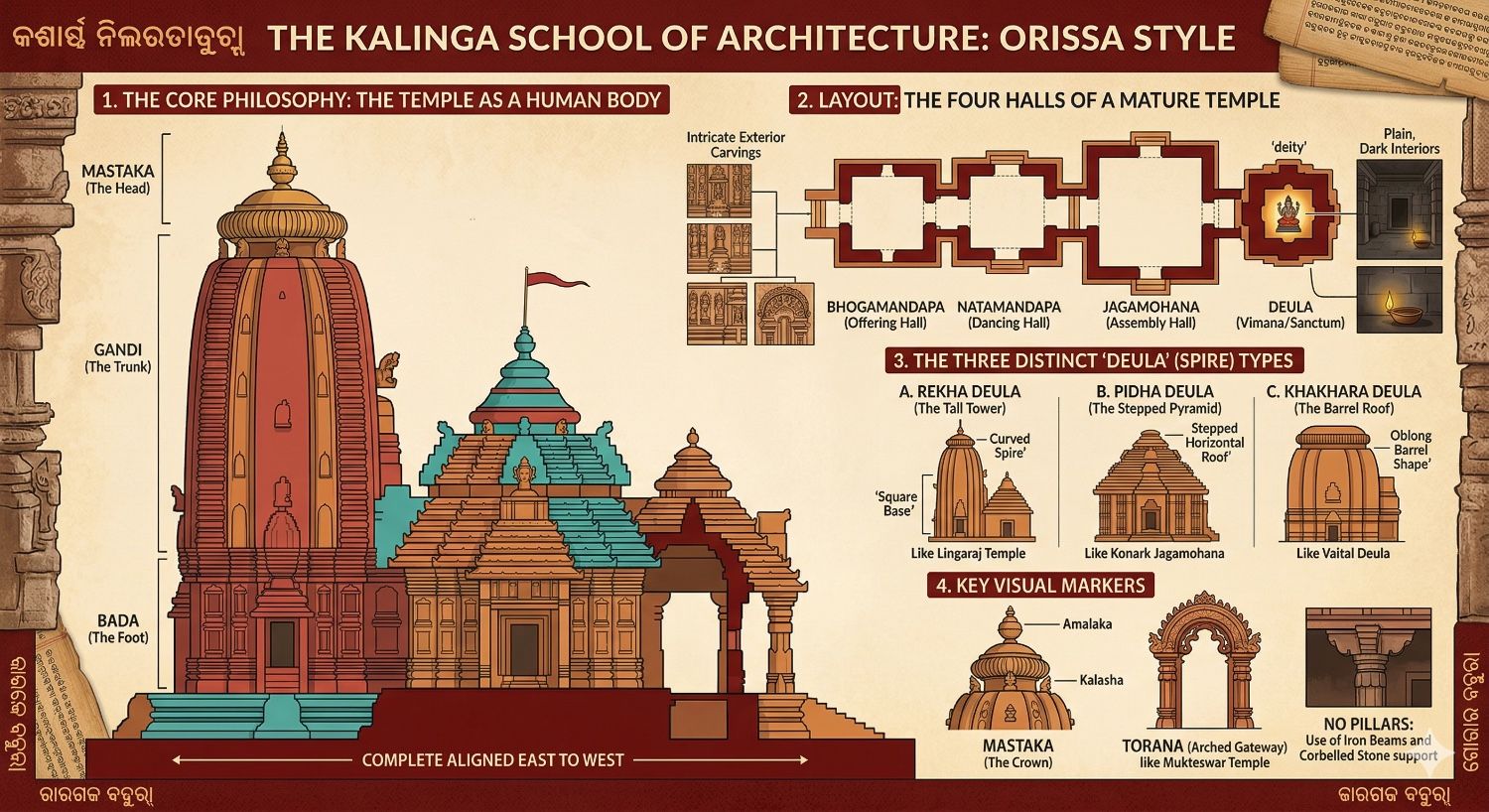
As the style evolved, the temple grew from a single room to a four-part linear complex (usually aligned East to West):
Deula (Vimana): The tall main tower housing the deity (Sanctum).
Jagamohana: The square/pyramidal Assembly Hall for devotees.
Natamandapa: The Dancing Hall (added later for ritual performances).
Bhogamandapa: The Offering Hall (where Prasad is offered).
Pro-Tip: The Interiors are always plain and dark (to focus on God), while the Exteriors are packed with thousands of intricate carvings.
3. The Three Distinct "Deula" (Spire) Types
The "look" of an Odisha temple is defined by the shape of its roof.
A. Rekha Deula (The Tall Tower)
Shape: Square base with a tall, vertical spire that curves sharply at the top.
Usage: Always used for the Main Sanctum.
Example: Lingaraj Temple (Bhubaneswar).
B. Pidha Deula (The Stepped Pyramid)
Shape: A roof made of horizontal "steps" (Pidhas) stacked like a pyramid.
Usage: Usually for the Jagamohana (Assembly Hall).
Example: The main surviving structure at Konark.
C. Khakhara Deula (The Barrel Roof)
Shape: An oblong roof shaped like a barrel or a semi-cylinder (looks like a Gopuram).
Usage: Dedicated to Shakti (Goddesses) or Tantric worship.
Example: Vaital Deula (Bhubaneswar).
4. Key Visual Markers
Mastaka (The Crown): Every spire is topped with an Amalaka (a stone disc resembling a fruit) and a Kalasha (a holy water pot).
No Pillars: Unlike South Indian temples, Kalinga temples use Iron Beams and corbelled stone instead of pillars to support the roof.
Torana: Beautifully carved, free-standing Archways (e.g., Mukteswar Temple).
5. Evolution Timeline
| Phase | Century | Main Feature | Best Example |
|---|---|---|---|
| Early | 7th – 9th | Small, simple, flat-roofed halls. | Parashurameswar |
| Middle | 9th – 11th | Introduction of the Torana and elaborate art. | Mukteswar (The "Gem") |
| Mature | 11th – 13th | Huge scale, four-hall plan, high platforms. | Lingaraj, Konark, Puri |
6. Masterpieces to Remember
The Lingaraj Temple (The Peak)
Why it's special: It is the perfect balance of Rekha and Pidha styles.
Height: 180 feet.
Deity: Harihara (Combined Shiva & Vishnu).
The Sun Temple, Konark (The Chariot)
Design: A giant stone chariot with 24 wheels (Sun dials) and 7 horses (Days of the week).
Nickname: The "Black Pagoda" (used as a landmark by ancient sailors).
The Jagannath Temple, Puri (The Giant)
Why it's special: One of the Char Dhams.
Scale: Built on a high platform with a tower reaching 214 feet.
7. Sculpture Motifs
Alasa Kanyas: Graceful women in daily life (looking in a mirror, etc.).
Mithuna: Erotic art symbolizing fertility and life.
Gaja-Simha: A lion standing over an elephant (Spirit over Matter).
कलिंग वास्तुकला शैली (ओडिशा शैली)
यह नागर (उत्तर भारतीय) शैली की एक क्षेत्रीय शाखा है।
1. मुख्य दर्शन: मानव शरीर के रूप में मंदिर
कलिंग परंपरा में, मंदिर ईश्वरीय ब्रह्मांड (Microcosm) का प्रतीक है। इसे खड़े हुए मानव शरीर के अंगों की नकल करने के लिए बनाया गया है:
बाड़ा (पांव): निचली दीवार और आधार।
गांडी (धड़): शिखर का मुख्य भाग।
मस्तक (सिर): सबसे ऊपर का शीर्ष भाग।
2. लेआउट: एक परिपक्व मंदिर के चार हॉल
जैसे-जैसे शैली विकसित हुई, मंदिर एक कमरे से बढ़कर चार भागों वाले रैखिक परिसर में बदल गया (आमतौर पर पूर्व से पश्चिम की ओर संरेखित):
देउल (विमान): मुख्य ऊंची मीनार जिसमें देवता विराजमान होते हैं (गर्भगृह)।
जगमोहन: भक्तों के लिए चौकोर/पिरामिडनुमा सभा मंडप।
नाटमंडप: नृत्य कक्ष (धार्मिक प्रदर्शनों के लिए बाद में जोड़ा गया)।
भोगमंडप: प्रसाद कक्ष (जहाँ भगवान को भोग लगाया जाता है)।
प्रो-टिप: मंदिरों का आंतरिक भाग (Interior) हमेशा सादा और अंधेरा होता है (ताकि ध्यान भगवान पर रहे), जबकि बाहरी भाग (Exterior) हजारों जटिल नक्काशी से भरा होता है।
3. तीन विशिष्ट "देउल" (शिखर) प्रकार
ओडिशा के मंदिर का "लुक" उसकी छत के आकार से निर्धारित होता है।
A. रेखा देउल (ऊंची मीनार)
आकार: चौकोर आधार वाली एक ऊंची, ऊर्ध्वाधर मीनार जो ऊपर की ओर तेजी से मुड़ती है।
उपयोग: हमेशा मुख्य गर्भगृह के लिए उपयोग किया जाता है।
उदाहरण: लिंगराज मंदिर (भुवनेश्वर)।
B. पीढ़ा देउल (पिरामिडनुमा छत)
आकार: क्षैतिज "सीढ़ियों" (पीढ़ा) से बनी छत जो पिरामिड की तरह दिखती है।
उपयोग: आमतौर पर जगमोहन (सभा मंडप) के लिए।
उदाहरण: कोणार्क का मुख्य जगमोहन।
C. खाखरा देउल (बैरल छत)
आकार: एक आयताकार छत जो बैरल या अर्ध-बेलन के आकार की होती है (यह दक्षिण भारतीय 'गोपुरम' जैसा दिखता है)।
उपयोग: शक्ति (देवियों) या तांत्रिक पूजा के लिए समर्पित।
उदाहरण: वैताल देउल (भुवनेश्वर)।
4. मुख्य दृश्य पहचान (Visual Markers)
मस्तक (मुकुट): प्रत्येक शिखर के ऊपर एक आमलक (फल जैसा दिखने वाला पत्थर का डिस्क) और एक कलश होता है।
खंभों का अभाव: दक्षिण भारतीय मंदिरों के विपरीत, कलिंग मंदिरों में छत को सहारा देने के लिए खंभों के बजाय लोहे के बीम और पत्थर की परतों (Corbelled stone) का उपयोग किया जाता है।
तोरण: खूबसूरती से नक्काशीदार, मुक्त खड़े मेहराबदार प्रवेश द्वार (जैसे: मुक्तेश्वर मंदिर)।
5. विकास का कालक्रम
| चरण | शताब्दी | मुख्य विशेषता | सबसे अच्छा उदाहरण |
|---|---|---|---|
| प्रारंभिक | 7वीं – 9वीं | छोटे, सरल, सपाट छत वाले हॉल। | परशुरामेश्वर |
| मध्य | 9वीं – 11वीं | 'तोरण' और विस्तृत कला की शुरुआत। | मुक्तेश्वर (कला का "रत्न") |
| परिपक्व | 11वीं – 13वीं | विशाल पैमाना, चार-हॉल योजना, ऊंचे चबूतरे। | लिंगराज, कोणार्क, पुरी |
6. याद रखने योग्य उत्कृष्ट कृतियाँ
लिंगराज मंदिर (शिखर)
विशेषता: यह रेखा और पीढ़ा शैलियों का एक आदर्श संतुलन है।
ऊंचाई: 180 फीट।
देवता: हरिहर (शिव और विष्णु का सम्मिलित रूप)।
सूर्य मंदिर, कोणार्क (रथ)
डिज़ाइन: एक विशाल पत्थर का रथ जिसमें 24 पहिये (धूप घड़ी) और 7 घोड़े (सप्ताह के दिन) हैं।
उपनाम: "ब्लैक पगोडा" (प्राचीन नाविकों द्वारा मील के पत्थर के रूप में उपयोग किया जाता था)।
जगन्नाथ मंदिर, पुरी (विशालकाय)
विशेषता: चार धामों में से एक।
पैमाना: एक ऊंचे चबूतरे पर बना है जिसकी मीनार 214 फीट तक पहुंचती है।
7. मूर्तिकला के रूपांकन (Motifs)
अलसा कन्याएं: दैनिक जीवन में सुंदर महिलाएं (दर्पण देखना, आदि)।
मिथुन: प्रजनन क्षमता और जीवन की पूर्णता का प्रतीक कामुक कला।
गज-सिंह: हाथी के ऊपर खड़ा एक शेर (पदार्थ पर आत्मा की विजय)।