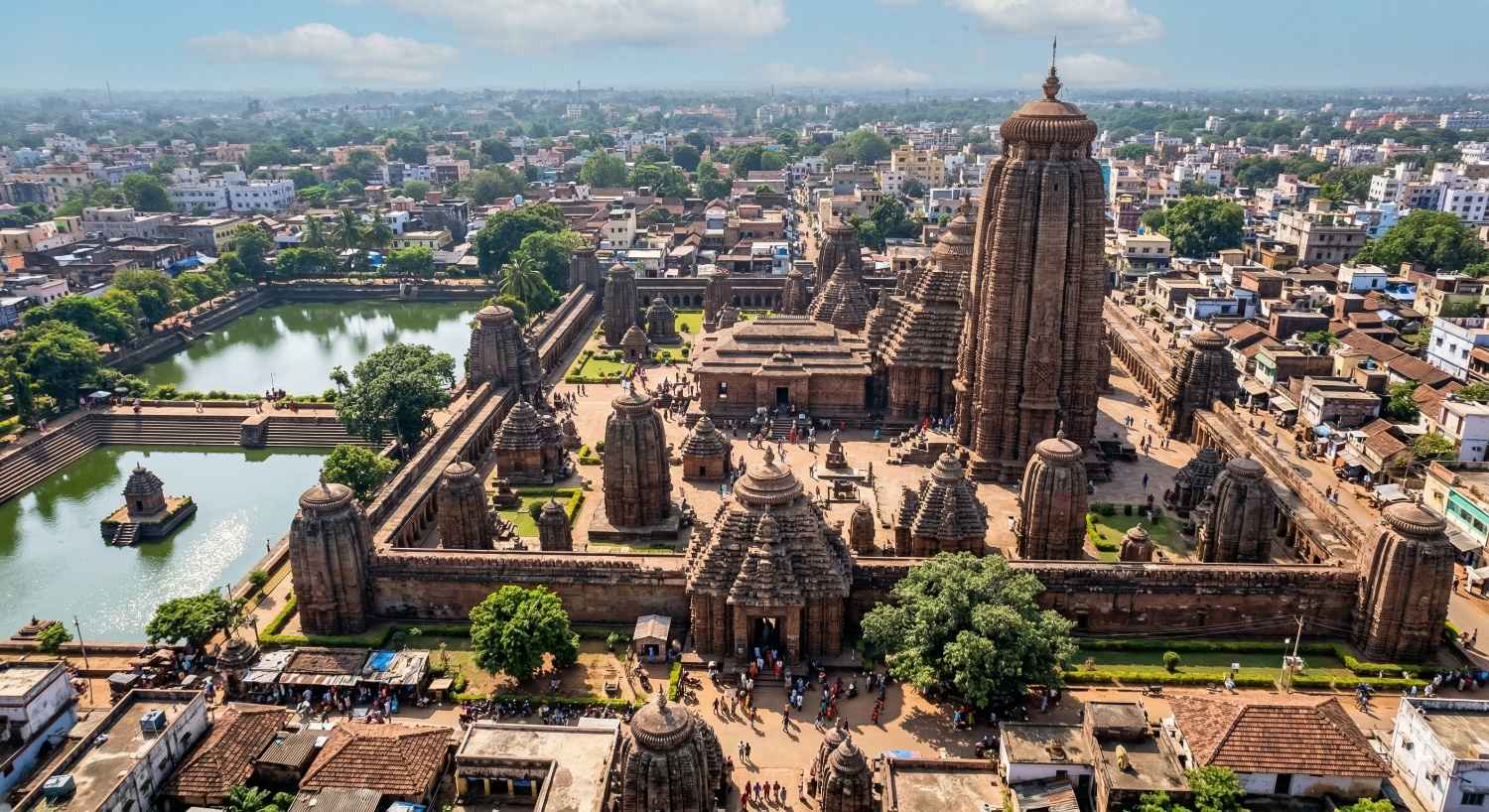
The Lingaraj Temple, located in Bhubaneswar, is the largest and most significant landmark of the "Temple City" of India. Built in the 11th century CE, it represents the absolute climax of the Kalinga School of Architecture.
1. Historical Context
Period: Constructed primarily during the reign of the Somavamshi Dynasty.
Builders: It was started by King Jajati Keshari and completed by his grandson Udyotakesari.
Deity: The temple is dedicated to Harihara, a combined form of Shiva (Hari) and Vishnu (Hara). This reflects the historical transition and harmony between Shaivism and Vaishnavism in Odisha.
2. Architectural Excellence
The Lingaraj Temple is a "mature" Kalinga temple, meaning it contains all four essential components of the style, arranged in a straight line:
Vimana (Deula): The main sanctum housing the Swayambhu (self-manifested) Linga. It is a Rekha Deula with a massive curvilinear spire reaching 180 feet.
Jagamohana: The assembly hall for devotees, built in the Pidha Deula (pyramidal) style.
Natamandapa: The dancing hall, used for ritual dance performances (Odissi).
Bhogamandapa: The hall of offerings where Prasad is offered to the deity.
3. Key Features and Symbolism
The Bindusagar Lake: The temple is located near this sacred tank, which is said to contain water from every holy river in India.
No Pillars: Like most Kalinga masterpieces, the massive roofs are supported by iron beams and the corbelled stone technique rather than free-standing pillars.
Exquisite Carvings: The exterior walls are a "visual encyclopedia," featuring:
Alasa Kanyas: Graceful female figures.
Parsvadevatas: Sculptures of Ganesha, Kartikeya, and Parvati in the niches.
Mythological Scenes: Depictions of various legends from the Puranas.
The Curvilinear Spire: The vertical lines of the Gandi (trunk) emphasize the height, drawing the eye toward the Amalaka and Kalasha at the summit.
4. Religious Significance
It is a non-congregational temple where only Hindus are allowed inside the main sanctum.
The presiding deity is the Tribhuvaneshwar (Lord of the Three Worlds), from which the city's name, Bhubaneswar, is derived.
लिंगराज मंदिर
भुवनेश्वर में स्थित लिंगराज मंदिर, भारत के "मंदिरों के शहर" का सबसे बड़ा और सबसे महत्वपूर्ण मील का पत्थर है। 11वीं शताब्दी ईस्वी में निर्मित, यह कलिंग वास्तुकला शैली के पूर्ण चरमोत्कर्ष का प्रतिनिधित्व करता है।
1. ऐतिहासिक संदर्भ (Historical Context)
काल: मुख्य रूप से सोमवंशी राजवंश के शासनकाल के दौरान निर्मित।
निर्माता: इसकी शुरुआत राजा जजाति केशरी ने की थी और उनके पोते उद्योतकेसरी ने इसे पूरा किया था।
देवता: यह मंदिर हरिहर को समर्पित है, जो शिव (हरि) और विष्णु (हर) का सम्मिलित रूप है। यह ओडिशा में शैव और वैष्णव धर्म के बीच ऐतिहासिक परिवर्तन और सद्भाव को दर्शाता है।
2. वास्तुकला की उत्कृष्टता (Architectural Excellence)
लिंगराज मंदिर एक "परिपक्व" कलिंग मंदिर है, जिसका अर्थ है कि इसमें इस शैली के सभी चार आवश्यक घटक शामिल हैं, जो एक सीधी रेखा में व्यवस्थित हैं:
विमान (देउल): मुख्य गर्भगृह जिसमें स्वयंभू लिंग स्थापित है। यह एक रेखा देउल है जिसका विशाल वक्रीय शिखर 180 फीट तक ऊंचा है।
जगमोहन: भक्तों के लिए सभा मंडप, जो पीढ़ा देउल (पिरामिडनुमा) शैली में बना है।
नाटमंडप: नृत्य कक्ष, जिसका उपयोग औपचारिक नृत्य प्रदर्शनों (ओडिसी) के लिए किया जाता था।
भोगमंडप: प्रसाद कक्ष जहाँ देवता को नैवेद्य अर्पित किया जाता है।
3. मुख्य विशेषताएं और प्रतीकवाद (Key Features and Symbolism)
बिंदुसागर झील: मंदिर इस पवित्र तालाब के पास स्थित है, जिसके बारे में कहा जाता है कि इसमें भारत की प्रत्येक पवित्र नदी का जल है।
खंभों का अभाव: कलिंग के अधिकांश उत्कृष्ट नमूनों की तरह, इसकी विशाल छतों को मुक्त खड़े खंभों के बजाय लोहे के बीम और पत्थर की परतों (Corbelled stone) की तकनीक द्वारा सहारा दिया गया है।
अति सुंदर नक्काशी: बाहरी दीवारें एक "दृश्य विश्वकोश" (Visual Encyclopedia) हैं, जिनमें शामिल हैं:
अलसा कन्याएं: सुंदर महिला आकृतियां।
पार्श्वदेवता: ताखों (Niches) में गणेश, कार्तिकेय और पार्वती की मूर्तियां।
पौराणिक दृश्य: पुराणों की विभिन्न किंवदंतियों का चित्रण।
वक्रीय शिखर: गांडी (धड़) की ऊर्ध्वाधर रेखाएं ऊंचाई पर जोर देती हैं, जो आंखों को शिखर पर स्थित आमलक और कलश की ओर खींचती हैं।
4. धार्मिक महत्व (Religious Significance)
यह एक गैर-मंडली (Non-congregational) मंदिर है जहाँ केवल हिंदुओं को मुख्य गर्भगृह के अंदर जाने की अनुमति है।
मंदिर के मुख्य देवता त्रिभुवनेश्वर (तीनों लोकों के स्वामी) हैं, जिनसे शहर का नाम 'भुवनेश्वर' पड़ा है।
अगला कदम: क्या आप चाहेंगे कि मैं लिंगराज मंदिर और कोणार्क सूर्य मंदिर की तुलना करने वाली एक सारांश तालिका (Summary Table)तैयार करूँ ताकि आप उनके वास्तुशिल्प अंतर को आसानी से समझ सकें?