Exam Points
- Dharmachakra Pravartana: The formal term given to Buddha's first sermon at Sarnath.
- Panchavargiya Bhikkhus: The first five ascetic disciples of Buddha who received his teachings here (Kaundinya, Ashvajit, Bhadrika, Mahanaman, and Dashabala).
- Maha Bodhi Society: Played a pivotal role in the modern restoration of Sarnath, led by the Sri Lankan Buddhist leader Anagarika Dharmapala.
- Gupta Art: Sarnath became a major school of Buddhist art during the Gupta period, famous for its beautifully carved sandstone Buddha statues with wet drapery effects.
News Item
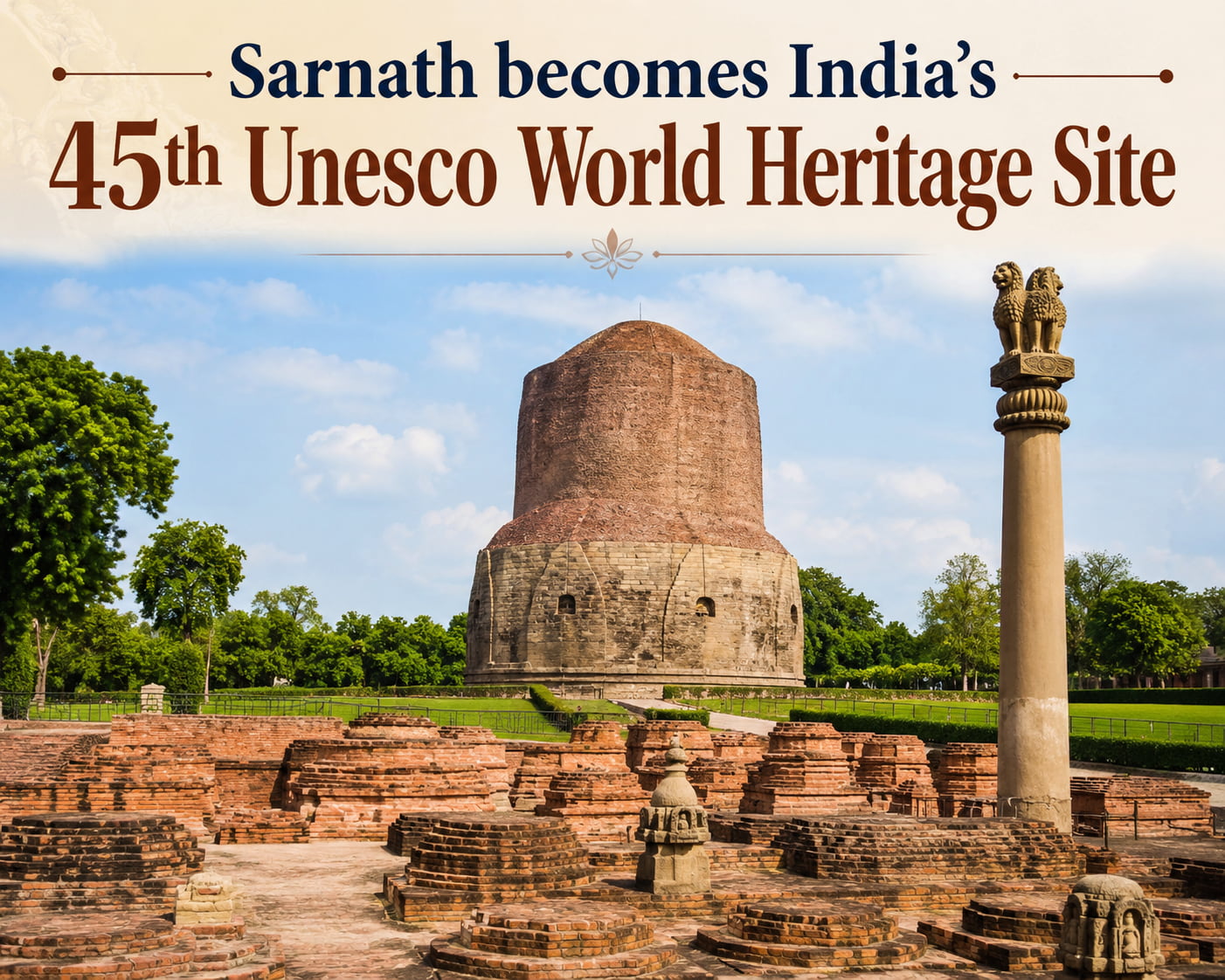
In a proud moment for India's spiritual heritage, Sarnath in Uttar Pradesh has been officially inscribed on the UNESCO World Heritage List. Prime Minister Narendra Modi highlighted that this global recognition celebrates Lord Buddha’s eternal message of compassion and will boost cultural tourism.
Background
Sarnath is exceptionally significant as it is one of the four major Buddhist pilgrimage sites in the world. After attaining enlightenment in Bodh Gaya, Lord Buddha traveled to Sarnath and delivered his first sermon, a monumental event known as Dharmachakra Pravartana (Turning the Wheel of Law). The site was historically known as Isipatana (the place where holy men landed) and Mrigadava (Deer Park). Over the centuries, especially under Emperor Ashoka, it blossomed into a magnificent center of Buddhist art, culture, and monastic life.
Prelims Facts
- Dharmachakra Pravartana: The formal term given to Buddha's first sermon at Sarnath.
- Panchavargiya Bhikkhus: The first five ascetic disciples of Buddha who received his teachings here (Kaundinya, Ashvajit, Bhadrika, Mahanaman, and Dashabala).
- Maha Bodhi Society: Played a pivotal role in the modern restoration of Sarnath, led by the Sri Lankan Buddhist leader Anagarika Dharmapala.
- Gupta Art: Sarnath became a major school of Buddhist art during the Gupta period, famous for its beautifully carved sandstone Buddha statues with wet drapery effects.
Mains Focus & Analysis
- The inclusion of Sarnath in the UNESCO World Heritage List is a testament to India's soft power and its foundational role in global Buddhist heritage. To leverage this, India must focus on sustainable tourism infrastructure under schemes like PRASHAD and Swadesh Darshan, while meticulously preserving the ecological and structural integrity of the archaeological ruins against rapid urbanisation.
GS Mapping
GS1: Indian Heritage and Culture, GS2: International Relations
Quick Check · 1 question
Explanation: Statement 1 is correct: The Dhamek Stupa marks the exact spot of the first sermon. Statement 2 is incorrect: The octagonal tower on the Chaukhandi Stupa was built much later in 1588 by Todar Mal to commemorate Emperor Humayun's visit, not by Ashoka. Statement 3 is correct: The Lion Capital was a part of the Ashoka Pillar erected at Sarnath.
परीक्षा बिंदु (Exam Points)
- धर्मचक्र प्रवर्तन: सारनाथ में बुद्ध के पहले उपदेश को दिया गया औपचारिक नाम।
- पंचवर्गीय भिक्षु: बुद्ध के पहले पांच तपस्वी शिष्य जिन्होंने यहां उनकी शिक्षाएं प्राप्त कीं (कौंडिन्य, अश्वजित, भद्रिक, महानाम और दशबल)।
- महाबोधि सोसाइटी: श्रीलंकाई बौद्ध नेता अनागारिक धर्मपाल के नेतृत्व में सारनाथ के आधुनिक जीर्णोद्धार में महत्वपूर्ण भूमिका निभाई।
- गुप्त कला: गुप्त काल के दौरान सारनाथ बौद्ध कला का एक प्रमुख केंद्र बन गया, जो अपनी खूबसूरती से उकेरी गई बलुआ पत्थर की बुद्ध मूर्तियों के लिए प्रसिद्ध है।
समाचार
भारत की आध्यात्मिक विरासत के लिए एक गर्व के क्षण में, उत्तर प्रदेश के सारनाथ को आधिकारिक तौर पर यूनेस्को विश्व धरोहर सूची में शामिल किया गया है। प्रधानमंत्री नरेंद्र मोदी ने इस बात पर प्रकाश डाला कि यह वैश्विक मान्यता भगवान बुद्ध के करुणा के शाश्वत संदेश का जश्न मनाती है और सांस्कृतिक पर्यटन को बढ़ावा देगी।
पृष्ठभूमि
सारनाथ असाधारण रूप से महत्वपूर्ण है क्योंकि यह दुनिया के चार प्रमुख बौद्ध तीर्थस्थलों में से एक है। बोधगया में ज्ञान प्राप्त करने के बाद, भगवान बुद्ध ने सारनाथ की यात्रा की और अपना पहला उपदेश दिया, इस ऐतिहासिक घटना को धर्मचक्र प्रवर्तन के रूप में जाना जाता है। ऐतिहासिक रूप से इस स्थान को ऋषिपतन (जहां पवित्र पुरुष उतरे थे) और मृगदाव (हिरण पार्क) के रूप में जाना जाता था। सदियों से, विशेष रूप से सम्राट अशोक के अधीन, यह बौद्ध कला, संस्कृति और मठवासी जीवन के एक शानदार केंद्र के रूप में विकसित हुआ।
प्रारंभिक परीक्षा तथ्य
- धर्मचक्र प्रवर्तन: सारनाथ में बुद्ध के पहले उपदेश को दिया गया औपचारिक नाम।
- पंचवर्गीय भिक्षु: बुद्ध के पहले पांच तपस्वी शिष्य जिन्होंने यहां उनकी शिक्षाएं प्राप्त कीं (कौंडिन्य, अश्वजित, भद्रिक, महानाम और दशबल)।
- महाबोधि सोसाइटी: श्रीलंकाई बौद्ध नेता अनागारिक धर्मपाल के नेतृत्व में सारनाथ के आधुनिक जीर्णोद्धार में महत्वपूर्ण भूमिका निभाई।
- गुप्त कला: गुप्त काल के दौरान सारनाथ बौद्ध कला का एक प्रमुख केंद्र बन गया, जो अपनी खूबसूरती से उकेरी गई बलुआ पत्थर की बुद्ध मूर्तियों के लिए प्रसिद्ध है।
मुख्य परीक्षा दृष्टिकोण (विश्लेषण)
- सारनाथ को यूनेस्को विश्व धरोहर सूची में शामिल करना भारत की सॉफ्ट पावर और वैश्विक बौद्ध विरासत में इसकी मूलभूत भूमिका का प्रमाण है। इसका लाभ उठाने के लिए, भारत को प्रसाद (PRASHAD) और स्वदेश दर्शन जैसी योजनाओं के तहत स्थायी पर्यटन बुनियादी ढांचे पर ध्यान केंद्रित करना चाहिए, जबकि तेजी से शहरीकरण के खिलाफ पुरातात्विक खंडहरों की पारिस्थितिक और संरचनात्मक अखंडता को सावधानीपूर्वक संरक्षित करना चाहिए।
जीएस मैपिंग
GS1: भारतीय विरासत और संस्कृति, GS2: अंतर्राष्ट्रीय संबंध
त्वरित अभ्यास · 1 प्रश्न
व्याख्या: कथन 1 सही है: धमेक स्तूप पहले उपदेश के सटीक स्थान को चिह्नित करता है। कथन 2 गलत है: चौखंडी स्तूप पर अष्टकोणीय मीनार का निर्माण सम्राट अशोक ने नहीं, बल्कि 1588 में हुमायूं की यात्रा की याद में टोडरमल द्वारा किया गया था। कथन 3 सही है: सिंह शीर्ष सारनाथ में बनाए गए अशोक स्तंभ का हिस्सा था।