Phases of Moon, Lunar Month and Moon–Sun–Earth Geometry
The Moon does not actually change its shape. What changes is how much of its sunlit half we can see from Earth. This simple idea explains New Moon, Full Moon, waxing, waning, lunar months, moonrise timings and many UPSC/PCS traps.
Scope of this post: This post completes the Moon topic. Detailed eclipse geometry, nodes, umbra/penumbra and why eclipses do not occur every month will be studied in the next topic so that the same Sun–Earth–Moon alignment is not repeated unnecessarily.
1. The Most Important Idea — Half of the Moon is Always Sunlit
The Moon does not produce its own visible light. Moonlight is sunlight reflected from the lunar surface.
At any moment, except during an eclipse, the Sun illuminates roughly one-half of the Moon. The other half is in lunar night.
What changes during the month is the amount of that illuminated half that faces us.
Classic trap: Moon phases are not caused by Earth's shadow. Earth's shadow causes a lunar eclipse, which is a different event.
2. Why Do Moon Phases Occur?
Imagine the Moon moving around Earth. The Sun stays very far away and illuminates one side of the Moon. As the Moon changes position in its orbit, we see different amounts of its bright side.
First Quarter → we see half of the visible disk illuminated
Full Moon → bright half faces Earth
Third Quarter → opposite half of visible disk is illuminated
Between these four principal positions, the Moon passes through crescent and gibbous phases.
3. The Eight Phases of the Moon — Complete Sequence
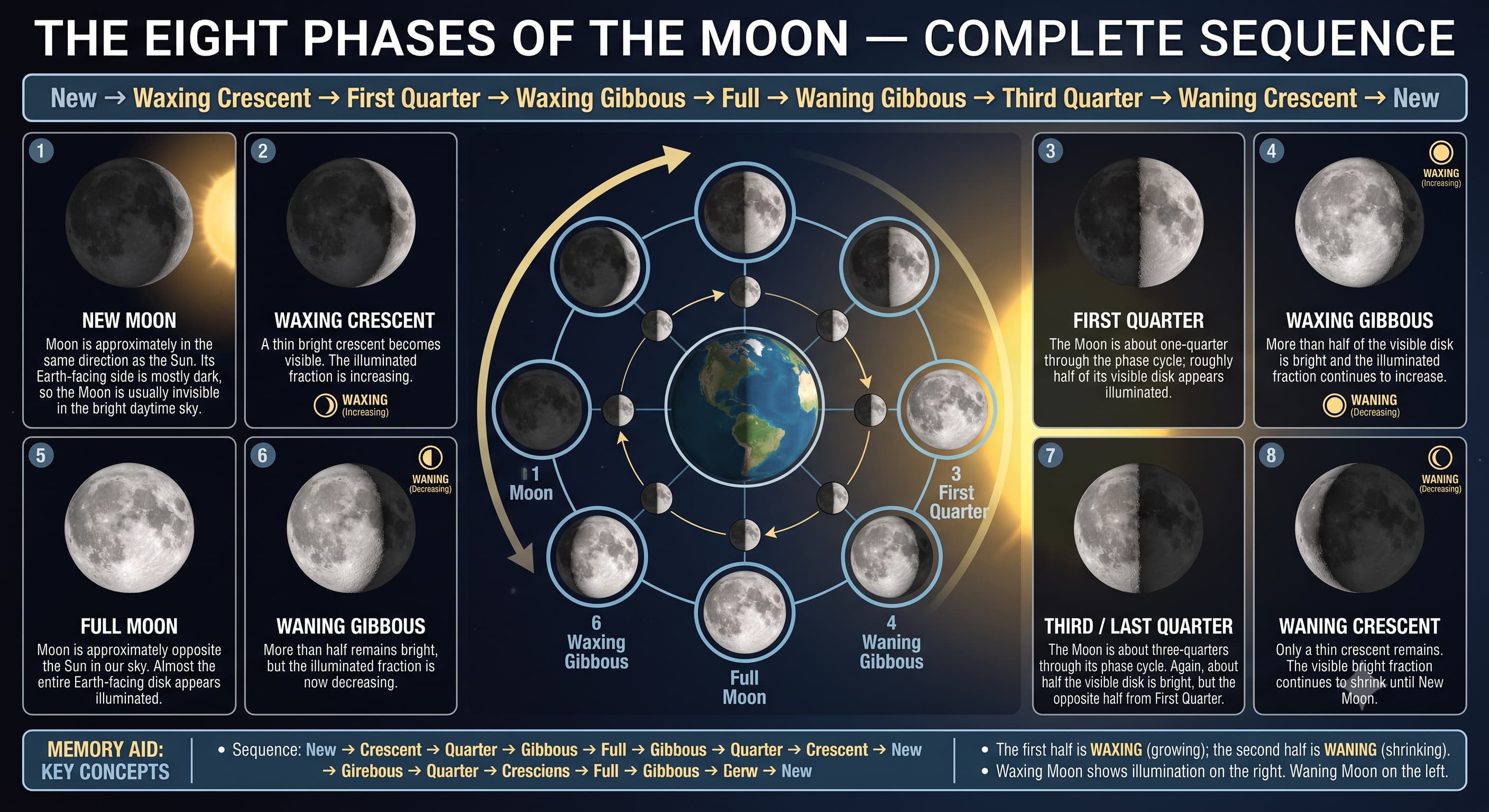
1. New Moon
Moon is approximately in the same direction as the Sun. Its Earth-facing side is mostly dark, so the Moon is usually invisible in the bright daytime sky.
2. Waxing Crescent
A thin bright crescent becomes visible. The illuminated fraction is increasing.
3. First Quarter
The Moon is about one-quarter through the phase cycle; roughly half of its visible disk appears illuminated.
4. Waxing Gibbous
More than half of the visible disk is bright and the illuminated fraction continues to increase.
5. Full Moon
Moon is approximately opposite the Sun in our sky. Almost the entire Earth-facing disk appears illuminated.
6. Waning Gibbous
More than half remains bright, but the illuminated fraction is now decreasing.
7. Third / Last Quarter
The Moon is about three-quarters through its phase cycle. Again, about half the visible disk is bright, but the opposite half from First Quarter.
8. Waning Crescent
Only a thin crescent remains. The visible bright fraction continues to shrink until New Moon.
Memory: New → Crescent → Quarter → Gibbous → Full → Gibbous → Quarter → Crescent → New. The first half is waxing; the second half is waning.
4. Waxing and Waning — The Simplest Meaning
Waxing
The illuminated part visible from Earth is growing from New Moon toward Full Moon.
Waning
The illuminated part visible from Earth is shrinking from Full Moon toward New Moon.
Do not use “right side = waxing” as a universal rule. In the Northern Hemisphere a waxing Moon commonly appears bright on the right, but orientation can look different from the Southern Hemisphere and can also rotate depending on observer orientation. For exams, use increasing vs decreasing illumination.
5. Crescent, Quarter and Gibbous — What Do These Words Mean?
Crescent
Less than half of the visible disk is illuminated.
Quarter
The Moon is one-quarter or three-quarters through its phase cycle; the visible disk appears about half illuminated.
Gibbous
More than half, but less than all, of the visible disk is illuminated.
Very common trap: First Quarter is called “quarter” because the Moon has completed about one-quarter of the phase cycle, not because only one-quarter of its visible disk is bright.
6. New Moon — Why Is It Usually Invisible?
At New Moon, the Moon lies roughly between Earth and the Sun in direction. The side illuminated by the Sun faces mostly away from Earth, while the side facing us is in lunar night.
Also, the Moon appears close to the Sun in the sky, so the bright daylight makes the dark lunar disk extremely difficult to see.
A solar eclipse can occur only near New Moon, but not at every New Moon because the lunar orbit is tilted. The detailed reason comes in the Eclipse topic.
7. Full Moon — Why Does the Entire Disk Look Bright?
At Full Moon, the Moon is approximately on the opposite side of Earth from the Sun. The hemisphere illuminated by the Sun is almost the same hemisphere that faces Earth.
A lunar eclipse can occur only near Full Moon, but not every Full Moon produces an eclipse because the Moon usually passes above or below Earth's shadow.
8. Moon–Sun Angular Geometry — A Powerful UPSC Shortcut
For exam reasoning, think about the Moon's approximate angular separation from the Sun as seen from Earth.
| Phase | Approx. Separation from Sun | Visible Disk |
|---|---|---|
| New Moon | ≈ 0° | Almost dark |
| First Quarter | ≈ 90° east of Sun | About half illuminated |
| Full Moon | ≈ 180° | Almost fully illuminated |
| Third Quarter | ≈ 90° west of Sun | About half illuminated |
9. Moonrise, Transit and Moonset — Learn the Four Anchor Phases
The phase tells us roughly where the Moon is relative to the Sun, so it also tells us roughly when the Moon rises and sets.
| Phase | Approx. Rise | Highest / Transit | Approx. Set | Best General Viewing |
|---|---|---|---|---|
| New Moon | Sunrise | Noon | Sunset | Usually not visible |
| First Quarter | Around noon | Around sunset | Around midnight | Afternoon / evening |
| Full Moon | Sunset | Midnight | Sunrise | All night |
| Third Quarter | Midnight | Sunrise | Noon | Late night / morning |
Accuracy note: These are approximate anchor times. Exact moonrise and moonset vary with location, latitude, season and the Moon's changing orbit.
10. Why Does the Moon Rise About 50 Minutes Later Each Day?
Earth rotates eastward once in about 24 hours, but during those 24 hours the Moon also moves eastward in its orbit around Earth.
So after Earth has completed one rotation, it must rotate a little more before the Moon returns to the same position in the local sky.
This is an average. The actual daily delay varies, especially at high latitudes and because the lunar orbit is not perfectly circular.
11. Can We See the Moon During the Day?
Yes. The Moon is not a “night-only” object. Its visibility depends on its phase, position in the sky and contrast with daylight.
First Quarter is often visible during the afternoon.
Third Quarter is commonly visible during the morning.
Crescent and gibbous phases can also be visible in daylight.
Trap: “The Moon is visible only at night” is false.
12. Sidereal Month vs Synodic Month — One of the Most Important Differences
Sidereal Month
Moon's orbital period relative to distant stars: about 27.3 days.
Synodic Month
Time from one same phase to the next, such as New Moon to New Moon or Full Moon to Full Moon: about 29.53 days.
Why is the synodic month longer?
During the 27.3 days in which the Moon completes one orbit relative to the stars, Earth itself has moved forward in its orbit around the Sun. The Moon therefore has to travel a little farther to recreate the same Sun–Earth–Moon geometry.
Earth has moved around Sun meanwhile
Moon travels extra angle to regain same phase → 29.53 d synodic month
Exam memory: Sidereal = Stars = 27.3 days | Synodic = Same phase = 29.53 days.
13. Lunar Day — Why Day and Night on the Moon Are So Long
A lunar solar day—roughly sunrise to next sunrise at the same lunar location—lasts about one synodic month: 29.5 Earth days.
Therefore, many lunar locations experience roughly 14–15 Earth days of daylight followed by roughly 14–15 Earth days of darkness.
14. Indian Terms — Amavasya, Purnima, Shukla Paksha and Krishna Paksha
Amavasya
New Moon condition; the Earth-facing lunar disk is nearly dark.
Shukla Paksha
Waxing half of the lunar cycle, from Amavasya toward Purnima.
Purnima
Full Moon condition; the visible lunar disk is nearly fully illuminated.
Krishna Paksha
Waning half of the lunar cycle, from Purnima toward Amavasya.
Simple mapping: Shukla Paksha = Waxing | Krishna Paksha = Waning | Amavasya = New Moon | Purnima = Full Moon.
15. What is a Tithi? — Scientific Basis of the Traditional Lunar Date
A tithi is based on the changing angular separation between the Sun and Moon as seen from Earth. In the standard astronomical definition, one tithi corresponds to an increase of about 12° in this angular separation.
Since a complete cycle is 360°:
A tithi is not exactly equal to a 24-hour civil day. Because the Sun and Moon do not move at perfectly uniform apparent rates, a tithi can begin or end at different clock times.
UPSC/PCS trap: India's National Calendar (Saka Calendar) used for civil purposes is a solar calendar; traditional Panchanga systems use luni-solar calculations for religious/festival purposes. Do not treat the two as identical.
16. Earthshine — Why Can the “Dark” Part of a Crescent Moon Glow?
Sometimes during a thin crescent phase, the rest of the Moon's disk is faintly visible even though it is not directly illuminated by the Sun.
This dim glow is called Earthshine.
It is sometimes called the Da Vinci glow.
17. Terminator — Why Craters Often Look Better Away from Full Moon
The boundary between the illuminated and dark portions of the Moon is called the terminator.
Near the terminator, sunlight strikes the lunar surface at a low angle. Mountains and crater rims cast long shadows, making relief easier to see.
Observation fact: Full Moon is bright, but it is often not the best phase for seeing crater relief because sunlight falls more directly and shadows are shorter.
18. Blue Moon — Does the Moon Actually Turn Blue?
Usually, no. “Blue Moon” is normally a calendar name, not a colour change.
Monthly Blue Moon
The second Full Moon in one calendar month under the common modern usage.
Seasonal Blue Moon
The third Full Moon in an astronomical season containing four Full Moons.
Trap: A Blue Moon is not normally blue in colour. Very unusual atmospheric dust or smoke can sometimes make the Moon appear bluish, but that is a different phenomenon.
19. Earth Seen from the Moon — The Phases Are Opposite
An observer on the Moon would see Earth go through phases too.
Full Moon from Earth ≈ New Earth from Moon
The two phase cycles are complementary because the Sun illuminates Earth and Moon from the same general direction.
20. Moon Phases vs Eclipses vs Perigee/Apogee — Never Mix These
| Concept | Main Cause | Key Example |
|---|---|---|
| Moon Phases | Changing viewing geometry of Moon's sunlit half | New, Quarter, Full |
| Eclipses | Special alignment near orbital nodes | Solar or Lunar Eclipse |
| Perigee / Apogee | Elliptical lunar orbit changes distance | Closest / farthest point |
21. Verified Previous-Year Questions — Phase Concepts
Q1. Consider the following statements regarding the Moon:
I. The illuminated part of the Moon visible from Earth increases each day after New Moon.
II. After Full Moon, the illuminated part visible from Earth decreases each day.
Answer: Both statements are correct.
Logic: New Moon → Full Moon is waxing; Full Moon → New Moon is waning.
Q2. After Full Moon, the next fourteen days in which the Moon appears thinner and thinner and finally becomes invisible are called:
(a) Waxing phase (b) Waning phase (c) Increasing phase (d) Growing phase
Answer: (b) Waning phase
Q3. The approximate period between two consecutive New Moons is:
(a) 15.5 days (b) 29.5 days (c) 14.5 days (d) More than one
Answer: (b) 29.5 days
Logic: New Moon to New Moon is one synodic month ≈ 29.53 days.
Q4. The time period from one Full Moon to the next Full Moon is:
(a) 29 days (b) 28 days (c) 30 days (d) Slightly longer than 29 days
Answer: (d) Slightly longer than 29 days
Logic: The mean synodic month is about 29.53 days.
22. Tough-Question Logic — Solve Phase Questions Without Memorising Everything
Step 1 — Find phase direction: New → Full = waxing | Full → New = waning.
Step 2 — Use Sun separation: New ≈ 0° | Quarter ≈ 90° | Full ≈ 180°.
Step 3 — Convert phase to time: New rises with Sun | First Quarter around noon | Full at sunset | Third Quarter around midnight.
Step 4 — Month trap: Stars → 27.3 d sidereal | Same phase → 29.53 d synodic.
Step 5 — Reject shadow trap: Normal phases are not caused by Earth's shadow.
23. High-Value UPSC / PCS Traps
Moon phases are caused by viewing geometry, not Earth's shadow.
At every normal phase, roughly half of the Moon is illuminated by the Sun.
New Moon is near the Sun in the sky; Full Moon is approximately opposite the Sun.
First and Third Quarter look like “half moons,” but “quarter” refers to position in the phase cycle.
Waxing = visible light increasing; Waning = decreasing.
Crescent = less than half lit; Gibbous = more than half lit.
Moon can be visible in the daytime.
Full Moon rises roughly at sunset and sets roughly at sunrise.
Moonrise occurs on average about 50 minutes later each day.
Sidereal month ≈ 27.3 d; Synodic month ≈ 29.53 d.
Amavasya = New Moon; Purnima = Full Moon; Shukla = waxing; Krishna = waning.
One tithi corresponds to about 12° Sun–Moon angular separation; it is not necessarily 24 hours long.
A Blue Moon normally does not look blue.
Earthshine is light reflected Sun → Earth → Moon → observer.
New Moon is necessary for a solar eclipse and Full Moon for a lunar eclipse, but neither produces an eclipse every month.
24. One-View Master Table
| Phase | Trend | Visible Bright Part | Approx. Rise | Approx. Set |
|---|---|---|---|---|
| New | Start waxing | Nearly 0% | Sunrise | Sunset |
| Waxing Crescent | Increasing | < 50% | Morning | Evening |
| First Quarter | Increasing | ≈ 50% | Noon | Midnight |
| Waxing Gibbous | Increasing | > 50% | Afternoon | After midnight |
| Full | Start waning | Nearly 100% | Sunset | Sunrise |
| Waning Gibbous | Decreasing | > 50% | Evening / night | Morning |
| Third Quarter | Decreasing | ≈ 50% | Midnight | Noon |
| Waning Crescent | Decreasing | < 50% | Pre-dawn | Afternoon |
Quick Revision
Moon phases = changing view of the Moon's sunlit half.
Eight phases: New → Waxing Crescent → First Quarter → Waxing Gibbous → Full → Waning Gibbous → Third Quarter → Waning Crescent.
Waxing = illuminated fraction increasing; Waning = decreasing.
Crescent < half; Gibbous > half.
Quarter means position in phase cycle, not one-quarter illuminated.
New Moon ≈ 0° from Sun; First/Third Quarter ≈ 90°; Full Moon ≈ 180°.
New Moon rises roughly with Sun; Full Moon rises roughly at sunset.
Moon rises on average about 50 minutes later each day.
Sidereal month ≈ 27.3 days; synodic month ≈ 29.53 days.
Lunar solar day ≈ 29.5 Earth days.
Amavasya = New; Purnima = Full; Shukla = waxing; Krishna = waning.
30 tithis per lunar cycle; about 12° Sun–Moon separation per tithi.
Earthshine = Sun → Earth → Moon → observer.
Blue Moon is usually a calendar term, not a blue-coloured Moon.
Normal Moon phases are not caused by Earth's shadow.
Think Like UPSC
For any phase question, ask five questions:
This chain converts Moon phases from a memory-heavy topic into a reasoning topic.
Source & Verification Note
Scientific concepts were cross-checked with NASA Science and NASA Goddard resources on Moon phases, Moonlight, Moon orbit, moonrise timing, Earthshine and synodic/sidereal months. Indian calendric terminology was cross-checked with the Positional Astronomy Centre / India Meteorological Department and Government educational material. PYQs were checked against exam-question repositories identifying the corresponding official exam papers.
Moon Topic Complete: Post 1 — Origin, Structure, Surface, Orbit & Earth–Moon Relationship → Post 2 — Phases, Lunar Month & Moon–Sun–Earth Geometry. Next Topic: Eclipses.
चंद्रमा की कलाएँ, चांद्र मास और चंद्रमा–सूर्य–पृथ्वी की ज्यामिति
चंद्रमा वास्तव में अपना आकार नहीं बदलता। परिवर्तन इसमें होता है कि पृथ्वी से हम उसके सूर्य-प्रकाशित आधे भाग का कितना हिस्सा देख पाते हैं। यही सरल विचार अमावस्या, पूर्णिमा, बढ़ती कला, घटती कला, चांद्र मास, चंद्रोदय के समय और UPSC/PCS के अनेक भ्रमकारी तथ्यों को समझाता है।
इस पोस्ट का दायरा: यह पोस्ट चंद्रमा विषय को पूरा करती है। ग्रहण की विस्तृत ज्यामिति, पात-बिंदु (Nodes), प्रच्छाया/उपच्छाया तथा हर महीने ग्रहण क्यों नहीं होता—इनका अध्ययन अगले विषय में किया जाएगा, ताकि सूर्य–पृथ्वी–चंद्रमा के उसी संरेखण को अनावश्यक रूप से दोहराना न पड़े।
1. सबसे महत्त्वपूर्ण विचार — चंद्रमा का आधा भाग सदैव सूर्य-प्रकाशित रहता है
चंद्रमा अपना दृश्य प्रकाश उत्पन्न नहीं करता। चाँदनी वास्तव में चंद्र सतह से परावर्तित सूर्यप्रकाश है।
किसी भी समय, ग्रहण को छोड़कर, सूर्य चंद्रमा के लगभग आधे भाग को प्रकाशित करता है। दूसरा आधा भाग चंद्र-रात्रि में रहता है।
महीने के दौरान केवल यह बदलता है कि उस प्रकाशित आधे भाग का कितना हिस्सा हमारी ओर है।
बहुप्रचलित भ्रम: चंद्रमा की कलाएँ पृथ्वी की छाया के कारण नहीं बनतीं। पृथ्वी की छाया से चंद्रग्रहण होता है, जो एक अलग घटना है।
2. चंद्रमा की कलाएँ क्यों बनती हैं?
कल्पना कीजिए कि चंद्रमा पृथ्वी के चारों ओर घूम रहा है। बहुत दूर स्थित सूर्य चंद्रमा के एक भाग को प्रकाशित करता है। अपनी कक्षा में चंद्रमा की स्थिति बदलने पर हमें उसके चमकीले भाग की अलग-अलग मात्रा दिखाई देती है।
प्रथम चतुर्थांश → हमें दृश्य चंद्र-बिंब का आधा भाग प्रकाशित दिखाई देता है
पूर्णिमा → प्रकाशित आधा भाग पृथ्वी की ओर होता है
तृतीय चतुर्थांश → दृश्य चंद्र-बिंब का विपरीत आधा भाग प्रकाशित होता है
इन चार प्रमुख स्थितियों के बीच चंद्रमा अर्धचंद्र और गिबस अवस्थाओं से गुजरता है।
3. चंद्रमा की आठ कलाएँ — पूर्ण क्रम
1. अमावस्या
चंद्रमा लगभग सूर्य की ही दिशा में होता है। पृथ्वी की ओर वाला उसका भाग अधिकांशतः अंधकारमय रहता है, इसलिए दिन के चमकीले आकाश में चंद्रमा सामान्यतः दिखाई नहीं देता।
2. वर्धमान अर्धचंद्र
एक पतला चमकीला अर्धचंद्र दिखाई देने लगता है। प्रकाशित भाग बढ़ रहा होता है।
3. प्रथम चतुर्थांश
चंद्रमा कला-चक्र का लगभग एक-चौथाई भाग पूरा कर चुका होता है; उसके दृश्य बिंब का लगभग आधा भाग प्रकाशित दिखाई देता है।
4. वर्धमान गिबस
दृश्य बिंब का आधे से अधिक भाग चमकीला होता है और प्रकाशित अंश लगातार बढ़ता रहता है।
5. पूर्णिमा
आकाश में चंद्रमा लगभग सूर्य के विपरीत दिशा में होता है। पृथ्वी की ओर वाला लगभग पूरा चंद्र-बिंब प्रकाशित दिखाई देता है।
6. क्षीणमान गिबस
आधे से अधिक भाग अभी भी चमकीला रहता है, किंतु अब प्रकाशित अंश घट रहा होता है।
7. तृतीय/अंतिम चतुर्थांश
चंद्रमा कला-चक्र का लगभग तीन-चौथाई भाग पूरा कर चुका होता है। दृश्य बिंब का लगभग आधा भाग फिर चमकीला होता है, पर यह प्रथम चतुर्थांश के विपरीत वाला आधा भाग होता है।
8. क्षीणमान अर्धचंद्र
केवल एक पतला अर्धचंद्र बचता है। अमावस्या तक दिखाई देने वाला चमकीला भाग लगातार घटता रहता है।
याद रखें: अमावस्या → अर्धचंद्र → चतुर्थांश → गिबस → पूर्णिमा → गिबस → चतुर्थांश → अर्धचंद्र → अमावस्या। पहला आधा भाग बढ़ती कला है; दूसरा आधा भाग घटती कला।
4. बढ़ती और घटती कला — सबसे सरल अर्थ
बढ़ती कला (Waxing)
पृथ्वी से दिखाई देने वाला प्रकाशित भाग बढ़ता है —अमावस्या से पूर्णिमा की ओर।
घटती कला (Waning)
पृथ्वी से दिखाई देने वाला प्रकाशित भाग घटता है —पूर्णिमा से अमावस्या की ओर।
“दायाँ भाग प्रकाशित = बढ़ती कला” को सार्वभौमिक नियम न मानें। उत्तरी गोलार्द्ध में बढ़ता चंद्रमा सामान्यतः दाईं ओर चमकीला दिखाई देता है, पर दक्षिणी गोलार्द्ध से उसका विन्यास अलग दिख सकता है और प्रेक्षक की स्थिति के अनुसार वह घूमा हुआ भी प्रतीत हो सकता है। परीक्षाओं में इस बात को आधार बनाएँ कि प्रकाशित भाग बढ़ रहा है या घट रहा है।
5. अर्धचंद्र, चतुर्थांश और गिबस — इन शब्दों का क्या अर्थ है?
अर्धचंद्र
दृश्य चंद्र-बिंब का आधे से कम भाग प्रकाशित होता है।
चतुर्थांश
चंद्रमा अपने कला-चक्र का एक-चौथाई या तीन-चौथाई भाग पूरा कर चुका होता है; दृश्य बिंब लगभग आधा प्रकाशित दिखाई देता है।
गिबस
दृश्य बिंब का आधे से अधिक, किंतु पूरे से कम भाग प्रकाशित होता है।
बहुत प्रचलित भ्रम: प्रथम चतुर्थांश को “चतुर्थांश” इसलिए कहते हैं क्योंकि चंद्रमा कला-चक्र का लगभग एक-चौथाई भाग पूरा कर चुका होता है, इसलिए नहीं कि उसके दृश्य बिंब का केवल एक-चौथाई भाग चमकीला है।
6. अमावस्या — यह सामान्यतः दिखाई क्यों नहीं देती?
अमावस्या के समय चंद्रमा दिशा की दृष्टि से लगभग पृथ्वी और सूर्य के बीच होता है। सूर्य द्वारा प्रकाशित उसका भाग अधिकांशतः पृथ्वी से विपरीत दिशा में रहता है, जबकि हमारी ओर वाला भाग चंद्र-रात्रि में होता है।
साथ ही, आकाश में चंद्रमा सूर्य के निकट दिखाई देता है; इसलिए दिन का तेज प्रकाश अंधकारमय चंद्र-बिंब को देखना अत्यंत कठिन बना देता है।
सूर्यग्रहण केवल अमावस्या के आसपास हो सकता है, किंतु चंद्र-कक्षा के झुके होने के कारण प्रत्येक अमावस्या पर सूर्यग्रहण नहीं होता। इसका विस्तृत कारण ग्रहण विषय में आएगा।
7. पूर्णिमा — पूरा चंद्र-बिंब चमकीला क्यों दिखाई देता है?
पूर्णिमा के समय चंद्रमा पृथ्वी के उस ओर होता है जो सूर्य से लगभग विपरीत है। सूर्य द्वारा प्रकाशित गोलार्द्ध लगभग वही गोलार्द्ध होता है जो पृथ्वी की ओर है।
चंद्रग्रहण केवल पूर्णिमा के आसपास हो सकता है, पर प्रत्येक पूर्णिमा पर ग्रहण नहीं होता क्योंकि चंद्रमा सामान्यतः पृथ्वी की छाया के ऊपर या नीचे से निकल जाता है।
8. चंद्रमा–सूर्य कोणीय ज्यामिति — UPSC के लिए उपयोगी शॉर्टकट
परीक्षा में तर्क लगाने के लिए पृथ्वी से देखे गए चंद्रमा और सूर्य के बीच लगभग कोणीय दूरी पर विचार करें।
| कला | सूर्य से लगभग कोणीय दूरी | दृश्य बिंब |
|---|---|---|
| अमावस्या | ≈ 0° | लगभग अंधकारमय |
| प्रथम चतुर्थांश | सूर्य से ≈ 90° पूर्व | लगभग आधा प्रकाशित |
| पूर्णिमा | ≈ 180° | लगभग पूर्णतः प्रकाशित |
| तृतीय चतुर्थांश | सूर्य से ≈ 90° पश्चिम | लगभग आधा प्रकाशित |
9. चंद्रोदय, याम्योत्तर-पारगमन और चंद्रास्त — चार आधार कलाएँ समझें
चंद्र-कला से मोटे तौर पर पता चलता है कि चंद्रमा सूर्य के सापेक्ष कहाँ है; इसलिए इससे चंद्रोदय और चंद्रास्त का लगभग समय भी ज्ञात हो जाता है।
| कला | लगभग उदय | सर्वोच्च स्थिति/पारगमन | लगभग अस्त | देखने का सामान्यतः सर्वोत्तम समय |
|---|---|---|---|---|
| अमावस्या | सूर्योदय | दोपहर | सूर्यास्त | सामान्यतः दिखाई नहीं देता |
| प्रथम चतुर्थांश | दोपहर के आसपास | सूर्यास्त के आसपास | मध्यरात्रि के आसपास | दोपहर बाद/संध्या |
| पूर्णिमा | सूर्यास्त | मध्यरात्रि | सूर्योदय | पूरी रात |
| तृतीय चतुर्थांश | मध्यरात्रि | सूर्योदय | दोपहर | देर रात/सुबह |
सटीकता संबंधी टिप्पणी: ये लगभग आधार समय हैं। चंद्रोदय और चंद्रास्त का वास्तविक समय स्थान, अक्षांश, ऋतु और चंद्रमा की बदलती कक्षा के अनुसार बदलता है।
10. चंद्रमा प्रतिदिन लगभग 50 मिनट देर से क्यों उदित होता है?
पृथ्वी लगभग 24 घंटे में एक बार पूर्व की ओर घूर्णन करती है, किंतु उन्हीं 24 घंटों में चंद्रमा भी पृथ्वी के चारों ओर अपनी कक्षा में पूर्व की ओर आगे बढ़ जाता है।
इसलिए पृथ्वी का एक घूर्णन पूरा हो जाने के बाद भी चंद्रमा को स्थानीय आकाश में उसी स्थिति में लाने के लिए पृथ्वी को थोड़ा और घूमना पड़ता है।
यह एक औसत है। वास्तविक दैनिक विलंब बदलता रहता है, विशेषतः उच्च अक्षांशों पर और इसलिए भी कि चंद्र-कक्षा पूर्णतः वृत्ताकार नहीं है।
11. क्या हम दिन में चंद्रमा देख सकते हैं?
हाँ। चंद्रमा केवल “रात में दिखाई देने वाला” पिंड नहीं है। उसकी दृश्यता उसकी कला, आकाश में स्थिति और दिन के प्रकाश के साथ उसके वैषम्य पर निर्भर करती है।
प्रथम चतुर्थांश प्रायः दिखाई देता है— दोपहर बाद।
तृतीय चतुर्थांश सामान्यतः दिखाई देता है— सुबह।
अर्धचंद्र और गिबस कलाएँ भी दिन के प्रकाश में दिखाई दे सकती हैं।
भ्रम: “चंद्रमा केवल रात में दिखाई देता है”—यह कथन गलत है।
12. नाक्षत्र मास बनाम कलामास — सबसे महत्त्वपूर्ण अंतरों में से एक
नाक्षत्र मास (Sidereal Month)
दूरस्थ तारों के सापेक्ष चंद्रमा का परिक्रमण काल: लगभग 27.3 दिन।
कलामास (Synodic Month)
एक समान कला से अगली समान कला तक का समय, जैसे अमावस्या से अमावस्या या पूर्णिमा से पूर्णिमा: लगभग 29.53 दिन।
कलामास अधिक लंबा क्यों होता है?
जिन 27.3 दिनों में चंद्रमा तारों के सापेक्ष एक परिक्रमा पूरी करता है, उस दौरान पृथ्वी स्वयं सूर्य के चारों ओर अपनी कक्षा में आगे बढ़ चुकी होती है। इसलिए उसी सूर्य–पृथ्वी–चंद्रमा ज्यामिति को पुनः बनाने के लिए चंद्रमा को कुछ अतिरिक्त दूरी तय करनी पड़ती है।
इस बीच पृथ्वी सूर्य के चारों ओर आगे बढ़ चुकी होती है
उसी कला को पुनः पाने के लिए चंद्रमा अतिरिक्त कोण तय करता है → 29.53 दिन का कलामास
परीक्षा के लिए याद रखें: नाक्षत्र = तारे = 27.3 दिन | कलामास = समान कला = 29.53 दिन।
13. चंद्र-दिवस — चंद्रमा पर दिन और रात इतने लंबे क्यों होते हैं?
एक चंद्र सौर दिवस—अर्थात चंद्रमा के किसी स्थान पर एक सूर्योदय से अगले सूर्योदय तक का समय—लगभग एक कलामास का होता है: 29.5 पृथ्वी-दिन।
इसलिए चंद्रमा के अनेक स्थानों पर लगभग 14–15 पृथ्वी-दिन तक दिन का प्रकाश और उसके बाद लगभग 14–15 पृथ्वी-दिन तक अंधकार का अनुभव होता है।
14. भारतीय शब्दावली — अमावस्या, पूर्णिमा, शुक्ल पक्ष और कृष्ण पक्ष
अमावस्या
अमावस्या की अवस्था; पृथ्वी की ओर वाला चंद्र-बिंब लगभग अंधकारमय रहता है।
शुक्ल पक्ष
चंद्र-चक्र का बढ़ती कलाओं वाला आधा भाग—अमावस्या से पूर्णिमा की ओर।
पूर्णिमा
पूर्णिमा की अवस्था; दृश्य चंद्र-बिंब लगभग पूर्णतः प्रकाशित रहता है।
कृष्ण पक्ष
चंद्र-चक्र का घटती कलाओं वाला आधा भाग—पूर्णिमा से अमावस्या की ओर।
सरल मिलान: शुक्ल पक्ष = बढ़ती कला | कृष्ण पक्ष = घटती कला | अमावस्या = नया चंद्र | पूर्णिमा = पूर्ण चंद्र।
15. तिथि क्या है? — पारंपरिक चांद्र तिथि का वैज्ञानिक आधार
एक तिथि पृथ्वी से देखे जाने वाले सूर्य और चंद्रमा के बीच बदलती कोणीय दूरी पर आधारित होती है। मानक खगोलीय परिभाषा में एक तिथि इस कोणीय दूरी में लगभग 12° की वृद्धि के बराबर होती है।
क्योंकि एक पूरा चक्र 360° का होता है:
एक तिथि 24 घंटे के नागरिक दिवस के ठीक बराबर नहीं होती। सूर्य और चंद्रमा की आभासी गतियाँ पूर्णतः समान दर वाली नहीं होतीं, इसलिए तिथि घड़ी के अलग-अलग समय पर आरंभ या समाप्त हो सकती है।
UPSC/PCS भ्रम-बिंदु: भारत का राष्ट्रीय पंचांग (शक संवत्) नागरिक उद्देश्यों के लिए प्रयुक्त सौर कैलेंडर है; जबकि पारंपरिक पंचांग प्रणालियाँ धार्मिक/पर्व संबंधी प्रयोजनों के लिए चंद्र-सौर गणनाओं का प्रयोग करती हैं। दोनों को समान न मानें।
16. पृथ्वी-प्रभा — अर्धचंद्र का “अंधकारमय” भाग क्यों चमक सकता है?
कभी-कभी पतले अर्धचंद्र की अवस्था में चंद्रमा का शेष बिंब भी हल्का दिखाई देता है, यद्यपि वह सूर्य से प्रत्यक्ष रूप से प्रकाशित नहीं होता।
इस मंद चमक को पृथ्वी-प्रभा (Earthshine) कहते हैं।
इसे कभी-कभी दा विंची प्रभा भी कहते हैं।
17. प्रकाश-विभाजक रेखा — पूर्णिमा से अलग कलाओं में क्रेटर अधिक स्पष्ट क्यों दिखते हैं?
चंद्रमा के प्रकाशित और अंधकारमय भागों के बीच की सीमा को प्रकाश-विभाजक रेखा (Terminator) कहते हैं।
प्रकाश-विभाजक रेखा के पास सूर्यप्रकाश चंद्र सतह पर छोटे कोण से पड़ता है। पर्वत और क्रेटरों के किनारे लंबी छायाएँ बनाते हैं, जिससे उच्चावच अधिक आसानी से दिखाई देता है।
प्रेक्षण तथ्य: पूर्णिमा का चंद्रमा चमकीला होता है, पर वह प्रायः क्रेटरों का उच्चावच देखने के लिए सर्वोत्तम कला नहीं होता क्योंकि सूर्यप्रकाश अधिक सीधा पड़ता है और छायाएँ छोटी होती हैं।
18. ब्लू मून — क्या चंद्रमा वास्तव में नीला हो जाता है?
सामान्यतः नहीं। “ब्लू मून” सामान्यतः कैलेंडर संबंधी नाम है, रंग में परिवर्तन नहीं।
मासिक ब्लू मून
सामान्य आधुनिक प्रयोग के अनुसार किसी एक कैलेंडर महीने की दूसरी पूर्णिमा को मासिक ब्लू मून कहते हैं।
मौसमी ब्लू मून
चार पूर्णिमाओं वाली किसी खगोलीय ऋतु की तीसरी पूर्णिमा को मौसमी ब्लू मून कहते हैं।
भ्रम: ब्लू मून सामान्यतः नीले रंग का नहीं दिखाई देता। अत्यंत असामान्य वायुमंडलीय धूल या धुआँ कभी-कभी चंद्रमा को नीला-सा दिखा सकता है, किंतु वह एक अलग परिघटना है।
19. चंद्रमा से दिखाई देने वाली पृथ्वी — कलाएँ विपरीत होती हैं
चंद्रमा पर स्थित प्रेक्षक पृथ्वी को भी विभिन्न कलाओं से गुजरते देखेगा।
पृथ्वी से पूर्णिमा ≈ चंद्रमा से अमावस्या जैसी पृथ्वी
दोनों कला-चक्र एक-दूसरे के पूरक होते हैं, क्योंकि सूर्य पृथ्वी और चंद्रमा को एक ही सामान्य दिशा से प्रकाशित करता है।
20. चंद्र-कलाएँ बनाम ग्रहण बनाम उपभू/अपभू — इन्हें कभी न मिलाएँ
| अवधारणा | मुख्य कारण | प्रमुख उदाहरण |
|---|---|---|
| चंद्रमा की कलाएँ | चंद्रमा के सूर्य-प्रकाशित आधे भाग को देखने की बदलती ज्यामिति | अमावस्या, चतुर्थांश, पूर्णिमा |
| ग्रहण | कक्षीय पात-बिंदुओं के निकट विशेष संरेखण | सूर्यग्रहण या चंद्रग्रहण |
| उपभू/अपभू | दीर्घवृत्ताकार चंद्र-कक्षा से दूरी में परिवर्तन | निकटतम/दूरतम बिंदु |
21. सत्यापित विगत-वर्षीय प्रश्न — चंद्र-कला संबंधी अवधारणाएँ
प्रश्न 1. चंद्रमा के संबंध में निम्नलिखित कथनों पर विचार कीजिए:
I. अमावस्या के बाद पृथ्वी से दिखाई देने वाला चंद्रमा का प्रकाशित भाग प्रतिदिन बढ़ता है।
II. पूर्णिमा के बाद पृथ्वी से दिखाई देने वाला प्रकाशित भाग प्रतिदिन घटता है।
उत्तर: दोनों कथन सही हैं।
तर्क: अमावस्या → पूर्णिमा बढ़ती कला है; पूर्णिमा → अमावस्या घटती कला।
प्रश्न 2. पूर्णिमा के बाद के वे चौदह दिन, जिनमें चंद्रमा क्रमशः पतला दिखाई देता जाता है और अंततः अदृश्य हो जाता है, क्या कहलाते हैं?
(a) बढ़ती कला (b) घटती कला (c) वृद्धि अवस्था (d) बढ़ने की अवस्था
उत्तर: (b) घटती कला
प्रश्न 3. दो क्रमागत अमावस्याओं के बीच की लगभग अवधि कितनी होती है?
(a) 15.5 दिन (b) 29.5 दिन (c) 14.5 दिन (d) एक से अधिक
उत्तर: (b) 29.5 दिन
तर्क: एक अमावस्या से अगली अमावस्या तक का समय एक कलामास ≈ 29.53 दिन होता है।
प्रश्न 4. एक पूर्णिमा से अगली पूर्णिमा तक की समयावधि कितनी होती है?
(a) 29 दिन (b) 28 दिन (c) 30 दिन (d) 29 दिन से थोड़ा अधिक
उत्तर: (d) 29 दिन से थोड़ा अधिक
तर्क: औसत कलामास लगभग 29.53 दिन।
22. कठिन प्रश्नों का तर्क — सब कुछ रटे बिना चंद्र-कला के प्रश्न हल करें
चरण 1 — कला की दिशा पहचानें: अमावस्या → पूर्णिमा = बढ़ती कला | पूर्णिमा → अमावस्या = घटती कला।
चरण 2 — सूर्य से कोणीय दूरी का प्रयोग करें: अमावस्या ≈ 0° | चतुर्थांश ≈ 90° | पूर्णिमा ≈ 180°।
चरण 3 — कला को समय से जोड़ें: अमावस्या सूर्य के साथ उदित होती है | प्रथम चतुर्थांश दोपहर के आसपास | पूर्णिमा सूर्यास्त पर | तृतीय चतुर्थांश मध्यरात्रि के आसपास।
चरण 4 — मास संबंधी भ्रम: तारे → 27.3 दिन नाक्षत्र मास | समान कला → 29.53 दिन कलामास।
चरण 5 — छाया वाले भ्रम को अस्वीकार करें: सामान्य चंद्र-कलाएँ पृथ्वी की छाया के कारण नहीं बनतीं।
23. UPSC/PCS के अत्यंत महत्त्वपूर्ण भ्रम-बिंदु
चंद्रमा की कलाएँ देखने की ज्यामिति के कारण बनती हैं, पृथ्वी की छाया के कारण नहीं।
प्रत्येक सामान्य कला में चंद्रमा का लगभग आधा भाग सूर्य से प्रकाशित रहता है।
अमावस्या आकाश में सूर्य के निकट होती है; पूर्णिमा लगभग सूर्य के विपरीत होती है।
प्रथम और तृतीय चतुर्थांश “आधे चंद्रमा” जैसे दिखते हैं, किंतु “चतुर्थांश” शब्द कला-चक्र में स्थिति को दर्शाता है।
बढ़ती कला (Waxing) = दृश्य प्रकाश बढ़ना; घटती कला (Waning) = घटना।
अर्धचंद्र = आधे से कम प्रकाशित; गिबस = आधे से अधिक प्रकाशित।
चंद्रमा दिन में भी दिखाई दे सकता है।
पूर्णिमा का चंद्रमा लगभग सूर्यास्त पर उदित होता है और लगभग सूर्योदय पर अस्त होता है।
चंद्रोदय औसतन प्रतिदिन लगभग 50 मिनट देर से होता है।
नाक्षत्र मास ≈ 27.3 दिन; कलामास ≈ 29.53 दिन।
अमावस्या = नया चंद्र; पूर्णिमा = पूर्ण चंद्र; शुक्ल = बढ़ती कला; कृष्ण = घटती कला।
एक तिथि लगभग 12° सूर्य–चंद्रमा कोणीय दूरी के बराबर होती है; इसकी अवधि आवश्यक नहीं कि 24 घंटे हो।
एक ब्लू मून सामान्यतः नीला दिखाई नहीं देता।
पृथ्वी-प्रभा वह प्रकाश है जो इस क्रम में परावर्तित होता है— सूर्य → पृथ्वी → चंद्रमा → प्रेक्षक।
सूर्यग्रहण के लिए अमावस्या और चंद्रग्रहण के लिए पूर्णिमा आवश्यक है, किंतु दोनों में से कोई भी हर महीने ग्रहण उत्पन्न नहीं करता।
24. एक नज़र में मास्टर तालिका
| कला | प्रवृत्ति | दिखाई देने वाला चमकीला भाग | लगभग उदय | लगभग अस्त |
|---|---|---|---|---|
| अमावस्या | बढ़ती कला आरंभ | लगभग 0% | सूर्योदय | सूर्यास्त |
| वर्धमान अर्धचंद्र | बढ़ता हुआ | < 50% | सुबह | संध्या |
| प्रथम चतुर्थांश | बढ़ता हुआ | ≈ 50% | दोपहर | मध्यरात्रि |
| वर्धमान गिबस | बढ़ता हुआ | > 50% | दोपहर बाद | मध्यरात्रि के बाद |
| पूर्णिमा | घटती कला आरंभ | लगभग 100% | सूर्यास्त | सूर्योदय |
| क्षीणमान गिबस | घटता हुआ | > 50% | संध्या/रात | सुबह |
| तृतीय चतुर्थांश | घटता हुआ | ≈ 50% | मध्यरात्रि | दोपहर |
| क्षीणमान अर्धचंद्र | घटता हुआ | < 50% | भोर से पहले | दोपहर बाद |
त्वरित पुनरावृत्ति
चंद्रमा की कलाएँ = चंद्रमा के सूर्य-प्रकाशित आधे भाग का बदलता दृश्य।
आठ कलाएँ: अमावस्या → वर्धमान अर्धचंद्र → प्रथम चतुर्थांश → वर्धमान गिबस → पूर्णिमा → क्षीणमान गिबस → तृतीय चतुर्थांश → क्षीणमान अर्धचंद्र।
बढ़ती कला = प्रकाशित भाग बढ़ना; घटती कला = प्रकाशित भाग घटना।
अर्धचंद्र < आधा; गिबस > आधा।
चतुर्थांश का अर्थ कला-चक्र में स्थिति है, न कि एक-चौथाई भाग प्रकाशित होना।
अमावस्या ≈ सूर्य से 0°; प्रथम/तृतीय चतुर्थांश ≈ 90°; पूर्णिमा ≈ 180°।
अमावस्या का चंद्रमा लगभग सूर्य के साथ उदित होता है; पूर्णिमा का चंद्रमा लगभग सूर्यास्त पर उदित होता है।
चंद्रमा औसतन प्रतिदिन लगभग 50 मिनट देर से होता है।
नाक्षत्र मास ≈ 27.3 दिन; कलामास ≈ 29.53 दिन।
चंद्र सौर दिवस ≈ 29.5 पृथ्वी-दिन।
अमावस्या = नया चंद्र; पूर्णिमा = पूर्ण चंद्र; शुक्ल = बढ़ती कला; कृष्ण = घटती कला।
प्रत्येक चंद्र-चक्र में 30 तिथियाँ; प्रत्येक तिथि में लगभग 12° सूर्य–चंद्रमा कोणीय दूरी।
पृथ्वी-प्रभा = सूर्य → पृथ्वी → चंद्रमा → प्रेक्षक।
ब्लू मून सामान्यतः कैलेंडर संबंधी शब्द है, नीले रंग का चंद्रमा नहीं।
सामान्य चंद्र-कलाएँ पृथ्वी की छाया के कारण नहीं बनतीं।
UPSC की तरह सोचें
चंद्र-कला से जुड़े किसी भी प्रश्न में पाँच प्रश्न पूछें:
यह क्रम चंद्र-कलाओं को रटने वाले विषय से तर्क-आधारित विषय में बदल देता है।
स्रोत एवं सत्यापन टिप्पणी
चंद्रमा की कलाओं, चाँदनी, चंद्र-कक्षा, चंद्रोदय के समय, पृथ्वी-प्रभा तथा कलामास/नाक्षत्र मास से जुड़ी वैज्ञानिक अवधारणाओं का NASA Science और NASA Goddard के संसाधनों से पुनः मिलान किया गया। भारतीय पंचांग संबंधी शब्दावली का स्थानिक खगोल विज्ञान केंद्र/भारत मौसम विज्ञान विभाग और सरकारी शैक्षिक सामग्री से मिलान किया गया। PYQs का सत्यापन संबंधित आधिकारिक परीक्षा-पत्रों की पहचान करने वाले प्रश्न-संग्रहों से किया गया।
चंद्रमा विषय पूर्ण: पोस्ट 1 — उत्पत्ति, संरचना, सतह, कक्षा और पृथ्वी–चंद्रमा संबंध → पोस्ट 2 — कलाएँ, चांद्र मास और चंद्रमा–सूर्य–पृथ्वी ज्यामिति। अगला विषय: ग्रहण।