Igneous Rocks: How They Form, Why Different Rocks Form & Bowen's Reaction Series
Igneous rocks are rocks formed when molten rock material cools and becomes solid.
But all molten material does not produce the same rock. The final rock mainly depends on three questions:
2. How fast does it cool? → slowly or rapidly?
3. What is present in the magma? → silica, iron, magnesium, calcium, sodium, potassium etc.
1. First Understand the Rock Cycle — How Can One Rock Become Another?
Rocks are not permanently fixed as one type. Over millions of years, the same material may pass through several geological processes and become a different type of rock.
However, a rock usually does not simply change its name directly. A specific physical or chemical process must act on it.
Any Rock → Melting → Magma → Cooling & Crystallisation → Igneous Rock
Any exposed Rock → Weathering → Erosion → Sediments → Deposition → Compaction + Cementation → Sedimentary Rock
Igneous / Sedimentary / older Metamorphic Rock → Heat + Pressure + Fluids, but without melting → Metamorphic Rock
For example, granite exposed at the surface may break down into sediments. Those sediments may later become a sedimentary rock. If buried deeply, that sedimentary rock may be changed by heat and pressure into a metamorphic rock. If it melts completely, magma is produced; when that magma cools, a new igneous rock forms.
2. Basic Idea: How Does an Igneous Rock Form?
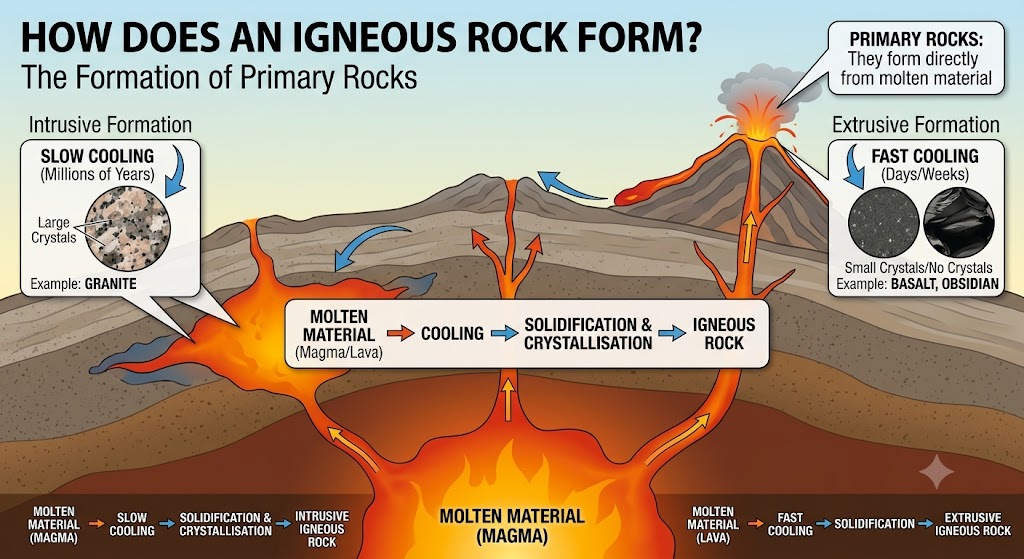
At some places inside the Earth, temperature becomes high enough for part of the rock to melt. This produces molten material called magma.
Magma is not normally a completely uniform liquid. It may contain molten material, mineral crystals and dissolved gases.
As magma loses heat, atoms and ions begin arranging themselves into organised mineral structures. This process is called crystallisation.
Igneous rocks are therefore commonly called primary rocks because they can form directly from molten Earth material.
3. Magma and Lava — What Is the Difference?
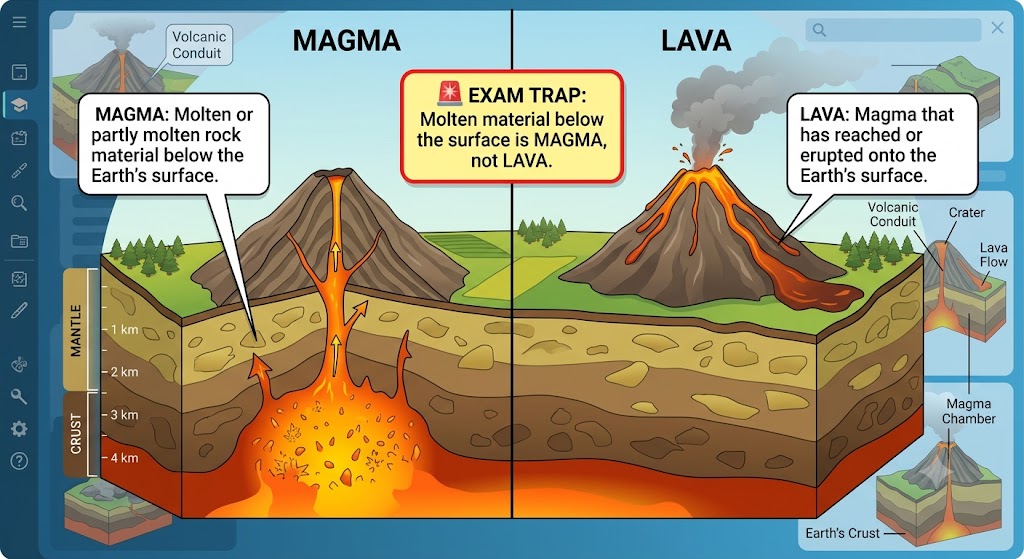
Magma
Molten or partly molten rock material below the Earth's surface.
Lava
Magma that reaches or erupts onto the Earth's surface.
Thus, magma and lava may originate from the same molten system. The terminology mainly changes according to location.
4. Master Story — How Can One Parent Magma Produce Different Igneous Rocks?
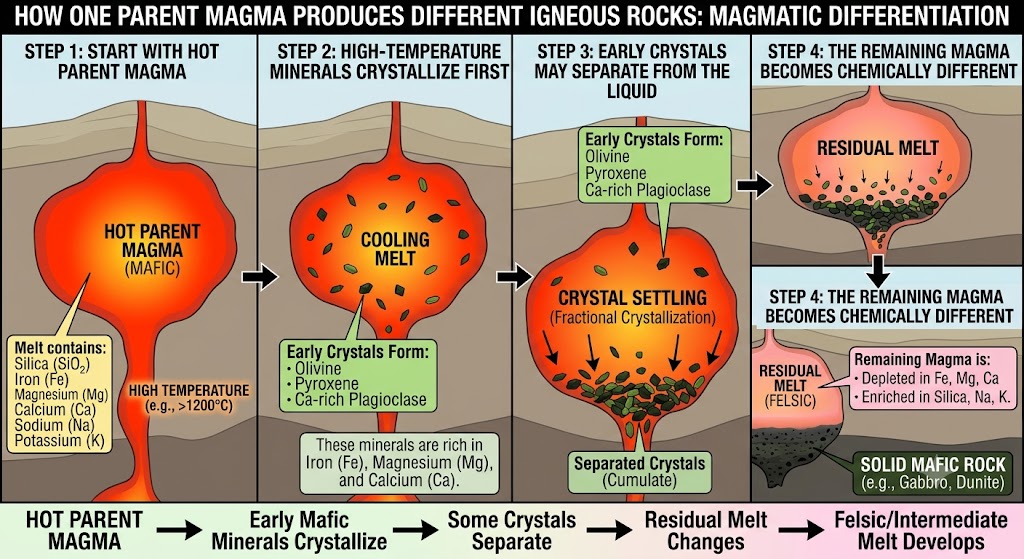
This is the most important idea of this Post. A magma does not necessarily remain chemically unchanged while it cools. As temperature falls, different minerals crystallise at different stages. If some early crystals become separated from the remaining liquid, the composition of the leftover magma changes. This gradual change is called magmatic differentiation; when crystal separation is important, the process is commonly described as fractional crystallisation.
First correction: a rock does not get a new name simply because the temperature falls. Temperature controls which minerals crystallise; composition + place of cooling + cooling rate together control the final rock.
Step 1 — Start with hot parent magma
Imagine a hot magma containing silica, iron, magnesium, calcium, sodium, potassium and other elements.
Step 2 — High-temperature minerals crystallise first
At relatively high temperatures, minerals such as olivine, pyroxene and calcium-rich plagioclase become stable early. These minerals use comparatively large amounts of iron, magnesium and calcium from the melt.
Step 3 — Early crystals may separate from the liquid
If these early crystals settle, accumulate, stick to chamber walls or are otherwise removed from continued reaction with the liquid, they take some Fe–Mg–Ca with them.
Step 4 — The remaining magma becomes chemically different
The residual melt becomes relatively depleted in some iron, magnesium and calcium and relatively enriched in components such as silica, sodium and potassium. In this way an initially mafic melt can, under suitable conditions, evolve toward more intermediate and then more felsic compositions.
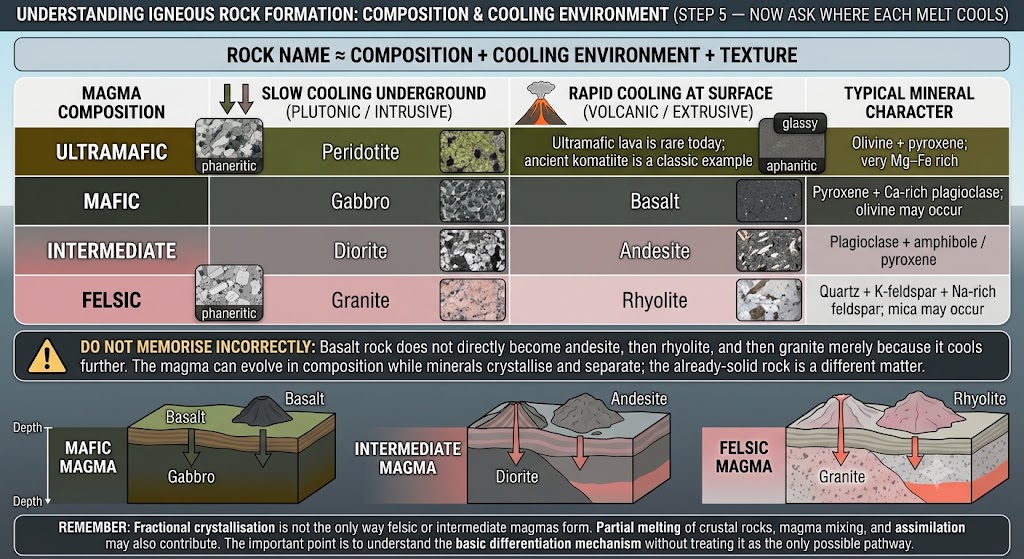
Step 5 — Now ask where each melt cools
Once the magma has a particular composition, its final rock name also depends strongly on whether it cools slowly underground or rapidly at the surface.
| Magma / Composition | Slow Cooling Underground | Rapid Cooling at Surface | Typical Mineral Character |
|---|---|---|---|
| Ultramafic | Peridotite | Ultramafic lava is rare today; ancient komatiite is a classic example | Olivine + pyroxene; very Mg–Fe rich |
| Mafic | Gabbro | Basalt | Pyroxene + Ca-rich plagioclase; olivine may occur |
| Intermediate | Diorite | Andesite | Plagioclase + amphibole / pyroxene |
| Felsic | Granite | Rhyolite | Quartz + K-feldspar + Na-rich feldspar; mica may occur |
One formula to remember:
Rock Name ≈ Composition + Cooling Environment + Texture
Therefore, mafic magma can give gabbro if it cools slowly underground and basalt if it cools rapidly at the surface. In the same way, intermediate magma gives the diorite–andesite pair, while felsic magma gives the granite–rhyolite pair.
Also remember that fractional crystallisation is not the only way felsic or intermediate magmas form. Partial melting of crustal rocks, magma mixing and assimilation may also contribute. For Geography examinations, the important point is to understand the basic differentiation mechanism without treating it as the only possible pathway.
5. Why Does the Same Magma Not Always Produce the Same Looking Rock?
Two rocks may contain broadly similar minerals but still look very different because their molten material cooled under different conditions.
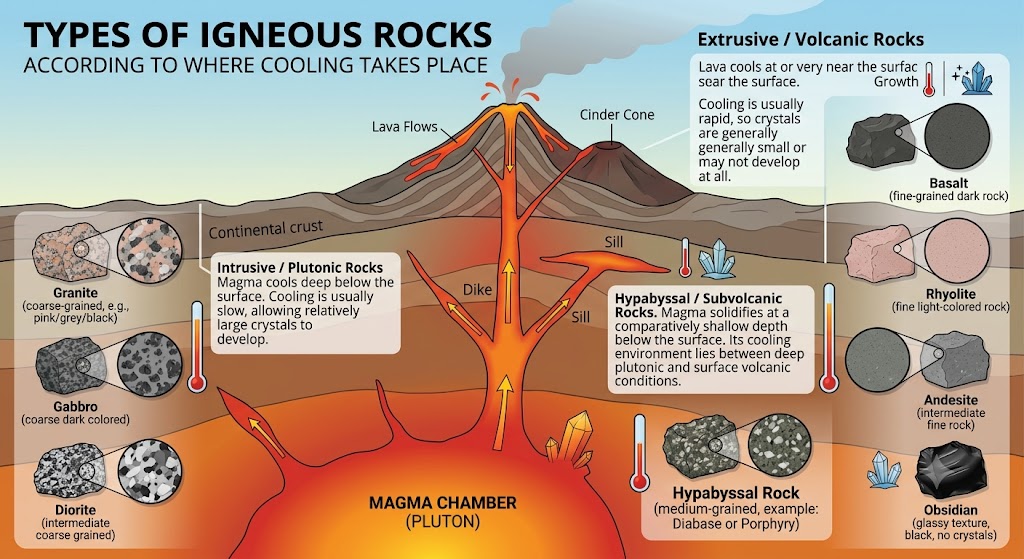
Intrusive / Plutonic
Magma remains deep inside the crust.
Surrounding rocks act like insulation, so heat escapes slowly.
Crystals get a long time to grow.
Therefore: crystals are usually large and visible.
Examples: Granite, Diorite, Gabbro.
Extrusive / Volcanic
Lava reaches the Earth's surface.
Heat is lost rapidly to the atmosphere, water or surrounding surface.
Crystals get little time to grow.
Therefore: crystals are usually very small, or may not form at all.
Examples: Basalt, Andesite, Rhyolite, Obsidian.
Hypabyssal / Subvolcanic
Magma solidifies at a relatively shallow depth.
Cooling is faster than in deep plutonic bodies but slower than surface lava.
6. Cooling Rate Controls Crystal Size — Why?
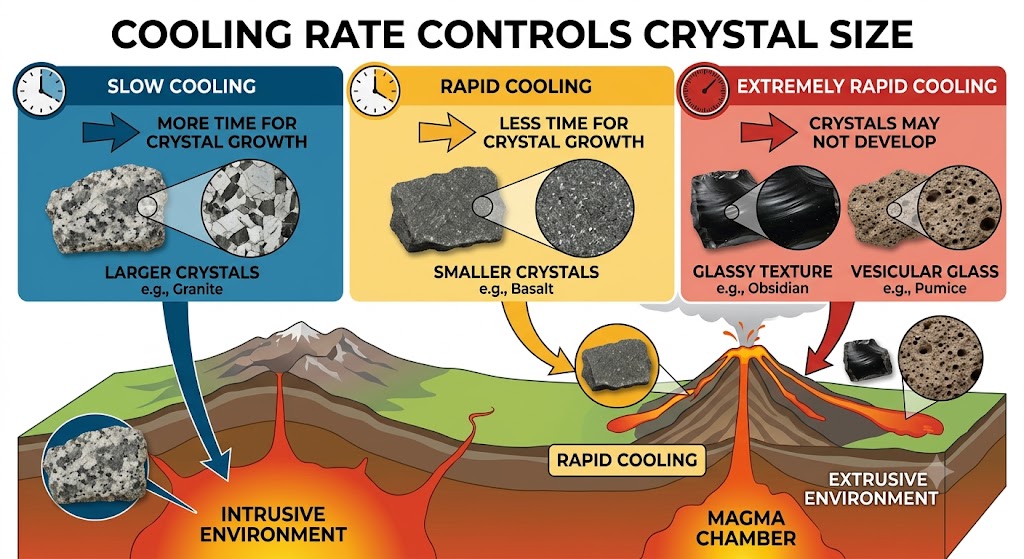
A crystal grows when atoms and ions have enough time to move and arrange themselves into an ordered structure.
This explains one of the most important comparisons in geology:
Granite: slowly cooled underground → large visible crystals.
Rhyolite: broadly similar felsic composition but rapidly cooled near the surface → small crystals.
7. Important Igneous Rock Textures — What Does Each Texture Tell Us?
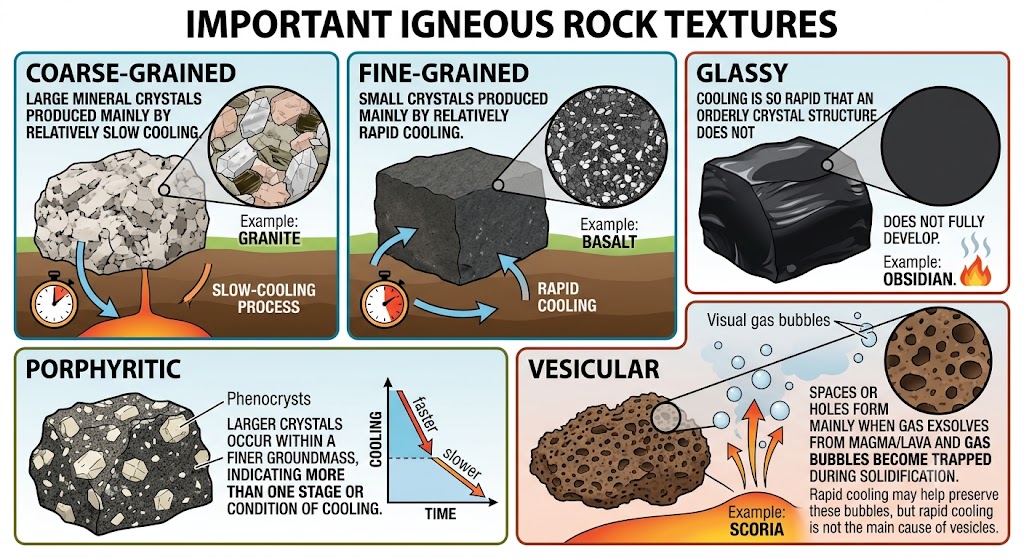
Coarse-grained
Large visible crystals. Indicates comparatively slow cooling, usually underground.
Fine-grained
Very small crystals. Indicates comparatively rapid cooling, commonly at or near the surface.
Glassy
Cooling was so rapid that atoms could not arrange themselves into normal mineral crystals.
Example: Obsidian.
Porphyritic
Large crystals occur inside a fine-grained background.
This normally records two stages of cooling.
First, magma cooled slowly underground and some large crystals formed. Later the remaining magma moved upward or erupted and cooled rapidly, producing the fine groundmass.
Vesicular
Magma contains dissolved gases. As pressure decreases near the surface, gases come out of solution and form bubbles.
If lava solidifies before the bubbles escape, holes called vesicles remain in the rock.
8. Classification by Composition — Why Are Some Rocks Light and Others Dark?
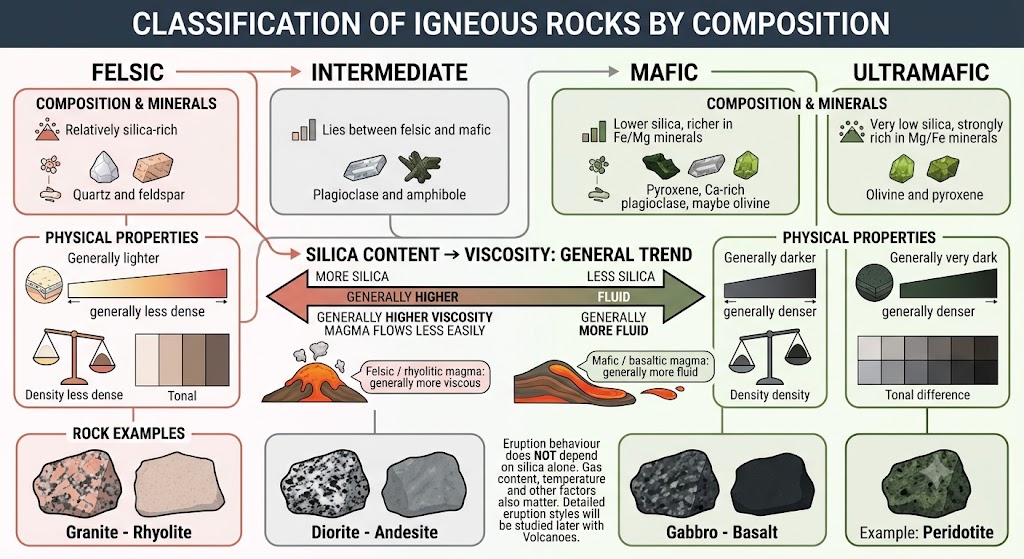
Igneous rocks are also classified according to the chemical and mineral composition of the magma from which they formed.
Felsic
Relatively rich in silica.
Common minerals: quartz, potassium feldspar and sodium-rich feldspar.
Generally light coloured and less dense.
Granite – Rhyolite
Intermediate
Composition lies between felsic and mafic.
Plagioclase and amphibole are common.
Diorite – Andesite
Mafic
Lower silica than felsic rocks.
Relatively rich in iron, magnesium and calcium-bearing minerals.
Pyroxene and calcium-rich plagioclase are common; olivine may occur.
Generally dark and denser.
Gabbro – Basalt
Ultramafic
Very low silica compared with felsic rocks.
Very rich in magnesium and iron-bearing minerals.
Olivine and pyroxene are important minerals.
Example: Peridotite.
Why does silica affect viscosity?
Silica-rich melts can develop interconnected silica structures. These make it more difficult for the melt to flow freely.
Therefore:
Higher silica → generally greater viscosity → magma flows less easily.
Lower-silica basaltic magma → generally lower viscosity → flows more easily.
Eruption behaviour also depends on temperature, dissolved gases and other factors, so silica alone does not determine whether an eruption will be explosive.
9. Important Intrusive–Extrusive Rock Pairs — Understand, Do Not Memorise Blindly
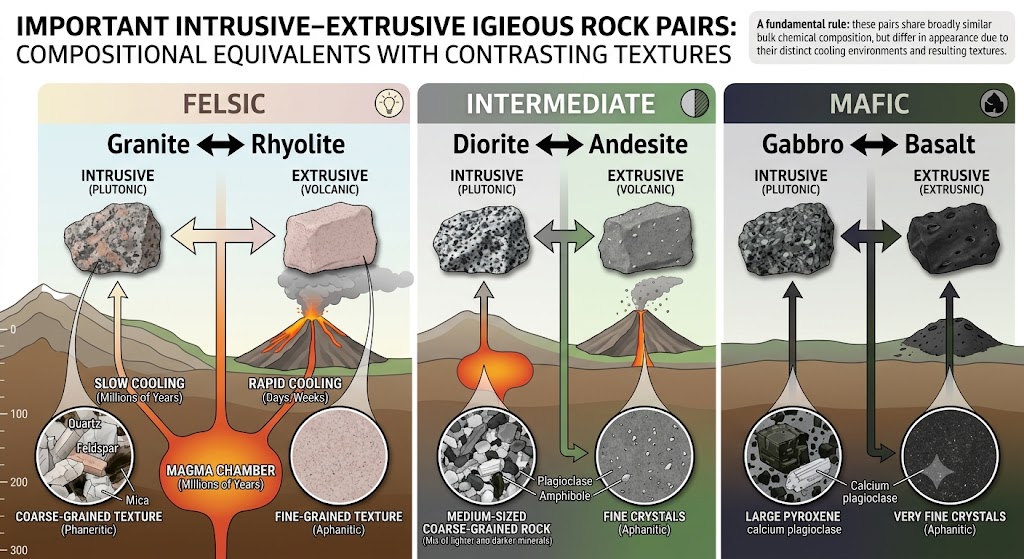
Felsic
Intermediate
Mafic
These pairs are called broad compositional equivalents.
It does not mean that granite changes directly into rhyolite or gabbro directly into basalt.
It means that molten material of broadly similar composition can form:
Rapid surface cooling → fine extrusive equivalent
Thus felsic magma may produce granite underground or rhyolite at the surface. Mafic magma may produce gabbro underground or basalt at the surface.
10. How the Major Igneous Rocks Form — Learn Them as Families
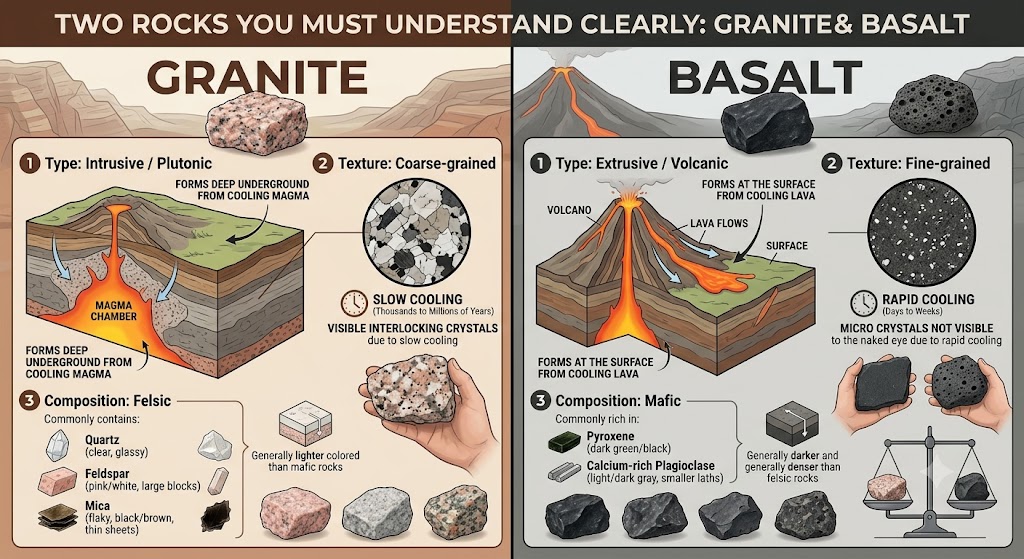
Do not learn the important igneous rocks as unrelated names. First identify the composition, then ask whether the melt cooled slowly underground or rapidly at/near the surface.
Peridotite — Ultramafic Intrusive Rock
Composition: very rich in Mg and Fe; olivine and pyroxene are important.
Formation: forms from ultramafic melt or mantle-derived material crystallising at depth.
Why coarse? deep, slow cooling allows large crystals to grow.
Peridotite is especially important because much of the upper mantle is broadly peridotitic in composition.
Gabbro — Mafic Intrusive Rock
Composition: mafic.
Formation: mafic magma cools slowly underground.
Result: pyroxene and Ca-rich plagioclase crystals have time to grow large.
Think: same broad composition as basalt, but much coarser texture.
Basalt — Mafic Extrusive Rock
Composition: mafic.
Formation: mafic lava reaches the surface and cools rapidly.
Result: crystals remain very small, so basalt is generally fine-grained.
Think: Gabbro below, Basalt above.
Diorite — Intermediate Intrusive Rock
Composition: intermediate between mafic and felsic.
Formation: intermediate magma cools slowly inside the crust.
Result: coarse crystals, commonly including plagioclase with amphibole and/or pyroxene.
Think: intrusive equivalent of andesite.
Andesite — Intermediate Extrusive Rock
Composition: intermediate.
Formation: intermediate lava cools relatively rapidly at or near the surface.
Result: generally fine-grained; porphyritic andesite is also common because cooling may occur in two stages.
Andesitic magmas are especially important in many subduction-related volcanic arcs.
Granite — Felsic Intrusive Rock
Composition: felsic; commonly quartz + feldspars + mica.
Formation: silica-rich magma cools slowly at depth.
Result: large visible crystals and generally light colour.
Think: intrusive equivalent of rhyolite.
Rhyolite — Felsic Extrusive Rock
Composition: felsic, broadly comparable with granite.
Formation: silica-rich lava or shallow magma cools rapidly.
Result: generally fine-grained because crystals have little time to grow.
Rhyolitic magma is generally highly viscous because of its high silica content.
Memory ladder:
Ultramafic → Peridotite
Mafic → Gabbro / Basalt
Intermediate → Diorite / Andesite
Felsic → Granite / Rhyolite
In each pair, the first name is the common intrusive/coarse equivalent and the second is the common extrusive/fine equivalent.
11. Intrusive Forms — Why Does Magma Form Different Shapes Underground?
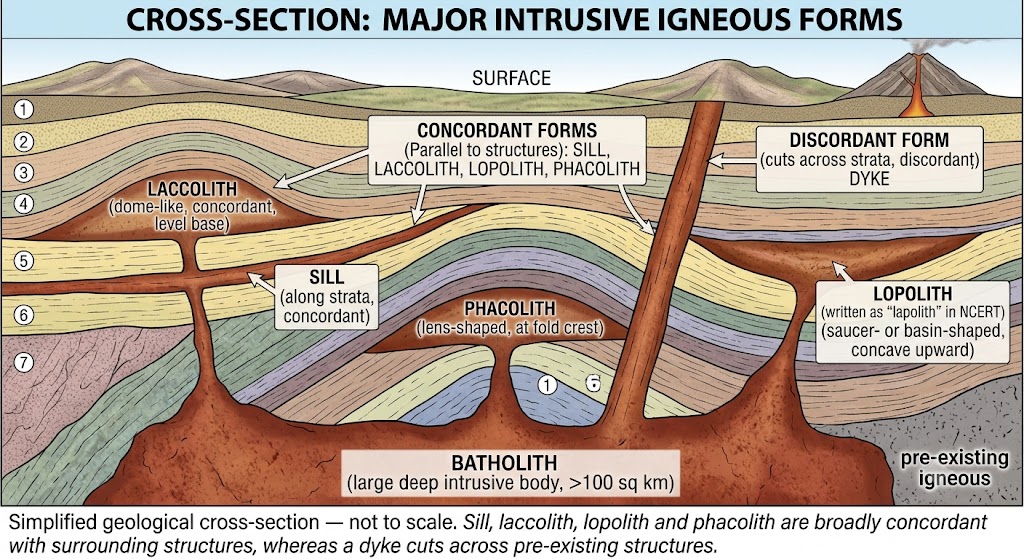
Magma moving upward does not always reach the surface.
It may enter cracks, weaknesses, bedding planes or spaces between pre-existing rock layers. If it cools there, the solidified magma forms an intrusive igneous body.
Its final shape depends largely on the space into which magma entered.
Batholith
An enormous irregular mass of intrusive igneous rock formed deep in the crust, commonly associated with large mountain-building regions.
Laccolith
Magma spreads between rock layers but is thick enough to push the overlying beds upward, producing a dome-like body.
Lopolith
A broad basin- or saucer-shaped intrusion that is concave upward.
Phacolith
A lens-shaped body typically associated with folded rocks, commonly along the crest of an anticline or trough of a syncline.
Sill
Magma enters between existing layers and spreads approximately parallel to them.
Dyke / Dike
Magma enters a fracture that cuts across existing rock layers. When it solidifies, it forms a wall-like tabular body.
12. Concordant vs Discordant Intrusions
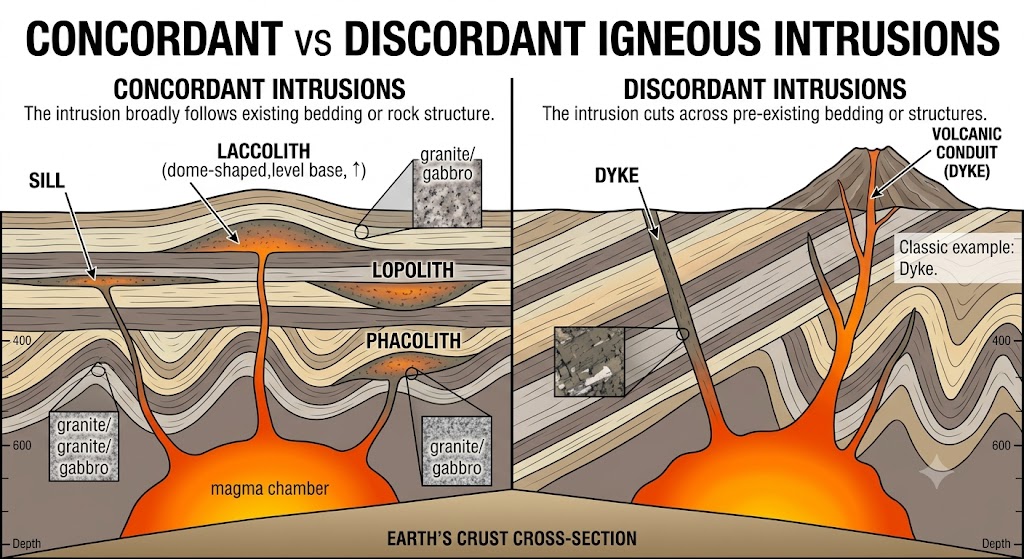
Concordant
Magma broadly follows the existing bedding or structure of the surrounding rocks instead of cutting across it.
Examples: Sill, laccolith, lopolith and phacolith.
Discordant
Magma cuts across the pre-existing rock layers or geological structures.
Classic example: Dyke.
13. Bowen's Reaction Series — Understand It in the Simplest Possible Way
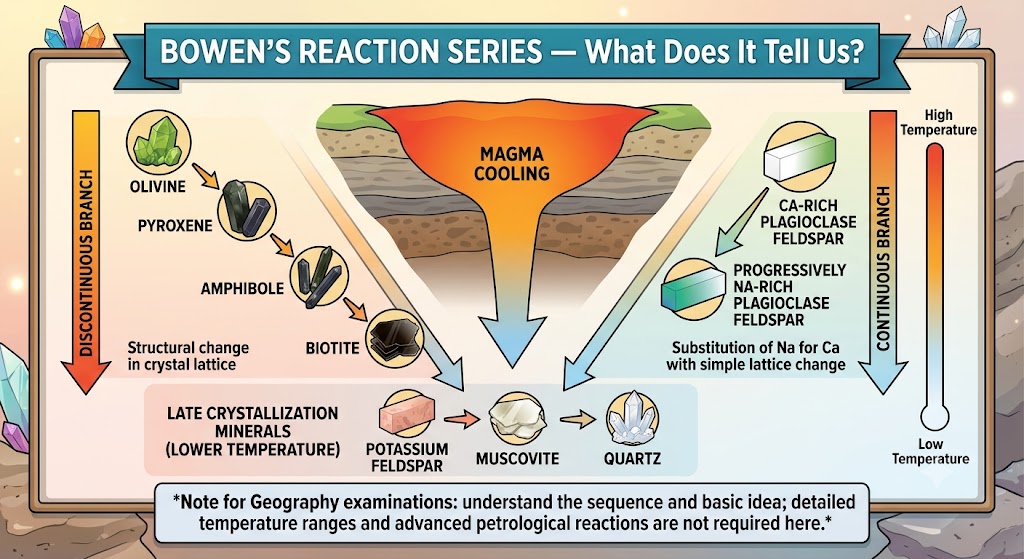
Magma contains many chemical elements, but all minerals do not crystallise at the same temperature.
Some minerals become stable and crystallise while the magma is still very hot. Other minerals form only after the magma has cooled further.
Bowen's Reaction Series shows this general order of mineral crystallisation as magma cools.
Do not read Bowen's Series as “high temperature = basalt and low temperature = granite.” The series describes the order in which minerals become stable during cooling. Rock names are assigned from the final mineral/chemical composition and texture. Temperature influences the process indirectly by controlling crystallisation.
A. Discontinuous Branch
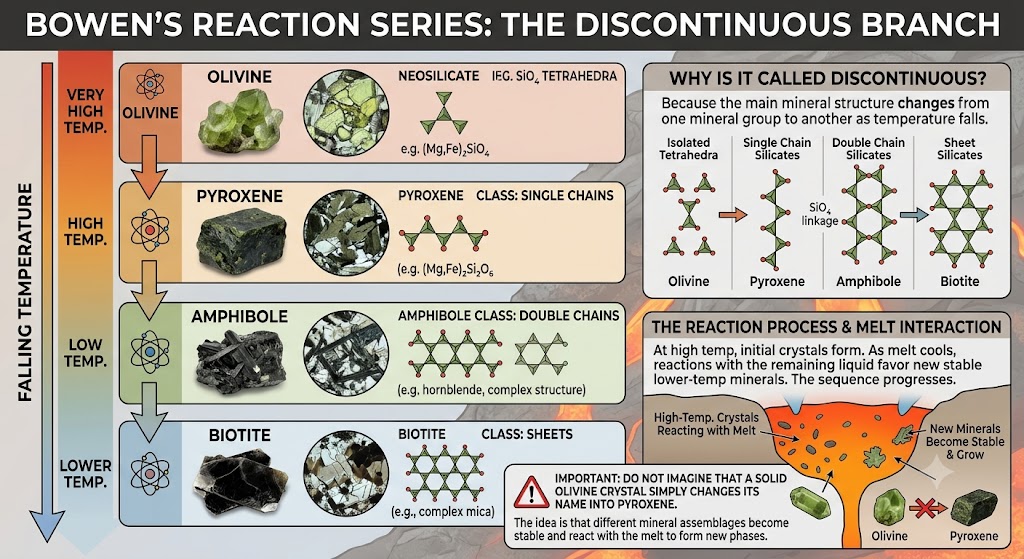
Olivine → Pyroxene → Amphibole → Biotite
Why is it called discontinuous?
Because the main mineral structure changes from one mineral group to another as temperature falls.
At very high temperature, olivine may crystallise first. If it remains in contact with the cooling melt under suitable conditions, reactions with the melt favour different lower-temperature minerals, broadly progressing toward pyroxene, amphibole and then biotite.
B. Continuous Branch
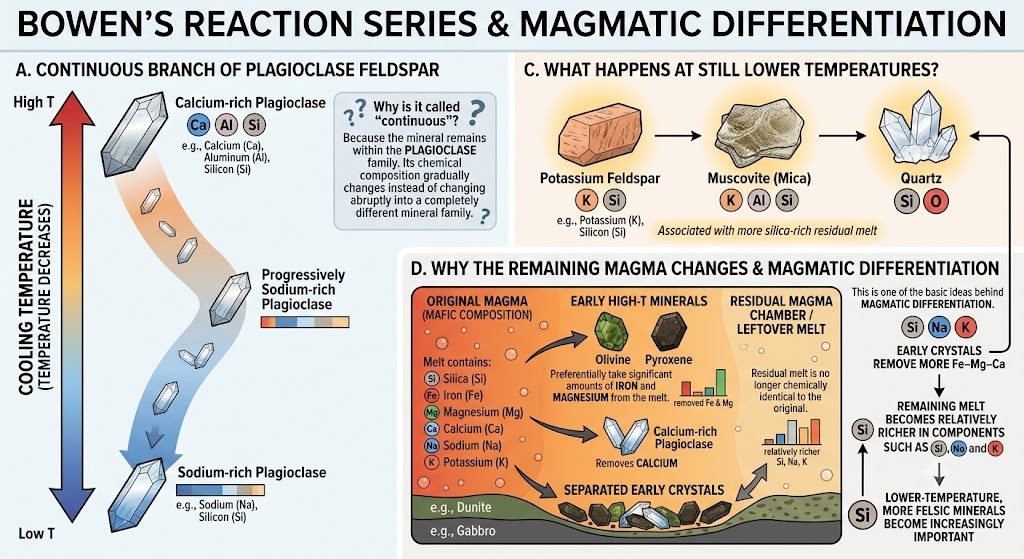
Calcium-rich Plagioclase → progressively Sodium-rich Plagioclase
Why is it called continuous?
Because the mineral remains within the plagioclase feldspar family. Its chemical composition gradually changes instead of changing abruptly into a completely different mineral family.
At higher temperature, plagioclase is relatively calcium-rich. As cooling continues, progressively more sodium-rich plagioclase becomes stable.
C. What Happens at Still Lower Temperatures?
As cooling continues, minerals associated with more silica-rich residual melt become important.
Potassium Feldspar → Muscovite → Quartz
D. Most Important Question — Why Does the Remaining Magma Change?
Imagine a magma containing iron, magnesium, calcium, sodium, potassium, silica and other elements.
Early minerals such as olivine and pyroxene preferentially take significant amounts of iron and magnesium from the melt. Calcium-rich plagioclase also removes calcium.
Therefore, if these early crystals become separated from the remaining melt, the residual magma is no longer chemically identical to the original magma.
Early crystals remove more Fe–Mg–Ca
↓
Remaining melt becomes relatively richer in components such as Si, Na and K
↓
Lower-temperature, more felsic minerals become increasingly important
This is one of the basic ideas behind magmatic differentiation.
E. So Can Basaltic Magma Eventually Produce More Felsic Material?
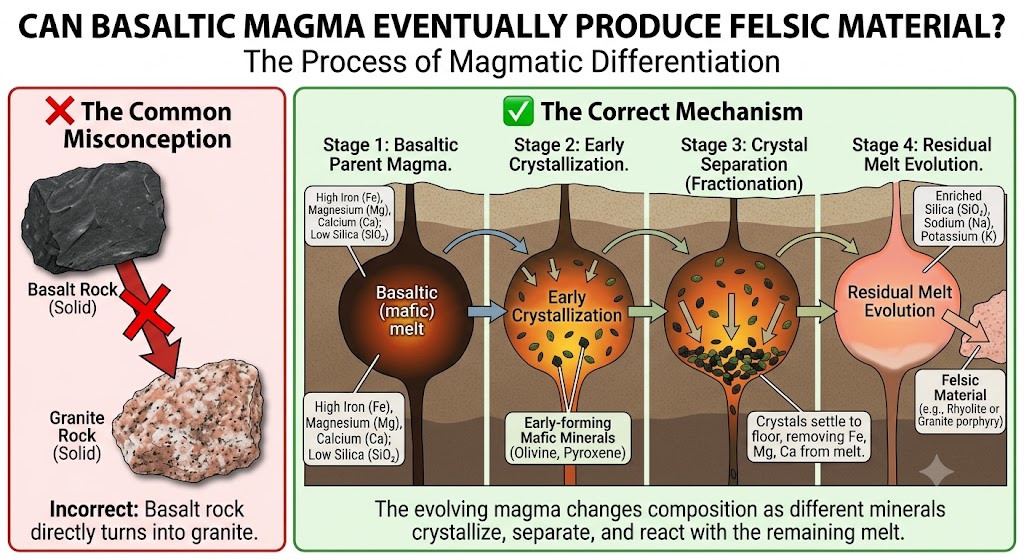
Under suitable conditions, yes. If early mafic minerals crystallise and are effectively removed or separated from the melt, the remaining magma can become relatively more silica-rich and chemically evolved.
But this should not be simplified as:
The correct idea is:
For UPSC and State PSC Geography, understand the sequence, high-temperature versus low-temperature minerals, continuous versus discontinuous branches, and the changing composition of residual magma. Exact laboratory temperature ranges are usually unnecessary.
14. Bowen Series and Rock Composition — Put the Whole Idea Together
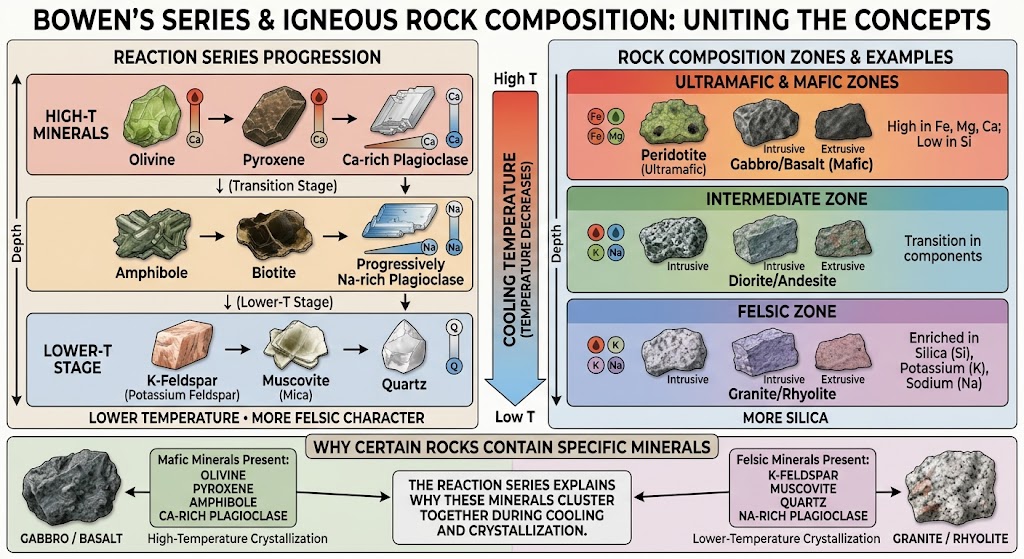
At the high-temperature end, minerals such as olivine, pyroxene and calcium-rich plagioclase are important. These minerals are strongly associated with mafic and ultramafic compositions.
At the lower-temperature end, potassium feldspar, muscovite and quartz become important. These minerals are strongly associated with felsic compositions.
Olivine / Pyroxene / Ca-rich Plagioclase
↓
More Mafic Character
↓
Amphibole / Biotite / progressively Na-rich Plagioclase
↓
Potassium Feldspar / Muscovite / Quartz
Lower Temperature • More Felsic Character
This single relationship helps explain why basalt and gabbro commonly contain mafic minerals, while granite and rhyolite commonly contain quartz and feldspars.
↓
High-temperature minerals crystallise first
↓
Early crystals may separate from the melt
↓
Residual magma composition changes
↓
Mafic → Intermediate → more Felsic tendency may develop
↓
Now ask: underground or surface?
↓
Mafic: Gabbro / Basalt
Intermediate: Diorite / Andesite
Felsic: Granite / Rhyolite
↓
Now ask: how fast did it cool?
↓
Slow = coarse • Fast = fine • Extremely fast = glassy • Two-stage = porphyritic • Gas bubbles = vesicular
15. Colour and Density Are Clues — Not Absolute Rules
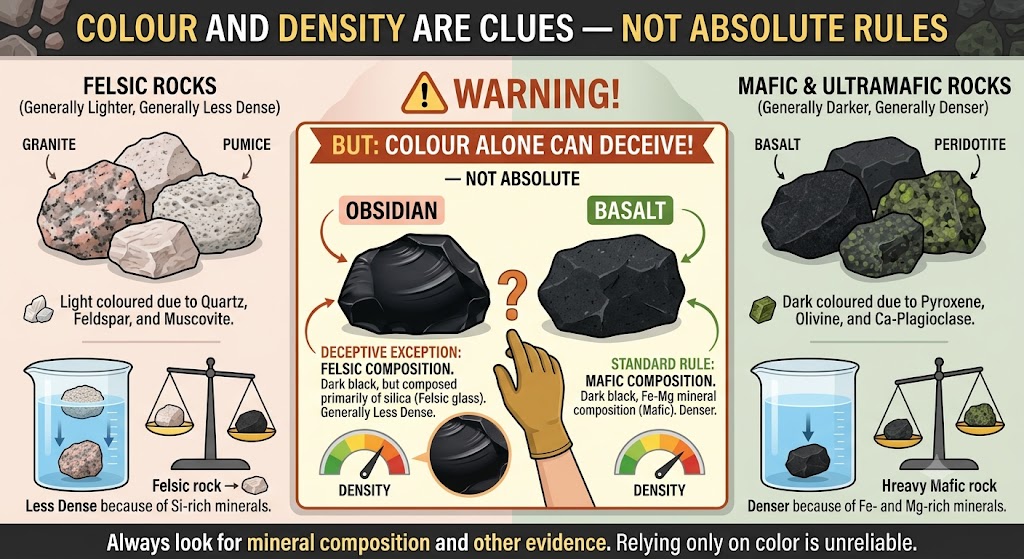
Felsic rocks: generally lighter and generally less dense.
Mafic and ultramafic rocks: generally darker and generally denser.
But: colour alone is not a perfect test because rock colour can also be influenced by texture, alteration, weathering and the proportions of individual minerals.
16. Important Igneous Rocks to Remember
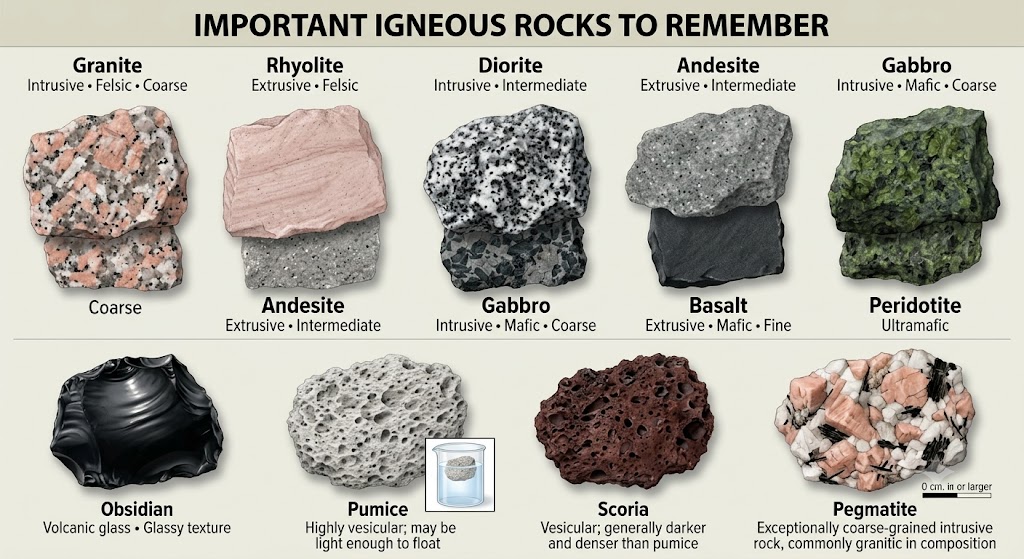
Intrusive • Felsic • Coarse
Extrusive • Felsic • Fine
Intrusive • Intermediate • Coarse
Extrusive • Intermediate
Intrusive • Mafic • Coarse
Extrusive • Mafic • Fine
Ultramafic • Olivine-rich
Volcanic glass • Extremely rapid cooling
Highly vesicular • Very low bulk density; some pieces float
Vesicular • Usually darker and denser than pumice
Pegmatite: an exceptionally coarse-grained intrusive rock. Its very large crystals generally form during late stages of magma crystallisation where volatile-rich residual melts can allow rapid movement of ions and exceptional crystal growth.
How the Special Igneous Rocks Form
Obsidian
Silica-rich lava may cool so rapidly that crystals cannot develop. The result is natural volcanic glass.
Pumice
Gas-rich, commonly silica-rich magma erupts; pressure drops, gases expand strongly and the lava freezes around abundant bubbles. The rock becomes extremely vesicular and very light.
Scoria
Gas-rich, commonly mafic lava also traps bubbles during cooling. Scoria is vesicular but is usually darker and denser than pumice.
Pegmatite
During late stages of magma crystallisation, a residual melt enriched in water and other volatile components may allow ions to move easily and very large crystals to grow.
Porphyritic Rock
The magma experiences two cooling stages: slow cooling first forms large crystals, then faster cooling forms a fine groundmass around them.
17. Important Indian Connection
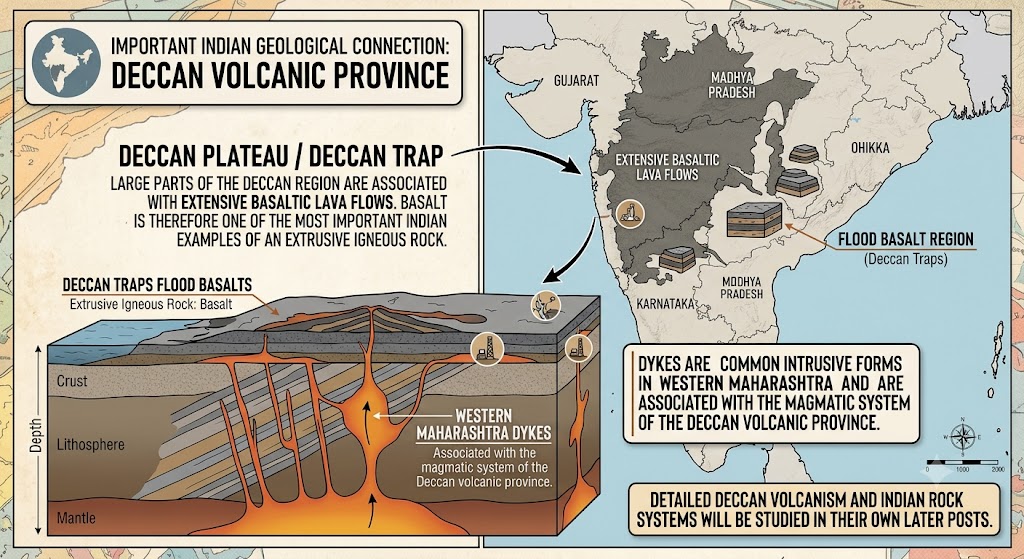
Deccan Plateau / Deccan Traps
The Deccan volcanic province formed through enormous outpourings of mainly basaltic lava.
Repeated lava flows spread over large areas and cooled one above another. This helped produce the characteristic step-like landscape from which the word “Trap” is associated.
Basalt is therefore one of India's most important examples of an extrusive igneous rock.
Western Maharashtra Dykes
During Deccan magmatism, magma also moved through fractures inside the crust. Where it cooled within such fractures, it produced dykes.
Detailed Deccan volcanism and Indian Rock Systems should be studied separately so that this post remains focused on basic igneous-rock concepts.
18. Exam Traps and Common Confusions
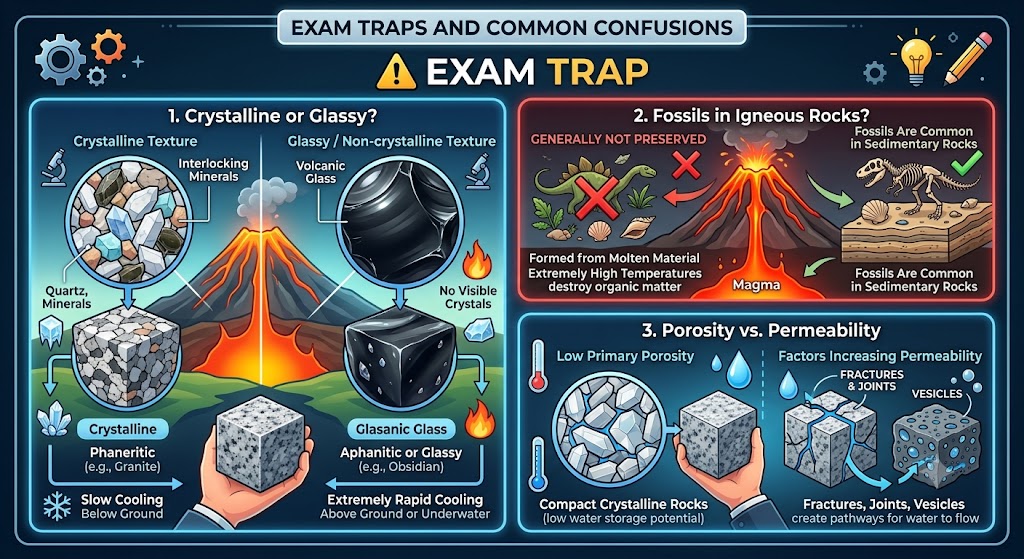
1. Igneous rocks are not always visibly crystalline. Obsidian has a glassy texture.
2. Fossils are generally absent from igneous rocks because they form from molten material.
3. Compact crystalline igneous rocks generally have low primary porosity, but joints, fractures and vesicles may create secondary spaces and permeability.
4. Vesicles are mainly caused by trapped gas bubbles, not simply by rapid cooling.
5. Porphyritic texture does not simply mean “medium-sized crystals.” It records large crystals embedded in a finer groundmass.
6. Granite and rhyolite are compositional equivalents; granite does not directly convert into rhyolite.
7. Bowen's Reaction Series describes mineral crystallisation and reaction during cooling; it is not merely a list of rock names.
19. Quick Concept Revision
Magma below ground; lava at surface.
Slow cooling → large crystals → commonly intrusive.
Rapid cooling → small crystals → commonly extrusive.
Extremely rapid cooling → glass.
Trapped gas bubbles → vesicular texture.
Two-stage cooling → porphyritic texture.
Granite ↔ Rhyolite = felsic equivalents.
Diorite ↔ Andesite = intermediate equivalents.
Gabbro ↔ Basalt = mafic equivalents.
Sill follows layers; dyke cuts across layers.
Bowen Series: different minerals crystallise at different stages as magma cools.
Discontinuous branch: Olivine → Pyroxene → Amphibole → Biotite.
Continuous branch: Ca-rich plagioclase → progressively Na-rich plagioclase.
Low-temperature end: potassium feldspar, muscovite and quartz become important.
Final memory rules:
• Temperature controls mineral crystallisation sequence; it does not by itself rename a rock.
• Composition decides the family: ultramafic / mafic / intermediate / felsic.
• Cooling place decides the common pair: Gabbro–Basalt, Diorite–Andesite, Granite–Rhyolite.
• Cooling speed mainly controls texture and crystal size.
• Fractional crystallisation can change the composition of the remaining melt because early crystals remove selected elements.
• A solid basalt does not simply cool into andesite or granite; magma evolution is the process being discussed.
Think Like UPSC
Whenever you see an igneous rock, ask these seven questions:
2. How fast did it cool? → large crystals, small crystals or glass?
3. What was the magma composition? → felsic, intermediate, mafic or ultramafic?
4. Were gases trapped? → vesicular texture?
5. Which minerals crystallised first or later? → Bowen's Reaction Series.
If these five questions are clear, most igneous-rock questions can be solved through logic rather than memorisation.