Why Universe is Studied in Geography
Geography is mainly the study of the Earth, but the Earth is not an isolated object. It is a planet in space, revolving around the Sun and interacting with the Moon, the Solar System and the wider universe.
That is why the universe is studied in Geography: to understand the Earth’s position, motions, climate, seasons, time, tides, eclipses and life-supporting conditions.
📌 View Visual Roadmap: Why Universe is Studied in Geography
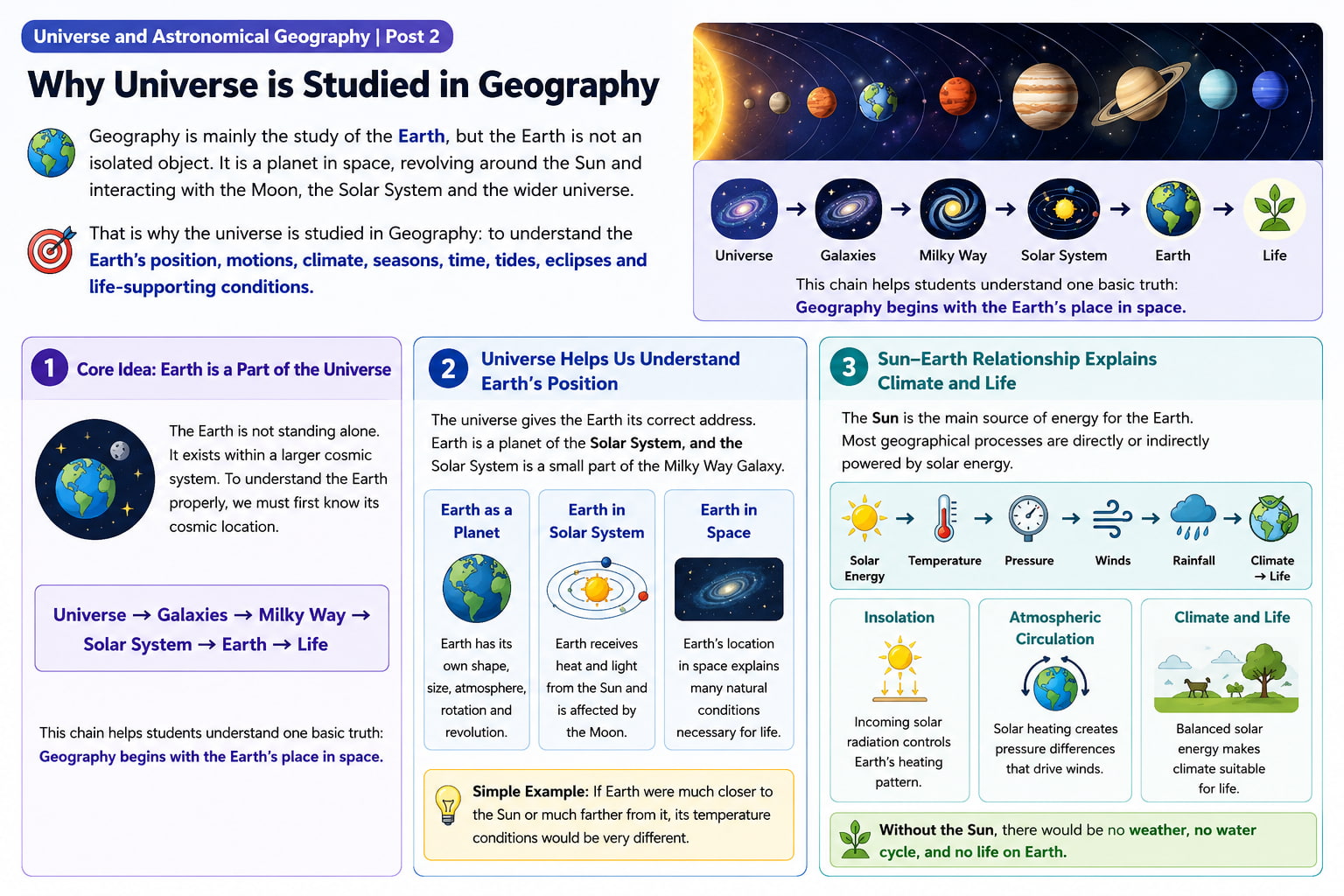
This visual roadmap explains how the universe helps us understand Earth’s position, Sun-Earth relationship, Moon-Earth relationship, time, seasons, climate and space technology.
1. Core Idea: Earth is a Part of the Universe
The Earth is not standing alone. It exists within a larger cosmic system. To understand the Earth properly, we must first know its cosmic location.
This chain helps students understand one basic truth: Geography begins with the Earth’s place in space.
2. Universe Helps Us Understand Earth’s Position
The universe gives the Earth its correct address. Earth is a planet of the Solar System, and the Solar System is a small part of the Milky Way Galaxy.
Earth as a Planet
Earth has its own shape, size, atmosphere, rotation and revolution.
Earth in Solar System
Earth receives heat and light from the Sun and is affected by the Moon.
Earth in Space
Earth’s location in space explains many natural conditions necessary for life.
Simple Example: If Earth were much closer to the Sun or much farther from it, its temperature conditions would be very different.
3. Sun-Earth Relationship Explains Climate and Life
The Sun is the main source of energy for the Earth. Most geographical processes are directly or indirectly powered by solar energy.
Insolation
Incoming solar radiation controls Earth’s heating pattern.
Atmospheric Circulation
Unequal heating creates pressure differences, winds and weather systems.
Life Support
Solar energy supports photosynthesis, food chains and the biosphere.
4. Earth’s Motions Explain Day, Night and Seasons
Many basic geographical facts are connected with Earth’s movements in space.
Rotation
Earth rotates on its axis, causing day and night.
Revolution
Earth revolves around the Sun, forming the basis of a year.
Axial Tilt
Earth’s tilted axis, along with revolution, causes seasons.
Longitude and Time
Earth’s rotation helps explain local time, standard time and time zones.
UPSC Trap: Seasons are not mainly caused by changing distance from the Sun. They are mainly caused by Earth’s axial tilt and revolution.
5. Moon-Sun-Earth Relationship Explains Tides and Eclipses
The Moon and the Sun influence several important geographical phenomena on Earth, especially oceans and sky events.
Tides
Tides are mainly caused by the gravitational pull of the Moon and also influenced by the Sun.
Eclipses
Solar and lunar eclipses occur due to special alignment of the Sun, Earth and Moon.
Moon Phases
Phases of the Moon are connected with the relative positions of the Sun, Earth and Moon.
Simple Example: Spring tides occur when the Sun, Moon and Earth are nearly in one line during new moon or full moon conditions.
6. Universe Helps Us Understand Scale and Distance
Geography uses scale to understand space. The universe teaches us that Earth is a very small part of a much larger system.
Concepts like Astronomical Unit, Light Year and Parsec help us understand extremely large distances in space. These will be studied in the next post.
7. Space Technology Strengthens Modern Geography
Today, Geography is not limited to books and maps. Space-based technology has transformed the way we study the Earth.
Satellites
Used for weather monitoring, communication, navigation and Earth observation.
Remote Sensing
Helps study forests, agriculture, glaciers, oceans, disasters and urban growth.
GIS and Mapping
Space data improves digital mapping, planning and decision-making.
8. What Geography Studies and What It Does Not
Geography does not study the entire universe in the same depth as Astronomy or Cosmology. Geography studies the universe mainly to understand its connection with the Earth.
Geography Studies
Earth’s position, motions, Sun-Earth relation, Moon-Earth relation, seasons, tides, time and space-based observation.
Geography Does Not Focus On
Detailed astrophysics, advanced cosmological mathematics or belief-based astrology.
UPSC Clarity: Study the universe only to the extent that it helps explain Earth, physical geography, maps, climate, time and space applications.
9. UPSC Relevance
Prelims: Solar System, planets, Earth’s motions, eclipses, tides, seasons and basic space concepts.
GS Paper I: Physical Geography, Earth-Sun relationship, climate foundations and time-related concepts.
Science and Technology: Satellites, space missions, remote sensing and space observation.
Map Practice: Latitude, longitude, hemispheres, time zones and global positioning.
Essay and Mains Link: Space technology, disaster management, climate monitoring and sustainable development.
Quick Revision
Universe is studied in Geography because Earth is a planet located in space.
Earth’s position in the Solar System affects temperature, climate and life-supporting conditions.
Sun-Earth relationship explains insolation, heat balance, winds, rainfall and climate.
Earth’s rotation causes day and night and helps explain time zones.
Earth’s revolution and axial tilt cause seasons.
Moon-Sun-Earth relationship explains tides, eclipses and lunar phases.
Space technology supports modern Geography through satellites, remote sensing, GIS and disaster monitoring.
Think Like UPSC: Do not study the universe as isolated astronomy facts. Always connect it with Earth: How does it affect climate, seasons, time, oceans, maps, life and modern technology?
भूगोल में ब्रह्मांड का अध्ययन क्यों किया जाता है
भूगोल मुख्य रूप से पृथ्वी का अध्ययन है, लेकिन पृथ्वी कोई अलग-थलग वस्तु नहीं है। यह अंतरिक्ष में स्थित एक ग्रह है, जो सूर्य की परिक्रमा करता है और चंद्रमा, सौरमंडल तथा व्यापक ब्रह्मांड से जुड़ा हुआ है।
इसी कारण भूगोल में ब्रह्मांड का अध्ययन किया जाता है: ताकि हम पृथ्वी की स्थिति, गतियों, जलवायु, ऋतुओं, समय, ज्वार-भाटा, ग्रहणों और जीवन के लिए अनुकूल परिस्थितियों को समझ सकें।
📌 दृश्य रोडमैप देखें: भूगोल में ब्रह्मांड का अध्ययन क्यों किया जाता है
यह दृश्य रोडमैप समझाता है कि ब्रह्मांड हमें पृथ्वी की स्थिति, सूर्य-पृथ्वी संबंध, चंद्रमा-पृथ्वी संबंध, समय, ऋतुओं, जलवायु और अंतरिक्ष प्रौद्योगिकी को समझने में कैसे सहायता करता है।
1. मूल विचार: पृथ्वी ब्रह्मांड का एक हिस्सा है
पृथ्वी अकेली खड़ी नहीं है। यह एक बड़े ब्रह्मांडीय तंत्र के भीतर स्थित है। पृथ्वी को सही ढंग से समझने के लिए हमें पहले उसकी ब्रह्मांडीय स्थिति को जानना आवश्यक है।
यह श्रृंखला विद्यार्थियों को एक मूल सत्य समझने में मदद करती है: भूगोल की शुरुआत अंतरिक्ष में पृथ्वी के स्थान से होती है।
2. ब्रह्मांड हमें पृथ्वी की स्थिति समझने में सहायता करता है
ब्रह्मांड पृथ्वी को उसका सही पता देता है। पृथ्वी सौरमंडल का एक ग्रह है और सौरमंडल मिल्की वे आकाशगंगा का एक छोटा-सा हिस्सा है।
एक ग्रह के रूप में पृथ्वी
पृथ्वी का अपना आकार, माप, वायुमंडल, घूर्णन और परिक्रमण है।
सौरमंडल में पृथ्वी
पृथ्वी सूर्य से ऊष्मा और प्रकाश प्राप्त करती है तथा चंद्रमा से भी प्रभावित होती है।
अंतरिक्ष में पृथ्वी
अंतरिक्ष में पृथ्वी की स्थिति जीवन के लिए आवश्यक अनेक प्राकृतिक परिस्थितियों को स्पष्ट करती है।
सरल उदाहरण: यदि पृथ्वी सूर्य के बहुत अधिक निकट या बहुत अधिक दूर होती, तो इसकी तापमान संबंधी परिस्थितियाँ बहुत अलग होतीं।
3. सूर्य-पृथ्वी संबंध जलवायु और जीवन को समझाता है
सूर्य पृथ्वी के लिए ऊर्जा का मुख्य स्रोत है। अधिकांश भौगोलिक प्रक्रियाएँ प्रत्यक्ष या अप्रत्यक्ष रूप से सौर ऊर्जा से संचालित होती हैं।
सूर्यातप
आने वाला सौर विकिरण पृथ्वी के ऊष्मन पैटर्न को नियंत्रित करता है।
वायुमंडलीय परिसंचरण
असमान ऊष्मन वायुदाब में अंतर, पवनों और मौसम प्रणालियों को जन्म देता है।
जीवन समर्थन
सौर ऊर्जा प्रकाश संश्लेषण, खाद्य श्रृंखलाओं और जीवमंडल को समर्थन देती है।
4. पृथ्वी की गतियाँ दिन, रात और ऋतुओं को समझाती हैं
अनेक मूलभूत भौगोलिक तथ्य अंतरिक्ष में पृथ्वी की गतियों से जुड़े हुए हैं।
घूर्णन
पृथ्वी अपनी धुरी पर घूमती है, जिससे दिन और रात होते हैं।
परिक्रमण
पृथ्वी सूर्य की परिक्रमा करती है, जो एक वर्ष का आधार बनाती है।
अक्षीय झुकाव
पृथ्वी की झुकी हुई धुरी, परिक्रमण के साथ मिलकर ऋतुओं का कारण बनती है।
देशांतर और समय
पृथ्वी का घूर्णन स्थानीय समय, मानक समय और समय क्षेत्रों को समझाने में सहायता करता है।
UPSC Trap: ऋतुएँ मुख्य रूप से सूर्य से दूरी बदलने के कारण नहीं होतीं। वे मुख्य रूप से पृथ्वी के अक्षीय झुकाव और परिक्रमण के कारण होती हैं।
5. चंद्रमा-सूर्य-पृथ्वी संबंध ज्वार-भाटा और ग्रहणों को समझाता है
चंद्रमा और सूर्य पृथ्वी पर कई महत्वपूर्ण भौगोलिक घटनाओं को प्रभावित करते हैं, विशेषकर महासागरों और आकाशीय घटनाओं को।
ज्वार-भाटा
ज्वार-भाटा मुख्य रूप से चंद्रमा के गुरुत्वाकर्षण खिंचाव के कारण होते हैं और सूर्य से भी प्रभावित होते हैं।
ग्रहण
सूर्य ग्रहण और चंद्र ग्रहण सूर्य, पृथ्वी और चंद्रमा की विशेष स्थिति के कारण होते हैं।
चंद्र कलाएँ
चंद्रमा की कलाएँ सूर्य, पृथ्वी और चंद्रमा की सापेक्ष स्थितियों से जुड़ी होती हैं।
सरल उदाहरण: वसंत ज्वार तब आते हैं जब अमावस्या या पूर्णिमा की स्थिति में सूर्य, चंद्रमा और पृथ्वी लगभग एक सीध में होते हैं।
6. ब्रह्मांड हमें पैमाना और दूरी समझने में सहायता करता है
भूगोल स्थान को समझने के लिए पैमाने का उपयोग करता है। ब्रह्मांड हमें सिखाता है कि पृथ्वी एक बहुत बड़े तंत्र का बहुत छोटा हिस्सा है।
खगोलीय इकाई, प्रकाश वर्ष और पारसेक जैसी अवधारणाएँ अंतरिक्ष की अत्यंत विशाल दूरियों को समझने में सहायता करती हैं। इनका अध्ययन अगले पोस्ट में किया जाएगा।
7. अंतरिक्ष प्रौद्योगिकी आधुनिक भूगोल को मजबूत बनाती है
आज भूगोल केवल पुस्तकों और मानचित्रों तक सीमित नहीं है। अंतरिक्ष-आधारित तकनीक ने पृथ्वी के अध्ययन के तरीके को बदल दिया है।
उपग्रह
इनका उपयोग मौसम निगरानी, संचार, नौवहन और पृथ्वी अवलोकन के लिए किया जाता है।
रिमोट सेंसिंग
यह वनों, कृषि, हिमनदों, महासागरों, आपदाओं और नगरीय विस्तार के अध्ययन में सहायता करती है।
GIS और मानचित्रण
अंतरिक्षीय आँकड़े डिजिटल मानचित्रण, योजना निर्माण और निर्णय लेने की प्रक्रिया को बेहतर बनाते हैं।
8. भूगोल क्या पढ़ता है और क्या नहीं
भूगोल पूरे ब्रह्मांड का उतनी गहराई से अध्ययन नहीं करता जितना खगोल विज्ञान या ब्रह्मांड विज्ञान करता है। भूगोल ब्रह्मांड का अध्ययन मुख्य रूप से पृथ्वी से उसके संबंध को समझने के लिए करता है।
भूगोल अध्ययन करता है
पृथ्वी की स्थिति, गतियाँ, सूर्य-पृथ्वी संबंध, चंद्रमा-पृथ्वी संबंध, ऋतुएँ, ज्वार-भाटा, समय और अंतरिक्ष-आधारित अवलोकन।
भूगोल मुख्य रूप से ध्यान नहीं देता
विस्तृत खगोल भौतिकी, उन्नत ब्रह्मांडीय गणित या विश्वास-आधारित ज्योतिष पर।
UPSC Clarity: ब्रह्मांड का अध्ययन केवल उतना ही करें, जितना वह पृथ्वी, भौतिक भूगोल, मानचित्रों, जलवायु, समय और अंतरिक्षीय अनुप्रयोगों को समझाने में सहायक हो।
9. UPSC में प्रासंगिकता
Prelims: सौरमंडल, ग्रह, पृथ्वी की गतियाँ, ग्रहण, ज्वार-भाटा, ऋतुएँ और अंतरिक्ष की मूल अवधारणाएँ।
GS Paper I: भौतिक भूगोल, पृथ्वी-सूर्य संबंध, जलवायु की आधारभूत बातें और समय से जुड़ी अवधारणाएँ।
Science and Technology: उपग्रह, अंतरिक्ष मिशन, रिमोट सेंसिंग और अंतरिक्षीय अवलोकन।
Map Practice: अक्षांश, देशांतर, गोलार्ध, समय क्षेत्र और वैश्विक स्थिति निर्धारण।
Essay and Mains Link: अंतरिक्ष प्रौद्योगिकी, आपदा प्रबंधन, जलवायु निगरानी और सतत विकास।
त्वरित पुनरावृत्ति
भूगोल में ब्रह्मांड का अध्ययन इसलिए किया जाता है क्योंकि पृथ्वी अंतरिक्ष में स्थित एक ग्रह है।
सौरमंडल में पृथ्वी की स्थिति तापमान, जलवायु और जीवन के लिए अनुकूल परिस्थितियों को प्रभावित करती है।
सूर्य-पृथ्वी संबंध सूर्यातप, ऊष्मा संतुलन, पवनों, वर्षा और जलवायु को समझाता है।
पृथ्वी का घूर्णन दिन-रात का कारण बनता है और समय क्षेत्रों को समझाने में सहायता करता है।
पृथ्वी का परिक्रमण और अक्षीय झुकाव ऋतुओं का कारण बनते हैं।
चंद्रमा-सूर्य-पृथ्वी संबंध ज्वार-भाटा, ग्रहणों और चंद्र कलाओं को समझाता है।
अंतरिक्ष प्रौद्योगिकी उपग्रहों, रिमोट सेंसिंग, GIS और आपदा निगरानी के माध्यम से आधुनिक भूगोल को सहायता देती है।
Think Like UPSC: ब्रह्मांड को अलग-थलग खगोल विज्ञान तथ्यों के रूप में न पढ़ें। इसे हमेशा पृथ्वी से जोड़कर देखें: यह जलवायु, ऋतुओं, समय, महासागरों, मानचित्रों, जीवन और आधुनिक तकनीक को कैसे प्रभावित करता है?