Stars and Their Birth: Nebula, Protostar and Main Sequence
Stars are not born suddenly. A star begins its life inside a huge cloud of gas and dust called a nebula.
In simple words, a star is a huge, hot, shining ball of gas that produces its own light and heat through nuclear fusion.

1. Big Idea: Stars Have a Life Story
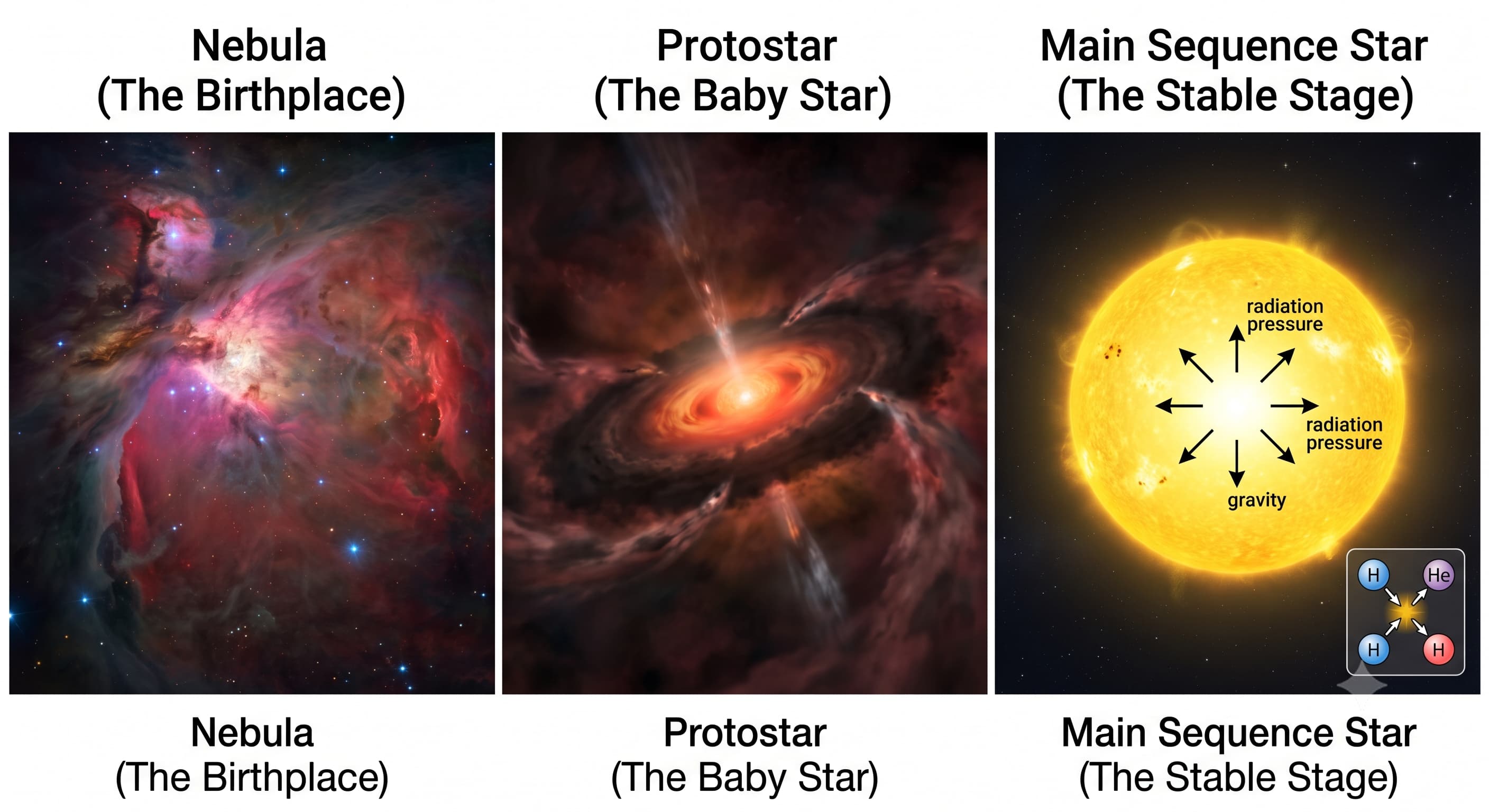
Just like a human life has stages — birth, youth, old age and death — stars also have different stages in their life.
In this post, we will study only the first three stages: nebula, protostar and main sequence star.
Easy Example: A school starts with a nursery class. In the same way, the life of a star starts inside a nebula.
2. What is a Star?
A star is a huge ball of very hot gas that produces its own light and heat.
The Sun is also a star. It looks bigger and brighter to us because it is the nearest star to Earth.
Star
A self-shining celestial body that produces light and heat from inside.
Plasma
A very hot state of matter where particles are highly energetic.
Gravity
The force that pulls matter together and helps in star formation.
Nuclear Fusion
The process by which hydrogen changes into helium and releases energy.
Common Mistake: Stars do not burn like wood or coal. Their energy comes from nuclear fusion, not from ordinary fire.
3. Nebula: Birthplace of Stars
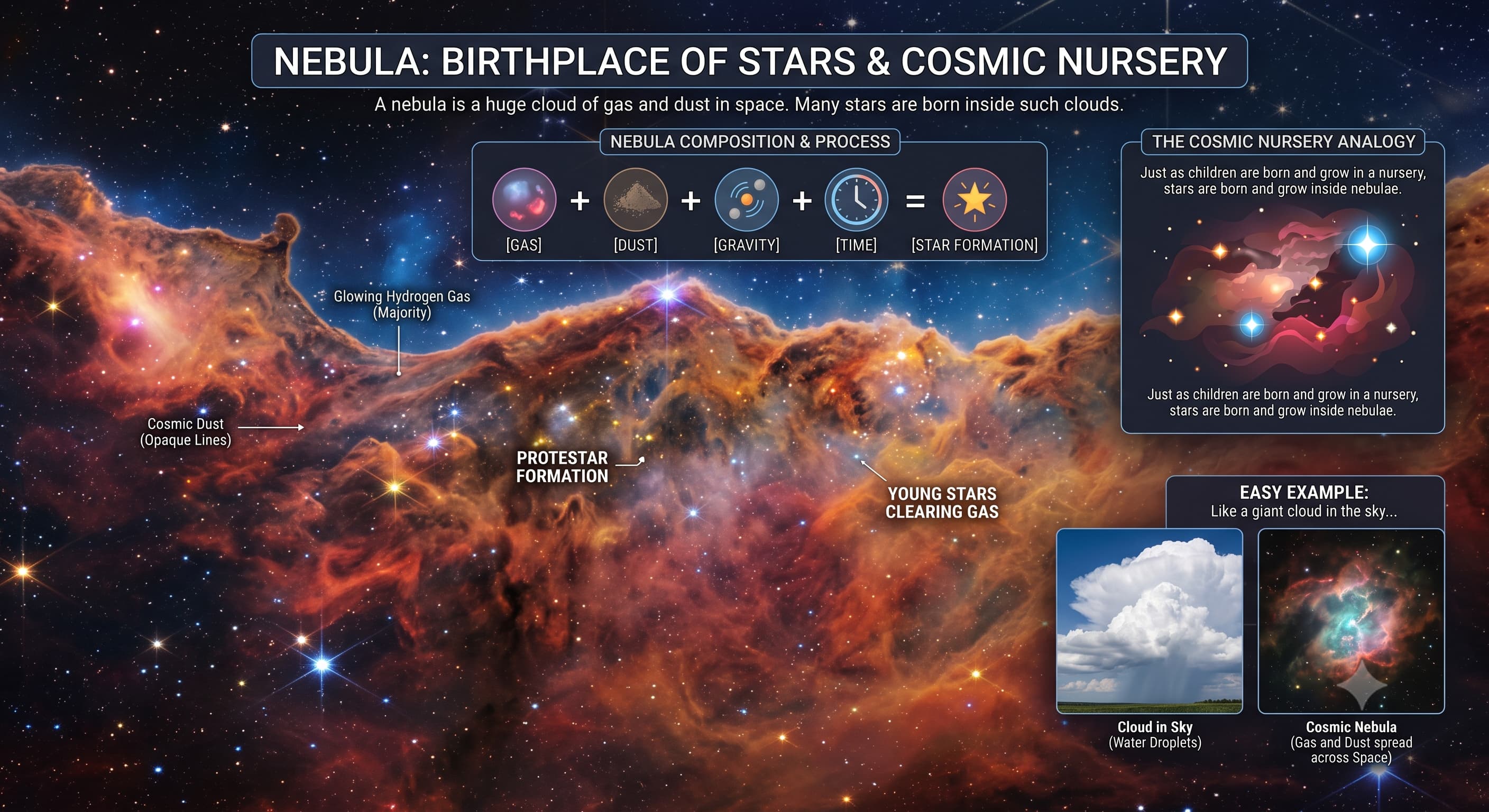
A nebula is a huge cloud of gas and dust in space. Many stars are born inside such clouds.
Most star-forming nebulae contain mainly hydrogen gas, some helium, and small amounts of dust and heavier elements.
A nebula is like a cosmic nursery. Just as children are born and grow in a nursery, stars are born and grow inside nebulae.
Easy Example: Think of a nebula like a giant cloud in the sky. But instead of water droplets, it contains gas and dust spread across space.
4. How Does Star Formation Start?
Star formation starts when some part of a nebula becomes denser than the surrounding region.
Due to gravity, gas and dust begin to pull together. As more matter collects at one place, the central region becomes hotter and denser.
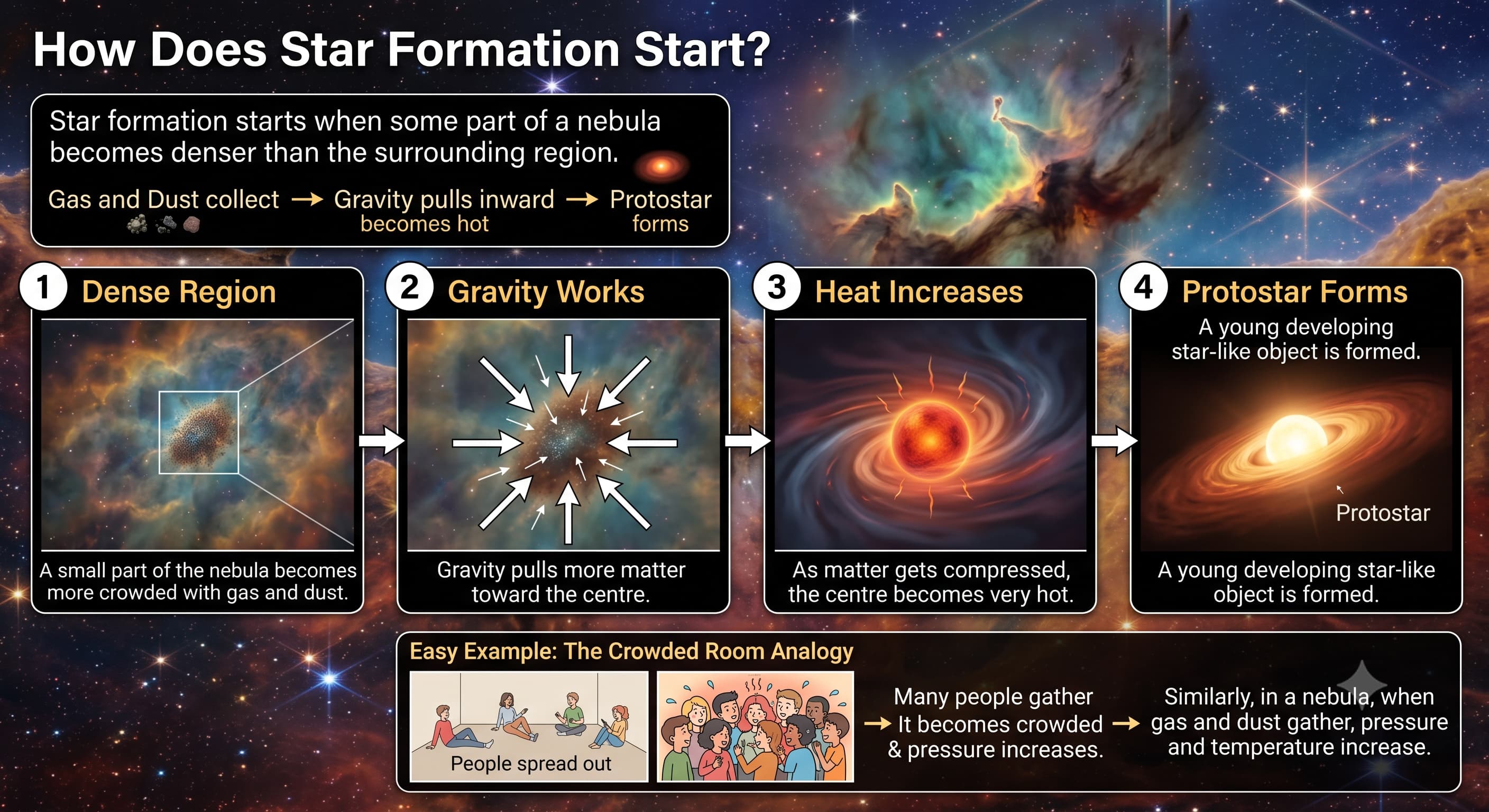
Step 1: Dense Region
A small part of the nebula becomes more crowded with gas and dust.
Step 2: Gravity Works
Gravity pulls more matter toward the centre.
Step 3: Heat Increases
As matter gets compressed, the centre becomes very hot.
Step 4: Protostar Forms
A young developing star-like object is formed.
Easy Example: When many people gather in one small place, it becomes crowded and pressure increases. In a nebula, when gas and dust gather at one place, pressure and temperature increase.
5. Protostar: A Baby Star
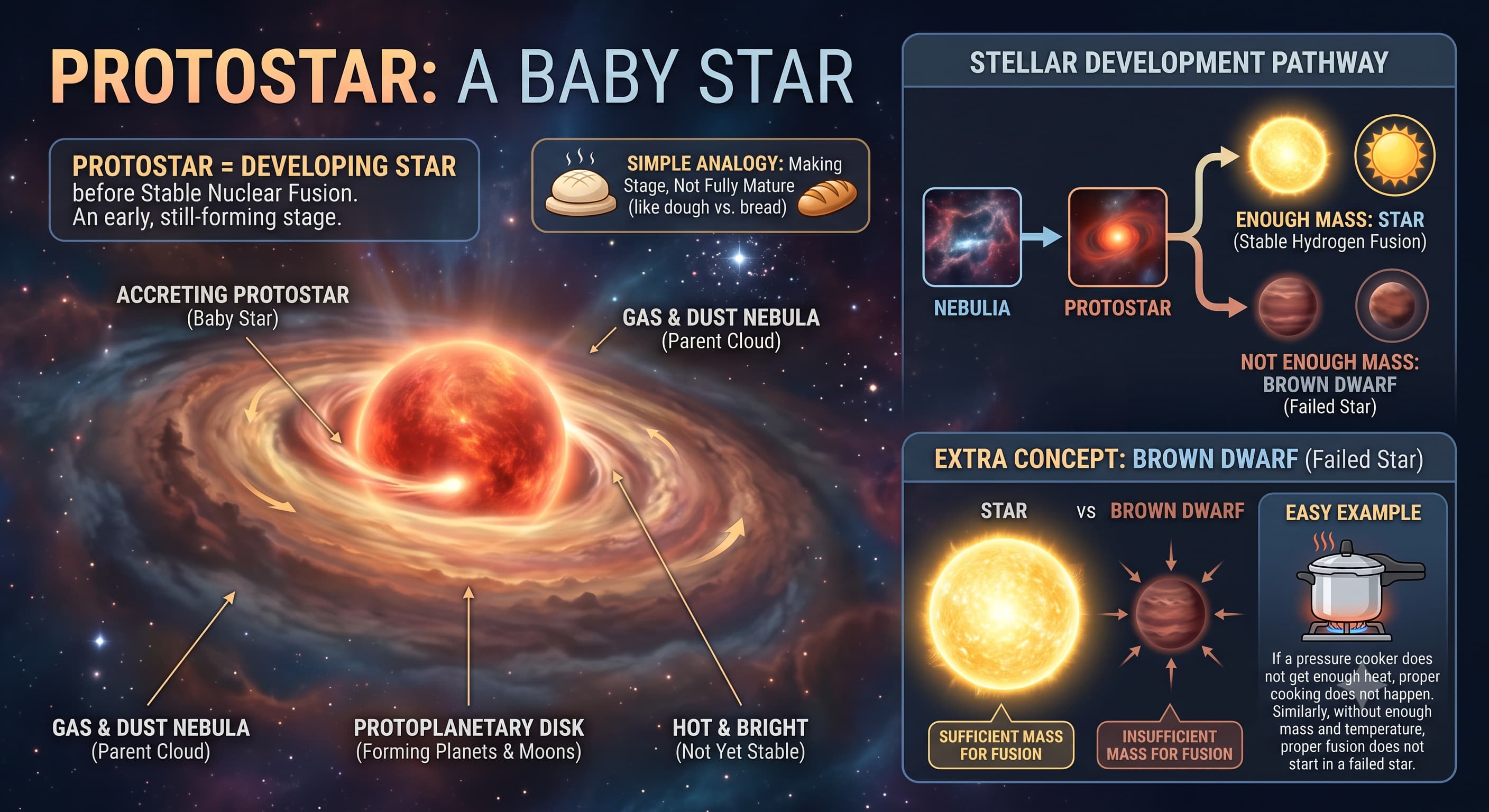
A protostar is an early stage of a star. It is like a baby star that is still forming.
A protostar is hot and bright, but it has not yet become a stable star because proper nuclear fusion has not fully started at its centre.
Around many protostars, gas and dust may form a rotating disk. Later, this disk can help form planets, moons and other small bodies.
Simple Understanding: A protostar is not a fully mature star. It is in the making stage, just like dough before it becomes a cooked bread.
Extra Concept: Brown Dwarf or Failed Star
Sometimes a protostar does not collect enough mass to start proper hydrogen fusion in its core. In that case, it cannot become a normal star.
Such an object is called a brown dwarf. It is often called a failed star because it forms like a star but does not shine like a normal main sequence star.
Easy Example: If a pressure cooker does not get enough heat, proper cooking does not happen. Similarly, if a protostar does not get enough mass and temperature, proper fusion does not start.
UPSC Point: Brown dwarfs are larger than most planets but smaller and cooler than normal stars. They are not true main sequence stars.
6. Nuclear Fusion: The Real Energy Source of Stars
When the centre of the protostar becomes extremely hot and dense, nuclear fusion begins.
In nuclear fusion, small hydrogen nuclei join together and form helium. During this process, a huge amount of energy is released.
This energy comes out as light and heat. This is why stars shine.
Easy Example: A bulb glows because electricity gives it energy. A star shines because nuclear fusion gives it energy from inside.
7. Main Sequence Star: The Stable Stage
When nuclear fusion becomes stable, the protostar becomes a main sequence star.
Most stars spend the longest part of their life in this stage. Our Sun is also a main sequence star.
In this stage, two forces remain balanced:
Gravity Pulls Inward
Gravity tries to pull the star’s matter toward the centre.
Fusion Pressure Pushes Outward
Energy from fusion pushes outward and stops the star from collapsing.
Simple Example: Imagine two teams pulling a rope from opposite sides with equal force. The rope stays balanced. In a star, gravity and fusion pressure balance each other.
8. Why Mass is Very Important
The future life of a star mainly depends on its mass. Mass means the amount of matter inside the star.
Small and medium stars live slowly and for a long time. Massive stars use their fuel very fast and have shorter lives.
Small or Sun-like Stars
They burn fuel slowly and can live for billions of years.
Massive Stars
They burn fuel quickly and usually have shorter but more dramatic lives.
Easy Example: A small candle burns slowly for a longer time, while a big fire burns strongly but may finish fuel faster. Similarly, massive stars use fuel very fast.
9. UPSC Relevance
For UPSC and State PCS, this topic is important because it builds the foundation for understanding the Sun, solar system, elements, supernovae and black holes.
Prelims: Basic concepts like nebula, star, fusion, main sequence and Sun as a star.
Science and Geography Link: Stars help us understand energy, matter and element formation.
Conceptual Clarity: The Sun is not a planet; it is a main sequence star.
Further Topics: This post prepares the base for H-R Diagram, life cycle of stars, supernovae and black holes.
Quick Revision
A star is a huge hot ball of gas that produces its own light and heat.
A nebula is a huge cloud of gas and dust where stars may form.
Gravity pulls gas and dust together inside a nebula.
A protostar is a baby star in the making stage.
Nuclear fusion begins when the centre becomes extremely hot and dense.
In fusion, hydrogen changes into helium and energy is released.
A main sequence star is a stable star where hydrogen fusion continues.
The mass of a star decides its future life cycle.
Our Sun is a main sequence star.
Think Like UPSC: Do not memorize star formation as isolated terms. Understand the flow: nebula gives material, gravity pulls matter, protostar forms, nuclear fusion starts, and a stable main sequence star is born.
तारे और उनका जन्म: नीहारिका, आदितारा और मुख्य अनुक्रम
तारे अचानक पैदा नहीं होते। किसी तारे का जीवन गैस और धूल के एक विशाल बादल के अंदर शुरू होता है, जिसे नीहारिका (Nebula) कहा जाता है।
सरल शब्दों में, तारा गैस का एक बहुत बड़ा, गर्म और चमकदार गोला होता है, जो नाभिकीय संलयन (Nuclear Fusion) के माध्यम से अपना प्रकाश और ऊष्मा स्वयं पैदा करता है।
1. मुख्य विचार: तारों की भी एक जीवन-कहानी होती है
जैसे मनुष्य के जीवन में जन्म, युवावस्था, वृद्धावस्था और मृत्यु जैसे चरण होते हैं, वैसे ही तारों के जीवन में भी अलग-अलग चरण होते हैं।
इस पोस्ट में हम केवल शुरुआती तीन चरणों को समझेंगे: नीहारिका (Nebula), आदितारा (Protostar) और मुख्य अनुक्रम तारा (Main Sequence Star)।
सरल उदाहरण: स्कूल की शुरुआत नर्सरी कक्षा से होती है। उसी तरह तारे का जीवन नीहारिका के अंदर शुरू होता है।
2. तारा क्या होता है?
तारा (Star) बहुत गर्म गैस का एक विशाल गोला होता है, जो अपना प्रकाश और ऊष्मा स्वयं पैदा करता है।
सूर्य भी एक तारा है। वह हमें बड़ा और अधिक चमकीला इसलिए दिखाई देता है क्योंकि वह पृथ्वी के सबसे निकट का तारा है।
तारा
ऐसा स्व-प्रकाशित खगोलीय पिंड, जो अपने अंदर से प्रकाश और ऊष्मा उत्पन्न करता है।
प्लाज़्मा
पदार्थ की अत्यधिक गर्म अवस्था, जिसमें कण बहुत अधिक ऊर्जा वाले होते हैं।
गुरुत्वाकर्षण
वह बल जो पदार्थ को अपनी ओर खींचता है और तारे बनने में सहायता करता है।
नाभिकीय संलयन
वह प्रक्रिया जिसमें हाइड्रोजन हीलियम में बदलती है और ऊर्जा मुक्त होती है।
सामान्य गलती: तारे लकड़ी या कोयले की तरह नहीं जलते। उनकी ऊर्जा नाभिकीय संलयन (Nuclear Fusion) से आती है, सामान्य आग से नहीं।
3. नीहारिका: तारों का जन्म-स्थान
नीहारिका (Nebula) अंतरिक्ष में गैस और धूल का एक विशाल बादल होती है। ऐसे ही बादलों के अंदर कई तारों का जन्म होता है।
अधिकांश तारा-निर्माण करने वाली नीहारिकाओं में मुख्य रूप से हाइड्रोजन गैस, कुछ हीलियम, और थोड़ी मात्रा में धूल तथा भारी तत्व होते हैं।
नीहारिका एक ब्रह्मांडीय शिशु-गृह (Cosmic Nursery) की तरह होती है। जैसे बच्चे नर्सरी में जन्म के बाद बढ़ते हैं, वैसे ही तारे नीहारिकाओं के अंदर जन्म लेते और विकसित होते हैं।
सरल उदाहरण: नीहारिका को आसमान के एक विशाल बादल की तरह समझिए। लेकिन इसमें पानी की बूंदें नहीं, बल्कि अंतरिक्ष में फैली गैस और धूल होती है।
4. तारा-निर्माण कैसे शुरू होता है?
तारा-निर्माण तब शुरू होता है, जब नीहारिका का कोई भाग आसपास के क्षेत्र की तुलना में अधिक घना हो जाता है।
गुरुत्वाकर्षण के कारण गैस और धूल एक साथ खिंचने लगते हैं। जैसे-जैसे अधिक पदार्थ एक स्थान पर जमा होता है, बीच वाला भाग अधिक गर्म और घना होता जाता है।
चरण 1: घना क्षेत्र
नीहारिका का एक छोटा भाग गैस और धूल से अधिक भरा हुआ हो जाता है।
चरण 2: गुरुत्वाकर्षण काम करता है
गुरुत्वाकर्षण अधिक पदार्थ को केंद्र की ओर खींचता है।
चरण 3: ऊष्मा बढ़ती है
पदार्थ के दबने और सघन होने से केंद्र बहुत गर्म हो जाता है।
चरण 4: आदितारा बनता है
एक युवा, विकसित हो रहा तारे जैसा पिंड बनता है।
सरल उदाहरण: जब बहुत से लोग एक छोटी जगह पर इकट्ठा होते हैं, तो भीड़ और दबाव बढ़ जाता है। इसी तरह नीहारिका में जब गैस और धूल एक जगह जमा होते हैं, तो दबाव और तापमान बढ़ते हैं।
5. आदितारा: एक शिशु तारा
आदितारा (Protostar) तारे के जीवन की शुरुआती अवस्था होती है। यह एक शिशु तारे जैसा होता है, जो अभी बन रहा होता है।
आदितारा गर्म और चमकीला होता है, लेकिन वह अभी स्थिर तारा नहीं बना होता, क्योंकि उसके केंद्र में ठीक से नाभिकीय संलयन पूरी तरह शुरू नहीं हुआ होता।
कई आदितारों के चारों ओर गैस और धूल की एक घूमती हुई चक्रिका (Rotating Disk) बन सकती है। बाद में यही चक्रिका ग्रहों, चंद्रमाओं और अन्य छोटे पिंडों के निर्माण में सहायता कर सकती है।
सरल समझ: आदितारा पूरी तरह विकसित तारा नहीं होता। वह बनने की अवस्था में होता है, जैसे आटा पककर रोटी बनने से पहले की अवस्था में होता है।
अतिरिक्त अवधारणा: भूरा बौना या असफल तारा
कभी-कभी कोई आदितारा अपने केंद्र में उचित हाइड्रोजन संलयन (Hydrogen Fusion) शुरू करने के लिए पर्याप्त द्रव्यमान इकट्ठा नहीं कर पाता। ऐसी स्थिति में वह सामान्य तारा नहीं बन पाता।
ऐसे पिंड को भूरा बौना (Brown Dwarf) कहा जाता है। इसे अक्सर असफल तारा (Failed Star) कहा जाता है, क्योंकि यह तारे की तरह बनता है लेकिन सामान्य मुख्य अनुक्रम तारे की तरह चमकता नहीं है।
सरल उदाहरण: यदि प्रेशर कुकर को पर्याप्त ऊष्मा न मिले, तो खाना ठीक से नहीं पकता। इसी तरह यदि आदितारा पर्याप्त द्रव्यमान और तापमान प्राप्त नहीं कर पाता, तो उचित संलयन शुरू नहीं होता।
UPSC Point: भूरे बौने अधिकांश ग्रहों से बड़े होते हैं, लेकिन सामान्य तारों से छोटे और ठंडे होते हैं। वे वास्तविक मुख्य अनुक्रम तारे नहीं होते।
6. नाभिकीय संलयन: तारों की वास्तविक ऊर्जा का स्रोत
जब आदितारे का केंद्र अत्यधिक गर्म और घना हो जाता है, तब नाभिकीय संलयन (Nuclear Fusion) शुरू होता है।
नाभिकीय संलयन में छोटे हाइड्रोजन नाभिक आपस में मिलकर हीलियम बनाते हैं। इस प्रक्रिया में बहुत बड़ी मात्रा में ऊर्जा मुक्त होती है।
यही ऊर्जा प्रकाश और ऊष्मा के रूप में बाहर आती है। इसी कारण तारे चमकते हैं।
सरल उदाहरण: बल्ब बिजली की ऊर्जा से चमकता है। तारा अपने अंदर होने वाले नाभिकीय संलयन की ऊर्जा से चमकता है।
7. मुख्य अनुक्रम तारा: स्थिर अवस्था
जब नाभिकीय संलयन स्थिर हो जाता है, तब आदितारा मुख्य अनुक्रम तारा (Main Sequence Star) बन जाता है।
अधिकांश तारे अपने जीवन का सबसे लंबा समय इसी अवस्था में बिताते हैं। हमारा सूर्य भी एक मुख्य अनुक्रम तारा है।
इस अवस्था में दो बल संतुलन में रहते हैं:
गुरुत्वाकर्षण अंदर की ओर खींचता है
गुरुत्वाकर्षण तारे के पदार्थ को केंद्र की ओर खींचने की कोशिश करता है।
संलयन दाब बाहर की ओर धकेलता है
संलयन से मिली ऊर्जा बाहर की ओर दबाव बनाती है और तारे को ढहने से रोकती है।
सरल उदाहरण: कल्पना कीजिए कि दो टीमें रस्सी को विपरीत दिशाओं में बराबर बल से खींच रही हैं। रस्सी संतुलित रहती है। तारे में गुरुत्वाकर्षण और संलयन दाब इसी तरह संतुलन बनाए रखते हैं।
8. द्रव्यमान बहुत महत्वपूर्ण क्यों है?
किसी तारे का भविष्य मुख्य रूप से उसके द्रव्यमान (Mass) पर निर्भर करता है। द्रव्यमान का अर्थ है — तारे के अंदर पदार्थ की मात्रा।
छोटे और मध्यम आकार के तारे धीरे-धीरे अपना ईंधन खर्च करते हैं और लंबे समय तक जीवित रहते हैं। विशाल तारे अपना ईंधन बहुत तेज़ी से खर्च करते हैं और उनका जीवन सामान्यतः छोटा लेकिन अधिक नाटकीय होता है।
छोटे या सूर्य जैसे तारे
ये अपना ईंधन धीरे-धीरे खर्च करते हैं और अरबों वर्षों तक जीवित रह सकते हैं।
विशाल तारे
ये अपना ईंधन तेजी से खर्च करते हैं और सामान्यतः उनका जीवन छोटा लेकिन अधिक नाटकीय होता है।
सरल उदाहरण: छोटी मोमबत्ती धीरे-धीरे जलती है और लंबे समय तक चल सकती है, जबकि बड़ी आग बहुत तेज़ जलती है लेकिन अपना ईंधन जल्दी समाप्त कर सकती है। इसी तरह विशाल तारे अपना ईंधन बहुत तेजी से खर्च करते हैं।
9. UPSC के लिए महत्व
UPSC और State PCS के लिए यह विषय महत्वपूर्ण है, क्योंकि यह सूर्य, सौरमंडल, तत्वों, सुपरनोवा और ब्लैक होल को समझने की आधारभूमि तैयार करता है।
Prelims: नीहारिका, तारा, संलयन, मुख्य अनुक्रम और सूर्य के तारा होने जैसी मूल अवधारणाएँ।
विज्ञान और भूगोल का संबंध: तारे हमें ऊर्जा, पदार्थ और तत्व निर्माण को समझने में सहायता करते हैं।
अवधारणात्मक स्पष्टता: सूर्य ग्रह नहीं है; वह एक मुख्य अनुक्रम तारा है।
आगे के विषय: यह पोस्ट H-R Diagram, तारों के जीवन-चक्र, सुपरनोवा और ब्लैक होल के लिए आधार तैयार करती है।
त्वरित पुनरावृत्ति
तारा बहुत गर्म गैस का विशाल गोला होता है, जो अपना प्रकाश और ऊष्मा स्वयं पैदा करता है।
नीहारिका गैस और धूल का विशाल बादल होती है, जहाँ तारों का निर्माण हो सकता है।
गुरुत्वाकर्षण नीहारिका के अंदर गैस और धूल को एक साथ खींचता है।
आदितारा बनने की अवस्था में एक शिशु तारा होता है।
केंद्र के अत्यधिक गर्म और घना होने पर नाभिकीय संलयन शुरू होता है।
संलयन में हाइड्रोजन हीलियम में बदलती है और ऊर्जा मुक्त होती है।
मुख्य अनुक्रम तारा वह स्थिर तारा है, जिसमें हाइड्रोजन संलयन चलता रहता है।
तारे का द्रव्यमान उसके भविष्य के जीवन-चक्र को तय करता है।
हमारा सूर्य एक मुख्य अनुक्रम तारा है।
Think Like UPSC: तारा-निर्माण को अलग-अलग शब्दों के रूप में याद न करें। पूरा क्रम समझें: नीहारिका पदार्थ देती है, गुरुत्वाकर्षण पदार्थ को खींचता है, आदितारा बनता है, नाभिकीय संलयन शुरू होता है और एक स्थिर मुख्य अनुक्रम तारे का जन्म होता है।