COGNITOIAS | History • Life • Ideas
Mahatma Gandhi
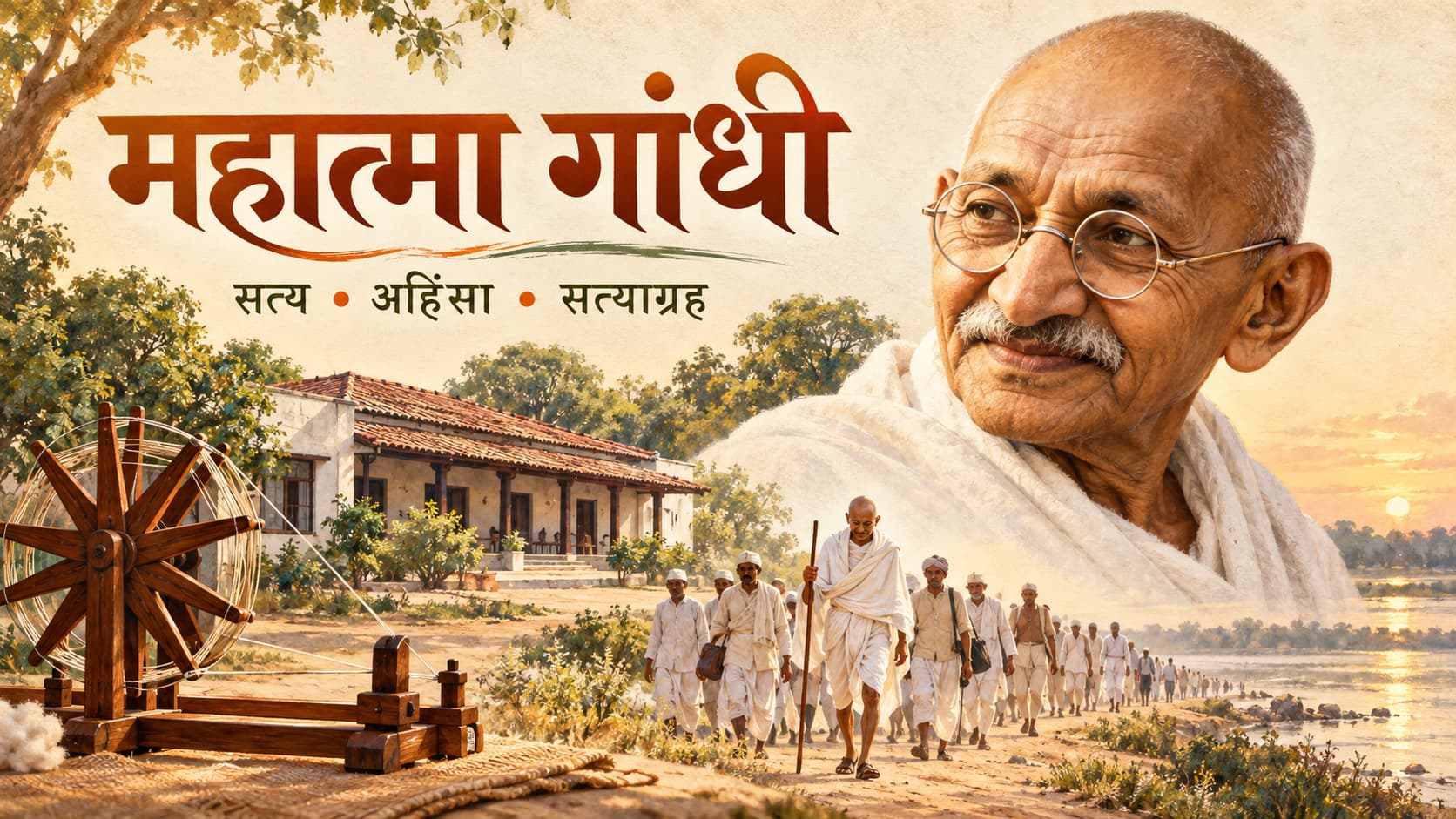
1869–1948: The Journey from Mohandas to Mahatma
Year-by-year life • Family and education • South Africa • National movement • Associates • Books • Ashrams • Ideas
How did a shy student become a lawyer, stand up against injustice and emerge as a leading figure in India's mass movements? Read each year through five connections: the problem, experience, method, associates and outcome.
These are detailed study notes on major events. Memories from the autobiography for which a definite year is unavailable are presented separately. Uncertain claims are not presented as established events.
Use the colours as you read:
Dates and numbers • People and mentors • Institutions, books and movements • Ideas and principles • Essential distinctions and cautions
Reading order
03. 1888–1892: London Changed His Thinking; India Put Him to the Test
04. 1893–1905: From Humiliation to Organisation in South Africa
06. 1915–1919: He First Understood India; India Then Recognised Him
07. 1920–1929: Mass Leadership, Prison and Constructive Work
11. From Events to Ideas: Understand Gandhi in Simple Language
13. Ashrams, Institutions and Returns to India: In One Place
14. Major Books: Original Works, Adaptations and Compilations
01. First, Know the Family
Father: Karamchand Uttamchand Gandhi, known as Kaba Gandhi. He served as diwan in the princely states of Kathiawar, including Porbandar and Rajkot. Gandhi remembered his courage, impartiality and devotion to his family. Died: 1885.
Mother: Putlibai, Karamchand's fourth wife. Her religious discipline, fasting and service deeply influenced Mohandas. She had died before Gandhi returned to India in 1891.
Full siblings: Elder brothers Lakshmidas and Karsandas; elder sister Raliyatbehn. Mohandas was the youngest of these four full siblings. His father also had two daughters from earlier marriages. Lakshmidas provided financial support for his overseas studies and early life.
Wife: Kasturba Gandhi, born on 11 April 1869; her father was Gokuldas Makanji Kapadia. They married in 1883. She later actively participated in running the ashrams, satyagraha in South Africa and movements in India. Remembering her only as Gandhi's wife would be incomplete.
Four sons: Harilal (1888), Manilal (1892), Ramdas (1897) and Devdas (1900). Their first baby, born in 1885, died within a few days; the usual reference to four sons therefore means the four who survived.
Notable aspects of the sons' lives: Relations with Harilal were strained over education and life choices. Manilal continued Indian Opinion and public work in South Africa. Ramdas participated in the movements. Devdas worked in journalism and was associated with Hindustan Times. Gandhi's own life involved difficult questions about public service and fatherhood.
02. 1869–1887: An Ordinary Boy's Extraordinary Lessons
A Clear Educational Sequence: School, College and Legal Studies
Porbandar: Early studies at a local primary school. The available autobiography does not give a definite institutional name; a modern name has not been added by guesswork.
Rajkot: Early classes at a branch of Taluka School, followed by the third and fourth Gujarati classes at City Taluka School. Records of his student life describe this stage.
Rajkot: Alfred High School / Kathiawar High School. The detailed school reference records admission on 1 December 1880; matriculation completed in 1887. Do not treat the names as three separate schools.
Bhavnagar: Samaldas College / Samaldas College. Studies began in January 1888; he left after approximately one term. Lectures in English were difficult to understand. He did not complete a college degree.
London: Registration and legal studies at University College London (UCL) during 1888–89. Studying at UCL and obtaining a complete university degree there are different claims.
London: Admitted to Inner Temple on 6 November 1888. It was one of the Inns of Court, a professional institution for becoming a barrister, rather than an ordinary college.
London matriculation: Unsuccessful at the first attempt in December 1889; passed in June 1890. Called to the Bar on 10 June 1891; enrolled in the High Court on 11 June.
Remember: School — Rajkot; college — Bhavnagar; law — London. Matriculation in 1887 and Samaldas College in 1888 were separate stages.
References: Detailed school account and admission year • Samaldas College: January 1888 • UCL's own registration reference • Taluka School: Archival account of student life
1869 Birth in Porbandar
Mohandas Karamchand Gandhi was born on 2 October in Porbandar, Kathiawar, in present-day Gujarat. Vaishnava religious life at home and the surrounding Jain traditions of non-violence and restraint influenced him.
1870 Infancy
Early childhood under the family's care; no separate major event is recorded in the available brief chronologies.
1871 Infancy
The available major chronologies do not identify a separate decisive event for this year.
1872 Early Childhood
A period within Porbandar's family environment; no separate year-specific event is identified.
1873 Early Childhood
No separate significant year-specific event is recorded in the available major chronologies.
1874 Early Childhood
Childhood continued; no separate decisive event is identified for this year.
1875 Childhood in Porbandar
Gandhi's early education was associated with Porbandar; the major brief chronologies do not provide precise year-by-year details for every stage.
1876 Towards Rajkot
The family moved to Rajkot. Primary education continued there. Much of his childhood was now spent in Rajkot.
He was engaged to Kasturba during childhood; they married in 1883. The engagement and marriage dates are different.
1877 School and Shyness
A period of early schooling in Rajkot. The autobiography describes Mohandas throughout this childhood phase as a shy boy who returned straight home from school.
1878 A Period of Study
Primary education continued; no separate major year-specific event is identified.
1879 A Period of Study
School life continued in Rajkot; no separate decisive event is identified in the available brief chronologies.
1880 The Stage of High School Admission
The Gandhi Heritage Portal's school account records admission to Alfred High School, Rajkot, on 1 December 1880. General brief chronologies often give 1881. The detailed school reference is distinguished here.
1881 High School Studies and a Test of Truth
He studied at Alfred High School in Rajkot, also known as Kathiawar High School. In an inspection test during his early high school years, he misspelt the English word kettle. He did not copy from his neighbour despite the teacher's prompting. The lesson: accept a wrong answer rather than obtain a correct one through dishonesty.
The inspecting officer was named Giles. The teacher wanted the word written correctly, but Mohandas did not copy from another student's slate.
1882 Student Life
High school studies continued. Major chronologies do not identify a separate decisive event for this year.
1883 Marriage at Thirteen
He married Kasturba as a child. Gandhi later criticised child marriage. In their early married life, he was also a possessive and jealous husband; he acknowledges his shortcomings in the autobiography. Marriage disrupted his studies.
1884 Adolescent Experiments
Around 1884–85, influenced by his friend Sheikh Mehtab, he secretly experimented with eating meat. The argument was that it would give him strength like the English. He eventually stopped because deceiving his parents caused him distress. Here we see the future Gandhi's central struggle: choosing between desire and truth.
The autobiography also mentions adolescent smoking, stealing small amounts of money and an abandoned idea of suicide using datura seeds. Understand these as frank admissions of mistakes rather than adventurous ideals; a definite year is unavailable for every episode.
1885 His Father's Death
His father Karamchand died. Mohandas cared for him during his illness, but regretted throughout his life that he had not been present at the final moment. Their first baby, born around this time, died within a few days. Gandhi connected these memories with questions of restraint and duty.
1886 Studies Continue
High school studies continued after his father's death. There was no separate major political or public event.
1887 Passing Matriculation
He passed the matriculation examination in Ahmedabad. This was the year he completed studies at Alfred/Kathiawar High School, Rajkot. The next stage, college, began in Bhavnagar in January 1888.
Childhood Episodes That Should Not Be Assigned a Definite Year
Shravana's devotion to his parents offered an ideal of parental service. A play about King Harishchandra inspired him to hold to truth even in adversity. His nurse Rambha suggested taking refuge in the name of Rama to overcome fear. He confessed in a letter to his father that he had stolen gold from his brother's armlet; he regarded his father's silent tears as a lesson in love and non-violence. Conversations at home among people of different religions introduced him to religious tolerance.
Important Teachers and Early Mentors
Dorabji Edalji Gimi: High school headmaster who emphasised discipline and exercise. Krishnashankar Pandya: Sanskrit teacher who encouraged him instead of letting him abandon the subject. Mavji Dave: Family adviser who suggested studying law in England. Becharji Swami: Helped secure the vows that reassured his mother before he went to England.
03. 1888–1892: London Changed His Thinking; India Put Him to the Test
1888 Studies Across the Sea
His son Harilal was born. After promising his mother to avoid meat, alcohol and immoral relationships, he left for England on 4 September. He began training as a barrister at Inner Temple, London. It was a major decision amid caste opposition and the family's financial difficulties.
Mavji Dave had advised legal studies; Lakshmidas helped arrange funds. The caste council excommunicated him for crossing the sea. Tryambakray Majmudar accompanied him on the journey. In London, Dr Pranjivan Mehta helped him understand manners and everyday living.
He entered Samaldas College, Bhavnagar, in January. He studied for approximately one term and left. Professional training at Inner Temple began in November; UCL studies were also undertaken in 1888–89.
1889 From Becoming an English Gentleman to Simplicity
His initial fascination with fine clothing, dancing, the violin and elocution gradually faded. He reduced expenses, walked and adopted simple living. Henry Salt's A Plea for Vegetarianism made vegetarianism a considered choice rather than merely a promise to his mother. During his London stay, he read the Gita, Edwin Arnold's The Song Celestial and The Light of Asia with Theosophist friends; the Bible's Sermon on the Mount also influenced him. The precise dates of all these religious encounters are uncertain.
Finding a London restaurant while searching for vegetarian food proved decisive. He began valuing study and self-restraint above fashionable display. Reading religious texts was an effort to understand his own and other beliefs, rather than an immediate conversion to another religion.
1890 Learning Organisation Through Vegetarianism
He passed the London Matriculation examination. He joined the London Vegetarian Society; meetings, friendships and discussions gave him experience of public life. Contacts such as Dr Josiah Oldfield arose in this environment. Even while adapting to English life, he learnt to examine his own beliefs.
By joining the vegetarian society's executive committee, he learnt how an organisation worked. He remained hesitant to speak at meetings; writing became a convenient way to express his ideas.
Latin had caused difficulty in the first London matriculation attempt; he succeeded in the second. This was separate from the barrister's examination.
1891 A Barrister, but Lacking Confidence
Called to the Bar on 10 June, he returned to India. He learnt of his mother's death after returning. He met Raychandbhai, also known as Shrimad Rajchandra, who later became an important guide on self-knowledge and religious questions. Writing for London's The Vegetarian was an early stage of his journalistic practice.
He began the sea voyage back to India in June and reached Bombay in July. Being a barrister and knowing the practical procedures of Indian courts were different matters.
1892 A Difficult Start in Legal Practice
In Bombay, he lacked confidence in speaking in court and became nervous in an early case. He began preparing petitions and legal documents in Rajkot. The lesson: he had qualified as a barrister, but his journey towards effective public speaking still lay ahead. Three lasting intellectual influences: Gandhi drew inspiration for introspection from Raychandbhai, moral resistance from Tolstoy, and labour and collective welfare from Ruskin. Remember these influences in their respective stages of his life.
While cross-examining in Mamibai's small case in Bombay, he became nervous and returned his fee. He drafted petitions in Rajkot. Pleading his brother's case before the English official Charles Olivant was humiliating. It exposed another side of influence-seeking and colonial authority. His son Manilal was born.
04. 1893–1905: From Humiliation to Organisation in South Africa
1893 A Night That Changed His Direction
He went to South Africa for a case involving Dada Abdulla's trading firm. On 7 June, despite holding a first-class ticket, he was removed from the train at Pietermaritzburg station. He also suffered humiliation and assault in a stagecoach; a dispute over his turban arose in the Durban court. He organised Indians in Pretoria. Arranging a settlement in the case taught him that a good lawyer could also resolve disputes.
He had obtained approximately a year's work explaining documents in a commercial dispute between Dada Abdulla and his relative Tayeb Haji Khan Muhammad. After landing in Durban, he resisted a demand to remove his turban in court. Following the railway incident, he resisted demands to sit outside and on the footboard of the stagecoach from Charlestown; he was assaulted. He also experienced racial discrimination at hotels.
He called a meeting of Indians at Tayeb Haji Khan Muhammad's premises in Pretoria. He stressed honesty in trade, cleanliness, unity and learning English. He discussed religion with the lawyer A. W. Baker and Christian friends; correspondence with Raychandbhai helped him understand his own religion. Arbitration and payment in instalments provided a way to resolve the case while avoiding bankruptcy and bitterness.
1894 Return Postponed, a Leader Emerges
He was about to return after completing his work, but stayed to oppose attempts to deprive Indians of voting rights. The Natal Indian Congress was formed on 22 August. Petitions, the press and organisation were the initial means of struggle. He was admitted to practise in Natal's Supreme Court. Tolstoy's The Kingdom of God Is Within You influenced his ethical thinking.
A short newspaper report at his farewell gathering alerted him to the Franchise Bill. He postponed his return to India and prepared petitions; a representation bearing approximately ten thousand signatures was sent to British authorities. The struggle did not immediately end legal discrimination, but brought the Indian question into public discussion.
Abdulla Haji Adam became president of the Natal Indian Congress and Gandhi its honorary secretary. Its early base consisted mainly of traders and prosperous Indians; wider contact with poor indentured workers developed later. Systematic membership, subscriptions, meetings and accounts strengthened the organisation.
1895 From Traders to Workers
He helped an abused indentured worker named Balasundaram, increasing direct contact with indentured labourers' problems. He opposed the annual three-pound tax on former indentured Indians and other discrimination. He published The Indian Franchise: An Appeal to Every Briton in South Africa.
Balasundaram had been beaten by his employer and his teeth were broken. With medical evidence and legal assistance, Gandhi arranged the transfer of his indenture to another employer. Workers felt they could take their grievances to Gandhi.
Indentured labourer = a worker brought under a contract for a fixed period. The £3 annual tax imposed economic pressure on Indians who chose independent life after completing their contracts. A £25 tax had initially been proposed; even £3 was a heavy burden. The struggle to abolish it continued until 1914; the issue was not resolved in 1895 alone. Conversations with religious friends such as Spencer Walton continued.
1896 An Interim Visit to India
He raised the problems of South African Indians in India. He published the Green Pamphlet in Rajkot. He gathered public support in Bombay, Poona, Madras and Calcutta, meeting leaders such as Pherozeshah Mehta, Tilak and Gokhale. He also participated in sanitation work in Rajkot. At the year's end, he left for South Africa with his wife and children.
The Green Pamphlet aimed to inform people about injustice against Indians in South Africa. He sought support from Pherozeshah Mehta, Bal Gangadhar Tilak, Gokhale and Bhandarkar. Gandhi later described Mehta as the Himalayas, Tilak as the ocean and Gokhale as the Ganges—an account of their personal impact on him.
Facing the threat of plague in Rajkot, he joined a sanitation committee and inspected household latrines. Experiences in poor settlements challenged the assumption that wealth automatically meant cleanliness. A brief Reuters report was interpreted provocatively in South Africa. He returned aboard the Courland with his family and nephew Gokuldas; another ship, the Naderi, also carried Indian passengers.
1897 A Mob Attack and Refusal to Prosecute
A white mob attacked him on landing in Durban in January. Mrs Alexander, a police officer's wife, helped protect him. Gandhi refused to prosecute the attackers. His son Ramdas was born. The family began living alongside his public work in South Africa.
Passengers were prevented from landing on the pretext of plague. The 23-day period was counted from departure from Bombay; do not interpret it as an additional full 23-day stay in the harbour. On 13 January, a mob attacked him when he disembarked and walked with the lawyer Laughton.
Mrs Alexander shielded him with her umbrella. He reached Parsi Rustomji's house, but the mob surrounded it. On police advice, he escaped safely disguised as an Indian policeman. Colonial Secretary Chamberlain wanted action; Gandhi rejected personal revenge. This did not immediately make all whites supporters, but his conduct attracted attention.
1898 The Legal Struggle for Rights
Legal and public efforts continued against restrictions on Indians' trading licences and on living and trading in designated settlements. Complaints reached the Indian National Congress and British officials. This was not yet the phase of collective satyagraha.
He opposed discriminatory licensing of Indian traders under laws such as the Dealers’ Licenses Act. Alongside a successful legal practice, he also met the costs of public service. He emphasised transparent subscription accounts and the use of institutional property in the Natal Congress.
Racial barriers affected the children's education. Experiments in self-reliance, including home education, washing and ironing his own clothes and cutting his own hair, developed during this South African period; it is incorrect to assign all these experiments solely to 1898.
1899 Service in the Boer War
He organised the Indian Ambulance Corps for the British side. At that time, he believed that fulfilling civic duties within the British Empire could strengthen Indians' claim to equal rights. This loyalty to the Empire later changed substantially.
The Boer War was fought between Britain and the Boer republics. Gandhi assembled a medical support corps of approximately 1,100 Indians. Dr Booth helped with training. Indians carried the wounded on stretchers; this was not an armed combat unit.
His argument at the time was that those seeking rights from the Empire should serve it in a crisis. This early imperial loyalty must be understood in a different period from Gandhi's later commitment to complete independence.
1900 Care for the Wounded and Family Life
Ambulance service continued in the Boer War; he helped carry wounded soldiers in the Spion Kop area. His son Devdas was born. His faith in service, health and self-reliance grew stronger.
During the Battle of Spion Kop in January, they carried wounded men over difficult distances. Gandhi and some leaders of the corps received the Queen’s South Africa Medal; do not confuse it with the Kaiser-i-Hind medal of 1915. Devdas was born on 22 May.
1901 Towards India Again
He returned to India with his family, promising to return to South Africa if needed. He decided to reserve valuable farewell gifts for public use rather than make them personal property. Seeing sanitation problems at the Congress camp, he cleaned it himself. Raychandbhai's death deeply saddened him.
Kasturba naturally disagreed over the farewell jewellery and valuable gifts. Gandhi decided to place them in a trust for public benefit. The episode raised questions about family needs and a public servant's property.
Dinshaw Wacha presided over the Calcutta session in December. Gandhi moved a resolution on South African Indians, supported by Gokhale. He worked as a clerk for Bhupendranath Ghosal in the Congress office. Do not describe this as becoming Gokhale's private secretary.
1902 Understanding India, Then a Summons
Living with Gokhale helped him understand Indian public life. Travelling third class exposed ordinary passengers' hardships; he also visited Rangoon. Just as he was establishing a Bombay practice, he was summoned from South Africa. He reached there again at the year's end; this Indian stay did not become a permanent return.
His approximately month-long stay with Gokhale and third-class journeys belong mainly to this year, after the Congress session. Visits to Benares, Rangoon and other places revealed religious life, filth and ordinary travellers' difficulties. He attempted legal practice in Rajkot and then Bombay.
News of Chamberlain's South African visit prompted the Indian community to remind him of his promise. Gandhi left his growing Indian practice and returned. Understand his South African stays in three stages: 1893–96, 1897–1901 and 1902–14; the 1902 return was not merely the second stage.
1903 A Newspaper Alongside the Law
The British Indian Association strengthened organisation. Indian Opinion's first issue appeared on 4 June. Madanjit handled practical publishing arrangements and Mansukhlal Nazar was the early editor; Gandhi became a central source of its direction, writing and financial support.
Work expanded beyond Natal to Transvaal issues. Experiences such as his exclusion from a delegation in Pretoria revealed discrimination. He represented Indians through legal practice in Johannesburg and the British Indian Association.
Indian Opinion began in Durban, initially with English, Gujarati, Hindi and Tamil sections. Financial difficulties later closed the Hindi and Tamil sections. Do not regard it as a paper edited by Gandhi alone in every language. His study and regular recollection of the Gita deepened in Johannesburg. Experiments in nature cure influenced by Adolf Just's Return to Nature began around this time, rather than only in 1905.
1904 A Book Leads to an Experiment in Living
He served plague victims in Johannesburg. Henry Polak gave him Ruskin's Unto This Last to read. Its lesson: individual welfare lies in everyone's welfare, and all honest labour deserves respect. He established Phoenix Settlement near Durban; farming, labour, simplicity and printing Indian Opinion became part of community life. Albert West, Chhaganlal and Maganlal Gandhi became important associates.
Pneumonic plague spread in Johannesburg's Indian settlement. Madanjit sheltered the sick; Dr William Godfrey, Gandhi and colleagues served them. Helping patients strengthened the emphasis on cleanliness and community responsibility.
Three lessons from Ruskin: Our welfare lies in the welfare of all; a lawyer and a barber have an equal right to earn a livelihood through their labour; a life of work involving farming and handicrafts is valuable. This means equal human dignity of labour, rather than a claim that market wages for all jobs were already equal.
Phoenix was established on approximately 100 acres near Durban. Indian Opinion's printing moved there. Farming, collective work and living on a limited income were practised. Do not confuse it with an Indian ashram or a settlement solely for former prisoners.
1905 Practising Shared Living
He carried forward Phoenix's work and public responsibilities in Johannesburg. Henry Polak became a close associate; Millie Polak also joined the family-like social environment. He lectured on religions and wrote on Indian rights and relief work in India. That year he also criticised India's salt tax in Indian Opinion—salt was on his mind long before Dandi.
Indian Opinion discussed the partition of Bengal and the Swadeshi movement. Events in Russia and workers' resistance prompted reflection on organised non-cooperation. His 8 July article on the salt tax reminds us that the issue of 1930 entered his thinking much earlier.
Henry and Millie Polak's marriage and close family contact became part of shared living. Experiments with simple food, grinding grain, doing one's own cleaning and health developed. Comparative study of religions continued.
05. 1906–1914: The Laboratory of Satyagraha
1906 A Collective Pledge Not to Accept Injustice
During suppression of the Zulu rebellion, he served the wounded with an Indian stretcher-bearer corps. The brutality of war affected him. He took a lifelong vow of brahmacharya. On 11 September, a meeting at Johannesburg's Empire Theatre opposed the discriminatory Asiatic registration proposal. They would bear punishment but refuse an unjust law—a decisive early moment in South African satyagraha. Indian leaders such as Haji Habib and Abdul Gani played important roles.
During the Zulu suppression, the medical support corps also served wounded Zulus. Witnessing British repression deepened his questions about service, war and non-violence. Afterwards, he took the brahmacharya vow with Kasturba's knowledge.
The August Asiatic Ordinance contained humiliating rules requiring registration, fingerprints and police checks for Asians over eight years of age. At the Empire Theatre meeting on 11 September, Haji Habib and community leaders pledged resistance. This was a decisive early stage of satyagraha; its final name emerged later.
He travelled to London with H. O. Ali and presented the issue to Colonial Secretary Lord Elgin. The proposal's failure to receive immediate royal assent brought relief; a new law followed the next year after Transvaal obtained self-government.
1907 Resistance to the Black Act
He opposed compulsory registration and fingerprinting under Transvaal's Asiatic Registration Act. Peaceful resistance at registration offices and arrests followed. The struggle targeted an unjust rule; hatred of opponents was not its ideal.
Transvaal introduced the Asiatic Registration Act. Indians opposed compulsory registration through peaceful persuasion and picketing at registration offices. Acceptance of the risk of imprisonment and punishment became a defining feature of the movement.
In a naming competition, Maganlal proposed Sadagraha, meaning firmness in a good cause; Gandhi changed it to Satyagraha. Its distinction from Passive Resistance: an active force of truth and non-violence, rather than merely political weakness or a temporary expedient. Read the name's development in the context of 1907–08.
1908 Prison, Compromise and Renewed Resistance
His first imprisonment came in January. Following an understanding with General Jan Smuts, he accepted voluntary registration, but repeal of the law remained unresolved. Mir Alam attacked him; Gandhi did not seek prosecution. He refined Maganlal's Sadagraha into Satyagraha in Indian Opinion's naming competition. His Gujarati adaptation of Ruskin's ideas, Sarvodaya, also appeared that year.
On 10 January, he was imprisoned for the first time and sentenced to two months. On 30 January, he accepted voluntary registration on the basis of an understanding with Smuts, but trust broke down over repeal of the old law. He distinguished a voluntary act from a humiliating compulsory law.
Mir Alam attacked him on 10 February; Reverend Joseph Doke cared for him. Gandhi did not demand punishment of his attackers. On 16 August, registration certificates were burnt near Johannesburg's Hamidia Mosque. He was imprisoned again with hard labour in October.
Sarvodaya, the Gujarati adaptation of Ruskin's ideas, was published. Family members, including Harilal, joined the struggle. Satyagraha had moved beyond leaders' speeches to questions of imprisonment, livelihood and family hardship.
1909 Writing Hind Swaraj
Imprisoned again, he went to London to present the Indians' case. Correspondence with Tolstoy began. On his return voyage aboard the Kildonan Castle, he wrote Hind Swaraj in Gujarati in November. The question was not simply removing the British: What civilisation, methods and swaraj were desirable? An English version followed the next year.
He received another prison sentence in February. That year, he travelled to London with Haji Habib to raise the case of South African Indians; Lord Ampthill was a supportive ally. He debated revolutionary nationalism with Indian youths. Madan Lal Dhingra's assassination of Curzon Wyllie intensified debate over violence and freedom.
Understand his ideological disagreement with Vinayak Savarkar; Shyamji Krishna Varma had been in Paris since 1907, so do not claim a London meeting with him in 1909 without evidence. Thoreau's essay on civil disobedience strengthened his ideas, but satyagraha was not merely a copy of it.
He wrote Hind Swaraj aboard the Kildonan Castle between 13 and 22 November. When one hand tired, he also wrote with the other. Its 20 chapters use a dialogue between reader and editor to question swaraj, civilisation, railways, doctors, lawyers, machines and non-violent force. It appeared in Indian Opinion in December.
1910 Tolstoy Farm
With Hermann Kallenbach's help, he established Tolstoy Farm near Johannesburg. Satyagrahis and families lived together, practising labour, education and discipline. Gandhi taught children and asked teachers to share in physical work. Correspondence with Tolstoy continued; they never met personally.
Hind Swaraj's Gujarati edition was banned in India; Gandhi presented its English version, Indian Home Rule. With Hermann Kallenbach's help, Tolstoy Farm was established on approximately 1,100 acres near Lawley.
Satyagrahis' families lived on the farm; farming, cleaning, cooking, study and shoemaking were shared tasks. Children of different religions studied together. Phoenix and Tolstoy Farm were different places. Gandhi corresponded with Tolstoy but never met him; Tolstoy died in November 1910.
1911 Partial Agreement, Continued Preparation
Resistance was suspended following a temporary understanding with Smuts. Discussions on Indians' immigration and registration rights continued. Sending new indentured workers from India to South Africa was stopped. Experiments in education and labour continued at Tolstoy Farm.
The struggle paused after an interim understanding with Smuts. This was not a settlement equivalent to the final relief legislation of 1914. Experiments in children's education, labour and character formation continued on the farm.
Sending new indentured workers from India to Natal stopped. Distinguish this from the 1917 halt to all indentured recruitment from India and the termination of old contracts by 1920.
1912 Gokhale Arrives in South Africa
His political mentor Gopal Krishna Gokhale visited South Africa; Gandhi accompanied him. Hopes arose for relief from discriminatory laws and the three-pound tax. The Phoenix Trust was established. Ashram life and public movements continued to support each other.
Gokhale visited South Africa in October–November. Gandhi assisted with the welcome, travel and discussions. Botha and Smuts gave assurances concerning Indians' taxes and rights, but the problems remained unresolved into the following year.
A trust was arranged to give Phoenix a permanent public purpose. Dietary experiments, including giving up milk and eating fruit, continued. Gandhi's legal practice gradually became secondary to public service; without evidence, do not describe the whole process as a single-day renunciation in 1912.
1913 Women and Workers at the Centre of the Struggle
A crisis over legal recognition of non-Christian marriages performed according to Indian customs and the three-pound tax broadened the movement. Women, including Kasturba, went to prison; Thambi Naidoo, A. M. Cachalia and many Tamil activists were important. Young women satyagrahis such as Valliamma suffered hardship. The Newcastle miners' strike and the November Great March from Natal towards Transvaal followed; Gandhi, Polak and Kallenbach were arrested. Satyagraha had grown from a few traders' petitions into a struggle involving families and workers.
The Searle judgment in March threatened legal recognition of marriages performed according to Indian religious customs. This affected women's dignity and families' status. Women, including Kasturba, joined satyagraha and went to prison.
Women from Phoenix crossed the Natal–Transvaal border. Another group of women from Transvaal reached Newcastle in Natal and mobilised miners. Thambi Naidoo, Tamil families and Valliamma played important roles. The £3 tax, marriage and migration issues combined into a broad labour movement.
On 6 November, the Great March began crossing the border from Charlestown; its intended destination was Tolstoy Farm. Women and children accompanied the men. Gandhi was repeatedly arrested; workers faced repression. Gokhale and the press gathered support in India; Viceroy Hardinge expressed concern about Indians' hardships.
That year, following an incident involving moral discipline in the ashram, Gandhi undertook a seven-day fast for self-purification and ate only once daily for several subsequent months. This was not a political fast to abolish the £3 tax.
1914 Relief and the Close of the South African Chapter
C. F. Andrews and W. W. Pearson assisted efforts towards a settlement. The Gandhi–Smuts agreement and Indian Relief Act brought relief on issues such as abolition of the three-pound tax and recognition of Indian marriages; all racial discrimination did not end. He finally left South Africa in July and went to England. He helped organise an Indian medical service corps in the First World War and left for India in December. South African associates—who did what? Dada Abdulla: The early case and Indian trading community. Parsi Rustomji: Support and satyagraha. Polak: Law, the press and Ruskin's book. Kallenbach: Tolstoy Farm and communal life. Albert West: Phoenix and printing. Sonja Schlesin: Office work, correspondence and movement administration. Maganlal and Chhaganlal: Settlement, labour and the press. Cachalia and Thambi Naidoo: Organisation and resistance. Kasturba and women satyagrahis: Imprisonment and broadening the movement. Reverend Joseph Doke: Assistance after the 1908 attack and an early biography.
C. F. Andrews and William Pearson assisted dialogue and support. By suspending his action during white railway workers' strike, Gandhi demonstrated a policy of not unfairly exploiting an opponent's difficulties. Do not treat this as the sole reason for the legal changes.
The Indian Relief Act abolished the £3 tax and introduced reforms such as recognition of monogamous marriages performed according to Indian customs. All racial laws, voting discrimination and immigration problems did not disappear. Valliamma died in February; her sacrifice in the struggle was remembered.
He finally left South Africa on 18 July. He gave Smuts sandals he had made himself; this became a symbol of abandoning personal hatred towards an opponent. He reached London in August and organised medical support in the First World War. Lung illness affected his health. He left for India in December.
06. 1915–1919: He First Understood India; India Then Recognised Him
1915 Permanent Return and the First Indian Ashram
He reached Bombay on 9 January. Gokhale advised him first to observe and understand India. He visited Santiniketan; ties with Tagore and Andrews deepened. In May, he established Satyagraha Ashram at Kochrab, Ahmedabad. Admitting a Dalit family caused opposition and financial difficulties. Opposing untouchability was now also a test in personal life.
His permanent return to Bombay on 9 January is the historical background of Pravasi Bharatiya Divas. That year he received the Kaiser-i-Hind award for public service, which he returned in 1920. Gokhale advised touring and understanding India without hasty political intervention; this did not mean a full year of absolute silence. Gokhale died on 19 February.
He met his Phoenix companions at Santiniketan and experienced Gurukul Kangri and the Haridwar Kumbh. He tried to join the Servants of India Society but ultimately did not become a member. He raised the customs-related difficulties of travellers at Viramgam; a solution later emerged through correspondence with the government.
Satyagraha Ashram was established on 25 May in Jivanlal Desai's house at Kochrab, Ahmedabad. Admission of Dudabhai, Danibehn and their daughter Lakshmi faced opposition; despite reduced assistance, the decision to reject untouchability was maintained. Ambalal Sarabhai's support helped during the crisis. A relationship with Tagore developed.
1916 Uncomfortable Questions in Benares
At the inauguration of Banaras Hindu University in February, his speech questioned poverty, cleanliness, language and the responsibilities of the wealthy. Vinoba Bhave joined the ashram. At the Lucknow Congress, the peasant Rajkumar Shukla urged him to visit Champaran; he also met Jawaharlal Nehru at this session.
At the Banaras Hindu University ceremony on 4 February, he raised questions about princes' jewellery, people's poverty, cleanliness and the mother tongue. Some, including Annie Besant, objected to the speech. Speaking of poor India at an elite ceremony was its distinctive feature.
At the Lucknow Congress, Rajkumar Shukla urged him to visit Champaran. He also met Nehru during this period. Vinoba joined the ashram on 7 June and later became an important associate in education and constructive work.
1917 Champaran: Breaking Fear Was the First Victory
He reached Champaran, Bihar, in April. He investigated the indigo tinkathia system, requiring cultivation of indigo on 3/20 of a holding, and peasant exploitation. A settlement agreed to refund 25 percent of illegal collections; the later Champaran agrarian legislation of 1918 abolished tinkathia. He accepted responsibility in court for refusing an order to leave the district. Rajendra Prasad, Brajkishore Prasad, J. B. Kripalani, Mahadev Desai, Narhari Parikh and others helped; educational and sanitation work also followed. He was also active in the campaign to end indentured recruitment.
Under tinkathia in Champaran, peasants had to cultivate indigo on approximately 3/20 of their land. Gandhi reached Motihari on 15 April. He refused the order to leave the district and, in court on 18 April, acknowledged disobeying an unjust order while respecting the law.
He joined the official inquiry committee. A compromise provided for refunding 25 percent of additional money illegally collected from peasants; curbing landlords' arbitrariness was the more important underlying achievement. Tinkathia's abolition took legal form in 1918. Schools, health and cleanliness were also linked with satyagraha.
Rajendra Prasad, Brajkishore Prasad, Mazharul Haq, Kripalani, Mahadev Desai, Narhari Parikh and Kasturba helped. The ashram moved to the Sabarmati riverbank on 17 June. Gangabehn Majmudar helped locate spinning wheels in Vijapur. The decision to stop indentured recruitment from India came in March.
1918 Peasants, Workers and Difficult Contradictions
He worked with Anasuya Sarabhai in the Ahmedabad mill workers' wage dispute; he fasted for three days to uphold the pledge, and arbitration awarded workers a 35 percent wage rise. In Kheda, he demanded revenue relief after crop failure; Vallabhbhai Patel, Indulal Yagnik and local activists worked with him. The outcome included postponing collection from peasants unable to pay; all revenue for all peasants was not permanently abolished. Meanwhile, he supported army recruitment for the First World War. This is an important year for understanding his changing political beliefs from British cooperation towards non-cooperation.
The Ahmedabad mill dispute concerned wages after the plague bonus. On Gandhi's advice, workers demanded a 35 percent rise; employers offered 20 percent. Anasuya Sarabhai supported the workers, while Ambalal stood on the employers' side. Gandhi undertook a three-day fast; arbitration granted a 35 percent rise. Anandshankar Dhruv was the arbitrator.
Kheda's demand was revenue relief after poor harvests. Patel, Mohanlal Pandya, Shankarlal Parikh and Indulal Yagnik joined satyagraha from 22 March. Ultimately, collection from poor peasants was deferred while those able to pay were charged; tax was not abolished permanently for every peasant in the district.
After the Delhi War Conference in April, Gandhi assisted recruitment for the British army. This reveals tension between his remaining hopes in the Empire and non-violence. Dysentery seriously affected his health in August; distinguish the illness from the goat's-milk episode of January 1919.
The work of the Dakshina Bharat Hindi Prachar Sabha began in Madras in 1918. Gandhi connected Hindi promotion in South India with national communication; Devdas Gandhi participated in early propagation. He regarded mother-tongue education and a link language between regions as different needs.
1919 The First All-India Satyagraha
The Satyagraha Sabha and the 6 April hartal opposed the Rowlatt legislation. Seeing violence, he suspended the movement and regarded his assessment of preparedness as a major mistake. The Jallianwala Bagh massacre of 13 April and repression in Punjab shattered trust in British rule. He also became active on the Khilafat question.
He took goat's milk in January to recover from illness. He acknowledged that a literal interpretation of his vow to give up milk had compromised its spirit. Personal self-criticism is an important feature of his autobiography.
The Rowlatt legislation retained wartime repressive measures such as detention without an ordinary trial. The Satyagraha Sabha was formed. The hartal was initially announced for 30 March, then changed to 6 April, so action took place earlier in Delhi. He was stopped at Palwal while travelling towards Punjab.
On 13 April, General Dyer ordered firing at Jallianwala Bagh in Amritsar. Seeing violent reactions, Gandhi stopped the movement in April and called launching it without adequate discipline a Himalayan blunder. The Khilafat issue brought closer ties with the Ali brothers, Maulana Azad, Hakim Ajmal Khan and Dr Ansari.
Young India already existed; Gandhi assumed its editorship and direction in 1919. The Gujarati Navajivan, associated with Indulal Yagnik, became a weekly under his leadership from September. Do not call it a Hindi paper or claim that both publications were first founded in 1919.
07. 1920–1929: Mass Leadership, Prison and Constructive Work
1920 Non-Cooperation: Withdrawing Support from the Government
The Non-Cooperation Movement addressed Khilafat and injustice in Punjab. Muhammad Ali, Shaukat Ali, Maulana Azad and many Congress leaders joined. He returned medals, including Kaiser-i-Hind, in August. Boycott of titles, government educational institutions, courts and foreign cloth was emphasised. Gujarat Vidyapith was established. Congress organisation became more rooted in the masses.
He called for non-cooperation from 1 August and returned honours. Tilak died the same day. Boycotts covered schools, courts, councils, titles and foreign cloth; national education, khadi and Hindu–Muslim unity were constructive elements. This was not an immediate instruction to refuse taxes everywhere.
Lala Lajpat Rai presided over the special Calcutta session in September. C. Vijayaraghavachariar presided over the Nagpur session in December, where Congress accepted the programme. Four-anna membership, linguistic provincial units and a working committee extended the organisation to the masses.
He assumed the presidency of the All India Home Rule League; the organisation became known as Swarajya Sabha. Gujarat Vidyapith was established on 18 October to offer alternative national education to students boycotting government education.
Gandhi formally inaugurated Ahmedabad's Textile Labour Association / Majoor Mahajan Sangh on 25 February. Anasuya Sarabhai and Shankarlal Banker were important figures. Beyond the 1918 strike, a permanent workers' organisation, arbitration and welfare work developed.
1921 Clothing Became a Political Language
Boycott of foreign cloth, spinning and khadi, and the Tilak Swaraj Fund campaign progressed. On 22 September in Madurai, he adopted extremely simple clothing to express solidarity with poor India. He fasted after violence in Bombay in November. Mobilising crowds while keeping them non-violent was becoming his hardest challenge.
The Bezwada meeting set targets such as one crore members, one crore rupees for the Tilak Swaraj Fund and twenty lakh spinning wheels. Gandhi advised adding symbols of all communities and the spinning wheel to Pingali Venkayya's flag proposal; this was not the final tricolour of 1931.
Bonfires of foreign cloth in July–August made khadi a public message. In Madurai on 22 September, he adopted minimal dhoti attire to identify himself with poor India's circumstances.
Boycott and violence accompanied the Prince of Wales's arrival in Bombay on 17 November. Gandhi undertook a five-day penitential fast. Hakim Ajmal Khan presided over the Ahmedabad session in December; Gandhi received broad authority to lead the movement further.
1922 Chauri Chaura and the Decision to Stop the Movement
On 4 February, a crowd set fire to the police station at Chauri Chaura; 22 policemen died. On 12 February, the decision was taken to suspend the wider non-cooperation campaign. For Gandhi, non-violent means were as important as the goal; several associates disagreed. Arrest followed on 10 March, and the Ahmedabad sedition trial on 18 March. Judge C. N. Broomfield sentenced him to six years; charges concerned Young India articles.
Mass civil disobedience from Bardoli was being prepared, with a letter to the Viceroy on 1 February. On 4 February, a crowd burnt the Chauri Chaura police station and killed policemen. On 12 February, Gandhi secured the decision to halt the campaign and fasted for five days. Many leaders felt that successful mass energy had been stopped.
He was arrested on 10 March. The sedition trial concerned three Young India articles; Shankarlal Banker was also accused. On 18 March, Judge C. N. Broomfield imposed six years' imprisonment. Gandhi accepted the facts of the charges and called non-cooperation with an unjust government his moral duty.
1923 Reflection in Prison
Imprisoned in Yeravda, he studied and worked on an account of the South African struggle. Outside, C. R. Das and Motilal Nehru formed the Swaraj Party and pursued entry into legislative councils. Gandhi's priorities remained constructive work such as khadi, village work and social reform. Gandhi Seva Sangh arose through Jamnalal Bajaj's initiative.
Gandhi studied and wrote about South African satyagraha in Yeravda prison. Outside, C. R. Das and Motilal Nehru formed the Swaraj Party to oppose government within councils. No-changers such as Rajaji, Rajendra Prasad and Patel emphasised the constructive programme.
Jamnalal Bajaj and Patel played roles in the Nagpur Flag Satyagraha. Gandhi was imprisoned, so do not describe him as its on-site leader. Organisations such as Gandhi Seva Sangh advanced constructive ideas.
Jamnalal Bajaj established Gandhi Seva Sangh in 1923 to carry forward Gandhi's ideas and constructive programme.
1924 Unity and the Congress Presidency
He was released in February following surgery for appendicitis. He fasted for 21 days in September–October for Hindu–Muslim unity, maintaining close contact in Delhi with associates such as Dr Mukhtar Ahmad Ansari and Muhammad Ali.
He underwent appendix surgery at Sassoon Hospital in January and was released on 5 February. After communal violence in Kohat in September, he fasted for 21 days from 18 September to 8 October at Muhammad Ali's house in Delhi.
The Gandhi–Das–Nehru agreement in November enabled Swarajists and constructive workers to remain together in Congress. He presided over the Belgaum Congress in December; this was his only Congress presidential session.
1925 The Spinning Wheel and Autobiography
The All India Spinners’ Association was formed. He spoke with activists and officials involved in the anti-untouchability struggle at Vaikom; he had not initiated the movement. His autobiography began appearing serially in Gujarati in Navajivan and in English in Young India; Mahadev Desai translated it into English. Madeleine Slade arrived in India and became Mirabehn.
The All India Spinners’ Association was formed. Kerala's Vaikom movement concerned Dalits' right to use public roads around the temple, rather than immediate entry inside it. T. K. Madhavan, Kelappan, E. V. Ramasamy and others had distinct roles; Gandhi held discussions in March.
Mirabehn, or Madeleine Slade, reached the ashram in November. Romain Rolland's writings about Gandhi had inspired her. Serialisation of the autobiography began in Navajivan on 29 November; the English version also appeared in Young India. It continued until 1929.
C. R. Das died in June. Sarojini Naidu, president of the Kanpur Congress, was its first Indian woman president; Annie Besant had been its first woman president in 1917. Gandhi took some rest from direct politics the following year; this was not permanent retirement. He also undertook a seven-day fast over an incident involving ashram discipline.
On 22 October, Young India published the seven social sins: Politics without principle, wealth without work, pleasure without conscience, knowledge without character, commerce without morality, science without humanity and worship without sacrifice.
1926 Pausing to Work More Deeply
He spent most of his time at Sabarmati focusing on the ashram, writing, autobiography and khadi. This was a year of respite from extensive political travel. Do not interpret it as a whole year without speaking a word; his weekly silence was a separate practice.
Regular discourses on the Gita took place at Sabarmati, from which Anasaktiyoga later developed. Weekly silence, particularly on Mondays, was a discipline; he did not stop speaking for the entire year.
Swami Shraddhanand was murdered on 23 December. Gandhi condemned the crime while opposing hatred of an entire community. Khadi, education and ashram management remained his main work.
1927 Travelling for Khadi
He toured many parts of India and Ceylon, present-day Sri Lanka, emphasising khadi, removal of untouchability and public assistance. Poor health also required rest. Amid mass movements, he continued preparing for social change.
He travelled to promote khadi, rested in Nandi Hills during illness and visited Ceylon in November. He met Viceroy Irwin. The British government announced the Simon Commission, which had no Indian member.
The Madras Congress raised the demand for complete independence; Dr M. A. Ansari was president. Gandhi wanted organisational and non-violent preparation among the people to accompany major declarations. Bardoli's principal satyagraha occurred in 1928, not 1927.
1928 Bardoli and a Deadline for Swaraj
Bardoli peasants' revenue satyagraha succeeded under Vallabhbhai Patel; Gandhi provided support and guidance. At the Calcutta Congress, he proposed a compromise giving the British government one year to grant Dominion Status, failing which further struggle would follow.
The Simon Commission arrived in India on 3 February and faced widespread boycott. Lala Lajpat Rai, injured in a lathi charge in Lahore, died on 17 November. Understand this as national struggle context, rather than an event in Gandhi's personal travels.
Patel led resistance to increased revenue in Bardoli; Gandhi supported it. Inquiry and settlement reduced the increase. Patel became identified by the title Sardar.
The Nehru Report, prepared under Motilal Nehru's chairmanship, proposed a constitutional route to Dominion Status. At the Calcutta Congress, Gandhi secured a compromise with a one-year deadline; rejection of the demand would lead towards complete independence and a movement.
1929 Towards Complete Independence
The Lahore Congress, presided over by Jawaharlal Nehru, declared complete independence as its goal. Gandhi became a central guide to the coming struggle's strategy. The decision was taken to observe Independence Day on 26 January 1930. Note: The declaration was in 1929; its public observance was in 1930.
Irwin's October declaration spoke of future Dominion Status without granting definite immediate rights. December talks produced no solution. The Lahore session under Nehru accepted complete independence.
The flag was hoisted beside the Ravi on the night of 31 December; an Independence Day pledge was scheduled for 26 January 1930. Remember separately the complete independence resolution in 1929 and the pledge day in 1930.
08. 1930–1934: Salt, Negotiations and Social Equality
1930 Salt United India
He began the Dandi March from Sabarmati on 12 March with 78 selected companions. Salt was an everyday necessity for rich and poor, connecting the movement easily with people's lives. Following his arrest in May, Abbas Tyabji, Sarojini Naidu and others carried it forward. Non-violent resistance at the Dharasana salt works attracted international attention. Gandhi did not attend the First Round Table Conference.
The complete independence pledge was taken on 26 January. Gandhi's eleven demands included abolishing the salt tax, reducing land revenue, prohibition, lowering military spending and releasing political prisoners. He wrote to Irwin on 2 March; Reginald Reynolds delivered the letter.
On 12 March, he left Sabarmati for Dandi with 78 companions. The journey of approximately 24 days and over 380 kilometres involved contact with village after village. He arrived on 5 April and broke the salt law on 6 April. Salt, needed by everyone, became a simple shared symbol of injustice.
Rajagopalachari led a salt march at Vedaranyam. Participation grew among women, peasants and the frontier's Khudai Khidmatgars. Gandhi was arrested at Karadi on 5 May. At Dharasana, Sarojini Naidu and colleagues led the campaign after Abbas Tyabji's arrest; journalist Webb Miller reported the 21 May repression to the world. Congress did not attend the First Round Table Conference in November.
Anasaktiyoga: Gandhi's Gujarati translation of the Gita and interpretation of non-attachment were published. Its basic message: Perform your duty without allowing attachment to results to become your master.
The Eleven Demands of 1930: People's Needs Beyond Salt
Complete prohibition of alcohol.
Fix the rupee exchange rate at 1 shilling 4 pence.
Reduce land revenue by 50 percent.
Abolish the salt tax.
Reduce military expenditure by at least 50 percent.
Halve the salaries of higher civil services.
Impose protective duties on foreign cloth.
Protect/reserve Indian coastal shipping.
Release political prisoners, except those convicted of murder.
Abolish the CID.
Issue arms licences for self-defence under popular control.
Meaning: Swaraj concerned more than the departure of the British; peasants' revenue, poor people's salt, Indian employment and civil liberty were also part of it. Do not treat all these demands as accepted terms of the 1931 Gandhi–Irwin Pact.
1931 Agreement and the Second London Visit
The Karachi Congress adopted resolutions on fundamental rights and the national economic programme. He went to London as Congress's sole representative at the Second Round Table Conference. He stayed at Kingsley Hall in the East End with Muriel Lester's hospitality, and met Lancashire workers and Charlie Chaplin. The conference yielded no satisfactory settlement. On his return, he met Romain Rolland in Switzerland.
After his release on 26 January, the Gandhi–Irwin Pact was concluded on 5 March. Congress agreed to suspend civil disobedience and attend the Second Round Table Conference. Provisions included releasing non-violent political prisoners, restoring confiscated property not yet auctioned, peaceful picketing and relief for limited coastal salt manufacture.
Bhagat Singh, Rajguru and Sukhdev were executed on 23 March. Gandhi sought clemency/commutation but failed; the adequacy of his efforts remained subject to criticism. Patel presided over the Karachi session in March, which accepted fundamental rights and the national economic programme.
He left for England aboard the Rajputana in August. At the Second Round Table Conference in September–December, he was Congress's sole representative, not the sole representative of all Indians. He stayed at Muriel Lester's Kingsley Hall, spoke with workers and Lancashire textile workers, and met Charlie Chaplin.
He differed with Ambedkar over Dalit representation and with other leaders over communal representation. He met the British king. On his return journey, he met Romain Rolland in Switzerland and Mussolini in Italy; a meeting should not be interpreted as support for their politics. He returned in December, as repression increased under Viceroy Willingdon.
On 23 February, Churchill criticised the Gandhi–Irwin talks with a derogatory remark describing Gandhi as a half-naked fakir. This was not an honour or award.
1932 The Poona Pact: The Dispute over Unity and Representation
Arrested again in January, he began fasting in Yeravda prison on 20 September against separate electorates for the Depressed Classes under the Communal Award. Ambedkar stressed independent political representation for Dalits. The Poona Pact of 24 September provided joint electorates with 148 reserved provincial legislative seats. It was not an agreement abolishing reservations. An anti-untouchability organisation established in September became known as Harijan Sevak Sangh. Study Gandhi and Ambedkar without concealing their differences. He was also involved with K. Kelappan's fast and movement for Guruvayur temple entry; Kelappan ended his fast at Gandhi's request.
He was arrested on 4 January. British Prime Minister Ramsay MacDonald's Communal Award of 16 August arranged representation for several communities; Gandhi opposed separate electorates for Dalits. Under a separate electorate, a community elects its representative from a separate electoral roll; reserved seats and separate electorates are not the same.
The fast began on 20 September, the Poona Pact was reached on 24 September and the fast ended on 26 September. Ambedkar sought independent political power for Dalits. The agreement retained reserved seats within joint electorates: 148 provincial seats instead of 71. At the Centre, Dalits received 18 percent of the seats allocated to the general electorate of British India, not 18 percent of the entire House.
Dalit representatives and other Hindu leaders signed the agreement; Gandhi himself was not a signatory. An anti-untouchability institution formed in September later became Harijan Sevak Sangh; Ghanshyam Das Birla and A. V. Thakkar were prominent.
1933 New Journalism for Social Reform
The English Harijan began publication on 11 February; Hindi Harijan Sevak and Gujarati Harijanbandhu were related journals. In May, he undertook a 21-day fast linked to self-purification and removal of untouchability. He dissolved Sabarmati Ashram's old communal arrangement. An extensive anti-untouchability tour began in November, focusing on fundraising, social dialogue and temple entry.
Harijan appeared from 11 February. The 8–29 May fast was for a predetermined 21 days, not unto death. He was also released on 8 May. On 26 July, he dissolved the then-existing Sabarmati ashram arrangement; the buildings and subsequent social work did not completely cease.
Arrest in August was followed by opposition to release conditions and renewed imprisonment. A fast over the denial of facilities for anti-untouchability work in prison led to release. An extensive tour began from Nagpur on 7 November and continued into 1934.
1934 Formal Distance from Congress, Towards Villages
The anti-untouchability tour continued, alongside relief and travel after the Bihar earthquake. Tagore disagreed with Gandhi's remark linking the earthquake to the sin of untouchability—moral interpretation and scientific causes are different. Civil disobedience was withdrawn. He left formal Congress membership but continued to guide it. The All India Village Industries Association was founded; J. C. Kumarappa became a leading associate.
Tagore challenged Gandhi's moral comment on the Bihar earthquake of 15 January. An earthquake's scientific cause lies in processes within the Earth; do not teach it as evidence of a community's sin. A bomb attacked his reception procession in Poona on 25 June; Gandhi was not in the car whose occupants were injured.
Civil disobedience was withdrawn in May. He left Congress membership in October to pursue constructive work, without ending ties with national leadership. Through the Village Industries Association, J. C. Kumarappa worked on production, employment and the rural economy.
09. 1935–1941: Villages, Education and the Question of War
1935 Making Village Industries Practical Work
He focused on village industries, khadi, cleanliness and rural reconstruction in Wardha. He worked on the rural economy with J. C. Kumarappa and others. In his view, freedom was useful only if village life and employment improved.
The Government of India Act 1935 laid the basis for provincial autonomy, but not complete independence. Gandhi considered village work an essential companion to political change. Work in the Wardha area continued alongside attention to health and rest. The Wardha Education Conference took place in 1937, not this year.
1936 Sevagram: Understanding Villages by Living in One
He began living in Segaon near Wardha; this centre became known as Sevagram. Simple accommodation, local service and direct experience of village life were emphasised. Harilal's conversion and subsequent reconversion brought family tensions into public discussion; personal relationships cannot be understood solely through political life.
With Jamnalal Bajaj's assistance, he began living in Segaon in April. The village later became Sevagram; do not date its establishment to 1934. The first rural Congress session, presided over by Nehru, took place at Faizpur, Maharashtra, in December.
There were discussions and disagreements with Nehru and socialist associates over industry, class struggle and the economy. Gandhi stressed non-violent social change and village employment; he did not regard every tool or form of industry alike.
1937 The Nai Talim Proposal
At the Wardha Education Conference of 22–23 October, he proposed seven years of free compulsory education, the mother tongue, learning through useful handicrafts and the integrated development of body, intellect and character. A committee chaired by Dr Zakir Husain developed the scheme. Congress provincial governments were expected to advance public service and constructive work.
Elections were held under the 1935 Act. Congress gained clear majorities in five provinces and became the largest party in some others. After assurances concerning governors' special powers, ministries formed in seven provinces in 1937; Assam joined in 1938. Do not confuse the number of provinces with majorities and the number with ministries.
Following the Wardha conference of 22–23 October, the Zakir Husain Committee developed the Basic Education scheme. The mother tongue, seven years of free compulsory education and integrating knowledge with productive handicrafts were central.
1938 Non-Violence on the Frontier
He visited and maintained contact with Khan Abdul Ghaffar Khan and the Khudai Khidmatgars in the North-West Frontier Province. He did not confine non-violence to one religion or community. Nai Talim's institutional development also progressed.
Subhas Chandra Bose became president at the Haripura Congress. Nandalal Bose and other artists gave visual expression to rural Indian life. Discussions of national planning and development intensified.
Praja Mandal movements grew in influence in princely states. Gandhi's involvement with Rajkot and other states deepened; this was not the founding date of every princely-state movement. On the frontier, he observed non-violent social strength with Ghaffar Khan.
The Hindustani Talimi Sangh was established at Sevagram in April. The Wardha conference of 1937, Zakir Husain Committee and Sangh of 1938 were separate stages of the education scheme.
1939 Rajkot, Congress Differences and World War
He fasted in March to secure fulfilment of promises of governance reform in Rajkot. Subhas Chandra Bose's re-election as Congress president and the Tripuri crisis exposed strategic differences with Gandhi-supporting leadership. The Second World War began in September; India's inclusion without Indian consent became a central issue.
Subhas defeated Pattabhi Sitaramayya in the Congress presidential election in January. Gandhi called Pattabhi's defeat his own defeat. The Tripuri session in March intensified the crisis over the Working Committee and movement strategy. Bose resigned on 29 April; the Forward Bloc was formed in May.
The Rajkot fast lasted from 3 to 7 March. When world war began in September, Viceroy Linlithgow involved India without Indian consent. Congress ministries resigned in October–November. Gandhi's moral sympathy for the British people and unconditional political cooperation were different things.
1940 Individual Satyagraha
Instead of immediately launching a major mass movement, he chose limited individual satyagraha. Vinoba Bhave was the first satyagrahi, beginning the campaign with an anti-war statement on 17 October. Jawaharlal Nehru was the second selected satyagrahi. The issues were freedom to express non-violent opposition to war and India's consent.
The Muslim League's Lahore Resolution in March demanded independent units in Muslim-majority areas, later linked to the Pakistan demand. The August Offer of 8 August promised constitutional change after the war; Congress did not receive sufficient assurance of immediate responsible government.
In individual satyagraha, selected individuals made non-violent anti-war statements and accepted punishment. This was not a nationwide Do or Die movement like 1942. Nehru was the second selected satyagrahi, but was arrested before his proposed statement.
1941 Social Preparation for Swaraj
Individual satyagraha continued. The first edition of Constructive Programme: Its Meaning and Place appeared. Social unity, removal of untouchability, khadi, village industries, cleanliness, education and economic equality were presented as preparation for independence. At the year's end, differences over Congress's war policy led him to step aside from direct leadership responsibilities; he returned to a decisive role the following year.
Individual satyagraha continued; policy changed towards the year's end amid wartime circumstances and releases. Tagore died on 7 August. Gandhi was relieved of direct leadership responsibilities concerning Congress's war policy on 30 December.
Distinguish the first Constructive Programme booklet from the later expanded list. The widely circulated later version contains 18 subjects; do not claim all appeared exactly as such in the first 1941 edition.
The Goseva Sangh associated with Jamnalal Bajaj aimed at animal care, useful animal husbandry and improving the rural economy. Gandhi's October 1941 letter mentions the new Goseva Sangh.
10. 1942–1948: The Hardest Human Struggle Amid Independence
1942 Quit India, Detention and Mahadev's Death
The Cripps proposals produced no settlement. On 8 August in Bombay, the Quit India resolution and Gandhi's Do or Die message followed. Arrested on 9 August, he was detained at the Aga Khan Palace in Poona. After the top leadership's arrest, the movement spread in different forms; violence occurred in some places. His private secretary and close associate Mahadev Desai died on 15 August—a profound personal loss.
The Cripps Mission proposed post-war Dominion Status and constitution-making, including a route for provinces to remain outside. Immediate power and national unity remained unresolved. Gandhi criticised it as a future promise; do not present the popular bankrupt-bank saying as a definite verbatim quotation without original evidence.
Following the Wardha Working Committee meeting of 14 July, the All India Congress Committee accepted the Quit India resolution at Bombay's Gowalia Tank Maidan on 8 August. Do or Die expressed a firm non-violent resolve for freedom. Arrest followed the next day.
Aruna Asaf Ali hoisted the flag; leaders such as Jayaprakash Narayan and Rammanohar Lohia worked underground. Parallel government experiments in Ballia, Tamluk and Satara followed different local chronologies. Not every local action was part of a direct daily plan issued by Gandhi from prison.
He wrote the chapters of Arogya Ki Kunji at the Aga Khan Palace between 27 August and 18 December. The available English Key to Health was first published in October 1948, after his death; Dr Sushila Nayar translated it.
1943 A 21-Day Fast in Detention
He fasted from 10 February to 3 March. The government held him responsible for the movement's violence; he defended his and Congress's non-violent intentions. Detention, health problems and Kasturba's illness made this period extremely difficult.
The Aga Khan Palace fast of 10 February–3 March was a fixed 21-day fast, not unto death. The government blamed Congress for violence; Gandhi sought impartial examination and dialogue. Mahadev had already died in 1942; Kasturba was alive but ill.
1944 Kasturba's Death
Kasturba died at the Aga Khan Palace on 22 February. His companion in over six decades of marriage and a long public struggle was gone. Gandhi was released for health reasons on 6 May. Talks with Jinnah took place in September; differences over partition remained unresolved. Kasturba memorial work increased attention to women and rural service.
Kasturba died on 22 February. Their marriage from 1883 to 1944 lasted approximately 61 years; about six decades is an appropriate description. Gandhi was released on 6 May following malaria and a health crisis.
The Rajaji Formula proposed a plebiscite in Muslim-majority areas after independence and mutual agreements if partition occurred. Despite lengthy September talks with Jinnah, they did not agree on the definition of nationhood, boundaries or the decision-making process. The Kasturba memorial fund and later trust advanced service to rural women.
In a 1944 radio address, Subhas Chandra Bose called Gandhi Father of the Nation and sought his blessings. The 6 July address is particularly well known. Do not interpret this as conferring a constitutional or governmental office.
1945 Shimla and the Way Forward
Gandhi was not a formal delegate, but Congress leaders and the Viceroy consulted him. Congress–League differences prevented a settlement. The war's end brought independence closer, but political distrust between communities remained.
The Shimla Conference of June–July concerned Wavell's Executive Council plan. Gandhi was an adviser; Maulana Azad formally led Congress. Congress and League claims over Muslim representation clashed; attributing failure solely to one person's stubbornness is incomplete.
The war ended. The Indian National Army trials stirred public opinion. Gandhi engaged with the soldiers' patriotism and the question of fair treatment; do not describe this as support for their prosecution and punishment.
1946 From Political Talks to Noakhali's Lanes
He held talks with the Cabinet Mission and sought a political solution. He took an interest in nature cure and rural health work at Uruli Kanchan. After communal violence in Calcutta and East Bengal, he reached Noakhali in November. With Nirmal Kumar Bose, Pyarelal, Manu Gandhi and others, he tried to restore trust in villages. His question: What would freedom mean if neighbours feared one another?
The Cabinet Mission arrived in March; its May plan proposed a union, provincial groupings and a Constituent Assembly. An interim government under Nehru formed in September. Terrible communal violence followed Direct Action Day on 16 August in Calcutta.
Following October violence in Noakhali, Gandhi reached there on 7 November. He was not entirely alone; associates and local people helped. The extensive walking tour began in January 1947. Mountbatten's One-man Boundary Force praise related to the 1947 Calcutta peace effort, not the 1946 arrival in Noakhali.
1947 India Becomes Free; Gandhi Searches for Peace
He walked through Noakhali, then worked in Bihar for the safety of affected Muslims and reconciliation. He was distressed by partition; after Congress leaders accepted it, he did not choose violence or coercion to impose his position. On 15 August, he remained in Calcutta instead of attending Delhi celebrations, fasting and praying. H. S. Suhrawardy joined peace efforts in Beliaghata. His September fast helped stop Calcutta's violence; he then worked in Delhi for refugees' and minorities' safety.
The Noakhali walking tour began on 2 January; he later went to Bihar. He emphasised women's safety, confidence among returning victims, dialogue between neighbours and prayer. Distressed by the 3 June partition plan, he consulted Congress leaders but could not prevent partition.
On 15 August, he was at Hyderi Manzil in Beliaghata, Calcutta. He worked for peace with Suhrawardy. The fast of 1–4 September and local assurances helped stop violence. He reached Delhi on 9 September, attending both to Hindu–Sikh refugees' difficulties and Muslim citizens' safety.
1948 The Final Fast and Assassination
13–18 January: His final fast in Delhi sought communal peace; representatives of different communities promised peace. He also supported just payment regarding the withholding of ₹55 crore owed to Pakistan; the fast's broader purpose was peace. A bomb attack at the prayer meeting failed on 20 January. He prepared a proposal to transform Congress into a public-service organisation such as Lok Sevak Sangh. On the evening of 30 January, Nathuram Godse shot and killed him while he was going to prayer at Birla House, Delhi. He was 78. Cremation took place on 31 January; Raj Ghat became his memorial. A difficult aspect of his final years: Gandhi also conducted controversial brahmacharya experiments, including sleeping alongside young women to test self-restraint. His own associates objected. These should not be treated as universally accepted ideals; biography must consider his intentions alongside ethical criticism and unequal power.
The final fast, beginning on 13 January in Delhi, sought the safety of all communities. Payment of the remaining ₹55 crore of Pakistan's total cash entitlement was also involved; the fast was not solely about money. It ended on 18 January after assurances from different communities.
Madan Lal Pahwa detonated a bomb in the conspiracy of 20 January. Gandhi prepared a final draft proposing Congress's transformation from a power-centred party into Lok Sevak Sangh; this was not an implemented constitutional order.
At approximately 5:17 p.m. on 30 January, Godse shot him as he walked to prayer supported by Manu and Abha. Know Hey Ram as a widely remembered account; eyewitness descriptions of his last words are not unanimous. Nehru broadcast a message of mourning that evening. Ramdas lit the funeral pyre on 31 January.
Changing Ideas and Difficult Questions
In his early South African writings, Gandhi also used derogatory language for Africans and argued for Indians to receive a status distinct from theirs. The struggle then primarily concerned Indian community rights. His language opposing racial discrimination and supporting wider human equality subsequently developed. Criticism, change and achievement should be studied together.
Opposing untouchability and completely abolishing the caste–varna order are different things. Gandhi's early views on varna, his later changes and Ambedkar's demand for structural equality differed. Treating the Poona Pact solely as Gandhi's victory or Ambedkar's defeat diminishes the complex question of Dalit representation.
References: Gandhi's early views of Africans and criticism; another historical interpretation of evolving racial ideas; Gandhi's statements against racial discrimination
11. From Events to Ideas: Understand Gandhi in Simple Language
Truth
Keep words, conduct and decisions honest; admit mistakes. This thread runs from his childhood confession to his autobiography. He spoke of remaining willing to revise his conclusions.
Non-Violence
Do not submit to injustice; resist courageously without hatred or physical violence. For Gandhi, it was a value for living as well as a political technique.
Satyagraha
Resisting injustice through truth and non-violence; suffering oneself rather than hurting others into submission. South Africa became its laboratory. Disobeying an unjust law while accepting punishment is one form of it.
Means and Ends
Good means are necessary for a good goal. Freedom is desirable, but violent methods also shape the future society. Understand his decision after Chauri Chaura through this belief.
Non-Cooperation and Civil Disobedience
Non-cooperation: Stop supporting an unjust system. Civil disobedience: Break an unjust law openly and non-violently and accept the consequences. Both can fall within the wider approach of satyagraha, but they are not identical terms.
Sarvodaya
The uplift of all; one group's prosperity should not rest on others' suffering. Influenced by Ruskin's Unto This Last, he experimented with this in living. Honest labour by lawyers, farmers and barbers has equal human dignity. Phoenix was an early practical expression.
Swaraj and Gram Swaraj
Swaraj includes freedom from foreign rule, self-restraint and taking responsibility for oneself. Gram Swaraj emphasises local decisions, panchayats, self-reliance, cleanliness and a participatory society. Villages should be cooperating communities rather than isolated closed units.
Swadeshi, the Spinning Wheel and Khadi
Give priority to the needs and employment of nearby people. The spinning wheel became more than a cloth-making machine: a symbol of labour, rural income and mass participation. Khadi brought the freedom movement into everyday life.
Trusteeship
The wealthy should regard themselves as responsible custodians for society's benefit rather than absolute owners of property. Wealth and production should serve everyone's welfare. This was his ethical economic proposal; its practical implementation remained debated.
Labour for One's Bread: Bread Labour
Every able person should do some productive physical work to meet their needs. Manual work is not inferior. Gandhi adopted this idea, associated with Tolstoy and the Russian thinker Bondarev, in his ashram life.
Nai Talim: Learning Through Life and Work
Education in the mother tongue; learning language, mathematics and science alongside useful handicrafts or productive work. Example: Understanding measurement and calculation through weaving. The goal was integrated development of hands, intellect and character, not merely employment. The Wardha conference of 1937 was an important stage; the Zakir Husain Committee developed the scheme.
Constructive Programme
A free society does not emerge from movements alone. Daily work for religious unity, removal of untouchability, women's advancement, khadi, village industries, cleanliness, health and education is essential. His 1941 booklet organised these ideas; they were expanded later.
Equal Respect for Religions and Ram Rajya
Respect for all religions, freedom of conscience and communal unity. Gandhi's Ram Rajya meant justice and ethical governance, rather than rule by followers of only one religion. Prayer meetings and his final peace journeys reflected this belief.
Opposition to Untouchability and Differences with Ambedkar
Ending untouchability was a central commitment for Gandhi, but his views on caste and Dalit political representation differed from Ambedkar's and changed over time. Harijan was a historical term he used; today, not all Dalit communities accept it.
Brahmacharya, Non-Possession and Restraint
The brahmacharya vow of 1906; limiting needs, abandoning unnecessary accumulation and controlling desires, including taste. These personal disciplines and controversial experiments should be evaluated separately.
Seven Social Sins: A Memorable Ethical List
Politics without principle: Power without values and accountability.
Wealth without work: Earnings from others' labour or injustice.
Pleasure without conscience: Enjoyment without concern for its consequences.
Knowledge without character: Education without honesty.
Commerce without morality: Deception or exploitation for profit.
Science without humanity: Progress that neglects human welfare.
Worship without sacrifice: Religious rituals without service or responsibility.
This list appeared in Young India on 22 October 1925. Saying Gandhi published it is more precise; there is no need to claim it was solely his independent original composition.
Non-Attachment and the Distinction Between Satyagraha and Obstinacy
Non-attachment means fulfilling responsibility without attachment to its rewards, rather than escaping duty. Satyagraha requires examining the truth of one's position, correcting mistakes and respecting the opponent's dignity. Insistence merely on having one's own way is obstinacy, or duragraha.
References: Constructive Programme: Original text; seven social sins: Young India reference
12. Remember Associates Through Their Roles
Gopal Krishna Gokhale: Political mentor; inspiration to understand India and practise responsible public life. Raychandbhai: Spiritual guide. Tagore: Friend and partner in intellectual dialogue; they did not agree on everything.
Mahadev Desai: Private secretary, diarist, writer and English translator of the autobiography. Pyarelal: Secretary and biographer. Maganlal Gandhi: An important foundation of ashram administration and its life of labour.
Vallabhbhai Patel: Kheda, Bardoli and Congress organisation. Rajendra Prasad and Brajkishore Prasad: Champaran. Anasuya Sarabhai: Ahmedabad workers' struggle; Ambalal Sarabhai was associated with mill employers and public assistance—keep their roles distinct.
Nehru, Rajagopalachari, Maulana Azad and Kripalani: Important associates in national politics and organisation, with independent views of their own. Sarojini Naidu: A leading role in public mobilisation and the Salt Satyagraha.
Ghanshyam Das Birla: An important supporter through financial assistance, dialogue and public work; Gandhi's final Delhi stay was at his Birla House.
Khan Abdul Ghaffar Khan: The frontier's non-violent movement and Khudai Khidmatgars. Vinoba Bhave: Ashram, education, constructive work and the first individual satyagrahi in 1940.
Jamnalal Bajaj: Support for ashrams, Wardha and constructive work. J. C. Kumarappa: Village industries and Gandhian economics. Zakir Husain, E. W. Aryanayakam and Asha Devi Aryanayakam: Roles in developing Nai Talim.
C. F. Andrews: Supporter of Indian rights, known as Deenabandhu. Mirabehn: Ashram and service. Sushila Nayar: Physician and associate. Manu and Abha Gandhi: Daily care and companionship on walks to prayer in his final years.
Who should not be conflated with the associates? Jan Smuts, Irwin, Jinnah and Ambedkar were negotiators, opponents or critics on different questions. Working together on an agreement does not mean agreement on every idea. With Subhas Bose, mutual respect coexisted with serious strategic differences.
Rajkumari Amrit Kaur: Close associate, secretarial assistance and public work concerning women and health. Kaka Kalelkar: Ashram and education. Kishorlal Mashruwala: Gandhian thought, writing and constructive work.
13. Ashrams, Institutions and Returns to India: In One Place
Ashrams and Communal Settlements
Phoenix Settlement — 1904; near Durban, South Africa. Farming, shared labour and printing Indian Opinion.
Tolstoy Farm — 1910; near Johannesburg. Kallenbach's support; satyagrahis' families, education and labour.
Kochrab Satyagraha Ashram — 25 May 1915; Ahmedabad. Truth, non-violence, communal labour and opposition to untouchability.
Sabarmati Ashram — 1917; relocation to the riverbank in Ahmedabad. A centre of khadi, training and movements. Its existing communal arrangement was dissolved in 1933; the site and social work did not cease.
Sevagram — Residence from 1936 in Segaon near Wardha, later named Sevagram. A centre of village service and Nai Talim.
Major Organisations and Educational Institutions
Natal Indian Congress — 1894; an organisation for South African Indians' rights.
British Indian Association — 1903; work on Indian issues in Transvaal.
Dakshina Bharat Hindi Prachar Sabha — 1918; Madras, Hindi promotion and national communication.
Textile Labour Association / Majoor Mahajan Sangh — 1920; Ahmedabad, workers' organisation and welfare.
Gujarat Vidyapith — 1920; Ahmedabad, national education.
Gandhi Seva Sangh — 1923; Jamnalal Bajaj, dissemination of Gandhi's ideas and constructive programme.
All India Spinners’ Association / All India Spinners’ Association — 1925; khadi, spinning and rural income.
Harijan Sevak Sangh — The later familiar name of the anti-untouchability organisation formed in 1932; support from Birla and Thakkar Bapa.
All India Village Industries Association — 1934; rural production and employment, with a leading role for J. C. Kumarappa.
Hindustani Talimi Sangh — April 1938; Sevagram, research and propagation of Basic Education. The Wardha conference was in 1937.
Goseva Sangh — Reference to the new organisation of 1941; Bajaj's support, animal husbandry and improvement of rural life.
Journeys Back to India
1891 — Return to India after studies in London.
1896 — Temporary Indian stay from South Africa; returned with his family.
1901–02 — Indian stay, Congress and legal practice; returned to South Africa.
1914 — Final departure from South Africa; first reached England.
9 January 1915 — Permanent return to India.
References: Gandhi Seva Sangh: Bajaj Foundation; Hindustani Talimi Sangh: April 1938, relevant book chapter; Goseva Sangh: Gandhi's letters to Patel
14. Major Books: Original Works, Adaptations and Compilations
Original Works and Major Booklets
Green Pamphlet — 1896. An account of Indian grievances in South Africa; popularly named after its green cover.
Sarvodaya — 1908. Gujarati summary/adaptation of Ruskin's Unto This Last; welfare of all and dignity of labour.
Hind Swaraj — Gujarati, 1909; English Indian Home Rule, 1910. Swaraj, civilisation and means explored through a reader–editor dialogue.
Satyagraha in South Africa — His own history of the South African struggle. Written and serialised in the 1920s; the Gujarati book and English translation are associated with 1928. Do not treat it as a book published immediately in 1914.
The Story of My Experiments with Truth — Autobiography, serialised in Gujarati Navajivan in 1925–29; Mahadev Desai translated it into English. It is not a complete account from birth to 1948.
Anasaktiyoga — 1930. Gujarati translation of the Gita and explanation of non-attachment; associated with the 1926 discourses and subsequent study.
From Yeravda Mandir / Ashram Vows — Letters on ashram discipline written from prison; a useful source for understanding truth, non-violence and vows.
Constructive Programme: Its Meaning and Place — First edition, 1941; later expanded. A plan for social reconstruction alongside independence.
Key to Health / Arogya Ki Kunji — Originally written in 1942; the available first English edition appeared in October 1948, translated by Sushila Nayar. Ideas on health, diet, cleanliness and nature cure.
Compilations of Gandhi's Articles and Statements
Gokhale: My Political Guru — The available English edition was first published in February 1955. A posthumous compilation of Gandhi's articles and statements on Gokhale.
India of My Dreams — A thematic compilation of Gandhi's articles and statements on independent India, editorially associated with R. K. Prabhu. Distinguish it from an original standalone book continuously written by Gandhi.
Collected Works of Mahatma Gandhi — An extensive collection of letters, articles, speeches and documents; an important primary archive for checking dates and disputed statements.
References: Key to Health: Writing and first English edition; Gokhale: My Political Guru, publication details; India of My Dreams: Collected articles
15. Newspapers and Journals: Language, Year and Role
Distinguish a Publication's Founding from Gandhi's Role
The Vegetarian — An early platform for Gandhi's writing in London; not a publication he founded.
Indian Opinion — 1903, South Africa. Initially English, Gujarati, Hindi and Tamil; Hindi and Tamil sections later closed. Madanjit and Mansukhlal Nazar were important in early publishing and editing; Gandhi was a major writer, guide and financial supporter. It became linked with Phoenix in 1904.
Young India — English weekly; Gandhi's editorial leadership began in 1919. The publication already existed.
Navajivan — Gujarati; an earlier publication became a weekly under Gandhi's leadership in 1919. A platform for the national movement, social reform and autobiography.
Harijan — English; from 11 February 1933. Opposition to untouchability and constructive work.
Harijan Sevak — Hindi, a related publication of 1933.
Harijanbandhu — Gujarati, a related publication of 1933.
Importance of journalism: Announcing movements, communicating with the public, admitting mistakes and social reform. Do not assume that all publications began simultaneously or were first established by Gandhi himself.
Reference: Collection of original newspapers and journals
16. Forms of Address, Titles and Awards
Major Forms of Address
Mahatma — Tagore gave prominence to this form of address. There are differing claims about its first use; do not associate Champaran with 1915, because the Champaran Satyagraha occurred in 1917.
Bapu — A popular expression of fatherly affection and respect. Without definite original evidence, do not attribute its first use to a single person.
Father of the Nation / Father of the Nation — Particularly popularised through Subhas Bose's 1944 radio address; an honorific, not a constitutional office.
Half-Naked Fakir — Churchill's derogatory political comment in 1931, in the context of the Gandhi–Irwin talks; not an honorary title.
Medals and Their Return
Boer War Medal / Queen’s South Africa Medal — Associated with medical support work during the Boer War.
Zulu War Medal — A separate medal associated with medical support work in the Zulu campaign.
Kaiser-i-Hind Gold Medal — Received for public service in 1915.
1 August 1920 — Gandhi wrote to the Viceroy and returned the Kaiser-i-Hind and Boer and Zulu war medals. A symbol of non-cooperation with unjust rule.
Nobel Peace Prize: Nomination and Award Are Different
Gandhi was nominated for the Nobel Peace Prize in 1937, 1938, 1939, 1947 and 1948, but never received it. No Peace Prize was awarded in 1948. Do not describe nomination as receiving the award.
How to Read Less Well-Documented Forms of Address
Names such as Malang Baba, Bhikhari Raja and Bhangi Shiromani appear in some examination compilations or biographical traditions. These notes do not claim their first use, definite year, the person who bestowed them or their being self-assumed titles. Cleanliness and the dignity of labour are documented Gandhian ideas; a particular epithet also requires its original context.
References: Context of Churchill's 1931 comment; historical context of Bose's 1944 address
17. Avoid Confusion in Examinations
The satyagraha movement began in 1906; distinguish it from later naming and development of the practice. Champaran in 1917 is considered the first major Gandhi-led satyagraha in India; Ahmedabad and Kheda followed in 1918.
Bardoli: 1928, principal leader Patel. Non-Cooperation: 1920–22; Salt Satyagraha: 1930; Individual Satyagraha: 1940; Quit India: 1942—do not treat these as one movement.
Belgaum, 1924, was Gandhi's only Congress presidential session. Nehru presided over Lahore in 1929. Gandhi attended only the Second Round Table Conference, in 1931.
Gandhi began the Dandi March with 78 selected companions—the initial total was 79. The Gandhi–Irwin Pact of 1931 and Poona Pact of 1932 were different. The Poona Pact did not abolish Dalit reservations.
Mahadev Desai died in 1942, Kasturba in 1944 and Gandhi in 1948. Gandhi was in Calcutta on 15 August 1947.
Claims about the first use of Mahatma differ; do not uncritically describe one person as its undisputed first bestower. Tagore gave the address prominence. Father of the Nation is a popular honorific, not a constitutional office.
A useful memory aid: Childhood taught truth; London provided practice in ideas and writing; South Africa taught organisation and satyagraha; India brought mass movements and village work; the final years made communal peace the hardest test of his life.
18. Major Movements at a Glance
South Africa, 1906–14: Discrimination concerning registration, migration, marriage and the £3 tax; disobedience, imprisonment, women's satyagraha and workers' marches; limited but significant relief in 1914.
Champaran, 1917: Indigo peasants; inquiry, non-violent disobedience of an order and village service; the path towards ending tinkathia.
Ahmedabad, 1918: Mill wages; strike, fast and arbitration; a 35 percent increase.
Kheda, 1918: Revenue after poor harvests; tax refusal by peasants unable to pay; collection relief for the poor.
Rowlatt, 1919: Civil liberty; nationwide hartal; suspension after violence and self-criticism.
Non-Cooperation, 1920–22: Injustice in Punjab, Khilafat and swaraj; boycott of titles, institutions and foreign cloth; withdrawal after Chauri Chaura.
Bardoli, 1928: Revenue increase; principal leader Patel, supported by Gandhi; review of the increase.
Civil Disobedience, 1930–34: Complete independence; beginning with salt, non-violent violation of other laws; agreement in 1931, renewed struggle in 1932 and withdrawal in 1934.
Individual Satyagraha, 1940–41: The right to independent opinion on war; selected satyagrahis, Vinoba first.
Quit India, 1942: Immediate British departure; Do or Die; arrest of top leaders and nationwide struggle.
Final Peace Campaign, 1946–48: Noakhali, Bihar, Calcutta and Delhi; stopping religious violence, protecting victims and building community trust.
19. Ashram Rules, Daily Life and the Constructive Programme
The ashram was more than a political meeting place. It practised education, cleaning, cooking, spinning, farming, labour and living with different religions. The dignity of rich and poor, women and men, and so-called high and low castes was tested in everyday conduct.
The familiar eleven vows: Truth, non-violence, brahmacharya, asteya (non-stealing), aparigraha (avoiding unnecessary accumulation), physical labour, asvada (not pursuing taste), abhaya (fearlessness), equal respect for all religions, swadeshi and removal of untouchability. Their expression changed at different stages; do not assume every vow was practised from childhood.
The 18 subjects of the expanded Constructive Programme: Communal unity; removal of untouchability; prohibition; khadi; other village industries; village sanitation; new/basic education; adult education; women's uplift; education in health and hygiene; provincial languages; national language; economic equality; peasants; workers; Adivasis; people affected by leprosy; students.
Example of practical work: Saying untouchability is wrong is insufficient—equal respect must also be practised in shared water access, schools, public temple roads, meals and cleaning. A slogan of swaraj alone is insufficient—peasants, workers and women also need education, employment and safety.
Gandhi's health ideas: Low cost, cleanliness, regularity, dietary restraint and access to rural healthcare. His personal earth-and-water treatments and dietary experiments are historical facts, not proven medical prescriptions for every disease.
20. A Brief Map of His Inspirations
Putlibai → Vows, restraint and service.
Karamchand's forgiveness → Admission of truth and the power of love.
Shravana and Harishchandra → Service to parents and truth.
Rambha → The name of Rama and overcoming fear.
Krishnashankar Pandya → Encouragement to persevere in studies.
Henry Salt → Vegetarianism as a considered choice.
The Gita → Selfless action, self-restraint and non-attachment.
Sermon on the Mount → Love and avoidance of revenge.
Raychandbhai → Personal guidance on religion and self-knowledge.
Gokhale → Responsibility in public life and understanding India first.
Ruskin → Welfare of all, dignity of labour and communal living.
Tolstoy → Moral resistance, love and labour.
Thoreau → Conscience-based non-cooperation with unjust laws.
People's experiences → Testing ideas against actual poverty, racial discrimination, labour and violence.
21. Essential Corrections to Claims Found in Sources
Indian Opinion: 1903; Phoenix: 1904; Tolstoy Farm: 1910.
Residence with Gokhale and major third-class journeys: After the 1901 session, mainly in 1902. Congress clerical work was for Ghosal.
Goat's milk: January 1919; illness began in 1918.
Autobiography: Serialised in 1925–29; it does not cover his entire life up to 1948.
Residence in Sevagram: 1936; Wardha conference on Nai Talim: 1937.
Kasturba's death: 22 February 1944, not 1943.
The 21-day fasts of 1933 and 1943 had fixed durations; do not call them fasts unto death.
Gandhi's non-violence, Bose's strategy, Ambedkar's Dalit politics and Jinnah's theory of nationhood were different perspectives. Do not reduce disagreement to personal enmity or one leader's fault.
Distinguish arrival in Noakhali in 1946 from the walking tour in 1947; the One-man Boundary Force praise relates to Calcutta in 1947.
There is disagreement over the final words Hey Ram; do not present them as an undisputed, proven final statement.
22. Original Sources and References
When reading sources, distinguish Gandhi's original works, later compilations and historians' interpretations. Even short online timelines can contain errors; for disputed facts, consult original letters, issues or publication details.
Additional Facts and Educational References
CognitoIAS • History in Simple Language, Ideas Alongside Events
COGNITOIAS | इतिहास • जीवन • विचार
महात्मा गांधी
1869–1948 : मोहनदास से महात्मा बनने की यात्रा
वर्षवार जीवन • परिवार और शिक्षा • दक्षिण अफ्रीका • राष्ट्रीय आंदोलन • सहयोगी • पुस्तकें • आश्रम • विचार
एक संकोची विद्यार्थी कैसे वकील बना, फिर अन्याय के विरुद्ध खड़ा हुआ और भारत के जनआंदोलन का प्रमुख नेता बना? हर वर्ष को पाँच बातों से जोड़कर पढ़ें: समस्या, अनुभव, तरीका, सहयोगी और परिणाम।
यह प्रमुख घटनाओं का विस्तृत अध्ययन-नोट है। आत्मकथा की जिन स्मृतियों का निश्चित वर्ष उपलब्ध नहीं है, उन्हें अलग रखा गया है। अनिश्चित दावों को प्रमाणित घटना की तरह नहीं प्रस्तुत किया गया है।
पढ़ते समय रंगों से पहचानें:
तिथि और संख्या • व्यक्ति और मार्गदर्शक • संस्था, पुस्तक और आंदोलन • विचार और सिद्धांत • जरूरी अंतर और सावधानी
पढ़ने का क्रम
01. पहले परिवार को पहचानें
पिता: करमचंद उत्तमचंद गांधी, जिन्हें काबा गांधी कहा जाता था। पोरबंदर और राजकोट सहित काठियावाड़ की रियासतों में दीवान रहे। गांधीजी ने उनके साहस, निष्पक्षता और परिवार-निष्ठा को याद किया। मृत्यु: 1885।
माता: पुतलीबाई, करमचंद की चौथी पत्नी। धार्मिक अनुशासन, उपवास और सेवा ने मोहनदास को गहराई से प्रभावित किया। 1891 में गांधीजी के भारत लौटने से पहले उनका निधन हो चुका था।
सगे भाई-बहन: बड़े भाई लक्ष्मीदास और करसंदास; बड़ी बहन रलियतबहन। इन चार सगे बच्चों में मोहनदास सबसे छोटे थे। पिता के पहले के विवाहों से दो बेटियाँ भी थीं। लक्ष्मीदास ने उनकी विदेश में पढ़ाई और शुरुआती जीवन में आर्थिक सहायता की।
पत्नी: कस्तूरबा गांधी, जन्म 11 अप्रैल 1869; पिता गोकुलदास मकनजी कपाड़िया। विवाह 1883 में हुआ। आगे चलकर वे आश्रम-संचालन, दक्षिण अफ्रीका के सत्याग्रह और भारत के आंदोलनों में स्वयं सक्रिय रहीं। उन्हें केवल गांधीजी की पत्नी के रूप में याद करना अधूरा होगा।
चार पुत्र: हरिलाल (1888), मणिलाल (1892), रामदास (1897), देवदास (1900)। 1885 में जन्मा पहला शिशु कुछ दिनों में चल बसा था; इसलिए चार पुत्रों का प्रचलित उल्लेख जीवित रहे चार बेटों का है।
पुत्रों के जीवन की विशेष बात: हरिलाल से शिक्षा और जीवन-निर्णयों को लेकर संबंध तनावपूर्ण रहे। मणिलाल ने दक्षिण अफ्रीका में Indian Opinion और सार्वजनिक कार्य को आगे बढ़ाया। रामदास आंदोलनों से जुड़े। देवदास पत्रकारिता में सक्रिय हुए और Hindustan Times से जुड़े। सार्वजनिक सेवा और पिता की भूमिका के बीच गांधीजी का जीवन भी कठिन प्रश्नों से भरा था।
02. 1869–1887: एक साधारण बालक की असाधारण सीख
शिक्षा का स्पष्ट क्रम: विद्यालय, कॉलेज और कानून की पढ़ाई
पोरबंदर: स्थानीय प्राथमिक विद्यालय में शुरुआती पढ़ाई। उपलब्ध आत्मकथा में उसके लिए कोई निश्चित संस्थागत नाम नहीं दिया गया है; आधुनिक नाम अनुमान से नहीं जोड़ा गया है।
राजकोट: Taluka School की शाखा में प्रारंभिक कक्षाएँ; फिर City Taluka School में तीसरी–चौथी गुजराती कक्षा। इस चरण का वर्णन छात्र-जीवन के अभिलेखों में मिलता है।
राजकोट: Alfred High School / Kathiawar High School। विस्तृत विद्यालय-संदर्भ में प्रवेश 1 दिसंबर 1880; 1887 में मैट्रिक पूरी। इसे अलग-अलग तीन विद्यालय न समझें।
भावनगर: Samaldas College / सामलदास कॉलेज। जनवरी 1888 में पढ़ाई शुरू; लगभग एक सत्र के बाद छोड़ दिया। अंग्रेजी में व्याख्यान समझना कठिन था। कॉलेज की डिग्री पूरी नहीं की।
लंदन: University College London (UCL) में 1888–89 के दौरान कानून के लिए पंजीकरण और अध्ययन। UCL में पढ़ना तथा वहाँ से पूर्ण विश्वविद्यालय डिग्री प्राप्त करना एक ही दावा नहीं है।
लंदन: Inner Temple में 6 नवंबर 1888 को प्रवेश। यह Inns of Court में से एक, बैरिस्टर बनने की पेशेवर संस्था थी; सामान्य कॉलेज नहीं।
लंदन मैट्रिक: दिसंबर 1889 में पहला प्रयास असफल, जून 1890 में उत्तीर्ण। 10 जून 1891 को Bar में प्रवेश; 11 जून को High Court में नामांकन।
याद रखें: स्कूल — राजकोट; कॉलेज — भावनगर; कानून — लंदन। मैट्रिक 1887 और सामलदास कॉलेज 1888 अलग चरण हैं।
संदर्भ: विद्यालय का विस्तृत विवरण और प्रवेश-वर्ष • सामलदास कॉलेज: जनवरी 1888 • UCL का अपना पंजीकरण-संदर्भ • Taluka School: छात्र-जीवन का अभिलेखीय विवरण
1869 पोरबंदर में जन्म
2 अक्टूबर को मोहनदास करमचंद गांधी का जन्म पोरबंदर, काठियावाड़, वर्तमान गुजरात में हुआ। घर में वैष्णव धार्मिक जीवन तथा आसपास जैन अहिंसा और संयम की परंपरा का प्रभाव था।
1870 शैशव
परिवार के संरक्षण में शुरुआती बचपन; अलग प्रमुख घटना उपलब्ध संक्षिप्त जीवन-क्रमों में दर्ज नहीं।
1871 शैशव
इस वर्ष की कोई अलग निर्णायक घटना उपलब्ध प्रमुख जीवन-क्रमों में नहीं मिलती।
1872 शुरुआती बचपन
पोरबंदर के पारिवारिक वातावरण का दौर; अलग वर्ष-विशिष्ट घटना नहीं मिलती।
1873 शुरुआती बचपन
कोई अलग महत्वपूर्ण वर्ष-विशिष्ट घटना उपलब्ध प्रमुख जीवन-क्रमों में दर्ज नहीं।
1874 शुरुआती बचपन
बाल्यकाल की निरंतरता; इस वर्ष के लिए अलग निर्णायक घटना नहीं मिलती।
1875 पोरबंदर का बाल्यकाल
गांधीजी की शुरुआती शिक्षा पोरबंदर से जुड़ी थी; उसके प्रत्येक चरण की सटीक सालवार जानकारी प्रमुख संक्षिप्त जीवन-क्रमों में नहीं है।
1876 राजकोट की ओर
परिवार राजकोट आया। यहाँ प्राथमिक शिक्षा जारी रही। उनके बचपन का बड़ा हिस्सा अब राजकोट में बीता।
बाल्यावस्था में कस्तूरबा से सगाई हुई; विवाह 1883 में हुआ। सगाई और विवाह की तिथियाँ अलग हैं।
1877 विद्यालय और संकोच
राजकोट की प्रारंभिक शिक्षा का दौर। आत्मकथा में इस पूरे बाल्यकाल के मोहनदास को संकोची, स्कूल से सीधे घर लौटने वाला बालक बताया गया है।
1878 पढ़ाई का दौर
प्राथमिक शिक्षा जारी; अलग वर्ष-विशिष्ट प्रमुख घटना नहीं मिलती।
1879 पढ़ाई का दौर
राजकोट में विद्यालयी जीवन की निरंतरता; अलग निर्णायक घटना उपलब्ध संक्षिप्त chronology में नहीं मिलती।
1880 हाईस्कूल में प्रवेश का चरण
Gandhi Heritage Portal के विद्यालय-विवरण में Alfred High School, राजकोट में प्रवेश 1 दिसंबर 1880 दर्ज है। सामान्य संक्षिप्त जीवन-क्रम अक्सर 1881 देते हैं। यहाँ विस्तृत विद्यालय-संदर्भ को अलग बताया गया है।
1881 हाईस्कूल की पढ़ाई और सत्य की परीक्षा
राजकोट के Alfred High School, जिसे Kathiawar High School भी कहा जाता है, में पढ़ाई। शुरुआती हाईस्कूल वर्ष की निरीक्षण-परीक्षा में अंग्रेजी शब्द kettle गलत लिखा। शिक्षक का संकेत समझकर पड़ोसी से नकल नहीं की। कहानी का महत्व: गलत उत्तर स्वीकार करना, सही उत्तर के लिए छल न करना।
निरीक्षण करने वाले अधिकारी का नाम जाइल्स था। शिक्षक चाहते थे कि शब्द ठीक लिखा जाए, लेकिन मोहनदास ने दूसरे विद्यार्थी की स्लेट से नकल नहीं की।
1882 विद्यार्थी जीवन
हाईस्कूल की पढ़ाई जारी। इस वर्ष की अलग निर्णायक घटना प्रमुख जीवन-क्रमों में नहीं मिलती।
1883 तेरह वर्ष की उम्र में विवाह
कस्तूरबा से बाल-विवाह। गांधीजी ने बाद में बाल-विवाह की आलोचना की। प्रारंभिक दांपत्य में वे अधिकार जताने वाले और ईर्ष्यालु पति भी थे; आत्मकथा में अपनी कमियाँ स्वीकार करते हैं। विवाह ने पढ़ाई में व्यवधान पैदा किया।
1884 किशोरावस्था के प्रयोग
1884–85 के आसपास मित्र शेख मेहताब के प्रभाव में चोरी-छिपे मांस खाने का प्रयोग किया। तर्क था कि इससे अंग्रेजों जैसा बल मिलेगा। अंततः माता-पिता को धोखा देने की पीड़ा के कारण इसे छोड़ा। यहाँ भविष्य के गांधी का मूल संघर्ष दिखाई देता है: इच्छा और सत्य के बीच चुनाव।
किशोरावस्था में धूम्रपान, छोटे पैसे चुराने और धतूरे के बीजों से आत्महत्या का असफल विचार भी आत्मकथा में आता है। इन्हें साहसिक आदर्श नहीं, गलतियों की स्पष्ट स्वीकारोक्ति के रूप में समझें; प्रत्येक प्रसंग का पक्का साल उपलब्ध नहीं है।
1885 पिता की मृत्यु
पिता करमचंद का निधन। उनकी बीमारी में मोहनदास सेवा करते थे, लेकिन अंतिम क्षण में उपस्थित न रह पाने का पछतावा जीवनभर रहा। इसी समय जन्मे पहले शिशु का कुछ दिनों में निधन हुआ। गांधीजी ने इन स्मृतियों को संयम और कर्तव्य के प्रश्नों से जोड़ा।
1886 पढ़ाई जारी
पिता की मृत्यु के बाद भी हाईस्कूल की पढ़ाई जारी रही। अलग प्रमुख राजनीतिक या सार्वजनिक घटना नहीं।
1887 मैट्रिक पास
अहमदाबाद में मैट्रिक परीक्षा उत्तीर्ण की। यह Alfred/Kathiawar High School, राजकोट की पढ़ाई पूरी होने का वर्ष था। कॉलेज का अगला चरण जनवरी 1888 में भावनगर में शुरू हुआ।
वे बचपन के प्रसंग जिनका निश्चित वर्ष नहीं बाँधना चाहिए
श्रवण की पितृभक्ति ने माता-पिता की सेवा का आदर्श दिया। राजा हरिश्चंद्र के नाटक ने कठिनाई में भी सत्य पर टिके रहने की प्रेरणा दी। दाई रंभा ने डर दूर करने के लिए रामनाम का सहारा बताया। भाई के कड़े से सोना चुराने की बात पत्र में पिता को स्वीकार की; पिता के मौन आँसुओं को उन्होंने प्रेम और अहिंसा की सीख माना। घर में अनेक धर्मों के लोगों की बातचीत से धार्मिक सहिष्णुता की शुरुआती समझ बनी।
महत्वपूर्ण शिक्षक और शुरुआती मार्गदर्शक
दोराबजी एदलजी गिमी: हाईस्कूल के प्रधानाध्यापक, अनुशासन और व्यायाम पर जोर। कृष्णशंकर पंड्या: संस्कृत शिक्षक, जिन्होंने पढ़ाई छोड़ने के बजाय प्रोत्साहित किया। मावजी दवे: परिवार के सलाहकार, जिन्होंने इंग्लैंड में कानून की पढ़ाई का सुझाव दिया। बेचरजी स्वामी: इंग्लैंड जाने से पहले माँ को आश्वस्त करने वाली प्रतिज्ञाएँ दिलाने में भूमिका।
03. 1888–1892: लंदन ने सोच बदली, भारत ने कठिन परीक्षा ली
1888 समुद्र पार पढ़ाई
पुत्र हरिलाल का जन्म। माँ के सामने मांस, मदिरा और अनैतिक संबंधों से दूर रहने की प्रतिज्ञा के बाद 4 सितंबर को इंग्लैंड रवाना हुए। लंदन के Inner Temple में बैरिस्टर की पढ़ाई शुरू की। जातीय विरोध और परिवार की आर्थिक कठिनाइयों के बीच यह बड़ा निर्णय था।
कानून पढ़ने की सलाह मावजी दवे ने दी थी; लक्ष्मीदास ने धन जुटाने में मदद की। समुद्र पार जाने के विरोध में जाति-पंचायत ने बहिष्कार किया। यात्रा में त्र्यंबकराय मजमुदार साथ थे। लंदन में डॉ. प्राणजीवन मेहता ने व्यवहार और रहन-सहन समझने में मदद की।
जनवरी में Samaldas College, भावनगर में प्रवेश लिया। लगभग एक सत्र पढ़े और कॉलेज छोड़ दिया। नवंबर में Inner Temple का पेशेवर प्रशिक्षण शुरू हुआ; 1888–89 में UCL का अध्ययन भी जुड़ा।
1889 अंग्रेजी सज्जन बनने से सादगी की ओर
अच्छे कपड़े, नृत्य, वायलिन और वक्तृत्व सीखने का शुरुआती आकर्षण धीरे-धीरे छूटा। खर्च घटाया, पैदल चलना और सरल जीवन अपनाया। हेनरी साल्ट की A Plea for Vegetarianism ने शाकाहार को केवल माँ से किया वादा रहने के बजाय विचारपूर्ण चुनाव बनाया। लंदन प्रवास में थियोसोफिस्ट मित्रों के साथ गीता, एडविन आर्नोल्ड का The Song Celestial और The Light of Asia पढ़े; बाइबिल के Sermon on the Mount ने भी प्रभावित किया। इन धार्मिक मुलाकातों की हर तारीख निश्चित नहीं है।
शाकाहारी भोजन की तलाश में लंदन के भोजनालय तक पहुँचना निर्णायक रहा। अध्ययन और आत्मसंयम को दिखावटी फैशन से अधिक महत्व देने लगे। धार्मिक ग्रंथों का अध्ययन दूसरे धर्म में तत्काल परिवर्तन नहीं, अपने और दूसरे विश्वासों को समझने का प्रयास था।
1890 शाकाहार से संगठन सीखना
London Matriculation परीक्षा पास की। London Vegetarian Society से जुड़े; बैठकों, मित्रताओं और विचार-विमर्श से सार्वजनिक जीवन का अभ्यास मिला। डॉक्टर जोसाया ओल्डफील्ड जैसे संपर्क इसी वातावरण में बने। अंग्रेजी जीवन को अपनाते हुए भी अपनी मान्यताओं पर विचार करना सीखा।
शाकाहारी समाज की कार्यकारिणी से जुड़कर संस्था का काम सीखा। बैठकों में बोलने का संकोच बना रहा; लेखन उनके लिए विचार प्रकट करने का सुविधाजनक रास्ता बना।
लंदन मैट्रिक के पहले प्रयास में लैटिन की कठिनाई आई थी; दूसरे प्रयास में सफलता मिली। यह बैरिस्टर की परीक्षा से अलग परीक्षा थी।
1891 बैरिस्टर, लेकिन आत्मविश्वास की कमी
10 जून को Bar में बुलाए गए; भारत लौटे। माँ की मृत्यु की खबर लौटने पर मिली। रायचंदभाई, अर्थात श्रीमद् राजचंद्र, से परिचय हुआ—आगे चलकर आत्मज्ञान और धार्मिक प्रश्नों में महत्वपूर्ण मार्गदर्शक बने। लंदन के The Vegetarian में लेखन उनके पत्रकारिता-अभ्यास का शुरुआती चरण था।
भारत लौटने की समुद्री यात्रा जून में शुरू की और जुलाई में बंबई पहुँचे। बैरिस्टर होना और भारतीय अदालत की व्यावहारिक प्रक्रिया जानना अलग बातें थीं।
1892 वकालत का कठिन आरंभ
बंबई में अदालत में बोलने का आत्मविश्वास कम था; शुरुआती मुकदमे में घबराहट हुई। राजकोट में अर्जियाँ और कानूनी दस्तावेज तैयार करने लगे। जीवन का संदेश: बैरिस्टर की योग्यता मिल गई थी, पर प्रभावी सार्वजनिक वक्ता बनने की यात्रा अभी बाकी थी। तीन स्थायी बौद्धिक प्रभाव: गांधीजी ने रायचंदभाई से आत्मचिंतन, टॉल्स्टॉय से नैतिक प्रतिरोध और रस्किन से श्रम तथा सामूहिक कल्याण की प्रेरणा पाई। इन प्रभावों को उनके अलग-अलग जीवन-चरणों से जोड़कर याद करें।
बंबई में ममीबाई के छोटे मुकदमे में जिरह करते समय घबराहट हुई और फीस वापस कर दी। राजकोट में अर्जियाँ लिखने का काम किया। अंग्रेज अधिकारी चार्ल्स ऑलिवेंट से भाई के मामले में पैरवी का अनुभव अपमानजनक रहा। इससे सिफारिश की राजनीति और औपनिवेशिक सत्ता का दूसरा चेहरा देखा। पुत्र मणिलाल का जन्म हुआ।
04. 1893–1905: दक्षिण अफ्रीका में अपमान से संगठन तक
1893 एक रात जिसने दिशा बदल दी
दादा अब्दुल्ला की व्यापारिक फर्म के मुकदमे के लिए दक्षिण अफ्रीका गए। 7 जून को प्रथम श्रेणी का टिकट होने के बावजूद पीटरमैरिट्जबर्ग स्टेशन पर रेलगाड़ी से उतार दिए गए। डाकगाड़ी में भी अपमान और मारपीट झेली; डरबन अदालत में पगड़ी का विवाद हुआ। प्रिटोरिया में भारतीयों को संगठित किया। मुकदमे में समझौता कराने से सीखा कि अच्छा वकील विवाद सुलझा भी सकता है।
दादा अब्दुल्ला और उनके रिश्तेदार तैयब हाजी खान मोहम्मद के व्यापारिक विवाद में दस्तावेज समझाने के लिए लगभग एक वर्ष का काम मिला था। डरबन में उतरने के बाद अदालत में पगड़ी उतारने की माँग का विरोध किया। रेल की घटना के बाद चार्ल्सटाउन से डाकगाड़ी में बाहर बैठाने और पैरदान पर बैठाने की माँग का प्रतिरोध किया; मारपीट हुई। होटलों में भी नस्ली भेदभाव झेला।
प्रिटोरिया में तैयब हाजी खान मोहम्मद के यहाँ भारतीयों की बैठक बुलाई। व्यापार में ईमानदारी, स्वच्छता, एकता और अंग्रेजी सीखने की जरूरत बताई। वकील ए. डब्ल्यू. बेकर तथा ईसाई मित्रों से धर्म पर संवाद हुआ; रायचंदभाई से पत्राचार ने अपने धर्म को समझने में मदद की। मुकदमे में पंचनिर्णय और किस्तों से भुगतान का रास्ता बना, जिससे दिवालियापन और कटुता से बचाया जा सके।
1894 वापसी टली, नेता उभरा
काम पूरा होने पर लौटने वाले थे, लेकिन भारतीयों का मताधिकार छीनने की कोशिश के विरुद्ध रुक गए। 22 अगस्त को Natal Indian Congress बना। याचिकाएँ, प्रेस और संगठन संघर्ष के शुरुआती साधन थे। नेटाल के सुप्रीम कोर्ट में वकालत के लिए प्रवेश मिला। टॉल्स्टॉय की The Kingdom of God Is Within You ने उनके नैतिक चिंतन को प्रभावित किया।
विदाई-समारोह में अखबार की छोटी खबर से Franchise Bill का पता चला। भारत वापसी टालकर याचिकाएँ तैयार कीं; लगभग दस हजार हस्ताक्षरों वाला प्रतिवेदन ब्रिटिश अधिकारियों तक भेजा गया। संघर्ष से कानून का भेदभाव तुरंत समाप्त नहीं हुआ, लेकिन भारतीय प्रश्न सार्वजनिक बना।
नेटाल इंडियन कांग्रेस में अब्दुल्ला हाजी आदम अध्यक्ष और गांधी मानद सचिव बने। प्रारंभिक आधार मुख्यतः व्यापारी और संपन्न भारतीय थे; गरीब गिरमिटिया श्रमिकों से व्यापक संपर्क बाद में बढ़ा। सदस्यता, चंदा, बैठक और हिसाब-किताब को व्यवस्थित रखना संगठन की ताकत बना।
1895 व्यापारियों से मजदूरों तक
बालसुंदरम नामक पीड़ित गिरमिटिया मजदूर की मदद की; इससे अनुबंधित श्रमिकों की समस्याओं से सीधा संपर्क बढ़ा। पूर्व गिरमिटिया भारतीयों पर तीन पाउंड वार्षिक कर तथा अन्य भेदभाव के विरोध में प्रयास किए। The Indian Franchise: An Appeal to Every Briton in South Africa प्रकाशित किया।
बालसुंदरम को मालिक ने पीटा था और उसके दाँत टूटे थे। डॉक्टर का प्रमाण और कानूनी सहायता लेकर उसका अनुबंध दूसरे मालिक को स्थानांतरित कराया। मजदूरों को लगा कि अपनी शिकायत लेकर गांधी के पास जाया जा सकता है।
गिरमिटिया = निश्चित अवधि के करार पर लाया गया मजदूर। अनुबंध पूरा होने पर स्वतंत्र जीवन चुनने वाले भारतीयों पर £3 वार्षिक कर आर्थिक दबाव था। पहले £25 का प्रस्ताव आया था; £3 भी भारी बोझ था। इसे खत्म करने का संघर्ष 1914 तक चला; केवल 1895 में समस्या हल नहीं हुई। स्पेंसर वाल्टन जैसे धार्मिक मित्रों से बातचीत जारी रही।
1896 बीच में भारत आए
दक्षिण अफ्रीका के भारतीयों की समस्याएँ भारत में उठाईं। राजकोट में Green Pamphlet प्रकाशित किया। बंबई, पुणे, मद्रास और कलकत्ता में जनसमर्थन जुटाया; फिरोजशाह मेहता, तिलक और गोखले जैसे नेताओं से मिले। राजकोट में स्वच्छता के काम में भी भाग लिया। पत्नी और बच्चों को लेकर वर्ष के अंत में दक्षिण अफ्रीका रवाना हुए।
हरी पुस्तिका का उद्देश्य दक्षिण अफ्रीका में भारतीयों पर अन्याय की जानकारी देना था। फिरोजशाह मेहता, बाल गंगाधर तिलक, गोखले और भांडारकर से समर्थन माँगा। गांधी ने बाद में मेहता को हिमालय, तिलक को समुद्र और गोखले को गंगा जैसा अनुभव बताया—यह उनके व्यक्तिगत प्रभाव का वर्णन है।
राजकोट में प्लेग के खतरे पर स्वच्छता-समिति से जुड़े और घरों के शौचालय देखे। गरीब बस्तियों के अनुभव ने धन और सफाई को स्वतः समान मानने की धारणा तोड़ी। Reuters के संक्षिप्त समाचार को दक्षिण अफ्रीका में भड़काऊ ढंग से समझा गया। परिवार और भानजे गोकुलदास के साथ Courland जहाज से लौटे; दूसरा जहाज Naderi भी भारतीय यात्रियों को ला रहा था।
1897 भीड़ का हमला, मुकदमे से इनकार
जनवरी में डरबन उतरने पर श्वेत भीड़ ने हमला किया। पुलिस अधिकारी की पत्नी श्रीमती अलेक्जेंडर ने बचाने में सहायता की। गांधीजी ने हमलावरों पर मुकदमा चलाने से इनकार किया। पुत्र रामदास का जन्म। परिवार दक्षिण अफ्रीका में उनके सार्वजनिक जीवन के साथ रहने लगा।
प्लेग के बहाने यात्रियों को उतरने से रोका गया। 23 दिनों की अवधि बंबई से प्रस्थान के समय से गिनी गई थी; इसे बंदरगाह पर पूरे 23 दिन का अतिरिक्त ठहराव न समझें। 13 जनवरी को वकील लॉटन के साथ पैदल उतरने पर भीड़ ने हमला किया।
श्रीमती अलेक्जेंडर ने अपनी छतरी से बचाव किया। पारसी रुस्तमजी के घर पहुँचे, लेकिन भीड़ ने घर घेर लिया। पुलिस की सलाह पर भारतीय पुलिसकर्मी का वेश बनाकर सुरक्षित निकले। औपनिवेशिक मंत्री चेम्बरलेन कार्रवाई चाहते थे; गांधी ने व्यक्तिगत प्रतिशोध से इनकार किया। इससे सभी गोरे तत्काल समर्थक नहीं बने, पर उनके व्यवहार की चर्चा हुई।
1898 अधिकारों की कानूनी लड़ाई
भारतीयों के व्यापारिक लाइसेंस और निर्धारित बस्तियों में रहने-व्यापार करने की पाबंदियों के विरुद्ध कानूनी और सार्वजनिक प्रयास जारी। भारतीय राष्ट्रीय कांग्रेस और ब्रिटिश अधिकारियों तक शिकायतें पहुँचाईं। यह अभी सामूहिक सत्याग्रह का दौर नहीं था।
Dealers’ Licenses Act जैसे कानूनों के तहत भारतीय व्यापारियों को अनुमति देने में भेदभाव का विरोध किया। सफल वकालत के साथ सार्वजनिक सेवा का खर्च भी उठाया। नेटाल कांग्रेस में चंदे का स्पष्ट लेखा और संस्था की संपत्ति के उपयोग पर जोर दिया।
परिवार के बच्चों की शिक्षा में नस्ली बाधाएँ थीं। घर पर शिक्षा, स्वयं कपड़े धोना, इस्तरी करना और बाल काटना जैसे आत्मनिर्भरता के प्रयोग इसी दक्षिण अफ्रीकी दौर में विकसित हुए; सभी प्रयोगों को केवल 1898 की घटना कहना सही नहीं।
1899 बोअर युद्ध में सेवा
ब्रिटिश पक्ष के लिए Indian Ambulance Corps संगठित किया। उस समय उनका विश्वास था कि ब्रिटिश साम्राज्य में नागरिक कर्तव्य निभाकर भारतीय अपने समान अधिकारों का दावा मजबूत कर सकते हैं। आगे चलकर इस साम्राज्य-निष्ठा में बड़ा परिवर्तन हुआ।
बोअर युद्ध ब्रिटिश और बोअर गणराज्यों के बीच था। गांधी ने लगभग 1,100 भारतीयों की चिकित्सा-सहायक टोली जुटाई। डॉ. बूथ ने प्रशिक्षण में सहायता की। भारतीयों ने घायलों को स्ट्रेचर पर उठाया; यह हथियारबंद लड़ाकू टुकड़ी नहीं थी।
उनकी तत्कालीन दलील थी कि साम्राज्य से अधिकार माँगने वाले उसके संकट में सेवा करें। इस शुरुआती साम्राज्य-निष्ठा को बाद के पूर्ण स्वराज वाले गांधी से अलग समय में समझना जरूरी है।
1900 घायलों की सेवा और परिवार
बोअर युद्ध में एम्बुलेंस सेवा जारी; स्पियन कॉप क्षेत्र में घायल सैनिकों को उठाने का काम किया। पुत्र देवदास का जन्म। सेवा, स्वास्थ्य और आत्मनिर्भरता में उनका विश्वास मजबूत होता गया।
जनवरी में स्पियोन कोप की लड़ाई के दौरान कठिन दूरी तक घायलों को उठाया। गांधी तथा टोली के कुछ नेताओं को Queen’s South Africa Medal मिला; इसे 1915 के Kaiser-i-Hind पदक से न मिलाएँ। देवदास का जन्म 22 मई को हुआ।
1901 फिर भारत की ओर
परिवार सहित भारत लौटे, लेकिन जरूरत पड़ने पर दक्षिण अफ्रीका लौटने का वादा किया। विदाई में मिले कीमती उपहारों को व्यक्तिगत संपत्ति बनाने के बजाय सार्वजनिक उपयोग के लिए रखने का निर्णय किया। कांग्रेस शिविर में सफाई की समस्या देखकर स्वयं सफाई की। रायचंदभाई की मृत्यु से उन्हें गहरा दुख हुआ।
विदाई के गहने और मूल्यवान उपहारों को लेकर कस्तूरबा की स्वाभाविक असहमति भी हुई। गांधी ने उन्हें सार्वजनिक हित के लिए न्यास में रखने का निर्णय किया। इस प्रसंग में परिवार की जरूरत और सार्वजनिक सेवक की संपत्ति का प्रश्न जुड़ा था।
दिसंबर के कलकत्ता अधिवेशन के अध्यक्ष दिनशॉ वाचा थे। गांधी ने दक्षिण अफ्रीका के भारतीयों पर प्रस्ताव रखा; गोखले का समर्थन मिला। कांग्रेस दफ्तर में भूपेंद्रनाथ घोषाल के लिए क्लर्क का काम किया। इसे गोखले का निजी सचिव बनना न लिखें।
1902 भारत समझा, फिर बुलावा आया
गोखले के साथ रहकर भारतीय सार्वजनिक जीवन को समझा। तीसरी श्रेणी में यात्रा कर आम यात्रियों की कठिनाइयाँ देखीं; रंगून भी गए। बंबई में वकालत जमाने लगे थे कि दक्षिण अफ्रीका से बुलावा आया। वर्ष के अंत में फिर वहाँ पहुँचे—यह भारत-प्रवास स्थायी वापसी नहीं बना।
गोखले के साथ लगभग एक महीने का निवास और तीसरी श्रेणी की यात्राएँ मुख्यतः अधिवेशन के बाद इस वर्ष से जुड़ी हैं। बनारस, रंगून तथा अन्य यात्राओं में धार्मिक जीवन, गंदगी और आम यात्रियों की परेशानी देखी। राजकोट और फिर बंबई में वकालत का प्रयास किया।
चेम्बरलेन के दक्षिण अफ्रीका दौरे की खबर पर भारतीय समुदाय ने वचन याद दिलाया। गांधी भारत में जम रही वकालत छोड़कर लौटे। दक्षिण अफ्रीका के प्रवास तीन चरणों में समझें: 1893–96, 1897–1901 और 1902–14; 1902 की वापसी केवल दूसरा चरण नहीं थी।
1903 कानून के साथ अखबार
British Indian Association से संगठन को बल मिला। 4 जून को Indian Opinion का पहला अंक निकला। मदनजीत व्यावहारिक प्रकाशन-व्यवस्था से जुड़े और मंसुखलाल नाजर शुरुआती संपादक थे; गांधीजी उसकी दिशा, लेखन और आर्थिक समर्थन के प्रमुख आधार बने।
नेटाल से आगे ट्रांसवाल के प्रश्नों पर काम बढ़ा। प्रिटोरिया में प्रतिनिधिमंडल से उनका नाम हटाने जैसे अनुभव ने भेदभाव दिखाया। जोहान्सबर्ग में वकालत और British Indian Association के माध्यम से भारतीयों का पक्ष रखा।
Indian Opinion डरबन से शुरू हुआ; आरंभ में अंग्रेजी, गुजराती, हिंदी और तमिल खंड थे। आगे आर्थिक कठिनाइयों से हिंदी और तमिल खंड बंद हुए। इसे अकेले गांधी द्वारा हर भाषा में संपादित पत्र न मानें। जोहान्सबर्ग में गीता का अध्ययन और नियमित स्मरण गहरा हुआ। एडोल्फ जस्ट की Return to Nature से प्रभावित प्राकृतिक चिकित्सा का प्रयोग इसी समय शुरू हुआ, केवल 1905 में नहीं।
1904 एक पुस्तक से जीवन का प्रयोग
जोहान्सबर्ग में प्लेग-पीड़ितों की सेवा। हेनरी पोलक ने रस्किन की Unto This Last पढ़ने को दी। विचार मिला: व्यक्ति का हित सबके हित में है और हर ईमानदार श्रम का सम्मान होना चाहिए। डरबन के पास Phoenix Settlement स्थापित किया; खेती, श्रम, सादगी और Indian Opinion का मुद्रण सामुदायिक जीवन से जुड़े। अल्बर्ट वेस्ट, छगनलाल और मगनलाल गांधी महत्वपूर्ण सहयोगी बने।
जोहान्सबर्ग की भारतीय बस्ती में न्यूमोनिक प्लेग फैला। मदनजीत ने बीमारों को आश्रय दिया; डॉ. विलियम गॉडफ्रे, गांधी और साथियों ने सेवा की। रोगियों की सहायता के साथ स्वच्छता और सामुदायिक जिम्मेदारी पर जोर बढ़ा।
रस्किन से तीन बातें मिलीं: अपना हित सबके हित में है; वकील और नाई दोनों को अपने श्रम से जीविका का समान अधिकार है; खेती और दस्तकारी वाला श्रमशील जीवन मूल्यवान है। इसका अर्थ हर काम की बाजार-मजदूरी पहले से बराबर होना नहीं, श्रम की समान मानवीय गरिमा है।
फीनिक्स डरबन के निकट लगभग 100 एकड़ भूमि पर बना। Indian Opinion की छपाई वहाँ स्थानांतरित हुई। खेती, सामूहिक काम और सीमित आय पर जीवन का प्रयोग हुआ। इसे भारत का आश्रम या केवल जेल गए लोगों की बस्ती न समझें।
1905 साझा जीवन का अभ्यास
Phoenix के काम और जोहान्सबर्ग की सार्वजनिक जिम्मेदारियों को आगे बढ़ाया। हेनरी पोलक निकट सहयोगी बने; मिल्ली पोलक भी परिवार-जैसे सामाजिक वातावरण का हिस्सा बनीं। धर्मों पर व्याख्यान दिए, भारतीयों के अधिकारों और भारत में राहत-कार्यों के लिए लिखा। उन्होंने इसी वर्ष Indian Opinion में भारत के नमक-कर की आलोचना भी की—डांडी से बहुत पहले नमक उनकी दृष्टि में था।
बंगाल-विभाजन और स्वदेशी आंदोलन की चर्चा Indian Opinion में हुई। रूस की घटनाओं और श्रमिकों के प्रतिरोध से संगठित असहयोग की शक्ति पर विचार किया। नमक-कर पर 8 जुलाई का लेख याद दिलाता है कि 1930 का प्रश्न उनकी सोच में बहुत पहले आया था।
हेनरी और मिल्ली पोलक का विवाह तथा निकट पारिवारिक संपर्क साझा जीवन का हिस्सा बना। साधारण भोजन, चक्की चलाने, स्वयं सफाई और स्वास्थ्य के प्रयोग विकसित हुए। धर्मों का तुलनात्मक अध्ययन जारी रहा।
05. 1906–1914: सत्याग्रह की प्रयोगशाला
1906 अन्याय को न मानने की सामूहिक प्रतिज्ञा
ज़ुलू विद्रोह के दमन के दौरान भारतीय stretcher-bearer दल के साथ घायलों की सेवा की। युद्ध की क्रूरता ने प्रभावित किया। ब्रह्मचर्य का आजीवन व्रत लिया। 11 सितंबर को जोहान्सबर्ग के Empire Theatre में भेदभावपूर्ण एशियाई पंजीकरण प्रस्ताव के विरुद्ध सभा हुई। दंड सहेंगे, पर अन्यायपूर्ण कानून स्वीकार नहीं करेंगे—दक्षिण अफ्रीका के सत्याग्रह का प्रारंभिक निर्णायक क्षण। हाजी हबीब और अब्दुल गनी जैसे भारतीय नेताओं की भूमिका महत्वपूर्ण थी।
जुलु दमन के दौरान चिकित्सा-सहायक दल ने घायल जुलुओं की भी सेवा की। ब्रिटिश दमन देखकर सेवा, युद्ध और अहिंसा के संबंध पर उनके भीतर प्रश्न गहरे हुए। इसके बाद कस्तूरबा की जानकारी में ब्रह्मचर्य-व्रत लिया।
अगस्त के Asiatic Ordinance में आठ वर्ष से ऊपर एशियाई लोगों के पंजीकरण, उँगलियों के निशान और पुलिस-जाँच जैसे अपमानजनक नियम थे। 11 सितंबर की Empire Theatre सभा में हाजी हबीब तथा समुदाय के नेताओं ने प्रतिरोध का संकल्प लिया। यही सत्याग्रह का आरंभिक निर्णायक पड़ाव था, नाम का अंतिम रूप बाद में आया।
एच. ओ. अली के साथ लंदन जाकर औपनिवेशिक मंत्री लॉर्ड एल्गिन के समक्ष प्रश्न रखा। प्रस्ताव को तत्काल शाही मंजूरी न मिलने से राहत मिली; ट्रांसवाल को स्वशासन मिलने पर अगले वर्ष नया कानून आ गया।
1907 Black Act के विरुद्ध प्रतिरोध
ट्रांसवाल के Asiatic Registration Act के तहत अनिवार्य पंजीकरण और उँगलियों के निशान का विरोध। पंजीकरण कार्यालयों पर शांतिपूर्ण प्रतिरोध और गिरफ्तारी का दौर। संघर्ष का लक्ष्य अन्यायपूर्ण नियम था; प्रतिद्वंद्वी से घृणा उसका आदर्श नहीं था।
ट्रांसवाल में Asiatic Registration Act आया। भारतीयों ने बाध्यकारी पंजीकरण का विरोध किया, पंजीकरण-दफ्तरों पर शांतिपूर्ण समझाइश और पिकेटिंग हुई। जेल और दंड का खतरा स्वीकार करना आंदोलन की विशेषता बना।
नाम की प्रतियोगिता में मगनलाल का Sadagraha यानी अच्छे उद्देश्य में दृढ़ता प्रस्ताव आया; गांधी ने इसे Satyagraha किया। Passive Resistance से भेद: केवल राजनीतिक कमजोरी या अस्थायी उपाय नहीं, सत्य और अहिंसा की सक्रिय शक्ति। नाम के विकास को 1907–08 के संदर्भ में पढ़ें।
1908 जेल, समझौता, फिर प्रतिरोध
जनवरी में पहली कैद। जनरल जान स्मट्स से समझौते के बाद स्वैच्छिक पंजीकरण स्वीकार किया, लेकिन कानून हटने का प्रश्न अनसुलझा रहा। मीर आलम ने हमला किया; गांधीजी ने अभियोजन नहीं चाहा। Indian Opinion की नाम-प्रतियोगिता में मगनलाल के Sadagraha को सुधारकर Satyagraha नाम दिया गया। इसी वर्ष रस्किन के विचारों का गुजराती रूपांतरण Sarvodaya सामने आया।
10 जनवरी को पहली बार जेल और दो महीने की सजा मिली। 30 जनवरी को स्मट्स से समझ के आधार पर स्वैच्छिक पंजीकरण स्वीकार किया, लेकिन पुराने कानून को हटाने के प्रश्न पर विश्वास टूटा। स्वैच्छिक कदम और अपमानजनक बाध्यकारी कानून को वे अलग मानते थे।
10 फरवरी को मीर आलम ने हमला किया; पादरी जोसेफ डोक ने देखभाल की। गांधी ने हमलावरों को सजा देने की माँग नहीं की। 16 अगस्त को जोहान्सबर्ग की हमीदिया मस्जिद के पास पंजीकरण-प्रमाणपत्र जलाए गए। अक्टूबर में फिर जेल और कठिन श्रम मिला।
रस्किन के विचारों का गुजराती रूपांतरण Sarvodaya प्रकाशित हुआ। हरिलाल सहित परिवार के सदस्य संघर्ष में आए। सत्याग्रह केवल नेताओं के भाषण से आगे जेल, आजीविका और परिवार की कठिनाई का प्रश्न बन चुका था।
1909 हिन्द स्वराज की रचना
फिर कैद; भारतीयों का मामला रखने लंदन गए। टॉल्स्टॉय से पत्राचार शुरू हुआ। लौटते समय Kildonan Castle जहाज पर नवंबर में गुजराती Hind Swaraj लिखा। सवाल केवल अंग्रेजों को हटाना नहीं था: कैसी सभ्यता, कैसे साधन और कैसा स्वराज चाहिए? अंग्रेजी रूपांतरण अगले वर्ष आया।
फरवरी में फिर जेल की सजा हुई। वर्ष में हाजी हबीब के साथ लंदन जाकर दक्षिण अफ्रीकी भारतीयों का मामला उठाया; लॉर्ड एम्पथिल सहयोगी समर्थक थे। क्रांतिकारी राष्ट्रवाद पर भारतीय युवकों से बहस हुई। मदनलाल धींगरा द्वारा कर्जन वाइली की हत्या से हिंसा और स्वतंत्रता पर विवाद तेज हुआ।
विनायक सावरकर से वैचारिक असहमति समझें; श्यामजी कृष्ण वर्मा 1907 से पेरिस में थे, इसलिए बिना प्रमाण 1909 में लंदन में उनसे मुलाकात न लिखें। थॉरो के कानून-अवज्ञा संबंधी लेख ने विचारों को बल दिया, पर सत्याग्रह केवल उसी की नकल नहीं था।
Kildonan Castle पर 13–22 नवंबर के बीच Hind Swaraj लिखा। हाथ थकने पर दूसरे हाथ से भी लिखा। पाठक और संपादक के संवाद में 20 अध्याय: स्वराज, सभ्यता, रेल, डॉक्टर, वकील, मशीन और अहिंसक शक्ति पर प्रश्न। दिसंबर में Indian Opinion में प्रकाशित हुआ।
1910 Tolstoy Farm
हरमन कैलनबाख की सहायता से जोहान्सबर्ग के पास Tolstoy Farm स्थापित किया। सत्याग्रहियों और परिवारों ने साथ रहकर श्रम, शिक्षा और अनुशासन का अभ्यास किया। गांधीजी बच्चों को पढ़ाते और शिक्षकों को भी काम में भाग लेने के लिए कहते थे। टॉल्स्टॉय से पत्राचार जारी रहा; दोनों की व्यक्तिगत मुलाकात नहीं हुई।
Hind Swaraj के गुजराती संस्करण पर भारत में प्रतिबंध लगा; Gandhi ने अंग्रेजी Indian Home Rule रूप प्रस्तुत किया। हरमन कैलनबाख की मदद से Lawley के पास लगभग 1,100 एकड़ पर Tolstoy Farm बना।
फार्म में सत्याग्रहियों के परिवार रहे; खेती, सफाई, रसोई, पढ़ाई और जूते बनाने का काम साझा हुआ। अलग धर्मों के बच्चों को साथ पढ़ाया गया। फीनिक्स और टॉल्स्टॉय फार्म अलग स्थान हैं। टॉल्स्टॉय से पत्राचार हुआ, व्यक्तिगत मुलाकात नहीं; उनका निधन नवंबर 1910 में हुआ।
1911 आंशिक समझौता, तैयारी जारी
स्मट्स के साथ अस्थायी समझौते के आधार पर प्रतिरोध स्थगित हुआ। भारतीयों के आव्रजन और पंजीकरण संबंधी अधिकारों पर बातचीत जारी रही। दक्षिण अफ्रीका के लिए भारत से नए गिरमिटिया श्रमिक भेजना बंद किया गया। Tolstoy Farm पर शिक्षा और श्रम के प्रयोग जारी रहे।
स्मट्स से अंतरिम समझ के बाद संघर्ष कुछ समय स्थगित हुआ। यह 1914 वाले अंतिम राहत-कानून जितना समाधान नहीं था। फार्म में बच्चों की शिक्षा, श्रम और चरित्र-निर्माण के प्रयोग चलते रहे।
नेटाल के लिए भारत से नए गिरमिटिया श्रमिकों का भेजा जाना बंद हुआ। इसे 1917 में भारत से समस्त गिरमिटिया भर्ती रोकने और 1920 तक पुराने करारों के समाप्त होने से अलग रखें।
1912 गोखले दक्षिण अफ्रीका पहुँचे
राजनीतिक गुरु गोपालकृष्ण गोखले ने दक्षिण अफ्रीका का दौरा किया; गांधीजी उनके साथ रहे। भेदभावपूर्ण कानूनों और तीन पाउंड कर से राहत की उम्मीद बनी। Phoenix Trust की स्थापना हुई। आश्रम-जीवन और सार्वजनिक आंदोलन एक-दूसरे को सहारा देते रहे।
गोखले अक्टूबर–नवंबर में दक्षिण अफ्रीका आए। गांधी ने स्वागत, यात्राओं और संवाद में सहायता की। बोथा और स्मट्स से भारतीयों के कर और अधिकारों पर आश्वासन मिला, लेकिन अगले वर्ष तक समस्या हल नहीं हुई।
फीनिक्स को स्थायी सार्वजनिक उद्देश्य देने के लिए न्यास की व्यवस्था हुई। दूध छोड़ने और फलाहार जैसे आहार-प्रयोग आगे बढ़े। गांधी की वकालत क्रमशः सार्वजनिक सेवा के सामने गौण हुई; पूरी प्रक्रिया को बिना प्रमाण एक दिन में 1912 का त्याग न बताएँ।
1913 महिलाएँ और मजदूर संघर्ष के केंद्र में
भारतीय रीति से हुए गैर-ईसाई विवाहों की कानूनी मान्यता पर संकट और तीन पाउंड कर ने आंदोलन को व्यापक बनाया। कस्तूरबा सहित महिलाएँ जेल गईं; थम्बी नायडू, ए. एम. काछलिया और अनेक तमिल कार्यकर्ता महत्वपूर्ण रहे। वल्लियम्मा जैसी युवा महिला सत्याग्रही ने यातना सही। न्यूकैसल के खनिकों की हड़ताल और नवंबर में नेटाल से ट्रांसवाल की ओर Great March; गांधीजी, पोलक और कैलनबाख गिरफ्तार हुए। सत्याग्रह अब कुछ व्यापारियों की याचिका से बढ़कर परिवारों और मजदूरों का संघर्ष था।
मार्च के Searle निर्णय ने भारतीय धार्मिक रीति से हुए विवाहों की कानूनी मान्यता संकट में डाल दी। इससे स्त्रियों की गरिमा और परिवार की स्थिति प्रभावित हुई। कस्तूरबा सहित महिलाएँ सत्याग्रह में उतरीं और जेल गईं।
फीनिक्स की महिलाओं ने नेटाल से ट्रांसवाल की सीमा पार की। ट्रांसवाल की दूसरी महिला टोली नेटाल के न्यूकैसल पहुँची और खनिकों को जोड़ा। थंबी नायडू, तमिल परिवारों और वल्लियम्मा की भूमिका महत्वपूर्ण थी। £3 कर, विवाह और प्रवास के प्रश्न जुड़कर व्यापक श्रमिक आंदोलन बने।
6 नवंबर को चार्ल्सटाउन से सीमा पार करने वाला Great March शुरू हुआ; नियोजित दिशा टॉल्स्टॉय फार्म थी। पुरुषों के साथ महिलाएँ और बच्चे भी थे। गांधी बार-बार गिरफ्तार हुए; श्रमिकों पर दमन हुआ। भारत में गोखले और प्रेस ने समर्थन जुटाया; वायसराय हार्डिंग ने भारतीयों की कठिनाई पर चिंता व्यक्त की।
इसी वर्ष आश्रम के नैतिक अनुशासन की घटना पर गांधी ने सात दिन का आत्मशुद्धि-उपवास और आगे कई महीनों तक एक समय भोजन किया। यह £3 कर हटाने के लिए किया गया राजनीतिक उपवास नहीं था।
1914 राहत मिली, दक्षिण अफ्रीका का अध्याय पूरा
सी. एफ. एंड्रयूज और डब्ल्यू. डब्ल्यू. पियर्सन ने समाधान के प्रयासों में सहायता की। Gandhi–Smuts समझौते और Indian Relief Act से तीन पाउंड कर हटाने तथा भारतीय विवाहों की मान्यता जैसे प्रश्नों पर राहत मिली; समस्त नस्ली भेदभाव समाप्त नहीं हुआ। जुलाई में दक्षिण अफ्रीका से अंतिम प्रस्थान, फिर इंग्लैंड। प्रथम विश्वयुद्ध में भारतीय चिकित्सा-सेवा दल के संगठन में भाग लिया; दिसंबर में भारत के लिए रवाना हुए। दक्षिण अफ्रीका के सहयोगी: कौन किस काम में?: दादा अब्दुल्ला: शुरुआती मुकदमा और भारतीय व्यापारी समुदाय। पारसी रुस्तमजी: समर्थन और सत्याग्रह। पोलक: कानून, प्रेस और रस्किन की पुस्तक। कैलनबाख: Tolstoy Farm और सामुदायिक जीवन। अल्बर्ट वेस्ट: Phoenix और मुद्रण। सोन्या श्लेसिन: कार्यालय, पत्राचार और आंदोलन-व्यवस्था। मगनलाल व छगनलाल: बस्ती, श्रम और प्रेस। काछलिया व थम्बी नायडू: संगठन और प्रतिरोध। कस्तूरबा व महिला सत्याग्रही: जेल और आंदोलन को व्यापक बनाना। रेवरेंड जोसेफ डोक: 1908 के हमले के बाद सहायता और शुरुआती जीवनी।
सी. एफ. एंड्रयूज और विलियम पियर्सन ने संवाद और सहायता की। गांधी ने श्वेत रेलवे कर्मचारियों की हड़ताल के समय अपनी कार्रवाई रोककर विरोधी की कठिनाई का अनुचित लाभ न लेने की नीति दिखाई। इसे कानून बदलने का एकमात्र कारण न मानें।
Indian Relief Act से £3 कर समाप्त हुआ और भारतीय रीति के एकपत्नी/एकपति विवाहों की मान्यता जैसे सुधार मिले। सभी नस्ली कानून, मताधिकार-भेद और आव्रजन समस्या समाप्त नहीं हुई। वल्लियम्मा का फरवरी में निधन हुआ; संघर्ष में उसका बलिदान याद रखा गया।
18 जुलाई को दक्षिण अफ्रीका से अंतिम विदाई। स्मट्स को अपने हाथ से बने सैंडल दिए; यह विरोधी के प्रति व्यक्तिगत घृणा छोड़ने का प्रतीक बना। अगस्त में लंदन पहुँचे और प्रथम विश्वयुद्ध में चिकित्सा-सहायक संगठन बनाया। फेफड़ों की बीमारी से स्वास्थ्य बिगड़ा। दिसंबर में भारत के लिए रवाना हुए।
06. 1915–1919: पहले भारत को समझा, फिर भारत ने उन्हें पहचाना
1915 स्थायी वापसी और पहला भारतीय आश्रम
9 जनवरी को बंबई पहुँचे। गोखले ने पहले भारत को देखने-समझने की सलाह दी। शांति निकेतन गए; टैगोर और एंड्रयूज से संबंध गहरे हुए। मई में अहमदाबाद के कोचरब में Satyagraha Ashram स्थापित किया। दलित परिवार को आश्रम में लेने से विरोध और आर्थिक संकट आया। अस्पृश्यता का विरोध अब निजी जीवन की परीक्षा भी था।
9 जनवरी को बंबई में स्थायी वापसी; यह प्रवासी भारतीय दिवस की ऐतिहासिक पृष्ठभूमि है। इसी वर्ष सार्वजनिक सेवा के लिए Kaiser-i-Hind सम्मान मिला, जिसे 1920 में लौटाया। गोखले ने भारत घूमकर समझने और जल्दबाजी में राजनीतिक हस्तक्षेप न करने की सलाह दी; इसका अर्थ सालभर पूर्ण मौन नहीं। गोखले का निधन 19 फरवरी को हुआ।
शांतिनिकेतन में फीनिक्स के साथियों से मिले; गुरुकुल कांगड़ी और हरिद्वार के कुंभ का अनुभव भी हुआ। Servants of India Society में शामिल होने का प्रयास किया, पर अंततः सदस्य नहीं बने। वीरमगाम में यात्रियों को सीमा-शुल्क संबंधी परेशानी का प्रश्न उठाया; समाधान आगे सरकारी पत्राचार से आया।
25 मई को अहमदाबाद के कोचरब में जीवनलाल देसाई के मकान में सत्याग्रह आश्रम बना। दूदाभाई, दानीबहन और उनकी बेटी लक्ष्मी के प्रवेश का विरोध हुआ; सहायता घटने पर भी अस्पृश्यता न मानने का निर्णय कायम रखा। अंबालाल साराभाई की सहायता ने संकट में सहारा दिया। टैगोर से संबंध विकसित हुआ।
1916 बनारस में असुविधाजनक प्रश्न
फरवरी में बनारस हिंदू विश्वविद्यालय के उद्घाटन अवसर पर भाषण: गरीबी, स्वच्छता, भाषा और संपन्न वर्ग की जिम्मेदारी पर सवाल उठाए। विनोबा भावे आश्रम से जुड़े। लखनऊ कांग्रेस में किसान राजकुमार शुक्ल ने चंपारण आने का आग्रह किया; जवाहरलाल नेहरू से परिचय भी इसी अधिवेशन में हुआ।
4 फरवरी के काशी हिंदू विश्वविद्यालय समारोह में राजाओं के आभूषण, जनता की गरीबी, स्वच्छता और मातृभाषा के प्रश्न उठाए। एनी बेसेंट सहित कुछ लोगों ने भाषण पर आपत्ति की। उच्च वर्ग के समारोह में गरीब भारत की बात करना इसकी विशेषता थी।
लखनऊ कांग्रेस में राजकुमार शुक्ल ने चंपारण चलने का आग्रह किया। नेहरू से परिचय भी इसी दौर में हुआ। 7 जून को विनोबा आश्रम से जुड़े; आगे शिक्षा और रचनात्मक काम के महत्वपूर्ण साथी बने।
1917 चंपारण: भय टूटना पहली जीत
अप्रैल में बिहार के चंपारण पहुँचे। नील की तीनकठिया व्यवस्था, अर्थात जोत के 3/20 भाग पर नील उगाने की बाध्यता, और किसानों के शोषण की जाँच। समझौते में अवैध वसूली का 25 प्रतिशत लौटाने पर सहमति बनी; बाद के चंपारण कृषि कानून, 1918, से तीनकठिया समाप्त हुई। जिला छोड़ने के आदेश को न मानने पर अदालत में जिम्मेदारी स्वीकार की। राजेंद्र प्रसाद, ब्रजकिशोर प्रसाद, जे. बी. कृपलानी, महादेव देसाई, नरहरि पारिख और अन्य सहयोगियों ने सहायता की; शिक्षा और स्वच्छता के काम भी हुए। गिरमिटिया भर्ती समाप्त करने के अभियान में भी सक्रिय रहे।
चंपारण में तिनकठिया के तहत किसान को लगभग 3/20 भूमि पर नील लगानी पड़ती थी। गांधी 15 अप्रैल को मोतिहारी पहुँचे। जिला छोड़ने का आदेश मानने से इनकार किया और 18 अप्रैल को अदालत में कानून का सम्मान रखते हुए अन्यायपूर्ण आदेश की अवज्ञा स्वीकार की।
सरकारी जाँच समिति में भाग लिया। किसानों से लिए गए अतिरिक्त अवैध धन के 25 प्रतिशत की वापसी पर समझौता हुआ; उसके पीछे जमींदारों की मनमानी पर अंकुश अधिक महत्वपूर्ण था। तिनकठिया की समाप्ति का कानूनी रूप 1918 में आया। स्कूल, स्वास्थ्य और सफाई को भी सत्याग्रह से जोड़ा।
राजेंद्र प्रसाद, ब्रजकिशोर प्रसाद, मजहरुल हक, कृपलानी, महादेव देसाई, नरहरि पारिख और कस्तूरबा ने सहायता की। 17 जून को आश्रम साबरमती किनारे स्थानांतरित हुआ। गंगाबहन मजमुदार ने विजापुर में चरखे खोजने में मदद की। मार्च में भारत से गिरमिटिया भर्ती बंद करने का निर्णय हुआ।
1918 किसान, मजदूर और कठिन विरोधाभास
अहमदाबाद मिल मजदूरों के वेतन-विवाद में अनसूया साराभाई के साथ काम; प्रतिज्ञा बनाए रखने के लिए तीन दिन उपवास; पंच-निर्णय में मजदूरों को 35 प्रतिशत वेतन-वृद्धि मिली। खेड़ा में फसल खराब होने पर लगान में राहत की माँग; वल्लभभाई पटेल, इंदुलाल याज्ञिक और स्थानीय कार्यकर्ता साथ रहे। परिणाम में असमर्थ किसानों के लिए वसूली स्थगित करने की राहत थी; सभी किसानों का सारा लगान स्थायी रूप से समाप्त नहीं हुआ। दूसरी ओर प्रथम विश्वयुद्ध के लिए सैनिक भर्ती का समर्थन किया। यह उनके ब्रिटिश सहयोग से असहयोग की ओर बदलते राजनीतिक विश्वास को समझने का महत्वपूर्ण वर्ष है।
अहमदाबाद मिल विवाद में प्लेग बोनस के बाद मजदूरी का प्रश्न था। मजदूरों ने गांधी की सलाह पर 35 प्रतिशत वृद्धि की माँग रखी; मालिक 20 प्रतिशत पर थे। अनसूया साराभाई मजदूरों के साथ, अंबालाल मालिक पक्ष में थे। गांधी का तीन दिन का उपवास हुआ; पंचनिर्णय से 35 प्रतिशत वृद्धि मिली। आनंदशंकर ध्रुव पंच बने।
खेड़ा में कम फसल पर लगान राहत की माँग थी। 22 मार्च से सत्याग्रह में पटेल, मोहनलाल पंड्या, शंकरलाल पारिख और इंदुलाल याज्ञिक जुड़े। अंत में गरीबों से वसूली टालने और समर्थ किसानों से वसूली की व्यवस्था बनी; पूरे जिले के सभी किसानों का कर हमेशा के लिए समाप्त नहीं हुआ।
अप्रैल की दिल्ली युद्ध-सभा के बाद गांधी ने ब्रिटिश सेना के लिए भर्ती में सहायता की। यह उनकी साम्राज्य के प्रति बची आशा और अहिंसा के बीच तनाव दिखाता है। अगस्त में पेचिश से स्वास्थ्य गंभीर हुआ; बीमारी और बकरी के दूध की जनवरी 1919 वाली घटना अलग रखें।
दक्षिण भारत हिंदी प्रचार सभा का कार्य 1918 में मद्रास से शुरू हुआ। गांधी ने दक्षिण भारत में हिंदी के प्रचार को राष्ट्रीय संपर्क से जोड़ा; देवदास गांधी शुरुआती प्रचार-कार्य से जुड़े। मातृभाषा में शिक्षा और विभिन्न क्षेत्रों के बीच संपर्क-भाषा को वे अलग जरूरतें मानते थे।
1919 पहला अखिल भारतीय सत्याग्रह
रॉलेट कानून के विरुद्ध Satyagraha Sabha और 6 अप्रैल की हड़ताल। हिंसा देखकर आंदोलन स्थगित किया और तैयारी के अपने आकलन को बड़ी भूल माना। 13 अप्रैल के जलियाँवाला बाग हत्याकांड तथा पंजाब के दमन ने ब्रिटिश शासन पर भरोसा तोड़ा। खिलाफत प्रश्न पर भी सक्रिय हुए।
बीमारी से उबरने के लिए जनवरी में बकरी का दूध लिया। उन्होंने स्वयं स्वीकार किया कि दूध छोड़ने की प्रतिज्ञा की शब्दगत व्याख्या ने उसकी मूल भावना से समझौता कराया। निजी आत्मालोचना उनकी आत्मकथा का महत्वपूर्ण पक्ष है।
रॉलेट कानून ने बिना सामान्य मुकदमे के हिरासत जैसे युद्धकालीन दमनकारी उपाय बनाए रखे। सत्याग्रह सभा बनी। पहले 30 मार्च की हड़ताल का संदेश गया; बदलकर 6 अप्रैल किया गया, जिससे दिल्ली में पहले ही कार्रवाई हुई। पंजाब जाते समय पलवल पर रोके गए।
13 अप्रैल को जनरल डायर ने अमृतसर के जलियाँवाला बाग में गोली चलवाई। हिंसक प्रतिक्रियाएँ देखकर गांधी ने अप्रैल में आंदोलन रोका और पर्याप्त अनुशासन बिना अभियान चलाने को हिमालय जैसी भूल कहा। खिलाफत प्रश्न पर अली बंधु, मौलाना आजाद, हकीम अजमल खान और डॉ. अंसारी से निकटता बढ़ी।
Young India पहले से निकल रहा था; 1919 में गांधी ने संपादन और दिशा सँभाली। इंदुलाल याज्ञिक से जुड़ा गुजराती Navajivan सितंबर से उनके नेतृत्व में साप्ताहिक बना। इसे हिंदी पत्र या दोनों पत्रों की पहली स्थापना 1919 न कहें।
07. 1920–1929: जननेता, जेल और रचनात्मक काम
1920 असहयोग: शासन को मिलने वाला सहयोग वापस
खिलाफत और पंजाब के अन्याय के प्रश्नों पर असहयोग आंदोलन। मोहम्मद अली, शौकत अली, मौलाना आजाद तथा अनेक कांग्रेस नेता साथ आए। अगस्त में कैसर-ए-हिंद सहित पदक लौटाए। उपाधियाँ, सरकारी शिक्षण संस्थाएँ, अदालतें और विदेशी वस्त्रों के बहिष्कार पर जोर। गुजरात विद्यापीठ स्थापित हुआ। कांग्रेस का संगठन अधिक जनाधारित बनाया गया।
1 अगस्त से असहयोग शुरू करने का आह्वान; सम्मान लौटाए। इसी दिन तिलक का निधन हुआ। स्कूल, अदालत, परिषद, उपाधि और विदेशी कपड़े का बहिष्कार; राष्ट्रीय शिक्षा, खादी और हिंदू-मुस्लिम एकता सकारात्मक पक्ष थे। तुरंत हर जगह कर न देने का आदेश नहीं था।
सितंबर के कलकत्ता विशेष अधिवेशन में लाला लाजपत राय अध्यक्ष थे। दिसंबर के नागपुर अधिवेशन के अध्यक्ष सी. विजयाराघवाचारियार थे; कांग्रेस ने कार्यक्रम स्वीकार किया। चार आने की सदस्यता, भाषायी प्रांतीय इकाइयाँ और कार्यसमिति के माध्यम से संगठन जनता तक फैला।
अखिल भारतीय होमरूल लीग की अध्यक्षता सँभाली; संगठन Swarajya Sabha कहलाया। 18 अक्टूबर को गुजरात विद्यापीठ बना। उद्देश्य सरकारी शिक्षा का बहिष्कार करते छात्रों को वैकल्पिक राष्ट्रीय शिक्षा देना था।
25 फरवरी को अहमदाबाद Textile Labour Association / मजदूर महाजन संघ का औपचारिक उद्घाटन गांधी ने किया। अनसूया साराभाई और शंकरलाल बैंकर महत्वपूर्ण थे। 1918 की हड़ताल से आगे मजदूरों का स्थायी संगठन, पंचनिर्णय और कल्याण-कार्य विकसित हुआ।
1921 कपड़े भी राजनीतिक भाषा बने
विदेशी कपड़ों का बहिष्कार, चरखा-खादी और तिलक स्वराज कोष अभियान। 22 सितंबर को मदुरै में अत्यंत सादा वस्त्र अपनाया ताकि गरीब भारत के साथ एकात्मता व्यक्त कर सकें। नवंबर में बंबई में हिंसा होने पर उपवास किया। भीड़ जुटाने के साथ उसे अहिंसक बनाए रखना उनकी सबसे कठिन चुनौती बन रही थी।
बेजवाड़ा की बैठक में एक करोड़ सदस्य, तिलक स्वराज कोष के लिए एक करोड़ रुपये और बीस लाख चरखों जैसे लक्ष्य रखे गए। पिंगली वेंकैया के ध्वज-प्रस्ताव में गांधी ने सभी समुदायों और चरखे का प्रतीक जोड़ने की सलाह दी; यह 1931 वाला अंतिम तिरंगा नहीं था।
जुलाई–अगस्त में विदेशी वस्त्रों की होली खादी का सार्वजनिक संदेश बनी। 22 सितंबर को मदुरै में न्यूनतम धोती वाला पहनावा अपनाया, ताकि गरीब भारत की स्थिति से स्वयं को जोड़ सकें।
17 नवंबर को प्रिंस ऑफ वेल्स के बंबई आगमन पर बहिष्कार और हिंसा हुई। गांधी ने पाँच दिन का प्रायश्चित्त-उपवास किया। दिसंबर के अहमदाबाद अधिवेशन में हकीम अजमल खान अध्यक्ष थे; गांधी को आगे आंदोलन चलाने का व्यापक अधिकार मिला।
1922 चौरी-चौरा और आंदोलन रोकने का निर्णय
4 फरवरी को चौरी-चौरा में भीड़ ने थाने में आग लगाई; 22 पुलिसकर्मी मारे गए। 12 फरवरी को व्यापक असहयोग अभियान स्थगित करने का निर्णय हुआ। गांधीजी के लिए साधनों की अहिंसा लक्ष्य जितनी महत्वपूर्ण थी; कई सहयोगी इससे असहमत थे। 10 मार्च को गिरफ्तारी, 18 मार्च को अहमदाबाद में राजद्रोह मुकदमा। न्यायाधीश सी. एन. ब्रूमफील्ड ने छह वर्ष की कैद सुनाई; आरोप Young India के लेखों से जुड़े थे।
बारदोली से सामूहिक सविनय अवज्ञा शुरू करने की तैयारी और 1 फरवरी का वायसराय को पत्र था। 4 फरवरी को चौरी-चौरा में भीड़ ने थाना जलाया और पुलिसकर्मी मारे गए। 12 फरवरी को गांधी ने अभियान रोकने का निर्णय कराया; पाँच दिन उपवास किया। कई नेताओं को लगा कि सफल जनऊर्जा रोक दी गई।
10 मार्च को गिरफ्तार हुए। Young India के तीन लेखों पर राजद्रोह का मुकदमा चला; शंकरलाल बैंकर भी आरोपी थे। 18 मार्च को न्यायाधीश सी. एन. ब्रूमफील्ड ने छह वर्ष की सजा दी। गांधी ने आरोप के तथ्य स्वीकार कर अन्यायपूर्ण शासन से असहयोग को अपना नैतिक कर्तव्य बताया।
1923 जेल में आत्मचिंतन
यरवदा में कैद। पढ़ाई और दक्षिण अफ्रीका के संघर्ष का विवरण तैयार करने पर काम। बाहर सी. आर. दास और मोतीलाल नेहरू ने Swaraj Party बनाई तथा विधान परिषदों में प्रवेश का रास्ता अपनाया। गांधीजी की प्राथमिकता खादी, ग्रामकार्य और सामाजिक सुधार जैसे रचनात्मक काम रहे। जमनालाल बजाज की पहल पर Gandhi Seva Sangh बना।
गांधी यरवदा जेल में थे; अध्ययन और दक्षिण अफ्रीका के सत्याग्रह का लेखन किया। बाहर सी. आर. दास और मोतीलाल नेहरू ने स्वराज पार्टी बनाकर परिषदों के भीतर विरोध की नीति अपनाई। राजाजी, राजेंद्र प्रसाद और पटेल जैसे अपरिवर्तनवादी रचनात्मक कार्यक्रम पर जोर देते थे।
नागपुर झंडा सत्याग्रह में जमनालाल बजाज और पटेल की भूमिका रही। गांधी जेल में थे, इसलिए उन्हें उसका मौके पर नेतृत्वकर्ता न लिखें। गांधी सेवा संघ जैसे संगठनों ने रचनात्मक विचार आगे बढ़ाए।
गांधी सेवा संघ की स्थापना जमनालाल बजाज ने 1923 में गांधी के विचारों और रचनात्मक कार्यक्रम को आगे बढ़ाने के लिए की।
1924 एकता और कांग्रेस अध्यक्षता
अपेंडिसाइटिस के ऑपरेशन के बाद फरवरी में रिहाई। सितंबर–अक्टूबर में हिंदू-मुस्लिम एकता के लिए 21 दिन उपवास; दिल्ली में डॉ. मुख्तार अहमद अंसारी और मोहम्मद अली जैसे सहयोगियों से निकट संपर्क।
जनवरी में ससून अस्पताल में अपेंडिक्स की शल्यक्रिया हुई; 5 फरवरी को रिहा हुए। सितंबर में कोहाट की सांप्रदायिक हिंसा के बाद दिल्ली में मोहम्मद अली के घर 18 सितंबर–8 अक्टूबर तक 21 दिन का उपवास किया।
नवंबर के गांधी–दास–नेहरू समझौते ने स्वराजवादियों और रचनात्मक कार्य करने वालों को कांग्रेस में साथ रखने का रास्ता दिया। दिसंबर में बेलगाम कांग्रेस की अध्यक्षता की; यही उनका एकमात्र कांग्रेस अध्यक्षीय अधिवेशन था।
1925 चरखा और आत्मकथा
All India Spinners’ Association बनी। वैकोम में अस्पृश्यता-विरोधी संघर्ष से जुड़े लोगों और अधिकारियों से बातचीत की; आंदोलन उन्होंने शुरू नहीं किया था। आत्मकथा का गुजराती धारावाहिक Navajivan में और अंग्रेजी रूप Young India में शुरू हुआ; अंग्रेजी अनुवाद महादेव देसाई ने किया। मेडेलीन स्लेड भारत आईं और मीराबेन बनीं।
अखिल भारतीय चरखा संघ बना। केरल के वैकोम आंदोलन में मंदिर के आसपास की सार्वजनिक सड़कों पर दलितों के चलने का अधिकार मुद्दा था, तत्काल मंदिर के भीतर प्रवेश नहीं। टी. के. माधवन, केलप्पन तथा ई. वी. रामासामी सहित कई कार्यकर्ताओं की अलग भूमिका रही; गांधी ने मार्च में संवाद किया।
मीराबेन यानी मेडेलीन स्लेड नवंबर में आश्रम पहुँचीं। Romain Rolland के गांधी संबंधी लेखन ने उन्हें प्रेरित किया था। 29 नवंबर से Navajivan में आत्मकथा की धारावाहिक शुरुआत हुई, अंग्रेजी Young India में भी आई। यह 1929 तक चली।
जून में सी. आर. दास का निधन हुआ। कानपुर कांग्रेस की अध्यक्ष सरोजिनी नायडू पहली भारतीय महिला अध्यक्ष थीं; पहली महिला अध्यक्ष एनी बेसेंट 1917 में थीं। गांधी ने अगले वर्ष प्रत्यक्ष राजनीति से कुछ विश्राम लिया; यह स्थायी संन्यास नहीं था। आश्रम-अनुशासन की घटना पर सात दिन का उपवास भी हुआ।
22 अक्टूबर को Young India में सात सामाजिक पापों की सूची प्रकाशित की: सिद्धांतहीन राजनीति, श्रमहीन धन, विवेकहीन सुख, चरित्रहीन ज्ञान, नैतिकताहीन व्यापार, मानवताहीन विज्ञान और त्यागहीन उपासना।
1926 रुककर गहराई से काम
अधिकांश समय साबरमती में आश्रम, लेखन, आत्मकथा और खादी पर ध्यान। व्यापक राजनीतिक यात्राओं से विराम का वर्ष। इसे पूरे साल एक भी शब्द न बोलने वाला मौन न समझें; उनका साप्ताहिक मौन अलग अभ्यास था।
साबरमती में गीता पर नियमित प्रवचन हुए, जिनसे आगे Anasaktiyoga विकसित हुआ। साप्ताहिक मौन विशेषतः सोमवार का अनुशासन था; पूरे वर्ष बोलना बंद नहीं किया।
23 दिसंबर को स्वामी श्रद्धानंद की हत्या हुई। गांधी ने अपराध की निंदा करते हुए पूरे समुदाय से नफरत करने का विरोध किया। खादी, शिक्षा और आश्रम-संचालन मुख्य काम रहे।
1927 खादी के लिए यात्राएँ
भारत के अनेक क्षेत्रों और सीलोन, वर्तमान श्रीलंका, की यात्रा; खादी, अस्पृश्यता-निवारण और सार्वजनिक सहायता पर जोर। खराब स्वास्थ्य के कारण आराम भी करना पड़ा। जनआंदोलन के बीच वे सामाजिक परिवर्तन की तैयारी जारी रखते थे।
खादी प्रचार के लिए यात्राएँ कीं; बीमारी पर नंदी हिल्स में विश्राम और नवंबर में सीलोन यात्रा हुई। वायसराय इरविन से भेंट की। ब्रिटिश सरकार ने साइमन कमीशन घोषित किया, जिसमें कोई भारतीय सदस्य नहीं था।
मद्रास कांग्रेस में पूर्ण स्वतंत्रता की माँग उठी; अध्यक्ष डॉ. एम. ए. अंसारी थे। गांधी चाहते थे कि बड़ी घोषणा के साथ जनता की संगठनात्मक और अहिंसक तैयारी भी हो। बारदोली का मुख्य सत्याग्रह 1928 में हुआ, 1927 में नहीं।
1928 बारदोली और स्वराज की समयसीमा
वल्लभभाई पटेल के नेतृत्व में बारदोली किसानों का लगान-विरोधी सत्याग्रह सफल हुआ; गांधीजी ने समर्थन और मार्गदर्शन दिया। कलकत्ता कांग्रेस में ब्रिटिश सरकार को डोमिनियन स्टेटस देने के लिए एक वर्ष की समयसीमा वाला समझौता-प्रस्ताव रखा; ऐसा न होने पर आगे आंदोलन का रास्ता।
3 फरवरी को साइमन कमीशन भारत पहुँचा; व्यापक बहिष्कार हुआ। लाहौर में लाठीचार्ज से घायल लाला लाजपत राय का 17 नवंबर को निधन हुआ। इसे गांधी की निजी यात्रा की घटना नहीं, राष्ट्रीय संघर्ष का संदर्भ समझें।
बारदोली में बढ़े लगान के विरुद्ध पटेल ने नेतृत्व किया; गांधी ने समर्थन दिया। जाँच और समझौते से लगान-वृद्धि कम हुई। पटेल को सरदार की पहचान मिली।
मोतीलाल नेहरू की अध्यक्षता वाली नेहरू रिपोर्ट ने डोमिनियन स्टेटस का संवैधानिक रास्ता रखा। कलकत्ता कांग्रेस में गांधी ने एक वर्ष की समयसीमा का समझौता कराया; माँग न मानी जाए तो पूर्ण स्वतंत्रता और आंदोलन की ओर बढ़ना था।
1929 पूर्ण स्वराज की दिशा
लाहौर कांग्रेस, अध्यक्ष जवाहरलाल नेहरू, ने पूर्ण स्वराज का लक्ष्य घोषित किया। गांधीजी आगामी संघर्ष की रणनीति के केंद्रीय मार्गदर्शक बने। 26 जनवरी 1930 को स्वतंत्रता दिवस मनाने का निर्णय हुआ। ध्यान दें: घोषणा 1929 में, उसका सार्वजनिक पालन 1930 में।
इरविन की अक्टूबर घोषणा ने भविष्य के डोमिनियन स्टेटस की बात की, लेकिन निश्चित तत्काल अधिकार नहीं दिए। दिसंबर की वार्ता से समाधान नहीं निकला। नेहरू की अध्यक्षता वाले लाहौर अधिवेशन ने पूर्ण स्वराज स्वीकार किया।
31 दिसंबर की रात रावी किनारे ध्वज फहराया गया; 26 जनवरी 1930 को स्वतंत्रता-दिवस की शपथ का निर्णय हुआ। पूर्ण स्वराज के प्रस्ताव का वर्ष 1929 और शपथ-दिवस का वर्ष 1930 अलग याद रखें।
08. 1930–1934: नमक, बातचीत और सामाजिक समानता
1930 नमक ने पूरे भारत को जोड़ा
12 मार्च को साबरमती से 78 चुने हुए साथियों सहित डांडी यात्रा शुरू की। नमक गरीब और अमीर दोनों की रोजमर्रा की जरूरत था; आंदोलन आसानी से लोगों के जीवन से जुड़ा। मई में गिरफ्तारी के बाद अब्बास तैयबजी, सरोजिनी नायडू और अन्य कार्यकर्ता आगे आए। धरसाना नमक-कारखाने का अहिंसक प्रतिरोध अंतरराष्ट्रीय चर्चा में आया। गांधीजी प्रथम गोलमेज सम्मेलन में नहीं गए।
26 जनवरी को पूर्ण स्वराज की शपथ हुई। गांधी ने ग्यारह माँगों में नमक-कर समाप्ति, भूमि-राजस्व में कमी, निषेध, सैन्य खर्च में कमी तथा राजनीतिक बंदियों की रिहाई जैसे विषय रखे। 2 मार्च को इरविन को पत्र भेजा; पत्र पहुँचाने वाले रेजिनाल्ड रेनॉल्ड्स थे।
12 मार्च को साबरमती से 78 साथियों के साथ डांडी की ओर चले। लगभग 24 दिन और 380 से अधिक किलोमीटर की यात्रा में गाँव-गाँव संपर्क हुआ। 5 अप्रैल को पहुँचे और 6 अप्रैल को नमक कानून तोड़ा। नमक गरीब और अमीर सबकी जरूरत था, इसलिए अन्याय का सरल साझा प्रतीक बना।
राजगोपालाचारी ने वेदारण्यम में नमक यात्रा की। महिलाओं, किसानों और सीमांत के खुदाई खिदमतगारों की भागीदारी बढ़ी। 5 मई को कराड़ी में गांधी गिरफ्तार हुए। धरसाना में अब्बास तैयबजी की गिरफ्तारी के बाद सरोजिनी नायडू और साथियों ने अभियान चलाया; 21 मई के दमन को पत्रकार वेब मिलर ने विश्व तक पहुँचाया। नवंबर के पहले गोलमेज सम्मेलन में कांग्रेस शामिल नहीं हुई।
Anasaktiyoga: गीता के गुजराती अनुवाद और गांधी की अनासक्ति संबंधी व्याख्या का प्रकाशन हुआ। इसका बुनियादी संदेश है—कर्तव्य करो, परिणाम के मोह को अपना स्वामी न बनने दो।
1930 की ग्यारह माँगें: नमक से आगे जनता की जरूरतें
पूर्ण मद्यनिषेध।
रुपये की विनिमय दर 1 शिलिंग 4 पेंस करना।
भूमि-राजस्व में 50 प्रतिशत कमी।
नमक-कर समाप्त करना।
सैन्य खर्च में कम-से-कम 50 प्रतिशत कमी।
उच्च सिविल सेवाओं के वेतन आधे करना।
विदेशी कपड़े पर संरक्षणकारी शुल्क।
भारतीय तटीय जहाजरानी को संरक्षण/आरक्षण।
हत्या में दोषसिद्ध लोगों को छोड़कर राजनीतिक बंदियों की रिहाई।
CID का उन्मूलन।
लोक-नियंत्रण के अधीन आत्मरक्षा के लिए हथियारों के लाइसेंस।
अर्थ: स्वराज केवल अंग्रेजों की विदाई नहीं था; किसान का लगान, गरीब का नमक, भारतीय रोजगार और नागरिक स्वतंत्रता भी उसका हिस्सा थे। इन माँगों को 1931 के गांधी–इरविन समझौते की स्वीकार की गई सभी शर्तें न समझें।
1931 समझौता और दूसरी लंदन यात्रा
कराची कांग्रेस में मूल अधिकार और राष्ट्रीय आर्थिक कार्यक्रम पर प्रस्ताव हुए। दूसरे गोलमेज सम्मेलन में कांग्रेस के एकमात्र प्रतिनिधि के रूप में लंदन गए। East End के Kingsley Hall में म्यूरियल लेस्टर के आतिथ्य में रहे; लंकाशायर के मजदूरों और चार्ली चैप्लिन से मिले। सम्मेलन से संतोषजनक समाधान नहीं निकला। लौटते समय स्विट्जरलैंड में रोमें रोलां से मिले।
26 जनवरी को रिहाई के बाद 5 मार्च को गांधी–इरविन समझौता हुआ। कांग्रेस ने सविनय अवज्ञा स्थगित कर दूसरे गोलमेज सम्मेलन में भाग लेना स्वीकार किया। अहिंसक राजनीतिक बंदियों की रिहाई, नीलाम न हुई जब्त संपत्ति की वापसी, शांतिपूर्ण पिकेटिंग तथा सीमित तटीय नमक निर्माण पर राहत जैसी बातें थीं।
23 मार्च को भगत सिंह, राजगुरु और सुखदेव को फाँसी दी गई। गांधी ने दया/सजा बदलने का प्रयास किया, लेकिन सफल नहीं हुए; प्रयासों की पर्याप्तता पर आलोचना रही। मार्च के कराची अधिवेशन में पटेल अध्यक्ष थे; मौलिक अधिकार और राष्ट्रीय आर्थिक कार्यक्रम स्वीकार किए गए।
अगस्त में Rajputana जहाज से इंग्लैंड रवाना हुए। सितंबर–दिसंबर के दूसरे गोलमेज सम्मेलन में कांग्रेस के अकेले प्रतिनिधि थे, सभी भारतीयों के अकेले प्रतिनिधि नहीं। म्यूरियल लेस्टर के Kingsley Hall में रहे; मजदूरों और लंकाशायर के कपड़ा-कामगारों से संवाद किया। चार्ली चैपलिन से मिले।
दलित प्रतिनिधित्व पर आंबेडकर तथा सांप्रदायिक प्रतिनिधित्व पर अन्य नेताओं से मतभेद रहे। ब्रिटिश राजा से भेंट हुई। वापसी में स्विट्जरलैंड में रोमां रोलां और इटली में मुसोलिनी से मिले; मुलाकात को उनकी राजनीति का समर्थन न मानें। दिसंबर में लौटे, तब वायसराय विलिंगडन के अधीन दमन बढ़ रहा था।
23 फरवरी को चर्चिल ने गांधी–इरविन वार्ता की आलोचना करते हुए गांधी के बारे में अर्धनग्न फकीर वाली अपमानजनक टिप्पणी की। यह सम्मान या पुरस्कार नहीं था।
1932 पूना समझौता: एकता और प्रतिनिधित्व का विवाद
जनवरी में फिर गिरफ्तार। Communal Award में Depressed Classes के अलग निर्वाचक मंडल का विरोध करते हुए 20 सितंबर को यरवदा जेल में उपवास शुरू किया। आंबेडकर दलितों के स्वतंत्र राजनीतिक प्रतिनिधित्व पर जोर दे रहे थे। 24 सितंबर के Poona Pact में संयुक्त निर्वाचन के साथ प्रांतीय विधानमंडलों में 148 आरक्षित सीटों का प्रावधान हुआ। यह आरक्षण समाप्त करने का समझौता नहीं था। सितंबर में अस्पृश्यता-निवारण के लिए संगठन बना, जो Harijan Sevak Sangh कहलाया। गांधीजी और आंबेडकर के मतभेदों को छिपाए बिना पढ़ें। गुरुवायूर मंदिर-प्रवेश के लिए के. केलप्पन के उपवास और आंदोलन से भी जुड़े; गांधीजी के आग्रह पर केलप्पन ने उपवास रोका।
4 जनवरी को गिरफ्तार हुए। ब्रिटिश प्रधानमंत्री रैम्जे मैकडोनाल्ड के 16 अगस्त के Communal Award ने कई समुदायों के प्रतिनिधित्व का प्रबंध किया; दलितों के अलग निर्वाचक मंडल पर गांधी ने विरोध किया। अलग निर्वाचन में समुदाय अपना प्रतिनिधि अलग मतदाता-सूची से चुनता; आरक्षित सीट और अलग निर्वाचन समान बात नहीं।
20 सितंबर को उपवास; 24 सितंबर को पूना समझौता हुआ और 26 सितंबर को उपवास टूटा। आंबेडकर दलितों की स्वतंत्र राजनीतिक शक्ति चाहते थे। समझौते में संयुक्त निर्वाचन के भीतर आरक्षित सीटें बनीं: प्रांतों में 71 के स्थान पर 148। केंद्र में ब्रिटिश भारत की सामान्य निर्वाचन को आवंटित सीटों का 18 प्रतिशत दलितों के लिए था, पूरे सदन का 18 प्रतिशत नहीं।
समझौते पर दलित प्रतिनिधियों और अन्य हिंदू नेताओं ने हस्ताक्षर किए; गांधी स्वयं हस्ताक्षरकर्ता नहीं थे। सितंबर में अस्पृश्यता-विरोधी संस्था बनी, आगे Harijan Sevak Sangh कहलायी; घनश्यामदास बिड़ला और ए. वी. ठक्कर प्रमुख थे।
1933 समाज-सुधार के लिए नई पत्रकारिता
11 फरवरी को अंग्रेजी Harijan का प्रकाशन शुरू; हिंदी Harijan Sevak और गुजराती Harijanbandhu संबद्ध पत्र बने। मई में आत्मशुद्धि और अस्पृश्यता-निवारण से जुड़ा 21 दिन का उपवास। साबरमती आश्रम की पुरानी सामुदायिक व्यवस्था भंग की। नवंबर से व्यापक अस्पृश्यता-विरोधी यात्रा शुरू की; धन-संग्रह, सामाजिक संवाद और मंदिर-प्रवेश जैसे प्रश्न केंद्र में रहे।
11 फरवरी से Harijan आया। 8–29 मई का उपवास पहले से तय 21 दिन का था, आमरण नहीं। 8 मई को रिहाई भी हुई। 26 जुलाई को साबरमती की तत्कालीन आश्रम-व्यवस्था भंग की; भवन और आगे का सामाजिक काम पूरी तरह समाप्त नहीं हुए।
अगस्त में गिरफ्तारी, रिहाई की शर्त का विरोध और फिर कैद हुई। जेल में अस्पृश्यता-विरोधी काम की सुविधा न मिलने पर उपवास के बाद रिहाई मिली। 7 नवंबर से नागपुर से व्यापक यात्रा शुरू की, जो 1934 तक चली।
1934 कांग्रेस से औपचारिक दूरी, गाँवों की ओर
अस्पृश्यता-विरोधी दौरा जारी; बिहार भूकंप के बाद राहत और यात्रा। भूकंप को अस्पृश्यता के पाप से जोड़ने वाली उनकी टिप्पणी पर टैगोर ने असहमति जताई—नैतिक व्याख्या और वैज्ञानिक कारण अलग हैं। सविनय अवज्ञा वापस ली गई। कांग्रेस की औपचारिक सदस्यता छोड़ी, पर मार्गदर्शन जारी रहा। All India Village Industries Association स्थापित; जे. सी. कुमारप्पा प्रमुख सहयोगी बने।
15 जनवरी के बिहार भूकंप पर गांधी की नैतिक टिप्पणी को टैगोर ने चुनौती दी। भूकंप का वैज्ञानिक कारण पृथ्वी की प्रक्रिया है; उसे किसी समुदाय के पाप का प्रमाण न पढ़ाएँ। 25 जून को पुणे में उनके स्वागत-जुलूस पर बम हमला हुआ; गांधी उस घायल कार में नहीं थे।
मई में सविनय अवज्ञा वापस ली। अक्टूबर में कांग्रेस सदस्यता छोड़ी, ताकि रचनात्मक काम कर सकें; राष्ट्रीय नेतृत्व से संबंध समाप्त नहीं किया। ग्रामोद्योग संघ के माध्यम से जे. सी. कुमारप्पा ने उत्पादन, रोजगार और ग्रामीण अर्थव्यवस्था पर काम किया।
09. 1935–1941: गाँव, शिक्षा और युद्ध का प्रश्न
1935 ग्रामोद्योग को ठोस काम बनाना
वर्धा में ग्रामोद्योग, खादी, स्वच्छता और ग्रामीण पुनर्निर्माण पर ध्यान। जे. सी. कुमारप्पा और अन्य सहयोगियों के साथ ग्रामीण अर्थव्यवस्था पर काम। उनकी दृष्टि में स्वतंत्रता तभी उपयोगी थी जब गाँवों में जीवन और रोजगार सुधरें।
भारत सरकार अधिनियम 1935 ने प्रांतीय स्वायत्तता का आधार दिया, लेकिन पूर्ण स्वतंत्रता नहीं। गांधी ने ग्रामकार्य को राजनीतिक बदलाव का आवश्यक साथी माना। स्वास्थ्य और विश्राम के साथ वर्धा क्षेत्र में काम जारी रहा। वर्धा शिक्षा सम्मेलन इस वर्ष नहीं, 1937 में हुआ।
1936 सेवाग्राम: गाँव में रहकर गाँव समझना
वर्धा के पास सेगाँव में रहने लगे; यही केंद्र सेवाग्राम कहलाया। साधारण निवास, स्थानीय सेवा और ग्रामीण जीवन का प्रत्यक्ष अभ्यास। हरिलाल के धर्म-परिवर्तन और बाद के पुनःपरिवर्तन की घटनाओं ने पारिवारिक तनाव को सार्वजनिक चर्चा का विषय बनाया; निजी संबंधों को केवल राजनीतिक जीवन से नहीं समझा जा सकता।
जमनालाल बजाज की सहायता से अप्रैल में सेगाँव में रहने लगे। यही गाँव आगे सेवाग्राम कहलाया; इसे 1934 में स्थापित न लिखें। दिसंबर में महाराष्ट्र के फैजपुर में नेहरू की अध्यक्षता वाला पहला ग्रामीण कांग्रेस अधिवेशन हुआ।
नेहरू और समाजवादी साथियों से उद्योग, वर्ग-संघर्ष तथा अर्थव्यवस्था पर संवाद और असहमति रही। गांधी का जोर अहिंसक सामाजिक परिवर्तन और ग्रामरोजगार पर था; वे हर उपकरण या हर प्रकार के उद्योग को एक जैसा नहीं मानते थे।
1937 नई तालीम का प्रस्ताव
22–23 अक्टूबर के वर्धा शिक्षा सम्मेलन में सात वर्ष की निःशुल्क अनिवार्य शिक्षा, मातृभाषा, उपयोगी हस्तकला के माध्यम से सीखने तथा शरीर, बुद्धि और चरित्र के समग्र विकास का विचार रखा। डॉ. जाकिर हुसैन की अध्यक्षता में समिति ने योजना विकसित की। कांग्रेस की प्रांतीय सरकारों से अपेक्षा थी कि जनसेवा और रचनात्मक काम को आगे बढ़ाएँ।
1935 के अधिनियम के तहत चुनाव हुए। कांग्रेस को पाँच प्रांतों में स्पष्ट बहुमत मिला, अन्य कुछ में सबसे बड़ा दल बनी। गवर्नरों की विशेष शक्तियों पर आश्वासन के बाद 1937 में सात प्रांतों में सरकारें बनीं; असम 1938 में जुड़ा। बहुमत वाले प्रांतों और सरकारों की संख्या को न मिलाएँ।
22–23 अक्टूबर के वर्धा सम्मेलन के बाद जाकिर हुसैन समिति ने बुनियादी शिक्षा योजना विकसित की। मातृभाषा, सात वर्ष की निःशुल्क अनिवार्य शिक्षा और उत्पादक हस्तकला के साथ ज्ञान का समन्वय मुख्य था।
1938 सीमांत में अहिंसा
उत्तर-पश्चिम सीमांत प्रांत में खान अब्दुल गफ्फार खान और खुदाई खिदमतगारों के साथ संपर्क और यात्रा। अहिंसा को उन्होंने केवल किसी एक धर्म या समुदाय तक सीमित नहीं माना। नई तालीम के संस्थागत विकास को भी आगे बढ़ाया गया।
हरिपुरा कांग्रेस में सुभाषचंद्र बोस अध्यक्ष बने। नंदलाल बोस और कलाकारों ने ग्रामीण भारतीय जीवन को दृश्य रूप दिया। राष्ट्रीय योजना और विकास पर चर्चाएँ तेज हुईं।
रियासतों में प्रजामंडल आंदोलनों का प्रभाव बढ़ा। गांधी का राजकोट और अन्य राज्यों के प्रश्नों से संपर्क गहरा हुआ; यह सभी रियासती आंदोलनों की जन्म-तिथि नहीं थी। सीमांत में गफ्फार खान के साथ अहिंसक सामाजिक शक्ति को देखा।
अप्रैल में सेवाग्राम में हिन्दुस्तानी तालीमी संघ बना। 1937 का वर्धा सम्मेलन, जाकिर हुसैन समिति और 1938 का संघ—शिक्षा-योजना के अलग पड़ाव हैं।
1939 राजकोट, कांग्रेस का मतभेद और विश्वयुद्ध
राजकोट में शासन-सुधार के वादे पूरे कराने के लिए मार्च में उपवास। कांग्रेस में सुभाषचंद्र बोस के दोबारा अध्यक्ष चुने जाने और त्रिपुरी संकट में गांधी समर्थक नेतृत्व से रणनीतिक मतभेद सामने आए। सितंबर में द्वितीय विश्वयुद्ध शुरू; भारत को बिना भारतीय सहमति युद्ध में शामिल करने का प्रश्न केंद्रीय बना।
सुभाष ने जनवरी में पट्टाभि सीतारमैया को हराकर कांग्रेस अध्यक्ष चुनाव जीता। गांधी ने पट्टाभि की हार को अपनी हार कहा। मार्च के त्रिपुरी अधिवेशन में कार्यसमिति और आंदोलन की रणनीति पर संकट बढ़ा। बोस ने 29 अप्रैल को इस्तीफा दिया; मई में फॉरवर्ड ब्लॉक बना।
राजकोट उपवास 3–7 मार्च हुआ। सितंबर में विश्वयुद्ध आरंभ होने पर वायसराय लिनलिथगो ने बिना भारतीय सहमति भारत को युद्ध में शामिल किया। कांग्रेस मंत्रिमंडलों ने अक्टूबर–नवंबर में इस्तीफे दिए। गांधी की ब्रिटेन के लोगों के प्रति नैतिक सहानुभूति और बिना शर्त राजनीतिक सहयोग अलग बातें थीं।
1940 व्यक्तिगत सत्याग्रह
तुरंत बड़ा जनआंदोलन चलाने के बजाय सीमित व्यक्तिगत सत्याग्रह चुना। विनोबा भावे पहले सत्याग्रही; 17 अक्टूबर को युद्ध-विरोधी वक्तव्य देकर अभियान शुरू किया। जवाहरलाल नेहरू दूसरे चुने गए सत्याग्रही थे। मुद्दा अहिंसक ढंग से युद्ध-विरोध व्यक्त करने की स्वतंत्रता और भारत की सहमति था।
मार्च के मुस्लिम लीग लाहौर प्रस्ताव ने मुस्लिम बहुल क्षेत्रों में स्वतंत्र इकाइयों की माँग रखी, जो आगे पाकिस्तान की माँग से जुड़ी। 8 अगस्त के August Offer में युद्ध के बाद संवैधानिक बदलाव का वादा था; कांग्रेस को तत्काल जिम्मेदार शासन का पर्याप्त आश्वासन नहीं मिला।
व्यक्तिगत सत्याग्रह में चुने हुए व्यक्ति युद्ध-विरोध का अहिंसक वक्तव्य देकर दंड स्वीकार करते थे। यह 1942 जैसा देशव्यापी करो या मरो आंदोलन नहीं था। नेहरू दूसरे चुने गए सत्याग्रही थे, लेकिन प्रस्तावित वक्तव्य से पहले गिरफ्तार हो गए।
1941 स्वराज की सामाजिक तैयारी
व्यक्तिगत सत्याग्रह जारी। Constructive Programme: Its Meaning and Place की पहली आवृत्ति प्रकाशित हुई। सामाजिक एकता, अस्पृश्यता-निवारण, खादी, ग्रामोद्योग, स्वच्छता, शिक्षा और आर्थिक समानता को स्वतंत्रता की तैयारी बताया। वर्ष के अंत में युद्ध के प्रति कांग्रेस की नीति से मतभेद के कारण प्रत्यक्ष नेतृत्व की जिम्मेदारी से अलग हुए; अगले वर्ष फिर निर्णायक भूमिका में आए।
व्यक्तिगत सत्याग्रह आगे चला; वर्ष के अंत में युद्ध की परिस्थिति और रिहाइयों के साथ नीति बदली। 7 अगस्त को टैगोर का निधन हुआ। 30 दिसंबर को गांधी को कांग्रेस के प्रत्यक्ष युद्ध-नीति नेतृत्व की जिम्मेदारी से अलग किया गया।
रचनात्मक कार्यक्रम की पहली पुस्तक और उसके बाद बढ़ी सूची अलग समझें। बाद के प्रचलित विस्तृत रूप में 18 विषय आते हैं; सभी को पहली 1941 आवृत्ति में ज्यों का त्यों रखने का दावा न करें।
जमनालाल बजाज से जुड़े गोसेवा संघ के कार्य का उद्देश्य पशुओं की देखभाल, उपयोगी पशुपालन और ग्रामीण अर्थव्यवस्था का सुधार था। गांधी के अक्टूबर 1941 के पत्र में नए गोसेवा संघ का उल्लेख है।
10. 1942–1948: स्वतंत्रता के बीच सबसे कठिन मानवीय संघर्ष
1942 भारत छोड़ो, कैद और महादेव की मृत्यु
क्रिप्स प्रस्तावों से समाधान नहीं निकला। 8 अगस्त को बंबई में Quit India प्रस्ताव और गांधीजी का करो या मरो संदेश। 9 अगस्त को गिरफ्तार कर पुणे के आगा खान पैलेस में नजरबंद किया गया। शीर्ष नेतृत्व की गिरफ्तारी के बाद आंदोलन कई रूपों में फैला; कुछ स्थानों पर हिंसा हुई। 15 अगस्त को निजी सचिव और निकट साथी महादेव देसाई की मृत्यु—गांधीजी के लिए गहरी व्यक्तिगत क्षति।
क्रिप्स मिशन ने युद्ध के बाद डोमिनियन और संविधान बनाने की व्यवस्था रखी, जिसमें प्रांतों के बाहर रहने का रास्ता भी था। तत्काल सत्ता और देश की एकता पर प्रश्न अनसुलझे रहे। गांधी ने इसे भविष्य का वादा मानकर आलोचना की; दिवालिया बैंक वाले लोकप्रिय कथन को बिना मूल प्रमाण निश्चित शब्दशः उद्धरण न बनाएँ।
14 जुलाई की वर्धा कार्यसमिति के बाद 8 अगस्त को बंबई के गोवालिया टैंक मैदान में अखिल भारतीय कांग्रेस समिति ने भारत छोड़ो प्रस्ताव स्वीकार किया। करो या मरो स्वतंत्रता के लिए दृढ़ अहिंसक संकल्प था। अगले दिन गिरफ्तारी हुई।
अरुणा आसफ अली ने ध्वज फहराया; जयप्रकाश नारायण और राममनोहर लोहिया जैसे नेता भूमिगत सक्रिय हुए। बलिया, तामलुक और सतारा में समानांतर शासन के प्रयोग अलग स्थानीय समयक्रम में हुए। सारे स्थानीय कदम गांधी की जेल से दी गई प्रत्यक्ष दिनवार योजना नहीं थे।
आगा खान पैलेस में 27 अगस्त–18 दिसंबर के बीच आरोग्य की कुंजी के अध्याय लिखे। उपलब्ध अंग्रेजी Key to Health का प्रथम प्रकाशन अक्टूबर 1948 में, उनके निधन के बाद हुआ; अनुवाद डॉ. सुशीला नायर ने किया।
1943 कैद में 21 दिन का उपवास
10 फरवरी से 3 मार्च तक उपवास। सरकार ने आंदोलन की हिंसा के लिए उन्हें जिम्मेदार माना; उन्होंने अपने और कांग्रेस के अहिंसक आशय का पक्ष रखा। कैद, स्वास्थ्य और कस्तूरबा की बीमारी ने यह दौर अत्यंत कठिन बना दिया।
आगा खान पैलेस का उपवास 10 फरवरी–3 मार्च तक 21 दिन का निश्चित उपवास था, आमरण नहीं। सरकार हिंसा का दोष कांग्रेस पर डालती थी; गांधी निष्पक्ष परीक्षण और संवाद चाहते थे। महादेव का निधन पहले 1942 में हो चुका था; कस्तूरबा जीवित थीं, लेकिन बीमार थीं।
1944 कस्तूरबा का निधन
22 फरवरी को आगा खान पैलेस में कस्तूरबा की मृत्यु। छह दशक से अधिक के दांपत्य और लंबे सार्वजनिक संघर्ष की साथी चली गईं। 6 मई को गांधीजी स्वास्थ्य कारणों से रिहा हुए। सितंबर में जिन्ना से वार्ता हुई; विभाजन संबंधी मतभेद नहीं सुलझे। कस्तूरबा स्मारक कार्य के माध्यम से महिलाओं और ग्रामीण सेवा पर ध्यान बढ़ा।
कस्तूरबा का निधन 22 फरवरी को हुआ। 1883–1944 का दांपत्य लगभग 61 वर्ष का था; लगभग छह दशक कहना उचित है। गांधी को मलेरिया और स्वास्थ्य-संकट के बाद 6 मई को रिहा किया गया।
राजाजी फार्मूले में स्वतंत्रता के बाद मुस्लिम बहुल क्षेत्रों में जनमत और विभाजन होने पर पारस्परिक समझौते का रास्ता प्रस्तावित था। सितंबर में जिन्ना से लंबी बातचीत के बावजूद राष्ट्र की परिभाषा, सीमा और निर्णय की प्रक्रिया पर सहमति नहीं बनी। कस्तूरबा स्मारक निधि और आगे न्यास ने ग्रामीण महिला-सेवा को आगे बढ़ाया।
सुभाषचंद्र बोस ने 1944 के रेडियो संबोधन में गांधी को राष्ट्रपिता कहा और आशीर्वाद माँगा। 6 जुलाई का संबोधन विशेष रूप से प्रचलित है। इसे संवैधानिक या सरकारी पद प्रदान करना न समझें।
1945 शिमला और आगे का रास्ता
गांधीजी औपचारिक प्रतिनिधि नहीं थे, लेकिन कांग्रेस नेतृत्व और वायसराय उनसे परामर्श करते थे। कांग्रेस–लीग मतभेदों से समाधान नहीं निकला। युद्ध के अंत के साथ स्वतंत्रता की संभावना निकट आई, पर समुदायों के बीच राजनीतिक अविश्वास बना रहा।
जून–जुलाई का शिमला सम्मेलन वेवेल की कार्यकारी परिषद योजना पर था। गांधी सलाहकार थे; कांग्रेस का औपचारिक नेतृत्व मौलाना आजाद कर रहे थे। मुस्लिम प्रतिनिधित्व पर कांग्रेस और लीग के परस्पर दावे टकराए; विफलता को केवल एक व्यक्ति की जिद बताना अधूरा है।
युद्ध समाप्त हुआ। आजाद हिंद फौज के मुकदमों ने जनमत को आंदोलित किया। गांधी सैनिकों के देशभक्ति-भाव और न्यायपूर्ण व्यवहार के प्रश्न से जुड़े; इसे उनके विरुद्ध मुकदमा और सजा का समर्थन न लिखें।
1946 राजनीतिक वार्ता से नोआखाली की गलियों तक
कैबिनेट मिशन के साथ बातचीत और राजनीतिक समाधान के प्रयास। उरुली कांचन में प्राकृतिक चिकित्सा तथा ग्रामीण स्वास्थ्य के काम में रुचि। कलकत्ता और पूर्वी बंगाल में सांप्रदायिक हिंसा के बाद नवंबर में नोआखाली पहुँचे। निर्मल कुमार बोस, प्यारेलाल, मनु गांधी और अन्य साथियों के साथ गाँवों में विश्वास बहाल करने का प्रयास। उनका प्रश्न था: यदि पड़ोसी ही पड़ोसी से डरता है, तो स्वतंत्रता का अर्थ क्या होगा?
मार्च में कैबिनेट मिशन आया; मई की योजना ने संघ, प्रांतीय समूहों और संविधान सभा का रास्ता रखा। सितंबर में नेहरू के नेतृत्व में अंतरिम सरकार बनी। 16 अगस्त के Direct Action Day के बाद कलकत्ता में भयावह सांप्रदायिक हिंसा हुई।
अक्टूबर में नोआखाली की हिंसा के बाद गांधी 7 नवंबर को वहाँ पहुँचे। वे पूरी तरह अकेले नहीं थे; साथियों और स्थानीय लोगों ने सहायता की। व्यापक पैदल यात्रा जनवरी 1947 में आरंभ हुई। Mountbatten की One-man Boundary Force वाली प्रशंसा 1947 के कलकत्ता शांति प्रयास से जुड़ी है, 1946 के नोआखाली आगमन से नहीं।
1947 देश स्वतंत्र, गांधी शांति की खोज में
नोआखाली में पैदल यात्राएँ, फिर बिहार में पीड़ित मुसलमानों की सुरक्षा और मेल-मिलाप का काम। विभाजन से दुखी थे; कांग्रेस नेतृत्व के स्वीकार कर लेने के बाद अपनी सहमति थोपने के लिए हिंसक या जबरन रास्ता नहीं चुना। 15 अगस्त को दिल्ली के समारोहों के बजाय कलकत्ता में रहे और उपवास-प्रार्थना की। बेलियाघाटा में शांति प्रयासों में एच. एस. सुहरावर्दी साथ आए। सितंबर के उपवास से कलकत्ता की हिंसा थमी; फिर दिल्ली में शरणार्थियों और अल्पसंख्यकों की सुरक्षा का काम।
2 जनवरी से नोआखाली पैदल यात्रा शुरू हुई; बाद में बिहार गए। महिलाओं की सुरक्षा, लौटने वाले पीड़ितों का विश्वास, पड़ोसियों के बीच संवाद और प्रार्थना पर जोर था। 3 जून की विभाजन योजना से दुखी थे; उन्होंने कांग्रेस नेतृत्व से विमर्श किया, पर विभाजन रोक नहीं सके।
15 अगस्त को कलकत्ता के बेलियाघाटा की हैदरी मंजिल में थे। सुहरावर्दी के साथ शांति का प्रयास किया। सितंबर 1–4 के उपवास और स्थानीय लोगों के आश्वासन से हिंसा थमी। 9 सितंबर को दिल्ली पहुँचे; हिंदू-सिख शरणार्थियों की कठिनाइयों और मुस्लिम नागरिकों की सुरक्षा दोनों पर ध्यान दिया।
1948 अंतिम उपवास और हत्या
13–18 जनवरी: दिल्ली में सांप्रदायिक शांति के लिए अंतिम उपवास; विभिन्न समुदायों के प्रतिनिधियों ने शांति का आश्वासन दिया। पाकिस्तान को देय 55 करोड़ रुपये रोकने के प्रश्न पर भी उन्होंने न्यायपूर्ण भुगतान का समर्थन किया; उपवास का व्यापक उद्देश्य शांति था। 20 जनवरी को प्रार्थना-सभा में बम हमला विफल हुआ। कांग्रेस को Lok Sevak Sangh जैसी जनसेवा संस्था में बदलने का प्रस्ताव तैयार किया। 30 जनवरी की शाम बिड़ला हाउस, दिल्ली में प्रार्थना के लिए जाते समय नाथूराम गोडसे ने गोली मारकर हत्या की। आयु 78 वर्ष। 31 जनवरी को अंतिम संस्कार; राजघाट उनका स्मारक बना। अंतिम वर्षों की एक कठिन बात: गांधीजी ने ब्रह्मचर्य के कुछ विवादास्पद प्रयोग भी किए, जिनमें युवा महिलाओं के साथ सोकर संयम जाँचना शामिल था। उनके अपने सहयोगियों ने आपत्ति की। इन्हें सर्वस्वीकृत आदर्श मानना सही नहीं; जीवनी में उनके उद्देश्य के साथ नैतिक आलोचना और शक्ति-असमानता का प्रश्न भी समझना चाहिए।
13 जनवरी का अंतिम उपवास दिल्ली में सभी समुदायों की सुरक्षा के लिए था। पाकिस्तान को कुल देय नकद हिस्से में शेष 55 करोड़ रुपये देने का प्रश्न भी जुड़ा; उपवास केवल रुपये के लिए नहीं था। 18 जनवरी को विभिन्न समुदायों के आश्वासन पर उपवास समाप्त हुआ।
20 जनवरी की साजिश में मदनलाल पाहवा का बम विस्फोट हुआ। कांग्रेस को सत्ता-केंद्रित दल से लोक सेवक संघ में बदलने का अंतिम मसौदा तैयार किया; यह लागू संवैधानिक आदेश नहीं था।
30 जनवरी शाम लगभग 5:17 बजे मनु और आभा के सहारे प्रार्थना को जाते समय गोडसे ने गोली मारी। हे राम को प्रचलित स्मृति के रूप में जानें; अंतिम शब्दों पर प्रत्यक्षदर्शियों के विवरण एकमत नहीं हैं। नेहरू ने उसी शाम रेडियो पर शोक-संदेश दिया। 31 जनवरी को अंतिम संस्कार में रामदास ने चिता को अग्नि दी।
विचारों का बदलाव और कठिन प्रश्न
दक्षिण अफ्रीका के शुरुआती लेखन में गांधी ने अफ्रीकियों के लिए अपमानजनक भाषा और भारतीयों को उनसे अलग दर्जा दिलाने वाली दलीलें भी दीं। उस दौर का संघर्ष मुख्यतः भारतीय समुदाय के अधिकारों पर केंद्रित था। आगे नस्ली भेदभाव के विरोध और व्यापक मानव-समानता की उनकी भाषा विकसित हुई। आलोचना, परिवर्तन और उपलब्धि—तीनों को साथ पढ़ना चाहिए।
अस्पृश्यता का विरोध और जाति-वर्ण व्यवस्था का संपूर्ण उन्मूलन एक ही बात नहीं। गांधी की आरंभिक वर्ण-संबंधी धारणाएँ, उनके बाद के बदलाव और आंबेडकर की संरचनात्मक समानता की माँग में अंतर था। पूना समझौते को केवल गांधी की विजय या आंबेडकर की पराजय बनाना दलित प्रतिनिधित्व के जटिल प्रश्न को छोटा कर देता है।
संदर्भ: अफ्रीकियों पर गांधी की शुरुआती धारणाएँ और आलोचना; नस्ली विचारों के विकास पर दूसरी ऐतिहासिक व्याख्या; गांधी के नस्ल-विरोध संबंधी वक्तव्य
11. घटनाओं से विचार तक: गांधीजी को आसान भाषा में समझें
सत्य
अपनी बात, व्यवहार और निर्णय को ईमानदार रखना; भूल होने पर स्वीकार करना। बचपन की स्वीकारोक्ति से आत्मकथा तक यह धागा चलता है। वे अपने निष्कर्षों को सुधारने के लिए तैयार रहने की बात करते थे।
अहिंसा
अन्याय के आगे झुकना नहीं; बिना घृणा और शारीरिक हिंसा के साहस से प्रतिरोध करना। गांधीजी के लिए यह केवल राजनीतिक तकनीक नहीं, जीवन-मूल्य भी थी।
सत्याग्रह
सत्य और अहिंसा के आधार पर अन्याय का प्रतिरोध; स्वयं कष्ट सहना, दूसरे को चोट पहुँचाकर झुकाना नहीं। दक्षिण अफ्रीका इसकी प्रयोगशाला बना। गलत कानून की अवज्ञा करते हुए दंड स्वीकार करना इसका एक रूप है।
साधन और साध्य
अच्छा लक्ष्य पाने के लिए अच्छे साधन जरूरी। स्वतंत्रता चाहिए, लेकिन हिंसा का साधन भविष्य के समाज को भी प्रभावित करेगा। चौरी-चौरा के बाद उनका निर्णय इसी विश्वास से समझें।
असहयोग और सविनय अवज्ञा
असहयोग: अन्यायपूर्ण व्यवस्था को अपना सहयोग देना बंद करना। सविनय अवज्ञा: अन्यायपूर्ण कानून को खुले और अहिंसक ढंग से तोड़ना तथा परिणाम स्वीकार करना। दोनों सत्याग्रह के व्यापक दृष्टिकोण में आ सकते हैं, लेकिन समान शब्द नहीं हैं।
सर्वोदय
सबका उत्थान; किसी समूह की समृद्धि दूसरों की पीड़ा पर आधारित न हो। रस्किन की Unto This Last से प्रभावित होकर इसका जीवन में प्रयोग किया। वकील, किसान और नाई के ईमानदार श्रम में मानवीय गरिमा समान है। Phoenix इसका शुरुआती व्यावहारिक रूप था।
स्वराज और ग्राम स्वराज
स्वराज में विदेशी शासन से मुक्ति के साथ आत्मसंयम और अपनी जिम्मेदारी स्वयं निभाना शामिल। ग्राम स्वराज में स्थानीय निर्णय, पंचायत, स्वावलंबन, स्वच्छता और सहभागी समाज पर जोर। गाँव अलग-थलग बंद इकाइयाँ नहीं, सहयोग करने वाले समुदाय हों।
स्वदेशी, चरखा और खादी
आसपास के लोगों की जरूरत और रोजगार को प्राथमिकता देना। चरखा केवल कपड़ा बनाने की मशीन नहीं, श्रम, ग्रामीण आय और जनभागीदारी का प्रतीक बना। खादी से स्वतंत्रता आंदोलन रोजमर्रा के जीवन में पहुँचा।
ट्रस्टीशिप
धनवान स्वयं को संपत्ति का निरंकुश स्वामी नहीं, समाज के हित में जिम्मेदार संरक्षक समझे। धन और उत्पादन का उपयोग सबकी भलाई के लिए हो। यह उनका नैतिक आर्थिक प्रस्ताव था; इसके व्यावहारिक क्रियान्वयन पर बहस रही।
रोटी के लिए श्रम: Bread Labour
हर सक्षम व्यक्ति अपनी जरूरतों के लिए कुछ उत्पादक शारीरिक श्रम करे। हाथ का काम छोटा नहीं। टॉल्स्टॉय और रूसी चिंतक बॉन्दारेव से जुड़े इस विचार को गांधीजी ने अपने आश्रम-जीवन में अपनाया।
नई तालीम: सीखना जीवन और काम के माध्यम से
मातृभाषा में शिक्षा; उपयोगी हस्तकला या उत्पादक काम के साथ भाषा, गणित और विज्ञान सीखना। उदाहरण: बुनाई से माप और गणना समझना। लक्ष्य केवल रोजगार नहीं, हाथ, बुद्धि और चरित्र का समग्र विकास। 1937 का वर्धा सम्मेलन महत्वपूर्ण पड़ाव; जाकिर हुसैन समिति ने योजना विकसित की।
रचनात्मक कार्यक्रम
केवल आंदोलन से स्वतंत्र समाज नहीं बनता। धार्मिक एकता, अस्पृश्यता-निवारण, महिला उन्नति, खादी, ग्रामोद्योग, सफाई, स्वास्थ्य और शिक्षा के दैनिक काम जरूरी। 1941 की पुस्तक में इसे व्यवस्थित किया; बाद में विस्तार भी किया गया।
धार्मिक समान सम्मान और रामराज्य
सभी धर्मों के प्रति सम्मान, अंतःकरण की स्वतंत्रता और सांप्रदायिक एकता। गांधीजी के रामराज्य का आशय न्याय और नैतिक शासन था; केवल किसी एक धर्म के लोगों का शासन नहीं। प्रार्थना-सभाएँ और अंतिम शांति यात्राएँ इस विश्वास से जुड़ी थीं।
अस्पृश्यता-विरोध और आंबेडकर से मतभेद
अस्पृश्यता समाप्त करना गांधीजी की केंद्रीय प्रतिबद्धता थी, लेकिन जाति-व्यवस्था और दलित राजनीतिक प्रतिनिधित्व पर उनके विचार आंबेडकर से अलग रहे तथा समय के साथ बदले। Harijan उनका प्रयुक्त ऐतिहासिक शब्द था; आज सभी दलित समुदाय इसे स्वीकार नहीं करते।
ब्रह्मचर्य, अपरिग्रह और संयम
1906 का ब्रह्मचर्य-व्रत; आवश्यकताओं को सीमित करना, अनावश्यक संचय छोड़ना और स्वाद सहित इच्छाओं पर नियंत्रण। इन निजी अनुशासनों और विवादास्पद प्रयोगों का मूल्यांकन अलग-अलग करना चाहिए।
सात सामाजिक पाप: नैतिकता की याद रखने योग्य सूची
सिद्धांतहीन राजनीति: सत्ता मिले, लेकिन मूल्य और जवाबदेही न हों।
श्रमहीन धन: दूसरों के श्रम या अन्याय से कमाई।
विवेकहीन सुख: अपने आनंद के परिणाम की चिंता न करना।
चरित्रहीन ज्ञान: शिक्षा मिले, लेकिन ईमानदारी न हो।
नैतिकताहीन व्यापार: लाभ के लिए धोखा या शोषण।
मानवताहीन विज्ञान: प्रगति हो, लेकिन मनुष्य के हित की उपेक्षा।
त्यागहीन उपासना: धार्मिक कर्मकांड हो, लेकिन सेवा और जिम्मेदारी न हो।
यह सूची Young India, 22 अक्टूबर 1925 में प्रकाशित हुई थी। इसे गांधी ने प्रकाशित किया कहना अधिक सटीक है; केवल उनकी स्वतंत्र मौलिक रचना होने का दावा आवश्यक नहीं।
अनासक्ति और सत्याग्रह में दुराग्रह से भेद
अनासक्ति = कर्तव्य से भागना नहीं, फल के मोह के बिना जिम्मेदारी निभाना। सत्याग्रह में अपनी बात की सत्यता जाँचना, भूल सुधारना और विरोधी की गरिमा मानना जरूरी है। केवल अपनी इच्छा मनवाने की जिद दुराग्रह है।
संदर्भ: रचनात्मक कार्यक्रम: मूल ग्रंथ; सात सामाजिक पाप: Young India संदर्भ
12. सहयोगियों को उनकी भूमिका से याद करें
गोपालकृष्ण गोखले: राजनीतिक गुरु; भारत को समझने और जिम्मेदार सार्वजनिक जीवन की प्रेरणा। रायचंदभाई: आध्यात्मिक मार्गदर्शक। टैगोर: मित्र और विचार-संवाद के साथी; सभी बातों पर सहमत नहीं थे।
महादेव देसाई: निजी सचिव, डायरीकार, लेखक और आत्मकथा के अंग्रेजी अनुवादक। प्यारेलाल: सचिव और जीवन-वृत्त लेखक। मगनलाल गांधी: आश्रम की व्यवस्था और श्रम-जीवन का महत्वपूर्ण आधार।
वल्लभभाई पटेल: खेड़ा, बारदोली और कांग्रेस संगठन। राजेंद्र प्रसाद व ब्रजकिशोर प्रसाद: चंपारण। अनसूया साराभाई: अहमदाबाद मजदूर संघर्ष; अंबालाल साराभाई मिल-मालिक पक्ष और सार्वजनिक सहायता से जुड़े थे—दोनों की भूमिका अलग रखें।
नेहरू, राजगोपालाचारी, मौलाना आजाद और कृपलानी: राष्ट्रीय राजनीति तथा संगठन में महत्वपूर्ण साथी, लेकिन अपने स्वतंत्र विचार भी रखते थे। सरोजिनी नायडू: जनसंपर्क और नमक सत्याग्रह में प्रमुख भूमिका।
घनश्यामदास बिड़ला: आर्थिक सहायता, संवाद और सार्वजनिक कार्य के महत्वपूर्ण सहयोगी; अंतिम दिल्ली-प्रवास उनके बिड़ला हाउस में था।
खान अब्दुल गफ्फार खान: सीमांत के अहिंसक आंदोलन और खुदाई खिदमतगार। विनोबा भावे: आश्रम, शिक्षा, रचनात्मक कार्य और 1940 के पहले व्यक्तिगत सत्याग्रही।
जमनालाल बजाज: आश्रम, वर्धा और रचनात्मक कार्यों के सहयोगी। जे. सी. कुमारप्पा: ग्रामोद्योग और गांधीवादी अर्थव्यवस्था। जाकिर हुसैन, ई. डब्ल्यू. आर्यनायकम और आशादेवी आर्यनायकम: नई तालीम के विकास में भूमिका।
सी. एफ. एंड्रयूज: भारतीय अधिकारों के सहयोगी, दीनबंधु। मीराबेन: आश्रम और सेवा। सुशीला नायर: चिकित्सक और सहयोगी। मनु व आभा गांधी: अंतिम वर्षों की दैनिक सेवा और प्रार्थना-यात्राओं में साथ।
किसे सहयोगी की सूची में न मिलाएँ? जान स्मट्स, इरविन, जिन्ना और आंबेडकर अलग प्रश्नों पर वार्ताकार, विरोधी या आलोचक रहे। किसी समझौते में साथ होना हर विचार पर सहयोगी होना नहीं है। सुभाष बोस के साथ पारस्परिक सम्मान और गंभीर रणनीतिक मतभेद दोनों थे।
राजकुमारी अमृत कौर: निकट सहयोगी, सचिवीय सहायता, महिला और स्वास्थ्य संबंधी सार्वजनिक कार्य। काका कालेलकर: आश्रम और शिक्षा। किशोरलाल मशरूवाला: गांधीवादी विचार, लेखन और रचनात्मक कार्य।
13. आश्रम, संस्थाएँ और भारत-वापसी: एक जगह
आश्रम और सामुदायिक बस्तियाँ
फीनिक्स सेटलमेंट — 1904; डरबन के निकट, दक्षिण अफ्रीका। खेती, साझा श्रम और Indian Opinion की छपाई।
टॉल्स्टॉय फार्म — 1910; जोहान्सबर्ग के निकट। कैलनबाख का सहयोग; सत्याग्रहियों के परिवार, शिक्षा और श्रम।
कोचरब सत्याग्रह आश्रम — 25 मई 1915; अहमदाबाद। सत्य, अहिंसा, सामुदायिक श्रम और अस्पृश्यता-विरोध।
साबरमती आश्रम — 1917; अहमदाबाद में नदी किनारे स्थानांतरण। खादी, प्रशिक्षण और आंदोलनों का केंद्र। 1933 में तत्कालीन सामुदायिक व्यवस्था भंग हुई; स्थान और सामाजिक कार्य समाप्त नहीं हुए।
सेवाग्राम — 1936 से सेगाँव, वर्धा के निकट निवास; बाद में सेवाग्राम नाम। ग्रामसेवा और नई तालीम का केंद्र।
प्रमुख संगठन और शिक्षण संस्थाएँ
नेटाल इंडियन कांग्रेस — 1894; दक्षिण अफ्रीकी भारतीयों के अधिकारों का संगठन।
British Indian Association — 1903; ट्रांसवाल में भारतीयों के प्रश्नों पर काम।
दक्षिण भारत हिंदी प्रचार सभा — 1918; मद्रास, हिंदी प्रचार और राष्ट्रीय संपर्क।
Textile Labour Association / मजदूर महाजन संघ — 1920; अहमदाबाद, मजदूर संगठन और कल्याण।
गुजरात विद्यापीठ — 1920; अहमदाबाद, राष्ट्रीय शिक्षा।
गांधी सेवा संघ — 1923; जमनालाल बजाज, गांधी के विचारों और रचनात्मक कार्यक्रम का प्रसार।
अखिल भारतीय चरखा संघ / All India Spinners’ Association — 1925; खादी, कताई और ग्रामीण आय।
हरिजन सेवक संघ — 1932 में बनी अस्पृश्यता-विरोधी संस्था का आगे प्रचलित नाम; बिड़ला और ठक्कर बापा का सहयोग।
अखिल भारतीय ग्रामोद्योग संघ — 1934; ग्रामीण उत्पादन और रोजगार, जे. सी. कुमारप्पा की प्रमुख भूमिका।
हिन्दुस्तानी तालीमी संघ — अप्रैल 1938; सेवाग्राम, बुनियादी शिक्षा का अनुसंधान और प्रसार। वर्धा सम्मेलन 1937 का था।
गोसेवा संघ — 1941 के नए संगठन का संदर्भ; बजाज का सहयोग, पशुपालन और ग्रामीण जीवन का सुधार।
भारत लौटने की यात्राएँ
1891 — लंदन की पढ़ाई के बाद भारत वापसी।
1896 — दक्षिण अफ्रीका से अस्थायी भारत-प्रवास; परिवार लेकर वापस गए।
1901–02 — भारत-प्रवास, कांग्रेस और वकालत; फिर दक्षिण अफ्रीका गए।
1914 — दक्षिण अफ्रीका को अंतिम विदाई; पहले इंग्लैंड पहुँचे।
9 जनवरी 1915 — भारत में स्थायी वापसी।
संदर्भ: गांधी सेवा संघ: बजाज फाउंडेशन; हिन्दुस्तानी तालीमी संघ: अप्रैल 1938, पुस्तक का संबंधित अध्याय; गोसेवा संघ: गांधी के पटेल को पत्र
14. प्रमुख पुस्तकें: रचना, रूपांतरण और संकलन
मूल रचनाएँ और प्रमुख पुस्तिकाएँ
Green Pamphlet — 1896। दक्षिण अफ्रीका में भारतीयों की शिकायतों का विवरण; हरे आवरण से लोकप्रिय नाम।
Sarvodaya — 1908। रस्किन की Unto This Last का गुजराती सार/रूपांतरण; सबका हित और श्रम की गरिमा।
Hind Swaraj — गुजराती 1909; अंग्रेजी Indian Home Rule 1910। पाठक–संपादक संवाद में स्वराज, सभ्यता और साधन।
Satyagraha in South Africa — दक्षिण अफ्रीका के संघर्ष का अपना इतिहास। 1920 के दशक में लेखन और धारावाहिक प्रकाशन; गुजराती पुस्तक 1928 तथा अंग्रेजी अनुवाद 1928 से जुड़ा। इसे 1914 में तुरंत प्रकाशित पुस्तक न मानें।
The Story of My Experiments with Truth — आत्मकथा; 1925–29 में गुजराती Navajivan में धारावाहिक, अंग्रेजी अनुवाद महादेव देसाई ने किया। यह जन्म से 1948 तक का पूर्ण वृत्तांत नहीं।
Anasaktiyoga — 1930। गीता का गुजराती अनुवाद और अनासक्ति की व्याख्या; 1926 के प्रवचनों और आगे के अध्ययन से संबंध।
From Yeravda Mandir / आश्रम के व्रत — जेल से लिखे आश्रम-अनुशासन संबंधी पत्र; सत्य, अहिंसा और व्रतों को समझने का उपयोगी स्रोत।
Constructive Programme: Its Meaning and Place — 1941 की पहली आवृत्ति; बाद में विस्तार। स्वतंत्रता के साथ सामाजिक पुनर्निर्माण की योजना।
Key to Health / आरोग्य की कुंजी — मूल लेखन 1942; उपलब्ध अंग्रेजी प्रथम संस्करण अक्टूबर 1948, सुशीला नायर का अनुवाद। स्वास्थ्य, आहार, सफाई और प्राकृतिक चिकित्सा संबंधी विचार।
गांधी के लेखों और वक्तव्यों के संकलन
Gokhale: My Political Guru — उपलब्ध अंग्रेजी संस्करण फरवरी 1955 में पहली बार प्रकाशित। गोखले पर गांधी के लेखों और वक्तव्यों का मरणोपरांत संकलन।
India of My Dreams — स्वतंत्र भारत पर गांधी के लेखों और वक्तव्यों का विषयवार संकलन; आर. के. प्रभु से जुड़ा संपादकीय संकलन। इसे गांधी की लगातार लिखी मूल स्वतंत्र पुस्तक से अलग रखें।
Collected Works of Mahatma Gandhi — पत्र, लेख, भाषण और दस्तावेजों का व्यापक संग्रह; तिथि या विवादित कथन जाँचने का महत्वपूर्ण मूल अभिलेख।
संदर्भ: आरोग्य की कुंजी: लेखन और प्रथम अंग्रेजी संस्करण; गोखले: My Political Guru, प्रकाशकीय विवरण; India of My Dreams: संकलित लेख
15. पत्र-पत्रिकाएँ: भाषा, वर्ष और भूमिका
पत्रों को स्थापना और गांधी की भूमिका से अलग पहचानें
The Vegetarian — लंदन में गांधी का प्रारंभिक लेखन-मंच; उनका स्थापित पत्र नहीं।
Indian Opinion — 1903, दक्षिण अफ्रीका। आरंभ में अंग्रेजी, गुजराती, हिंदी, तमिल; बाद में हिंदी-तमिल खंड बंद। मदनजीत और मंसुखलाल नाजर शुरुआती प्रकाशन-संपादन में महत्वपूर्ण; गांधी प्रमुख लेखक, मार्गदर्शक और आर्थिक समर्थक। 1904 में फीनिक्स से जुड़ा।
Young India — अंग्रेजी साप्ताहिक; गांधी का संपादकीय नेतृत्व 1919 से। पत्र पहले से निकलता था।
Navajivan — गुजराती; पूर्व पत्र को गांधी के नेतृत्व में 1919 में साप्ताहिक रूप मिला। राष्ट्रीय आंदोलन, सामाजिक सुधार और आत्मकथा का मंच।
Harijan — अंग्रेजी; 11 फरवरी 1933 से। अस्पृश्यता-विरोध और रचनात्मक कार्य।
Harijan Sevak — हिंदी, 1933 का संबद्ध पत्र।
Harijanbandhu — गुजराती, 1933 का संबद्ध पत्र।
पत्रकारिता का महत्व: आंदोलन की घोषणा, जनता से संवाद, गलतियों की स्वीकारोक्ति और समाज-सुधार। सभी पत्रों को एक ही समय में या स्वयं गांधी द्वारा पहली बार स्थापित हुआ न समझें।
संदर्भ: मूल पत्र-पत्रिकाओं का संग्रह
16. संबोधन, उपाधियाँ और पुरस्कार
प्रमुख संबोधन
महात्मा — टैगोर ने संबोधन को प्रतिष्ठा दी। प्रथम उपयोग के अलग दावे हैं; 1915 के साथ चंपारण न जोड़ें, क्योंकि चंपारण सत्याग्रह 1917 में था।
बापू — पिता-सदृश स्नेह और सम्मान का लोकप्रिय संबोधन। सबसे पहले किसने कहा, इसे बिना निश्चित मूल प्रमाण एक व्यक्ति के नाम न बाँधें।
राष्ट्रपिता / Father of the Nation — सुभाष बोस के 1944 के रेडियो संबोधन से विशेष प्रसिद्धि; सम्मानसूचक शब्द, संवैधानिक पद नहीं।
Half-Naked Fakir — चर्चिल की 1931 की अपमानजनक राजनीतिक टिप्पणी; गांधी–इरविन वार्ता के प्रसंग में, सम्मान की उपाधि नहीं।
पदक और उन्हें लौटाना
Boer War Medal / Queen’s South Africa Medal — बोअर युद्ध के चिकित्सा-सहायक कार्य से जुड़ा।
Zulu War Medal — जुलु अभियान के चिकित्सा-सहायक कार्य से जुड़ा अलग पदक।
Kaiser-i-Hind Gold Medal — 1915 में सार्वजनिक सेवा के लिए मिला।
1 अगस्त 1920 — गांधी ने वायसराय को पत्र लिखकर Kaiser-i-Hind तथा बोअर और जुलु युद्ध के पदक लौटाए। अन्यायपूर्ण शासन से असहयोग का प्रतीक।
नोबेल शांति पुरस्कार: नामांकन और पुरस्कार में अंतर
गांधी को 1937, 1938, 1939, 1947 और 1948 में नोबेल शांति पुरस्कार के लिए नामित किया गया, लेकिन पुरस्कार कभी नहीं मिला। 1948 में किसी को शांति पुरस्कार नहीं दिया गया। नामांकन को पुरस्कार प्राप्ति न लिखें।
कम प्रमाणित संबोधनों को कैसे पढ़ें
मलंग बाबा, भिखारी राजा और भंगी शिरोमणि जैसे संबोधन कुछ परीक्षा-संकलनों या जीवनी-परंपराओं में मिलते हैं। इस नोट में इनके प्रथम उपयोग, निश्चित वर्ष, देने वाले व्यक्ति अथवा स्वयं ग्रहण की गई उपाधि होने का दावा नहीं किया गया है। सफाई और श्रम की गरिमा गांधी के प्रमाणित विचार हैं; विशेष संबोधन के साथ उसका मूल प्रसंग भी आवश्यक है।
संदर्भ: चर्चिल की 1931 वाली टिप्पणी का प्रसंग; बोस के 1944 संबोधन का ऐतिहासिक संदर्भ
17. परीक्षा में भ्रम से बचें
सत्याग्रह का आंदोलन 1906 में शुरू हुआ; नाम की खोज और प्रयोग के विकास को बाद के चरण से अलग समझें। चंपारण 1917 भारत का पहला प्रमुख गांधी-नेतृत्व वाला सत्याग्रह माना जाता है; अहमदाबाद और खेड़ा 1918 में हुए।
बारदोली 1928, मुख्य नेता पटेल। असहयोग 1920–22, नमक सत्याग्रह 1930, व्यक्तिगत सत्याग्रह 1940 और भारत छोड़ो 1942—इन्हें एक आंदोलन न बनाएँ।
बेलगाम 1924 गांधीजी का एकमात्र कांग्रेस अध्यक्षीय अधिवेशन। लाहौर 1929 के अध्यक्ष नेहरू थे। गांधीजी केवल दूसरे गोलमेज सम्मेलन, 1931, में गए।
डांडी यात्रा में गांधीजी के साथ 78 चुने हुए साथी थे—आरंभिक कुल दल 79। गांधी–इरविन समझौता 1931 और पूना समझौता 1932 अलग थे। पूना समझौते ने दलित आरक्षण समाप्त नहीं किया।
महादेव देसाई की मृत्यु 1942, कस्तूरबा की 1944 और गांधीजी की 1948। 15 अगस्त 1947 को गांधीजी कलकत्ता में थे।
महात्मा उपाधि के प्रथम उपयोग को लेकर अलग दावे हैं; बिना सावधानी एक व्यक्ति को निर्विवाद पहला देने वाला न लिखें। टैगोर ने इस संबोधन को प्रतिष्ठा दी। राष्ट्रपिता लोकप्रिय सम्मानसूचक संबोधन है; कोई संवैधानिक पद नहीं।
एक उपयोगी स्मृति-सूत्र: बचपन ने सत्य की सीख दी; लंदन ने विचार और लेखन का अभ्यास; दक्षिण अफ्रीका ने संगठन और सत्याग्रह; भारत ने जनआंदोलन और ग्रामकार्य; अंतिम वर्षों ने सांप्रदायिक शांति को जीवन की सबसे कठिन परीक्षा बना दिया।
18. बड़े आंदोलनों को एक नजर में समझें
दक्षिण अफ्रीका, 1906–14: पंजीकरण, प्रवास, विवाह और £3 कर में भेदभाव; कानून की अवज्ञा, जेल, महिला सत्याग्रह और श्रमिक मार्च; 1914 में सीमित लेकिन महत्वपूर्ण राहत।
चंपारण, 1917: नील किसान; जाँच, आदेश की अहिंसक अवज्ञा और ग्रामसेवा; तिनकठिया के अंत का रास्ता।
अहमदाबाद, 1918: मिल मजदूरी; हड़ताल, उपवास और पंचनिर्णय; 35 प्रतिशत वृद्धि।
खेड़ा, 1918: खराब फसल के बाद लगान; असमर्थ किसानों का कर रोकना; गरीबों को वसूली में राहत।
रॉलेट, 1919: नागरिक स्वतंत्रता; देशव्यापी हड़ताल; हिंसा पर स्थगन और आत्मालोचना।
असहयोग, 1920–22: पंजाब का अन्याय, खिलाफत और स्वराज; उपाधि, संस्थाओं और विदेशी वस्त्र का बहिष्कार; चौरी-चौरा के बाद वापसी।
बारदोली, 1928: लगान-वृद्धि; प्रमुख नेता पटेल, गांधी का समर्थन; वृद्धि की समीक्षा।
सविनय अवज्ञा, 1930–34: पूर्ण स्वराज; नमक से आरंभ, अन्य कानूनों का अहिंसक उल्लंघन; 1931 समझौता, 1932 पुनः संघर्ष, 1934 वापसी।
व्यक्तिगत सत्याग्रह, 1940–41: युद्ध पर स्वतंत्र राय का अधिकार; चुने हुए सत्याग्रही, विनोबा प्रथम।
भारत छोड़ो, 1942: तत्काल ब्रिटिश प्रस्थान; करो या मरो; शीर्ष नेतृत्व की गिरफ्तारी और देशव्यापी संघर्ष।
अंतिम शांति अभियान, 1946–48: नोआखाली, बिहार, कलकत्ता और दिल्ली; धार्मिक हिंसा रोकना, पीड़ितों की सुरक्षा और सामुदायिक विश्वास।
19. आश्रम के नियम, दैनिक जीवन और रचनात्मक कार्यक्रम
आश्रम राजनीति की बैठक भर नहीं था। वहाँ शिक्षा, सफाई, रसोई, कताई, खेती, श्रम और विभिन्न धर्मों के साथ रहने का अभ्यास किया जाता था। धनवान और गरीब, स्त्री और पुरुष, तथाकथित ऊँची और नीची जाति—सभी की गरिमा का प्रश्न रोजमर्रा के व्यवहार में जाँचा जाता था।
प्रचलित ग्यारह व्रत: सत्य, अहिंसा, ब्रह्मचर्य, अस्तेय (चोरी न करना), अपरिग्रह (अनावश्यक संचय न करना), शरीर-श्रम, अस्वाद (स्वाद के पीछे न भागना), अभय (निर्भयता), सर्वधर्म समानत्व, स्वदेशी और अस्पृश्यता-निवारण। अलग चरणों में नियमों की अभिव्यक्ति बदली; हर व्रत को बचपन से अपनाया हुआ न मानें।
विस्तृत रचनात्मक कार्यक्रम के 18 विषय: सांप्रदायिक एकता; अस्पृश्यता-निवारण; मद्यनिषेध; खादी; अन्य ग्रामोद्योग; गाँवों की सफाई; नई/बुनियादी शिक्षा; प्रौढ़ शिक्षा; महिलाओं का उत्थान; स्वास्थ्य और सफाई की शिक्षा; प्रांतीय भाषाएँ; राष्ट्रभाषा; आर्थिक समानता; किसान; मजदूर; आदिवासी; कुष्ठरोगी; विद्यार्थी।
काम का उदाहरण: केवल छुआछूत गलत है कहना पर्याप्त नहीं—साझा पानी, विद्यालय, मंदिर के सार्वजनिक रास्ते, भोजन और सफाई में समान सम्मान का अभ्यास भी चाहिए। केवल स्वराज का नारा पर्याप्त नहीं—किसान, श्रमिक और महिला को शिक्षा, रोजगार और सुरक्षा भी चाहिए।
गांधी का स्वास्थ्य-विचार: कम खर्च, सफाई, नियमितता, भोजन-संयम और ग्रामीण स्वास्थ्य तक पहुँच। उनके निजी मिट्टी-पानी तथा आहार-प्रयोग ऐतिहासिक तथ्य हैं; सभी रोगों के लिए प्रमाणित चिकित्सा-नुस्खा नहीं।
20. प्रेरणाओं का छोटा मानचित्र
पुतलीबाई → व्रत, संयम और सेवा।
करमचंद की क्षमा → सत्य-स्वीकार और प्रेम की शक्ति।
श्रवण और हरिश्चंद्र → माता-पिता की सेवा तथा सत्य।
रंभा → रामनाम और भय से उबरना।
कृष्णशंकर पंड्या → पढ़ाई में टिके रहने का प्रोत्साहन।
हेनरी साल्ट → विचारपूर्वक शाकाहार।
गीता → निष्काम कर्म, आत्मसंयम और अनासक्ति।
Sermon on the Mount → प्रेम और प्रतिशोध से दूरी।
रायचंदभाई → धर्म और आत्मज्ञान पर व्यक्तिगत मार्गदर्शन।
गोखले → सार्वजनिक जीवन की जिम्मेदारी और भारत को पहले समझना।
रस्किन → सबका हित, श्रम की गरिमा और सामुदायिक जीवन।
टॉल्स्टॉय → नैतिक प्रतिरोध, प्रेम और श्रम।
थॉरो → अन्यायपूर्ण कानून से अंतःकरण के आधार पर असहयोग।
जनता के अनुभव → विचारों को वास्तविक गरीबी, नस्ली भेदभाव, श्रम और हिंसा की कसौटी पर जाँचना।
21. स्रोतों में मिले दावों के जरूरी सुधार
Indian Opinion: 1903, फीनिक्स: 1904, टॉल्स्टॉय फार्म: 1910।
गोखले के साथ निवास और तीसरी श्रेणी की प्रमुख यात्राएँ: 1901 के अधिवेशन के बाद, मुख्यतः 1902। कांग्रेस में क्लर्क का काम घोषाल के लिए था।
बकरी का दूध: जनवरी 1919; बीमारी का आरंभ 1918।
आत्मकथा: 1925–29 का धारावाहिक; पूरे जीवन के 1948 तक की घटनाएँ इसमें नहीं हैं।
सेवाग्राम में निवास: 1936; नई तालीम का वर्धा सम्मेलन: 1937।
कस्तूरबा की मृत्यु: 22 फरवरी 1944, 1943 नहीं।
1933 और 1943 के 21 दिन वाले उपवास निश्चित अवधि के थे; उन्हें आमरण उपवास न लिखें।
गांधी की अहिंसा, बोस की रणनीति, आंबेडकर की दलित राजनीति और जिन्ना का राष्ट्र-सिद्धांत अलग दृष्टियाँ थीं। मतभेद को निजी शत्रुता या एक ही नेता की गलती बनाकर न पढ़ें।
1946 में नोआखाली पहुँचने और 1947 की पदयात्रा का क्रम अलग रखें; One-man Boundary Force संबंधी प्रशंसा कलकत्ता 1947 की है।
अंतिम शब्द हे राम पर मतभेद है; इसे निर्विवाद प्रमाणित अंतिम वाक्य की तरह न लिखें।
22. मूल स्रोत और संदर्भ
स्रोत-पठन में गांधी की मूल रचना, बाद का संकलन और इतिहासकार की व्याख्या अलग पहचानें। छोटी ऑनलाइन समयरेखाओं में भी त्रुटियाँ हो सकती हैं; विवादित तथ्य के लिए मूल पत्र, अंक या पुस्तक का प्रकाशकीय विवरण देखें।
नए तथ्य और शिक्षा-संदर्भ
CognitoIAS • सरल भाषा में इतिहास, घटनाओं के साथ विचार