COGNITO IAS • CURRENT AFFAIRS
Asian Games 2026
Records, India’s Gold Medallists and Essential Examination Facts
Fact-check: 4 October 2026, night — after the closing ceremony • Reading time: approximately 9 minutes
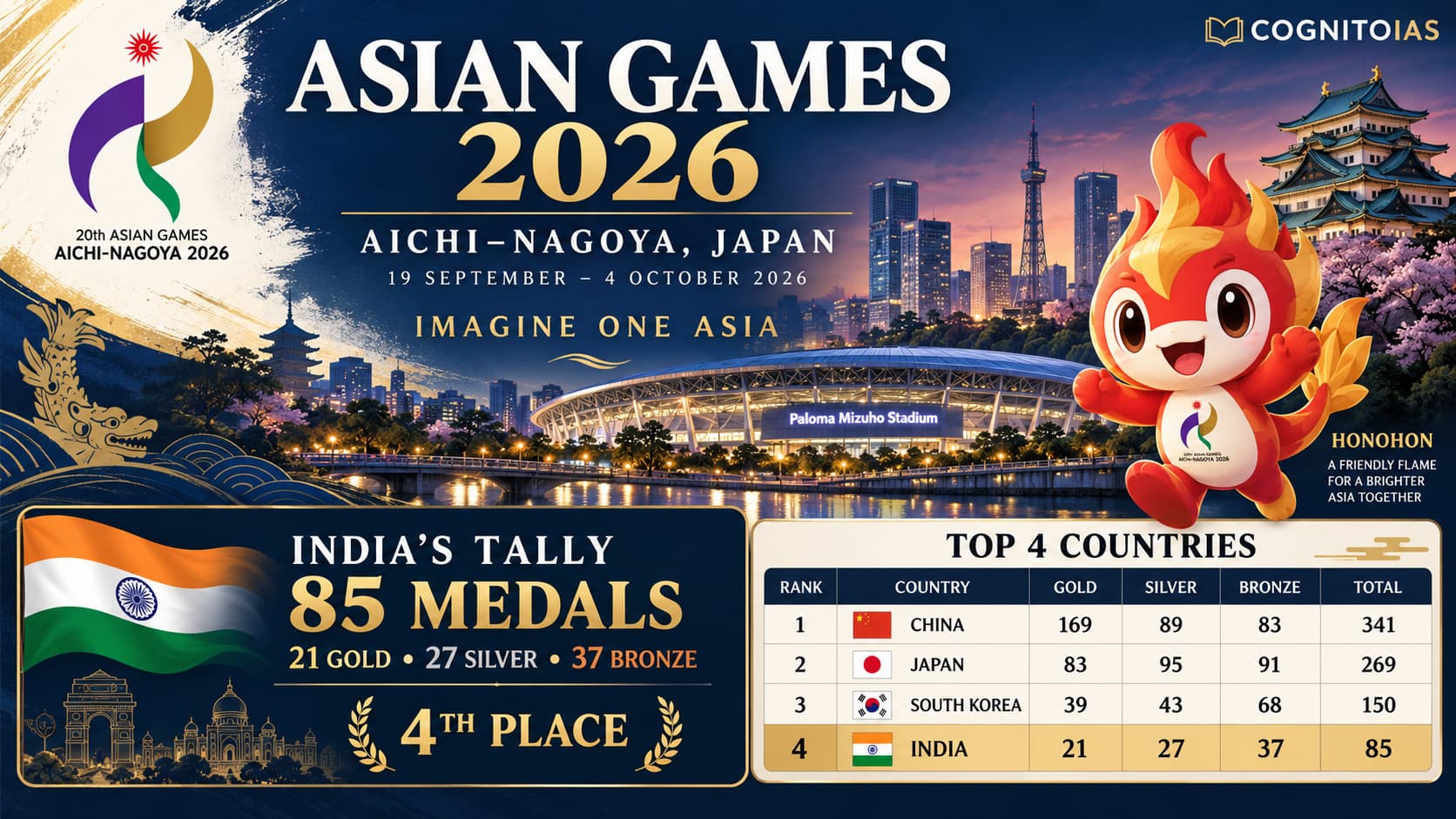
At a glance: 20th Asian Games • Aichi–Nagoya, Japan • 19 September–4 October 2026 • Mascot: Honohon • Motto: Imagine One Asia. India’s opening ceremony flag bearers: Manu Bhaker and Pawan Sehrawat. The third edition hosted in Japan: Tokyo 1958, Hiroshima 1994 and Aichi–Nagoya 2026.
Mascot, Emblem and Ceremonies
- Mascot Honohon: Symbolises the athletes’ enthusiasm and a flame. The name comes from the old Japanese word ‘honoho’, meaning flame. Its appearance is inspired by Nagoya’s symbol, the shachihoko—a mythical guardian with a tiger’s head and a fish’s body.
- Main stadium: Nagoya City Mizuho Park Athletic Stadium, also known as Paloma Mizuho Stadium. It hosted the opening and closing ceremonies and the main athletics events. All sports were not held at a single stadium; different sporting venues were used.
- Opening ceremony—19 September: Japan’s Emperor Naruhito formally opened the Games. The theme was ‘Harmonic Heart Beat’—a shared heartbeat of unity; dance, music and fireworks showcased the participation of 45 countries and territories. India’s flag bearers were Manu Bhaker and Pawan Sehrawat.
- Emblem: Flowing lines represent the movement and unity of the Games. Purple symbolises Aichi’s iris flower, gold represents the shachihoko of Nagoya Castle, and green symbolises environmental awareness. The red sun is the symbol of the Olympic Council of Asia. The design incorporates the initial letters of Asia–Aichi and Nagoya; its creator is Hiroshi Miyashita.
- Closing ceremony—4 October: The ceremony concluded at Paloma Mizuho Stadium with music, dance and a tribute to the athletes. Olympic Council of Asia President Sheikh Joaan bin Hamad Al Thani declared the Games closed. India’s flag bearer was Neeru Dhanda. The Games flag was handed over to the next host, Doha 2030.
1. Medal Table — Top 5
The final medal table published after the conclusion of the Games on 4 October 2026.
| Rank / Country | Gold | Silver | Bronze | Total |
|---|---|---|---|---|
| 1. China | 169 | 89 | 83 | 341 |
| 2. Japan | 83 | 95 | 91 | 269 |
| 3. South Korea | 39 | 43 | 68 | 150 |
| 4. India | 21 | 27 | 37 | 85 |
| 5. Uzbekistan | 21 | 25 | 24 | 70 |
Examination point: Rankings are determined first by gold, then silver, and then bronze medals. With India and Uzbekistan winning 21 gold medals each, India’s higher silver tally (27 versus 25) places it above Uzbekistan.
Comparison of India’s Medals in Women’s and Men’s Events
| Event Category | Gold | Silver | Bronze | Total |
|---|---|---|---|---|
| Women | 11 | 11 | 16 | 38 |
| Men | 7 | 14 | 17 | 38 |
| Mixed | 3 | 2 | 4 | 9 |
| India Total | 21 | 27 | 37 | 85 |
Conclusion: Women’s and men’s events produced an equal total number of medals, but women’s events yielded 4 more gold medals. This is an event-wise calculation based on the published list of medal winners. Each team medal has been counted once; mixed-event medals have not been counted again under both categories. These figures do not represent the number of individual medal-winning athletes.
India’s contribution: Most medals—Athletics: 24; Shooting: 15; Archery: 9. Most gold medals—Archery: 5. The tally of 85 medals is India’s second-highest Asian Games medal total.
2. Major International Records of 2026
- Shin Ohashi, Japan: A world record of 2 minutes 04.83 seconds in the men’s 200-metre breaststroke; the first man to complete the event in under 2 minutes 05 seconds.
- Zhang Zhanshuo, China: The first swimmer to win 7 gold medals in a single edition; surpassed the record of 6 gold medals held by Rikako Ikee and Zhang Yufei. He also set an Asian record of 1 minute 43.49 seconds in the 200-metre freestyle.
- Yu Zidi, China, aged 13: Won 3 gold medals; set a world junior record of 2 minutes 06.10 seconds in the women’s 200-metre individual medley. China won a record 30 swimming gold medals.
- Most Valuable Player awards: Men—Thai sprinter Puripol Boonson; Women—Chinese swimmer Yu Zidi. Puripol won 2 gold medals and 1 silver medal.
- South Korea: Won a fourth consecutive gold medal in men’s football; defeated Japan 1–0 in the final.
3. All 21 Indian Gold Medals — Sport-wise List
This list includes every event in which India won gold. Large teams are identified by their team names, while individuals, pairs and smaller teams are identified by the athletes’ names.
Archery — 5
Women’s individual recurve: Kumkum Anil Mohod.
Women’s recurve team: Ankita Bhakat, Kirti Sharma and Kumkum Mohod.
Women’s compound team: Jyothi Surekha Vennam, Prithika Pradeep and Chikitha Taniparthi.
Men’s compound team: Sahil Jadhav, Kushal Dalal and Ganesh Mani Ratnam Thirumuru.
Mixed compound: Chikitha Taniparthi and Sahil Jadhav.
Shooting — 3
10-metre air pistol mixed team: Kamaljeet and Suruchi Singh.
Women’s individual trap: Neeru Dhanda.
Mixed trap: Neeru Dhanda and Kynan Chenai.
Boxing — 3
Lovlina Borgohain — Women’s 75 kg; Parveen Hooda — Women’s 65 kg; Ankush Panghal — Men’s 80 kg.
Wrestling — 2
Aman Sehrawat — Men’s freestyle 57 kg; Sujeet Kalkal — Men’s freestyle 65 kg.
Cricket — 2 | Hockey — 2 | Kabaddi — 2
India’s men’s and women’s teams won gold in all three sports.
Athletics — 1
Women’s 4×400-metre relay: Kiran Pahal, Prachi Choudhary, M. R. Poovamma and Vithya Ramraj.
Golf — 1
Pranavi Urs — Women’s individual.
Recurve is the category using a conventional curved bow; compound bows use a pulley system. In mixed events, female and male athletes compete together.
4. India’s Most Important Records and Achievements
- Kumkum: India’s first individual recurve gold; a total of 2 gold medals + 1 silver medal. The women’s recurve team ended South Korea’s gold-medal dominance, which had continued since 1998. India also secured a quota for the 2028 Olympics; this quota belongs to the country and is not an individual qualification ticket for the athlete.
- Neeru: Ended a 48-year wait for an individual trap gold after Randhir Singh’s victory in 1978. With Kynan, set an Asian record of 34/40 in mixed trap; won a total of 2 gold medals and 1 silver medal.
- Hockey: The women defeated China 1–0 to win their first gold since 1982—after 44 years. The men defended their title for the first time, defeating Malaysia 5–1 in the final. Both Indian hockey teams won gold in the same edition for the first time; both secured qualification for the Los Angeles 2028 Olympics.
- Pranavi Urs: India’s first women’s individual golf gold. Among men, Lakshman Singh (1982) and Shiv Kapur (2002) had previously won gold.
- Vithya Ramraj: Won bronze in the 400-metre hurdles with a time of 54.75 seconds; broke P. T. Usha’s national record of 55.42 seconds, set in 1984. Including relay events, won 1 gold, 1 silver and 1 bronze in this edition.
- Boxing: 3 gold medals—India’s best boxing performance in terms of gold medals. Lovlina and Parveen joined Mary Kom among India’s women’s boxing gold medallists.
- Mirabai Chanu: Silver in the women’s 49 kg category; India’s first weightlifting medal since 1998. Sawan Barwal: Marathon silver—the first Indian men’s marathon medal since 1982 and the first won overseas.
- Individual hockey records: Manpreet Singh—the first Indian hockey player to win three Asian Games gold medals (2014, the 2022 edition and 2026). Harmanpreet Singh—the first Indian captain to lead the team to two gold medals. This is the men’s team’s fifth gold.
- Shafali Verma: Scored an unbeaten 100 off 49 balls against Bangladesh in the semifinal—the first century in Asian Games women’s cricket.
- Other athletics records: Sarvesh Kushare—silver in the men’s high jump with 2.25 metres, an Indian medal after 56 years. Parul Chaudhary—a national record of 9 minutes 08.67 seconds and bronze in the 3000-metre steeplechase. Gulveer Singh—silver in the 1500 and 10,000 metres, and bronze in the 5000 metres. Sawan Barwal also improved his own national marathon record.
- First medals: Suchika Tariyal—mixed martial arts bronze; Jay Meena—soft tennis bronze; Barnika Elangovan—women’s pole vault bronze; Satnam Singh–Salman Khan—men’s double sculls rowing bronze.
- Other important achievements: Anahat Singh—India’s first silver in women’s singles squash; first medals for the women’s skeet team and mixed skeet team; Nitesh Siwach—97 kg Greco-Roman silver, an Indian Greco-Roman finalist after 1962. Roshibina Devi—medals in wushu in three consecutive Asian Games editions.
5. Two Short Inspirational Stories
Kumkum: Making History with a Small Bow
The 17-year-old archer from Amravati began with a wooden bow purchased using ₹3,000 gifted by her grandmother. Her father made boxes for sweet shops. Limited resources and an old bow could not halt her progress—in 2026, she won three medals. Lesson: Discipline and consistent practice can create a path even amid a shortage of resources.
Vithya: From Matching a Record to Surpassing It
The daughter of a truck driver, Vithya received financial support from her twin sister Nithya for her training. She continued her efforts even after equalling Usha’s record in 2023; in 2026, she ran 0.67 seconds faster. Lesson: One achievement can become the foundation for the next effort.
6. History and India’s Best Performance
- First Asian Games: New Delhi, 4–11 March 1951. India finished second with 51 medals, including 15 gold medals. Sachin Nag won India’s first Asian Games gold in the men’s 100-metre freestyle.
- Organiser: Olympic Council of Asia; the usual interval is four years. The scheduled next hosts are Doha, Qatar (2030) and Riyadh, Saudi Arabia (2034).
- Editions hosted in India: 1951 and 1982—both in New Delhi. The 1982 Games were the ninth edition; their mascot was the elephant Appu—the first official Asian Games mascot.
- India’s best performance in terms of medals and gold: Hangzhou 2022, which was held in 2023 because of COVID-19—107 medals: 28 gold, 38 silver and 41 bronze; fourth place.
- Best performance by rank: Second place in 1951. “Most medals” and “best rank” are different facts. In 2026, India won 22 fewer medals and 7 fewer gold medals than in Hangzhou.
Remember: First edition—Delhi 1951 | Hosted in India—1951, 1982 | Highest Indian medal tally—Hangzhou 107 | 2026—85 medals, 21 gold | Kumkum—Recurve | Neeru—Trap | Pranavi—Women’s Golf | Vithya—54.75 seconds.
Sources: Emblem and Motto · Closing Ceremony and Flag Bearer · Closing Ceremony and Most Valuable Players · Medal Table · Gold Medal List · Indian Achievements · World Aquatics: Records · Indian Olympic Association: 1951 · Indian Olympic Association: 1982 · Press Information Bureau: Hangzhou · Official Mascot · Kumkum’s Story · Vithya’s Story · Hockey India: Records · Shafali’s Century · Sarvesh and Parul · Next Hosts · Main Stadium · Opening Ceremony · Mascot’s Name · Opening Ceremony Details.
कॉग्निटो आईएएस • समसामयिकी
एशियाई खेल 2026
रिकॉर्ड, भारत के स्वर्ण विजेता और परीक्षा के जरूरी तथ्य
तथ्य-जाँच: 4 अक्टूबर 2026, रात — समापन के बाद • पढ़ने का समय: लगभग 9 मिनट
एक नज़र में: 20वें एशियाई खेल • आइची–नागोया, जापान • 19 सितम्बर–4 अक्टूबर 2026 • शुभंकर: होनोहोन • आदर्श वाक्य: इमैजिन वन एशिया — एक एशिया की कल्पना। उद्घाटन के भारतीय ध्वजवाहक: मनु भाकर और पवन सहरावत। जापान में तीसरा आयोजन: टोक्यो 1958, हिरोशिमा 1994 और आइची–नागोया 2026।
शुभंकर, प्रतीक चिह्न और समारोह
- शुभंकर होनोहोन: खिलाड़ियों के उत्साह और अग्निशिखा का प्रतीक। नाम पुराने जापानी शब्द ‘होनोहो’ यानी ज्वाला से बना है। आकृति नागोया के प्रतीक शाचिहोको से प्रेरित है—बाघ के सिर और मछली के शरीर वाला पौराणिक रक्षक।
- मुख्य स्टेडियम: नागोया सिटी मिज़ुहो पार्क एथलेटिक स्टेडियम, जिसे पालोमा मिज़ुहो स्टेडियम भी कहते हैं। उद्घाटन, समापन और मुख्य एथलेटिक्स स्पर्धाओं का स्थल। सभी खेल एक ही मैदान में नहीं हुए; अलग-अलग खेल-स्थल इस्तेमाल हुए।
- उद्घाटन—19 सितम्बर: जापान के सम्राट नारुहितो ने खेलों का औपचारिक उद्घाटन किया। विषय था ‘हार्मोनिक हार्ट बीट’—एकता की साझा धड़कन; नृत्य, संगीत और आतिशबाजी के साथ 45 देशों एवं क्षेत्रों की भागीदारी प्रदर्शित हुई। भारतीय ध्वजवाहक मनु भाकर और पवन सहरावत रहे।
- प्रतीक चिह्न: प्रवाहमयी रेखाएँ खेलों की गति और एकता दर्शाती हैं। बैंगनी रंग आइची के आइरिस फूल, सुनहरा नागोया किले के शाचिहोको और हरा पर्यावरण चेतना का प्रतीक है। लाल सूर्य एशियाई ओलंपिक परिषद का प्रतीक है। आकृति में एशिया–आइची और नागोया के नामों के शुरुआती अक्षर समाहित हैं; रचनाकार हिरोशी मियाशिता हैं।
- समापन—4 अक्टूबर: पालोमा मिज़ुहो स्टेडियम में संगीत, नृत्य और खिलाड़ियों के सम्मान के साथ समारोह सम्पन्न हुआ। एशियाई ओलंपिक परिषद के अध्यक्ष शेख जोआन बिन हमद अल थानी ने खेलों के समापन की घोषणा की। भारतीय ध्वजवाहक नीरू ढांडा रहीं। आयोजन का ध्वज अगले मेजबान दोहा 2030 को सौंपा गया।
1. पदक तालिका — शीर्ष 5
4 अक्टूबर 2026 को खेलों के समापन के बाद प्रकाशित अंतिम पदक तालिका।
| स्थान / देश | स्वर्ण | रजत | कांस्य | कुल |
|---|---|---|---|---|
| 1. चीन | 169 | 89 | 83 | 341 |
| 2. जापान | 83 | 95 | 91 | 269 |
| 3. दक्षिण कोरिया | 39 | 43 | 68 | 150 |
| 4. भारत | 21 | 27 | 37 | 85 |
| 5. उज्बेकिस्तान | 21 | 25 | 24 | 70 |
परीक्षा बिंदु: रैंक पहले स्वर्ण, फिर रजत, फिर कांस्य से तय होती है। भारत और उज्बेकिस्तान के 21–21 स्वर्ण होने पर भारत के अधिक रजत (27 बनाम 25) उसे ऊपर रखते हैं।
भारतीय महिला–पुरुष पदकों की तुलना
| स्पर्धा श्रेणी | स्वर्ण | रजत | कांस्य | कुल |
|---|---|---|---|---|
| महिला | 11 | 11 | 16 | 38 |
| पुरुष | 7 | 14 | 17 | 38 |
| मिश्रित | 3 | 2 | 4 | 9 |
| भारत कुल | 21 | 27 | 37 | 85 |
निष्कर्ष: महिला और पुरुष स्पर्धाओं में कुल पदक बराबर, लेकिन महिला स्पर्धाओं में 4 स्वर्ण अधिक। यह प्रकाशित पदक-विजेता सूची से की गई स्पर्धावार गणना है। टीम का पदक एक बार गिना गया है; मिश्रित पदक दोनों श्रेणियों में दोहराए नहीं गए हैं। यह पदक जीतने वाले अलग-अलग खिलाड़ियों की संख्या नहीं है।
भारत का योगदान: सर्वाधिक पदक—एथलेटिक्स 24; निशानेबाजी—15; तीरंदाजी—9। सर्वाधिक स्वर्ण—तीरंदाजी 5। 85 पदक भारत का दूसरा सबसे बड़ा एशियाई खेल पदक-योग है।
2. 2026 के बड़े अंतरराष्ट्रीय रिकॉर्ड
- शिन ओहाशी, जापान: पुरुष 200 मीटर ब्रेस्टस्ट्रोक में 2 मिनट 04.83 सेकंड का विश्व रिकॉर्ड; 2 मिनट 05 सेकंड से कम समय लेने वाले पहले पुरुष।
- झांग झानशुओ, चीन: एक संस्करण में 7 स्वर्ण जीतने वाले पहले तैराक; रिकाको इकेई और झांग युफेई के 6 स्वर्ण का रिकॉर्ड पीछे छोड़ा। 200 मीटर फ्रीस्टाइल में 1 मिनट 43.49 सेकंड का एशियाई रिकॉर्ड भी।
- यू ज़िदी, चीन, 13 वर्ष: 3 स्वर्ण; महिला 200 मीटर मेडले में 2 मिनट 06.10 सेकंड का विश्व जूनियर रिकॉर्ड। चीन ने तैराकी में रिकॉर्ड 30 स्वर्ण जीते।
- सर्वश्रेष्ठ खिलाड़ी पुरस्कार: पुरुष—थाईलैंड के धावक पुरिपोल बूनसन; महिला—चीन की तैराक यू ज़िदी। पुरिपोल ने 2 स्वर्ण और 1 रजत जीता।
- दक्षिण कोरिया: पुरुष फुटबॉल में लगातार चौथा स्वर्ण; फाइनल में जापान को 1–0 से हराया।
3. भारत के सभी 21 स्वर्ण — खेलवार सूची
यह स्वर्ण जीतने वाली सभी स्पर्धाओं की सूची है। बड़े दलों का उल्लेख दल के नाम से और व्यक्तिगत, जोड़ी तथा छोटे दलों का उल्लेख खिलाड़ियों के नाम से किया गया है।
तीरंदाजी — 5
महिला व्यक्तिगत रिकर्व: कुमकुम अनिल मोहोद।
महिला रिकर्व दल: अंकिता भकत, कीर्ति शर्मा, कुमकुम मोहोद।
महिला कंपाउंड दल: ज्योति सुरेखा वेन्नम, पृथिका प्रदीप, चिकिथा तनिपर्थी।
पुरुष कंपाउंड दल: साहिल जाधव, कुशल दलाल, गणेश मणि रत्नम थिरुमुरु।
मिश्रित कंपाउंड: चिकिथा तनिपर्थी और साहिल जाधव।
निशानेबाजी — 3
10 मीटर एयर पिस्टल मिश्रित: कमलजीत और सुरुचि सिंह।
महिला व्यक्तिगत ट्रैप: नीरू ढांडा।
मिश्रित ट्रैप: नीरू ढांडा और काइनन चेनाई।
मुक्केबाजी — 3
लवलीना बोर्गोहैन — महिला 75 किग्रा; परवीन हुड्डा — महिला 65 किग्रा; अंकुश पंघाल — पुरुष 80 किग्रा।
कुश्ती — 2
अमन सहरावत — पुरुष फ्रीस्टाइल 57 किग्रा; सुजीत कलकल — पुरुष फ्रीस्टाइल 65 किग्रा।
क्रिकेट — 2 | हॉकी — 2 | कबड्डी — 2
तीनों खेलों में भारत के पुरुष और महिला दोनों दलों ने स्वर्ण जीता।
एथलेटिक्स — 1
महिला 4×400 मीटर रिले दौड़: किरण पहल, प्राची चौधरी, एम. आर. पूवम्मा और विथ्या रामराज।
गोल्फ — 1
प्रणवी उर्स — महिला व्यक्तिगत।
रिकर्व सामान्य मुड़े हुए धनुष की श्रेणी है; कंपाउंड में पुली वाला धनुष होता है। मिश्रित स्पर्धा में महिला और पुरुष खिलाड़ी साथ खेलते हैं।
4. भारत के सबसे जरूरी रिकॉर्ड और उपलब्धियाँ
- कुमकुम: व्यक्तिगत रिकर्व में भारत का पहला स्वर्ण; कुल 2 स्वर्ण + 1 रजत। महिला रिकर्व दल ने दक्षिण कोरिया का 1998 से जारी स्वर्ण-वर्चस्व समाप्त किया। देश के लिए 2028 ओलंपिक का कोटा भी मिला; यह कोटा देश का है, खिलाड़ी का व्यक्तिगत टिकट नहीं।
- नीरू: रणधीर सिंह (1978) के बाद व्यक्तिगत ट्रैप स्वर्ण की 48 वर्ष की प्रतीक्षा समाप्त। काइनन के साथ मिश्रित ट्रैप में 34/40 का एशियाई रिकॉर्ड; कुल 2 स्वर्ण और 1 रजत।
- हॉकी: महिलाओं ने चीन को 1–0 से हराकर 1982 के बाद पहला स्वर्ण जीता—44 वर्ष बाद। पुरुषों ने पहली बार खिताब बचाया; फाइनल में मलेशिया 5–1 से पराजित। पहली बार दोनों भारतीय हॉकी दलों का एक ही संस्करण में स्वर्ण; दोनों ने लॉस एंजिलिस 2028 ओलंपिक में प्रवेश हासिल किया।
- प्रणवी उर्स: भारत का पहला महिला व्यक्तिगत गोल्फ स्वर्ण। पुरुषों में लक्ष्मण सिंह (1982) और शिव कपूर (2002) पहले स्वर्ण जीत चुके हैं।
- विथ्या रामराज: 400 मीटर बाधा दौड़ में 54.75 सेकंड और कांस्य; पी. टी. उषा का 1984 का 55.42 सेकंड राष्ट्रीय रिकॉर्ड तोड़ा। इस संस्करण में रिले दौड़ सहित 1 स्वर्ण, 1 रजत, 1 कांस्य।
- मुक्केबाजी: 3 स्वर्ण—भारत का स्वर्ण संख्या के आधार पर सर्वश्रेष्ठ मुक्केबाजी प्रदर्शन। लवलीना और परवीन ने महिला मुक्केबाजी के स्वर्ण विजेताओं में मैरी कॉम के साथ स्थान बनाया।
- मीराबाई चानू: महिला 49 किग्रा में रजत; भारत का 1998 के बाद पहला भारोत्तोलन पदक। सावन बरवाल: मैराथन रजत—1982 के बाद पहला भारतीय पुरुष मैराथन पदक और विदेश में पहला।
- हॉकी के व्यक्तिगत रिकॉर्ड: मनप्रीत सिंह—तीन एशियाई खेल स्वर्ण जीतने वाले पहले भारतीय हॉकी खिलाड़ी (2014, 2022 संस्करण और 2026)। हरमनप्रीत सिंह—दो स्वर्ण दिलाने वाले पहले भारतीय कप्तान। पुरुष दल का यह पाँचवाँ स्वर्ण है।
- शेफाली वर्मा: बांग्लादेश के विरुद्ध सेमीफाइनल में 49 गेंदों पर नाबाद 100—एशियाई खेलों के महिला क्रिकेट का पहला शतक।
- अन्य एथलेटिक्स कीर्तिमान: सर्वेश कुशारे—पुरुष ऊँची कूद में 2.25 मीटर के साथ रजत, 56 वर्ष बाद भारतीय पदक। पारुल चौधरी—3000 मीटर स्टीपलचेज में 9 मिनट 08.67 सेकंड का राष्ट्रीय रिकॉर्ड और कांस्य। गुलवीर सिंह—1500 और 10,000 मीटर में रजत तथा 5000 मीटर में कांस्य। सावन बरवाल ने मैराथन का अपना राष्ट्रीय रिकॉर्ड भी सुधारा।
- पहले पदक: सुचिका तारियाल—मिश्रित मार्शल आर्ट कांस्य; जय मीणा—सॉफ्ट टेनिस कांस्य; बरनिका इलंगोवन—महिला पोल वॉल्ट कांस्य; सतनाम सिंह–सलमान खान—पुरुष डबल स्कल्स नौकायन कांस्य।
- अन्य महत्वपूर्ण उपलब्धियाँ: अनाहत सिंह—महिला एकल स्क्वॉश में भारत का पहला रजत; महिला स्कीट दल और मिश्रित स्कीट दल के पहले पदक; नितेश सिवाच—97 किग्रा ग्रीको-रोमन रजत, 1962 के बाद भारतीय ग्रीको-रोमन फाइनलिस्ट। रोशिबिना देवी—वुशु में लगातार तीसरे एशियाई खेल संस्करण में पदक।
5. दो छोटी प्रेरक कहानियाँ
कुमकुम: छोटे धनुष से बड़ा इतिहास
अमरावती की 17 वर्षीय तीरंदाज ने दादी के दिए ₹3,000 से खरीदे लकड़ी के धनुष से शुरुआत की। पिता मिठाई की दुकानों के लिए डिब्बे बनाते थे। सीमित साधन और पुराना धनुष उनकी प्रगति नहीं रोक सके—2026 में उन्होंने तीन पदक जीते। सीख: अनुशासन और लगातार अभ्यास साधनों की कमी के बीच भी रास्ता बनाते हैं।
विथ्या: बराबरी से आगे निकलने तक
ट्रक चालक की बेटी विथ्या की तैयारी में जुड़वाँ बहन नित्या ने आर्थिक सहायता दी। 2023 में उषा के रिकॉर्ड की बराबरी करने के बाद भी प्रयास जारी रखा; 2026 में उससे 0.67 सेकंड तेज दौड़ीं। सीख: एक उपलब्धि अगली कोशिश का आधार बन सकती है।
6. इतिहास और भारत का सर्वश्रेष्ठ प्रदर्शन
- पहले एशियाई खेल: नई दिल्ली, 4–11 मार्च 1951। भारत 15 स्वर्ण सहित 51 पदकों के साथ दूसरे स्थान पर रहा। सचिन नाग ने पुरुष 100 मीटर फ्रीस्टाइल में भारत का पहला एशियाई खेल स्वर्ण जीता।
- आयोजक: एशियाई ओलंपिक परिषद; सामान्य अंतराल चार वर्ष। निर्धारित अगले मेजबान—दोहा, कतर (2030) और रियाद, सऊदी अरब (2034)।
- भारत में आयोजन: 1951 और 1982—दोनों बार नई दिल्ली। 1982 नौवाँ संस्करण था; उसका शुभंकर हाथी अप्पू था—एशियाई खेलों का पहला आधिकारिक शुभंकर।
- पदकों और स्वर्ण के आधार पर भारत का सर्वश्रेष्ठ: हांगझोऊ 2022, जो कोविड-19 के कारण 2023 में आयोजित हुआ—107 पदक: 28 स्वर्ण, 38 रजत, 41 कांस्य; चौथा स्थान।
- रैंक के आधार पर सर्वश्रेष्ठ: 1951 में दूसरा स्थान। “सबसे अधिक पदक” और “सबसे अच्छी रैंक” अलग तथ्य हैं। 2026 में हांगझोऊ से 22 पदक और 7 स्वर्ण कम रहे।
याद रखें: पहला आयोजन—दिल्ली 1951 | भारत में—1951, 1982 | सर्वाधिक भारतीय पदक—हांगझोऊ 107 | 2026—85 पदक, 21 स्वर्ण | कुमकुम—रिकर्व | नीरू—ट्रैप | प्रणवी—महिला गोल्फ | विथ्या—54.75 सेकंड।
स्रोत: प्रतीक चिह्न और आदर्श वाक्य · समापन और ध्वजवाहक · समापन और सर्वश्रेष्ठ खिलाड़ी · पदक तालिका · स्वर्ण सूची · भारतीय उपलब्धियाँ · विश्व तैराकी महासंघ: रिकॉर्ड · भारतीय ओलंपिक संघ: 1951 · भारतीय ओलंपिक संघ: 1982 · पत्र सूचना कार्यालय: हांगझोऊ · आधिकारिक शुभंकर · कुमकुम की कहानी · विथ्या की कहानी · हॉकी इंडिया: रिकॉर्ड · शेफाली का शतक · सर्वेश और पारुल · अगले मेजबान · मुख्य स्टेडियम · उद्घाटन समारोह · शुभंकर का नाम · उद्घाटन विवरण।