METALS, MINERALS, ORES AND ALLOYS • POST 1
Metals and Non-metals: Learn from Everyday Life
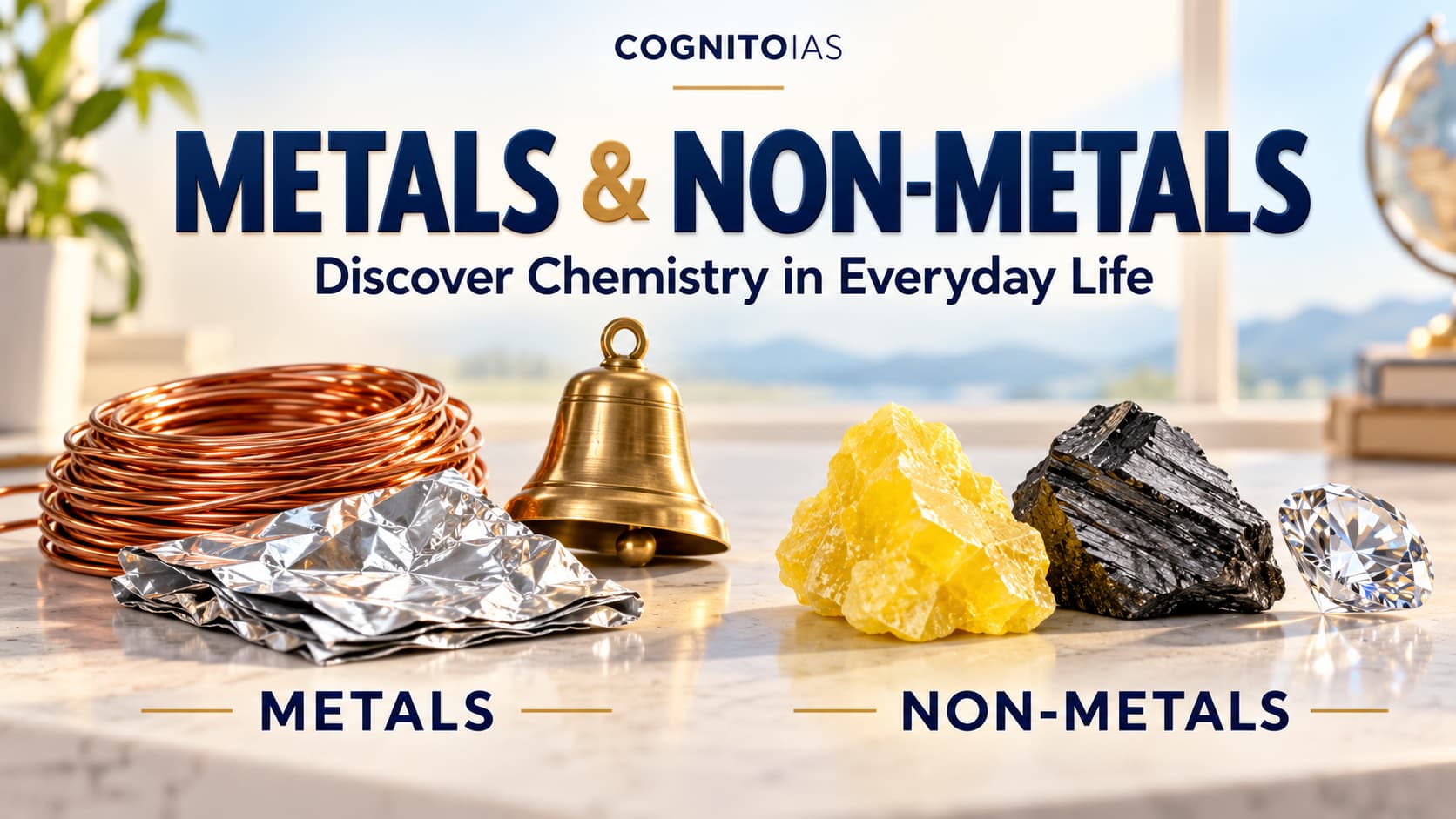
Why are electric wires made of copper? How is aluminium made into thin foil? Why does a metal bell ring? Let us discover the properties behind these familiar things.
1. Start with Things You Know
Copper wire: Copper allows electricity to pass through it easily. It can also be drawn into wires.
Aluminium foil: Aluminium can be pressed or beaten into thin sheets.
A metal bell: It produces a ringing sound when struck.
The connection: Copper and aluminium are metals. Their properties help explain their uses.
Elements are commonly grouped as metals, non-metals and metalloids. Metalloids have some properties of metals and some of non-metals. Here, we focus on metals and non-metals.
2. Six Useful Properties of Metals
Lustre means shine.
Metals usually have a shiny surface when freshly cleaned.
Malleability means the ability to form sheets.
A metal can be beaten or pressed into a thin sheet. Aluminium foil is an example.
Ductility means the ability to form wires.
A metal can be drawn into a wire. Copper wire is an example.
Keep these two separate:
Sheet → Malleability
Wire → Ductility
Sonority means a ringing sound.
Metals generally produce a ringing sound when struck.
Conductivity means allowing heat or electricity to pass.
Metals generally conduct both well. A metal spoon becomes hot when left in hot food.
Hardness:
Most metals are hard, but some are soft. You will meet these exceptions shortly.
Pause and Think — 1
A metal is drawn into a long, thin wire. Which property does this show?
Check your answer: Ductility. A wire shows ductility; a sheet shows malleability.
3. How Are Non-metals Different?
Non-metals generally do not show the same properties as metals.
- They are usually dull.
- Solid non-metals are generally brittle: they break instead of changing shape when struck.
- They generally cannot be made into sheets or wires.
- They usually do not produce a ringing sound.
- They are generally poor conductors of heat and electricity.
Example: Sulphur is a non-metal. A piece of solid sulphur breaks when struck rather than becoming a thin sheet.
Use the word “generally”. These properties are useful patterns, but they are not rules without exceptions.
4. Meet the Important Exceptions
Mercury (Hg): A metal that is liquid at room temperature.
Bromine (Br2): A non-metal that is liquid at room temperature.
Sodium and potassium: Metals that are soft enough to be cut with a knife.
Iodine: A non-metal that shows lustre.
Graphite: A form of carbon that conducts electricity.
Diamond: Another form of carbon that is extremely hard. It does not normally conduct electricity.
Selenium: A non-metal with semiconducting and photoconductive behaviour. This means its electrical conductivity depends on conditions and can increase when light falls on it.
One element, different properties: Diamond and graphite are both forms of carbon. Their atoms are arranged differently, so their properties differ.
Pause and Think — 2
“This substance is shiny, so it must be a metal.” Is this conclusion reliable?
Check your answer: No. Iodine is a shiny non-metal. One property alone is not enough to identify a metal.
5. What Happens When Metals Meet Oxygen?
Many metals react with oxygen to form metal oxides. An oxide is a compound of oxygen with another element.
Metal + Oxygen → Metal oxide
Example: Magnesium ribbon burns with a bright white light and forms white magnesium oxide.
2Mg + O2 → 2MgO
Here, magnesium combines with oxygen to form a new substance.
Most common metal oxides are basic.
They react with acids, usually forming salt and water.
Non-metal oxides are generally acidic.
They react with bases, usually forming salt and water. Carbon dioxide is a familiar example.
Some oxides are amphoteric.
They react with both acids and bases. Remember aluminium oxide (Al2O3) and zinc oxide (ZnO).
Another exception: Some non-metal oxides, such as carbon monoxide (CO), are neutral rather than acidic.
Pause and Think — 3
An oxide reacts with both an acid and a base. What is it called?
Check your answer: An amphoteric oxide. Examples: Al2O3 and ZnO.
6. Do All Metals React with Water?
No. Some react very quickly, some need hot water or steam, and others do not react under ordinary conditions.
- Potassium and sodium: React very vigorously with cold water.
- Calcium: Reacts with cold water, less vigorously than sodium and potassium.
- Magnesium: Reacts with hot water and also with steam.
- Aluminium, zinc and iron: React with steam under suitable conditions.
- Copper, silver and gold: Do not react with water under ordinary conditions.
Example: Sodium reacts with water to form sodium hydroxide and hydrogen gas.
2Na + 2H2O → 2NaOH + H2
Why is sodium stored in kerosene?
It reacts readily with air and moisture. Kerosene keeps it away from direct contact with them.
These reactions are for understanding. Sodium–water reactions must not be tried at home.
Pause and Think — 4
Will copper react vigorously if placed in cold water?
Check your answer: No. Copper does not react with water under ordinary conditions.
7. What Happens When Metals Meet Acids?
Many reactive metals react with dilute hydrochloric acid or dilute sulphuric acid. A salt forms and hydrogen gas is released.
Reactive metal + Dilute acid → Salt + Hydrogen
Example: Zinc reacts with dilute hydrochloric acid. The bubbles produced contain hydrogen gas.
Zn + 2HCl → ZnCl2 + H2
Copper, silver and gold do not release hydrogen from dilute hydrochloric acid or dilute sulphuric acid.
Nitric acid is different.
It is a strong oxidising agent. It generally converts the hydrogen that would form into water, so hydrogen gas is usually not released.
Important exception: Magnesium and manganese can release hydrogen with very dilute nitric acid.
8. Can Metals React with Bases Too?
Some can. Aluminium and zinc react with strong bases, such as sodium hydroxide, under suitable conditions. These reactions can release hydrogen gas.
Remember the distinction: Al2O3 and ZnO are amphoteric oxides. Aluminium and zinc are the metals whose reactions with strong bases we are discussing.
Pause and Think — 5
“Every metal reacting with any acid releases hydrogen.” Is this correct?
Check your answer: No. The metal and the acid both matter. Nitric acid generally does not give hydrogen, and copper does not release hydrogen from dilute HCl.
9. A Simple Look at Electrons
When forming compounds, metals generally lose electrons. They then become positively charged ions, called cations.
Non-metals may gain electrons and become negatively charged ions, called anions. They can also share electrons when forming compounds.
Example: In the formation of sodium chloride, sodium loses one electron and chlorine gains it. They become Na+ and Cl−.
Why does losing an electron give a positive charge?
Electrons carry negative charge. After losing an electron, the atom has more positive charges than negative charges.
Pause and Think — 6
An atom gains an electron. Does it become positively or negatively charged?
Check your answer: Negatively charged, because it gains a negative charge.
10. One-Minute Revision
Cover the answers above and complete these lines:
- Making a sheet shows __________; making a wire shows __________.
- The liquid metal is __________; the liquid non-metal is __________.
- The conducting form of carbon is __________.
- An oxide reacting with both acids and bases is __________.
- Sodium reacts vigorously with __________ water.
- Zinc + dilute HCl produces a salt and __________ gas.
- Metals generally __________ electrons to form positive ions.
Answer key:
1. Malleability; ductility
2. Mercury; bromine
3. Graphite
4. Amphoteric
5. Cold
6. Hydrogen
7. Lose
Next: The reactivity series—why some metals react more readily than others.
धातु, खनिज, अयस्क और मिश्रधातु • पोस्ट 1
धातु और अधातु: रोज़मर्रा की चीज़ों से सीखें
बिजली के तार ताँबे से क्यों बनाए जाते हैं? एल्युमिनियम की इतनी पतली पन्नी कैसे बनती है? धातु की घंटी क्यों बजती है? आइए, इन परिचित चीज़ों के पीछे छिपे गुणों को समझें।
1. परिचित चीज़ों से शुरुआत करें
ताँबे का तार: ताँबे से बिजली आसानी से गुजरती है। इसे खींचकर तार भी बनाया जा सकता है।
एल्युमिनियम की पन्नी: एल्युमिनियम को दबाकर या पीटकर पतली चादर बनाई जा सकती है।
धातु की घंटी: चोट लगने पर यह बजने की आवाज़ पैदा करती है।
इनका संबंध समझें: ताँबा और एल्युमिनियम धातुएँ हैं। उनके गुण हमें उनके उपयोग समझने में मदद करते हैं।
तत्वों को सामान्यतः धातु, अधातु और उपधातु में बाँटा जाता है। उपधातुओं में कुछ गुण धातुओं जैसे और कुछ अधातुओं जैसे होते हैं। यहाँ हम धातुओं और अधातुओं पर ध्यान देंगे।
2. धातुओं के छह उपयोगी गुण
धात्विक चमक का अर्थ है चमकीली सतह।
धातुओं की सतह साफ करने पर सामान्यतः चमकती है।
आघातवर्धनीयता का अर्थ है चादर बनाने की क्षमता।
धातु को पीटकर या दबाकर पतली चादर बनाई जा सकती है। एल्युमिनियम की पन्नी इसका उदाहरण है।
तन्यता का अर्थ है तार बनाने की क्षमता।
धातु को खींचकर तार बनाया जा सकता है। ताँबे का तार इसका उदाहरण है।
इन दोनों में अंतर याद रखें:
चादर → आघातवर्धनीयता
तार → तन्यता
ध्वानिकता का अर्थ है बजने की आवाज़ पैदा करना।
धातुएँ सामान्यतः चोट लगने पर बजने की आवाज़ पैदा करती हैं।
चालकता का अर्थ है ऊष्मा या बिजली को गुजरने देना।
धातुएँ सामान्यतः दोनों की अच्छी चालक होती हैं। गर्म भोजन में छोड़ने पर धातु का चम्मच गर्म हो जाता है।
कठोरता:
अधिकांश धातुएँ कठोर होती हैं, लेकिन कुछ मुलायम होती हैं। इन अपवादों को हम आगे समझेंगे।
रुकें और सोचें — 1
किसी धातु को खींचकर लंबा और पतला तार बनाया जाता है। यह किस गुण को दर्शाता है?
अपना उत्तर जाँचें: तन्यता। तार बनना तन्यता और चादर बनना आघातवर्धनीयता को दर्शाता है।
3. अधातुएँ किस प्रकार अलग हैं?
अधातुओं में सामान्यतः धातुओं जैसे गुण नहीं होते।
- इनमें सामान्यतः चमक नहीं होती।
- ठोस अधातुएँ सामान्यतः भंगुर होती हैं: चोट लगने पर आकार बदलने के बजाय टूट जाती हैं।
- इनसे सामान्यतः चादर या तार नहीं बनाए जा सकते।
- ये सामान्यतः चोट लगने पर बजने की आवाज़ नहीं पैदा करतीं।
- ये सामान्यतः ऊष्मा और बिजली की कुचालक होती हैं।
उदाहरण: सल्फर एक अधातु है। ठोस सल्फर का टुकड़ा चोट लगने पर पतली चादर बनने के बजाय टूट जाता है।
“सामान्यतः” शब्द का प्रयोग करें। ये गुण पदार्थों को समझने में मदद करते हैं, लेकिन इनके अपवाद भी होते हैं।
4. महत्त्वपूर्ण अपवादों को जानें
पारा (Hg): एक धातु जो कमरे के तापमान पर द्रव होती है।
ब्रोमीन (Br2): एक अधातु जो कमरे के तापमान पर द्रव होती है।
सोडियम और पोटैशियम: इतनी मुलायम धातुएँ कि इन्हें चाकू से काटा जा सकता है।
आयोडीन: एक अधातु जिसमें चमक होती है।
ग्रेफाइट: कार्बन का एक रूप जो बिजली का चालक है।
हीरा: कार्बन का एक अन्य रूप जो अत्यंत कठोर है। यह सामान्यतः बिजली का चालक नहीं होता।
सेलेनियम: एक अधातु जो अर्धचालक और प्रकाशचालक व्यवहार दिखाती है। इसका अर्थ है कि इसकी विद्युत चालकता परिस्थितियों पर निर्भर करती है और इस पर प्रकाश पड़ने से बढ़ सकती है।
एक तत्व, अलग-अलग गुण: हीरा और ग्रेफाइट दोनों कार्बन के रूप हैं। इनमें परमाणुओं की व्यवस्था अलग होती है, इसलिए इनके गुण भी अलग होते हैं।
रुकें और सोचें — 2
“यह पदार्थ चमकीला है, इसलिए यह अवश्य धातु होगा।” क्या यह निष्कर्ष भरोसेमंद है?
अपना उत्तर जाँचें: नहीं। आयोडीन एक चमकीली अधातु है। केवल एक गुण देखकर धातु की पहचान करना पर्याप्त नहीं है।
5. धातुएँ ऑक्सीजन से मिलकर क्या बनाती हैं?
अनेक धातुएँ ऑक्सीजन से अभिक्रिया करके धातु ऑक्साइड बनाती हैं। ऑक्साइड, ऑक्सीजन और किसी अन्य तत्व का यौगिक होता है।
धातु + ऑक्सीजन → धातु ऑक्साइड
उदाहरण: मैग्नीशियम का फीता तेज सफेद प्रकाश के साथ जलता है और सफेद मैग्नीशियम ऑक्साइड बनाता है।
2Mg + O2 → 2MgO
यहाँ मैग्नीशियम, ऑक्सीजन से मिलकर नया पदार्थ बनाता है।
अधिकांश सामान्य धातु ऑक्साइड क्षारकीय होते हैं।
ये अम्लों से अभिक्रिया करके सामान्यतः लवण और जल बनाते हैं।
अधातु ऑक्साइड सामान्यतः अम्लीय होते हैं।
ये क्षारकों से अभिक्रिया करके सामान्यतः लवण और जल बनाते हैं। कार्बन डाइऑक्साइड इसका परिचित उदाहरण है।
कुछ ऑक्साइड उभयधर्मी होते हैं।
ये अम्ल और क्षारक, दोनों से अभिक्रिया करते हैं। एल्युमिनियम ऑक्साइड (Al2O3) और जिंक ऑक्साइड (ZnO) याद रखें।
एक और अपवाद: कुछ अधातु ऑक्साइड, जैसे कार्बन मोनोऑक्साइड (CO), अम्लीय होने के बजाय उदासीन होते हैं।
रुकें और सोचें — 3
कोई ऑक्साइड अम्ल और क्षारक, दोनों से अभिक्रिया करता है। उसे क्या कहते हैं?
अपना उत्तर जाँचें: उभयधर्मी ऑक्साइड। उदाहरण: Al2O3 और ZnO।
6. क्या सभी धातुएँ पानी से अभिक्रिया करती हैं?
नहीं। कुछ बहुत तेजी से अभिक्रिया करती हैं, कुछ को गर्म पानी या भाप चाहिए और कुछ सामान्य परिस्थितियों में अभिक्रिया नहीं करतीं।
- पोटैशियम और सोडियम: ठंडे पानी से बहुत तीव्र अभिक्रिया करते हैं।
- कैल्शियम: ठंडे पानी से अभिक्रिया करता है, लेकिन सोडियम और पोटैशियम की तुलना में कम तीव्रता से।
- मैग्नीशियम: गर्म पानी और भाप से अभिक्रिया करता है।
- एल्युमिनियम, जिंक और लोहा: उपयुक्त परिस्थितियों में भाप से अभिक्रिया करते हैं।
- ताँबा, चाँदी और सोना: सामान्य परिस्थितियों में पानी से अभिक्रिया नहीं करते।
उदाहरण: सोडियम, पानी से अभिक्रिया करके सोडियम हाइड्रॉक्साइड और हाइड्रोजन गैस बनाता है।
2Na + 2H2O → 2NaOH + H2
सोडियम को मिट्टी के तेल में क्यों रखा जाता है?
यह हवा और नमी से आसानी से अभिक्रिया करता है। मिट्टी का तेल इसे इनके सीधे संपर्क से बचाता है।
ये अभिक्रियाएँ समझने के लिए दी गई हैं। सोडियम और पानी की अभिक्रिया घर पर करने का प्रयास न करें।
रुकें और सोचें — 4
क्या ताँबे को ठंडे पानी में रखने पर तीव्र अभिक्रिया होगी?
अपना उत्तर जाँचें: नहीं। ताँबा सामान्य परिस्थितियों में पानी से अभिक्रिया नहीं करता।
7. धातुएँ अम्लों से कैसे अभिक्रिया करती हैं?
अनेक अभिक्रियाशील धातुएँ तनु हाइड्रोक्लोरिक अम्ल या तनु सल्फ्यूरिक अम्ल से अभिक्रिया करती हैं। इससे लवण बनता है और हाइड्रोजन गैस निकलती है।
अभिक्रियाशील धातु + तनु अम्ल → लवण + हाइड्रोजन
उदाहरण: जिंक, तनु हाइड्रोक्लोरिक अम्ल से अभिक्रिया करता है। बनने वाले बुलबुलों में हाइड्रोजन गैस होती है।
Zn + 2HCl → ZnCl2 + H2
ताँबा, चाँदी और सोना तनु हाइड्रोक्लोरिक अम्ल या तनु सल्फ्यूरिक अम्ल से हाइड्रोजन गैस नहीं निकालते।
नाइट्रिक अम्ल अलग व्यवहार करता है।
यह एक प्रबल ऑक्सीकारक है। यह सामान्यतः बनने वाली हाइड्रोजन को जल में बदल देता है, इसलिए हाइड्रोजन गैस आमतौर पर नहीं निकलती।
महत्त्वपूर्ण अपवाद: मैग्नीशियम और मैंगनीज, अत्यंत तनु नाइट्रिक अम्ल से हाइड्रोजन गैस निकाल सकते हैं।
8. क्या धातुएँ क्षारकों से भी अभिक्रिया कर सकती हैं?
कुछ धातुएँ कर सकती हैं। एल्युमिनियम और जिंक उपयुक्त परिस्थितियों में सोडियम हाइड्रॉक्साइड जैसे प्रबल क्षारकों से अभिक्रिया करते हैं। इन अभिक्रियाओं में हाइड्रोजन गैस निकल सकती है।
यह अंतर याद रखें: Al2O3 और ZnO उभयधर्मी ऑक्साइड हैं। एल्युमिनियम और जिंक वे धातुएँ हैं जिनकी प्रबल क्षारकों से अभिक्रिया की चर्चा हम कर रहे हैं।
रुकें और सोचें — 5
“हर धातु किसी भी अम्ल से अभिक्रिया करके हाइड्रोजन निकालती है।” क्या यह सही है?
अपना उत्तर जाँचें: नहीं। धातु और अम्ल, दोनों का प्रकार महत्त्वपूर्ण है। नाइट्रिक अम्ल सामान्यतः हाइड्रोजन नहीं देता और ताँबा तनु HCl से हाइड्रोजन नहीं निकालता।
9. इलेक्ट्रॉनों को आसान तरीके से समझें
यौगिक बनाते समय धातुएँ सामान्यतः इलेक्ट्रॉन खोती हैं। तब वे धनावेशित आयन बन जाती हैं, जिन्हें धनायन कहते हैं।
अधातुएँ इलेक्ट्रॉन ग्रहण करके ऋणावेशित आयन बन सकती हैं, जिन्हें ऋणायन कहते हैं। यौगिक बनाते समय वे इलेक्ट्रॉनों की साझेदारी भी कर सकती हैं।
उदाहरण: सोडियम क्लोराइड बनते समय सोडियम एक इलेक्ट्रॉन खोता है और क्लोरीन उसे ग्रहण करता है। वे Na+ और Cl− बन जाते हैं।
इलेक्ट्रॉन खोने से धनावेश क्यों बनता है?
इलेक्ट्रॉनों पर ऋणावेश होता है। इलेक्ट्रॉन खोने के बाद परमाणु में ऋणावेश की तुलना में धनावेश अधिक हो जाता है।
रुकें और सोचें — 6
कोई परमाणु एक इलेक्ट्रॉन ग्रहण करता है। वह धनावेशित होगा या ऋणावेशित?
अपना उत्तर जाँचें: ऋणावेशित, क्योंकि वह एक ऋणावेश ग्रहण करता है।
10. एक मिनट में दोहराएँ
ऊपर दिए गए उत्तरों को ढककर ये रिक्त स्थान भरें:
- चादर बनाना __________ को दर्शाता है; तार बनाना __________ को दर्शाता है।
- द्रव धातु __________ है; द्रव अधातु __________ है।
- कार्बन का विद्युत चालक रूप __________ है।
- अम्ल और क्षारक, दोनों से अभिक्रिया करने वाला ऑक्साइड __________ होता है।
- सोडियम __________ पानी से तीव्र अभिक्रिया करता है।
- जिंक + तनु HCl से लवण और __________ गैस बनती है।
- धातुएँ सामान्यतः इलेक्ट्रॉन __________ धनायन बनाती हैं।
उत्तर:
1. आघातवर्धनीयता; तन्यता
2. पारा; ब्रोमीन
3. ग्रेफाइट
4. उभयधर्मी
5. ठंडे
6. हाइड्रोजन
7. खोकर
अगला विषय: अभिक्रियाशीलता श्रेणी—कुछ धातुएँ दूसरों की तुलना में अधिक आसानी से अभिक्रिया क्यों करती हैं?