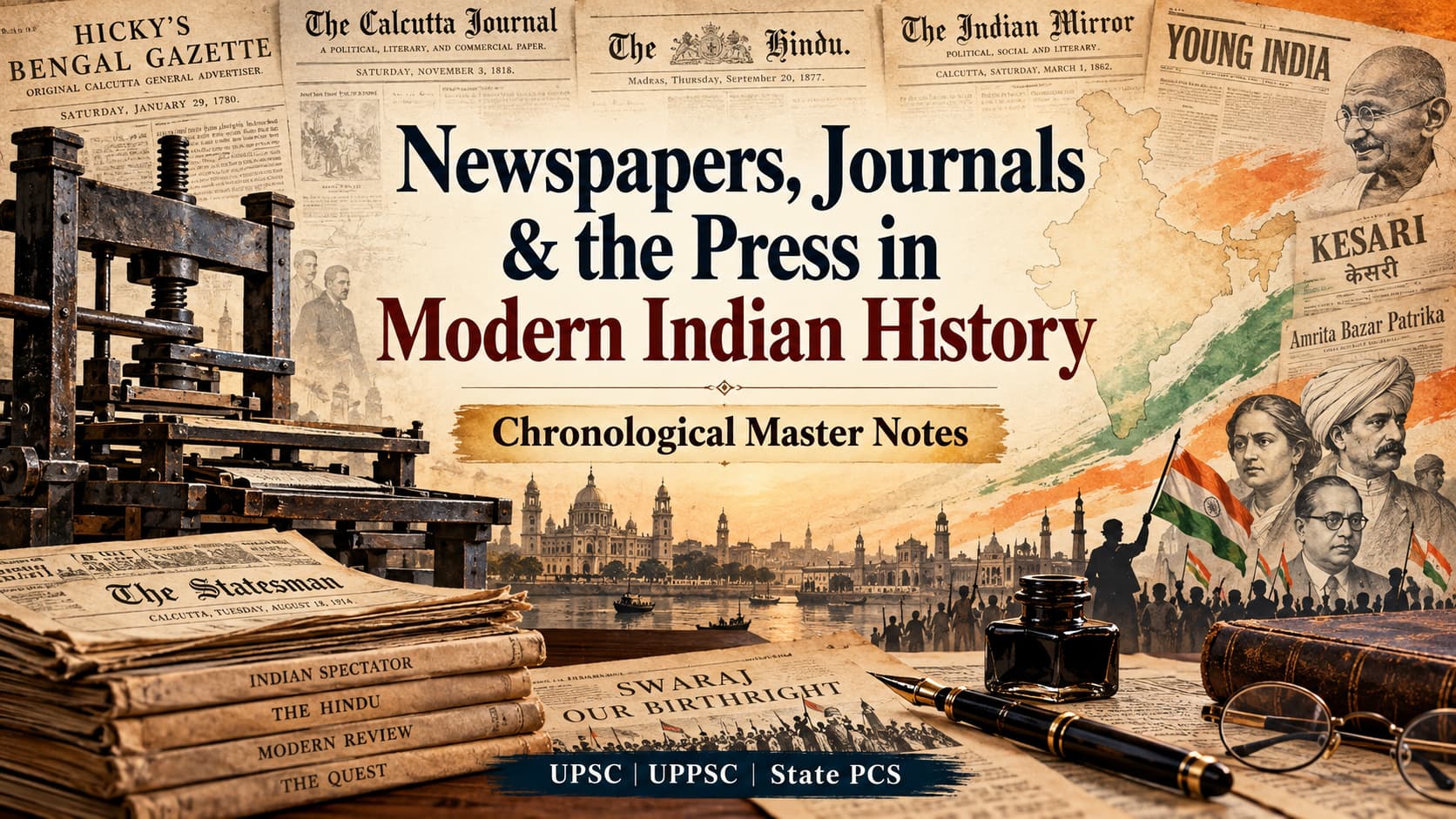
Newspapers, Journals and the Press in Modern Indian History
Final Fact-Checked Chronological Master Notes — Indian, regional and overseas press under British rule
Main body = chronology. High-yield firsts, source cautions and revision banks are highlighted separately.
Printing → Early Presidency Press → Indian-Owned Press → Reform Journals → Nationalist Press → Revolutionary Press → Mass Political Press
UPSC | UPPSC | State PCS
⭐ Must Remember — Language & Press Firsts
FIRST NEWSPAPER IN INDIA
Hicky's Bengal Gazette — 1780 — English — James Augustus Hicky — Calcutta.
GAN GADHAR / GANGA KISHORE BHATTACHARYA'S BENGAL GAZETTE — SOURCE-SENSITIVE
c.1816–18 — Calcutta. Safest exam fact: first Indian-owned newspaper in the CognitoIAS/UPPSC convention. Some journalism histories call it the first English newspaper published by an Indian; Bengali press histories describe Bangal Gazeti as an early/first Bengali weekly. Because the surviving evidence and date/language traditions conflict, do not use it as an unqualified language-first.
FIRST BENGALI MONTHLY PERIODICAL
Digdarshan — April 1818 — Serampore — J.C. Marshman. It was a monthly periodical, not the same publication as Samachar Darpan.
FIRST BENGALI NEWSPAPER — STANDARD EXAM ANSWER
Samachar Darpan — 23 May 1818 — Bengali weekly — Serampore Mission. Historical caution: Bangal Gazeti has an earlier/equal claim in some Bengali press histories.
FIRST BENGALI DAILY
Sambad Prabhakar — started 1831; became daily on 4 June 1839 — Ishwar Chandra Gupta.
FIRST URDU NEWSPAPER
Jam-i-Jahan-Numa — 28 March 1822 — Calcutta — generally regarded as the first Urdu weekly/newspaper.
FIRST GUJARATI NEWSPAPER
Bombay/Mumbai Samachar — 1 July 1822 — Fardunji Marzban — Bombay.
FIRST HINDI NEWSPAPER
Udant Martand — 30 May 1826 — Jugal Kishore Shukla — Calcutta.
FIRST HINDI DAILY — EXAM CONVENTION
Samachar Sudha Varshan — 1854 — Calcutta — Hindi-Bengali bilingual.
FIRST MARATHI NEWSPAPER
Darpan / Bombay Darpan — 6 January 1832 — Balshastri Jambhekar — Anglo-Marathi.
High-Yield Press Personalities
Raja Rammohan Roy — Pioneer of Reformist Journalism & Press Freedom
1821 — Brahmunical Magazine — religious-intellectual controversy.
1821 — Sambad Kaumudi — Bengali reformist weekly; Roy was the promoter/intellectual force.
1822 — Mirat-ul-Akhbar — Persian political/reform journal.
1823 — Press freedom protest — opposed John Adam's licensing regulations and closed Mirat-ul-Akhbar in protest.
1829 — Bengal Herald / Banga Duta — associated with Roy, Dwarkanath Tagore and the reformist press network.
Exam idea: Rammohan used journalism not merely to report news but to campaign for social reform, rational religious debate and freedom of the press.
James Silk Buckingham — Early Champion of Press Freedom
1818 — Calcutta Journal — Buckingham's outspoken English paper.
1821 — John Bull in the East — conservative rival created in explicit opposition to the Calcutta Journal.
1823 — Buckingham expelled/deported after repeated conflict with the East India Company government.
Why important: his struggle is central to the early nineteenth-century debate over freedom of the press in India.
Annie Besant — Press Background
Britain: National Reformer — associated with Charles Bradlaugh; Besant contributed from 1874 and later served as sub-editor/co-editor.
India: Commonweal — 1914.
Madras Standard → New India — she purchased the paper/press in July 1914; from 1 August it appeared as New India.
I. Beginnings of Printing and the Early Presidency Press (1556–1839)
Printing Press at Goa
The modern European printing press was introduced in India by the Portuguese at Goa.
Newspapers and periodicals appeared much later.
Hicky's Bengal Gazette
Place: Calcutta
Language: English
Founder/Editor: James Augustus Hicky
First issue: 29 January 1780.
Also called Bengal Gazette / Calcutta General Advertiser.
Generally regarded as the first newspaper published in India.
The India Gazette / Calcutta Public Advertiser
Place: Calcutta
Language: English
Started in November 1780.
Early rival to Hicky's Bengal Gazette and generally more sympathetic to the colonial establishment.
Calcutta Gazette / Oriental Advertiser
Place: Calcutta
Language: English
First issue: 4 March 1784.
Founder: Francis Gladwin.
Government-sanctioned weekly and an important medium for official/public information.
Bengal Journal
Place: Calcutta
Language: English
One of the important early Calcutta newspapers of the 1780s.
Madras Courier
Place: Madras
Language: English
Founder: Richard Johnston
Launched: 12 October 1785.
First newspaper of the Madras Presidency.
Bombay Herald
Place: Bombay
Language: English
Established in 1789.
Commonly treated as the first newspaper of Bombay / Bombay Presidency.
Bombay Courier
Place: Bombay
Language: English
Started in 1790.
One of the earliest newspapers of Bombay; carried commercial news and even Gujarati advertisements.
Bombay Gazette
Place: Bombay
Language: English
Appeared in 1791 in the early Bombay press lineage.
Closely connected with / developed from the Bombay Herald tradition.
Bengal Hurkaru / Bengal Harkaru
Place: Calcutta
Language: English
Started as a weekly in 1795; became a daily in 1819.
An important liberal Anglo-Indian newspaper and later associated with James Sutherland.
Calcutta Morning Post
Place: Calcutta
Language: English
Started in 1798.
One of the notable late-eighteenth-century Calcutta newspapers before Wellesley's 1799 censorship regime.
Wellesley's Press Regulations
Governor-General Lord Wellesley introduced pre-publication censorship.
Printer, editor and proprietor details had to be disclosed; government scrutiny was strengthened.
Early Indian Bengal Gazette / Bangal Gazeti
Place: Calcutta
Associated with Gangadhar / Ganga Kishore Bhattacharya.
Most secure exam fact: an early Indian-controlled / Indian-owned newspaper tradition.
Some journalism histories describe it as an English weekly and the first English newspaper published by an Indian.
Bengali press histories describe Bangal Gazeti as an early Bengali weekly and, in some accounts, the first Bengali weekly.
Lord Hastings and Press Liberalisation
Lord Hastings abolished the system of pre-publication censorship.
Government guidelines and restrictions, however, did not disappear.
Digdarshan / Dig-Darshan
Place: Serampore
Association: Serampore Baptist Mission; J.C. Marshman.
First appeared in April 1818.
A monthly Bengali periodical devoted to educational, literary, scientific and historical material.
It was a separate publication from Samachar Darpan.
Samachar Darpan
Place: Serampore
Language: Bengali
First issue: 23 May 1818
Published by the Serampore Mission; J.C. Marshman was the formal editor, with Bengali/Sanskrit scholars performing much editorial work.
Standard competitive-exam convention: first Bengali newspaper.
It became bilingual (English-Bengali) in 1829; briefly bi-weekly in 1832, then returned to weekly publication.
Calcutta Journal — James Silk Buckingham
Place: Calcutta
Language: English
Editor: James Silk Buckingham
First appeared on 2 October 1818.
One of India's important early English-language political newspapers; it became a daily during Buckingham's editorship.
Buckingham criticised Company officials and defended wider freedom of public discussion.
After repeated conflict with the government, Buckingham was expelled/deported from India in 1823.
Friend of India
Place: Serampore
Associated with the Baptist missionary circle / William Carey tradition.
Founded in 1818.
Later became part of the institutional lineage that fed into The Statesman under Robert Knight.
Brahmunical Magazine / Brahman Sebadhi
Place: Calcutta
Associated with Raja Rammohan Roy (writing under the name Shibprasad Sarma in the controversy).
Exact title: The Brahmunical Magazine; or, The Missionary and the Brahmun.
First appeared in 1821; the short-lived series continued into 1823.
Used to answer missionary attacks and defend a rational-monotheistic interpretation of Hindu religion.
Sambad Kaumudi
Place: Calcutta
Language: Bengali
First issue: 4 December 1821.
Bhabanicharan Bandyopadhyay and Tarachand Datta had early publication/editorial roles.
Raja Rammohan Roy was its promoter, proprietor/intellectual force and closely directed its reformist line.
It campaigned on social reform, especially against sati, and for public discussion.
John Bull in the East
Place: Calcutta
Language: English
Founded in 1821 as a conservative daily.
Created in explicit opposition to James Silk Buckingham's Calcutta Journal.
The two papers represented rival conservative and liberal currents in the early Anglo-Indian press.
Samachar Chandrika
Place: Calcutta
Language: Bengali
Founder/Editor: Bhabanicharan Bandyopadhyay
First issue: 5 March 1822.
Conservative/orthodox Hindu weekly established after Bhabanicharan's break with the Sambad Kaumudi circle.
It opposed Rammohan Roy's reformist campaign, including the anti-sati movement.
Jam-i-Jahan-Numa
Place: Calcutta
Language: Urdu
First issue: 28 March 1822.
Editor: Harihar Dutta in contemporary press histories.
Generally regarded as the first Urdu weekly / first Urdu newspaper.
Mirat-ul-Akhbar
Place: Calcutta
Language: Persian
Founder/Editor: Raja Rammohan Roy
Important political and reform journal dealing with society, government, international affairs and freedom of expression.
Rammohan Roy discontinued it in 1823 as a protest against John Adam's licensing restrictions.
Bombay Samachar
Place: Bombay
Language: Gujarati
Founder/Editor: Fardunji Marzban
First issue: 1 July 1822.
First Gujarati newspaper.
One of India's oldest continuously published newspaper traditions.
John Adam's Licensing Regulations
Acting Governor-General John Adam introduced restrictive licensing regulations.
Rammohan Roy's closure of Mirat-ul-Akhbar became a famous protest against these restrictions.
Udant Martand
Place: Calcutta
Language: Hindi
Starter/Editor: Jugal Kishore Shukla
First issue: 30 May 1826
Standard exam answer: first Hindi newspaper.
Bengal Herald / Banga Duta
Place: Calcutta
Bengal Herald was an English weekly associated with R.M. Martin.
Raja Rammohan Roy, Dwarkanath Tagore and other reformist associates were among its proprietors/financial supporters.
Its vernacular companion Banga Duta / Banga-Doot appeared in Bengali, Persian and Nagri/Hindi forms.
The venture represented Rammohan's continuing use of journalism after Mirat-ul-Akhbar.
Sambad Prabhakar
Started on 28 January 1831 by Ishwar Chandra Gupta with Jogendra Mohan Tagore.
It became a daily on 4 June 1839.
Standard historical convention: first Bengali daily newspaper.
Important platform for nineteenth-century Bengali literary and public life.
Darpan / Bombay Darpan
Place: Bombay
Founder/Editor: Balshastri Jambhekar
First issue: 6 January 1832.
Anglo-Marathi bilingual newspaper.
Standard answer: first Marathi newspaper.
Initially fortnightly; became weekly from May 1832.
Metcalfe and Press Liberalisation
Sir Charles Metcalfe relaxed the restrictive licensing system.
He became famous as the "Liberator of the Indian Press".
The Bombay Times and Journal of Commerce → The Times of India
Place: Bombay
First issue: 3 November 1838 as The Bombay Times and Journal of Commerce.
It began as a bi-weekly and became a daily in 1850.
In 1861 the masthead was renamed The Times of India.
Do not assign the 1838 founding simplistically to Robert Knight; his major editorial role belongs to the later consolidation phase.
II. Reform, Indian-Owned and Regional Press (1840–1879)
Tattvabodhini Patrika
Place: Calcutta
Association: Tattvabodhini Sabha / Debendranath Tagore
Editor: Akshay Kumar Datta
Promoted Brahmo reform, rational thought, education and intellectual debate.
Calcutta Review
Place: Calcutta
Language: English
Founded in 1844.
Important quarterly review dealing with Indian administration, society, education, history and public affairs.
Banaras Akhbar
Place: Varanasi
Raja Shiv Prasad "Sitara-i-Hind"
Early editor: Govind Raghunath Thatte
UPPSC convention: first Hindi newspaper of Uttar Pradesh.
Sudhakar
Place: Varanasi
Association: Tara Mohan Mitra
Early Hindi weekly.
Rast Goftar
Language: Gujarati
Founder: Dadabhai Naoroji
Important reformist publication of western India, especially the Parsi reform milieu.
Hindu Patriot
Place: Calcutta
Language: English
Launched from Madhusudan Roy's press
First editor: Girish Chandra Ghosh
Major later editor: Harish Chandra Mukherjee
Mukherjee became famous for supporting Indigo cultivators and exposing planter abuses.
Samachar Sudha Varshan
Place: Calcutta
Language: Hindi-Bengali bilingual
Associated editor: Shyam Sundar Sen
Competitive-exam convention: first Hindi daily newspaper.
Canning's Gagging Act
Governor-General Lord Canning imposed new restrictions during the Revolt of 1857.
Act XV of 1857 restored licensing controls.
Som Prakash
Language: Bengali
Founder/Editor: Dwarkanath Vidyabhushan
Closely connected with Ishwar Chandra Vidyasagar's reform-intellectual milieu.
Among the papers proceeded against under the Vernacular Press Act, 1878.
Avadh Akhbar
Place: Lucknow
Association: Munshi Naval Kishore
Important Urdu publication of North India.
Indian Mirror
Place: Calcutta
Manmohan Ghose → early starter/editorial role
Debendranath Tagore → major financial/institutional association.
The Bengalee
Founded / early association: Girish Chandra Ghosh
In 1879 Surendranath Banerjea became proprietor and editor.
Under Banerjea it became an important moderate-nationalist newspaper.
Indu Prakash
Place: Bombay
First appeared on 2 January 1862.
Anglo-Marathi / bilingual periodical.
Vishnu Parshuram Shastri Pandit had an important founding/editorial association.
M.G. Ranade was a major contributor, especially associated with its English section.
Closely linked with social-reform debates, including widow remarriage.
Bamabodhini Patrika
Important association: Umesh Chandra Datta
Important forum for women's education, women's social position and social reform.
Native Opinion
Place: Bombay
Launched on 4 January 1864.
V.N. Mandlik was the driving force / brain behind the publication.
It began in English; an English-Marathi bilingual phase followed from 1866.
Important public-opinion journal of western India.
Pioneer
Started by George Allen
Initially associated with Allahabad; later shifted to Lucknow.
Important English-language newspaper in the United Provinces.
Aligarh Institute Gazette
Connection: Sir Syed Ahmad Khan and the Scientific Society
Languages: Urdu and English
Medium for modern knowledge, scientific and educational ideas and the intellectual programme of the Aligarh Movement.
Press and Registration of Books Act
Created a regular system of declaration, registration and identification of printers and publishers.
Primarily regulatory rather than a vernacular-only gagging measure.
Kavivachan Sudha
Place: Varanasi
Founder/Editor: Bharatendu Harishchandra
Important Hindi literary-public journal that also carried social, economic and political discussion.
Amrita Bazar Patrika
Founders: Sisir Kumar Ghosh and Motilal Ghosh
Began as a Bengali publication, later became bilingual.
In 1878 it rapidly converted into an English paper to escape the special restrictions of the Vernacular Press Act.
Madras Mail
Place: Madras
Language: English
Founded in 1868.
Important Anglo-Indian newspaper of the Madras Presidency.
Often remembered as an early/leading evening newspaper; its long rivalry with The Hindu became significant in the Madras press world.
Tahzib-ul-Akhlaq
Founder/Association: Sir Syed Ahmad Khan
Promoted educational, ethical, social and religious reform among Indian Muslims.
Bangadarshan
Founder/Editor: Bankim Chandra Chattopadhyay
Language: Bengali
Important literary and intellectual monthly.
Government commemorative accounts connect the first publication of Vande Mataram with Bangadarshan in 1875.
Vande Mataram was later incorporated into Anandamath; the book edition of Anandamath appeared in 1882.
Harishchandra Magazine → Harishchandra Chandrika
Place: Varanasi
Founder/Editor association: Bharatendu Harishchandra.
Started as Harishchandra Magazine and later appeared under the title Harishchandra Chandrika.
Important in the development of modern Hindi prose and public discussion.
Bala Bodhini / Balabodhini
Founder/Editor: Bharatendu Harishchandra
Place: Varanasi
Hindi monthly for women.
Focused especially on women's education and women's questions.
National Reformer — Annie Besant's Pre-India Press Background
Place: Britain — NOT an Indian newspaper.
A secularist/radical weekly associated chiefly with Charles Bradlaugh.
Annie Besant began contributing in 1874, later became sub-editor and for a period co-editor.
This belongs to Besant's pre-India political-journalistic background and should not be confused with her Indian papers.
The Indian Statesman / The Statesman
Place: Calcutta
Robert Knight established The Indian Statesman in January 1875.
He then acquired the older Friend of India and shifted its publication from Serampore to Calcutta.
This combination formed the institutional lineage of The Statesman.
Civil and Military Gazette
Place: Lahore
Language: English
Important Anglo-Indian newspaper; standard NCERT chronology places the Lahore paper in 1876.
Rudyard Kipling later worked on it as assistant editor from 1882.
Dinbandhu / Deenbandhu
Founder: Krishnarao Bhalekar
Later important editor: Narayan Meghaji Lokhande
Connection: Satyashodhak Samaj
Gave voice to peasants, workers and socially disadvantaged groups.
Bharat Mitra
Place: Calcutta
Language: Hindi
First editor: Harmukund Shastri
Later important editor: Balmukund Gupta
Important nationalist and political Hindi journalism; also useful for language-matching questions.
Avadh Punch
Place: Lucknow
Founder/Editor association: Sajjad Husain
Important Urdu satirical publication.
Hindi Pradeep
Place: Allahabad
Founder/Editor: Balkrishna Bhatt
Important Hindi monthly.
The Hindu
Place: Madras
Language: English
Started by the group later known as the Triplicane Six.
Important early personalities: G. Subramania Aiyer and M. Veeraraghavachariar.
G. Subramania Aiyer became its major early editor.
Vernacular Press Act
Viceroy: Lord Lytton
Targeted the Indian-language press; English-language newspapers were treated differently.
Som Prakash was among the papers proceeded against.
Repealed by Lord Ripon in 1882.
The Theosophist
Place: Bombay
Founder/Editor: H.P. Blavatsky
First issue: 1 October 1879.
Official journal of the Theosophical movement; later linked with the Adyar phase of the Theosophical Society.
III. Nationalist, Cultural and Revolutionary Expansion (1880–1899)
Indian Spectator
Major editor from around 1880: Behramji Malabari
Associated especially with reform campaigns involving women's issues, infant marriage, widowhood and age-of-consent debates.
The Tribune
Place: Lahore
Language: English
Founder: Dyal Singh Majithia
Important public-opinion and political newspaper of Punjab.
Kesari
Language: Marathi
Closely associated with Bal Gangadhar Tilak and Gopal Ganesh Agarkar.
Major instrument of political awakening in Maharashtra.
The Mahratta / Maratha
Language: English
Closely associated with Bal Gangadhar Tilak and Gopal Ganesh Agarkar.
Tilak and Agarkar — Journalism and Imprisonment
17 July 1882: Tilak and Agarkar were sentenced to four months' imprisonment in a Kolhapur-related defamation case connected with their journalism.
Swadesamitran
Place: Madras
Language: Tamil
Founder: G. Subramania Iyer
Developed into an important Tamil nationalist newspaper.
Repeal of the Vernacular Press Act
Lord Ripon repealed the Vernacular Press Act.
Voice of India
Founder/Established by: Dadabhai Naoroji
Important nationalist-public affairs publication.
Brahman
Place: Kanpur
Founder/Editor: Pratap Narayan Mishra
Associated with the slogan/current "Hindi, Hindu, Hindustan" in UP press history.
Hindosthan
Place: Kalakankar (Pratapgarh)
Raja Rampal Singh
1883 → English phase
1885 → Hindi daily phase
Important early editor: Madan Mohan Malaviya
UPPSC/project convention: first Hindi daily of Uttar Pradesh.
Sanjibani / Sanjivani
Language: Bengali
Editor / major association: Krishna Kumar Mitra.
Important nationalist weekly.
Later became strongly associated with Swadeshi and boycott propaganda.
Bangabasi
Place: Calcutta
Language: Bengali
An institutional chronology records it as starting in 1884 under the editorship of Jananendralal Roy.
Jogendra Nath Bose later became its owner and a major association.
Important low-priced Bengali political/public-affairs paper.
Bharat Jiwan
Place: Varanasi
Association: Ramkrishna Varma
Hindi weekly.
Sudharak
Founder/Starter: Gopal Ganesh Agarkar
Gopal Krishna Gokhale had a genuine association with its English editorial section.
Indian Social Reformer
Place: Bombay
Editor/Publisher: K. Natarajan
Important journal of social-reform discussion.
Brahmavadin
Place: Madras
Founder/editorial initiative: Alasinga Perumal
Inspired by Swami Vivekananda
Focused on Vedanta, religion, philosophy and cultural-intellectual awakening.
Prabuddha Bharata
Language: English
Connection: Swami Vivekananda / Ramakrishna movement
Early editor: B.R. Rajam Iyer
Important Vedanta and intellectual monthly.
Kal / Kaal
Language: Marathi
Person: Shivram Mahadev Paranjape
Important militant-nationalist publication.
Udbodhan
Language: Bengali
First editor: Swami Trigunatitananda
Connection: Ramakrishna Mission / Vivekananda
Important Bengali vehicle of the Ramakrishna-Vivekananda movement.
IV. Swadeshi and Revolutionary Press in India & Abroad (1900–1914)
Saraswati
Place: Allahabad
Publisher: Indian Press / Chintamani Ghosh
Major editor: Mahavir Prasad Dwivedi (1903–20)
One of the most influential Hindi literary magazines of the period.
Indian Review
Place: Madras
Founder/Editor/Publisher: G.A. Natesan
Started in 1900.
Important monthly intellectual journal carrying political, social, economic and literary discussion.
Prabasi
Founder/Editor: Ramananda Chatterjee
Language: Bengali
Began at Allahabad and later shifted to Calcutta.
Important literary and cultural-nationalist monthly.
New India — Bipin Chandra Pal
Place: Calcutta
Associated with Bipin Chandra Pal.
Indian Opinion
Place: South Africa
First issue: 4 June 1903.
First editor: Mansukhlal Hiralal Nazar.
Languages included English, Gujarati, Hindi and Tamil.
Gandhi was central to its direction and later made it an important instrument of political education and satyagraha.
Zamindar
Started by Maulvi Sirajuddin Ahmad in 1903.
Later Zafar Ali Khan took charge and transformed it into a highly influential Urdu political newspaper.
Sandhya
Person: Brahmabandhab Upadhyay
Important militant-nationalist publication in Bengal.
The Panjabee
Closely associated with Lala Lajpat Rai.
Important part of Lajpat Rai's press network.
Swadeshabhimani
Region: Travancore / Kerala
Founder/Publisher: Vakkom Abdul Khader Moulavi
First editor: C.P. Govinda Pillai
From January 1906 K. Ramakrishna Pillai became editor.
1910: press confiscated and Ramakrishna Pillai exiled from Travancore.
The Indian Sociologist
Founder/Editor: Shyamji Krishna Varma
Initial place: London
Language: English
Connections: Indian Home Rule Society and India House
Later appeared from Paris and Geneva; major ideological journal of overseas revolutionary nationalism.
Yugantar
Important associations: Barindra Kumar Ghosh, Bhupendranath Dutta and other revolutionaries.
Closely associated with Bengal's revolutionary movement.
Bande Mataram — Calcutta
Language: English
Bipin Chandra Pal played an important role in starting it.
Sri Aurobindo became deeply involved in writing and editorial direction.
Modern Review
Founder/Editor: Ramananda Chatterjee
Place: Calcutta
Language: English
One of the leading intellectual-nationalist journals of twentieth-century India.
Circular-i-Azadi / Circular-e-Azadi
Associated with Ram Nath Puri
Language: Urdu
Region: California / North American West Coast
Early anti-colonial publication among Indian activists in North America.
Abhyudaya
Place: Allahabad
Founder/Association: Madan Mohan Malaviya
Hindi nationalist publication.
Swarajya — Allahabad
Place: Allahabad
Language: Urdu weekly
Association: Shanti Narayan Bhatnagar.
Free Hindustan / Free Hindusthan
Founder/Editor/Publisher: Taraknath Das
Initial place: Vancouver, Canada
Language: English
Important overseas anti-colonial publication.
Newspapers (Incitement to Offences) Act
Viceroy: Lord Minto
Enabled action against publications regarded as encouraging violence or revolutionary offences.
Bande Mataram — European Revolutionary Edition
First issue: 10 September 1909
Publication setting: Geneva / Paris revolutionary network
Madame Bhikaji Cama → central association
Lala Har Dayal → important early editorial role.
Talvar / Madan's Talwar
Publication centre: Berlin
Editorial responsibility: Virendranath Chattopadhyay
Support/establishment network: Madame Bhikaji Cama and the Paris Indian revolutionary network
Title commemorated Madan Lal Dhingra.
Leader
Place: Allahabad
Association: Madan Mohan Malaviya
Major editor: C.Y. Chintamani
Important English daily of the United Provinces.
Stri Darpan / Stree Darpan
Place: Allahabad
Language: Hindi
Chief editor: Rameshwari Nehru
Women-run illustrated monthly; an important forum for women's education, public participation and social questions.
Indian Press Act
Viceroy: Lord Minto
Strengthened colonial control through securities, forfeiture and action against prohibited publications.
Swadesh Sewak
Person: G.D. / Guru Dutt Kumar
Place: Vancouver
Language: Gurmukhi
Connected with the Swadesh Sevak Home and mobilisation among Indian, especially Punjabi, immigrants.
Maryada
Place: Allahabad
Association: Krishnakant Malaviya
Hindi monthly.
Comrade
Founder/Editor: Muhammad Ali Jauhar
Language: English
Important Muslim political and nationalist weekly.
Hitavada
Founder: Gopal Krishna Gokhale
Connection: Servants of India Society
Important English-language public and political newspaper.
Al-Hilal
Founder/Editor: Maulana Abul Kalam Azad
Language: Urdu
Powerful anti-colonial political weekly.
Ghadar / Hindustan Ghadar
First issue: 1 November 1913
Place: San Francisco
Publishing organisation: Hindustan Association of the Pacific Coast (later popularly Ghadar Party)
Headquarters/press: Yugantar Ashram
Party President: Sohan Singh Bhakna
Major ideologue / initial editorial leadership: Lala Har Dayal
Kartar Singh Sarabha: sub-editorial work, translation, typesetting and printing-press work
First issue was in Urdu; Punjabi/Gurmukhi followed soon afterward
Masthead: "Angrezi Raj ka Dushman"
Recurring feature: "Angrezi Raj Ka Kacha Chittha"
Revolutionary poetry circulated as Ghadar di Gunj.
Hamdard
Founder/Editor: Muhammad Ali Jauhar
Language: Urdu
Important political newspaper.
Pratap
Place: Kanpur
Founder/Editor: Ganesh Shankar Vidyarthi
Important Hindi nationalist weekly; later a daily.
Prabha
Initially published from Khandwa.
Launched by Kalu Ram Gangrade / Gangrane.
Makhanlal Chaturvedi was entrusted with its early editing and became a major editorial figure.
The publication later shifted to Kanpur; Balkrishna Sharma 'Navin' also became associated with it.
Hindi monthly.
Bombay Chronicle
Place: Bombay
Language: English
A group of Indian liberals led by Pherozeshah Mehta was behind its establishment.
Bibliographic publication records begin in 1913.
B.G. Horniman became its first / major early editor and gave it a strong nationalist character.
Commonweal
Place: Madras
Founder/Editor: Annie Besant
Political weekly founded in January 1914.
Used to advocate self-government and Home Rule.
Madras Standard
Place: Madras
An established English daily/press before Annie Besant's purchase.
Annie Besant purchased the press and goodwill in July 1914.
From 1 August 1914 the paper was renamed New India.
New India — Annie Besant
Place: Madras
Annie Besant purchased the existing Madras Standard press and goodwill in July 1914.
From 1 August 1914 the newspaper was published under the new title New India.
It became Besant's principal daily organ for Home Rule and political propaganda.
V. Mass Politics, Gandhi, Swarajists and Social Justice (1915–1929)
Al-Balagh
Started by Abul Kalam Azad after restrictions were imposed on Al-Hilal.
Navajivan — Earlier Tradition
Indulal Yagnik was associated with the earlier Gujarati monthly Navajivan / Navajivan ane Satya tradition.
This earlier publication was later placed at Gandhi's disposal.
Gandhi recast Navajivan as a weekly in 1919.
Justice
Language: English
Movement: South Indian Liberal Federation / Justice Party / non-Brahmin movement
Important editorial association: T.M. Nair
The newspaper became so closely associated with the organisation that it was popularly called the Justice Party.
Searchlight
Place: Patna
Language: English
Started by Sachchidananda Sinha in 1918.
Rajendra Prasad was also associated with its founding / early history.
Murli Manohar Prasad was an important later editor.
Shakti
Place: Almora
Association: Badri Datt Pandey
Important for the Coolie-Begar agitation in Kumaon.
Young India
Young India existed before Gandhi became its editor.
Earlier associations included Home Rule activists Jamnadas Dwarkadas and Shankarlal Banker.
Gandhi took over its editorship in 1919.
Navajivan
Gandhi took over the earlier Navajivan tradition associated with Indulal Yagnik and recast it as a weekly.
The first issue of Gandhi's Navajivan appeared on 7 September 1919.
It became one of Gandhi's principal Gujarati vehicles for political education and constructive work.
Independent
Place: Allahabad
Founder: Motilal Nehru
English nationalist daily.
Swadesh
Place: Gorakhpur
Association: Dashrath Prasad Dwivedi
Hindi weekly.
Mooknayak
First issue: 31 January 1920
Initiative / intellectual leadership: Dr B.R. Ambedkar
First official editor: Pandurang Nandram Bhatkar (P.N. Bhatkar).
Vande Mataram — Lala Lajpat Rai
Language: Urdu/Hindustani
Associated with Lala Lajpat Rai
UPPSC association: Lahore; exact place wording is source-sensitive.
Aaj
Place: Varanasi
Founder: Shiv Prasad Gupta
Major editor: Baburao Vishnu Paradkar
Important Hindi daily.
Liberty
Appeared as a successor/related Swarajist publication in the Forward press lineage.
Swarajya — T. Prakasam
Place: Madras
Language: English
Founder/associated leader: T. Prakasam
Nationalist daily associated with the freedom movement in Madras Presidency.
Press Law Repeal and Amendment Act
Act XIV of 1922 repealed the Newspapers (Incitement to Offences) Act, 1908 and the Indian Press Act, 1910.
Madhuri
Place: Lucknow
Association: Naval Kishore Press / Dulare Lal Bhargava
Important Hindi literary monthly.
Chand
Place: Allahabad
Association: Ramrakh Singh Sahgal
Special fact: banned "Phansi Ank" — 1928.
Forward
Connection: C.R. Das and the Swaraj Party
Place: Calcutta
Language: English
Major English organ associated with the Swaraj Party.
Hindustan Times
Origin: Akali / Sikh reform-nationalist milieu
Early initiators included Sunder Singh Lyallpuri and Tej Singh Samundri
First editor: K.M. Panikkar
Publisher: Krishan Das Kohli
Later important support/association: Madan Mohan Malaviya and G.D. Birla
Lala Lajpat Rai also had an important association.
The People
Founded/strongly associated with Lala Lajpat Rai.
Kudi Arasu
Language: Tamil
Founder/Editor: E.V. Ramasamy Periyar
Connection: Self-Respect Movement
Major vehicle for anti-caste thought, rationalism and Self-Respect ideas.
Bahishkrit Bharat
Founder/Editor: B.R. Ambedkar
Important forum for mobilisation of oppressed classes.
Samata
Movement connection: Samaj Samata Sangh
Editor: Devrao Naik
Functioned in the wider equality movement associated with Ambedkar.
Free Press Journal
Place: Bombay
Founder/Editorial initiative: S. Sadanand
Closely connected with the Free Press of India news-agency initiative.
Reference traditions differ between 1928 and 1930 for its founding/first-issue chronology.
VI. Civil Disobedience Era to the End of Colonial Rule (1930–1945)
Janata
Publication began in 1930
First editor: Devrao Naik
Important long-running publication associated with the Ambedkar-led movement.
Hans
Place: Varanasi
Founder/Editor association: Premchand
Important Hindi literary-social journal.
Indian Press (Emergency Powers) Act
During the Civil Disobedience period the government obtained strong emergency powers involving security deposits, forfeiture and restrictions on publications.
Jagaran — Premchand
Hindi weekly associated with Premchand; he took over its running in 1932.
Distinct from the later Jagran newspaper associated with Puran Chandra Gupta.
Harijan
First issue: 11 February 1933.
Associated with Mahatma Gandhi.
Used especially for social reform, anti-untouchability and public education.
Harijan Sevak
Language: Hindi
Commenced on 23 February 1933.
Hindi member of Gandhi's Harijan publication family.
Harijan Bandhu
Language: Gujarati
Commenced on 12 March 1933.
Gujarati member of Gandhi's Harijan publication family.
National Herald
Place: Lucknow
Founder: Jawaharlal Nehru
First editor: K. Rama Rao
Important Congress-nationalist newspaper.
Jagran — Puran Chandra Gupta
Started at Jhansi; later associated with Kanpur
Founder: Puran Chandra Gupta
Hindi daily tradition.
Qaumi Awaz
Place: Lucknow
Language: Urdu
Launched in 1945 under Associated Journals Ltd., the publishing group created in the Nehru-led nationalist press tradition.
Jawaharlal Nehru is securely associated with its launch; Hayatullah Ansari was an important early editor.
UPPSC/project association also links Rafi Ahmed Kidwai with the venture.
Final Thematic Revision Banks
Press-Law Chain
1799 Wellesley → 1818 Hastings → 1823 Adam → 1835 Metcalfe → 1857 Canning → 1867 Press & Registration Act → 1878 Vernacular Press Act → 1882 Ripon repeal → 1908 Newspapers Act → 1910 Indian Press Act → 1922 repeal/amendment → 1931 Emergency Powers Act
Rammohan Roy Press Chain
Brahmunical Magazine (1821) → Sambad Kaumudi (1821) → Mirat-ul-Akhbar (1822) → protest against 1823 Press Regulations → Bengal Herald / Banga Duta (1829)
Buckingham / Early Press Freedom
Calcutta Journal (1818) → John Bull in the East as conservative rival (1821) → Buckingham deported (1823)
Revolutionary Press Abroad
1905 Indian Sociologist → 1907 Circular-i-Azadi → 1908 Free Hindustan → 1909 European Bande Mataram → 1909 Talvar → 1910 Swadesh Sewak → 1913 Ghadar
Gandhi's Press
1903 Indian Opinion → 1915 Navajivan antecedent → 1919 Young India → 1919 Navajivan → 1933 Harijan / Harijan Sevak / Harijan Bandhu
Ambedkar's Press
1920 Mooknayak → 1927 Bahishkrit Bharat → 1928–29 Samata → 1930 Janata
Annie Besant
National Reformer (Britain, pre-India context) → Commonweal (1914) → Madras Standard acquired → New India (1 Aug 1914)
Major South Indian English Press
Madras Courier (1785) → Madras Mail (1868) → The Hindu (1878) → New India (1914)
Bombay / Mumbai Press Line
Bombay Herald (1789) → Bombay Courier (1790) → Bombay Gazette (1791) → Bombay Samachar (1822) → Darpan (1832) → Bombay Times (1838) → Times of India (1861) → Bombay Chronicle (1913)
Statesman Lineage
Friend of India (1818) → Robert Knight's Indian Statesman (1875) → The Statesman lineage
Major Do Not Confuse
Hicky's Bengal Gazette vs Gangadhar's Bengal Gazette
Hicky's Bengal Gazette (1780) = English, James Augustus Hicky, first newspaper in India. Gangadhar/Ganga Kishore's Bengal Gazette/Bangal Gazeti (c.1816–18) = Indian-owned source-sensitive publication; language classification differs across source traditions.
Digdarshan vs Samachar Darpan
Digdarshan = April 1818 monthly Bengali periodical. Samachar Darpan = 23 May 1818 Bengali weekly newspaper. Digdarshan did NOT turn into Samachar Darpan.
Bengali 'First'
Standard objective-exam answer: Samachar Darpan = first Bengali newspaper. Historical caution: Bangal Gazeti is treated by some Bengali press histories as the first Bengali weekly.
Hindi Firsts
Udant Martand 1826 = first Hindi newspaper. Samachar Sudha Varshan 1854 = conventional first Hindi daily. Banaras Akhbar 1845 = UP exam convention. Hindosthan 1885 = first Hindi daily of UP in UPPSC convention.
Sambad Kaumudi vs Samachar Chandrika
Sambad Kaumudi = Rammohan-led reformist line. Samachar Chandrika = Bhabanicharan's conservative/orthodox counter-current.
New India
1901 B.C. Pal — Calcutta ≠ 1914 Annie Besant — Madras. Besant's New India came from the acquired Madras Standard.
Bande / Vande Mataram
1906 Calcutta — Pal + Aurobindo | 1909 Europe — Cama circle + Har Dayal | 1920 Lajpat Rai — Urdu/Hindustani
Swarajya
1907 Allahabad — Urdu — Shanti Narayan Bhatnagar ≠ 1921 Madras — English — T. Prakasam
Jagaran / Jagran
1932 Jagaran — Premchand ≠ 1942 Jagran — Puran Chandra Gupta
Prabuddha Bharata
1896 Vivekananda/Ramakrishna movement journal ≠ later Ambedkarite Prabuddha Bharat title
PCS Matching-Only Publications Discussed in the Project
These are retained because they were discussed in the project/PYQ layer, but they are not expanded into unsupported founder/editor narratives.
Prabhat
PCS matching association: Prabhat ↔ N.C. Kelkar.
Do not infer a stronger founder/editor role from this matching fact alone.
Rashtramat
Language-matching fact: Rashtramat → Marathi.
Prajamitra
Language-matching fact: Prajamitra → Gujarati.
Nayak
Language-matching fact: Nayak → Bengali.
Bharat Bandhu
Place-matching fact: Bharat Bandhu → Hathras.
Satyavadi
Place-matching fact: Satyavadi → Agra.
Fast Matching Banks
Paper ↔ Person
Calcutta Journal → James Silk Buckingham
Brahmunical Magazine → Raja Rammohan Roy
Sambad Kaumudi → Raja Rammohan Roy
Mirat-ul-Akhbar → Raja Rammohan Roy
Darpan / Bombay Darpan → Balshastri Jambhekar
Rast Goftar → Dadabhai Naoroji
Voice of India → Dadabhai Naoroji
Som Prakash → Dwarkanath Vidyabhushan
Indu Prakash → M.G. Ranade association
Native Opinion → V.N. Mandlik
Bangabasi → Jogendranath Bose (PCS association)
Sanjibani → Krishna Kumar Mitra
Bombay Chronicle → Pherozeshah Mehta / B.G. Horniman
Searchlight → Sachchidananda Sinha
Prabhat → N.C. Kelkar (PCS matching association only)
Language ↔ Publication
Bombay Samachar → Gujarati
Jam-i-Jahan-Numa → Urdu
Udant Martand → Hindi
Darpan → Marathi
Bharat Mitra → Hindi
Rashtramat → Marathi
Prajamitra → Gujarati
Nayak → Bengali
PCS 2022 — Paper ↔ Place
Swadesh → Gorakhpur
Bharat Bandhu → Hathras
Satyavadi → Agra
Shakti → Almora
Complete Publication Coverage Index
This index is intentionally retained so that no newspaper, journal or magazine discussed in this project is accidentally omitted in future revisions.
आधुनिक भारतीय इतिहास में समाचारपत्र, पत्रिकाएँ और प्रेस
अंतिम तथ्य-जाँचयुक्त कालानुक्रमिक समग्र नोट्स — ब्रिटिश शासन के अंतर्गत भारतीय, क्षेत्रीय और विदेश स्थित प्रेस
मुख्य पाठ = कालक्रम। परीक्षा के लिए महत्त्वपूर्ण प्रथम प्रकाशन, स्रोत-संबंधी सावधानियाँ और पुनरावृत्ति संकलन अलग से उभारे गए हैं।
मुद्रण → प्रारंभिक प्रेसीडेंसी प्रेस → भारतीय स्वामित्व वाला प्रेस → सुधारवादी पत्रिकाएँ → राष्ट्रवादी प्रेस → क्रांतिकारी प्रेस → जनराजनीतिक प्रेस
UPSC | UPPSC | राज्य PCS
⭐ अवश्य याद रखें — भाषाओं और प्रेस के प्रथम प्रकाशन
भारत का पहला समाचारपत्र
हिक्की का बंगाल गजट — 1780 — अंग्रेज़ी — जेम्स ऑगस्टस हिक्की — कलकत्ता।
गंगाधर / गंगा किशोर भट्टाचार्य का बंगाल गजट — स्रोत के अनुसार सावधानी आवश्यक
लगभग 1816–18 — कलकत्ता। परीक्षा के लिए सबसे सुरक्षित तथ्य: भारतीय स्वामित्व वाला पहला समाचारपत्र — CognitoIAS/UPPSC की प्रचलित मान्यता के अनुसार। पत्रकारिता के कुछ इतिहास इसे किसी भारतीय द्वारा प्रकाशित पहला अंग्रेज़ी समाचारपत्रकहते हैं; बांग्ला प्रेस के इतिहास बांगाल गजेटी को प्रारंभिक/पहला बांग्ला साप्ताहिक बताते हैं। उपलब्ध साक्ष्यों तथा तिथि/भाषा संबंधी परंपराओं में मतभेद के कारण इसे बिना किसी स्पष्टीकरण के किसी भाषा का प्रथम समाचारपत्र न मानें।
पहली बांग्ला मासिक पत्रिका
दिग्दर्शन — अप्रैल 1818 — श्रीरामपुर — जे. सी. मार्शमैन। यह एक मासिक पत्रिका थी; समाचार दर्पण से अलग प्रकाशन था।
पहला बांग्ला समाचारपत्र — मानक परीक्षा उत्तर
समाचार दर्पण — 23 मई 1818 — बांग्ला साप्ताहिक — श्रीरामपुर मिशन। ऐतिहासिक सावधानी: बांग्ला प्रेस के कुछ इतिहासों में बांगाल गजेटी का इससे पहले/समान समय का दावा मिलता है।
पहला बांग्ला दैनिक
संवाद प्रभाकर — 1831 में आरंभ; 4 जून 1839 को दैनिक बना — ईश्वर चंद्र गुप्त।
पहला उर्दू समाचारपत्र
जाम-ए-जहाँनुमा — 28 मार्च 1822 — कलकत्ता — सामान्यतः पहला उर्दू साप्ताहिक/समाचारपत्र माना जाता है।
पहला गुजराती समाचारपत्र
बॉम्बे/मुंबई समाचार — 1 जुलाई 1822 — फरदूनजी मर्ज़बान — बंबई।
पहला हिंदी समाचारपत्र
उदंत मार्तंड — 30 मई 1826 — जुगल किशोर शुक्ल — कलकत्ता।
पहला हिंदी दैनिक — परीक्षा की प्रचलित मान्यता
समाचार सुधा वर्षण — 1854 — कलकत्ता — हिंदी-बांग्ला द्विभाषी।
पहला मराठी समाचारपत्र
दर्पण / बॉम्बे दर्पण — 6 जनवरी 1832 — बालशास्त्री जांभेकर — अंग्रेज़ी-मराठी।
परीक्षा के लिए महत्त्वपूर्ण प्रेस व्यक्तित्व
राजा राममोहन राय — सुधारवादी पत्रकारिता और प्रेस स्वतंत्रता के अग्रदूत
1821 — ब्राह्मणिकल मैगज़ीन — धार्मिक-बौद्धिक विवाद।
1821 — संवाद कौमुदी — बांग्ला सुधारवादी साप्ताहिक; राय इसके प्रवर्तक/बौद्धिक प्रेरक थे।
1822 — मिरात-उल-अख़बार — फ़ारसी राजनीतिक/सुधारवादी पत्रिका।
1823 — प्रेस स्वतंत्रता के लिए विरोध — जॉन एडम के लाइसेंस नियमों का विरोध किया और विरोधस्वरूप मिरात-उल-अख़बार बंद कर दिया।
1829 — बंगाल हेराल्ड / बंगदूत — राय, द्वारकानाथ टैगोर और सुधारवादी प्रेस नेटवर्क से संबद्ध।
परीक्षा के लिए मुख्य विचार: राममोहन ने पत्रकारिता का उपयोग केवल समाचार देने के लिए नहीं, बल्कि सामाजिक सुधार, तर्कसंगत धार्मिक बहस और प्रेस की स्वतंत्रता के लिए अभियान चलाने में किया।
जेम्स सिल्क बकिंघम — प्रेस स्वतंत्रता के प्रारंभिक समर्थक
1818 — कलकत्ता जर्नल — बकिंघम का मुखर अंग्रेज़ी समाचारपत्र।
1821 — जॉन बुल इन द ईस्ट — कलकत्ता जर्नल के स्पष्ट विरोध में स्थापित रूढ़िवादी प्रतिद्वंद्वी।
1823 — बकिंघम निष्कासित/निर्वासित — ईस्ट इंडिया कंपनी सरकार से बार-बार टकराव के बाद।
महत्त्व का कारण: उनका संघर्ष भारत में उन्नीसवीं सदी के आरंभ की प्रेस स्वतंत्रता संबंधी बहस का केंद्रीय हिस्सा है।
एनी बेसेंट — प्रेस की पृष्ठभूमि
ब्रिटेन: नेशनल रिफॉर्मर — चार्ल्स ब्रैडलॉ से संबद्ध; बेसेंट ने 1874 से लेखन किया और बाद में उपसंपादक/सहसंपादक रहीं।
भारत: कॉमनवील — 1914।
मद्रास स्टैंडर्ड → न्यू इंडिया — उन्होंने जुलाई 1914 में समाचारपत्र/प्रेस खरीदा; 1 अगस्त से यह न्यू इंडिया के नाम से प्रकाशित हुआ।
I. मुद्रण का आरंभ और प्रारंभिक प्रेसीडेंसी प्रेस (1556–1839)
गोवा में मुद्रण प्रेस
भारत में आधुनिक यूरोपीय मुद्रण प्रेस पुर्तगालियों ने गोवा में शुरू किया।
समाचारपत्र और आवधिक पत्रिकाएँ बहुत बाद में सामने आए।
हिक्की का बंगाल गजट
स्थान: कलकत्ता
भाषा: अंग्रेजी
संस्थापक/संपादक: जेम्स ऑगस्टस हिक्की
पहला अंक: 29 जनवरी 1780।
इसे बंगाल गजट / कलकत्ता जनरल एडवरटाइज़र भी कहा जाता था।
सामान्यतः भारत में प्रकाशित पहला समाचारपत्र माना जाता है।
द इंडिया गजट / कलकत्ता पब्लिक एडवर्टाइज़र
स्थान: कलकत्ता
भाषा: अंग्रेजी
नवंबर 1780 में आरंभ हुआ।
हिक्की के बंगाल गजट का प्रारंभिक प्रतिद्वंद्वी और सामान्यतः औपनिवेशिक सत्ता के प्रति अधिक सहानुभूतिपूर्ण।
कलकत्ता गजट / ओरिएंटल एडवर्टाइज़र
स्थान: कलकत्ता
भाषा: अंग्रेजी
पहला अंक: 4 मार्च 1784।
संस्थापक: फ्रांसिस ग्लैडविन।
सरकारी स्वीकृति प्राप्त साप्ताहिक और सरकारी/सार्वजनिक सूचना का महत्त्वपूर्ण माध्यम।
बंगाल जर्नल
स्थान: कलकत्ता
भाषा: अंग्रेजी
1780 के दशक के कलकत्ता के महत्त्वपूर्ण प्रारंभिक समाचारपत्रों में से एक।
मद्रास कूरियर
स्थान: मद्रास
भाषा: अंग्रेजी
संस्थापक: रिचर्ड जॉनस्टन
आरंभ: 12 अक्टूबर 1785।
मद्रास प्रेसीडेंसी का पहला समाचारपत्र।
बॉम्बे हेराल्ड
स्थान: बंबई
भाषा: अंग्रेजी
1789 में स्थापित।
सामान्यतः बंबई / बंबई प्रेसीडेंसी का पहला समाचारपत्र माना जाता है।
बॉम्बे कूरियर
स्थान: बंबई
भाषा: अंग्रेजी
1790 में आरंभ हुआ।
बंबई के सबसे शुरुआती समाचारपत्रों में से एक; व्यापारिक समाचार और गुजराती विज्ञापन भी प्रकाशित करता था।
बॉम्बे गजट
स्थान: बंबई
भाषा: अंग्रेजी
बंबई के प्रारंभिक प्रेस की परंपरा में 1791 में प्रकाशित हुआ।
बॉम्बे हेराल्ड की परंपरा से निकट संबंध / उसी से विकसित।
बंगाल हरकारू / बंगाल हरकारु
स्थान: कलकत्ता
भाषा: अंग्रेजी
1795 में साप्ताहिक के रूप में आरंभ; 1819 में दैनिक बना।
महत्त्वपूर्ण उदारवादी आंग्ल-भारतीय समाचारपत्र; बाद में जेम्स सदरलैंड से संबद्ध।
कलकत्ता मॉर्निंग पोस्ट
स्थान: कलकत्ता
भाषा: अंग्रेजी
1798 में आरंभ हुआ।
वेलेजली की 1799 की सेंसरशिप व्यवस्था से पहले अठारहवीं सदी के अंत के कलकत्ता के उल्लेखनीय समाचारपत्रों में से एक।
वेलेजली के प्रेस विनियम
गवर्नर-जनरल लॉर्ड वेलेजली ने प्रकाशन-पूर्व सेंसरशिप लागू की।
मुद्रक, संपादक और स्वामी का विवरण देना आवश्यक था; सरकारी जाँच बढ़ाई गई।
प्रारंभिक भारतीय बंगाल गजट / बंगाल गजेटी
स्थान: कलकत्ता
गंगाधर / गंगा किशोर भट्टाचार्य से संबंधित।
परीक्षा के लिए सबसे सुरक्षित तथ्य: भारतीय नियंत्रण / भारतीय स्वामित्व वाले प्रारंभिक समाचारपत्र की परंपरा।
पत्रकारिता के कुछ इतिहास इसे अंग्रेज़ी साप्ताहिक और किसी भारतीय द्वारा प्रकाशित पहला अंग्रेज़ी समाचारपत्र बताते हैं।
बांग्ला प्रेस के इतिहास बांगाल गजेटी को प्रारंभिक बांग्ला साप्ताहिक और कुछ विवरणों में पहला बांग्ला साप्ताहिक बताते हैं।
लॉर्ड हेस्टिंग्स और प्रेस का उदारीकरण
लॉर्ड हेस्टिंग्स ने प्रकाशन-पूर्व सेंसरशिप की व्यवस्था समाप्त की।
हालाँकि सरकारी दिशानिर्देश और प्रतिबंध समाप्त नहीं हुए।
दिग्दर्शन / दिग्-दर्शन
स्थान: श्रीरामपुर
संबद्धता: श्रीरामपुर बैपटिस्ट मिशन; जे. सी. मार्शमैन।
पहली बार अप्रैल 1818 में प्रकाशित हुआ।
शैक्षिक, साहित्यिक, वैज्ञानिक और ऐतिहासिक सामग्री पर केंद्रित मासिक बांग्ला पत्रिका।
यह समाचार दर्पण से अलग प्रकाशन था।
समाचार दर्पण
स्थान: श्रीरामपुर
भाषा: बंगाली
पहला अंक: 23 मई 1818
श्रीरामपुर मिशन द्वारा प्रकाशित; जे. सी. मार्शमैन औपचारिक संपादक थे, जबकि बांग्ला/संस्कृत के विद्वान अधिकांश संपादकीय कार्य करते थे।
प्रतियोगी परीक्षाओं की मानक प्रचलित मान्यता: पहला बांग्ला समाचारपत्र।
1829 में द्विभाषी (अंग्रेज़ी-बांग्ला) बना; 1832 में कुछ समय सप्ताह में दो बार प्रकाशित हुआ, फिर साप्ताहिक प्रकाशन पर लौट आया।
कलकत्ता जर्नल — जेम्स सिल्क बकिंघम
स्थान: कलकत्ता
भाषा: अंग्रेजी
संपादक: जेम्स सिल्क बकिंघम
पहली बार 2 अक्टूबर 1818 को प्रकाशित हुआ।
भारत के महत्त्वपूर्ण प्रारंभिक अंग्रेज़ी राजनीतिक समाचारपत्रों में से एक; बकिंघम के संपादनकाल में दैनिक बना।
बकिंघम ने कंपनी अधिकारियों की आलोचना की और सार्वजनिक चर्चा की व्यापक स्वतंत्रता का समर्थन किया।
सरकार से बार-बार टकराव के बाद 1823 में बकिंघम को भारत से निष्कासित/निर्वासित कर दिया गया।
फ्रेंड ऑफ इंडिया
स्थान: श्रीरामपुर
बैपटिस्ट मिशनरी समूह / विलियम कैरी की परंपरा से संबद्ध।
1818 में स्थापित।
बाद में उस संस्थागत परंपरा का हिस्सा बना, जिससे रॉबर्ट नाइट के अंतर्गत द स्टेट्समैन विकसित हुआ।
ब्राह्मणिकल मैगज़ीन / ब्राह्मण सेबधि
स्थान: कलकत्ता
राजा राममोहन राय से संबद्ध (इस विवाद में शिवप्रसाद शर्मा नाम से लेखन)।
सटीक शीर्षक: द ब्राह्मणिकल मैगज़ीन; ऑर, द मिशनरी एंड द ब्राह्मण।
पहली बार 1821 में प्रकाशित; अल्पकालिक श्रृंखला 1823 तक चली।
मिशनरियों के आक्षेपों का उत्तर देने और हिंदू धर्म की तर्कसंगत एकेश्वरवादी व्याख्या का समर्थन करने के लिए प्रयुक्त।
संवाद कौमुदी
स्थान: कलकत्ता
भाषा: बंगाली
पहला अंक: 4 दिसंबर 1821।
भवानीचरण बंद्योपाध्याय और ताराचंद दत्त की प्रारंभिक प्रकाशन/संपादकीय भूमिकाएँ थीं।
राजा राममोहन राय इसके प्रवर्तक, स्वामी/बौद्धिक प्रेरक थे और इसकी सुधारवादी दिशा का निकटता से मार्गदर्शन करते थे।
इसने सामाजिक सुधार, विशेषकर सती-विरोध और सार्वजनिक चर्चा के लिए अभियान चलाया।
जॉन बुल इन द ईस्ट
स्थान: कलकत्ता
भाषा: अंग्रेजी
1821 में रूढ़िवादी दैनिक के रूप में स्थापित।
जेम्स सिल्क बकिंघम के कलकत्ता जर्नल के स्पष्ट विरोध में स्थापित।
दोनों पत्र प्रारंभिक आंग्ल-भारतीय प्रेस की प्रतिद्वंद्वी रूढ़िवादी और उदारवादी धाराओं का प्रतिनिधित्व करते थे।
समाचार चंद्रिका
स्थान: कलकत्ता
भाषा: बंगाली
संस्थापक/संपादक: भवानीचरण बंद्योपाध्याय
पहला अंक: 5 मार्च 1822।
संवाद कौमुदी के समूह से भवानीचरण के अलग होने के बाद स्थापित रूढ़िवादी/परंपरावादी हिंदू साप्ताहिक।
इसने राममोहन राय के सुधारवादी अभियान, जिसमें सती-विरोधी आंदोलन भी था, का विरोध किया।
जाम-ए-जहाँनुमा
स्थान: कलकत्ता
भाषा: उर्दू
पहला अंक: 28 मार्च 1822।
संपादक: समकालीन प्रेस इतिहासों के अनुसार हरिहर दत्त।
सामान्यतः पहला उर्दू साप्ताहिक / पहला उर्दू समाचारपत्र माना जाता है।
मिरात-उल-अखबार
स्थान: कलकत्ता
भाषा: फारसी
संस्थापक/संपादक: राजा राममोहन राय
समाज, सरकार, अंतरराष्ट्रीय मामलों और अभिव्यक्ति की स्वतंत्रता से संबंधित महत्त्वपूर्ण राजनीतिक और सुधारवादी पत्रिका।
राममोहन राय ने जॉन एडम के लाइसेंस प्रतिबंधों के विरोध में 1823 में इसे बंद कर दिया।
बॉम्बे समाचार
स्थान: बंबई
भाषा: गुजराती
संस्थापक/संपादक: फरदूनजी मर्ज़बान
पहला अंक: 1 जुलाई 1822।
पहला गुजराती समाचारपत्र।
भारत की सबसे पुरानी निरंतर प्रकाशित समाचारपत्र परंपराओं में से एक।
जॉन एडम के लाइसेंस संबंधी विनियम
कार्यवाहक गवर्नर-जनरल जॉन एडम ने प्रतिबंधात्मक लाइसेंस विनियम लागू किए।
राममोहन राय द्वारा मिरात-उल-अखबार बंद करना इन प्रतिबंधों के विरुद्ध प्रसिद्ध विरोध बना।
उदन्त मार्तण्ड
स्थान: कलकत्ता
भाषा: हिंदी
प्रारंभकर्ता/संपादक: जुगल किशोर शुक्ल
पहला अंक: 30 मई 1826
मानक परीक्षा उत्तर: पहला हिंदी समाचारपत्र।
बंगाल हेराल्ड / बंगदूत
स्थान: कलकत्ता
बंगाल हेराल्ड आर. एम. मार्टिन से संबद्ध अंग्रेज़ी साप्ताहिक था।
राजा राममोहन राय, द्वारकानाथ टैगोर और अन्य सुधारवादी सहयोगी इसके स्वामियों/वित्तीय समर्थकों में थे।
इसका देशज भाषाओं में सह-प्रकाशन बंगदूत / बंगा-दूत बांग्ला, फ़ारसी और नागरी/हिंदी रूपों में प्रकाशित हुआ।
यह प्रयास मिरात-उल-अख़बार के बाद भी राममोहन द्वारा पत्रकारिता के निरंतर उपयोग को दर्शाता है।
संवाद प्रभाकर
ईश्वरचंद्र गुप्त ने जोगेंद्र मोहन टैगोर के साथ 28 जनवरी 1831 को शुरू किया।
4 जून 1839 को यह दैनिक बना।
मानक ऐतिहासिक मान्यता: पहला बांग्ला दैनिक समाचारपत्र।
उन्नीसवीं सदी के बांग्ला साहित्यिक और सार्वजनिक जीवन का महत्त्वपूर्ण मंच।
दर्पण / बॉम्बे दर्पण
स्थान: बंबई
संस्थापक/संपादक: बालशास्त्री जांभेकर
पहला अंक: 6 जनवरी 1832।
अंग्रेज़ी-मराठी द्विभाषी समाचारपत्र।
मानक उत्तर: पहला मराठी समाचारपत्र।
आरंभ में पाक्षिक; मई 1832 से साप्ताहिक बना।
मेटकाफ और प्रेस का उदारीकरण
सर चार्ल्स मेटकाफ ने प्रतिबंधात्मक लाइसेंस व्यवस्था में ढील दी।
वे ‘भारतीय प्रेस के मुक्तिदाता’ के रूप में प्रसिद्ध हुए।
द बॉम्बे टाइम्स एंड जर्नल ऑफ कॉमर्स → द टाइम्स ऑफ इंडिया
स्थान: बंबई
पहला अंक: 3 नवंबर 1838 को द बॉम्बे टाइम्स एंड जर्नल ऑफ कॉमर्स के नाम से।
आरंभ में सप्ताह में दो बार प्रकाशित होता था और 1850 में दैनिक बना।
1861 में इसका शीर्षक बदलकर द टाइम्स ऑफ इंडिया कर दिया गया।
1838 की स्थापना का श्रेय सीधे रॉबर्ट नाइट को न दें; उनकी प्रमुख संपादकीय भूमिका बाद के समेकन के चरण से संबंधित है।
II. सुधारवादी, भारतीय स्वामित्व वाला और क्षेत्रीय प्रेस (1840–1879)
तत्त्वबोधिनी पत्रिका
स्थान: कलकत्ता
संबंध: तत्त्वबोधिनी सभा / देबेंद्रनाथ टैगोर
संपादक: अक्षय कुमार दत्त
ब्रह्मो सुधार, तर्कशील चिंतन, शिक्षा और बौद्धिक चर्चा को बढ़ावा दिया।
कलकत्ता रिव्यू
स्थान: कलकत्ता
भाषा: अंग्रेजी
1844 में स्थापित।
भारतीय प्रशासन, समाज, शिक्षा, इतिहास और सार्वजनिक मामलों से संबंधित महत्त्वपूर्ण त्रैमासिक समीक्षा पत्रिका।
बनारस अखबार
स्थान: वाराणसी
राजा शिवप्रसाद ‘सितारा-ए-हिंद’
प्रारंभिक संपादक: गोविंद रघुनाथ थत्ते
UPPSC की प्रचलित मान्यता: उत्तर प्रदेश का पहला हिंदी समाचारपत्र।
सुधाकर
स्थान: वाराणसी
संबंध: तारामोहन मित्र
प्रारंभिक हिंदी साप्ताहिक।
रास्त गोफ्तार
भाषा: गुजराती
संस्थापक: दादाभाई नौरोजी
पश्चिमी भारत का महत्वपूर्ण सुधारवादी प्रकाशन, विशेष रूप से पारसी सुधार परिवेश से संबंधित।
हिंदू पैट्रियट
स्थान: कलकत्ता
भाषा: अंग्रेजी
मधुसूदन राय के प्रेस से प्रारंभ हुआ
प्रथम संपादक: गिरीशचंद्र घोष
प्रमुख बाद के संपादक: हरिश्चंद्र मुखर्जी
मुखर्जी नील किसानों का समर्थन करने और बागान मालिकों के अत्याचार उजागर करने के लिए प्रसिद्ध हुए।
समाचार सुधा वर्षण
स्थान: कलकत्ता
भाषा: हिंदी-बंगाली द्विभाषी
संबंधित संपादक: श्यामसुंदर सेन
प्रतियोगी परीक्षा की प्रचलित मान्यता: पहला हिंदी दैनिक समाचारपत्र।
कैनिंग का गैगिंग एक्ट
गवर्नर-जनरल लॉर्ड कैनिंग ने 1857 के विद्रोह के दौरान नए प्रतिबंध लगाए।
1857 के अधिनियम XV ने लाइसेंस नियंत्रण फिर लागू किए।
सोम प्रकाश
भाषा: बंगाली
संस्थापक/संपादक: द्वारकानाथ विद्याभूषण
ईश्वरचंद्र विद्यासागर के सुधारवादी-बौद्धिक परिवेश से निकट संबंध।
वर्नाक्युलर प्रेस एक्ट, 1878 के अंतर्गत कार्रवाई झेलने वाले पत्रों में शामिल।
अवध अखबार
स्थान: लखनऊ
संबंध: मुंशी नवल किशोर
उत्तर भारत का महत्वपूर्ण उर्दू प्रकाशन।
इंडियन मिरर
स्थान: कलकत्ता
मनमोहन घोष → प्रारंभिक शुरुआत/संपादकीय भूमिका
देबेंद्रनाथ टैगोर → प्रमुख वित्तीय/संस्थागत संबंध।
द बंगाली
स्थापना / प्रारंभिक संबंध: गिरीशचंद्र घोष
1879 में सुरेंद्रनाथ बनर्जी इसके स्वामी और संपादक बने।
बनर्जी के अधीन यह महत्वपूर्ण उदारवादी राष्ट्रवादी समाचारपत्र बना।
इंदु प्रकाश
स्थान: बंबई
पहली बार 2 जनवरी 1862 को प्रकाशित हुआ।
अंग्रेजी-मराठी / द्विभाषी पत्र।
विष्णु परशुराम शास्त्री पंडित का स्थापना/संपादन में महत्वपूर्ण संबंध था।
एम. जी. रानाडे प्रमुख योगदानकर्ता थे, विशेष रूप से इसके अंग्रेजी भाग से संबंधित।
विधवा पुनर्विवाह सहित समाज सुधार की बहसों से निकट संबंध।
बामाबोधिनी पत्रिका
महत्वपूर्ण संबंध: उमेशचंद्र दत्त
महिला शिक्षा, महिलाओं की सामाजिक स्थिति और समाज सुधार का महत्वपूर्ण मंच।
नेटिव ओपिनियन
स्थान: बंबई
4 जनवरी 1864 को शुरू हुआ।
वी. एन. मांडलिक प्रकाशन के प्रमुख प्रेरक / विचारक थे।
यह अंग्रेजी में शुरू हुआ; 1866 से अंग्रेजी-मराठी द्विभाषी चरण आया।
पश्चिमी भारत की महत्वपूर्ण जनमत पत्रिका।
पायनियर
जॉर्ज एलन ने शुरू किया
शुरू में इलाहाबाद से संबंधित; बाद में लखनऊ स्थानांतरित हुआ।
संयुक्त प्रांत का महत्वपूर्ण अंग्रेजी समाचारपत्र।
अलीगढ़ इंस्टीट्यूट गजट
संबंध: सर सैयद अहमद खान और साइंटिफिक सोसायटी
भाषाएँ: उर्दू और अंग्रेजी
आधुनिक ज्ञान, वैज्ञानिक और शैक्षिक विचारों तथा अलीगढ़ आंदोलन के बौद्धिक कार्यक्रम का माध्यम।
प्रेस एवं पुस्तक पंजीकरण अधिनियम
मुद्रकों और प्रकाशकों की घोषणा, पंजीकरण तथा पहचान की नियमित व्यवस्था बनाई।
मुख्यतः नियामक कानून; केवल देशी भाषाओं के प्रेस को दबाने वाला उपाय नहीं।
कविवचन सुधा
स्थान: वाराणसी
संस्थापक/संपादक: भारतेंदु हरिश्चंद्र
महत्वपूर्ण हिंदी साहित्यिक-सार्वजनिक पत्रिका, जिसमें सामाजिक, आर्थिक और राजनीतिक चर्चा भी होती थी।
अमृत बाजार पत्रिका
संस्थापक: शिशिर कुमार घोष और मोतीलाल घोष
बंगाली प्रकाशन के रूप में शुरू हुई, बाद में द्विभाषी बनी।
1878 में वर्नाक्युलर प्रेस एक्ट के विशेष प्रतिबंधों से बचने के लिए तेजी से अंग्रेजी पत्र में परिवर्तित हो गई।
मद्रास मेल
स्थान: मद्रास
भाषा: अंग्रेजी
1868 में स्थापित।
मद्रास प्रेसीडेंसी का महत्त्वपूर्ण आंग्ल-भारतीय समाचारपत्र।
अक्सर प्रारंभिक/प्रमुख सांध्य समाचारपत्र के रूप में याद किया जाता है; द हिंदू के साथ इसकी लंबी प्रतिद्वंद्विता मद्रास के प्रेस जगत में महत्त्वपूर्ण बनी।
तहज़ीब-उल-अखलाक
संस्थापक/संबंध: सर सैयद अहमद खान
भारतीय मुसलमानों में शैक्षिक, नैतिक, सामाजिक और धार्मिक सुधार को बढ़ावा दिया।
बंगदर्शन
संस्थापक/संपादक: बंकिमचंद्र चट्टोपाध्याय
भाषा: बंगाली
महत्वपूर्ण साहित्यिक और बौद्धिक मासिक।
सरकारी स्मृति-विवरण वंदे मातरम् के प्रथम प्रकाशन को 1875 में बंगदर्शन से जोड़ते हैं।
वंदे मातरम् बाद में आनंदमठ में शामिल हुआ; आनंदमठ का पुस्तक संस्करण 1882 में प्रकाशित हुआ।
हरिश्चंद्र मैगज़ीन → हरिश्चंद्र चंद्रिका
स्थान: वाराणसी
संस्थापक/संपादक संबंध: भारतेंदु हरिश्चंद्र।
हरिश्चंद्र मैगज़ीन के रूप में शुरू हुई और बाद में हरिश्चंद्र चंद्रिका शीर्षक से प्रकाशित हुई।
आधुनिक हिंदी गद्य और सार्वजनिक चर्चा के विकास में महत्वपूर्ण।
बाला बोधिनी / बालाबोधिनी
संस्थापक/संपादक: भारतेंदु हरिश्चंद्र
स्थान: वाराणसी
महिलाओं के लिए हिंदी मासिक।
महिला शिक्षा और महिलाओं के प्रश्नों पर विशेष ध्यान।
नेशनल रिफॉर्मर — भारत आने से पहले एनी बेसेंट की प्रेस पृष्ठभूमि
स्थान: ब्रिटेन — भारतीय समाचारपत्र नहीं।
मुख्यतः चार्ल्स ब्रैडलॉ से संबद्ध धर्मनिरपेक्षतावादी/उग्र सुधारवादी साप्ताहिक।
एनी बेसेंट ने 1874 में लेखन आरंभ किया; बाद में उपसंपादक और कुछ समय सहसंपादक बनीं।
यह भारत आने से पहले की बेसेंट की राजनीतिक-पत्रकारितीय पृष्ठभूमि से संबंधित है; इसे उनके भारतीय पत्रों से न मिलाएँ।
द इंडियन स्टेट्समैन / द स्टेट्समैन
स्थान: कलकत्ता
रॉबर्ट नाइट ने जनवरी 1875 में द इंडियन स्टेट्समैन स्थापित किया।
इसके बाद उन्होंने पुराने फ्रेंड ऑफ इंडिया का अधिग्रहण किया और उसका प्रकाशन श्रीरामपुर से कलकत्ता स्थानांतरित किया।
इस संयोजन से द स्टेट्समैन की संस्थागत परंपरा बनी।
सिविल एंड मिलिट्री गजट
स्थान: लाहौर
भाषा: अंग्रेजी
महत्त्वपूर्ण आंग्ल-भारतीय समाचारपत्र; मानक NCERT कालक्रम में लाहौर के इस पत्र को 1876 में रखा गया है।
रुडयार्ड किपलिंग ने बाद में 1882 से इसमें सहायक संपादक के रूप में कार्य किया।
दीनबंधु
संस्थापक: कृष्णराव भालेकर
बाद के महत्वपूर्ण संपादक: नारायण मेघाजी लोखंडे
संबंध: सत्यशोधक समाज
किसानों, श्रमिकों और सामाजिक रूप से वंचित समूहों को आवाज दी।
भारत मित्र
स्थान: कलकत्ता
भाषा: हिंदी
प्रथम संपादक: हरमुकुंद शास्त्री
बाद के महत्वपूर्ण संपादक: बालमुकुंद गुप्त
महत्वपूर्ण राष्ट्रवादी और राजनीतिक हिंदी पत्रकारिता; भाषा-मिलान प्रश्नों के लिए भी उपयोगी।
अवध पंच
स्थान: लखनऊ
संस्थापक/संपादक संबंध: सज्जाद हुसैन
महत्वपूर्ण उर्दू व्यंग्यात्मक प्रकाशन।
हिंदी प्रदीप
स्थान: इलाहाबाद
संस्थापक/संपादक: बालकृष्ण भट्ट
महत्वपूर्ण हिंदी मासिक।
द हिंदू
स्थान: मद्रास
भाषा: अंग्रेजी
उस समूह ने शुरू किया जिसे बाद में ‘ट्रिप्लिकेन सिक्स’ कहा गया।
महत्वपूर्ण प्रारंभिक व्यक्ति: जी. सुब्रमण्यम अय्यर और एम. वीरराघवाचारियार।
जी. सुब्रमण्यम अय्यर इसके प्रमुख प्रारंभिक संपादक बने।
वर्नाक्युलर प्रेस एक्ट
वायसराय: लॉर्ड लिटन
भारतीय भाषाओं के प्रेस को लक्षित किया; अंग्रेजी समाचारपत्रों के साथ अलग व्यवहार किया गया।
सोम प्रकाश कार्रवाई झेलने वाले पत्रों में शामिल था।
लॉर्ड रिपन ने 1882 में निरस्त किया।
द थियोसोफिस्ट
स्थान: बंबई
संस्थापक/संपादक: एच. पी. ब्लावात्स्की
पहला अंक: 1 अक्टूबर 1879।
थियोसोफिकल आंदोलन की आधिकारिक पत्रिका; बाद में थियोसोफिकल सोसाइटी के अड्यार चरण से संबद्ध।
III. राष्ट्रवादी, सांस्कृतिक और क्रांतिकारी विस्तार (1880–1899)
इंडियन स्पेक्टेटर
लगभग 1880 से प्रमुख संपादक: बेहरामजी मालाबारी
महिला प्रश्नों, बाल विवाह, विधवापन और सहमति की आयु संबंधी बहसों के सुधार अभियानों से विशेष संबंध।
द ट्रिब्यून
स्थान: लाहौर
भाषा: अंग्रेजी
संस्थापक: दयाल सिंह मजीठिया
पंजाब का महत्वपूर्ण जनमत और राजनीतिक समाचारपत्र।
केसरी
भाषा: मराठी
बाल गंगाधर तिलक और गोपाल गणेश आगरकर से निकट संबंध।
महाराष्ट्र में राजनीतिक जागरण का प्रमुख साधन।
द मराठा / मराठा
भाषा: अंग्रेजी
बाल गंगाधर तिलक और गोपाल गणेश आगरकर से निकट संबंध।
तिलक और आगरकर — पत्रकारिता और कारावास
17 जुलाई 1882: पत्रकारिता से जुड़े कोल्हापुर संबंधी मानहानि मामले में तिलक और आगरकर को चार महीने के कारावास की सजा हुई।
स्वदेशमित्रन
स्थान: मद्रास
भाषा: तमिल
संस्थापक: जी. सुब्रमण्यम अय्यर
महत्वपूर्ण तमिल राष्ट्रवादी समाचारपत्र के रूप में विकसित हुआ।
वर्नाक्युलर प्रेस एक्ट का निरसन
लॉर्ड रिपन ने वर्नाक्युलर प्रेस एक्ट निरस्त किया।
वॉयस ऑफ इंडिया
संस्थापक/स्थापना: दादाभाई नौरोजी
महत्वपूर्ण राष्ट्रवादी और सार्वजनिक मामलों का प्रकाशन।
ब्राह्मण
स्थान: कानपुर
संस्थापक/संपादक: प्रताप नारायण मिश्र
उत्तर प्रदेश के प्रेस इतिहास में ‘हिंदी, हिंदू, हिंदुस्तान’ नारे/विचारधारा से संबंधित।
हिंदोस्थान
स्थान: कालाकांकर (प्रतापगढ़)
राजा रामपाल सिंह
1883 → अंग्रेजी चरण
1885 → हिंदी दैनिक चरण
महत्वपूर्ण प्रारंभिक संपादक: मदन मोहन मालवीय
UPPSC/परियोजना की प्रचलित मान्यता: उत्तर प्रदेश का पहला हिंदी दैनिक।
संजीवनी
भाषा: बंगाली
संपादक / प्रमुख संबंध: कृष्ण कुमार मित्र।
महत्वपूर्ण राष्ट्रवादी साप्ताहिक।
बाद में स्वदेशी और बहिष्कार के प्रचार से गहरा संबंध बना।
बंगवासी
स्थान: कलकत्ता
भाषा: बंगाली
एक संस्थागत कालक्रम में 1884 में जननेंद्रलाल राय के संपादन में शुरुआत दर्ज है।
जोगेंद्रनाथ बोस बाद में इसके स्वामी बने और इससे प्रमुख रूप से जुड़े।
कम कीमत वाला महत्वपूर्ण बंगाली राजनीतिक/सार्वजनिक मामलों का पत्र।
भारत जीवन
स्थान: वाराणसी
संबंध: रामकृष्ण वर्मा
हिंदी साप्ताहिक।
सुधारक
संस्थापक/प्रारंभकर्ता: गोपाल गणेश आगरकर
गोपाल कृष्ण गोखले का इसके अंग्रेजी संपादकीय भाग से वास्तविक संबंध था।
इंडियन सोशल रिफॉर्मर
स्थान: बंबई
संपादक/प्रकाशक: के. नटराजन
समाज सुधार की चर्चा की महत्वपूर्ण पत्रिका।
ब्रह्मवादिन
स्थान: मद्रास
स्थापना/संपादकीय पहल: अलासिंगा पेरुमल
स्वामी विवेकानंद से प्रेरित
वेदांत, धर्म, दर्शन और सांस्कृतिक-बौद्धिक जागरण पर केंद्रित।
प्रबुद्ध भारत
भाषा: अंग्रेजी
संबंध: स्वामी विवेकानंद / रामकृष्ण आंदोलन
प्रारंभिक संपादक: बी. आर. राजम अय्यर
महत्वपूर्ण वेदांत और बौद्धिक मासिक।
काल
भाषा: मराठी
व्यक्ति: शिवराम महादेव परांजपे
महत्वपूर्ण उग्र राष्ट्रवादी प्रकाशन।
उद्बोधन
भाषा: बंगाली
प्रथम संपादक: स्वामी त्रिगुणातीतानंद
संबंध: रामकृष्ण मिशन / विवेकानंद
रामकृष्ण-विवेकानंद आंदोलन का महत्वपूर्ण बंगाली माध्यम।
IV. भारत और विदेश में स्वदेशी एवं क्रांतिकारी प्रेस (1900–1914)
सरस्वती
स्थान: इलाहाबाद
प्रकाशक: इंडियन प्रेस / चिंतामणि घोष
प्रमुख संपादक: महावीर प्रसाद द्विवेदी (1903–20)
इस काल की सबसे प्रभावशाली हिंदी साहित्यिक पत्रिकाओं में से एक।
इंडियन रिव्यू
स्थान: मद्रास
संस्थापक/संपादक/प्रकाशक: जी. ए. नटेसन
1900 में आरंभ।
राजनीतिक, सामाजिक, आर्थिक और साहित्यिक चर्चा प्रकाशित करने वाली महत्त्वपूर्ण मासिक बौद्धिक पत्रिका।
प्रवासी
संस्थापक/संपादक: रामानंद चटर्जी
भाषा: बंगाली
इलाहाबाद में शुरू हुई और बाद में कलकत्ता स्थानांतरित हुई।
महत्वपूर्ण साहित्यिक और सांस्कृतिक-राष्ट्रवादी मासिक।
न्यू इंडिया — बिपिनचंद्र पाल
स्थान: कलकत्ता
बिपिनचंद्र पाल से संबंधित।
इंडियन ओपिनियन
स्थान: दक्षिण अफ्रीका
पहला अंक: 4 जून 1903।
प्रथम संपादक: मनसुखलाल हीरालाल नज़र।
भाषाओं में अंग्रेजी, गुजराती, हिंदी और तमिल शामिल थीं।
गांधी इसकी दिशा तय करने में केंद्रीय भूमिका में थे; बाद में इसे राजनीतिक शिक्षा और सत्याग्रह का महत्वपूर्ण साधन बनाया।
ज़मींदार
मौलवी सिराजुद्दीन अहमद ने 1903 में शुरू किया।
बाद में ज़फर अली खान ने जिम्मेदारी सँभाली और इसे अत्यंत प्रभावशाली उर्दू राजनीतिक समाचारपत्र बनाया।
संध्या
व्यक्ति: ब्रह्मबांधव उपाध्याय
बंगाल का महत्वपूर्ण उग्र राष्ट्रवादी प्रकाशन।
द पंजाबी
लाला लाजपत राय से निकट संबंध।
लाजपत राय के प्रेस नेटवर्क का महत्वपूर्ण भाग।
स्वदेशाभिमानी
क्षेत्र: त्रावणकोर / केरल
संस्थापक/प्रकाशक: वक्कम अब्दुल खादर मौलवी
प्रथम संपादक: सी. पी. गोविंद पिल्लै
जनवरी 1906 से के. रामकृष्ण पिल्लै संपादक बने।
1910: प्रेस जब्त किया गया और रामकृष्ण पिल्लै को त्रावणकोर से निर्वासित किया गया।
द इंडियन सोशियोलॉजिस्ट
संस्थापक/संपादक: श्यामजी कृष्ण वर्मा
प्रारंभिक स्थान: लंदन
भाषा: अंग्रेजी
संबंध: इंडियन होम रूल सोसायटी और इंडिया हाउस
बाद में पेरिस और जिनेवा से प्रकाशित हुआ; विदेश स्थित क्रांतिकारी राष्ट्रवाद की प्रमुख वैचारिक पत्रिका।
युगांतर
महत्वपूर्ण संबंध: बारींद्र कुमार घोष, भूपेंद्रनाथ दत्त और अन्य क्रांतिकारी।
बंगाल के क्रांतिकारी आंदोलन से निकट संबंध।
बंदे मातरम् — कलकत्ता
भाषा: अंग्रेजी
इसे शुरू करने में बिपिनचंद्र पाल की महत्वपूर्ण भूमिका थी।
श्री अरविंद लेखन और संपादकीय दिशा में गहराई से जुड़े।
मॉडर्न रिव्यू
संस्थापक/संपादक: रामानंद चटर्जी
स्थान: कलकत्ता
भाषा: अंग्रेजी
बीसवीं सदी के भारत की प्रमुख बौद्धिक-राष्ट्रवादी पत्रिकाओं में से एक।
सर्कुलर-ए-आजादी
रामनाथ पुरी से संबंधित
भाषा: उर्दू
क्षेत्र: कैलिफोर्निया / उत्तरी अमेरिका का पश्चिमी तट
उत्तरी अमेरिका में भारतीय कार्यकर्ताओं का प्रारंभिक उपनिवेशवाद-विरोधी प्रकाशन।
अभ्युदय
स्थान: इलाहाबाद
संस्थापक/संबंध: मदन मोहन मालवीय
हिंदी राष्ट्रवादी प्रकाशन।
स्वराज्य — इलाहाबाद
स्थान: इलाहाबाद
भाषा: उर्दू साप्ताहिक
संबंध: शांति नारायण भटनागर।
फ्री हिंदुस्तान
संस्थापक/संपादक/प्रकाशक: तारकनाथ दास
प्रारंभिक स्थान: वैंकूवर, कनाडा
भाषा: अंग्रेजी
विदेश का महत्वपूर्ण उपनिवेशवाद-विरोधी प्रकाशन।
समाचारपत्र (अपराधों के लिए उकसाना) अधिनियम
वायसराय: लॉर्ड मिंटो
हिंसा या क्रांतिकारी अपराधों को प्रोत्साहित करने वाला माने गए प्रकाशनों के विरुद्ध कार्रवाई की अनुमति दी।
बंदे मातरम् — यूरोपीय क्रांतिकारी संस्करण
पहला अंक: 10 सितंबर 1909
प्रकाशन परिवेश: जिनेवा / पेरिस का क्रांतिकारी नेटवर्क
मैडम भीकाजी कामा → केंद्रीय संबंध
लाला हरदयाल → महत्वपूर्ण प्रारंभिक संपादकीय भूमिका।
तलवार / मदन की तलवार
प्रकाशन केंद्र: बर्लिन
संपादकीय जिम्मेदारी: वीरेंद्रनाथ चट्टोपाध्याय
सहयोग/स्थापना नेटवर्क: मैडम भीकाजी कामा और पेरिस का भारतीय क्रांतिकारी नेटवर्क
शीर्षक मदनलाल धींगरा की स्मृति में था।
लीडर
स्थान: इलाहाबाद
संबंध: मदन मोहन मालवीय
प्रमुख संपादक: सी. वाई. चिंतामणि
संयुक्त प्रांत का महत्वपूर्ण अंग्रेजी दैनिक।
स्त्री दर्पण
स्थान: इलाहाबाद
भाषा: हिंदी
मुख्य संपादक: रामेश्वरी नेहरू
महिलाओं द्वारा संचालित सचित्र मासिक; महिला शिक्षा, सार्वजनिक भागीदारी और सामाजिक प्रश्नों का महत्वपूर्ण मंच।
भारतीय प्रेस अधिनियम
वायसराय: लॉर्ड मिंटो
जमानत, जब्ती और प्रतिबंधित प्रकाशनों के विरुद्ध कार्रवाई द्वारा औपनिवेशिक नियंत्रण बढ़ाया।
स्वदेश सेवक
व्यक्ति: जी. डी. / गुरुदत्त कुमार
स्थान: वैंकूवर
भाषा: गुरुमुखी
स्वदेश सेवक होम और भारतीय, विशेष रूप से पंजाबी, प्रवासियों को संगठित करने से संबंधित।
मर्यादा
स्थान: इलाहाबाद
संबंध: कृष्णकांत मालवीय
हिंदी मासिक।
कॉमरेड
संस्थापक/संपादक: मुहम्मद अली जौहर
भाषा: अंग्रेजी
महत्वपूर्ण मुस्लिम राजनीतिक और राष्ट्रवादी साप्ताहिक।
हितवाद
संस्थापक: गोपाल कृष्ण गोखले
संबंध: सर्वेंट्स ऑफ इंडिया सोसायटी
महत्वपूर्ण अंग्रेजी सार्वजनिक और राजनीतिक समाचारपत्र।
अल-हिलाल
संस्थापक/संपादक: मौलाना अबुल कलाम आजाद
भाषा: उर्दू
प्रभावशाली उपनिवेशवाद-विरोधी राजनीतिक साप्ताहिक।
गदर / हिंदुस्तान गदर
पहला अंक: 1 नवंबर 1913
स्थान: सैन फ्रांसिस्को
प्रकाशन संस्था: हिंदुस्तान एसोसिएशन ऑफ द पैसिफिक कोस्ट (बाद में लोकप्रिय नाम गदर पार्टी)
मुख्यालय/प्रेस: युगांतर आश्रम
पार्टी अध्यक्ष: सोहन सिंह भकना
प्रमुख विचारक / प्रारंभिक संपादकीय नेतृत्व: लाला हरदयाल
करतार सिंह सराभा: उपसंपादकीय कार्य, अनुवाद, टाइपसेटिंग और मुद्रण प्रेस का कार्य
पहला अंक उर्दू में था; जल्द ही पंजाबी/गुरुमुखी में भी आया
शीर्ष पंक्ति: ‘अंग्रेजी राज का दुश्मन’
नियमित स्तंभ: ‘अंग्रेजी राज का कच्चा चिट्ठा’
क्रांतिकारी कविताएँ ‘गदर दी गूँज’ के रूप में प्रसारित हुईं।
हमदर्द
संस्थापक/संपादक: मुहम्मद अली जौहर
भाषा: उर्दू
महत्वपूर्ण राजनीतिक समाचारपत्र।
प्रताप
स्थान: कानपुर
संस्थापक/संपादक: गणेश शंकर विद्यार्थी
महत्वपूर्ण हिंदी राष्ट्रवादी साप्ताहिक; बाद में दैनिक।
प्रभा
शुरू में खंडवा से प्रकाशित हुई।
कालूराम गंगराड़े / गंगराने ने शुरू की।
माखनलाल चतुर्वेदी को शुरुआती संपादन सौंपा गया और वे प्रमुख संपादकीय व्यक्तित्व बने।
प्रकाशन बाद में कानपुर स्थानांतरित हुआ; बालकृष्ण शर्मा ‘नवीन’ भी इससे जुड़े।
हिंदी मासिक।
बॉम्बे क्रॉनिकल
स्थान: बंबई
भाषा: अंग्रेजी
फिरोजशाह मेहता के नेतृत्व वाले भारतीय उदारवादियों के समूह ने इसकी स्थापना की।
ग्रंथसूची संबंधी प्रकाशन अभिलेख 1913 से शुरू होते हैं।
बी. जी. हॉर्निमैन इसके प्रथम / प्रमुख प्रारंभिक संपादक बने और इसे मजबूत राष्ट्रवादी स्वरूप दिया।
कॉमनवील
स्थान: मद्रास
संस्थापक/संपादक: एनी बेसेंट
जनवरी 1914 में स्थापित राजनीतिक साप्ताहिक।
स्वशासन और होम रूल के समर्थन में प्रयुक्त।
मद्रास स्टैंडर्ड
स्थान: मद्रास
एनी बेसेंट की खरीद से पहले से स्थापित अंग्रेज़ी दैनिक/प्रेस।
एनी बेसेंट ने जुलाई 1914 में प्रेस और उसकी व्यावसायिक साख खरीदी।
1 अगस्त 1914 से पत्र का नाम न्यू इंडिया कर दिया गया।
न्यू इंडिया — एनी बेसेंट
स्थान: मद्रास
एनी बेसेंट ने जुलाई 1914 में पहले से मौजूद मद्रास स्टैंडर्ड प्रेस और उसकी व्यावसायिक साख खरीदी।
1 अगस्त 1914 से समाचारपत्र न्यू इंडिया के नए शीर्षक से प्रकाशित हुआ।
यह होम रूल और राजनीतिक प्रचार के लिए बेसेंट का प्रमुख दैनिक मुखपत्र बना।
V. जन-राजनीति, गांधी, स्वराजवादी और सामाजिक न्याय (1915–1929)
अल-बलाग
अल-हिलाल पर प्रतिबंध लगाए जाने के बाद अबुल कलाम आजाद ने शुरू किया।
नवजीवन — पूर्ववर्ती परंपरा
इंदुलाल याज्ञिक पहले की गुजराती मासिक नवजीवन / नवजीवन अने सत्य परंपरा से जुड़े थे।
यह पहले का प्रकाशन बाद में गांधी को उपयोग के लिए सौंप दिया गया।
गांधी ने 1919 में नवजीवन को साप्ताहिक के रूप में नया स्वरूप दिया।
जस्टिस
भाषा: अंग्रेजी
आंदोलन: साउथ इंडियन लिबरल फेडरेशन / जस्टिस पार्टी / गैर-ब्राह्मण आंदोलन
महत्वपूर्ण संपादकीय संबंध: टी. एम. नायर
समाचारपत्र संस्था से इतना निकट जुड़ गया कि संस्था लोकप्रिय रूप से जस्टिस पार्टी कहलाने लगी।
सर्चलाइट
स्थान: पटना
भाषा: अंग्रेजी
सच्चिदानंद सिन्हा ने 1918 में शुरू किया।
राजेंद्र प्रसाद भी इसकी स्थापना / प्रारंभिक इतिहास से जुड़े थे।
मुरली मनोहर प्रसाद बाद के महत्वपूर्ण संपादक थे।
शक्ति
स्थान: अल्मोड़ा
संबंध: बद्रीदत्त पांडे
कुमाऊँ के कुली-बेगार आंदोलन में महत्वपूर्ण।
यंग इंडिया
गांधी के संपादक बनने से पहले यंग इंडिया मौजूद था।
पहले के संबंधों में होम रूल कार्यकर्ता जमनादास द्वारकादास और शंकरलाल बैंकर शामिल थे।
गांधी ने 1919 में इसका संपादन सँभाला।
नवजीवन
गांधी ने इंदुलाल याज्ञिक से जुड़ी पूर्ववर्ती नवजीवन परंपरा सँभाली और इसे साप्ताहिक का स्वरूप दिया।
गांधी के नवजीवन का पहला अंक 7 सितंबर 1919 को आया।
यह राजनीतिक शिक्षा और रचनात्मक कार्य के लिए गांधी के प्रमुख गुजराती माध्यमों में से एक बना।
इंडिपेंडेंट
स्थान: इलाहाबाद
संस्थापक: मोतीलाल नेहरू
अंग्रेजी राष्ट्रवादी दैनिक।
स्वदेश
स्थान: गोरखपुर
संबंध: दशरथ प्रसाद द्विवेदी
हिंदी साप्ताहिक।
मूकनायक
पहला अंक: 31 जनवरी 1920
पहल / बौद्धिक नेतृत्व: डॉ. बी. आर. अंबेडकर
प्रथम औपचारिक संपादक: पांडुरंग नंदराम भटकर (पी. एन. भटकर)।
वंदे मातरम् — लाला लाजपत राय
भाषा: उर्दू/हिंदुस्तानी
लाला लाजपत राय से संबंधित
UPPSC संबंध: लाहौर; स्थान की सटीक शब्दावली स्रोत पर निर्भर है।
आज
स्थान: वाराणसी
संस्थापक: शिवप्रसाद गुप्त
प्रमुख संपादक: बाबूराव विष्णु पराड़कर
महत्वपूर्ण हिंदी दैनिक।
लिबर्टी
फॉरवर्ड की प्रेस परंपरा में उत्तराधिकारी/संबंधित स्वराजवादी प्रकाशन के रूप में सामने आया।
स्वराज्य — टी. प्रकाशम
स्थान: मद्रास
भाषा: अंग्रेजी
संस्थापक/संबंधित नेता: टी. प्रकाशम
मद्रास प्रेसिडेंसी के स्वतंत्रता आंदोलन से संबंधित राष्ट्रवादी दैनिक।
प्रेस कानून निरसन एवं संशोधन अधिनियम
1922 के अधिनियम XIV ने समाचारपत्र (अपराधों के लिए उकसाना) अधिनियम, 1908 और भारतीय प्रेस अधिनियम, 1910 को निरस्त किया।
माधुरी
स्थान: लखनऊ
संबंध: नवल किशोर प्रेस / दुलारे लाल भार्गव
महत्वपूर्ण हिंदी साहित्यिक मासिक।
चाँद
स्थान: इलाहाबाद
संबंध: रामरख सिंह सहगल
विशेष तथ्य: प्रतिबंधित ‘फाँसी अंक’ — 1928।
फॉरवर्ड
संबंध: सी. आर. दास और स्वराज पार्टी
स्थान: कलकत्ता
भाषा: अंग्रेजी
स्वराज पार्टी से संबंधित प्रमुख अंग्रेजी मुखपत्र।
हिंदुस्तान टाइम्स
उद्गम: अकाली / सिख सुधारवादी-राष्ट्रवादी परिवेश
प्रारंभिक पहलकर्ताओं में सुंदर सिंह लायलपुरी और तेज सिंह समुंद्री शामिल थे
प्रथम संपादक: के. एम. पणिक्कर
प्रकाशक: कृष्ण दास कोहली
बाद का महत्वपूर्ण सहयोग/संबंध: मदन मोहन मालवीय और जी. डी. बिड़ला
लाला लाजपत राय का भी महत्वपूर्ण संबंध था।
द पीपल
लाला लाजपत राय द्वारा स्थापित/उनसे गहरा संबंध।
कुडी अरसु
भाषा: तमिल
संस्थापक/संपादक: ई. वी. रामासामी पेरियार
संबंध: आत्मसम्मान आंदोलन
जाति-विरोधी चिंतन, तर्कवाद और आत्मसम्मान के विचारों का प्रमुख माध्यम।
बहिष्कृत भारत
संस्थापक/संपादक: बी. आर. अंबेडकर
उत्पीड़ित वर्गों को संगठित करने का महत्वपूर्ण मंच।
समता
आंदोलन संबंध: समाज समता संघ
संपादक: देवराव नाइक
अंबेडकर से जुड़े व्यापक समानता आंदोलन में कार्य किया।
फ्री प्रेस जर्नल
स्थान: बंबई
संस्थापक/संपादकीय पहल: एस. सदानंद
फ्री प्रेस ऑफ इंडिया समाचार एजेंसी की पहल से निकट संबंध।
इसकी स्थापना/पहले अंक के कालक्रम के लिए संदर्भ परंपराओं में 1928 और 1930 के बीच मतभेद हैं।
VI. सविनय अवज्ञा काल से औपनिवेशिक शासन के अंत तक (1930–1945)
जनता
प्रकाशन 1930 में शुरू हुआ
प्रथम संपादक: देवराव नाइक
अंबेडकर के नेतृत्व वाले आंदोलन से संबंधित लंबे समय तक चलने वाला महत्वपूर्ण प्रकाशन।
हंस
स्थान: वाराणसी
संस्थापक/संपादक संबंध: प्रेमचंद
महत्वपूर्ण हिंदी साहित्यिक-सामाजिक पत्रिका।
भारतीय प्रेस (आपातकालीन शक्तियाँ) अधिनियम
सविनय अवज्ञा काल में सरकार को जमानत राशि, जब्ती और प्रकाशनों पर प्रतिबंध लगाने की मजबूत आपातकालीन शक्तियाँ मिलीं।
जागरण — प्रेमचंद
प्रेमचंद से संबंधित हिंदी साप्ताहिक; 1932 में उन्होंने इसका संचालन सँभाला।
पूरन चंद्र गुप्त से जुड़े बाद के जागरण समाचारपत्र से अलग।
हरिजन
पहला अंक: 11 फरवरी 1933।
महात्मा गांधी से संबंधित।
समाज सुधार, अस्पृश्यता-विरोध और जनशिक्षा के लिए विशेष रूप से उपयोग किया गया।
हरिजन सेवक
भाषा: हिंदी
23 फरवरी 1933 को शुरू हुआ।
गांधी के हरिजन प्रकाशन परिवार का हिंदी सदस्य।
हरिजन बंधु
भाषा: गुजराती
12 मार्च 1933 को शुरू हुआ।
गांधी के हरिजन प्रकाशन परिवार का गुजराती सदस्य।
नेशनल हेराल्ड
स्थान: लखनऊ
संस्थापक: जवाहरलाल नेहरू
प्रथम संपादक: के. रामाराव
महत्वपूर्ण कांग्रेस-राष्ट्रवादी समाचारपत्र।
जागरण — पूरन चंद्र गुप्त
झाँसी में शुरू हुआ; बाद में कानपुर से संबंधित
संस्थापक: पूरन चंद्र गुप्त
हिंदी दैनिक परंपरा।
कौमी आवाज़
स्थान: लखनऊ
भाषा: उर्दू
1945 में एसोसिएटेड जर्नल्स लिमिटेड के अंतर्गत शुरू हुआ; यह प्रकाशन समूह नेहरू के नेतृत्व वाली राष्ट्रवादी प्रेस परंपरा में बना था।
इसकी शुरुआत से जवाहरलाल नेहरू का संबंध पुष्ट है; हयातुल्लाह अंसारी महत्वपूर्ण प्रारंभिक संपादक थे।
UPPSC/परियोजना का संबंध रफी अहमद किदवई को भी इस प्रयास से जोड़ता है।
अंतिम विषयवार पुनरावृत्ति सूचियाँ
प्रेस कानूनों की शृंखला
1799 वेलेजली → 1818 हेस्टिंग्स → 1823 एडम → 1835 मेटकाफ → 1857 कैनिंग → 1867 प्रेस एवं पंजीकरण अधिनियम → 1878 वर्नाक्युलर प्रेस एक्ट → 1882 रिपन द्वारा निरसन → 1908 समाचारपत्र अधिनियम → 1910 भारतीय प्रेस अधिनियम → 1922 निरसन/संशोधन → 1931 आपातकालीन शक्तियाँ अधिनियम
राममोहन राय की प्रेस श्रृंखला
ब्राह्मणिकल मैगज़ीन (1821) → संवाद कौमुदी (1821) → मिरात-उल-अख़बार (1822) → 1823 के प्रेस नियमों का विरोध → बंगाल हेराल्ड / बंगदूत (1829)
बकिंघम / प्रारंभिक प्रेस स्वतंत्रता
कलकत्ता जर्नल (1818) → रूढ़िवादी प्रतिद्वंद्वी जॉन बुल इन द ईस्ट (1821) → बकिंघम निर्वासित (1823)
विदेश में क्रांतिकारी प्रेस
1905 इंडियन सोशियोलॉजिस्ट → 1907 सर्कुलर-ए-आजादी → 1908 फ्री हिंदुस्तान → 1909 यूरोपीय बंदे मातरम् → 1909 तलवार → 1910 स्वदेश सेवक → 1913 गदर
गांधी का प्रेस
1903 इंडियन ओपिनियन → 1915 नवजीवन की पूर्ववर्ती परंपरा → 1919 यंग इंडिया → 1919 नवजीवन → 1933 हरिजन / हरिजन सेवक / हरिजन बंधु
अंबेडकर का प्रेस
1920 मूकनायक → 1927 बहिष्कृत भारत → 1928–29 समता → 1930 जनता
एनी बेसेंट
नेशनल रिफॉर्मर (ब्रिटेन, भारत आने से पहले का संदर्भ) → कॉमनवील (1914) → मद्रास स्टैंडर्ड का अधिग्रहण → न्यू इंडिया (1 अगस्त 1914)
दक्षिण भारत का प्रमुख अंग्रेज़ी प्रेस
मद्रास कूरियर (1785) → मद्रास मेल (1868) → द हिंदू (1878) → न्यू इंडिया (1914)
बंबई / मुंबई की प्रेस श्रृंखला
बॉम्बे हेराल्ड (1789) → बॉम्बे कूरियर (1790) → बॉम्बे गजट (1791) → बॉम्बे समाचार (1822) → दर्पण (1832) → बॉम्बे टाइम्स (1838) → टाइम्स ऑफ इंडिया (1861) → बॉम्बे क्रॉनिकल (1913)
स्टेट्समैन की प्रकाशन परंपरा
फ्रेंड ऑफ इंडिया (1818) → रॉबर्ट नाइट का इंडियन स्टेट्समैन (1875) → द स्टेट्समैन की परंपरा
महत्वपूर्ण भेद — भ्रमित न हों
हिक्की का बंगाल गजट बनाम गंगाधर का बंगाल गजट
हिक्की का बंगाल गजट (1780) = अंग्रेज़ी, जेम्स ऑगस्टस हिक्की, भारत का पहला समाचारपत्र। गंगाधर/गंगा किशोर का बंगाल गजट/बांगाल गजेटी (लगभग 1816–18) = भारतीय स्वामित्व वाला प्रकाशन, जिसके विषय में स्रोत-संबंधी सावधानी आवश्यक है; विभिन्न स्रोत परंपराओं में भाषा का वर्गीकरण अलग है।
दिग्दर्शन बनाम समाचार दर्पण
दिग्दर्शन = अप्रैल 1818 की मासिक बांग्ला पत्रिका। समाचार दर्पण = 23 मई 1818 का बांग्ला साप्ताहिक समाचारपत्र। दिग्दर्शन समाचार दर्पण में परिवर्तित नहीं हुआ।
बांग्ला में ‘प्रथम’
वस्तुनिष्ठ परीक्षा का मानक उत्तर: समाचार दर्पण = पहला बांग्ला समाचारपत्र। ऐतिहासिक सावधानी: बांग्ला प्रेस के कुछ इतिहास बांगाल गजेटी को पहला बांग्ला साप्ताहिक मानते हैं।
हिंदी के प्रथम प्रकाशन
उदंत मार्तंड 1826 = पहला हिंदी समाचारपत्र। समाचार सुधा वर्षण 1854 = प्रचलित मान्यता के अनुसार पहला हिंदी दैनिक। बनारस अख़बार 1845 = उत्तर प्रदेश की परीक्षा मान्यता। हिंदोस्थान 1885 = UPPSC की मान्यता के अनुसार उत्तर प्रदेश का पहला हिंदी दैनिक।
संवाद कौमुदी बनाम समाचार चंद्रिका
संवाद कौमुदी = राममोहन के नेतृत्व वाली सुधारवादी दिशा। समाचार चंद्रिका = भवानीचरण की रूढ़िवादी/परंपरावादी विरोधी धारा।
न्यू इंडिया
1901 बी. सी. पाल — कलकत्ता ≠ 1914 एनी बेसेंट — मद्रास। बेसेंट का न्यू इंडिया अधिग्रहित मद्रास स्टैंडर्ड से विकसित हुआ।
बंदे / वंदे मातरम्
1906 कलकत्ता — पाल + अरविंद | 1909 यूरोप — कामा समूह + हरदयाल | 1920 लाजपत राय — उर्दू/हिंदुस्तानी
स्वराज्य
1907 इलाहाबाद — उर्दू — शांति नारायण भटनागर ≠ 1921 मद्रास — अंग्रेजी — टी. प्रकाशम
जागरण / जागरण
1932 जागरण — प्रेमचंद ≠ 1942 जागरण — पूरन चंद्र गुप्त
प्रबुद्ध भारत
1896 की विवेकानंद/रामकृष्ण आंदोलन की पत्रिका ≠ बाद का अंबेडकरवादी प्रबुद्ध भारत शीर्षक
परियोजना में चर्चित केवल PCS मिलान वाले प्रकाशन
इन्हें इसलिए रखा गया है क्योंकि परियोजना/पिछले प्रश्नों के स्तर पर चर्चा हुई थी; लेकिन इनके लिए अप्रमाणित संस्थापक/संपादक विवरण नहीं बढ़ाए गए हैं।
प्रभात
PCS मिलान संबंध: प्रभात ↔ एन. सी. केलकर।
केवल इस मिलान तथ्य के आधार पर संस्थापक/संपादक की अधिक निश्चित भूमिका न निकालें।
राष्ट्रमत
भाषा-मिलान तथ्य: राष्ट्रमत → मराठी।
प्रजामित्र
भाषा-मिलान तथ्य: प्रजामित्र → गुजराती।
नायक
भाषा-मिलान तथ्य: नायक → बंगाली।
भारत बंधु
स्थान-मिलान तथ्य: भारत बंधु → हाथरस।
सत्यवादी
स्थान-मिलान तथ्य: सत्यवादी → आगरा।
त्वरित मिलान सूचियाँ
पत्र ↔ व्यक्ति
कलकत्ता जर्नल → जेम्स सिल्क बकिंघम
ब्राह्मणिकल मैगज़ीन → राजा राममोहन राय
संवाद कौमुदी → राजा राममोहन राय
मिरात-उल-अख़बार → राजा राममोहन राय
दर्पण / बॉम्बे दर्पण → बालशास्त्री जांभेकर
रास्त गोफ्तार → दादाभाई नौरोजी
वॉयस ऑफ इंडिया → दादाभाई नौरोजी
सोम प्रकाश → द्वारकानाथ विद्याभूषण
इंदु प्रकाश → एम. जी. रानाडे से संबंध
नेटिव ओपिनियन → वी. एन. मांडलिक
बंगवासी → जोगेंद्रनाथ बोस (PCS संबंध)
संजीवनी → कृष्ण कुमार मित्र
बॉम्बे क्रॉनिकल → फिरोजशाह मेहता / बी. जी. हॉर्निमैन
सर्चलाइट → सच्चिदानंद सिन्हा
प्रभात → एन. सी. केलकर (केवल PCS मिलान संबंध)
भाषा ↔ प्रकाशन
बॉम्बे समाचार → गुजराती
जाम-ए-जहाँनुमा → उर्दू
उदंत मार्तंड → हिंदी
दर्पण → मराठी
भारत मित्र → हिंदी
राष्ट्रमत → मराठी
प्रजामित्र → गुजराती
नायक → बंगाली
PCS 2022 — पत्र ↔ स्थान
स्वदेश → गोरखपुर
भारत बंधु → हाथरस
सत्यवादी → आगरा
शक्ति → अल्मोड़ा
सभी प्रकाशनों की विषय-समावेश सूची
यह अनुक्रमणिका जानबूझकर रखी गई है, ताकि भविष्य के संशोधनों में इस परियोजना में चर्चित कोई समाचारपत्र, जर्नल या पत्रिका अनजाने में छूट न जाए।