CognitoIAS | History in Dialogue
Pallava Dynasty
One Dynasty, Two Rival Capitals, and the Story of Temples Carved from Stone
Simple English Dialogue • Actual Exam References • Illustrated Explanations • Precise Revision
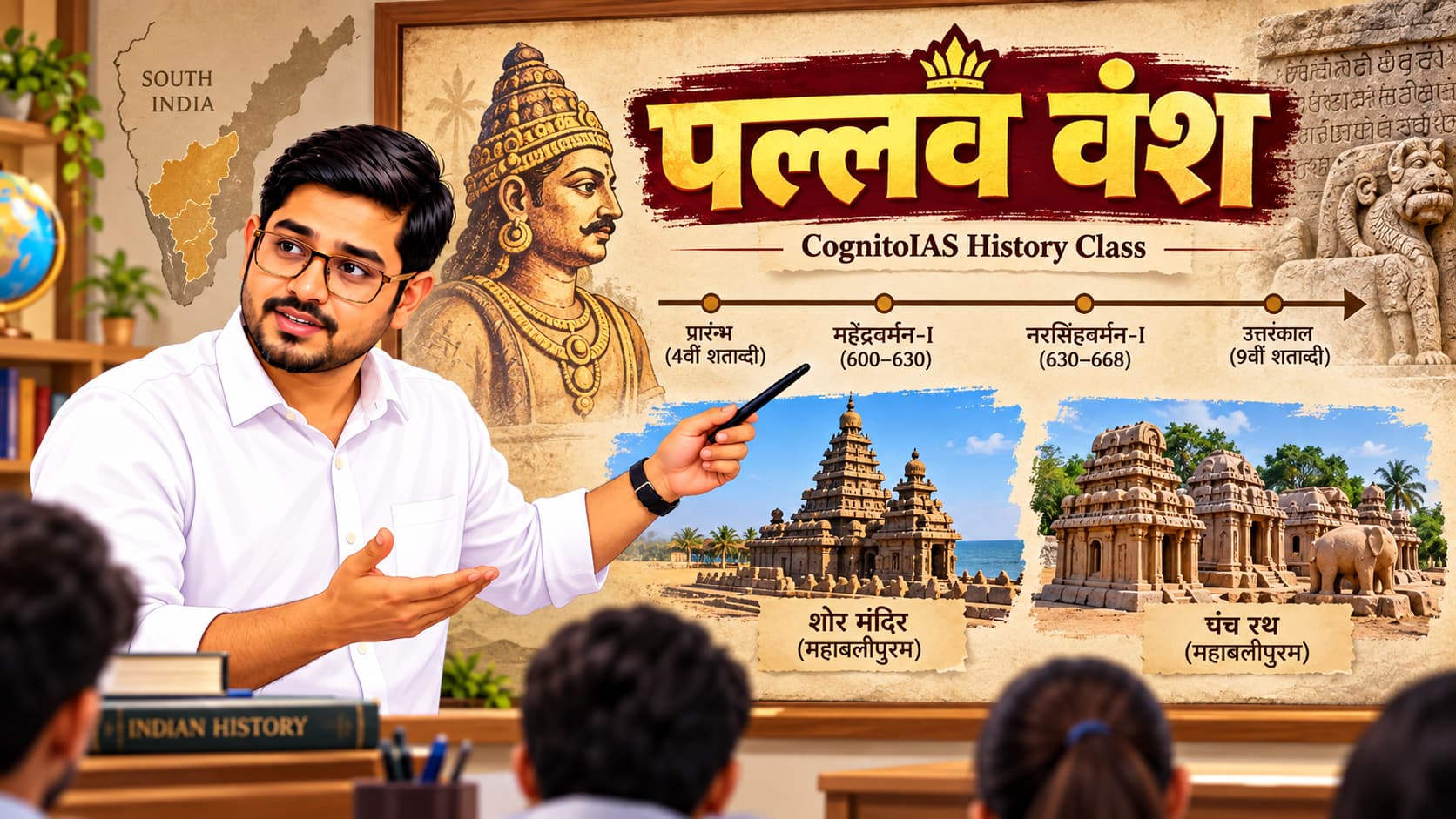
A note about the images: The chapter's posters are artistic illustrations intended for teaching; they are not substitutes for actual photographs of historical monuments, accurate territorial boundaries, or authenticated portraits of kings. On mobile devices, tap an image to open it at its original size.
01. The Mystery of the Five Rathas
We begin with a surprise—and through it, the story of the entire dynasty unfolds.
Student: Sir, there are rathas at Mahabalipuram named after Dharmaraja, Bhima, and Arjuna. Were they actually built by the Pandavas?
Teacher: No! These are monolithic monuments of the Pallava period. The names associated with characters from the Mahabharata arose from later traditions. And these are not movable chariots either.
Student: Then which king had such stone rathas built?
Teacher: We will find the answer in the coastal town of Mamallapuram and the Pallava dynasty that ruled there. But first, identify two capitals in our story—Kanchipuram and Vatapi.
Student: Two capitals of the same dynasty?
Teacher: No. Kanchipuram was the capital of the Pallavas; Vatapi, or Badami, was the capital of the Chalukyas. This rivalry will later connect the stories of both warfare and architecture.
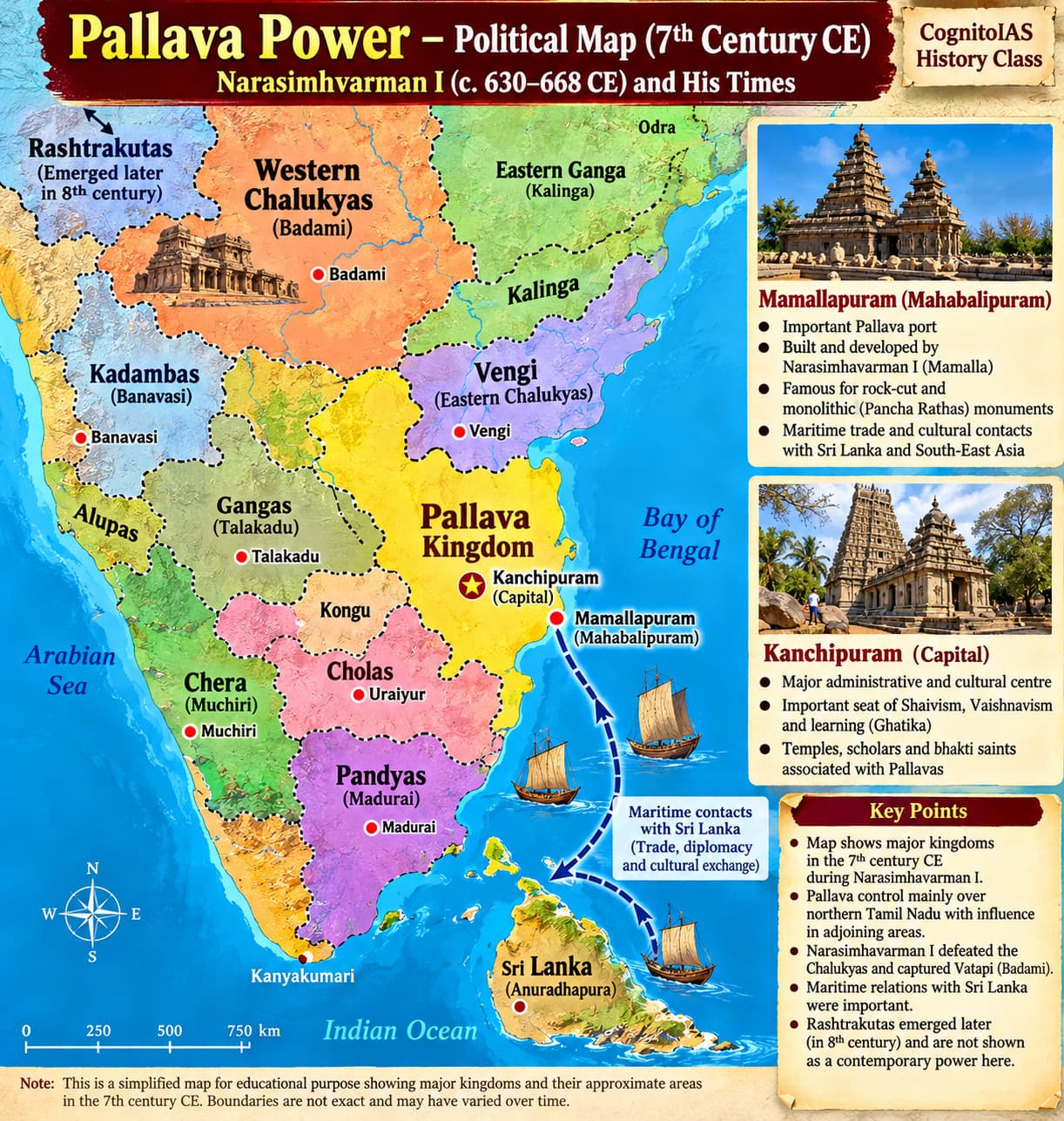
The principal territory of the Pallavas was Tondaimandalam, centred on present-day northern Tamil Nadu; at different times, their influence also extended into southern Andhra Pradesh. There are differing theories about Pallava origins—it would be unwise to treat any single hypothesis as established fact.
02. The Pallavas Long Before Simhavishnu
A dynasty does not begin merely when one of its rulers becomes famous.
Student: So was Simhavishnu the first Pallava king?
Teacher: No. It is convenient to begin the powerful phase of Pallava history with Simhavishnu, but copper-plate grants and inscriptions provide evidence of earlier Pallavas.
Student: Copper plates? You mean orders engraved on copper rather than written on paper?
Teacher: Exactly. Land grants and royal proclamations were inscribed on copper plates. Important sources for the early Pallavas include the copper-plate grants associated with Shivaskandavarman, namely the Mayidavolu and Hirahadagalli; these inscriptions use Prakrit.
Student: Do we know any names from even before him?
Teacher: The early epigraphic material does not conclusively name his father; scholars debate the genealogical position of early rulers such as Simhavarman. So do not turn these early kings into an unsupported, straightforward father–son succession. Shivaskandavarman's inscriptions also refer to claims of Vedic sacrifices, including the Ashvamedha.
Student: But doesn't the name “Vishnugopa” also appear in Gupta history?
Teacher: Excellent observation! Samudragupta's Prayaga Prashasti, composed by Harishena, names “Vishnugopa of Kanchi” among the southern rulers. This is an important link connecting the early Pallavas with the Guptas.
Student: So, when a question mentions both Samudragupta and Kanchi, we should remember Vishnugopa?
Teacher: Yes. The Uttar Pradesh PCS examination has also asked about precisely this association.
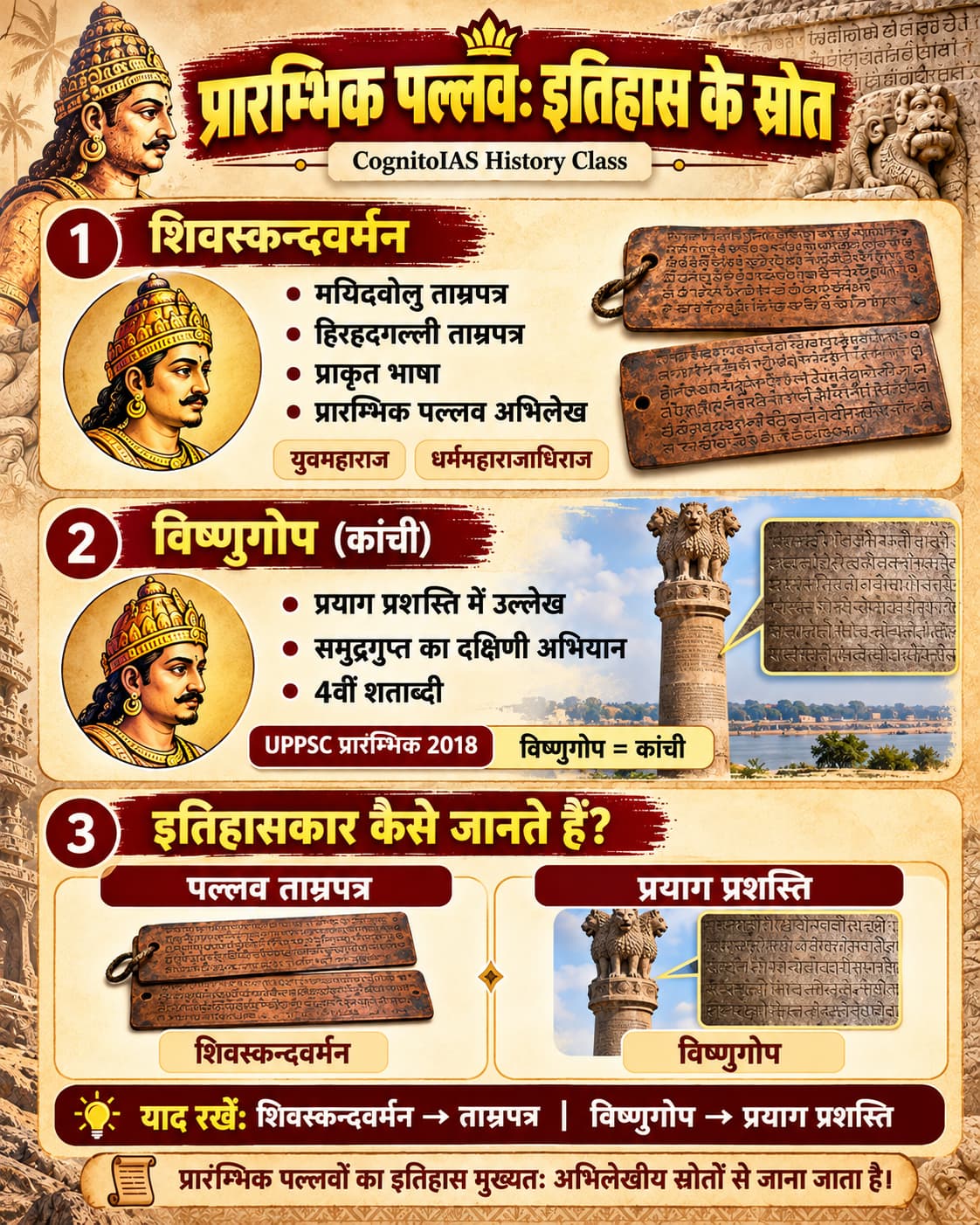
Remembering the Early Pallavas
Shivaskandavarman — Prakrit Copper PlatesVishnugopa — Kanchi and Samudragupta
03. The Ruler Who Revived Pallava Power
Our story now moves towards the latter half of the sixth century CE.
Student: How did the Pallavas suddenly become so prominent after Samudragupta?
Teacher: A long period and many rulers came in between. In the sixth century, during the reign of Simhavishnu, Pallava power underwent a major revival. He challenged Kalabhra dominance and extended his influence southwards.
Student: Who were the Kalabhras?
Teacher: Their name is associated with a complex political phase in Tamil history. Simhavishnu matters because the Pallavas emerged as a major power under him. We should also remember the role of the Pandya ruler Kadungon in ending Kalabhra dominance in the Tamil region—this achievement cannot be attributed to a single ruler.
Student: Was there anything notable about his royal court?
Teacher: Yes. According to tradition, the renowned Sanskrit poet Bharavi is associated with Simhavishnu's period. His work is the Kiratarjuniya. As we shall see, Pallava kings were associated not only with warfare but also with art and literature.
04. An Artist-King Confronts the Crisis of War
Mahendravarman I: Literature, Royal Titles, and Rock-Cut Temples.
Student: Who succeeded Simhavishnu?
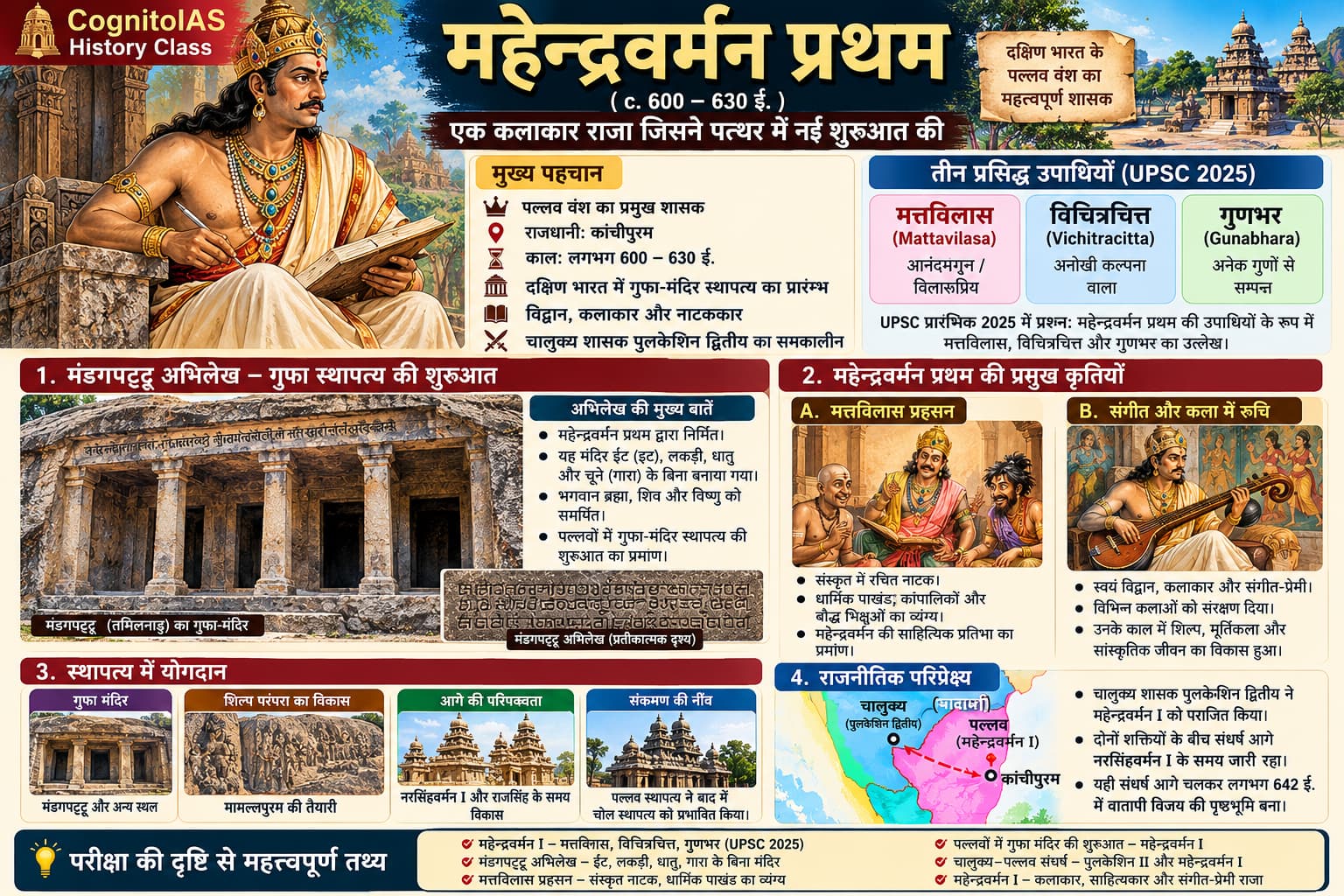
Teacher: His son, Mahendravarman I (approximately 600–630 CE), came next. He is as important for art and literature as he is for warfare.
Student: Could a king also be a writer himself?
Teacher: Certainly! He wrote the Sanskrit satirical farce Mattavilasa Prahasana, which mocks the pretensions of certain religious sects of his time.
Student: Sir, is Mattavilasa the name of a book or a title of the king?
Teacher: This is precisely the sort of distinction that can confuse students in examinations—Mattavilasa was one of Mahendravarman I's royal titles, while Mattavilasa Prahasana was also his literary work. His other major titles were Vichitrachitta and Gunabhara.
Student: So was this ruler also associated with the Shaiva saint Appar?
Teacher: Yes. According to the Shaiva bhakti tradition, he was first influenced by Jainism and then came to follow Shaivism under the influence of Appar/Tirunavukkarasar. Remember this as a traditional account.
Student: He loved art so much; then whom did he fight?
Teacher: He faced the powerful Chalukya ruler of Badami, Pulakeshin II. The Pallavas and Chalukyas came into conflict, and a battle associated with Pullalur is also mentioned. The Chalukyas put pressure on the Pallavas, but Kanchi remained a Pallava centre.
Student: Were Mahendravarman's artisans still constructing temples amid all these battles?
Teacher: This is where the first major chapter in architecture begins: Carving a temple inside a rock instead of assembling one from separate stones. The rock-cut cave halls of the Mahendra style are famous for this experiment.
Student: Carving rooms into hills—where do we find evidence of this?
Teacher: The Mandagapattu inscription proudly describes a temple built without brick, timber, metal, or mortar. Mandagapattu, Mahendravadi and Mamandur are examples associated with the Mahendra-period cave-temple tradition.
05. The Son Launched a Counterattack on Vatapi
The enemy's capital from a generation earlier now became the target.
Student: Mahendravarman faced Pulakeshin's challenge. What happened next?
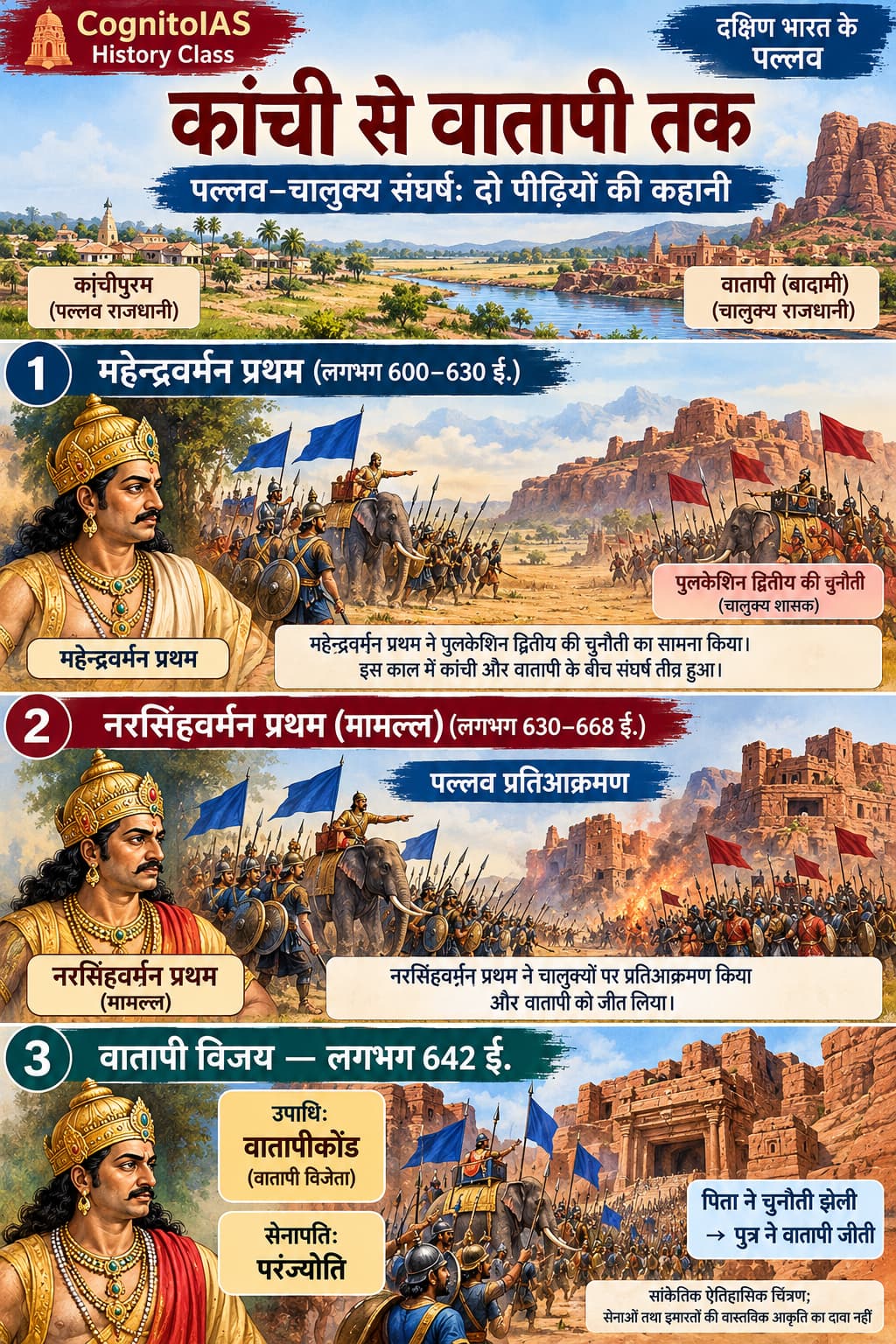
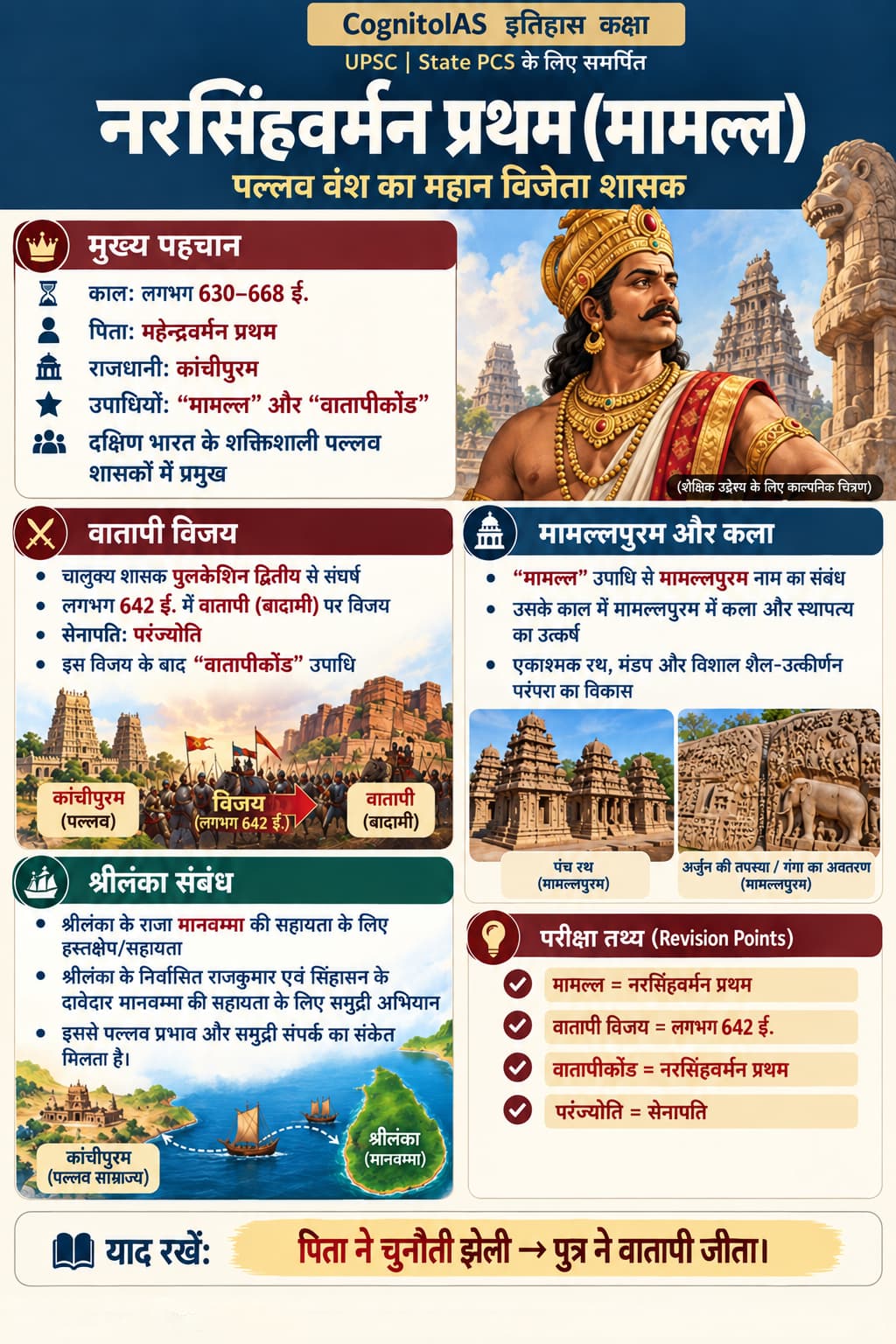
Teacher: His son, Narasimhavarman I (approximately 630–668 CE) ascended the throne. His famous title was Mamalla—“great wrestler” or “great warrior.”
Student: Did he continue his father's conflict?
Teacher: Yes. Manimangalam and other victories helped the Pallava army advance northwards; around 642 CE, it captured the Chalukya capital of Vatapi. Paranjyoti is regarded as a major commander associated with this campaign.
Student: Then who was called “Vatapikonda”?
Teacher: Narasimhavarman I. Vatapikonda means “conqueror of Vatapi.” Mamalla and Vatapikonda both refer to the same ruler.
Student: Did Mamalla's campaigns end after he fought so far from home?
Teacher: The story now crosses the sea. To support the exiled Sri Lankan prince Manavamma, Narasimhavarman I dispatched naval expeditions. These also demonstrate the Pallavas' maritime connections.
Student: Didn't a foreign traveller also write about Kanchi around this time?
Teacher: Yes. The Chinese Buddhist traveller Xuanzang (Hiuen Tsang) described Kanchi in the seventh century. He depicts it as an important religious and educational centre. Later, when we discuss the “Ghatika,” we will better understand Kanchi's learning environment.
MamallaVatapikondaParanjyotiManavamma—Sri LankaMamallapuram
MamallaMamallaVatapikondaParanjyotiManavamma—Sri LankaMamallapuram
06. When Five Rocks Became Five Different Temple Forms
Now we can identify the rathas not only by their names but also by their shapes.
Student: Mamalla achieved such an important political victory—why is Mamallapuram famous in his name?
Teacher: Because a unique centre of the artistic tradition associated with his name is Mamallapuram/Mahabalipuram. Here, sculptors carved natural rock formations into different temple forms.
Student: Mahendravarman also carved stone. How did the art of these two rulers differ?
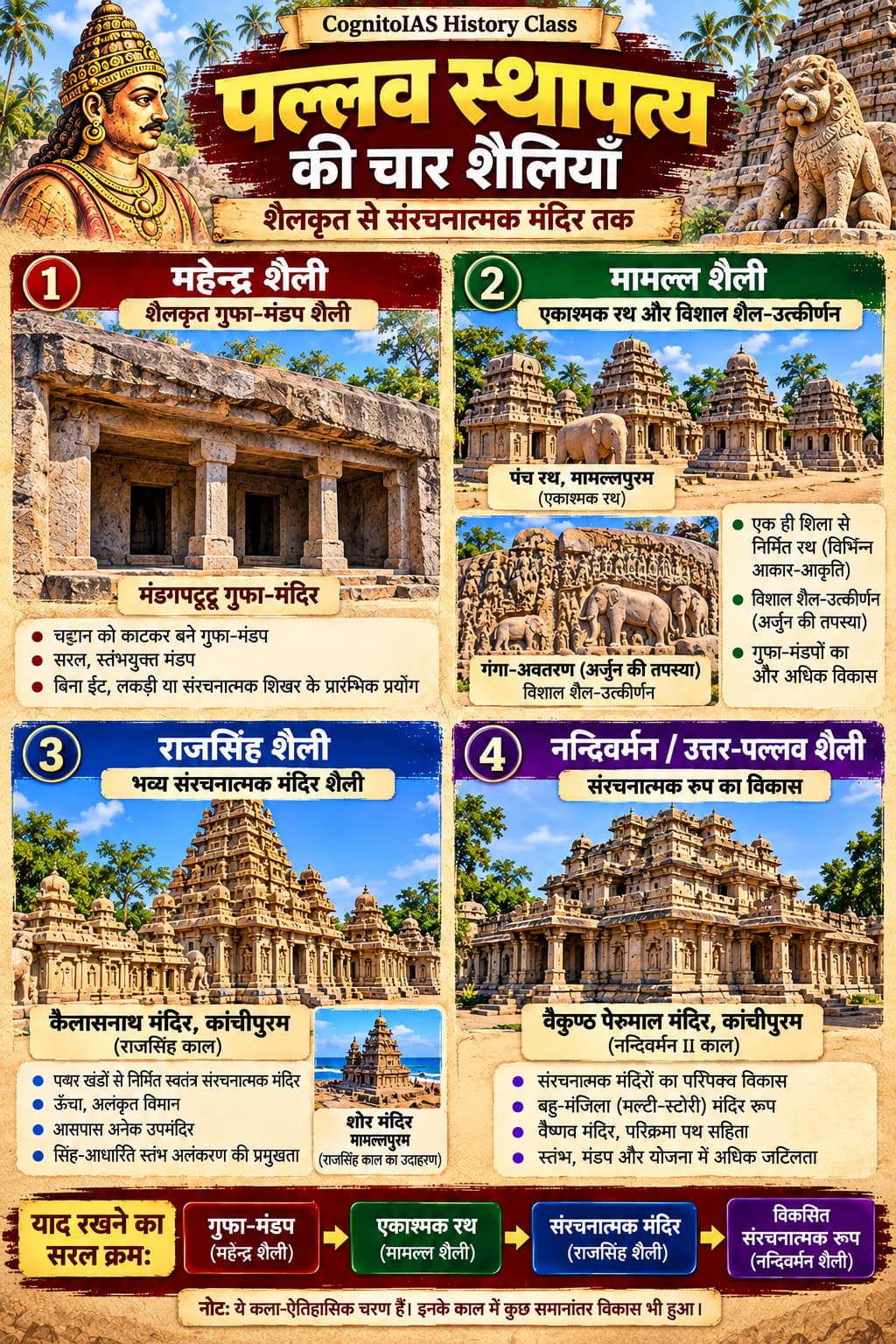
Teacher: The main experiment of the Mahendra style was the cave hall carved into rock. In the Mamalla style, caves developed further, along with monolithic rathas, lion-based pillars and massive large rock reliefs. The two phases also share techniques, and their periods overlap to some extent.
Student: Do all five rathas look alike?
Teacher: No! Imagine five craftsmen being asked to demonstrate five distinct roof shapes and temple plans. Identify each by its shape, and the names will be much easier to remember.
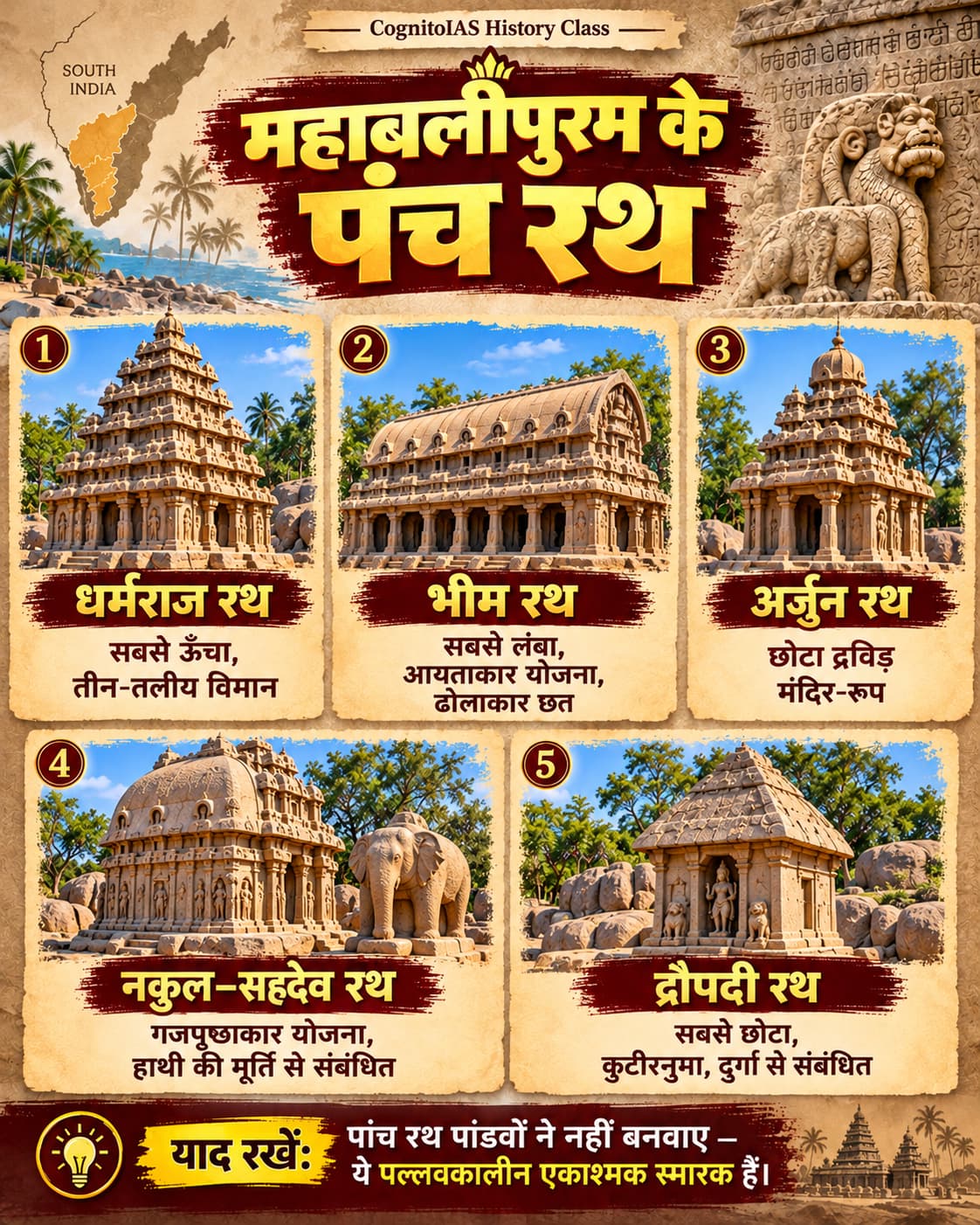
These are simplified symbols for distinguishing architectural styles, not scale drawings of the monuments.
Student: Three facts are now clear—Dharmaraja is tall, Bhima is long, and Draupadi is the smallest! But which is the largest?
Teacher: Many general descriptions call Dharmaraja the largest, while some study materials regard Bhima as larger on the basis of length or extent. So, for examinations, it is safer to remember the more precise distinctions: Dharmaraja—the tallest, Bhima—the longest, Draupadi—the smallest.
Student: Were only rathas built there?
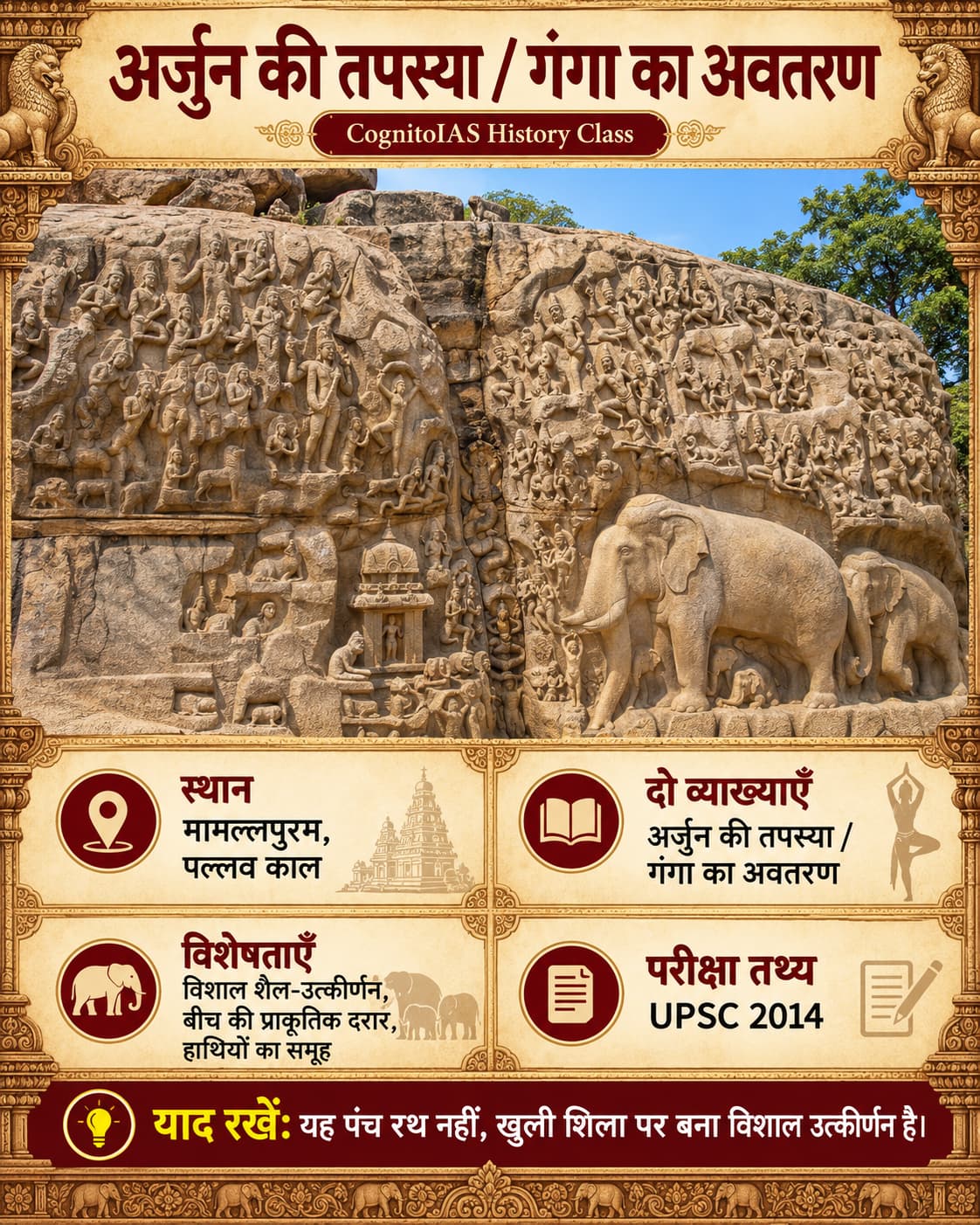
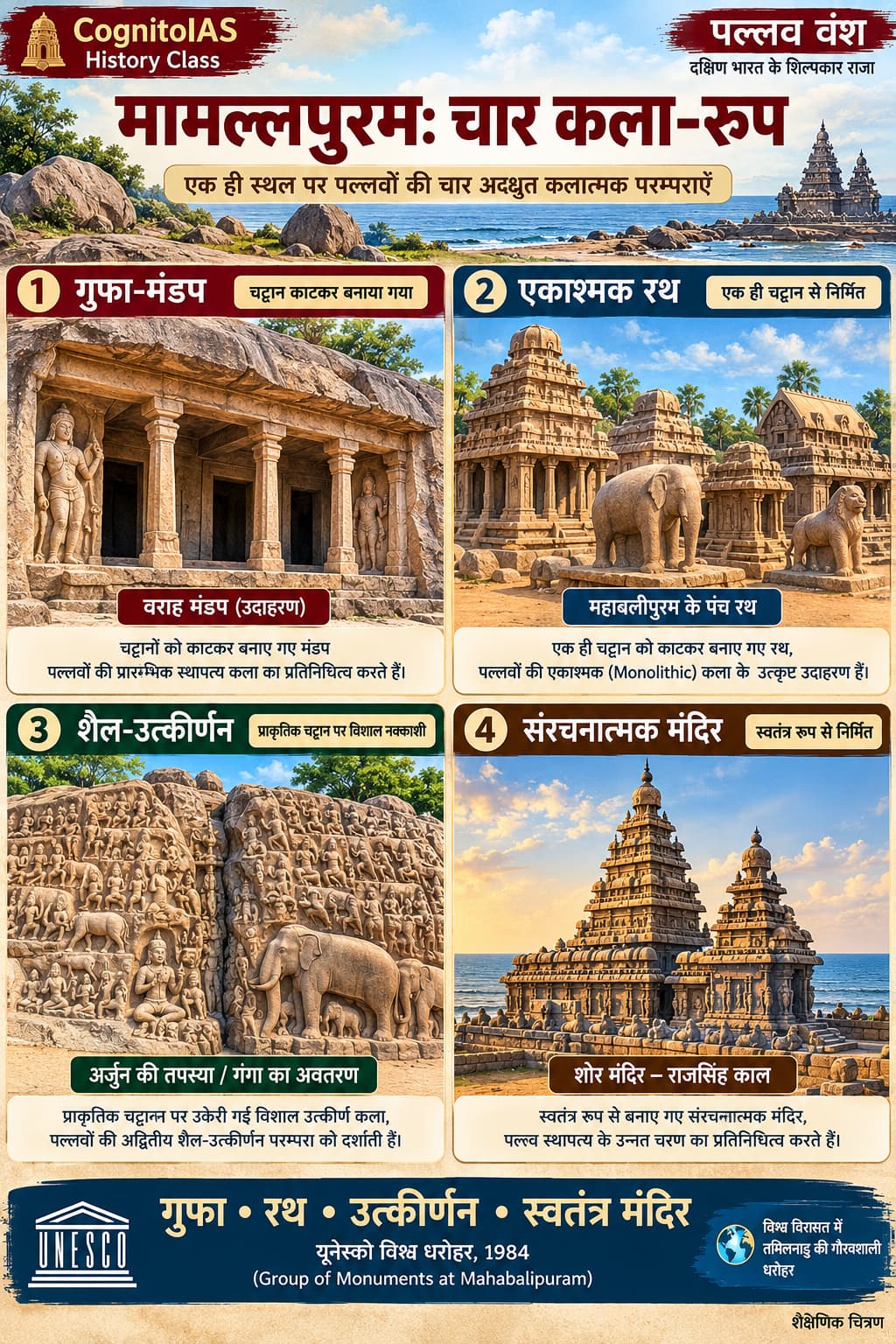
Teacher: No. That is what makes Mamallapuram special. It has cave halls (Varaha and Mahishasuramardini), monolithic rathas, large rock reliefs (Arjuna's Penance), and, later, the structural Shore Temple—all these architectural forms can be seen there.
Student: Is Arjuna's Penance a sculpture or an entire temple?
Teacher: It is not a temple, but a massive open-air rock relief carved onto large rock faces. It is interpreted under two names: “Arjuna's Penance” and “Descent of the Ganges”; scholars differ on its precise subject.
07. The Mystery of the “Seven Pagodas” by the Sea
Now learn to distinguish historical evidence from legend.
Student: Sir, why was Mamallapuram also called the “Seven Pagodas”? Is that another name for the Five Rathas?
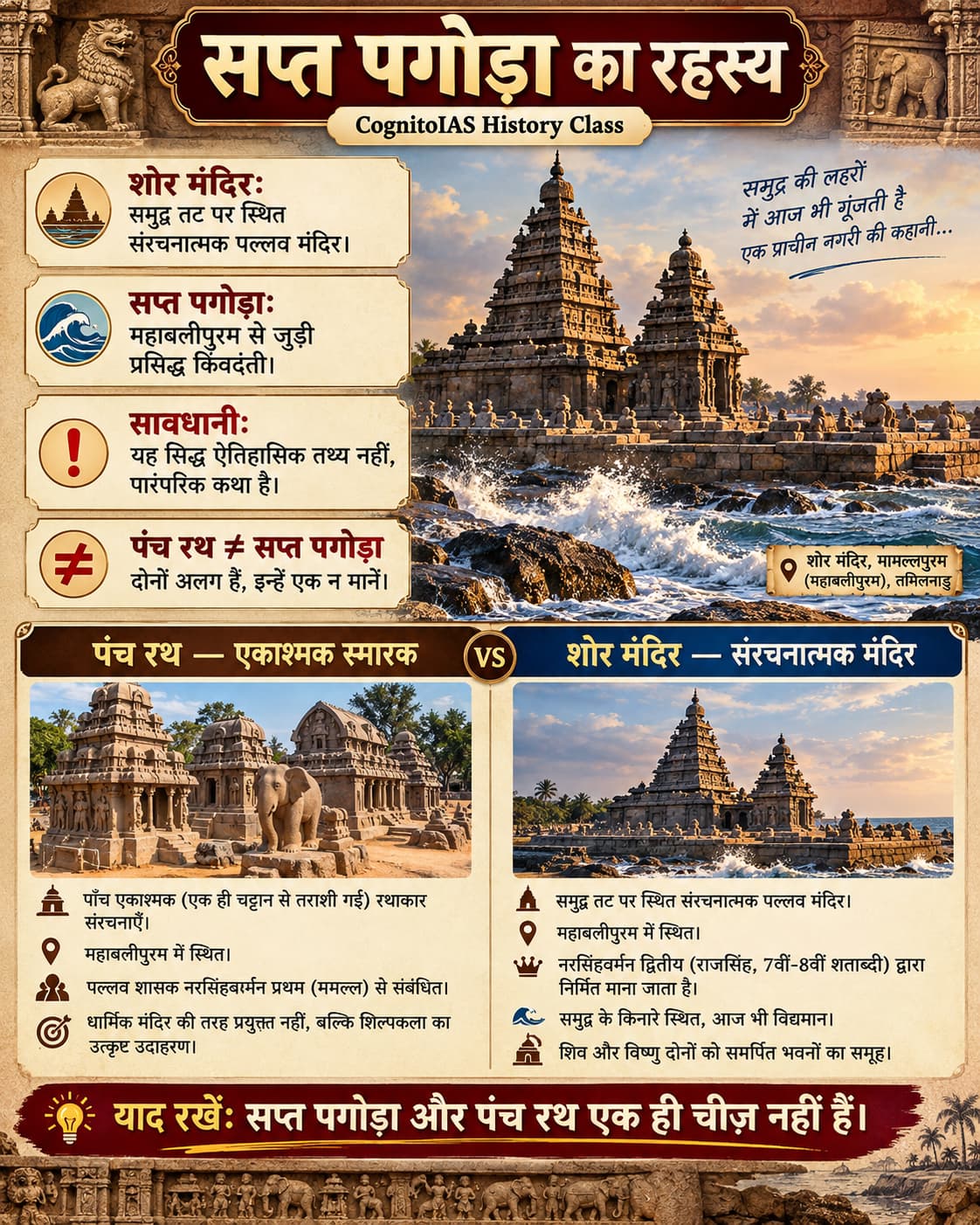
Teacher: No. Sapta Pagodas or the Seven Pagodas is a separate, famous expression associated with seafarers and European accounts. The word “pagoda” was used for a temple or a tall temple tower.
Student: Were there really seven temples in the sea?
Teacher: Tradition says that seven major temples stood along the coast and that most were swallowed by the sea; however, the claim that there were exactly seven temples and exactly six were submergedshould not be presented as established history. Archaeological remains have been found in coastal and underwater areas, suggesting older structures.
Student: So which temple still stands by the seashore today?
Teacher: The Shore Temple. But unlike the Five Rathas, it is not monolithic—it is a structural temple. The Pallava ruler associated with it brings us to the next major turning point.
08. The Chalukya–Pallava Conflict Was Not Yet Over
New rulers, but the same political rivalry.
Student: Did the two dynasties make peace after the conquest of Vatapi?
Teacher: No. Narasimhavarman I was succeeded by his son, Mahendravarman II, whose reign was very short. Then came Paramesvaravarman I.
Student: Who had replaced Pulakeshin II among the Chalukyas?
Teacher: His son, Vikramaditya I, became a major ruler at Badami. The struggle between the two powers continued. Peruvalanallur is associated with a battle involving Paramesvaravarman I; Pallava and Chalukya inscriptions sometimes emphasise their own successes differently.
Student: So we shouldn't study history as though “one victory ended everything”?
Teacher: Exactly. Meanwhile, temple architecture was gradually shifting from rock-cut monuments towards structural temples. The next ruler will illustrate that change very clearly.
09. Freestanding Temples Rose Instead of Being Cut into Rock
Rajasimha and the third major phase of Pallava architecture.
Student: So far, artisans had been cutting into rock. How did they then build a freestanding temple like the Shore Temple?
Teacher: By assembling separately carved blocks of stone. This method is called structural architecture. The major ruler associated with its magnificent development under the Pallavas was Narasimhavarman II, whose famous title was Rajasimha.
Student: But wasn't Narasimhavarman also the name of the king who conquered Vatapi?
Teacher: That is a classic examination trap: Narasimhavarman I = Mamalla = Vatapikonda, whereas Narasimhavarman II = Rajasimha = Shore Temple and Kailasanatha Temple.
Student: Which are the two most important temples of Rajasimha?
Teacher: The Shore Temple at Mamallapuram and the Kailasanatha Temple at Kanchipuram. Both are outstanding examples of structural Dravidian temple architecture. The main construction of Kailasanatha is associated with Rajasimha, while some additions are attributed to his son.
Student: How can I identify a structural temple in a picture?
Teacher: Look for the rising vimana (the tower over the sanctum), a structure assembled from dressed stones, lion/yali pillars, and, in several temples, representations of Somaskanda (Shiva, Parvati, and the child Skanda).
Student: Was any famous writer associated with the period, alongside these conflicts?
Teacher: The Sanskrit prose writer Dandin is associated with the wider Pallava cultural milieu. His principal works include Dashakumaracharita and Avantisundarikatha. Scholars disagree about his precise court connections, so it is not appropriate to describe him as an unequivocally established court poet of Rajasimha alone.
10. When There Was No Direct Heir to the Throne
The story of the succession is carved on the walls of a temple.
Student: Did the throne pass normally within Rajasimha's family after his reign?
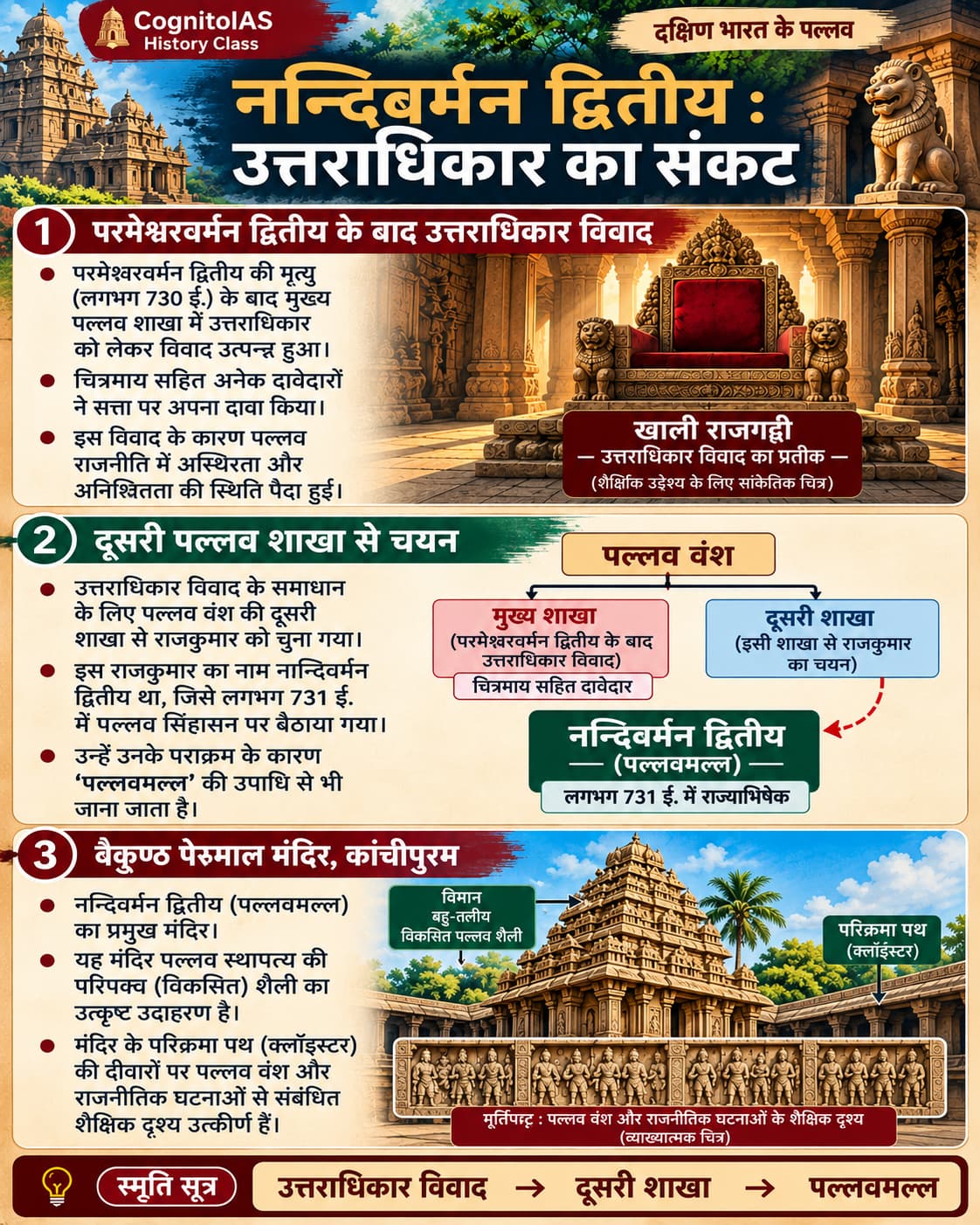
Teacher: He was followed by Paramesvaravarman II. After his death, a succession crisis arose. A boy from another branch of the Pallava family was chosen as king.
Student: A boy king? Who was he?
Teacher: Nandivarman II, whose title was Pallavamalla. Traditional accounts say he was selected at around twelve years of age. He had to contend with rebellions and neighbouring powers; Udayachandra was an important commander of his.
Student: How do we know about such an old succession dispute?
Teacher: The Vaikuntha Perumal Temple at Kanchipuram has historical sculpted panels that help us understand Pallava genealogy and succession. In other words, a temple is not merely a place of worship—it is alsovisual evidence of history.
Student: Is this also called the fourth architectural style? Was there a fourth construction technique?
Teacher: No. The Nandivarman or Later Pallava style is an art-historical phase in the further development of structural temples, not a separate “fourth building technique.” Kanchi's Vaikuntha Perumal Temple is a key example; Muktesvara and Matangesvara temples also exemplify the Later Pallava tradition.
11. Where and What Did Students Study in Kanchi?
From the capital emerges a story of education, devotion, language, and village life.
Student: You said Kanchi was an important centre of learning. Where did students study? Were there colleges like those we have today?
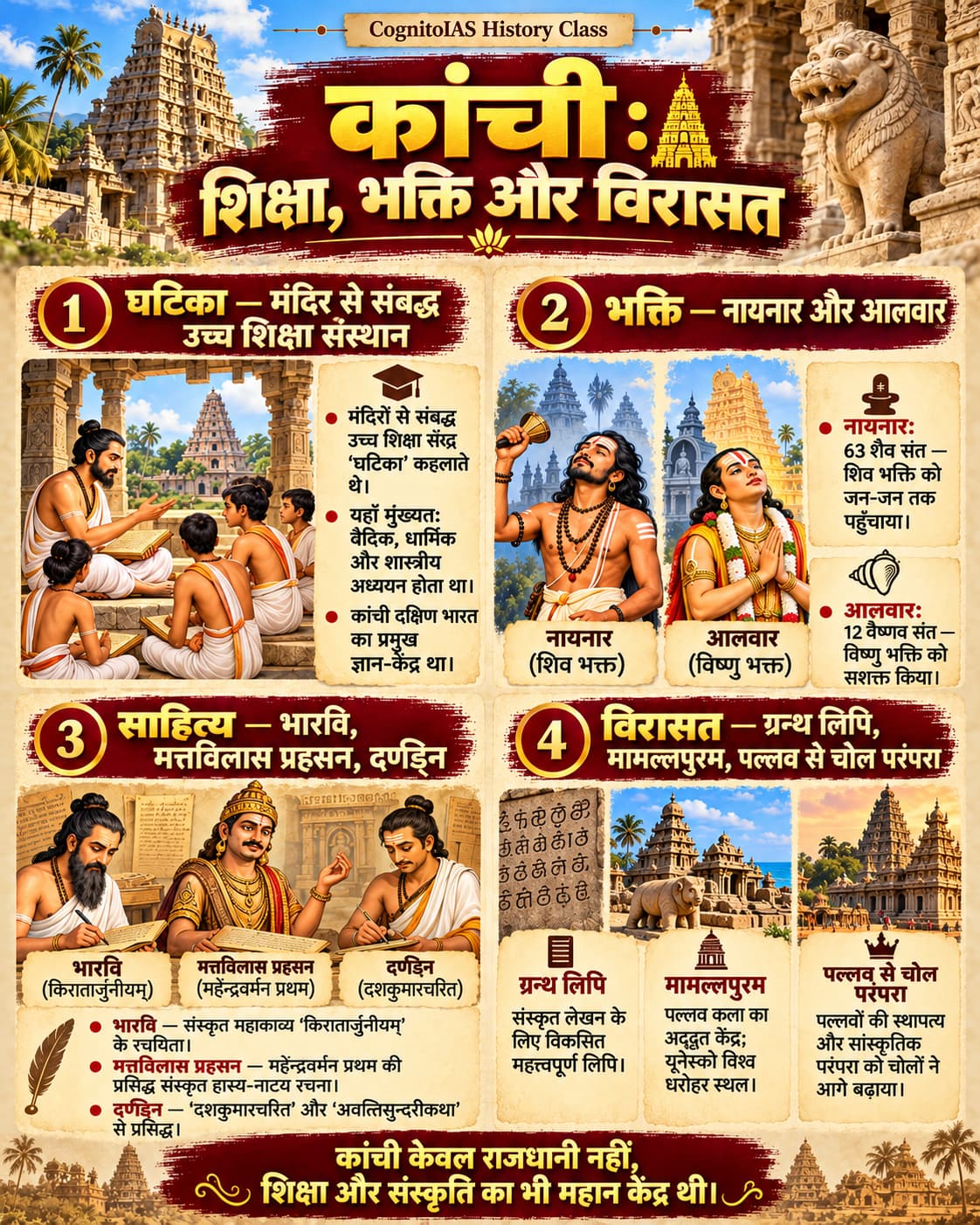
Teacher: Not exactly like modern colleges, but institutions of higher learning called Ghatikas were well known. They were generally associated with temples, where the Vedas, grammar, scriptures, and religious subjects were studied. Kanchi's Ghatika was particularly famous.
Student: So a “Ghatika” was not another name for a temple, but an educational institution?
Teacher: Exactly! Remember this distinction: Ghatika = generally a centre for advanced learning associated with a temple. UPSC has tested this directly.
Student: If religion and learning flourished together at Kanchi, was the Bhakti movement also expanding at the time?
Teacher: Yes. In South India, the traditions of the Nayanars, devotees of Shiva, and the Alvars, devotees of Vishnu, flourished. Tradition recognises 63 Nayanars and 12 Alvars. The saint Appar, associated with Mahendravarman, was part of this Shaiva bhakti milieu.
Student: Are the names of their hymns important for examinations too?
Teacher: Yes. Appar, Sambandar, and Sundarar composed Shaiva hymns associated with the Tevaram tradition. The Tamil Vaishnava devotional hymns of the Alvars were later compiled in the Nalayira Divya Prabandham.
Student: We have also learned about Bharavi, Mahendravarman, and Dandin in literature—can we remember them together?
Teacher: Certainly. Simhavishnu—Bharavi—Kiratarjuniya; Mahendravarman—Mattavilasa Prahasana; Pallava Cultural Milieu—Dandin—Dashakumaracharita. This makes a strong memory chain.
Student: Which languages were used in inscriptions?
Teacher: Initially, Prakritwas used, followed by extensive use of Sanskrit as well as significant use of Tamil. The Pallava-period tradition of the Grantha script, developed in South India for writing Sanskrit, influenced certain script traditions of Southeast Asia.
Student: Did the Pallavas develop village assemblies like those of the Cholas?
Teacher: There is evidence of local institutions and land-grant systems under the Pallavas. Administrative units included terms such as Kottam, Nadu, and village. At the village level, institutions such as the Sabha (particularly in Brahmin settlements) and the Ur, as well as Brahmadeya land grants and irrigation arrangements, were important. It would be incorrect to treat them as identical to the more fully developed forms of Chola administration.
12. Pallava Rule Ended—But Why Did Their Art Survive?
Political decline, cultural continuity.
Student: Did the Pallavas continue to rule for long after Nandivarman II?
Teacher: Yes. Among the important later rulers were Dantivarman → Nandivarman III → Nripatunga Varman → Aparajitavarman. Conflicts with the Pandyas, Rashtrakutas, and the rising Chola power weakened the Pallavas.
Student: Who brought Pallava political power to an end?
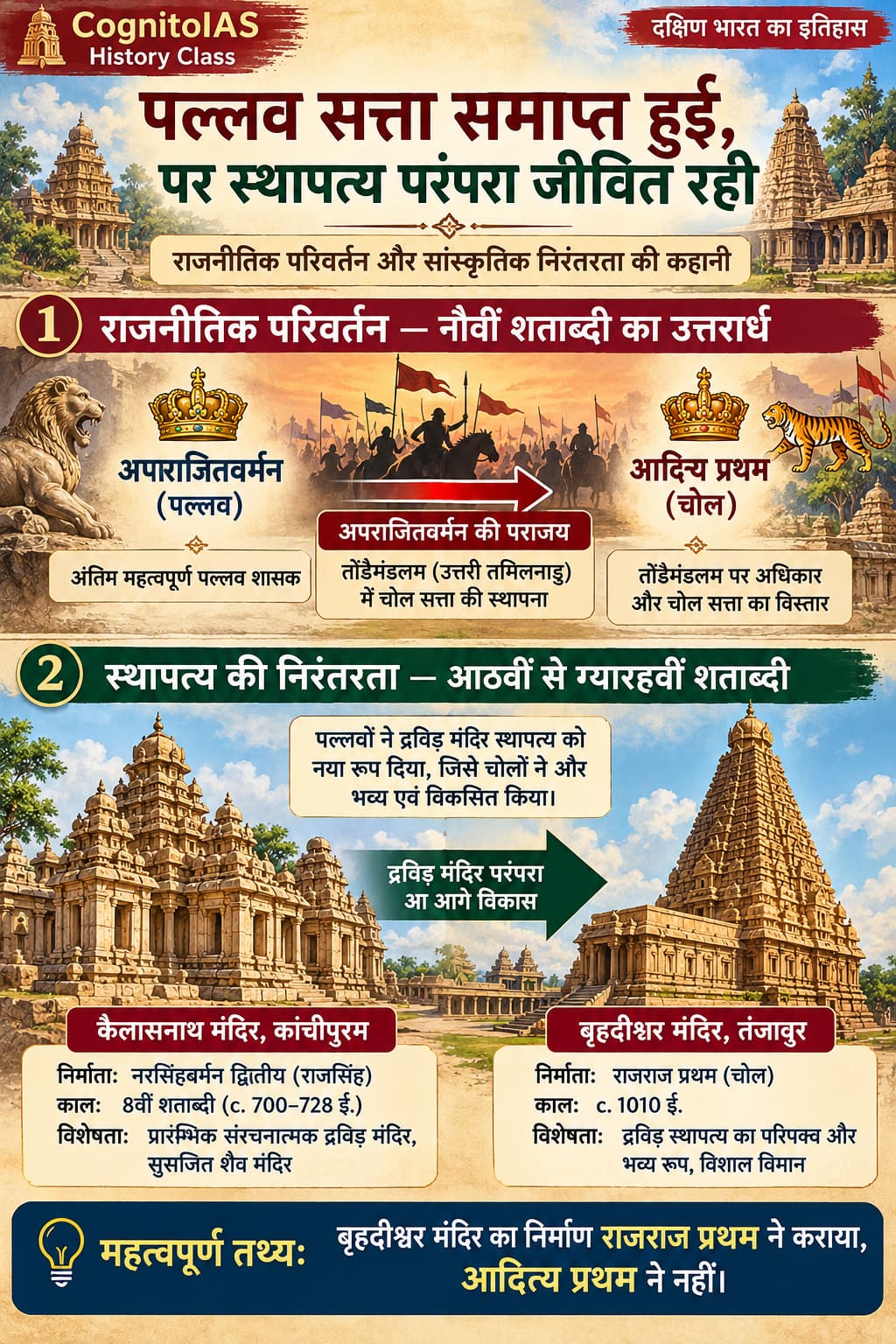
Teacher: Towards the end of the ninth century, the Chola king Aditya I defeated Aparajitavarman, and Chola influence was established over Tondaimandalam.
Student: Does that mean Pallava temple building came to an end too?
Teacher: No. Later Chola rulers developed Dravidian architecture—built upon Pallava caves, monolithic ratha experiments, and structural temples—into a larger and more mature form. Political power changed hands, but artistic traditions continued.
Student: Then why are the monuments of Mamallapuram still so famous?
Teacher: Because several forms of Pallava artistic achievement survive in one location—caves, monolithic rathas, great rock reliefs, and the Shore Temple. The Group of Monuments at Mahabalipuram was inscribed on the UNESCO World Heritage List in 1984.
13. The Entire Story in Sixty Seconds and Exam Practice
Do not just read—form the answer in your mind before revising.
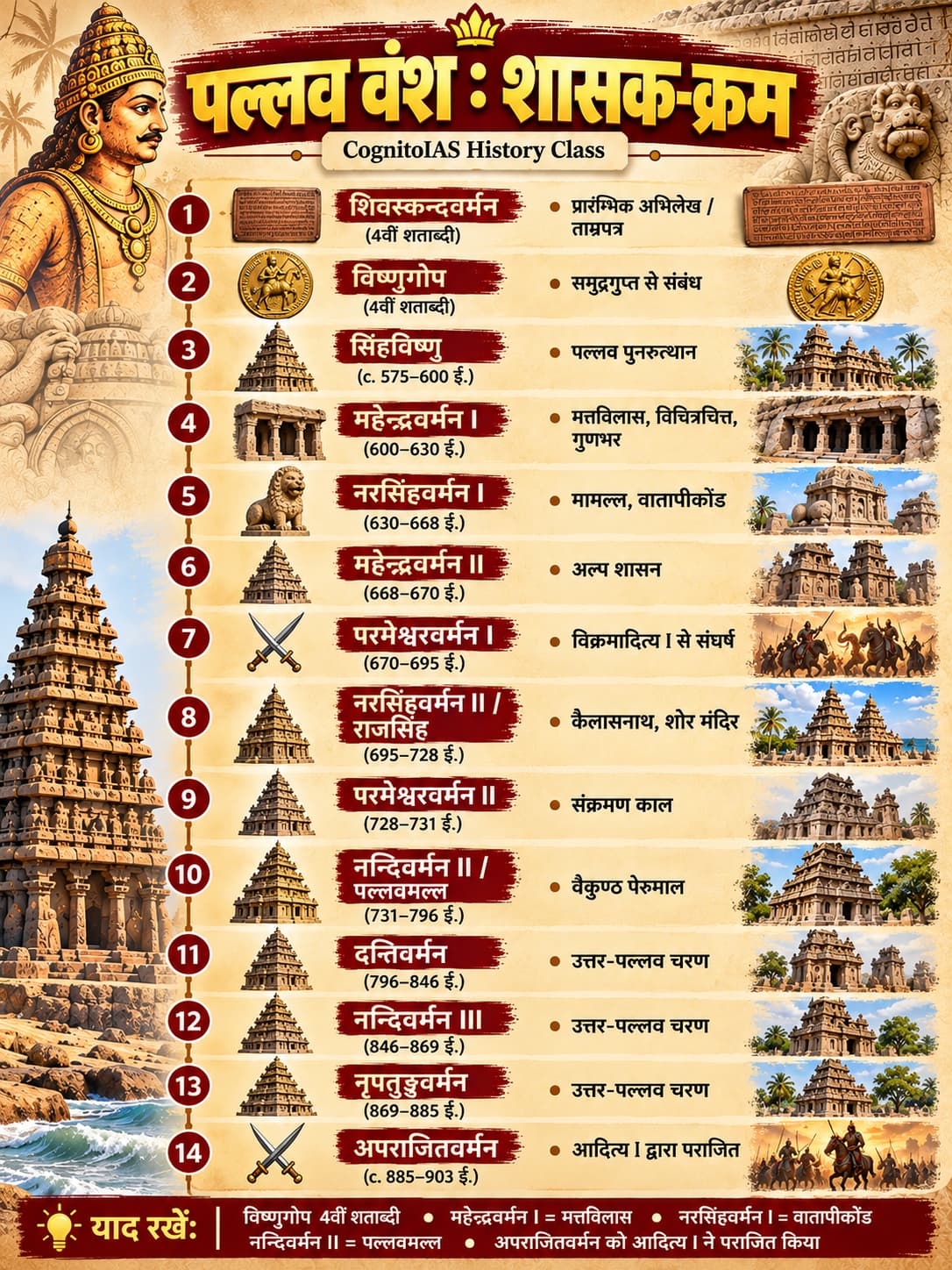
Final Memory Aid: Study the Pallavas not merely as a list of kings, but through the conflict between Kanchi and Vatapi, the evolution of architecture in stone and the continuity of education, devotion, and literature. Then the rulers and temples will naturally fall into place.
कॉग्निटोआईएएस | इतिहास की संवादशाला
पल्लव वंश
एक राजवंश, दो प्रतिद्वंद्वी राजधानियाँ और पत्थर से मंदिर बनने की कहानी
सरल हिन्दी संवाद • वास्तविक परीक्षा-संदर्भ • चित्रात्मक व्याख्या • सटीक पुनरावृत्ति
चित्र-संबंधी सावधानी: अध्याय के पोस्टर शिक्षण हेतु कलात्मक चित्रण हैं; ऐतिहासिक स्मारकों की वास्तविक तस्वीरों, सटीक भू-सीमाओं या राजाओं के प्रमाणित चित्रों का विकल्प नहीं। मोबाइल पर चित्र को टैप करके मूल आकार में खोल सकते हैं।
01. पाँच रथों का रहस्य
पहले एक आश्चर्य—और उसी से पूरी वंश-कथा का द्वार खुलेगा।
विद्यार्थी: सर, महाबलीपुरम में धर्मराज, भीम और अर्जुन के नाम पर रथ हैं। क्या इन्हें सचमुच पांडवों ने बनवाया था?
शिक्षक: नहीं! ये पल्लवकालीन एकाश्मक स्मारक हैं। महाभारत के पात्रों वाले नाम बाद की परंपरा से जुड़े हैं। और ये चलते हुए रथ भी नहीं हैं।
विद्यार्थी: तो राजा कौन था जिसने पत्थर के ऐसे रथ बनवाए?
शिक्षक: उसका उत्तर हमें एक समुद्री नगर मामल्लपुरम और वहाँ शासन करने वाले पल्लव राजवंश में मिलेगा। पर कहानी में पहले दो राजधानियाँ पहचानो—कांचीपुरम और वातापी।
विद्यार्थी: एक ही राजवंश की दो राजधानियाँ?
शिक्षक: नहीं। कांचीपुरम पल्लवों की राजधानी थी; वातापी या बादामी चालुक्यों की। यही प्रतिद्वंद्विता आगे युद्ध और स्थापत्य—दोनों की कहानी से जुड़ती जाएगी।
पल्लवों का मुख्य क्षेत्र तोंडैमंडलम था, जिसका केंद्र वर्तमान उत्तरी तमिलनाडु था; विभिन्न समयों में उनका प्रभाव दक्षिणी आंध्र प्रदेश तक भी रहा। पल्लवों की उत्पत्ति पर मतभेद हैं—किसी एक अनुमान को निश्चित सत्य मानना ठीक नहीं।
02. सिंहविष्णु से बहुत पहले के पल्लव
किसी राजा के प्रसिद्ध होने से राजवंश की शुरुआत नहीं हो जाती।
विद्यार्थी: अब पल्लवों का पहला राजा कौन था—सिंहविष्णु?
शिक्षक: नहीं। सिंहविष्णु से शक्तिशाली पल्लव चरण समझना सुविधाजनक है, मगर उनसे पहले के पल्लवों के प्रमाण ताम्रपत्रों और अभिलेखों में मिलते हैं।
विद्यार्थी: ताम्रपत्र? यानी कागज के स्थान पर ताँबे पर लिखे आदेश?
शिक्षक: बिल्कुल। भूमि-दान और राजकीय घोषणाएँ ताँबे की पट्टिकाओं पर अंकित होती थीं। प्रारम्भिक पल्लवों के अध्ययन में शिवस्कन्दवर्मन से जुड़े मयिदवोलु और हिरहदगल्ली ताम्रपत्र महत्वपूर्ण हैं; इनमें प्राकृत का प्रयोग मिलता है।
विद्यार्थी: क्या उससे पहले भी कोई नाम मिलता है?
शिक्षक: प्रारम्भिक अभिलेखीय सामग्री में उसके पिता का नाम निश्चित रूप से नहीं दिया गया है; विद्वान प्रारम्भिक सिंहवर्मन आदि नामों की वंशगत पहचान पर चर्चा करते हैं। इसलिए इन शुरुआती शासकों को बिना प्रमाण सीधी पिता-पुत्र श्रृंखला में मत बदलना। शिवस्कन्दवर्मन के अभिलेखों से अश्वमेध सहित वैदिक यज्ञों के दावे का भी पता चलता है।
विद्यार्थी: लेकिन “विष्णुगोप” नाम तो गुप्त इतिहास में भी आता है, है न?
शिक्षक: बहुत अच्छी पहचान! समुद्रगुप्त की प्रयाग प्रशस्ति, जिसे हरिषेण ने रचा, दक्षिण के शासकों में “कांची का विष्णुगोप” बताती है। यही प्रारम्भिक पल्लवों और गुप्तों को जोड़ने वाली कड़ी है।
विद्यार्थी: तो यदि प्रश्न में समुद्रगुप्त और कांची दोनों आएँ, हमें विष्णुगोप याद करना है?
शिक्षक: हाँ। और उत्तर प्रदेश पीसीएस ने इसी जोड़ी को पूछा भी था।
प्रारम्भिक पल्लवों की स्मृति
शिवस्कन्दवर्मन — प्राकृत ताम्रपत्रविष्णुगोप — कांची एवं समुद्रगुप्त
03. एक शासक जिसने पल्लव शक्ति को फिर खड़ा किया
कहानी अब छठी शताब्दी के उत्तरार्ध की ओर बढ़ती है।
विद्यार्थी: समुद्रगुप्त के बाद पल्लव अचानक इतने प्रसिद्ध कैसे हो गए?
शिक्षक: बीच में लंबा समय और अनेक शासक आए। छठी शताब्दी में सिंहविष्णु के समय पल्लव सत्ता का बड़ा पुनरुत्थान हुआ। उसने कलभ्र प्रभुत्व को चुनौती दी तथा दक्षिण की ओर प्रभाव बढ़ाया।
विद्यार्थी: कलभ्र कौन थे?
शिक्षक: तमिल क्षेत्र के इतिहास का एक जटिल राजनीतिक चरण उनके नाम से जुड़ा है। सिंहविष्णु का महत्व यह है कि उसके समय पल्लवों ने प्रमुख शक्ति का रूप लिया। तमिल क्षेत्र में कलभ्र प्रभुत्व को समाप्त करने में पांड्य शासक कडुंगोन की भूमिका भी याद रखनी चाहिए—यह उपलब्धि किसी एक शासक तक सीमित नहीं थी।
विद्यार्थी: उसके दरबार की भी कोई पहचान थी?
शिक्षक: हाँ, परंपरा में प्रसिद्ध संस्कृत कवि भारवि को सिंहविष्णु के समय से जोड़ा जाता है। उनकी रचना किरातार्जुनीयम् है। आगे देखोगे कि पल्लव राजा केवल युद्ध नहीं, कला और साहित्य से भी जुड़े रहे।
04. कलाकार राजा के सामने युद्ध का संकट
महेन्द्रवर्मन प्रथम: साहित्य, राजकीय उपाधियाँ और चट्टान में बने मंदिर।
विद्यार्थी: सिंहविष्णु के बाद कौन आया?
शिक्षक: उसका पुत्र महेन्द्रवर्मन प्रथम (लगभग 600–630 ई.)। वह जितना महत्वपूर्ण युद्ध में है, उतना ही कला और साहित्य में भी।
विद्यार्थी: एक राजा खुद भी लेखक हो सकता है?
शिक्षक: बिल्कुल! उसने संस्कृत का हास्य-व्यंग्य नाटक मत्तविलास प्रहसन लिखा, जिसमें उस समय के कुछ धार्मिक संप्रदायों के आडंबर पर व्यंग्य है।
विद्यार्थी: सर, मत्तविलास पुस्तक का नाम है या राजा की उपाधि?
शिक्षक: यही परीक्षा का सुंदर भ्रम है—मत्तविलास महेन्द्रवर्मन प्रथम की उपाधियों में भी आता है और मत्तविलास प्रहसन उसकी रचना भी है। उसकी दूसरी प्रमुख उपाधियाँ विचित्रचित्त और गुणभर थीं।
विद्यार्थी: तो यही शासक शैव संत अप्पर से भी जुड़ा था?
शिक्षक: हाँ। शैव भक्ति-परंपरा में उसे पहले जैन प्रभाव में और फिर अप्पर/तिरुनावुक्करसर के प्रभाव से शैव बताया गया है। इसे परंपरागत विवरण के रूप में याद करना चाहिए।
विद्यार्थी: इतना कला-प्रेमी राजा था, फिर युद्ध किससे हुआ?
शिक्षक: बादामी का शक्तिशाली चालुक्य शासक पुलकेशिन द्वितीय उसके सामने आया। पल्लवों और चालुक्यों में संघर्ष हुआ; पुल्ललूर से जुड़ी लड़ाई का भी उल्लेख मिलता है। चालुक्यों ने पल्लवों पर दबाव डाला, लेकिन कांची पल्लव केंद्र बना रहा।
विद्यार्थी: क्या इतनी लड़ाइयों के बीच महेन्द्रवर्मन के कारीगर मंदिर भी बना रहे थे?
शिक्षक: यहीं पहली बड़ी स्थापत्य कहानी शुरू होती है: पत्थर जोड़कर मंदिर बनाने के बजाय चट्टान के भीतर मंदिर निकालना। महेन्द्र शैली के शैलकृत गुफा-मंडप इसी प्रयोग के लिए प्रसिद्ध हैं।
विद्यार्थी: पहाड़ के भीतर कमरे बनाना—इसका प्रमाण किस स्थान पर मिलता है?
शिक्षक: मंडगपट्टू अभिलेख में ऐसे मंदिर का गर्वपूर्ण उल्लेख है जो ईंट, लकड़ी, धातु और गारे के बिना बनाया गया। मंडगपट्टू, महेन्द्रवाड़ी और मामंडूर महेन्द्र-कालीन गुफा मंदिर परंपरा से जुड़े उदाहरण हैं।
05. पुत्र ने वातापी तक प्रतिआक्रमण किया
एक पीढ़ी पहले जो राजधानी शत्रु की थी, अब वही लक्ष्य बन गई।
विद्यार्थी: महेन्द्रवर्मन को पुलकेशिन की चुनौती मिली, लेकिन उसके बाद क्या हुआ?
शिक्षक: उसका पुत्र नरसिंहवर्मन प्रथम (लगभग 630–668 ई.) सत्ता में आया। उसकी प्रसिद्ध उपाधि थी मामल्ल—महान पहलवान या महान योद्धा।
विद्यार्थी: क्या उसने पिता के संघर्ष को जारी रखा?
शिक्षक: हाँ। मणिमंगलम आदि संघर्षों से जुड़ी सफलता के बाद पल्लव सेना उत्तर की ओर बढ़ी और लगभग 642 ई. में चालुक्य राजधानी वातापी पर अधिकार किया। परंज्योति इस अभियान से जुड़ा प्रमुख सेनानायक माना जाता है।
विद्यार्थी: तो फिर “वातापीकोंड” किसे कहा गया?
शिक्षक: नरसिंहवर्मन प्रथम को। वातापीकोंड का अर्थ है—“वातापी का विजेता”। मामल्ल और वातापीकोंड दोनों एक ही शासक से जुड़े हैं।
विद्यार्थी: इतनी दूर जाकर लड़ने के बाद क्या मामल्ल का अभियान खत्म हो गया?
शिक्षक: कहानी अब समुद्र पार चली जाती है। श्रीलंका के निर्वासित राजकुमार मानवम्मा की सहायता के लिए नरसिंहवर्मन प्रथम ने समुद्री अभियान भेजे। इससे पल्लवों के समुद्री संपर्क भी स्पष्ट होते हैं।
विद्यार्थी: कांची के बारे में विदेशी यात्री ने भी इसी समय लिखा था न?
शिक्षक: हाँ। चीनी बौद्ध यात्री ह्वेनसांग (युवानच्वांग) ने सातवीं शताब्दी में कांची का वर्णन किया। वह इसे एक बड़े धार्मिक और शैक्षिक केंद्र के रूप में बताता है। आगे जब “घटिका” पढ़ेंगे, कांची के अध्ययन-परिवेश को और समझेंगे।
मामल्लवातापीकोंडपरंज्योतिमानवम्मा—श्रीलंकामामल्लपुरम
मामल्लवातापीकोंडपरंज्योतिमानवम्मा—श्रीलंकामामल्लपुरम
06. जब पाँच चट्टानें पाँच अलग मंदिर-रूप बनीं
विद्यार्थी अब रथों के नाम ही नहीं, आकार भी पहचान सके।
विद्यार्थी: मामल्ल ने इतनी बड़ी राजनीतिक जीत हासिल की—उसके नाम पर मामल्लपुरम क्यों प्रसिद्ध है?
शिक्षक: क्योंकि उसके नाम से जुड़ी कला-परंपरा का अनूठा केंद्र मामल्लपुरम/महाबलीपुरम है। यहाँ शिल्पकारों ने प्राकृतिक चट्टानों को अलग-अलग मंदिर-रूपों में तराशा।
विद्यार्थी: महेन्द्रवर्मन भी पत्थर काटता था। दोनों की कला में फर्क क्या हुआ?
शिक्षक: महेन्द्र शैली में प्रमुख प्रयोग चट्टान के भीतर गुफा-मंडप का था। मामल्ल शैली में गुफाएँ और विकसित हुईं, साथ ही एकाश्मक रथ, सिंह-आधारित स्तंभ और विशाल शैल-उत्कीर्ण दृश्य बने। दोनों चरणों की तकनीक में समानताएँ और समयगत आच्छादन भी हैं।
विद्यार्थी: क्या पाँचों रथ एक जैसे दिखते हैं?
शिक्षक: नहीं! मानो पाँच कारीगरों को पाँच अलग छत और मंदिर-योजनाएँ दिखाने का काम मिला हो। इन्हें आकृति से पहचानो—नाम अपने-आप याद हो जाएगा।
ये शैली-पहचान के सरल प्रतीक हैं, वास्तविक स्मारकों के पैमानेदार चित्र नहीं।
विद्यार्थी: अब तो तीन बातें साफ हैं—धर्मराज ऊँचा, भीम लंबा, द्रौपदी सबसे छोटा! पर सबसे बड़ा कौन?
शिक्षक: अनेक सामान्य विवरणों में धर्मराज को सबसे बड़ा कहा जाता है, जबकि कुछ अध्ययन सामग्री लंबाई/विस्तार के आधार पर भीम को बड़ा बताती है। इसलिए परीक्षा में निश्चित रूप से धर्मराज—सबसे ऊँचा, भीम—सबसे लंबा, द्रौपदी—सबसे छोटा याद रखना अधिक सुरक्षित है।
विद्यार्थी: क्या वहाँ केवल रथ ही बनाए गए?
शिक्षक: नहीं। यही मामल्लपुरम को खास बनाता है। वहाँ गुफा-मंडप (वराह और महिषासुरमर्दिनी), एकाश्मक रथ, विशाल शैल-उत्कीर्ण दृश्य (अर्जुन की तपस्या) और बाद में संरचनात्मक तट-मंदिर—सभी प्रकार मिलते हैं।
विद्यार्थी: अर्जुन की तपस्या तो मूर्ति है या पूरा मंदिर?
शिक्षक: यह मंदिर नहीं, बड़े शिलाखंडों पर उकेरी गई विशाल खुली शैल-उत्कीर्ण रचना है। इसे “अर्जुन की तपस्या” और “गंगा का अवतरण”—दो नामों से समझा जाता है; विषय की व्याख्या को लेकर मत हैं।
07. समुद्र किनारे “सात मंदिरों” का रहस्य
अब इतिहास और किंवदंती को अलग करना सीखें।
विद्यार्थी: सर, मामल्लपुरम को “सप्त पगोड़ा” भी क्यों कहा गया? क्या ये पाँच रथों का दूसरा नाम है?
शिक्षक: नहीं। सप्त पगोड़ा या सेवन पगोड़ा समुद्री यात्रियों और यूरोपीय वृत्तांतों से जुड़ी एक अलग प्रसिद्ध संज्ञा है। “पगोड़ा” शब्द मंदिर अथवा ऊँचे मंदिर-शिखर के लिए प्रयोग होता था।
विद्यार्थी: सात मंदिर सचमुच समुद्र में थे?
शिक्षक: परंपरा कहती है कि किनारे सात प्रमुख मंदिर थे और अधिकांश समुद्र में समा गए; पर ठीक सात मंदिर थे और ठीक छह डूबे—इसे प्रमाणित इतिहास की तरह नहीं कहना चाहिए। तटीय और जलमग्न क्षेत्रों में पुरातात्त्विक अवशेष मिले हैं, जो पुराने निर्माणों का संकेत देते हैं।
विद्यार्थी: तो आज समुद्र किनारे जो मंदिर खड़ा है, वह कौन-सा है?
शिक्षक: शोर मंदिर अथवा तट-मंदिर। लेकिन यह पंच रथों की तरह एकाश्मक नहीं है—यह संरचनात्मक मंदिर है। इसे किस पल्लव शासक से जोड़ना है, वह अगला बड़ा मोड़ है।
08. चालुक्य–पल्लव संघर्ष अभी समाप्त नहीं हुआ था
नए राजा, लेकिन राजनीतिक प्रतिद्वंद्विता वही।
विद्यार्थी: वातापी विजय के बाद क्या दोनों राजवंश शांत हो गए?
शिक्षक: नहीं। नरसिंहवर्मन प्रथम के बाद उसके पुत्र महेन्द्रवर्मन द्वितीय का बहुत छोटा शासन रहा। फिर परमेश्वरवर्मन प्रथम आया।
विद्यार्थी: चालुक्यों में अब पुलकेशिन द्वितीय के स्थान पर कौन था?
शिक्षक: बादामी में उसका पुत्र विक्रमादित्य प्रथम प्रमुख बना। दोनों शक्तियों का संघर्ष जारी रहा। पेरुवलनल्लूर का युद्ध परमेश्वरवर्मन प्रथम से जुड़ा है; पल्लव और चालुक्य अभिलेख कभी अपनी-अपनी सफलताओं पर अलग जोर देते हैं।
विद्यार्थी: तो इतिहास को केवल “एक युद्ध जीत लिया और सब खत्म” की तरह नहीं पढ़ना चाहिए?
शिक्षक: बिल्कुल। और उसी समय मंदिर-निर्माण में भी शैलकृत से संरचनात्मक रूप की ओर धीरे-धीरे बदलाव चल रहा था। अब अगला राजा इस बदलाव को बहुत स्पष्ट कर देगा।
09. अब चट्टान के भीतर नहीं, स्वतंत्र मंदिर खड़े हुए
राजसिंह और पल्लव स्थापत्य का तीसरा बड़ा चरण।
विद्यार्थी: शिल्पकार अब तक चट्टान काट रहे थे। फिर शोर मंदिर जैसा स्वतंत्र मंदिर कैसे बना?
शिक्षक: अलग-अलग तराशे पत्थरों को जोड़कर। इस निर्माण को कहते हैं संरचनात्मक स्थापत्य। पल्लव काल में इसके भव्य विकास से जुड़ा प्रमुख शासक था नरसिंहवर्मन द्वितीय, जिसकी प्रसिद्ध उपाधि राजसिंह थी।
विद्यार्थी: लेकिन नरसिंहवर्मन नाम तो वातापी विजय वाले राजा का भी था!
शिक्षक: यही परीक्षा-जाल है: नरसिंहवर्मन प्रथम = मामल्ल = वातापीकोंड, जबकि नरसिंहवर्मन द्वितीय = राजसिंह = शोर मंदिर और कैलासनाथ मंदिर।
विद्यार्थी: राजसिंह के दो सबसे महत्वपूर्ण मंदिर कौन-से हैं?
शिक्षक: मामल्लपुरम का शोर मंदिर और कांचीपुरम का कैलासनाथ मंदिर। दोनों संरचनात्मक द्रविड़ मंदिर स्थापत्य के उत्कृष्ट उदाहरण हैं। कैलासनाथ के मुख्य निर्माण का संबंध राजसिंह से और कुछ अतिरिक्त निर्माण उसके पुत्र से जोड़े जाते हैं।
विद्यार्थी: चित्र में संरचनात्मक मंदिर की पहचान कैसे करूँ?
शिक्षक: ऊपर उठता विमान (गर्भगृह के ऊपर शिखर), तराशे पत्थरों की जोड़ी हुई संरचना, सिंह/याली स्तंभ, और कई मंदिरों में सोमास्कन्द (शिव, पार्वती और बाल स्कन्द) के चित्रण जैसी विशेषताएँ देखो।
विद्यार्थी: क्या यहाँ भी युद्ध के साथ कोई प्रसिद्ध लेखक जुड़ा है?
शिक्षक: इस व्यापक पल्लव सांस्कृतिक परिवेश से संस्कृत गद्यकार दण्डिन् जुड़े माने जाते हैं। उनकी प्रमुख कृतियाँ दशकुमारचरित और अवन्तिसुन्दरीकथा हैं। दरबार से उनके सटीक संबंध पर विद्वानों में मतभेद हैं, इसलिए उन्हें केवल निश्चित राजसिंह-दरबारी कहना उचित नहीं।
10. जब राजगद्दी के लिए सीधा उत्तराधिकारी नहीं मिला
एक मंदिर की दीवार पर अंकित है उत्तराधिकार की कहानी।
विद्यार्थी: राजसिंह के बाद सत्ता उसके परिवार में सामान्य रूप से चली?
शिक्षक: उसके बाद परमेश्वरवर्मन द्वितीय आया। उसकी मृत्यु के बाद उत्तराधिकार का संकट खड़ा हुआ। पल्लव परिवार की दूसरी शाखा से एक बालक को राजा चुना गया।
विद्यार्थी: बालक राजा? कौन था?
शिक्षक: नन्दिवर्मन द्वितीय, जिसकी उपाधि थी पल्लवमल्ल। परंपरागत विवरण उसे करीब बारह वर्ष की उम्र में चुना गया बताते हैं। उसे विद्रोहों और पड़ोसी शक्तियों से जूझना पड़ा; उदयचन्द्र उसका महत्वपूर्ण सेनापति था।
विद्यार्थी: इतनी पुरानी गद्दी की कहानी हमें कैसे पता चली?
शिक्षक: कांचीपुरम के वैकुण्ठ पेरुमाल मंदिर में बने ऐतिहासिक मूर्तिपट पल्लव वंश और उत्तराधिकार की कथा समझने में मदद देते हैं। मतलब मंदिर केवल पूजा का केंद्र नहीं—इतिहास का दृश्य-साक्ष्य भी है।
विद्यार्थी: इसे स्थापत्य की चौथी शैली भी कहते हैं? क्या कोई चौथी तकनीक आ गई?
शिक्षक: नहीं। नन्दिवर्मन अथवा उत्तर-पल्लव शैली संरचनात्मक मंदिरों के आगे विकास का कला-ऐतिहासिक चरण है, अलग “चौथी निर्माण-तकनीक” नहीं। कांची का वैकुण्ठ पेरुमाल इसका प्रमुख अध्ययन-बिंदु है; मुक्तेश्वर और मातंगेश्वर मंदिर भी उत्तर-पल्लव परंपरा के उदाहरण हैं।
11. कांची में विद्यार्थी कहाँ और क्या पढ़ते थे?
राजधानी से शिक्षा, भक्ति, भाषा और ग्रामजीवन की कहानी निकलती है।
विद्यार्थी: कांची को बड़ा शिक्षा-केंद्र बताया; वहाँ छात्र पढ़ते कहाँ थे—आज जैसे महाविद्यालय भी थे?
शिक्षक: आधुनिक महाविद्यालय जैसे नहीं, पर घटिका नामक उच्च शिक्षण संस्थान प्रसिद्ध थे। ये सामान्यतः मंदिरों से जुड़े होते थे; इनमें वेद, व्याकरण, शास्त्र और धार्मिक अध्ययन का अध्ययन-परिवेश था। कांची की घटिका विशेष प्रसिद्ध थी।
विद्यार्थी: तो “घटिका” मंदिर का दूसरा नाम नहीं, शिक्षण संस्था थी?
शिक्षक: बिल्कुल! यही भेद याद रखो। घटिका = प्रायः मंदिर से संबद्ध उच्च अध्ययन-केंद्र। और यूपीएससी ने इसे सीधे परखा था।
विद्यार्थी: कांची में धर्म और अध्ययन साथ-साथ थे, तो क्या भक्ति आंदोलन भी इसी समय बढ़ रहा था?
शिक्षक: हाँ। दक्षिण भारत में नयनार शिवभक्त और आलवार विष्णुभक्त संतों की परंपराएँ फलीं। परंपरा में 63 नयनार और 12 आलवार माने जाते हैं। महेन्द्रवर्मन से जुड़ा संत अप्पर इसी शैव भक्ति-परिवेश का हिस्सा है।
विद्यार्थी: उनके भजनों के नाम भी परीक्षा के लिए हैं?
शिक्षक: हाँ। अप्पर, संबंदर और सुंदरर की शैव रचनाएँ तेवारम् परंपरा से जुड़ी हैं। आलवारों के तमिल वैष्णव भक्ति-पद बाद में नालायिर दिव्य प्रबंधम् में संगृहीत हुए।
विद्यार्थी: साहित्य में तो भारवि, महेन्द्रवर्मन और दण्डिन् भी आ गए—क्या इन्हें साथ याद कर सकते हैं?
शिक्षक: बिल्कुल। सिंहविष्णु—भारवि—किरातार्जुनीयम्; महेन्द्रवर्मन—मत्तविलास प्रहसन; पल्लव सांस्कृतिक परिवेश—दण्डिन्—दशकुमारचरित। यही स्मृति की मजबूत श्रृंखला है।
विद्यार्थी: अभिलेख किस भाषा में बनते थे?
शिक्षक: शुरुआत में प्राकृत, फिर संस्कृत का व्यापक उपयोग और तमिल का भी महत्वपूर्ण प्रयोग मिलता है। संस्कृत लेखन के लिए दक्षिण में विकसित ग्रन्थ लिपि की पल्लवकालीन परंपरा ने दक्षिण-पूर्व एशिया की कुछ लिपि-परंपराओं को प्रभावित किया।
विद्यार्थी: क्या पल्लवों ने चोलों जैसी ग्राम सभाएँ भी विकसित की थीं?
शिक्षक: पल्लवकाल में स्थानीय संस्थाओं और भूमि-दान व्यवस्था के प्रमाण हैं। शासन-इकाइयों में कोट्टम, नाडु और ग्राम जैसे शब्द मिलते हैं। गाँव में सभा (विशेषकर ब्राह्मण बस्ती) और ऊर जैसी सामुदायिक संस्थाएँ, ब्रह्मदेय भूमि-दान और सिंचाई व्यवस्था महत्वपूर्ण थे। इन्हें चोल प्रशासन के पूरी तरह विकसित रूप के समान मानना सही नहीं।
12. पल्लव सत्ता समाप्त हुई—पर उनकी कला क्यों जीवित रही?
राजनीतिक अंत, सांस्कृतिक निरंतरता।
विद्यार्थी: नन्दिवर्मन द्वितीय के बाद भी पल्लव बहुत समय तक रहे?
शिक्षक: हाँ। प्रमुख बाद के शासकों में दन्तिवर्मन → नन्दिवर्मन तृतीय → नृपतुंगवर्मन → अपराजितवर्मन आते हैं। पांड्य, राष्ट्रकूट और बढ़ती चोल शक्ति से संघर्ष ने पल्लवों को प्रभावित किया।
विद्यार्थी: पल्लवों की राजनीतिक शक्ति का अंत किसने किया?
शिक्षक: नौवीं शताब्दी के अंत में चोल राजा आदित्य प्रथम ने अपराजितवर्मन को पराजित किया और तोंडैमंडलम पर चोल प्रभाव स्थापित हुआ।
विद्यार्थी: क्या इसका मतलब पल्लव मंदिर-निर्माण भी समाप्त हो गया?
शिक्षक: नहीं। पल्लवों की गुफाओं, रथ-प्रयोगों और संरचनात्मक मंदिरों से विकसित द्रविड़ स्थापत्य को बाद के चोल शासकों ने और विशाल, परिपक्व रूप दिया। राज्य की सत्ता बदली, कला की परंपरा चलती रही।
विद्यार्थी: तो आज भी मामल्लपुरम के स्मारक इतने प्रसिद्ध क्यों हैं?
शिक्षक: क्योंकि एक ही क्षेत्र में पल्लव शिल्प-कला के अनेक रूप सुरक्षित हैं—गुफाएँ, एकाश्मक रथ, विशाल उत्कीर्णन और तट-मंदिर। महाबलीपुरम स्मारक-समूह 1984 में यूनेस्को विश्व धरोहर सूची में शामिल हुआ।
13. साठ सेकंड में पूरी कहानी और परीक्षा अभ्यास
पढ़कर नहीं—मन में उत्तर बनाकर दोहराएँ।
अंतिम स्मृति: पल्लवों को केवल राजाओं की सूची की तरह नहीं, कांची–वातापी के संघर्ष, पत्थर में बदलते स्थापत्य और शिक्षा–भक्ति–साहित्य की निरंतरता के रूप में समझो। तब नाम और मंदिर अपने-आप जगह पर बैठेंगे।