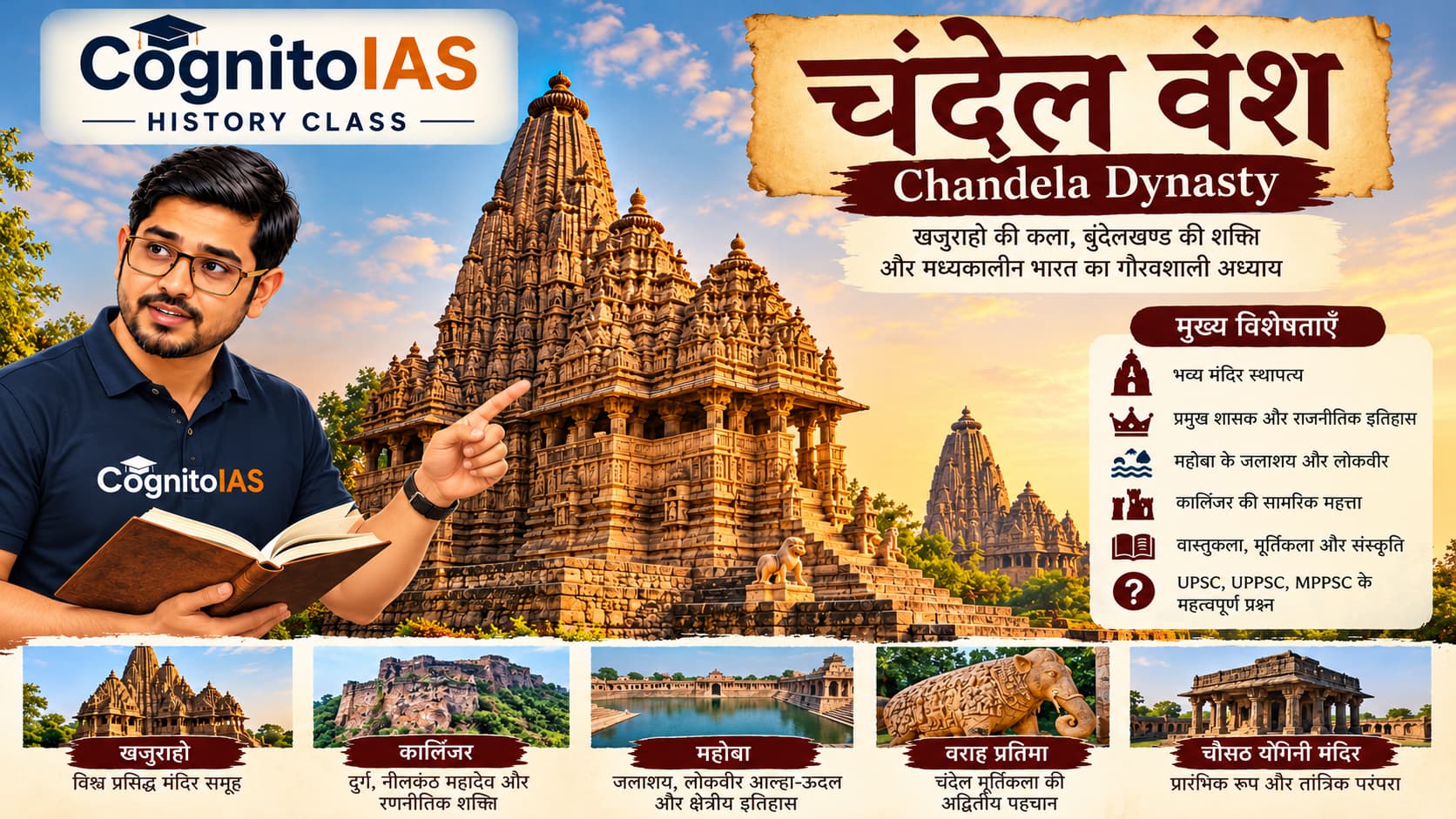
CognitoIAS HISTORY CLASS | History Through Dialogue
Chandela Dynasty
The Art of Khajuraho, the Might of Kalinjar, and the Heroic Ballads of Mahoba
English dialogue-based narrative • Evidence-based history • Exam alerts • Mobile-friendly revision
How to study: Each student question follows naturally from the teacher’s preceding answer. Remember important facts highlighted in blue and red; distinguish “Historian’s Caution” from established examination facts.
Chapter Index — 15 Episodes
01. A Temple Whose Name Hides Our First Question
Our journey through history begins at Khajuraho.
Student: Sir, is Khajuraho's Lakshmana Temple dedicated to Lakshmana, Lord Rama’s brother?
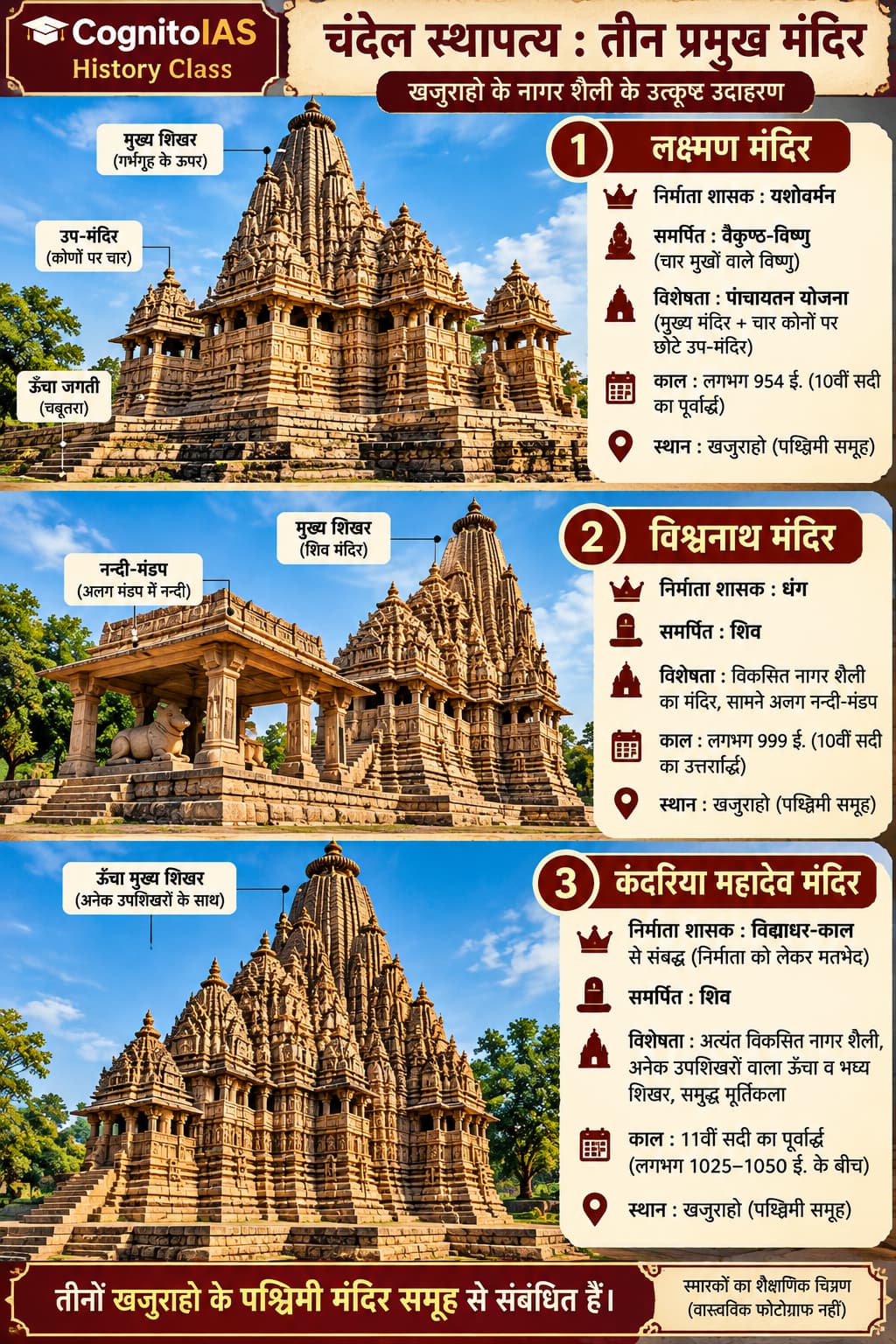
Teacher: That is our first interesting misconception! Although it is called Lakshmana Temple, its principal deity is Vaikuntha Vishnu. Its construction began under Chandela ruler Yashovarman.
Student: Which dynasty, then, gave us Khajuraho?
Teacher: The Chandela dynasty. In Jejakabhukti (Bundelkhand) in central India, the Chandelas brought temple architecture to new heights alongside their political rise.
Student: Where is Jejakabhukti today?
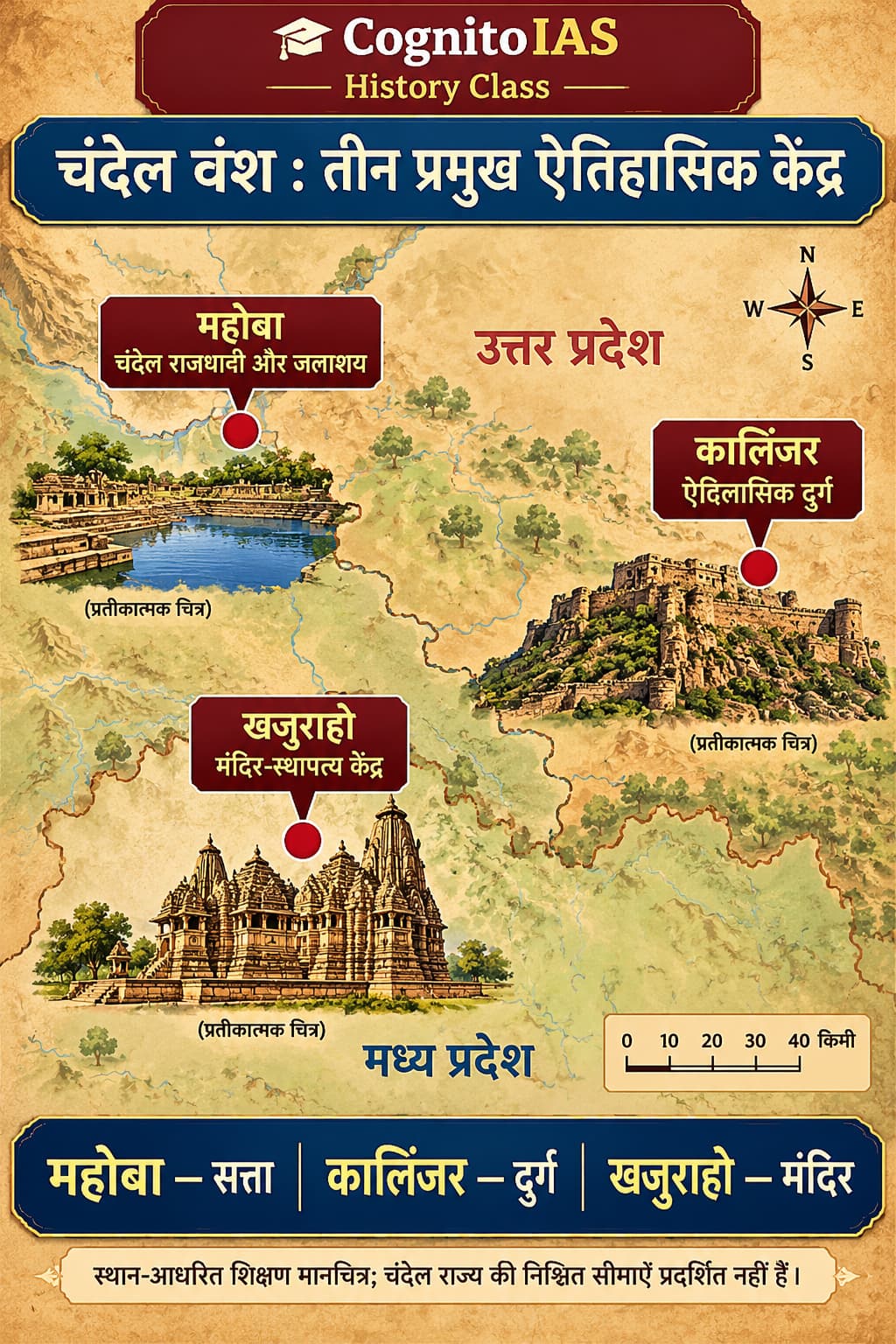
Teacher: Mainly in today's Bundelkhand region of Madhya Pradesh and Uttar Pradesh. Khajuraho (Chhatarpur), Kalinjar (Banda region), and Mahoba were three important centres.
UPSC CSE Prelims 2016 — GS-I, Places and Regions
Five pairs were given, including Khajuraho–Bundelkhand. The correct pairs were Khajuraho–Bundelkhand and Tirupati–Rayalaseema. Answer: Pairs 2 and 5 only.
Madhya Pradesh PCS Prelims 2013 — GS
In which district are the temples of Khajuraho situated? Answer: Chhatarpur (Madhya Pradesh). The exam year and answer were checked against a published question compilation.
Student: Were all three places capitals of the Chandelas?
Teacher: History cannot be reduced to a rigid “one capital” rule. Khajuraho was a major religious and cultural centre, Mahoba an important political centre, and Kalinjar a major fortified stronghold. Their significance changed over time.
Student: So the Chandela story begins on temple walls and reaches a fortress?
Teacher: Exactly. You will see how inscriptions, temples, battles, reservoirs, and folk songs together tell the history of a dynasty.
02. Born of the Moon: History or Legend?
Understand the difference between a fascinating tradition and historical evidence.
Student: Is the name “Chandela” related to the Moon?
Teacher: The dynasty's tradition of lunar descent is well known. A folk legend features Hemavati and the Moon-god. Historians, however, do not treat it as a verified account of the dynasty's actual birth.
Student: Who, then, is considered the first historical Chandela?
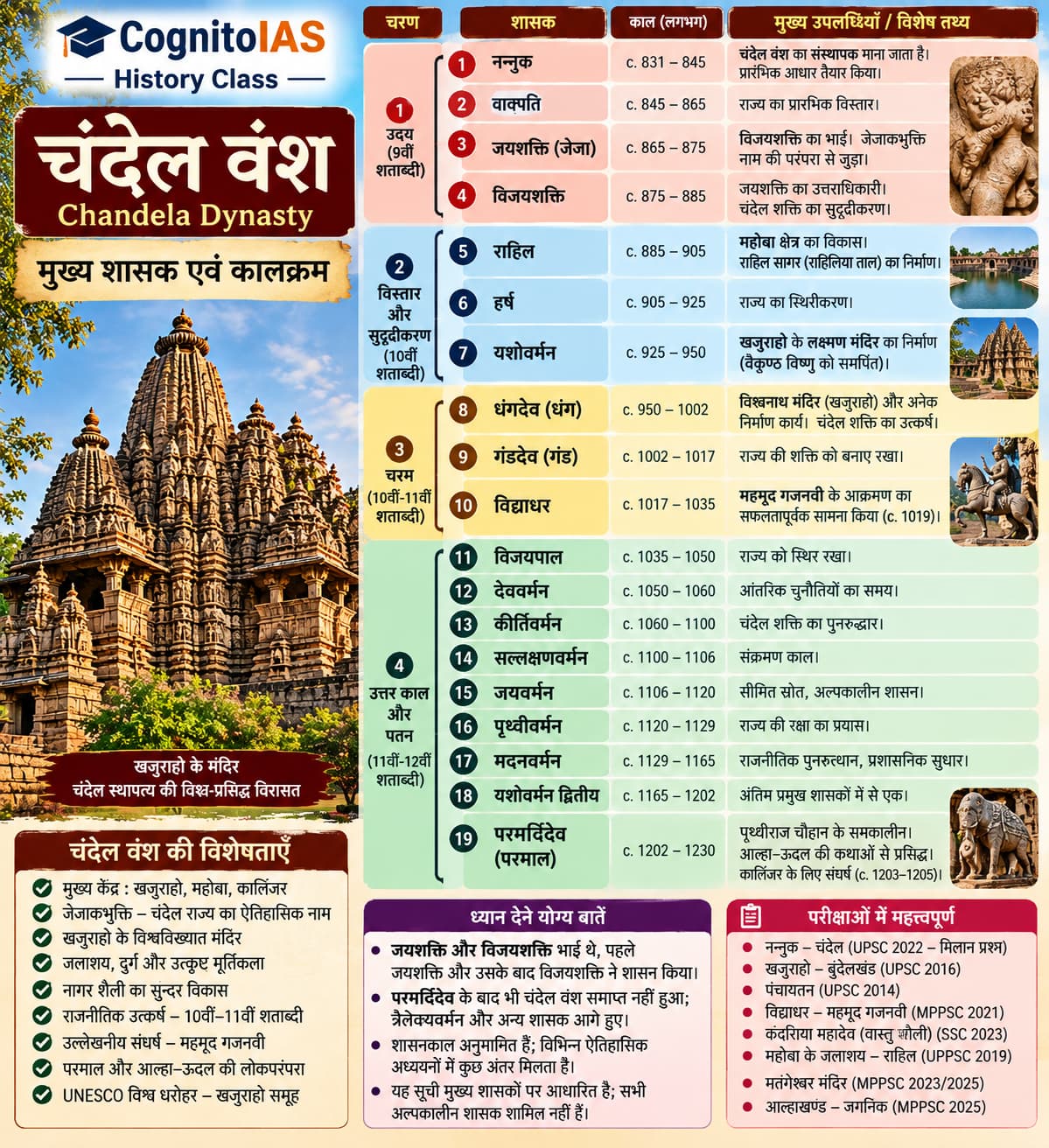
Teacher: Nannuka (Nannuk), an early known ruler of the first half of the ninth century and the dynasty's historical founder. The early Chandelas were associated with Gurjara-Pratihara overlordship.
Student: Did Yashovarman rule immediately after Nannuka?
Teacher: No. The traditional sequence is Vakpati → Jayashakti and Vijayashakti → Rahila → Harsha → Yashovarman. Precise dates for the early rulers are approximate.
Student: Where did the name “Jejakabhukti” come from?
Teacher: It is traditionally connected with Chandela ruler Jayashakti (Jejja). Jejjakabhukti, or Jejakabhukti, was the historical name of this region.
UPSC CSE Prelims 2022 — GS-I, Ruler–Dynasty Pairs
Four pairs were given: (1) Nannuka–Chandela, (2) Jayashakti–Paramara, (3) Nagabhata II–Gurjara-Pratihara, and (4) Bhoja–Rashtrakuta. Answer: Only two pairs, 1 and 3, were correct. Remember: Jayashakti belonged to the Chandelas, not the Paramaras; the Bhoja–Rashtrakuta pair was also incorrect.
Student: What evidence do we have for the dynasty's early history?
Teacher: The Khajuraho inscription of 954 CE and later Chandela inscriptions preserve dynastic sequences and royal eulogies. We must distinguish praise in an inscription from an independently established historical event.
History versus Legend
The Hemavati–Moon-god story belongs to the tradition of dynastic origins. Keep this separate from Nannuka and the early succession reconstructed from inscriptions.
03. Yashovarman: Growing Power and Temple Building
From Pratihara feudatories to an emerging regional power.
Student: Under whom did Nannuka's dynasty first rise to great prominence?
Teacher: Under Yashovarman (c. 925–950 CE), also known as Lakshavarman. Chandela political prestige increased considerably during his rule.
Student: What was his greatest military achievement?
Teacher: The capture of Kalinjar Fort is counted among his celebrated achievements. Historians differ on who held it earlier and on details of the conquest.
Student: What did he build at Khajuraho?
Teacher: The Lakshmana Temple was built under his patronage. Its inscription of 954 CE belongs to Dhanga's reign; construction began under Yashovarman and was completed or consecrated afterwards.
Student: Does it have an ordinary image of Vishnu?
Teacher: No. Its distinctive icon is the multi-faced Vaikuntha Vishnu, symbolically combining human, lion, and boar aspects. This is an important examination fact.
Visual Study — Lakshmana Temple: Name versus Principal Deity
This is a text-based teaching diagram, not a certified monument photograph or a scale drawing.
Student: What political message does such a grand temple convey?
Teacher: A king wanted to appear both a patron of religion and a symbol of independent power. Temple building was not merely worship; it also publicly expressed royal prestige.
Student: Did Yashovarman's son Dhanga succeed him?
Teacher: Yes. Dhanga's reign marked a major change: the Chandelas were no longer just a rising power but an increasingly independent royal authority.
Exam Trap
Lakshmana Temple = Vaikuntha Vishnu; the principal royal patron associated with its construction is Yashovarman. The inscription of 954 CE dates to Dhanga's reign and helps establish its construction and dedication chronology.
Asked in an Exam — Madhya Pradesh Employees Selection Board, Group 2/Subgroup 3 Recruitment 2022, Question 107
Which Chandela ruler built Khajuraho's famous Lakshmana Temple? Answer: Yashovarman.
04. Dhanga: Independence and the Vishvanatha Temple
Recognising rulers through their inscriptions and temples.
Student: Why is Dhanga's reign regarded as distinct?
Teacher: Inscriptions of Dhanga (c. 950–1002 CE) do not generally acknowledge the Pratihara ruler as overlord, suggesting the Chandelas' growing independence.
Student: How can I identify Dhanga through a temple?
Teacher: Vishvanatha Temple, Khajuraho — Shiva — Dhanga. Associated inscriptions dated around 999–1002 CE are important.
Student: The name Vishvanatha reminds me of Varanasi. Is this the same temple?
Teacher: No. The Vishvanatha Temple at Khajuraho is a Chandela monument; do not confuse it with Kashi Vishvanath. Also remember the Nandi pavilion in front.
Student: Did Chandela kings build only Shiva temples?
Teacher: No. Shaiva, Vaishnava and Jain architectural traditions flourished under their patronage. Some temples were also supported by donors other than the kings.
Student: Did their territorial expansion continue unchanged after Dhanga?
Teacher: Dhanga was followed by Ganda and then Vidyadhara. Vidyadhara's reign is remembered for a serious military challenge alongside the soaring architecture of Khajuraho.
05. Vidyadhara Faces Mahmud of Ghazni
The attack on the fortress and the need for caution about its outcome.
Student: What was that formidable challenge?
Teacher: Mahmud of Ghazni's invasions of northern India. Chandela ruler Vidyadhara, of the early eleventh century, figures prominently in the accounts of that period.
Student: How was Mahmud's Kannauj campaign connected with the Chandelas?
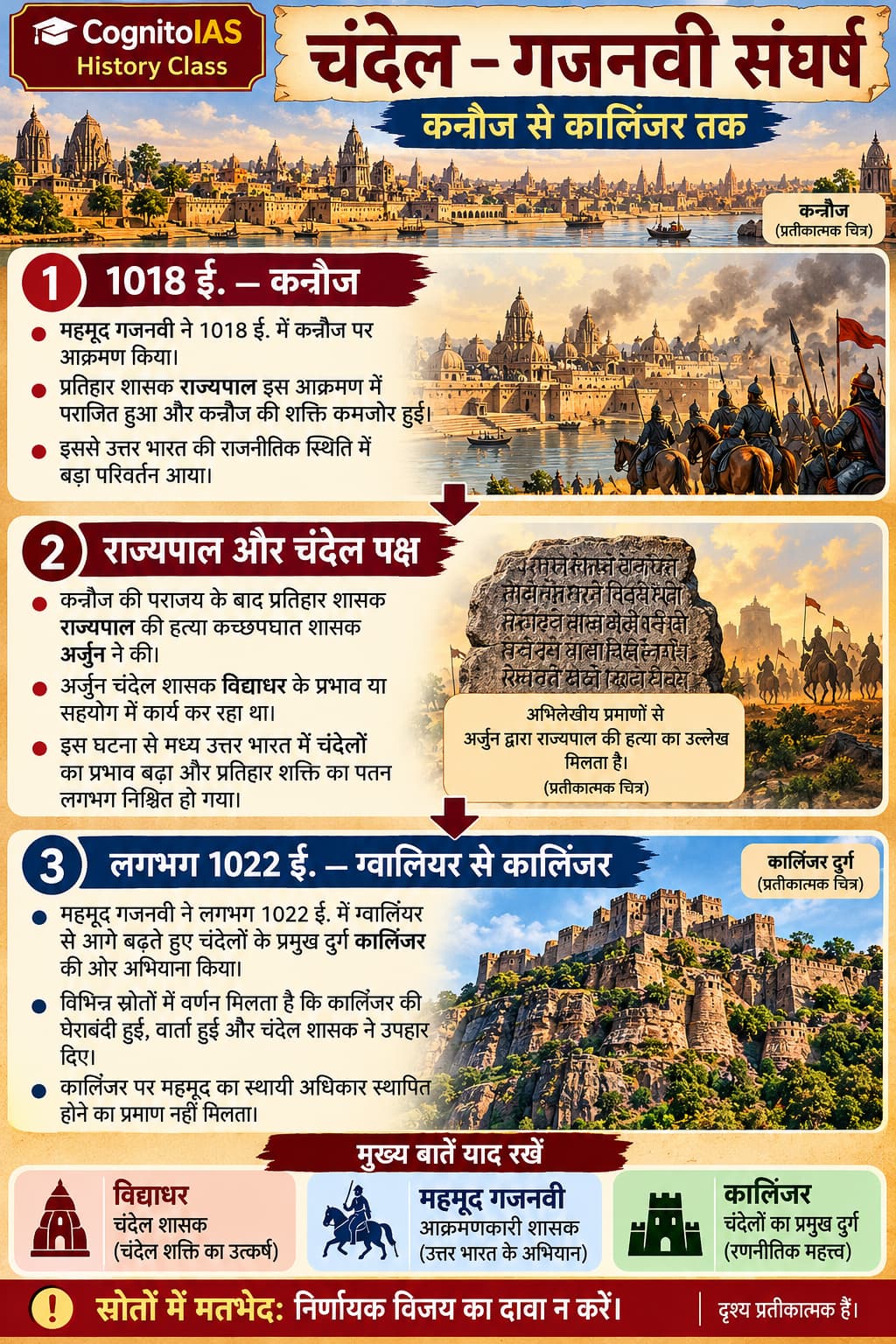
Teacher: Around 1018 CE, Mahmud attacked Kannauj. The retreat of its Gurjara-Pratihara ruler Rajyapala created a political crisis in northern India. Vidyadhara's name is prominent in the subsequent events.
Student: Who killed Rajyapala—Vidyadhara or one of his allies?
Teacher: According to the Dubkund inscription, Arjuna of the Kachchhapaghata dynasty, an ally or subordinate of Vidyadhara, was connected with Rajyapala's death. Some Chandela inscriptions credit Vidyadhara more broadly. Keep three identities separate: Vidyadhara—Chandela; Arjuna—Kachchhapaghata; Rajyapala—Gurjara-Pratihara.
Historian's Caution — The Rajyapala Episode
The relationship between Mahmud's campaign, Pratihara Rajyapala, and the Vidyadhara–Kachchhapaghata Arjuna conflict is reconstructed from the Dubkund inscription and other evidence. Do not imagine that all these figures necessarily fought face-to-face in a single battle.
Student: Did Mahmud attack Kalinjar as well?
Teacher: Accounts mention a campaign or siege of Kalinjar around 1022 CE. However, the sources differ regarding the events, gifts or negotiated settlement, and the military outcome.
Student: Can I simply write that Mahmud conquered Kalinjar?
Teacher: No. A permanent Ghaznavid occupation of Kalinjar resulting from this campaign is not established. Claims of either a “complete victory” or a “decisive defeat” would be misleading.
MPPSC State Service Prelims 2021 — GS-I (exam held 19 June 2022)
Which Chandela ruler faced Mahmud of Ghazni? Answer: Vidyadhara. The precise battle result and claims of permanent control of Kalinjar are separate historical questions.
Student: Why is Vidyadhara so famous, then?
Teacher: His reign is associated with Chandela military resistance and the mature architecture of Khajuraho. He is regarded as one of the dynasty's powerful rulers.
Student: Did he build the Kandariya Mahadeva Temple?
Teacher: This great Shiva temple is generally associated with Vidyadhara's period, in the early eleventh century. Sources do not uniformly name its individual builder, so it is unwise to declare Vidyadhara its certain founder.
Student: So a single king is remembered both for warfare and for art?
Teacher: Correct, but keep the evidence distinct: the military episode at Kalinjar and the dating of Kandariya Mahadeva's architecture are established through different kinds of sources.
Important Source Caveat
Interpretations differ on the date and individual patron of Kandariya Mahadeva. Many scholars associate it with Vidyadhara's age, while some exam compilations name Dhanga. Distinguish the official answer key from historical scholarship.
06. Khajuraho: The Story of 85 Temples and Three Groups
Checking temple counts and UNESCO facts.
Student: Sir, I have heard that Khajuraho had 85 temples. Are all of them still standing?
Teacher: Tradition speaks of about 85 temples; roughly two dozen structures survive today. UNESCO's detailed description counts 23 monuments, although some sources say “about 20,” depending on how they count.
Student: Are all of them in one place?
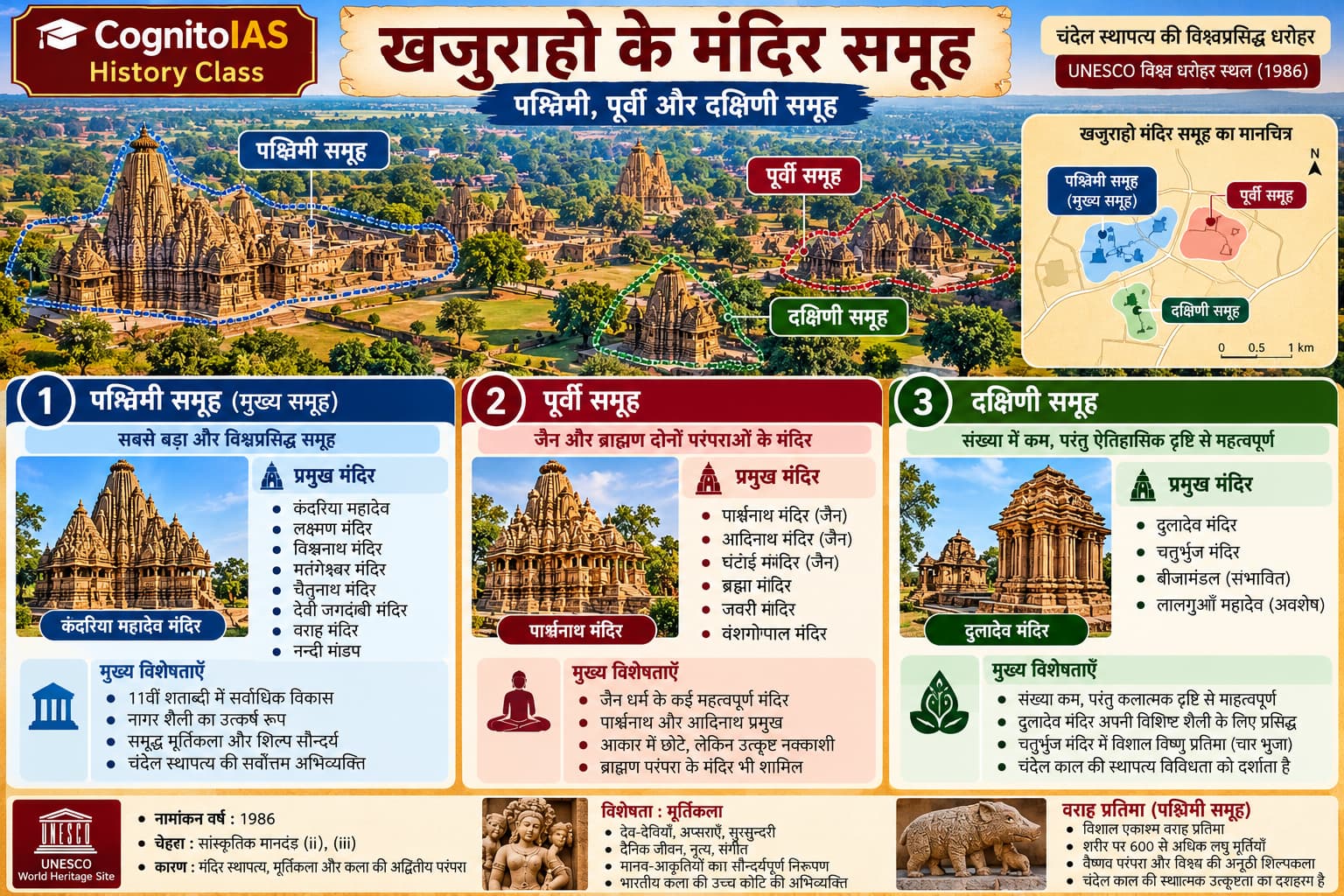
Teacher: No. Khajuraho's temples are divided into the Western, Eastern and Southern groups. Do not assume they all belong to the Western Group.
Student: Which group contains the most famous large temples?
Teacher: The Western Group includes important monuments such as Lakshmana, Kandariya Mahadeva, Vishvanatha, Chitragupta, Devi Jagadambi and Matangeshvara.
Student: Where are the Jain temples?
Teacher: Especially in the Eastern Group: Parshvanatha, Adinatha, Shantinatha and Ghantai are important Jain monuments. Hindu temples such as Vamana and Javari are also located in this area.
Student: How do we identify the Southern Group?
Teacher: The Southern Group includes Duladeo (Shiva) and the Jatkari/Chaturbhuj Temple. The Chaturbhuj sanctum contains a roughly nine-foot-tall four-armed image, but published sources disagree on the deity's identification. Do not draw a definitive conclusion from the modern temple name alone.
Chaturbhuj Icon
Differing Sources — An older ASI guide identifies the principal image as Vishnu; a more recent government tourism description calls it Dakshinamurti Shiva. Do not teach either identification as entirely undisputed in an exam context.
Student: When did UNESCO declare Khajuraho a World Heritage Site?
Teacher: In 1986, the Khajuraho Group of Monuments was inscribed on the World Heritage List. It is a world-famous example of Nagara temple architecture.
How should we state the number? The traditional figure is around 85 temples. Depending on conservation records and counting methods, approximately 20–23 principal monuments survive today. UNESCO's detailed account lists 23.
07. Understanding a Temple from Outside to Inside
Not a jumble of roofs, but an ordered Nagara design.
Student: Why do I see so many smaller spires when I look at Kandariya Mahadeva?
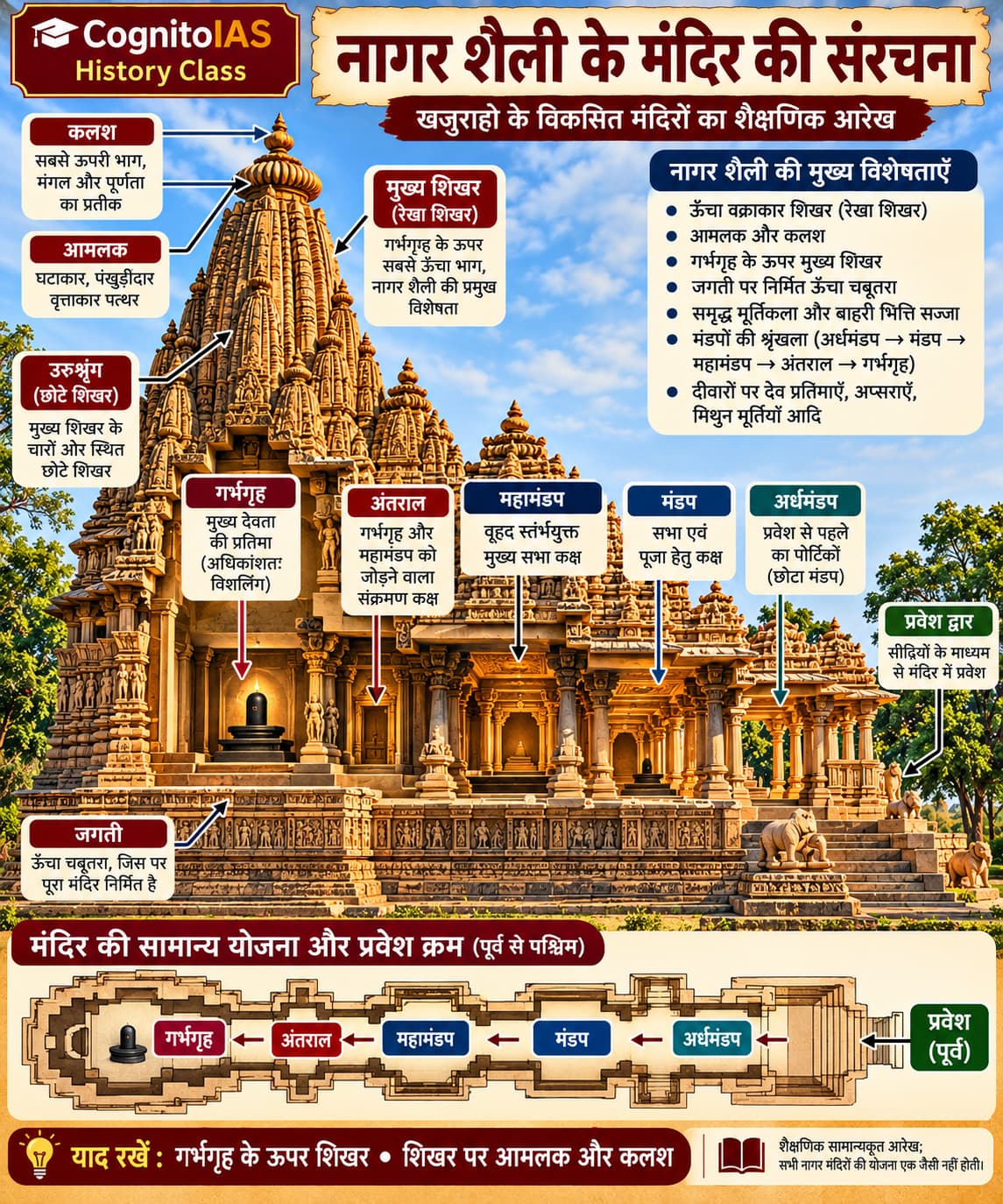
Teacher: Numerous subsidiary spires (urushringas) surround the principal shikhara. They create a rising rhythm, making the entire temple look like a mountain range.
Student: Which style of temple architecture is this?
Teacher: The North Indian Nagara style. At Khajuraho, it reaches a mature, tall, multi-spired form. Do not confuse this with the monumental gopuram gateways of South Indian Dravida architecture.
SSC Selection Post 2023 — 30 June, HSC Shift 2
Which architectural style does Kandariya Mahadeva Temple exemplify? Answer: Nagara style. Do not treat the construction date “999 CE” mentioned in the question as a firmly established historical date; the style is the point tested here.
Student: In what sequence would I enter the temple?
Teacher: Remember this simplified sequence: ardhamandapa → mandapa/mahamandapa → antarala → garbhagriha. Outside, the temple stands on a raised platform (jagati), and the principal shikhara rises above.
Student: Does jagati simply mean the steps?
Teacher: No. The jagati is the raised platform or plinth on which the temple stands. Its walls can also carry carvings of processions, battles, dancing and other scenes.
Student: Are panchayatana and pancharatha the same thing?
Teacher: No! Panchayatana means one main shrine with four subsidiary shrines at the corners. Pancharatha refers to a temple-wall or ground-plan type with five projections. Both contain the word “pancha,” but their meanings differ.
UPSC CSE Prelims 2014 — GS-I, Indian Culture
What does “Panchayatana” refer to in Indian cultural history? The options included an assembly of village elders, a religious sect, a style of temple construction, etc. Answer: A style of temple construction.
Student: What kind of temple is Lakshmana Temple?
Teacher: It is a developed Nagara temple with a panchayatana plan and a circumambulatory passage (sandhara). Its entrance and sanctum follow a common axis.
08. Temple Identification Challenge: Which Deity, Which King?
Avoid choosing the wrong deity from a temple's name.
Student: Which temple is the tallest and most elaborate?
Teacher: Kandariya Mahadeva is the largest and among the most sophisticated temples of Khajuraho; its principal tower is often described as about 31 metres high. It is dedicated to Shiva.
Student: From its name, should I assume Chitragupta Temple belongs to Yama's celestial record-keeper?
Teacher: That is an exam trap. Khajuraho's Chitragupta Temple is associated with Surya, the Sun-god. A distinctive image of Surya in its sanctum is particularly famous.
Student: Is there an easy way to recognise Chitragupta Temple through Surya's imagery?
Teacher: Yes. Remember the iconographic tradition of Surya's chariot drawn by seven horses. At Khajuraho, it is safer to identify Chitragupta as a Sun temple.
Student: What deity is Matangeshvara Temple dedicated to?
Teacher: Shiva. It has a large, worshipped Shiva lingam and is well known as an active place of worship.
MPPSC State Service Prelims 2025 — GS-I, Question 63
Where is the Matangeshvara Temple located in Madhya Pradesh? Answer: Khajuraho. Memory key: Matangeshvara — Shiva — Khajuraho.
Student: May I ask again which deity Lakshmana Temple honours?
Teacher: Vaikuntha Vishnu. Its name can easily mislead candidates in examinations.
Student: Is there an image near Lakshmana Temple that immediately reminds us of an incarnation of Vishnu?
Teacher: Yes. The Varaha Pavilion stands in front of Lakshmana Temple in the Western Group. It contains a huge monolithic boar image with numerous smaller divine figures carved over its body. Varaha is an incarnation of Vishnu.
Student: Which major Jain temple should I remember?
Teacher: Parshvanatha Temple is an important Jain monument of the Eastern Group. Also remember Adinatha and Shantinatha.
Student: Were all these temples built at the same time by a single king?
Teacher: No. Construction extended over several generations and involved different patrons. Therefore, Lakshmana–Yashovarman; Vishvanatha–Dhanga; and Kandariya–generally associated with Vidyadhara's period is a more useful sequence.
Asked in an Exam — UPPSC Prelims 1991, as reported in a published PYQ compilation
To which dynasty is Khajuraho's Kandariya Mahadeva Temple related? Answer: Chandela. An independent scan of the original question paper was not verified here.
Asked in an Exam — UPPSC Government Inter College Examination 2010, as reported in a published PYQ compilation
To which deity is Matangeshvara Temple dedicated? Answer: Shiva. An independent scan of the official original question paper was not found here.
09. Why Is the Chausath Yogini Temple Different?
An early sign of the evolution of Khajuraho architecture.
Student: Are all Khajuraho temples built from golden sandstone?
Teacher: Most mature temples are sandstone structures, but the early Chausath Yogini Temple was built using local granite.
Student: What is its most unusual feature?
Teacher: A rectangular, open-to-the-sky courtyard. Many other Yogini temples are circular, but the one at Khajuraho is not circular. This is a very important visual identification point.
Student: How did the architecture develop from granite to sandstone?
Teacher: A broad sequence runs from the early granite tradition of Chausath Yogini, through transitional structures like the Brahma and Lalguan Mahadeva temples, to the developed sandstone temples of Lakshmana and Kandariya.
Visual Study — From Granite Courtyards to Towering Shikharas
This is a text-based teaching diagram, not a certified monument photograph or a scale drawing.
Image 9 — Chausath Yogini Temple vs Developed Nagara Temple
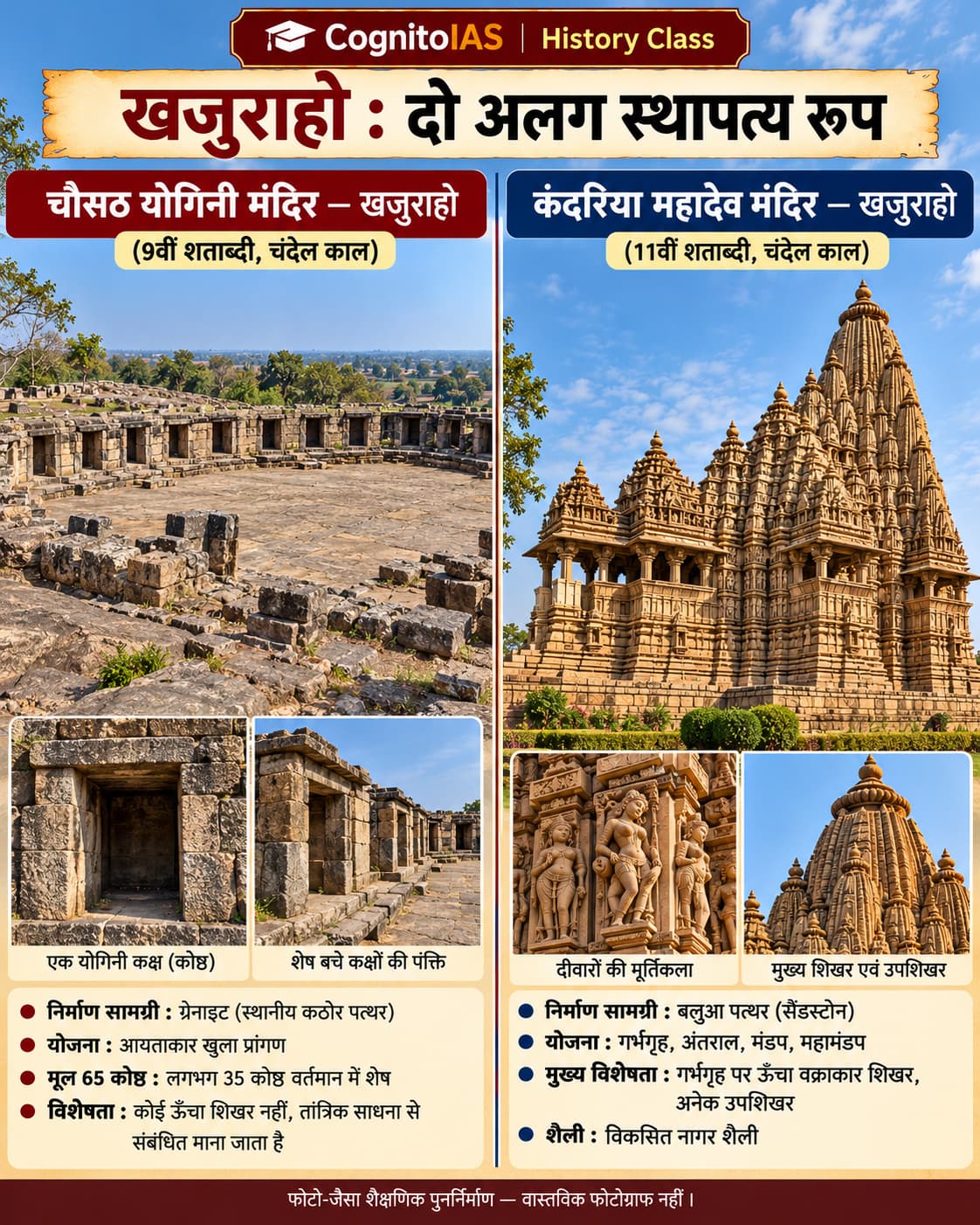
This comparison illustrates the earlier, relatively simple, rectangular, open-courtyard tradition of Chausath Yogini and the mature Nagara style with its towering shikhara. It is a photorealistic educational reconstruction, not an actual monument photograph.
Student: Is the so-called “Brahma Temple” actually dedicated to Brahma?
Teacher: The modern name is misleading. Khajuraho's Brahma Temple contains a four-faced Shiva lingam in historical accounts; do not determine its original dedication from the present name alone.
Student: Is this one of Khajuraho's oldest temples?
Teacher: Chausath Yogini is among Khajuraho's earliest surviving structures, generally dated to the later ninth century.
Visual Identification
Chausath Yogini Temple, Khajuraho = a rectangular, open courtyard and granite. Do not assume that every Chausath Yogini temple is circular.
10. A Whole World of Life on Temple Walls
Do not reduce the sculpture to a single theme.
Student: Why do some people speak only of erotic sculptures when discussing Khajuraho?
Teacher: Because those are famous, but that view is incomplete. The carvings also include deities, dancers, musicians, soldiers, animals, families, daily life, surasundaris and mithuna couples.
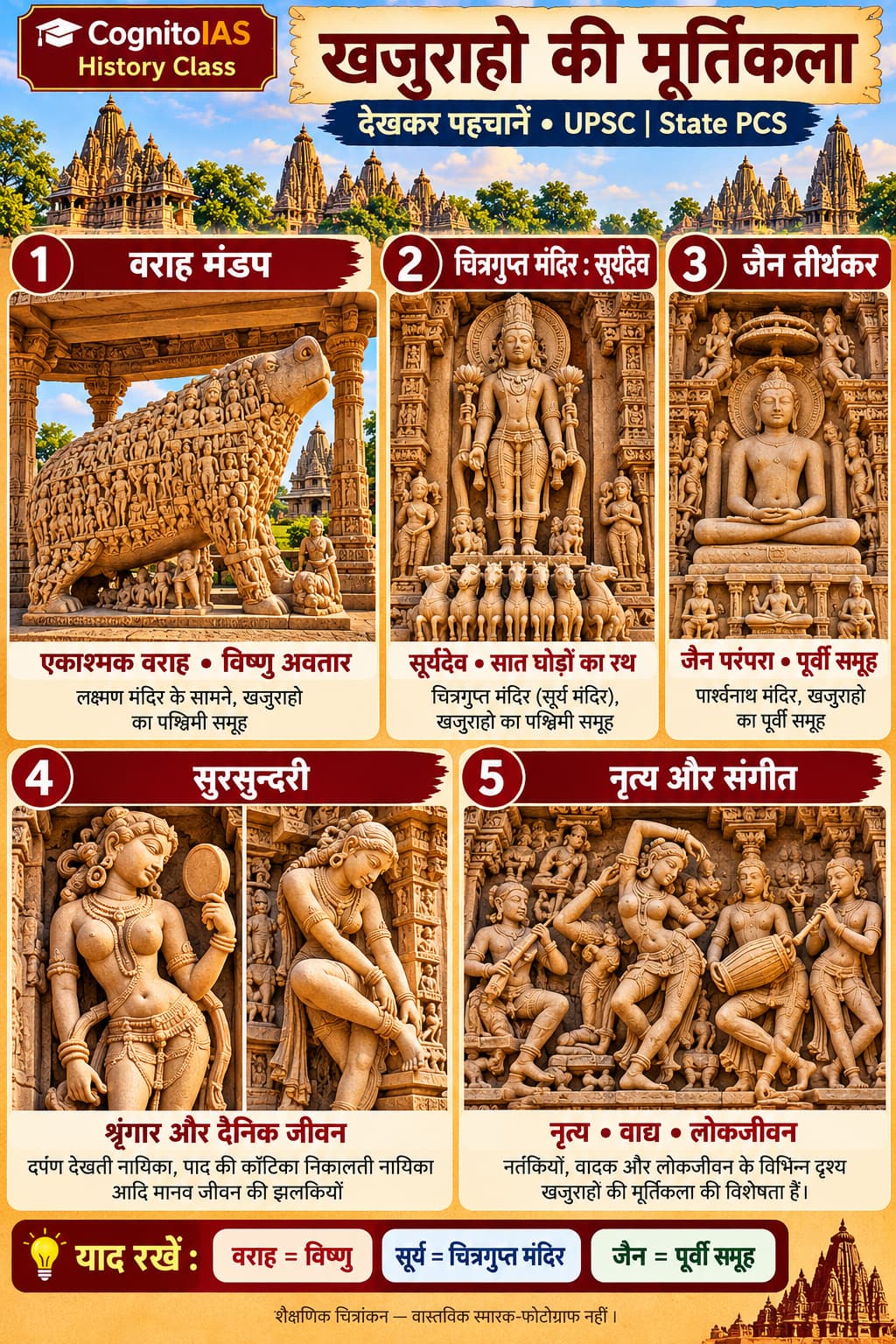
Student: Are all the sculptures erotic?
Teacher: Certainly not. Erotic scenes are only one part of a very large sculptural programme. There is no need to memorise a speculative percentage as an established fact.
Student: Does this prove the temples were secular?
Teacher: That conclusion would be too simplistic. These are religious buildings, yet the artists represented social life, beauty, devotion and varied symbolism together. Scholars differ in how they interpret some sculptures.
Student: Did Jain and Hindu traditions coexist here?
Teacher: Yes. Temples associated with Shiva, Vishnu, Surya, the Goddess and Jain Tirthankaras reflect the cultural diversity of the Chandela period.
Student: What can historians learn from these sculptures?
Teacher: They offer clues about the period's clothing, ornaments, music, dance, weapons and social life; however, sculptures are not exact photographic records of everyday society.
11. New Challenges After the Golden Age — Up to Kirtivarman
Chandela power did not rise in a straight line.
Student: Did the Chandelas remain equally powerful after Vidyadhara?
Teacher: No. Under Vijayapala and Devavarman, tensions with the neighbouring Kalachuris and political weakness became evident.
Student: Who then restored Chandela fortunes?
Teacher: Kirtivarman (c. 1060–1100 CE) revived Chandela power by successfully confronting the Kalachuri ruler Karna, also called Lakshmikarna.
Student: Is the name of any commander connected with his campaigns?
Teacher: A commander or associate named Gopala appears in accounts of Chandela victories and literary traditions. This was not a private duel fought by the king alone.
Student: Is there a famous book linked with this period?
Teacher: The Sanskrit play Prabodhachandrodaya, associated with Krishnamishra, is connected with Kirtivarman's historical milieu. It dramatises the struggle between abstract characters such as Knowledge and Ignorance.
Student: Were battles and temples the only things built in Bundelkhand?
Teacher: No. The Chandelas also developed tanks, lakes, water-storage systems and forts. Our next episode concerns those reservoirs.
12. How Can a King's Name Live On in a Reservoir?
Read dynastic history through the water bodies of Mahoba.
Student: Were reservoirs also named after Chandela kings?
Teacher: Yes. Around Mahoba, local historical associations connect Rahila Sagar with Rahila, Kirat Sagar with Kirtivarman, Madan Sagar with Madanavarman, and Vijay Sagar with Vijayapala.
Student: Why did they build such large tanks?
Teacher: They supported water storage, agriculture, settlements and displays of royal power in Bundelkhand's rugged plateau landscape. Water management is another major pillar of Chandela heritage alongside temple architecture.
Student: When did Madanavarman rule?
Teacher: Madanavarman (c. 1128–1165 CE) revived Chandela power during the twelfth century. Madan Sagar at Mahoba is a monument traditionally linked with his name.
Visual Study — Match Chandela Kings with Their Reservoirs
This is a text-based teaching diagram, not a certified monument photograph or a scale drawing.
Student: Which powers did Madanavarman confront?
Teacher: Records refer to campaigns and claims involving the Kalachuris, Paramaras and the Chalukyas/Chaulukyas of Gujarat. Each dynasty's inscriptions glorify its own victories, so do not treat all such claims as undisputed achievements.
Student: What else can we see at Mahoba?
Teacher: Temple remains such as Kakramath, Kirat Sagar, Madan Sagar and other Chandela-associated tanks connect political history with local geography.
Student: Apart from reservoirs, is there a temple at Mahoba I should recognise for exams?
Teacher: Yes. The Sun Temple and Suraj Kund at Rahiliya village, Kakramath, and Mahoba's Shiva Tandava sculpture are significant local heritage sites. Learn their monument–location associations rather than attaching an uncertain single builder to each.
13. The Heroic Ballads of Alha and Udal, and Paramardideva
Where history meets oral epic.
Student: Sir, whenever Mahoba is mentioned, Alha and Udal come to mind. During whose reign do their stories belong?
Teacher: The heroic ballads of Alha and Udal are associated with Paramardideva (Parmal), a Chandela ruler of the late twelfth century.
Student: Are these heroes documented in historical records exactly as they appear in the songs?
Teacher: Not every episode of folklore can be treated as a verified historical event. The Alhakhand and Alha singing tradition are important sources of cultural memory; distinguish their narrative elaborations from inscriptional evidence.
Student: Who is traditionally named as the author of this folk epic?
Teacher: Jagnik (Jagnika) is traditionally associated with Alhakhand. But the surviving textual layers and historical dating are complex; today's text is not a verbatim, authenticated twelfth-century manuscript.
MPPSC State Service Prelims 2025 — GS-I, Question 61
Who is the author of “Alhakhand”? Accepted examination answer: Jagnik. This is a traditional attribution; the present oral or written versions should not be mistaken for an authenticated original twelfth-century manuscript.
Student: Did Parmal fight Prithviraj Chauhan?
Teacher: Tradition and historical discussions refer to a conflict around 1182–1183 CE between the Chahamana ruler Prithviraj III and the Chandelas, with the Mahoba–Kalinjar region as its backdrop.
Student: Folk songs portray the battle dramatically. Should I study it in exactly that manner?
Teacher: The story helps memory, but for exams keep three identifications separate: Paramardideva—Chandela; Prithviraj III—Chahamana; Alha and Udal—the heroic tradition of Mahoba.
Student: Is this tradition still alive in Mahoba?
Teacher: Yes. The Kajli festival and Alha singing are part of the region's cultural memory. However, do not substitute a festival's traditional account for a verified military chronicle.
UPPSC RO/ARO 2021 — GS (5 December 2021): The folk saying “When ... was born, the Earth sank by two and a half hands” refers to which historical figure? Answer: Alha.
Folk Epic versus Inscription
Alhakhand is a major source of heroic tradition and cultural memory. Do not present every detail of its characters and events as an independently verified occurrence recorded in royal inscriptions.
14. The Fall of Kalinjar: Did the Dynasty End That Day?
A political defeat and the extinction of a dynasty are not the same event.
Student: Who posed the next major external threat during Paramardideva's later period?
Teacher: Accounts describe an attack and change in control in the Kalinjar–Mahoba region during the campaign of Qutb-ud-din Aibak around 1202–1203 CE.
Student: So did the Chandela dynasty end that same year?
Teacher: No. This was a severe political blow, but later Chandela rulers such as Trailokyavarman attempted to regain regional control. The dynasty's power declined gradually.
Student: Why was Kalinjar so strategically important?
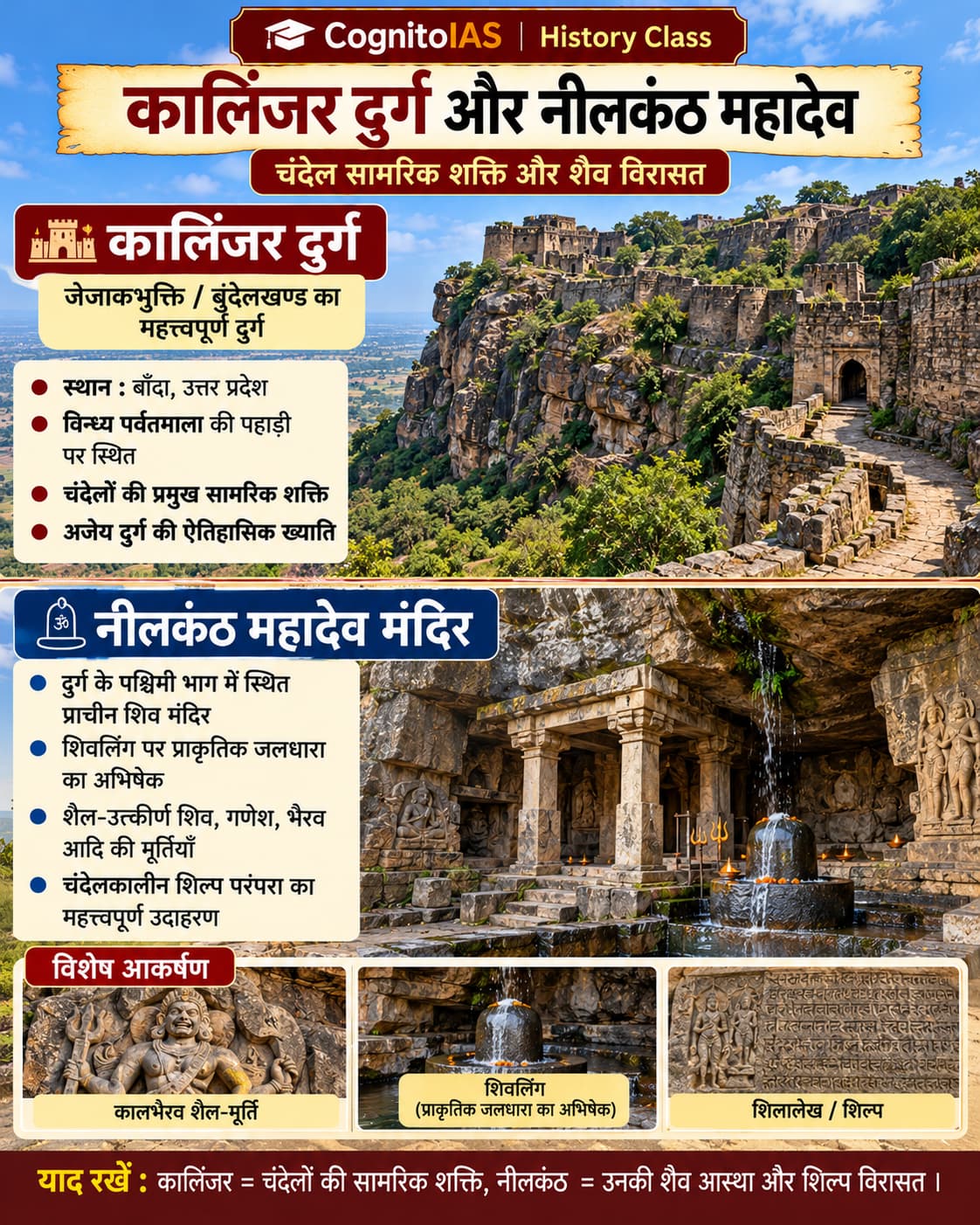
Teacher: It was renowned as a formidable hill fort of the Vindhyan region. Its defensible position and strategic location made it desirable to many rulers.
Student: Is there a famous temple of Chandela art inside Kalinjar Fort?
Teacher: Yes. Neelkanth Mahadeva Temple is an important Shaiva monument within Kalinjar Fort, containing a Shiva lingam, rock-cut images and intricate sculptural details. Local government tourism accounts also connect it with Paramardideva; study this with the possibility of several building phases in mind.
Location Alert
Kalinjar Fort — Banda, Uttar Pradesh — Neelkanth Mahadeva. Do not confuse it with Matangeshvara or Kandariya Mahadeva at Khajuraho.
Student: Is Sher Shah Suri also connected with Kalinjar?
Teacher: Yes, but much later, in 1545 CE. Sher Shah Suri died following a gunpowder explosion during the siege of Kalinjar. Do not confuse this with the Chandela conflicts of the twelfth and thirteenth centuries.
Visual Study — Three Distinct Events in Chronology
This is a text-based teaching diagram, not a certified monument photograph or a scale drawing.
Student: Is Rani Durgavati also connected with Chandela history?
Teacher: She is believed to have been born into a Chandela ruling family and later led the Garha-Katanga/Gond kingdom. This is a sixteenth-century story, not part of the main Nannuka–Paramardideva period.
Student: What is the biggest lesson of the Chandela story?
Teacher: Political fortunes rose and fell, but the temples of Khajuraho, the reservoirs of Mahoba, Kalinjar, and the Alha tradition have preserved Chandela heritage to this day.
15. The Whole Story in One Chain and a Final Exam Check
Four memory anchors: rulers, temples, places and time.
Student: If I need rapid revision, what five initial associations should I remember?
Teacher: Nannuka—beginnings; Jayashakti—Jejakabhukti; Yashovarman—Lakshmana Temple; Dhanga—Vishvanatha; Vidyadhara's period—Kandariya Mahadeva. Remember the caveat about the last temple's individual patron.
Student: How should I remember the political storyline?
Teacher: Emergence under the Pratiharas → Yashovarman's expansion → Dhanga's growing independence → Vidyadhara and the Ghaznavid challenge → Kirtivarman's recovery → Madanavarman → Paramardi and crisis → Trailokyavarman's attempted revival.
Student: What are three temple-related traps for examinations?
Teacher: Lakshmana = Vaikuntha Vishnu; Chitragupta = Surya; Khajuraho's Chausath Yogini = rectangular, granite.
Student: And the three keys to temple architecture?
Teacher: Nagara shikhara; ardhamandapa–mandapa–antarala–garbhagriha; panchayatana is not pancharatha.
Student: One last question: how would you describe the Chandelas in a single sentence?
Teacher: The power of Bundelkhand that left an indelible mark on medieval India through Kalinjar's defences, Mahoba's water management, and Khajuraho's Nagara temples.
Master Revision — Four Phases
The ruler sequence is schematic; the dates of all their reigns are not equally certain.
Completeness of the Succession
Recognise the sequence of lesser-discussed later rulers such as Sallakshanavarman, Jayavarman, Prithvivarman and Yashovarman II. The dynasty continued after Paramardideva as well; do not confuse his defeat with the end of the line.
Test Yourself — Ten Quick Questions
1. Who was the historical founder of the Chandela dynasty?
2. The name Jejakabhukti is connected with which ruler?
3. Who was the principal patron of Lakshmana Temple?
4. Who is the principal deity of Lakshmana Temple?
5. Vishvanatha Temple is associated with which ruler?
6. Kandariya Mahadeva is dedicated to which deity?
7. Which deity is honoured at Khajuraho’s Chitragupta Temple?
8. What are the layout and building material of Chausath Yogini Temple?
9. When did Khajuraho become a UNESCO World Heritage Site?
10. Which place is associated with Alha, Udal and Parmal?
Sources and Scope of Verification
Key points were checked against UNESCO, the Archaeological Survey of India (ASI), Government of India tourism and culture portals, the Mahoba district administration, and inscription-based studies. The following sources are provided for further study; the text is not copied verbatim from any single book.
Where the official question paper could not be located, a published PYQ compilation is explicitly identified. Differences concerning the individual patron of Kandariya Mahadeva have deliberately not been concealed.
CognitoIAS HISTORY CLASS | इतिहास की संवादशाला
चंदेल वंश
खजुराहो की कला, कालिंजर की शक्ति और महोबा की वीरगाथा
हिन्दी संवाद-कथा • प्रमाण-आधारित इतिहास • परीक्षा संकेत • मोबाइल-अनुकूल पुनरावृत्ति
पढ़ने का तरीका: विद्यार्थी का अगला प्रश्न शिक्षक के पिछले उत्तर से निकलेगा। लाल/नीले महत्त्वपूर्ण तथ्य याद रखें; “इतिहासकार की सावधानी” को परीक्षा-तथ्य से अलग समझें।
अध्याय-सूची देखें — 15 प्रकरण
01. एक मंदिर, जिसके नाम में छिपा है पहला प्रश्न
खजुराहो की यात्रा से इतिहास की पूरी कहानी शुरू होती है।
विद्यार्थी: सर, खजुराहो का लक्ष्मण मंदिर क्या श्रीराम के भाई लक्ष्मण को समर्पित है?
शिक्षक: यही पहला रोचक भ्रम है! मंदिर का नाम लक्ष्मण है, पर उसका मुख्य आराध्य वैकुण्ठ-विष्णु है। इसे चंदेल शासक यशोवर्मन ने बनवाना शुरू कराया था।
विद्यार्थी: तो खजुराहो किस वंश की देन है?
शिक्षक: चंदेल वंश की। मध्य भारत के जेजाकभुक्ति (बुन्देलखण्ड) में इस वंश ने राजनीतिक शक्ति के साथ मंदिर स्थापत्य को भी नया उत्कर्ष दिया।
विद्यार्थी: जेजाकभुक्ति आज कहाँ है?
शिक्षक: मुख्यतः वर्तमान मध्य प्रदेश और उत्तर प्रदेश के बुन्देलखण्ड में। खजुराहो (छतरपुर), कालिंजर (बाँदा क्षेत्र) और महोबा तीन महत्वपूर्ण केंद्र रहे।
विद्यार्थी: क्या तीनों जगह चंदेलों की राजधानी थीं?
शिक्षक: इतिहास को एक कठोर “एक राजधानी” वाले सूत्र में न बाँधें। खजुराहो प्रमुख धार्मिक-सांस्कृतिक केंद्र, महोबा महत्वपूर्ण राजनीतिक केंद्र और कालिंजर प्रमुख दुर्ग-आधार के रूप में प्रसिद्ध हैं; महत्त्व समय के साथ बदला।
विद्यार्थी: तो चंदेलों की कहानी मंदिर की दीवार से शुरू होकर किले तक जाती है?
शिक्षक: बिल्कुल। आज तुम देखोगे कि एक राजवंश का इतिहास अभिलेख, मंदिर, युद्ध, जलाशय और लोकगीत—सब मिलकर सुनाते हैं।
02. चंद्रमा से जन्म की कथा—इतिहास या किंवदंती?
कल्पना का आकर्षण और प्रमाण का अंतर समझें।
विद्यार्थी: चंदेल नाम क्या “चंद्र” से जुड़ा है?
शिक्षक: उनकी चंद्रवंशी उत्पत्ति की परंपरा प्रसिद्ध है। लोककथा में हेमवती और चंद्रदेव का प्रसंग आता है। लेकिन इसे इतिहासकार प्रमाणित वंश-जन्म की घटना नहीं मानते।
विद्यार्थी: तो पहला ऐतिहासिक चंदेल कौन माना जाता है?
शिक्षक: नन्नुक (नन्नुका)—नौवीं शताब्दी के पूर्वार्ध का आरम्भिक ज्ञात शासक और वंश का ऐतिहासिक संस्थापक। आरम्भिक काल में चंदेल गुर्जर-प्रतिहार सत्ता से संबद्ध थे।
विद्यार्थी: नन्नुक के बाद सीधे यशोवर्मन आ गए?
शिक्षक: नहीं। परंपरागत वंश-क्रम में वाक्पति → जयशक्ति और विजयशक्ति → राहिल → हर्ष → यशोवर्मन आते हैं। प्रारम्भिक वर्षों की सटीक तिथियाँ अनुमानित हैं।
विद्यार्थी: “जेजाकभुक्ति” नाम क्यों पड़ा?
शिक्षक: इसे चंदेल शासक जयशक्ति (जेज्जा) से जोड़कर समझाया जाता है। जेज्जाकभुक्ति / जेजाकभुक्ति क्षेत्र का ऐतिहासिक नाम है।
चार जोड़ियाँ दी गई थीं: (1) नन्नुक–चंदेल, (2) जयशक्ति–परमार, (3) नागभट्ट II–गुर्जर-प्रतिहार, (4) भोज–राष्ट्रकूट। उत्तर: केवल दो सही जोड़ियाँ (1 और 3)।
विद्यार्थी: फिर आरम्भिक इतिहास के प्रमाण कहाँ हैं?
शिक्षक: खजुराहो के 954 ई. के अभिलेख और बाद के चंदेल अभिलेख वंश-क्रम और राजकीय प्रशस्तियाँ बताते हैं। अभिलेख में प्रशंसा और स्वतंत्र प्रमाणित घटना में अंतर रखना जरूरी है।
इतिहास बनाम किंवदंती
हेमवती–चंद्रदेव की कथा वंशोत्पत्ति की लोक-परंपरा है। इतिहास में नन्नुक और अभिलेखों से प्रमाणित प्रारम्भिक शासक-क्रम को अलग रखें।
03. यशोवर्मन—जब शक्ति भी बढ़ी और मंदिर भी
प्रतिहार सामंत से क्षेत्रीय महाशक्ति तक की यात्रा।
विद्यार्थी: नन्नुक के वंश में पहला बड़ा उभार किसके साथ दिखता है?
शिक्षक: यशोवर्मन (लगभग 925–950 ई.) के साथ। उसे लक्षवर्मन भी कहा गया है। उसके समय चंदेलों की राजनीतिक प्रतिष्ठा बहुत बढ़ी।
विद्यार्थी: उसकी सबसे बड़ी सैनिक उपलब्धि क्या थी?
शिक्षक: कालिंजर दुर्ग पर अधिकार उसकी प्रसिद्ध उपलब्धियों में गिना जाता है। इसकी पूर्ववर्ती सत्ता और विजय-विवरण पर इतिहासकारों में कुछ मतांतर मिलते हैं।
विद्यार्थी: फिर उसने खजुराहो में क्या बनवाया?
शिक्षक: लक्ष्मण मंदिर का निर्माण उसके संरक्षण में हुआ। इसका 954 ई. का अभिलेख धंग के समय से जुड़ा है; निर्माण यशोवर्मन के समय आरम्भ हुआ और उसके बाद पूर्ण/प्रतिष्ठित हुआ।
विद्यार्थी: क्या इसकी मूर्ति विष्णु की साधारण प्रतिमा है?
शिक्षक: नहीं। मुख्य पहचान वैकुण्ठ-विष्णु की बहुमुखी प्रतिमा है—मानव, सिंह और वराह रूपों का प्रतीकात्मक संयोजन। यही इसकी विशेष परीक्षा-योग्य बात है।
चित्रात्मक अध्ययन — लक्ष्मण मंदिर: नाम बनाम आराध्य
यह पाठ्य आरेख है, वास्तविक स्मारक का फोटोग्राफ या पैमानेदार मानचित्र नहीं।
विद्यार्थी: इतना बड़ा मंदिर आखिर राजनीतिक रूप से क्या बताता है?
शिक्षक: कि राजा धर्म का संरक्षक और स्वाधीन शक्ति का प्रतीक दोनों दिखना चाहता था। मंदिर-निर्माण केवल पूजा नहीं, शासकीय प्रतिष्ठा का भी सार्वजनिक प्रदर्शन था।
विद्यार्थी: तो क्या यशोवर्मन के बाद उसका पुत्र धंग आया?
शिक्षक: हाँ। और धंग के समय कहानी में एक बड़ा परिवर्तन आता है—चंदेल अब केवल उभरती शक्ति नहीं, बल्कि अधिक स्पष्ट स्वतंत्र राजसत्ता के रूप में सामने आते हैं।
परीक्षा-जाल
लक्ष्मण मंदिर = वैकुण्ठ विष्णु, और निर्माता-परंपरा का प्रमुख शासक यशोवर्मन। 954 ई. का अभिलेख धंग के समय का है; इससे निर्माणकाल और समर्पण समझते हैं।
परीक्षा में पूछा गया — मध्य प्रदेश कर्मचारी चयन मंडल — समूह-2/उपसमूह-3 भर्ती 2022, प्रश्न 107
किस चंदेल शासक ने खजुराहो का प्रसिद्ध लक्ष्मण मंदिर बनवाया? उत्तर: यशोवर्मन।
04. धंग—स्वतंत्र सत्ता और विश्वनाथ मंदिर
किस अभिलेख से किस राजा की पहचान होती है?
विद्यार्थी: धंग ने ऐसा क्या किया कि उसका काल अलग पहचान रखता है?
शिक्षक: धंग (लगभग 950–1002 ई.) के अभिलेख प्रतिहार अधिराज की अधीनता का सामान्य उल्लेख नहीं करते। इससे चंदेलों की स्वतंत्र सत्ता अधिक स्पष्ट होती है।
विद्यार्थी: मंदिर के माध्यम से धंग को कैसे पहचानूँ?
शिक्षक: विश्वनाथ मंदिर, खजुराहो — शिव — धंग। लगभग 999–1002 ई. के आसपास की संबद्ध अभिलेखीय परंपरा महत्वपूर्ण है।
विद्यार्थी: विश्वनाथ नाम सुनते ही वाराणसी याद आती है। क्या यही वही मंदिर है?
शिक्षक: नहीं। खजुराहो का विश्वनाथ मंदिर चंदेल स्थापत्य का स्मारक है; इसे काशी विश्वनाथ से न मिलाएँ। इसके सामने नंदी मंडप की पहचान भी याद रखो।
विद्यार्थी: क्या चंदेल राजाओं ने सिर्फ शिव मंदिर बनवाए?
शिक्षक: नहीं। इस वंश के संरक्षण में शैव, वैष्णव और जैन परंपराओं से जुड़ी स्थापत्य-संस्कृति विकसित हुई। कुछ मंदिरों का संरक्षण राजाओं के अतिरिक्त स्थानीय दानदाताओं से भी जुड़ा था।
विद्यार्थी: तो धंग के बाद क्या उसी तरह विस्तार चलता रहा?
शिक्षक: धंग के बाद गण्ड और फिर विद्याधर आए। विद्याधर का समय मंदिरों की ऊँचाई के साथ एक कठिन सैन्य चुनौती के लिए भी याद किया जाता है।
05. विद्याधर के सामने महमूद गजनवी
किले पर धावा और परिणाम की ऐतिहासिक सावधानी।
विद्यार्थी: वह कठिन चुनौती कौन थी?
शिक्षक: महमूद गजनवी के उत्तर भारत में आक्रमण। उस दौर में चंदेल शासक विद्याधर (लगभग ग्यारहवीं शताब्दी का प्रारम्भ) का नाम सामने आता है।
विद्यार्थी: लेकिन महमूद के कन्नौज अभियान और चंदेलों का आपसी संबंध क्या था?
शिक्षक: लगभग 1018 ई. में महमूद ने कन्नौज पर आक्रमण किया। वहाँ के गुर्जर-प्रतिहार शासक राज्यपाल के पीछे हटने से उत्तर भारत की राजनीति में संकट आया। चंदेल विद्याधर का नाम इस घटनाक्रम में भी प्रमुखता से आता है।
विद्यार्थी: तो राज्यपाल को किसने मारा—विद्याधर ने या उसके किसी सहयोगी ने?
शिक्षक: दुबकुण्ड अभिलेख के अनुसार कच्छपघात वंश का अर्जुन, विद्याधर का सहयोगी/सामंत, राज्यपाल के वध से जुड़ा था। कुछ चंदेल अभिलेख इस सफलता का श्रेय व्यापक रूप से विद्याधर को देते हैं। इसलिए विद्याधर—चंदेल; अर्जुन—कच्छपघात; राज्यपाल—गुर्जर-प्रतिहार तीनों पहचान अलग रखो।
विद्यार्थी: क्या महमूद ने कालिंजर पर हमला किया था?
शिक्षक: 1022 ई. के आसपास कालिंजर अभियान/घेराबंदी का उल्लेख मिलता है। लेकिन घटनाक्रम, उपहार/समझौते और सैन्य परिणाम पर अलग-अलग स्रोतों का वर्णन समान नहीं है।
विद्यार्थी: क्या मैं लिख दूँ कि महमूद ने कालिंजर जीत लिया?
शिक्षक: नहीं—इसे निश्चित रूप से नहीं लिखना चाहिए। कालिंजर पर स्थायी गजनवी अधिकार उस अभियान से स्थापित होना प्रमाणित नहीं है। सीधे “पूर्ण विजय” या “निर्णायक पराजय” लिखना भ्रामक होगा।
विद्यार्थी: तो विद्याधर इतना प्रसिद्ध क्यों है?
शिक्षक: उसके समय चंदेल सैन्य प्रतिरोध और खजुराहो के परिपक्व स्थापत्य को विशेष महत्त्व मिला। उसे सामर्थ्यवान चंदेल शासकों में गिना जाता है।
विद्यार्थी: क्या कंदरिया महादेव उसने बनवाया था?
शिक्षक: इस विशाल शिव मंदिर का निर्माण सामान्यतः विद्याधर-काल (लगभग 11वीं सदी का पूर्वार्ध) से जोड़ा जाता है। निर्माता का व्यक्तिगत नाम सभी स्रोतों में एक जैसा नहीं है, इसलिए “निश्चित निर्माता विद्याधर” कहना सावधानी माँगता है।
विद्यार्थी: यानी एक राजा की पहचान दो तरह की हुई—युद्ध और कला?
शिक्षक: ठीक। लेकिन दोनों में भेद याद रखो: कालिंजर का सैन्य प्रसंग अलग है और कंदरिया महादेव का स्थापत्य-काल अलग प्रमाणों से समझा जाता है।
महत्त्वपूर्ण स्रोत-मात्रा
कंदरिया महादेव के निर्माणकाल/व्यक्तिगत संरक्षक पर मतभेद हैं। कई विद्वान इसे विद्याधर के युग से जोड़ते हैं; कुछ परीक्षा-संकलन धंग का नाम देते हैं। परीक्षा की आधिकारिक कुंजी और इतिहासलेखन का अंतर देखें।
06. खजुराहो—85 मंदिरों की कहानी और तीन समूह
मंदिर-संख्या तथा यूनेस्को की तथ्य-जाँच।
विद्यार्थी: सर, सुनते हैं कि खजुराहो में 85 मंदिर थे। क्या आज भी इतने हैं?
शिक्षक: परंपरा में लगभग 85 मंदिर बताए जाते हैं; आज उनमें से लगभग दो दर्जन संरचनाएँ बची हैं। यूनेस्को के विस्तृत विवरण में 23 स्मारक गिने गए हैं—गणना के आधार पर अलग स्रोत “करीब 20” भी कहते हैं।
विद्यार्थी: क्या वे सारे एक ही जगह हैं?
शिक्षक: नहीं। खजुराहो के मंदिर पश्चिमी, पूर्वी और दक्षिणी—तीन समूहों में देखे जाते हैं। सबको केवल पश्चिमी समूह न समझें।
विद्यार्थी: किस समूह में बड़े प्रसिद्ध मंदिर हैं?
शिक्षक: पश्चिमी समूह में लक्ष्मण, कंदरिया महादेव, विश्वनाथ, चित्रगुप्त, देवी जगदम्बी और मतंगेश्वर जैसे स्मारक महत्वपूर्ण हैं।
विद्यार्थी: जैन मंदिर कहाँ हैं?
शिक्षक: विशेषकर पूर्वी समूह में पार्श्वनाथ, आदिनाथ, शान्तिनाथ और घंटाई जैसे जैन स्मारक हैं। इसी क्षेत्र में वामन और जवारी जैसे हिन्दू मंदिर भी हैं।
विद्यार्थी: दक्षिणी समूह की पहचान क्या है?
शिक्षक: दक्षिणी समूह में दूल्हादेव (शिव) और जटकारी/चतुर्भुज मंदिर महत्त्वपूर्ण हैं। चतुर्भुज मंदिर के गर्भगृह में लगभग नौ फुट ऊँची चार-भुजा वाली प्रतिमा है; उसके देव-स्वरूप की पहचान पर प्रकाशित स्रोतों में मतांतर है। नाम मात्र से निश्चित निर्णय न करना।
विद्यार्थी: यूनेस्को ने इसे कब विश्व धरोहर बनाया?
शिक्षक: 1986 ई. में खजुराहो स्मारक समूह विश्व धरोहर सूची में शामिल हुआ। यह नागर मंदिर स्थापत्य का विश्वप्रसिद्ध उदाहरण है।
संख्या को कैसे लिखें?
खजुराहो की पारंपरिक कुल संख्या लगभग 85 है; संरक्षण/गणना की पद्धति के आधार पर आज लगभग 20–23 प्रमुख स्मारक बताए जाते हैं। यूनेस्को का विस्तृत विवरण 23 बताता है।
07. मंदिर को बाहर से भीतर तक पढ़ना
छतों की भीड़ नहीं—नागर शैली की व्यवस्थित रचना।
विद्यार्थी: जब मैं कंदरिया महादेव देखता हूँ तो बहुत सारे छोटे शिखर क्यों दिखते हैं?
शिक्षक: मुख्य शिखर के आसपास अनेक छोटे उरुशृंग हैं। वे ऊँचाई का क्रम बनाते हैं और पूरा मंदिर एक पर्वत-समूह जैसा दिखता है।
विद्यार्थी: यह किस मंदिर-शैली का उदाहरण है?
शिक्षक: उत्तर भारतीय नागर शैली का—खजुराहो में इसका परिपक्व, ऊँचा, बहु-शिखरी रूप मिलता है। इसे दक्षिण भारतीय द्रविड़ गोपुरम शैली से नहीं मिलाना चाहिए।
विद्यार्थी: मंदिर में अंदर जाने का क्रम क्या है?
शिक्षक: सरल क्रम याद करो: अर्धमंडप → मंडप/महामंडप → अंतराल → गर्भगृह। बाहर ऊँचा आधार जगती और ऊपर मुख्य शिखर होता है।
विद्यार्थी: जगती का मतलब केवल सीढ़ियाँ हैं?
शिक्षक: नहीं। जगती मंदिर की ऊँची चबूतरेनुमा वेदी है, जिस पर मंदिर खड़ा होता है। उसकी दीवारों पर भी जुलूस, युद्ध, नृत्य आदि दृश्य उत्कीर्ण हो सकते हैं।
विद्यार्थी: पंचायतन और पंचरथ क्या एक ही हैं?
शिक्षक: नहीं! पंचायतन = मुख्य देवालय के चार कोनों में चार सहायक देवालय। पंचरथ = दीवार/योजना में पाँच उभरे-धँसे प्रक्षेपों का स्थापत्य-प्रकार। दोनों शब्दों में “पंच” है लेकिन अर्थ अलग।
विद्यार्थी: लक्ष्मण मंदिर किस प्रकार का है?
शिक्षक: यह पंचायतन योजना और प्रदक्षिणापथ वाला (सांधार) विकसित नागर मंदिर है। इसका प्रवेश और गर्भगृह अक्षीय क्रम में जुड़े हैं।
08. मंदिर पहचानने का खेल: कौन-सा देवता, कौन-सा राजा?
नाम देखकर गलत देवता चुनने से बचिए।
विद्यार्थी: सबसे ऊँचा और विस्तृत मंदिर कौन-सा?
शिक्षक: कंदरिया महादेव—खजुराहो के मंदिरों में सबसे विशाल और उन्नत; लगभग 31 मीटर ऊँचा मुख्य शिखर बताया जाता है। यह शिव को समर्पित है।
विद्यार्थी: नाम के अनुसार चित्रगुप्त मंदिर यमराज के लेखाकार का होगा?
शिक्षक: यह परीक्षा का जाल है। खजुराहो का चित्रगुप्त मंदिर सूर्यदेव से संबंधित है। उसके गर्भगृह में सूर्य का विशिष्ट चित्रण प्रसिद्ध है।
विद्यार्थी: क्या सूर्यदेव को देखकर चित्रगुप्त मंदिर पहचानने का कोई आसान तरीका है?
शिक्षक: हाँ। सूर्यदेव के रथ और सात घोड़ों की प्रतिमात्मक परंपरा को याद रखो। खजुराहो में चित्रगुप्त मंदिर को सूर्य मंदिर के रूप में पहचानना अधिक सुरक्षित है।
विद्यार्थी: और मतंगेश्वर मंदिर किसका है?
शिक्षक: शिव का; यहाँ बड़े शिवलिंग की पूजा होती है और यह सक्रिय पूजा-स्थल के रूप में प्रसिद्ध है।
विद्यार्थी: लक्ष्मण मंदिर किस देवता का—फिर से पूछूँ?
शिक्षक: वैकुण्ठ-विष्णु। परीक्षाओं में नाम से भ्रम होने का जोखिम रहता है।
विद्यार्थी: क्या लक्ष्मण मंदिर के निकट कोई ऐसी मूर्ति भी है जिसे देखते ही विष्णु का अवतार याद आए?
शिक्षक: हाँ। पश्चिमी समूह में लक्ष्मण मंदिर के सामने वराह मंडप है। उसमें एक ही पत्थर की विशाल वराह प्रतिमा है, जिसके शरीर पर अनेक छोटी देव-आकृतियाँ उकेरी गई हैं। वराह विष्णु का अवतार है।
विद्यार्थी: जैन मंदिरों में सबसे प्रमुख किसे पहचानूँ?
शिक्षक: पार्श्वनाथ मंदिर पूर्वी समूह का एक प्रमुख जैन स्मारक है। आदिनाथ और शान्तिनाथ भी पहचानिए।
विद्यार्थी: क्या सभी मंदिर उसी समय और उसी एक राजा ने बनवाए?
शिक्षक: नहीं। निर्माण का विस्तार कई पीढ़ियों और दानदाताओं में हुआ। इसीलिए लक्ष्मण—यशोवर्मन; विश्वनाथ—धंग; कंदरिया—विद्याधर काल से सामान्यतः संबंध वाला क्रम अधिक उपयोगी है।
परीक्षा में पूछा गया — UPPSC प्रारम्भिक 1991 — प्रकाशित PYQ संकलन में उपलब्ध
खजुराहो के कंदरिया महादेव मंदिर का संबंध किस वंश से है? उत्तर: चंदेल। मूल प्रश्नपत्र का स्वतंत्र स्कैन यहाँ मिलान नहीं किया गया है।
परीक्षा में पूछा गया — UPPSC राजकीय इंटर कॉलेज परीक्षा 2010 — प्रकाशित PYQ संकलन में उपलब्ध
मतंगेश्वर मंदिर किस देवता को समर्पित है? उत्तर: शिव। मूल आधिकारिक प्रश्नपत्र का स्वतंत्र स्कैन यहाँ नहीं मिला।
09. एक चौसठ योगिनी मंदिर बाकी मंदिरों से अलग क्यों?
खजुराहो में स्थापत्य परिवर्तन का शुरुआती संकेत।
विद्यार्थी: क्या सारे खजुराहो मंदिर सुनहरे बलुआ पत्थर के हैं?
शिक्षक: अधिकांश परिपक्व मंदिर बलुआ पत्थर के हैं, लेकिन आरम्भिक चौसठ योगिनी मंदिर स्थानीय ग्रेनाइट से बना है।
विद्यार्थी: उसकी सबसे अनोखी बात क्या है?
शिक्षक: आयताकार, ऊपर से खुला प्रांगण। कई अन्य योगिनी मंदिर गोल हैं, पर खजुराहो वाला गोल नहीं। यह अत्यंत महत्वपूर्ण दृश्य-पहचान है।
विद्यार्थी: फिर ग्रेनाइट से बलुआ पत्थर की यात्रा कैसे हुई?
शिक्षक: चौसठ योगिनी से आरम्भिक ग्रेनाइट परंपरा, फिर ब्रह्मा/ललगुआँ महादेव जैसी संक्रमणकालीन संरचनाएँ और आगे लक्ष्मण व कंदरिया के परिपक्व बलुआ-पत्थर मंदिर—ऐसा सामान्य विकास-क्रम समझाया जाता है।
चित्रात्मक अध्ययन — चट्टान और शिखर की अलग कहानी
यह पाठ्य आरेख है, वास्तविक स्मारक का फोटोग्राफ या पैमानेदार मानचित्र नहीं।
चित्र 9 — चौसठ योगिनी मंदिर बनाम विकसित नागर मंदिर
यह तुलना-चित्र चौसठ योगिनी मंदिर की आरम्भिक, अपेक्षाकृत सरल, आयताकार और खुले प्रांगण वाली परंपरा तथा विकसित नागर मंदिर की ऊँचे शिखर वाली परिपक्व शैली को साथ रखकर समझाने के लिए है। यह वास्तविक स्मारक-फोटो नहीं, बल्कि यथार्थपरक शैक्षणिक पुनर्निर्माण है।
विद्यार्थी: तो “ब्रह्मा मंदिर” का आराध्य सचमुच ब्रह्मा है?
शिक्षक: इस नाम से भ्रम होता है। खजुराहो के ब्रह्मा मंदिर में चतुर्मुखी शिवलिंग की चर्चा मिलती है; केवल आधुनिक नाम के आधार पर मूल समर्पण न तय करें।
विद्यार्थी: क्या यह प्राचीनतम मंदिरों में गिना जाता है?
शिक्षक: चौसठ योगिनी खजुराहो की सबसे आरम्भिक बची हुई संरचनाओं में गिना जाता है; नौवीं सदी के उत्तरार्ध की तिथि सामान्यतः दी जाती है।
दृश्य-पहचान
चौसठ योगिनी मंदिर, खजुराहो = आयताकार खुला प्रांगण और ग्रेनाइट। सभी चौसठ योगिनी मंदिरों को गोल समझने की गलती न करें।
10. मंदिर की दीवारों पर जीवन की पूरी कहानी
मूर्तिकला को केवल एक विषय में सीमित न करें।
विद्यार्थी: खजुराहो की चर्चा में कुछ लोग केवल कामकला की मूर्तियाँ ही क्यों बताते हैं?
शिक्षक: क्योंकि वे प्रसिद्ध हैं, मगर यह अधूरी दृष्टि है। यहाँ देव-प्रतिमाएँ, नर्तक, संगीतकार, सैनिक, पशु, परिवार, दैनिक जीवन, सुरसुन्दरियाँ और मिथुन दृश्य भी हैं।
विद्यार्थी: क्या सभी मूर्तियाँ कामशिल्प वाली हैं?
शिक्षक: बिल्कुल नहीं। काम-विषयक मूर्तियाँ पूरे विशाल मूर्तिसमूह का सिर्फ एक हिस्सा हैं। किसी एक अनुमानित प्रतिशत को निश्चित तथ्य की तरह याद करना आवश्यक नहीं।
विद्यार्थी: क्या यह मंदिरों की धर्मनिरपेक्षता का प्रमाण है?
शिक्षक: इसे सरल निष्कर्ष नहीं बनाना चाहिए। ये धार्मिक स्थापत्य हैं, लेकिन कलाकारों ने सामाजिक जीवन, सौन्दर्य, भक्ति और विभिन्न प्रतीकों को साथ रखा। मूर्तियों की व्याख्या पर विद्वानों में मतभेद हैं।
विद्यार्थी: क्या जैन और हिन्दू परंपराएँ एक साथ थीं?
शिक्षक: हाँ। शिव, विष्णु, सूर्य, देवी और जैन तीर्थंकरों से संबंधित मंदिर चंदेल काल की बहुल सांस्कृतिक अभिव्यक्ति दिखाते हैं।
विद्यार्थी: इतिहासकार इन प्रतिमाओं से क्या सीखते हैं?
शिक्षक: उस दौर के वेशभूषा, आभूषण, संगीत, नृत्य, युद्ध उपकरण और सामाजिक जीवन पर संकेत मिलते हैं; लेकिन मूर्तियाँ पूरा जनजीवन ठीक-ठीक रिकॉर्ड करने वाली तस्वीरें नहीं हैं।
11. वैभव के बाद नई चुनौतियाँ—कीर्तिवर्मन तक
चंदेल साम्राज्य एक सीधी चढ़ती रेखा नहीं था।
विद्यार्थी: विद्याधर के बाद क्या चंदेल लगातार उतने ही शक्तिशाली रहे?
शिक्षक: नहीं। विजयपाल और देववर्मन के दौर में पड़ोसी कलचुरी शक्तियों से तनाव और राजनीतिक कमजोरी दिखाई देती है।
विद्यार्थी: फिर किसने चंदेल स्थिति सँभाली?
शिक्षक: कीर्तिवर्मन (लगभग 1060–1100 ई.) ने कलचुरी शासक कर्ण/लक्ष्मीकर्ण के विरुद्ध सफलता से चंदेल शक्ति को पुनर्जीवित किया।
विद्यार्थी: क्या उसके अभियान में किसी सेनापति का नाम भी आता है?
शिक्षक: गोपाल नामक सेनापति/सहयोगी का उल्लेख चंदेल विजय और साहित्यिक परंपरा में मिलता है। यह युद्ध अकेले राजा के निजी द्वंद्व की कहानी नहीं है।
विद्यार्थी: इससे जुड़ी कोई प्रसिद्ध पुस्तक है?
शिक्षक: संस्कृत का प्रबोधचन्द्रोदय नाटक कृष्णमिश्र से संबंधित है और कीर्तिवर्मन के ऐतिहासिक परिवेश से जोड़ा जाता है। इसमें ज्ञान-अज्ञान जैसे अमूर्त पात्रों का नाटकीय संघर्ष है।
विद्यार्थी: क्या बुन्देलखण्ड में केवल युद्ध और मंदिर ही बने?
शिक्षक: नहीं। चंदेलों ने तालाब, सागर, जल-संचय और किलों का भी विकास किया। अगला प्रसंग उन्हीं जलाशयों से जुड़ा है।
12. एक राजा का नाम तालाब में कैसे जीवित रहता है?
महोबा में राजवंश का विकास पानी के स्रोतों में पढ़िए।
विद्यार्थी: क्या चंदेल राजाओं के नाम पर जलाशय भी हैं?
शिक्षक: हाँ। महोबा के आसपास राहिल सागर—राहिल; कीरत सागर—कीर्तिवर्मन; मदन सागर—मदनवर्मन; विजय सागर—विजयपाल की स्थानीय ऐतिहासिक संबद्धता प्रसिद्ध है।
विद्यार्थी: इतने बड़े तालाब क्यों बनवाए जाते थे?
शिक्षक: बुन्देलखण्ड के ऊबड़-खाबड़ पठारी परिवेश में जल-संचय, कृषि, बस्तियों और शक्ति-प्रदर्शन के लिए। मंदिर स्थापत्य के साथ जल-व्यवस्था चंदेल विरासत का दूसरा स्तंभ है।
विद्यार्थी: मदनवर्मन कब आया?
शिक्षक: मदनवर्मन (लगभग 1128–1165 ई.) ने 12वीं शताब्दी में चंदेल शक्ति को फिर उभारा। मदन सागर महोबा से उसके नाम का जुड़ा हुआ स्मारक है।
चित्रात्मक अध्ययन — जलाशय: राजा याद रखने का सूत्र
यह पाठ्य आरेख है, वास्तविक स्मारक का फोटोग्राफ या पैमानेदार मानचित्र नहीं।
विद्यार्थी: उसका किससे संघर्ष हुआ?
शिक्षक: कलचुरी, परमार और गुजरात के चालुक्य/चौलुक्य शक्तियों से संबंधित अभियान और दावे मिलते हैं। अलग अभिलेख अपने-अपने राजा की विजय बढ़ा-चढ़ाकर बताते हैं, इसलिए सभी को निर्विवाद विजेता न लिखें।
विद्यार्थी: महोबा में और क्या देख सकते हैं?
शिक्षक: ककरामठ जैसे मंदिर-अवशेष, कीरत सागर और मदन सागर, तथा चंदेल-सम्बद्ध अन्य तालाब—ये राजनीतिक इतिहास को स्थानीय भूगोल से जोड़ते हैं।
विद्यार्थी: महोबा के जलाशयों के अलावा कोई ऐसा मंदिर भी है जिसे परीक्षा के लिए पहचानना चाहिए?
शिक्षक: हाँ। राहिलिया गाँव का सूर्य मंदिर और सूरजकुण्ड, ककरामठ तथा महोबा की शिवतांडव प्रतिमा महत्त्वपूर्ण स्थानीय विरासत हैं। इन्हें किसी अप्रमाणित एकल निर्माता से न जोड़कर स्थल–स्मारक के रूप में याद करो।
13. आल्हा–ऊदल की वीरगाथा और परमर्दिदेव
इतिहास और लोककाव्य के संगम पर।
विद्यार्थी: सर, महोबा का नाम आते ही आल्हा और ऊदल याद आते हैं। वे किसके समय के हैं?
शिक्षक: परमर्दिदेव (परमाल)—12वीं शताब्दी के उत्तरार्ध के चंदेल शासक—से आल्हा और ऊदल की वीरगाथा जुड़ी है।
विद्यार्थी: क्या वे इतिहास के दस्तावेजों में वैसे ही मिलते हैं जैसे गीतों में?
शिक्षक: सभी लोककथात्मक प्रसंगों को समान रूप से प्रमाणित घटना नहीं मान सकते। आल्हाखण्ड/आल्हा गायन लोकस्मृति का महत्वपूर्ण स्रोत है; उसके कथात्मक विस्तार को अभिलेख से अलग पहचानो।
विद्यार्थी: इस लोककाव्य का रचनाकार किसे कहते हैं?
शिक्षक: जगनिक (जागनिक) का नाम आल्हाखण्ड की परंपरा में प्रसिद्ध है। पर उपलब्ध पाठ की परतें और ऐतिहासिक काल-निर्धारण जटिल हैं; आज का पाठ अक्षरशः बारहवीं सदी की मूल प्रति नहीं है।
विद्यार्थी: परमाल का संघर्ष पृथ्वीराज चौहान से हुआ था?
शिक्षक: चाहमान शासक पृथ्वीराज तृतीय और चंदेलों के बीच लगभग 1182–1183 ई. संघर्ष की परंपरा व ऐतिहासिक चर्चा मिलती है। महोबा–कालिंजर क्षेत्र इसकी पृष्ठभूमि है।
विद्यार्थी: लोकगीत में युद्ध बहुत नाटकीय होता है—क्या उसी तरह पढ़ना ठीक है?
शिक्षक: कहानी याद रखने के लिए ठीक है, लेकिन परीक्षाओं में परमर्दिदेव—चंदेल; पृथ्वीराज तृतीय—चाहमान; आल्हा–ऊदल—महोबा की वीरगाथा अलग-अलग पहचानें सुरक्षित हैं।
विद्यार्थी: क्या आज भी महोबा में यह परंपरा जीवित है?
शिक्षक: हाँ। कजली उत्सव और आल्हा गायन क्षेत्रीय सांस्कृतिक स्मृति से जुड़े हैं। पर किसी उत्सव की परंपरागत व्याख्या को प्रमाणित युद्ध-वृत्तांत की जगह न रखें।
लोककाव्य बनाम शिलालेख
आल्हाखण्ड वीरगाथा और सांस्कृतिक स्मृति का बड़ा स्रोत है। पात्रों/घटनाओं की प्रत्येक सूक्ष्म कथा को शासकीय अभिलेख से प्रमाणित घटना की तरह प्रस्तुत न करें।
14. कालिंजर का पतन—क्या उसी दिन वंश समाप्त हो गया?
इतिहास में राजनैतिक पराजय और वंश का अंत अलग घटनाएँ हैं।
विद्यार्थी: परमर्दिदेव के बाद बाहरी चुनौती किसकी आई?
शिक्षक: कुतुबुद्दीन ऐबक के अभियान के समय 1202–1203 ई. के आसपास कालिंजर–महोबा पर आक्रमण और सत्ता-परिवर्तन का उल्लेख मिलता है।
विद्यार्थी: तो क्या चंदेल वंश उसी साल समाप्त हो गया?
शिक्षक: नहीं। यह उसका बहुत बड़ा राजनीतिक आघात था; बाद में त्रैलोक्यवर्मन जैसे चंदेल शासकों ने क्षेत्र में पुनः नियंत्रण स्थापित करने का प्रयास किया। वंश की शक्ति क्रमशः क्षीण हुई।
विद्यार्थी: “कालिंजर” का सामरिक महत्व क्या था?
शिक्षक: यह विंध्य के कठोर पहाड़ी दुर्ग के रूप में प्रसिद्ध था। इसी सुरक्षा और रणनीतिक स्थिति ने उसे कई शासकों के लिए आकर्षक बनाया।
विद्यार्थी: क्या कालिंजर के अंदर चंदेल कला का कोई प्रसिद्ध मंदिर भी है?
शिक्षक: हाँ। नीलकंठ महादेव मंदिर कालिंजर दुर्ग के भीतर प्रमुख शैव स्मारक है। यहाँ शिवलिंग, शैल-प्रतिमाएँ और शिल्प-विवरण मिलते हैं। स्थानीय सरकारी पर्यटन-विवरण इसे परमर्दिदेव से भी जोड़ते हैं; विभिन्न निर्माण-चरणों की संभावना ध्यान में रखकर पढ़ें।
विद्यार्थी: क्या शेरशाह सूरी भी कालिंजर से जुड़ा है?
शिक्षक: हाँ, पर वह बहुत बाद की घटना (1545 ई.) है। कालिंजर के अभियान के दौरान बारूद विस्फोट से शेरशाह सूरी की मृत्यु हुई; इसे 12वीं–13वीं सदी के चंदेल संघर्ष से न मिलाएँ।
चित्रात्मक अध्ययन — कालक्रम में दो अलग घटनाएँ
यह पाठ्य आरेख है, वास्तविक स्मारक का फोटोग्राफ या पैमानेदार मानचित्र नहीं।
विद्यार्थी: क्या रानी दुर्गावती भी चंदेल इतिहास से जुड़ती हैं?
शिक्षक: उनका जन्म चंदेल शासक-परिवार में माना जाता है, और बाद में उन्होंने गढ़ा-कटंगा/गोंड राज्य का नेतृत्व किया। यह 16वीं सदी का प्रसंग है, नन्नुक–परमर्दिदेव के मुख्य काल का नहीं।
विद्यार्थी: तो इस कहानी का सबसे बड़ा निष्कर्ष क्या हुआ?
शिक्षक: राजनीतिक सत्ता का उतार-चढ़ाव हुआ, लेकिन खजुराहो के मंदिर, महोबा के जलाशय, कालिंजर और आल्हा की परंपरा चंदेलों की विरासत लेकर आज तक टिके रहे।
15. पूरी कहानी एक सूत्र में और परीक्षा की अंतिम जाँच
राजा, मंदिर, स्थान और समय—चार अलग स्मृति-स्तंभ।
विद्यार्थी: मुझे जल्दी याद करना हो तो शुरुआती पाँच पहचानें क्या होंगी?
शिक्षक: नन्नुक—आरम्भ; जयशक्ति—जेजाकभुक्ति; यशोवर्मन—लक्ष्मण मंदिर; धंग—विश्वनाथ; विद्याधर-काल—कंदरिया महादेव। अंतिम संबद्धता में निर्माता संबंधी मतभेद की सावधानी रखो।
विद्यार्थी: राजनीतिक कहानी कैसे याद करूँ?
शिक्षक: प्रतिहारों से उदय → यशोवर्मन का विस्तार → धंग की अधिक स्वतंत्र सत्ता → विद्याधर और गजनवी चुनौती → कीर्तिवर्मन का पुनरुत्थान → मदनवर्मन → परमर्दि और संकट → त्रैलोक्यवर्मन का पुनरुत्थान-प्रयास।
विद्यार्थी: मंदिर में तीन परीक्षा-जाल कौन-से हैं?
शिक्षक: लक्ष्मण = वैकुण्ठ विष्णु; चित्रगुप्त = सूर्य; खजुराहो चौसठ योगिनी = आयताकार, ग्रेनाइट।
विद्यार्थी: और स्थापत्य की तीन चाबियाँ?
शिक्षक: नागर शिखर; अर्धमंडप–मंडप–अंतराल–गर्भगृह; पंचायतन ≠ पंचरथ।
विद्यार्थी: आखिरी सवाल: अगर केवल एक पंक्ति में चंदेलों को समझाना हो?
शिक्षक: बुन्देलखण्ड की वह शक्ति जिसने कालिंजर की रक्षा, महोबा की जल-व्यवस्था और खजुराहो के नागर मंदिरों से मध्यकालीन भारत पर अमिट छाप छोड़ी।
मास्टर पुनरावृत्ति — चार कालखंड
शासकों का क्रम सांकेतिक है; सभी के शासनकाल एक समान निश्चित नहीं हैं।
वंशावली की पूर्णता
सल्लक्षणवर्मन, जयवर्मन, पृथ्वीवर्मन, यशोवर्मन द्वितीय जैसे अल्प-विस्तृत उत्तरकालीन शासकों को क्रम में पहचानें। परमर्दिदेव के बाद भी त्रैलोक्यवर्मन एवं आगे के उत्तरवर्ती चंदेल शासक रहे; 1203 ई. को वंश का तत्काल अंत समझना गलत है।
खुद को जाँचिए — दस त्वरित प्रश्न
1. चंदेलों का ऐतिहासिक संस्थापक?
2. जेजाकभुक्ति किस नाम से जुड़ा है?
3. लक्ष्मण मंदिर के प्रमुख संरक्षक?
4. लक्ष्मण मंदिर के मुख्य आराध्य?
5. विश्वनाथ मंदिर किस शासक से जुड़ा?
6. कंदरिया महादेव किस देवता को समर्पित?
7. खजुराहो का चित्रगुप्त मंदिर किसका है?
8. चौसठ योगिनी मंदिर की योजना और पदार्थ?
9. खजुराहो को UNESCO विश्व धरोहर कब?
10. आल्हा–ऊदल और परमाल किस स्थान से प्रसिद्ध?
स्रोत-आधार एवं जाँच की सीमा
प्रमुख तथ्य UNESCO, भारतीय पुरातत्त्व सर्वेक्षण, भारत सरकार के पर्यटन/संस्कृति पोर्टल, महोबा जिला प्रशासन तथा अभिलेख-आधारित अध्ययनों से मिलाए गए। नीचे अध्ययन हेतु स्रोत हैं; प्रत्येक विवरण को एक ही ग्रंथ से अक्षरशः नहीं लिया गया है।
जहाँ आधिकारिक प्रश्नपत्र नहीं मिला, PYQ-संकलन का संदर्भ स्पष्ट रूप से चिह्नित है। कंदरिया मंदिर के व्यक्तिगत संरक्षक संबंधी मतभेद जानबूझकर नहीं छिपाए गए हैं।