Venus: Hottest Planet, Greenhouse Effect and Retrograde Rotation
Venus is the second planet from the Sun and the hottest planet in the Solar System. It is almost as large as Earth, but its dense carbon dioxide atmosphere, crushing pressure and runaway greenhouse effect have transformed it into an extremely hostile world.
Venus is especially important because it shows that two rocky planets of nearly similar size can develop in completely different ways. Earth became a water-rich, life-supporting planet, whereas Venus became a hot, dry and cloud-covered planet.
1. Basic Identity of Venus
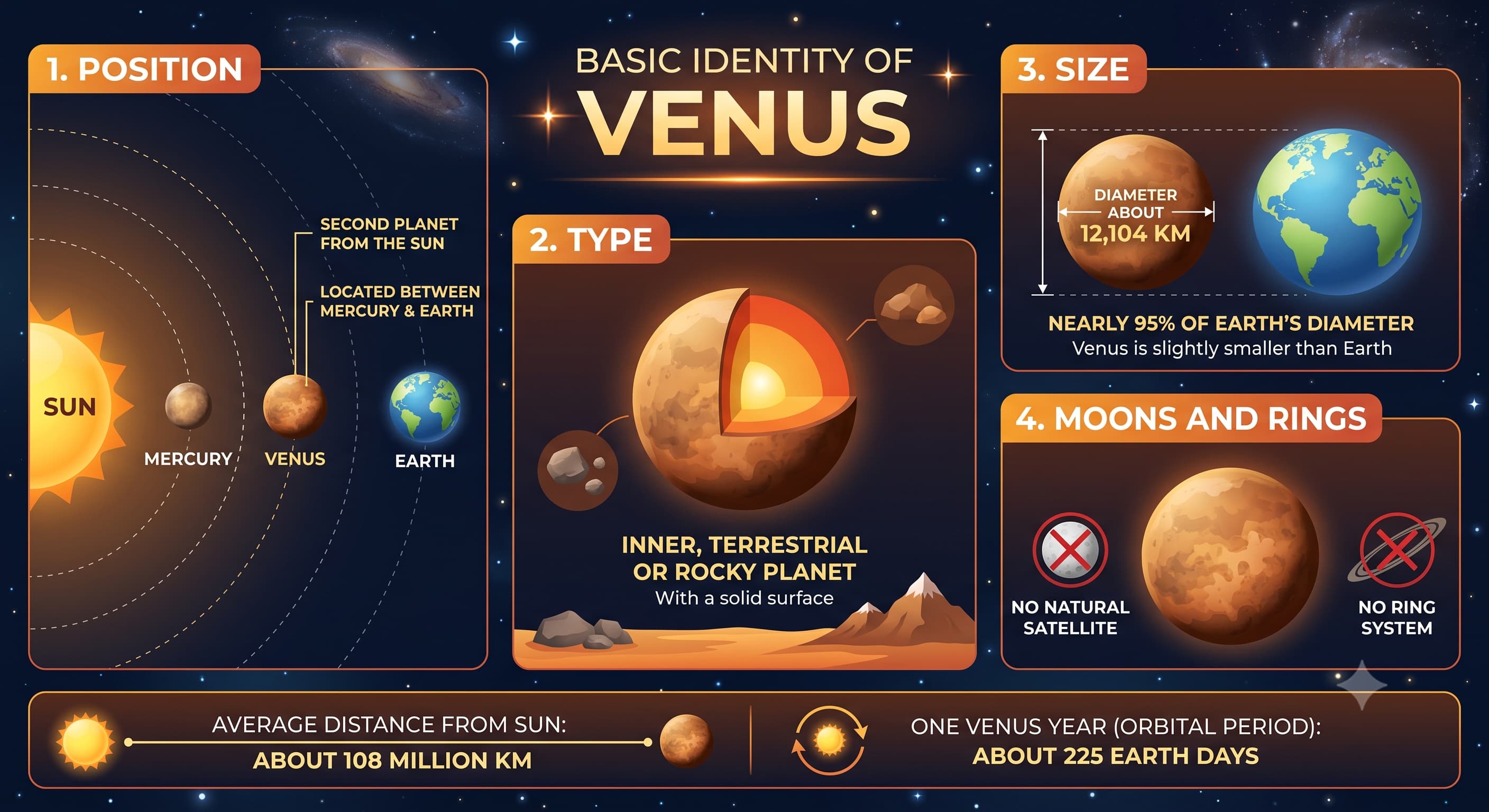
Position
Venus is the second planet from the Sun, located between Mercury and Earth.
Type
It is an inner, terrestrial or rocky planet.
Size
Its diameter is about 12,104 km, nearly 95% of Earth's diameter.
Moon and Rings
Venus has no natural satellite and no ring system.
2. Why is Venus Called Earth's Twin?
Venus is often called Earth's twin or Earth's sister planet because both planets are similar in size, mass, density, gravity and rocky composition.
Similar Size
Venus is only slightly smaller than Earth.
Similar Gravity
Surface gravity is about 90% of Earth's gravity.
Rocky Interior
Both probably contain a metallic core, rocky mantle and crust.
Important: Similar size does not mean similar environment. Venus has no surface ocean, almost no free oxygen, extreme heat, dense carbon dioxide and enormous atmospheric pressure. Therefore, it is also called Earth's evil twin.
3. Revolution and Orbit of Venus
Revolution means the movement of a planet around the Sun. Venus completes one revolution in about 224.7 Earth days, commonly rounded to 225 days.
Venus follows an almost circular orbit. Among the major planets, its orbit is one of the least elongated. Therefore, the difference between its nearest and farthest distances from the Sun is comparatively small.
Easy Meaning: A nearly circular orbit means Venus remains at a relatively similar distance from the Sun throughout its year.
4. Retrograde Rotation: Why Does Venus Spin Backwards?
Most planets rotate from west to east when viewed from above the Sun's north pole. Venus rotates in the opposite direction—from east to west. This is called retrograde rotation.
Venus takes about 243 Earth days to complete one rotation relative to distant stars. This is called its sidereal rotation period.
Scientists have proposed several explanations for the unusual rotation, including ancient collisions and long-term gravitational and atmospheric effects. However, the exact sequence that produced the present rotation is still being studied.
5. Venus Day, Venus Year and Solar Day: Do Not Confuse Them
Three different time periods are used while describing Venus. They must not be treated as the same thing.
Sidereal Day
One complete rotation relative to distant stars: about 243 Earth days.
Venus Year
One revolution around the Sun: about 225 Earth days.
Solar Day
Time from one sunrise to the next: about 117 Earth days.
UPSC Trap: A sidereal day on Venus is longer than its year, but its solar day is shorter than its year. Therefore, the statement “a day on Venus is longer than a year” is correct only when “day” means the sidereal rotation period.
Venus's retrograde rotation is the reason its solar day is about 117 Earth days rather than 243 days. Rotation and revolution act in opposite directions, causing the Sun to return to the same position in the Venusian sky sooner.
6. Why is Venus the Hottest Planet?
Venus is not the closest planet to the Sun—Mercury is. Yet Venus is hotter because Venus has a very dense carbon dioxide atmosphere that traps heat extremely efficiently.
Average Surface Temperature
About 465°C
Main Cause
Runaway Greenhouse Effect
The surface is hot enough to melt lead. Unlike Mercury, Venus remains extremely hot both during its long day and long night because its massive atmosphere stores and circulates heat around the entire planet.
Core Fact: Mercury is nearest to the Sun, but Venus is the hottest planet.
7. Greenhouse Effect and Runaway Greenhouse Effect
A greenhouse effect occurs when certain gases allow much of the incoming sunlight to reach a planet but absorb part of the heat that the warmed surface tries to send back into space.
On Earth, the natural greenhouse effect keeps the planet warm enough for life. On Venus, however, the process became extremely strong. This is called a runaway greenhouse effect.
Step 1: Initial Warming
Greater heating caused more surface water to evaporate, assuming early Venus possessed substantial water.
Step 2: More Water Vapour
Water vapour is itself a greenhouse gas, so additional vapour caused further warming.
Step 3: Positive Feedback
More warming produced more evaporation, and more evaporation produced still more warming.
Step 4: Water Loss
High in the atmosphere, sunlight broke water molecules apart and light hydrogen escaped into space.
Step 5: CO₂ Accumulation
With no ocean and no Earth-like carbon cycle to remove large amounts of CO₂, a massive CO₂ atmosphere remained.
Simple Meaning of “Runaway”: Warming strengthens a process that causes even more warming. The cycle keeps amplifying until the planet reaches a radically hotter state.
8. Atmosphere and Crushing Surface Pressure
Venus has the densest atmosphere among the four rocky planets. Its atmosphere consists mainly of carbon dioxide, with nitrogen and small amounts of other gases.
Carbon Dioxide
About 96.5%
Nitrogen
About 3.5%
Surface Pressure
About 92 Times Earth
Standing on the surface of Venus would expose an object to pressure similar to the pressure found roughly 900 metres below Earth's ocean surface. This pressure, together with extreme heat, destroys most spacecraft within a short time.
9. Sulfuric Acid Clouds and Atmospheric Super-Rotation
Venus is completely covered by thick clouds made mainly of droplets of sulfuric acid. These clouds hide the surface from ordinary visible-light cameras and reflect a large share of incoming sunlight, making Venus appear exceptionally bright from Earth.
Cloud Composition
Mostly sulfuric acid droplets, not water clouds like those commonly seen on Earth.
High Reflectivity
The bright cloud cover is a major reason Venus is the brightest planet in Earth's sky.
Super-Rotation
Cloud-top winds circle Venus in only about four Earth days, much faster than the solid planet rotates.
This rapid atmospheric circulation is called super-rotation. Venus itself rotates extremely slowly, yet its upper atmosphere races around the planet. The complete mechanism maintaining this super-rotation remains an important scientific question.
10. Surface of Venus: A Hidden Volcanic World
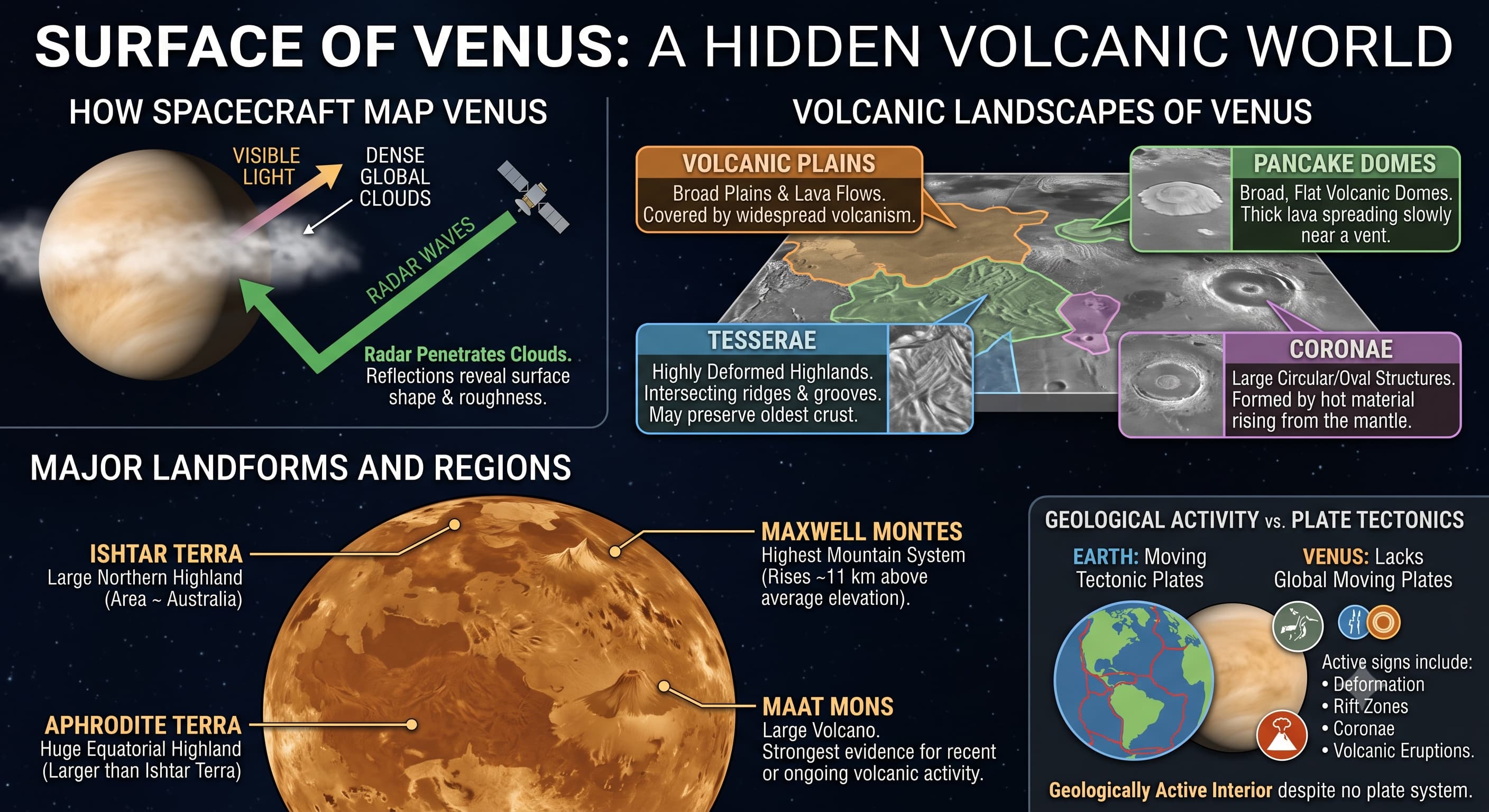
Venus's clouds prevent direct viewing of its surface in visible light. Therefore, spacecraft use radar, which can penetrate the clouds and map the land below.
Volcanic Plains
Most of the planet is covered by broad plains and lava flows produced by widespread volcanism.
Tesserae
Highly deformed highlands containing intersecting ridges and grooves; they may preserve some of the oldest crust.
Coronae
Large circular or oval structures probably formed by hot material rising from the mantle.
Pancake Domes
Broad, flat volcanic domes formed when thick lava spread slowly near a vent.
Why Radar is Used: Visible light cannot pass through the dense global cloud cover, but radar waves can travel through the clouds, reflect from the ground and reveal surface shape and roughness.
11. Major Landforms and Regions of Venus
Ishtar Terra
A large northern highland region, roughly comparable in area to Australia.
Aphrodite Terra
A huge equatorial highland region, larger than Ishtar Terra.
Maxwell Montes
The highest mountain system on Venus, rising about 11 km above the planet's average elevation.
Maat Mons
A large volcano associated with some of the strongest evidence for recent or ongoing volcanic activity.
Unlike Earth, Venus has no confirmed global system of moving tectonic plates. However, radar data reveal deformation, rift zones, coronae and other signs that its crust and interior remain geologically active.
12. Is Venus Volcanically Active Today?
Venus has thousands of volcanic structures, and most of its surface was shaped by lava. Scientists now possess strong evidence that volcanism may still be occurring.
These findings indicate that Venus is probably not a geologically dead planet. Future missions will repeatedly map the surface to identify fresh lava flows, ground deformation and other changes.
Careful Wording: Evidence for present-day volcanic activity is strong, but Venus is not yet monitored continuously like Earth. Future high-resolution observations are needed to determine how frequent the eruptions are.
13. Axial Tilt and Seasons on Venus
Venus is often described as having an axial tilt of about 177°. This does not mean it experiences extreme seasons. It means the planet is effectively upside down and rotates in the retrograde direction.
Relative to an upside-down upright position, its effective tilt is only about 3°. Therefore, sunlight distribution changes little during the Venusian year, and strong Earth-like seasons do not occur.
14. Water, Habitability and the Past of Venus
Present-day Venus is extremely dry and hostile to known life. However, measurements of its atmosphere and climate models raise the possibility that ancient Venus once possessed much more water and may have had milder conditions.
Possible Ancient Water
The atmosphere contains chemical clues consistent with major water loss over time.
Possible Mild Past
Some climate models suggest Venus may once have supported shallow oceans and temperate conditions.
Present Condition
No confirmed liquid water or life exists on the surface today.
Scientific Caution: An ancient ocean on Venus is a scientifically plausible hypothesis, not a directly observed fact. Future missions will test whether the planet was once wet and habitable.
15. Magnetic Field and Solar-Wind Interaction
Venus does not have a strong internally generated global magnetic field like Earth. Its very slow rotation may be one reason a powerful internal dynamo is absent.
However, Venus is not completely unprotected. Solar wind interacts with its ionosphere and creates an induced magnetosphere—a magnetic region generated by the interaction rather than by a powerful planetary magnetic field.
16. Venus as the Morning Star and Evening Star
Venus is the brightest planet seen from Earth. Because its orbit lies inside Earth's orbit, Venus always appears in the general direction of the Sun.
Morning Star
When visible before sunrise in the eastern sky, Venus is popularly called the Morning Star.
Evening Star
When visible after sunset in the western sky, Venus is popularly called the Evening Star.
UPSC Trap: Morning Star and Evening Star are not two different stars. Both names refer to the planet Venus at different positions in its orbit.
Venus also shows phases—crescent, half and nearly full—when observed through a telescope. These phases occur because we see different portions of its sunlit hemisphere as Venus and Earth move around the Sun.
17. Transit of Venus
A transit of Venus occurs when Venus passes directly between Earth and the Sun and appears as a small dark dot moving across the Sun's visible disc.
Transits are rare because Venus's orbit is slightly tilted relative to Earth's orbital plane. Usually, Venus passes above or below the visible disc of the Sun rather than directly across it.
Historical Importance: Observations of Venus transits were once used to estimate the Earth–Sun distance and improve knowledge of the scale of the Solar System.
18. Important Missions to Venus
Mariner 2 — USA
In 1962, it became the first successful spacecraft to visit another planet and confirmed Venus's extremely hot surface environment.
Venera Programme — USSR
Venera 7 achieved the first successful soft landing on another planet in 1970; Venera 9 later returned the first images from another planet's surface.
Magellan — NASA
From 1990 to 1994, radar mapped more than 98% of the surface and revealed volcanic plains, mountains and tectonic structures.
Venus Express — ESA
Studied the atmosphere, plasma environment and climate from 2006 to 2014.
Akatsuki — JAXA
Studied Venusian weather and atmospheric circulation from orbit; JAXA formally ended operations on 18 September 2025.
Upcoming Venus Missions — Status as of July 2026
India's Venus Orbiter Mission: ISRO plans an orbiter to study the surface, subsurface, atmosphere, clouds, ionosphere and Sun–Venus interaction; launch is scheduled for March 2028.
NASA DAVINCI: A flyby spacecraft and atmospheric descent probe designed to study atmospheric composition and investigate whether Venus was once wet and habitable; planned for the early 2030s.
NASA VERITAS: An orbiter intended to produce high-resolution radar and topographic maps and search for geological change; launch planned no earlier than 2031.
ESA Envision: An orbiter planned for launch in November 2031 to study Venus from its interior and surface to its atmosphere.
19. Venus, Earth and Mercury: Important Comparison
| Basis | Mercury | Venus | Earth |
|---|---|---|---|
| Position from Sun | First | Second | Third |
| Hottest Planet? | No | Yes | No |
| Main Atmosphere | Extremely thin exosphere | Dense CO₂ atmosphere | Mainly nitrogen and oxygen |
| Rotation | Prograde | Retrograde | Prograde |
| Natural Satellites | 0 | 0 | 1 |
| Surface Liquid Water | Absent | Absent today | Abundant |
| Global Internal Magnetic Field | Weak | No strong intrinsic field | Strong |
20. High-Value UPSC Facts and Exam Traps
Trap 1
Venus—not Mercury—is the hottest planet.
Trap 2
Venus rotates from east to west; the Sun would rise in the west.
Trap 3
Sidereal rotation is 243 days, year is 225 days and solar day is 117 days.
Trap 4
Venus has no moon and no ring.
Trap 5
Its clouds are mainly sulfuric acid droplets, while the atmosphere is mainly carbon dioxide.
Trap 6
A 177° axial tilt means nearly upside-down rotation, not extreme seasonal tilt.
Trap 7
Venus lacks a strong intrinsic magnetic field but has an induced magnetosphere.
Trap 8
Morning Star and Evening Star are both Venus, not actual stars.
Quick Revision
Venus is the second planet from the Sun and a terrestrial planet.
It is nearly Earth-sized and is called Earth's twin, but has a radically different environment.
It is the hottest planet, with an average surface temperature of about 465°C.
The main cause of extreme heat is the runaway greenhouse effect.
Its atmosphere is about 96.5% CO₂ and surface pressure is about 92 times Earth's.
Venus has sulfuric acid clouds and atmospheric super-rotation.
It rotates retrograde, so the Sun would rise in the west and set in the east.
Sidereal rotation: about 243 days; revolution: about 225 days; solar day: about 117 days.
Venus has no moon and no ring.
Major features include Ishtar Terra, Aphrodite Terra, Maxwell Montes, tesserae, coronae and Maat Mons.
Evidence suggests Venus may remain volcanically active.
It has no strong intrinsic global magnetic field but possesses an induced magnetosphere.
Venus appears as the Morning Star or Evening Star and shows phases like the Moon.
Major missions include Mariner 2, Venera missions, Magellan, Venus Express and Akatsuki.
Upcoming missions include India's Venus Orbiter Mission, NASA's DAVINCI and VERITAS, and ESA's Envision.
Think Like UPSC: Venus should not be remembered only as the hottest planet. Connect its dense CO₂ atmosphere with the runaway greenhouse effect; retrograde rotation with western sunrise; slow rotation with its unusual day-year relationship; sulfuric acid clouds with high brightness; and radar mapping with the hidden volcanic surface. These cause-and-effect links are more useful than isolated facts.
शुक्र: सबसे गर्म ग्रह, हरितगृह प्रभाव और प्रतिगामी घूर्णन
शुक्र सूर्य से दूसरा ग्रह और सौरमंडल का सबसे गर्म ग्रह है। इसका आकार लगभग पृथ्वी जितना है, लेकिन इसके घने कार्बन डाइऑक्साइड वायुमंडल, अत्यधिक दाब और अनियंत्रित हरितगृह प्रभाव ने इसे अत्यंत प्रतिकूल संसार बना दिया है।
शुक्र विशेष रूप से महत्त्वपूर्ण है, क्योंकि यह दिखाता है कि लगभग समान आकार के दो चट्टानी ग्रह बिल्कुल अलग-अलग रूप में विकसित हो सकते हैं। पृथ्वी जल-समृद्ध और जीवन को सहारा देने वाला ग्रह बनी, जबकि शुक्र गर्म, शुष्क और बादलों से ढका ग्रह बन गया।
1. शुक्र ग्रह का मूल परिचय
स्थिति
शुक्र सूर्य से दूसरा ग्रह है, जो बुध और पृथ्वी के बीच स्थित है।
प्रकार
यह एक आंतरिक, पार्थिव अथवा चट्टानी ग्रहहै।
आकार
इसका व्यास लगभग 12,104 किमीहै, जो पृथ्वी के व्यास का लगभग 95% है।
उपग्रह और वलय
शुक्र का न तो कोई प्राकृतिक उपग्रह है और न ही कोई वलय-तंत्रहै।
2. शुक्र को पृथ्वी का जुड़वाँ ग्रह क्यों कहा जाता है?
शुक्र को प्रायः पृथ्वी का जुड़वाँ या पृथ्वी का सहोदर ग्रह कहा जाता है, क्योंकि दोनों ग्रह आकार, द्रव्यमान, घनत्व, गुरुत्वाकर्षण और चट्टानी संरचना में समान हैं।
समान आकार
शुक्र पृथ्वी से केवल थोड़ा छोटा है।
समान गुरुत्वाकर्षण
शुक्र की सतही गुरुत्वाकर्षण शक्ति पृथ्वी की गुरुत्वाकर्षण शक्ति की लगभग 90%है।
चट्टानी आंतरिक संरचना
संभवतः दोनों ग्रहों में धात्विक क्रोड, चट्टानी मैंटल और भू-पर्पटी पाई जाती है।
महत्त्वपूर्ण: समान आकार का अर्थ समान पर्यावरण नहीं होता। शुक्र पर सतही महासागर नहीं हैं, मुक्त ऑक्सीजन लगभग नहीं है, तापमान अत्यधिक है, कार्बन डाइऑक्साइड घनी है और वायुमंडलीय दाब बहुत अधिक है। इसलिए इसे पृथ्वी का दुष्ट जुड़वाँभी कहा जाता है।
3. शुक्र का परिक्रमण और कक्षा
परिक्रमण का अर्थ किसी ग्रह का सूर्य के चारों ओर घूमना है। शुक्र अपनी एक परिक्रमा लगभग 224.7 पृथ्वी दिवसमें पूरी करता है, जिसे सामान्यतः 225 दिन माना जाता है।
शुक्र की कक्षा लगभग वृत्ताकार है। प्रमुख ग्रहों में इसकी कक्षा सबसे कम खिंची हुई कक्षाओं में से एक है। इसलिए सूर्य से इसकी निकटतम और अधिकतम दूरी के बीच का अंतर तुलनात्मक रूप से कम है।
सरल अर्थ: लगभग वृत्ताकार कक्षा का अर्थ है कि शुक्र अपने पूरे वर्ष के दौरान सूर्य से लगभग समान दूरी पर बना रहता है।
4. प्रतिगामी घूर्णन: शुक्र उलटी दिशा में क्यों घूमता है?
सूर्य के उत्तरी ध्रुव के ऊपर से देखने पर अधिकांश ग्रह पश्चिम से पूर्व दिशा में घूमते हैं। शुक्र इसके विपरीत दिशा—पूर्व से पश्चिम—में घूमता है। इसे प्रतिगामी घूर्णन (Retrograde Rotation)कहा जाता है।
शुक्र दूर स्थित तारों के सापेक्ष अपनी धुरी पर एक घूर्णन पूरा करने में लगभग 243 पृथ्वी दिवस लेता है। इसे उसका नाक्षत्र घूर्णन काल (Sidereal Rotation Period)कहा जाता है।
वैज्ञानिकों ने इस असामान्य घूर्णन के लिए कई संभावित कारण बताए हैं, जिनमें प्राचीन टक्करें तथा लंबे समय तक सक्रिय गुरुत्वाकर्षण और वायुमंडलीय प्रभाव शामिल हैं। फिर भी वर्तमान घूर्णन बनने की सटीक प्रक्रिया पर अभी अध्ययन जारी है।
5. शुक्र का दिन, शुक्र का वर्ष और सौर दिवस: इनमें भ्रम न करें
शुक्र का वर्णन करते समय तीन अलग-अलग समय-अवधियों का प्रयोग होता है। इन्हें एक ही चीज नहीं समझना चाहिए।
नाक्षत्र दिवस
दूर स्थित तारों के सापेक्ष एक पूरा घूर्णन: लगभग 243 पृथ्वी दिवस।
शुक्र का वर्ष
सूर्य के चारों ओर एक परिक्रमण: लगभग 225 पृथ्वी दिवस।
सौर दिवस
एक सूर्योदय से अगले सूर्योदय तक का समय: लगभग 117 पृथ्वी दिवस।
UPSC परीक्षा-जाल: शुक्र का नाक्षत्र दिवस उसके वर्ष से लंबा है, लेकिन उसका सौर दिवस उसके वर्ष से छोटा है। इसलिए “शुक्र का एक दिन उसके एक वर्ष से लंबा होता है” कथन तभी सही है, जब “दिन” का अर्थ नाक्षत्र घूर्णन काल हो।
शुक्र के प्रतिगामी घूर्णन के कारण उसका सौर दिवस 243 दिनों के स्थान पर लगभग 117 पृथ्वी दिवस का होता है। घूर्णन और परिक्रमण विपरीत दिशाओं में होते हैं, इसलिए शुक्र के आकाश में सूर्य अपेक्षाकृत जल्दी उसी स्थान पर लौट आता है।
6. शुक्र सौरमंडल का सबसे गर्म ग्रह क्यों है?
शुक्र सूर्य के सबसे निकट ग्रह नहीं है—बुध सबसे निकट है। फिर भी शुक्र अधिक गर्म है, क्योंकि उसके पास अत्यंत घना कार्बन डाइऑक्साइड वायुमंडल है, जो ऊष्मा को बहुत प्रभावी ढंग से रोककर रखता है।
औसत सतही तापमान
लगभग 465°C
मुख्य कारण
अनियंत्रित हरितगृह प्रभाव
शुक्र की सतह इतनी गर्म है कि सीसा भी पिघल सकता है। बुध के विपरीत, शुक्र अपने लंबे दिन और लंबी रात—दोनों के दौरान अत्यंत गर्म रहता है, क्योंकि उसका विशाल वायुमंडल पूरे ग्रह पर ऊष्मा को संचित और वितरित करता है।
मूल तथ्य: बुध सूर्य के सबसे निकट है, लेकिन शुक्र सबसे गर्म ग्रह है।
7. हरितगृह प्रभाव और अनियंत्रित हरितगृह प्रभाव
एक हरितगृह प्रभाव तब उत्पन्न होता है, जब कुछ गैसें आने वाले अधिकांश सूर्यप्रकाश को ग्रह की सतह तक पहुँचने देती हैं, लेकिन गर्म सतह द्वारा अंतरिक्ष में वापस भेजी जाने वाली ऊष्मा के एक भाग को अवशोषित कर लेती हैं।
पृथ्वी पर प्राकृतिक हरितगृह प्रभाव ग्रह को जीवन के लिए पर्याप्त गर्म बनाए रखता है। लेकिन शुक्र पर यह प्रक्रिया अत्यंत शक्तिशाली हो गई। इसे अनियंत्रित हरितगृह प्रभाव (Runaway Greenhouse Effect)कहा जाता है।
चरण 1: प्रारंभिक तापवृद्धि
यदि प्रारंभिक शुक्र पर पर्याप्त जल मौजूद था, तो अधिक ताप के कारण सतही जल का अधिक वाष्पीकरण हुआ।
चरण 2: अधिक जलवाष्प
जलवाष्प स्वयं एक हरितगृह गैस है, इसलिए अतिरिक्त जलवाष्प ने तापमान को और बढ़ाया।
चरण 3: धनात्मक प्रतिपुष्टि
अधिक ताप से अधिक वाष्पीकरण हुआ और अधिक वाष्पीकरण से तापमान और बढ़ गया।
चरण 4: जल की हानि
ऊपरी वायुमंडल में सूर्यप्रकाश ने जल के अणुओं को तोड़ दिया और हल्का हाइड्रोजन अंतरिक्ष में निकल गया।
चरण 5: CO₂ का संचय
महासागर और पृथ्वी जैसे कार्बन चक्र के अभाव में बड़ी मात्रा में CO₂ हट नहीं सकी और विशाल CO₂ वायुमंडल बना रहा।
“अनियंत्रित” का सरल अर्थ: तापवृद्धि ऐसी प्रक्रिया को अधिक शक्तिशाली बनाती है, जो आगे और अधिक तापवृद्धि पैदा करती है। यह चक्र लगातार बढ़ता रहता है, जब तक ग्रह अत्यधिक गर्म अवस्था में नहीं पहुँच जाता।
8. वायुमंडल और अत्यधिक सतही दाब
चारों चट्टानी ग्रहों में शुक्र का वायुमंडल सबसे घना है। इसका वायुमंडल मुख्यतः कार्बन डाइऑक्साइड से बना है, जबकि इसमें नाइट्रोजन और अन्य गैसों की थोड़ी मात्रा भी पाई जाती है।
कार्बन डाइऑक्साइड
लगभग 96.5%
नाइट्रोजन
लगभग 3.5%
सतही दाब
पृथ्वी से लगभग 92 गुना
शुक्र की सतह पर खड़ी किसी वस्तु पर लगभग उतना दाब पड़ेगा, जितना पृथ्वी के महासागर की सतह से लगभग 900 मीटर नीचेपाया जाता है। अत्यधिक गर्मी के साथ यह दाब अधिकांश अंतरिक्षयानों को थोड़े ही समय में नष्ट कर देता है।
9. सल्फ्यूरिक अम्ल के बादल और वायुमंडलीय सुपर-रोटेशन
शुक्र पूरी तरह घने बादलों से ढका है, जो मुख्यतः सल्फ्यूरिक अम्लकी बूंदों से बने हैं। ये बादल सामान्य दृश्य-प्रकाश कैमरों से सतह को छिपा देते हैं और आने वाले सूर्यप्रकाश के बड़े भाग को परावर्तित करते हैं, जिससे पृथ्वी से शुक्र असाधारण रूप से चमकीला दिखाई देता है।
बादलों की संरचना
मुख्यतः सल्फ्यूरिक अम्ल की बूंदें; ये पृथ्वी पर सामान्यतः दिखाई देने वाले जल-बादलों जैसे नहीं हैं।
उच्च परावर्तनशीलता
चमकीले बादलों का आवरण शुक्र को पृथ्वी के आकाश में सबसे चमकीला ग्रह बनाने का प्रमुख कारण है।
सुपर-रोटेशन
बादलों की ऊपरी परत की हवाएँ शुक्र का चक्कर केवल लगभग चार पृथ्वी दिनोंमें लगा लेती हैं, जो ठोस ग्रह के घूर्णन से बहुत तेज है।
इस तीव्र वायुमंडलीय परिसंचरण को सुपर-रोटेशनकहा जाता है। शुक्र स्वयं अत्यंत धीरे घूमता है, लेकिन उसका ऊपरी वायुमंडल बहुत तेजी से ग्रह का चक्कर लगाता है। इस सुपर-रोटेशन को बनाए रखने वाली पूरी प्रक्रिया अब भी एक महत्त्वपूर्ण वैज्ञानिक प्रश्न है।
10. शुक्र की सतह: बादलों के नीचे छिपा ज्वालामुखीय संसार
शुक्र के बादल दृश्य प्रकाश में उसकी सतह को सीधे देखने नहीं देते। इसलिए अंतरिक्षयान रडारका उपयोग करते हैं, जो बादलों को पार करके नीचे की भूमि का मानचित्र बना सकता है।
ज्वालामुखीय मैदान
ग्रह का अधिकांश भाग विस्तृत मैदानों और व्यापक ज्वालामुखीय गतिविधि से बने लावा प्रवाहों से ढका है।
टेसेरा (Tesserae)
बहुत अधिक विकृत उच्चभूमियाँ, जिनमें एक-दूसरे को काटती पर्वत-श्रेणियाँ और खाँचें होती हैं; इनमें संभवतः शुक्र की सबसे पुरानी भू-पर्पटी के कुछ भाग सुरक्षित हैं।
कोरोना (Coronae)
बड़े वृत्ताकार या अंडाकार स्थलरूप, जो संभवतः मैंटल से ऊपर उठे गर्म पदार्थ के कारण बने।
पैनकेक डोम
चौड़े और चपटे ज्वालामुखीय गुंबद, जो किसी ज्वालामुखीय छिद्र के निकट गाढ़े लावा के धीरे-धीरे फैलने से बने।
रडार का उपयोग क्यों किया जाता है? दृश्य प्रकाश घने वैश्विक बादल-आवरण को पार नहीं कर सकता, लेकिन रडार तरंगें बादलों से होकर गुजर सकती हैं, भूमि से परावर्तित होकर सतह के आकार और खुरदरेपन की जानकारी दे सकती हैं।
11. शुक्र के प्रमुख स्थलरूप और क्षेत्र
इश्तार टेरा
उत्तरी भाग का एक विशाल उच्चभूमि क्षेत्र, जिसका क्षेत्रफल लगभग ऑस्ट्रेलिया के बराबर है।
एफ्रोडाइट टेरा
भूमध्यरेखीय क्षेत्र में स्थित एक विशाल उच्चभूमि, जो इश्तार टेरा से भी बड़ी है।
मैक्सवेल मॉन्टेस
शुक्र की सबसे ऊँची पर्वत-प्रणाली, जो ग्रह की औसत ऊँचाई से लगभग 11 किमी ऊपर उठी हुई है।
माट मॉन्स
एक विशाल ज्वालामुखी, जिसके आसपास हाल की या वर्तमान ज्वालामुखीय गतिविधि के कुछ सबसे मजबूत प्रमाण मिले हैं।
पृथ्वी के विपरीत, शुक्र पर गतिशील विवर्तनिक प्लेटों की किसी वैश्विक प्रणाली की पुष्टि नहीं हुई है। फिर भी रडार आँकड़े विकृति, रिफ्ट क्षेत्र, कोरोना और अन्य संकेत दिखाते हैं, जिनसे पता चलता है कि इसकी भू-पर्पटी और आंतरिक भाग अब भी भूवैज्ञानिक रूप से सक्रिय हैं।
12. क्या शुक्र आज भी ज्वालामुखीय रूप से सक्रिय है?
शुक्र पर हजारों ज्वालामुखीय संरचनाएँ हैं और उसकी अधिकांश सतह लावा द्वारा निर्मित हुई है। अब वैज्ञानिकों के पास इस बात के मजबूत प्रमाण हैं कि वहाँ ज्वालामुखीय गतिविधि अभी भी हो सकती है।
इन निष्कर्षों से संकेत मिलता है कि शुक्र संभवतः भूवैज्ञानिक रूप से मृत ग्रह नहीं है। भविष्य के मिशन नई लावा धाराओं, भूमि-विकृति और अन्य परिवर्तनों की पहचान के लिए सतह का बार-बार मानचित्रण करेंगे।
सावधानीपूर्वक कथन: वर्तमान ज्वालामुखीय गतिविधि के प्रमाण मजबूत हैं, लेकिन पृथ्वी की तरह शुक्र की अभी निरंतर निगरानी नहीं होती। विस्फोट कितनी बार होते हैं, यह निर्धारित करने के लिए भविष्य में उच्च-विभेदन वाले प्रेक्षण आवश्यक होंगे।
13. शुक्र का अक्षीय झुकाव और ऋतुएँ
शुक्र का अक्षीय झुकाव प्रायः लगभग 177°बताया जाता है। इसका अर्थ यह नहीं कि वहाँ अत्यंत तीव्र ऋतुएँ होती हैं। इसका अर्थ है कि ग्रह लगभग उलटा है और प्रतिगामी दिशा में घूमता है।
उलटी लेकिन लगभग सीधी स्थिति के सापेक्ष इसका प्रभावी झुकाव केवल लगभग 3° है। इसलिए शुक्र-वर्ष के दौरान सूर्यप्रकाश के वितरण में बहुत कम परिवर्तन होता है और पृथ्वी जैसी स्पष्ट ऋतुएँ नहीं बनतीं।
14. जल, जीवन-योग्यता और शुक्र का अतीत
वर्तमान शुक्र अत्यंत शुष्क है और ज्ञात जीवन के लिए बहुत प्रतिकूल है। फिर भी उसके वायुमंडल के मापन और जलवायु मॉडल यह संभावना दिखाते हैं कि प्राचीन शुक्र पर कभी बहुत अधिक जल और अपेक्षाकृत सौम्य परिस्थितियाँ रही होंगी।
संभावित प्राचीन जल
वायुमंडल में ऐसे रासायनिक संकेत हैं, जो लंबे समय में बड़े पैमाने पर जल-हानि से मेल खाते हैं।
संभावित सौम्य अतीत
कुछ जलवायु मॉडल संकेत देते हैं कि शुक्र पर कभी उथले महासागर और समशीतोष्ण परिस्थितियाँ रही होंगी।
वर्तमान स्थिति
आज सतह पर तरल जल या जीवन की पुष्टि नहीं हुई है।
वैज्ञानिक सावधानी: शुक्र पर प्राचीन महासागर की संभावना वैज्ञानिक रूप से उचित परिकल्पना है, प्रत्यक्ष रूप से देखा गया तथ्य नहीं। भविष्य के मिशन जाँचेंगे कि क्या यह ग्रह कभी जलयुक्त और जीवन-योग्य था।
15. चुंबकीय क्षेत्र और सौर पवन की अंतःक्रिया
शुक्र के पास पृथ्वी जैसा आंतरिक रूप से उत्पन्न शक्तिशाली वैश्विक चुंबकीय क्षेत्र नहीं है। इसका अत्यंत धीमा घूर्णन शक्तिशाली आंतरिक डायनेमो के अभाव का एक कारण हो सकता है।
फिर भी शुक्र पूरी तरह असुरक्षित नहीं है। सौर पवन उसके आयनमंडल से अंतःक्रिया करके एक प्रेरित चुंबकमंडल (Induced Magnetosphere)बनाती है—यह शक्तिशाली ग्रहीय चुंबकीय क्षेत्र के बजाय सौर पवन और आयनमंडल की अंतःक्रिया से निर्मित चुंबकीय क्षेत्र है।
16. प्रातः तारा और सायं तारा के रूप में शुक्र
शुक्र पृथ्वी से दिखाई देने वाला सबसे चमकीला ग्रह है। चूँकि इसकी कक्षा पृथ्वी की कक्षा के भीतर है, इसलिए शुक्र हमेशा सूर्य की सामान्य दिशा के पास दिखाई देता है।
प्रातः तारा
जब शुक्र सूर्योदय से पहले पूर्वी आकाश में दिखाई देता है, तो इसे प्रचलित रूप से प्रातः तारा कहा जाता है।
सायं तारा
जब शुक्र सूर्यास्त के बाद पश्चिमी आकाश में दिखाई देता है, तो इसे प्रचलित रूप से सायं तारा कहा जाता है।
UPSC परीक्षा-जाल: प्रातः तारा और सायं तारा दो अलग-अलग तारे नहीं हैं। दोनों नाम शुक्र ग्रह को उसकी कक्षा की अलग-अलग स्थितियों में दर्शाते हैं।
दूरबीन से देखने पर शुक्र भी चंद्रमा की तरह विभिन्न कलाएँ—अर्धचंद्राकार, आधा और लगभग पूर्ण—दिखाता है। ये कलाएँ इसलिए बनती हैं, क्योंकि शुक्र और पृथ्वी के सूर्य की परिक्रमा करने के दौरान हमें उसके प्रकाशित गोलार्द्ध के अलग-अलग भाग दिखाई देते हैं।
17. शुक्र का पारगमन
शुक्र का पारगमन (Transit of Venus) तब होता है, जब शुक्र पृथ्वी और सूर्य के ठीक बीच से गुजरता है और सूर्य की दिखाई देने वाली डिस्क पर चलता हुआ एक छोटा काला बिंदु प्रतीत होता है।
पारगमन दुर्लभ होते हैं, क्योंकि शुक्र की कक्षा पृथ्वी के कक्षीय तल के सापेक्ष थोड़ी झुकी हुई है। सामान्यतः शुक्र सूर्य की दिखाई देने वाली डिस्क के ठीक सामने से गुजरने के बजाय उसके ऊपर या नीचे से गुजरता है।
ऐतिहासिक महत्त्व: शुक्र के पारगमन के प्रेक्षणों का उपयोग कभी पृथ्वी-सूर्य दूरी का अनुमान लगाने और सौरमंडल के पैमाने की समझ सुधारने के लिए किया गया था।
18. शुक्र से संबंधित महत्त्वपूर्ण अंतरिक्ष मिशन
मैरिनर 2 — अमेरिका
1962 में यह किसी दूसरे ग्रह तक सफलतापूर्वक पहुँचने वाला पहला अंतरिक्षयान बना और इसने शुक्र की अत्यंत गर्म सतही परिस्थितियों की पुष्टि की।
वेनेरा कार्यक्रम — सोवियत संघ
वेनेरा 7 ने 1970 में किसी अन्य ग्रह पर पहली सफल सॉफ्ट लैंडिंग की; बाद में वेनेरा 9 ने किसी अन्य ग्रह की सतह से पहली तस्वीरें भेजीं।
मैगेलन — NASA
1990 से 1994 के बीच रडार द्वारा शुक्र की 98% से अधिक सतह का मानचित्रण किया गया और ज्वालामुखीय मैदानों, पर्वतों तथा विवर्तनिक संरचनाओं का पता चला।
वीनस एक्सप्रेस — ESA
इसने 2006 से 2014 तक वायुमंडल, प्लाज़्मा परिवेश और जलवायु का अध्ययन किया।
अकात्सुकी — JAXA
इसने कक्षा से शुक्र के मौसम और वायुमंडलीय परिसंचरण का अध्ययन किया; JAXA ने 18 सितंबर 2025 को औपचारिक रूप से इसका संचालन समाप्त कर दिया।
आगामी शुक्र मिशन — जुलाई 2026 तक की स्थिति
भारत का शुक्र कक्षीय मिशन: ISRO सतह, उपसतह, वायुमंडल, बादलों, आयनमंडल और सूर्य-शुक्र अंतःक्रिया के अध्ययन के लिए एक कक्षीय यान की योजना बना रहा है; प्रक्षेपण मार्च 2028 के लिए निर्धारित है।
NASA DAVINCI: यह एक फ्लाईबाई अंतरिक्षयान और वायुमंडल में उतरने वाला प्रोब होगा, जिसे वायुमंडलीय संरचना का अध्ययन करने और यह जाँचने के लिए बनाया गया है कि शुक्र कभी जलयुक्त और जीवन-योग्य था या नहीं; मिशन की योजना 2030 के शुरुआती वर्षों के लिए है।
NASA VERITAS: यह उच्च-विभेदन वाले रडार और स्थलाकृतिक मानचित्र तैयार करने तथा भूवैज्ञानिक परिवर्तनों की खोज के लिए प्रस्तावित कक्षीय यान है; प्रक्षेपण 2031 से पहले नियोजित नहीं है।
ESA Envision: शुक्र के आंतरिक भाग और सतह से लेकर उसके वायुमंडल तक का अध्ययन करने वाला यह कक्षीय यान नवंबर 2031 में प्रक्षेपित किए जाने की योजना है।
19. शुक्र, पृथ्वी और बुध: महत्त्वपूर्ण तुलना
| आधार | बुध | शुक्र | पृथ्वी |
|---|---|---|---|
| सूर्य से स्थिति | पहला | दूसरा | तीसरा |
| सबसे गर्म ग्रह? | नहीं | हाँ | नहीं |
| मुख्य वायुमंडल | अत्यंत पतला बहिर्मंडल | घना CO₂ वायुमंडल | मुख्यतः नाइट्रोजन और ऑक्सीजन |
| घूर्णन | सामान्य अथवा अग्रगामी | प्रतिगामी | सामान्य अथवा अग्रगामी |
| प्राकृतिक उपग्रह | 0 | 0 | 1 |
| सतही तरल जल | अनुपस्थित | वर्तमान में अनुपस्थित | प्रचुर मात्रा में |
| आंतरिक वैश्विक चुंबकीय क्षेत्र | कमजोर | शक्तिशाली स्वाभाविक क्षेत्र नहीं | शक्तिशाली |
20. UPSC के लिए अत्यंत महत्त्वपूर्ण तथ्य और परीक्षा-जाल
परीक्षा-जाल 1
बुध नहीं, बल्कि शुक्र सबसे गर्म ग्रह है।
परीक्षा-जाल 2
शुक्र पूर्व से पश्चिम घूमता है; वहाँ सूर्य पश्चिम में उगता दिखाई देगा।
परीक्षा-जाल 3
नाक्षत्र घूर्णन 243 दिन, वर्ष 225 दिन और सौर दिवस 117 दिन का है।
परीक्षा-जाल 4
शुक्र का न तो कोई उपग्रह है और न ही कोई वलय।
परीक्षा-जाल 5
इसके बादल मुख्यतः सल्फ्यूरिक अम्ल की बूंदों से बने हैं, जबकि वायुमंडल मुख्यतः कार्बन डाइऑक्साइड से बना है।
परीक्षा-जाल 6
177° का अक्षीय झुकाव अत्यधिक मौसमी झुकाव नहीं, बल्कि लगभग उलटे घूर्णन को दर्शाता है।
परीक्षा-जाल 7
शुक्र के पास शक्तिशाली स्वाभाविक चुंबकीय क्षेत्र नहीं है, लेकिन प्रेरित चुंबकमंडल मौजूद है।
परीक्षा-जाल 8
प्रातः तारा और सायं तारा दोनों शुक्र ही हैं, वास्तविक तारे नहीं।
त्वरित पुनरावृत्ति
शुक्र सूर्य से दूसरा ग्रह है और एक पार्थिव ग्रह है।
यह आकार में लगभग पृथ्वी जितना है और पृथ्वी का जुड़वाँ कहलाता है, लेकिन इसका पर्यावरण बिल्कुल अलग है।
यह सबसे गर्म ग्रहहै, जिसका औसत सतही तापमान लगभग 465°C है।
अत्यधिक गर्मी का मुख्य कारण अनियंत्रित हरितगृह प्रभावहै।
इसके वायुमंडल में लगभग 96.5% CO₂ है और सतही दाब पृथ्वी से लगभग 92 गुना है।
शुक्र पर सल्फ्यूरिक अम्ल के बादल और वायुमंडलीय सुपर-रोटेशन पाया जाता है।
यह प्रतिगामी दिशा में घूमता है, इसलिए सूर्य पश्चिम में उगता और पूर्व में अस्त होता दिखाई देगा।
नाक्षत्र घूर्णन: लगभग 243 दिन; परिक्रमण: लगभग 225 दिन; सौर दिवस: लगभग 117 दिन।
शुक्र का न तो कोई उपग्रह है और न ही कोई वलय।
प्रमुख स्थलरूपों में इश्तार टेरा, एफ्रोडाइट टेरा, मैक्सवेल मॉन्टेस, टेसेरा, कोरोना और माट मॉन्स शामिल हैं।
प्रमाण संकेत देते हैं कि शुक्र आज भी ज्वालामुखीय रूप से सक्रिय हो सकता है।
इसके पास शक्तिशाली स्वाभाविक वैश्विक चुंबकीय क्षेत्र नहीं है, लेकिन प्रेरित चुंबकमंडल मौजूद है।
शुक्र प्रातः तारा अथवा सायं तारा के रूप में दिखाई देता है और चंद्रमा जैसी कलाएँ प्रदर्शित करता है।
प्रमुख मिशनों में मैरिनर 2, वेनेरा मिशन, मैगेलन, वीनस एक्सप्रेस और अकात्सुकी शामिल हैं।
आगामी मिशनों में भारत का शुक्र कक्षीय मिशन, NASA के DAVINCI और VERITAS तथा ESA का Envision शामिल हैं।
UPSC की तरह सोचें: शुक्र को केवल सबसे गर्म ग्रह के रूप में याद न करें। उसके घने CO₂ वायुमंडल को अनियंत्रित हरितगृह प्रभाव से; प्रतिगामी घूर्णन को पश्चिमी सूर्योदय से; धीमे घूर्णन को उसके असामान्य दिन-वर्ष संबंध से; सल्फ्यूरिक अम्ल के बादलों को अत्यधिक चमक से; और रडार मानचित्रण को बादलों के नीचे छिपी ज्वालामुखीय सतह से जोड़कर समझें। ऐसे कारण-परिणाम संबंध अलग-अलग तथ्यों की तुलना में अधिक उपयोगी हैं।