METALS, MINERALS, ORES AND ALLOYS • POST 3
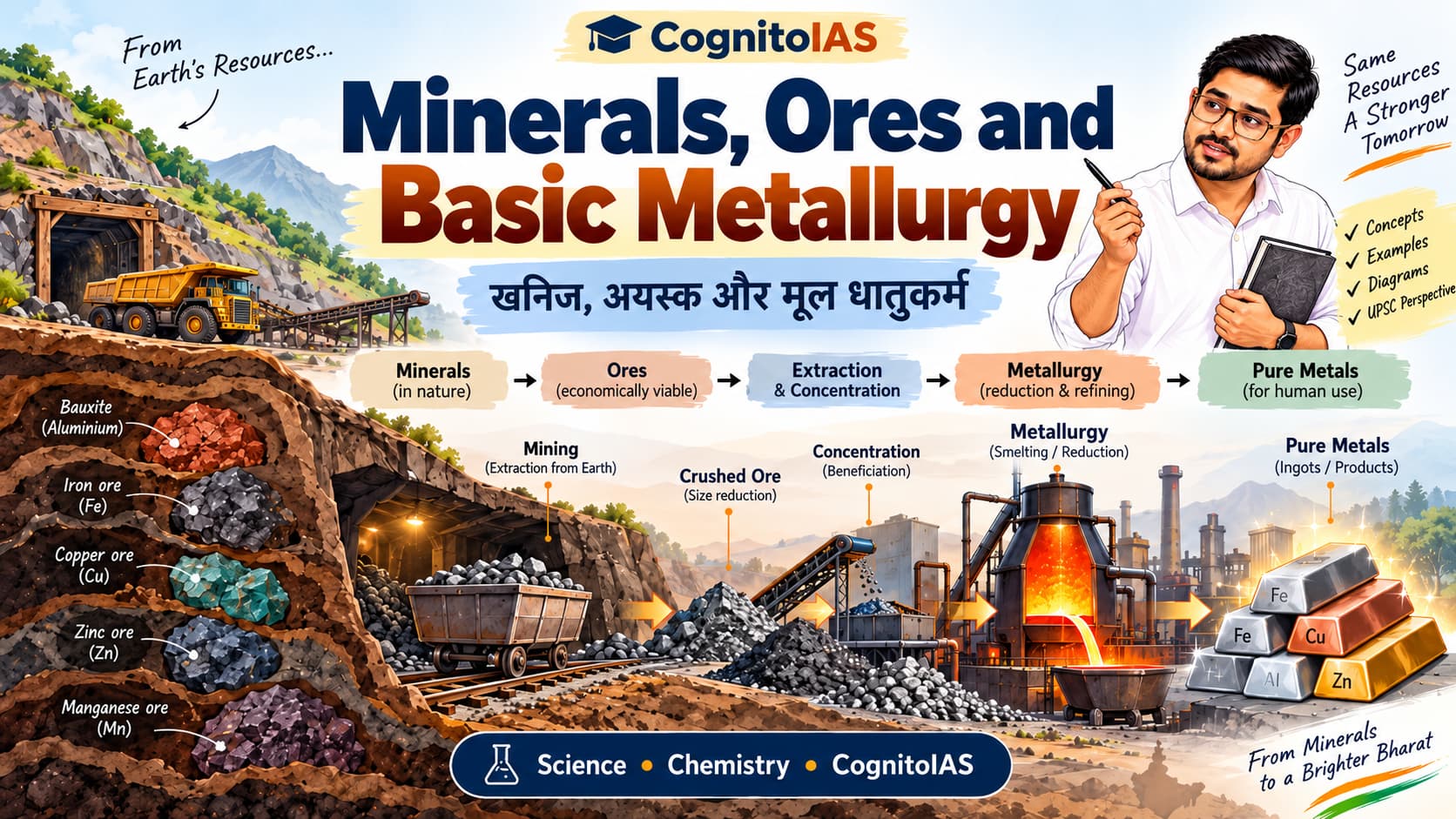
Minerals, Ores and Basic Metallurgy
How do we get iron from rocks? Why is every mineral not an ore? Understand the whole journey through a simple conversation between a student and a teacher.
1. Can We Find a Ready-made Iron Rod Underground?
Student: Sir, if we need iron, do we simply dig the ground and take it out?
Teacher: Usually not! Most metals occur in rocks as chemical compounds with other elements. We have to obtain the metal from these compounds.
Student: What is this entire process called?
Teacher: Metallurgy means the science and processes used to obtain metals from their ores and make them useful.
The complete journey: Ore from the Earth → Concentrate it → Prepare it if needed → Extract metal → Refine it.
2. Mineral vs Ore — The Most Important Difference
Student: Sir, are mineral and ore the same thing?
Teacher: No. A mineral is a naturally occurring substance, usually a solid with a fairly definite chemical composition. Most minerals are inorganic.
Teacher: An ore is a natural material from which a useful metal can be extracted economically—that means at a cost that makes extraction worthwhile.
Student: So why is every mineral not called an ore?
Teacher: A mineral may contain very little metal, or removing that metal may cost too much. Then it is not a useful ore under those conditions.
Remember: An ore contains useful mineral material, but not every mineral is an ore. Whether a deposit counts as an ore also depends on extraction cost and available technology.
Two examples only: Bauxite → aluminium and haematite (Fe2O3) → iron. We will learn the main ore names together in Post 4.
3. What Is Gangue? Why Do We Concentrate an Ore?
Student: Does an ore contain only the useful metal compound?
Teacher: No. It also contains unwanted materials such as sand, clay and rock pieces. These impurities are called gangue.
Student: Then what is the first step?
Teacher: We remove as much gangue as possible. This is called concentration of ore, also known as ore dressing or beneficiation.
Three easy methods to recognise:
• Gravity separation: heavier and lighter particles are separated using differences in density, often with water.
• Magnetic separation: magnetic material is separated from non-magnetic material.
• Froth flotation: used mainly for sulphide ores; selected ore particles attach to bubbles and rise with froth.
Student: So concentration does not give us pure metal?
Teacher: Correct. It only makes the ore richer in useful material.
4. Calcination vs Roasting — Do Not Mix Them Up
Student: Why is concentrated ore sometimes heated before extracting the metal?
Teacher: Heating can help change some ores into metal oxides. Two commonly tested processes are calcination and roasting.
Calcination — Heating an ore in the absence or limited supply of air.
Often used for carbonate and hydrated ores. It may remove CO2 or water.
Example: ZnCO3 → ZnO + CO2 (on heating).
Roasting — Heating an ore in excess air or oxygen.
Often used for sulphide ores. Sulphur is commonly released as SO2 (an air pollutant).
Example: 2ZnS + 3O2 → 2ZnO + 2SO2.
Memory trick: Calcination → little/no air; Roasting → plenty of air. These are alternative preparation steps chosen according to the ore; an ore does not necessarily undergo both.
5. How Is Metal Actually Extracted?
Student: Once we have a metal oxide, is it already the metal?
Teacher: No. In many cases, we must remove oxygen from the metal oxide. In these examples, this is called reduction.
Student: Who takes away the oxygen?
Teacher: For some metals, carbon or carbon monoxide can do this at high temperatures.
Simple example: Fe2O3 + 3CO → 2Fe + 3CO2.
The iron oxide loses oxygen and iron is obtained.
Important: In broader chemistry, reduction has a wider meaning (gain of electrons). Here we are recognising it by removal of oxygen.
6. Smelting, Flux and Slag — Three Related Words
Student: Sir, what does smelting mean?
Teacher: In smelting, an ore is processed at high temperature, commonly with a reducing agent, to obtain metal. The metal is often collected in a molten (liquid) state.
PYQ focus: The process of obtaining a metal in a fused or molten state is called smelting. — 67th BPSC Pre (Re-Exam), 2022.
Student: But what happens to the remaining unwanted impurities?
Teacher: A substance called flux may be added to combine with some impurities. The waste formed is called slag, which can be separated from the metal.
Think of it simply: Flux = added helper to remove impurities; Slag = unwanted waste formed after the reaction. For example, lime-based flux can combine with sandy silica impurities to form calcium silicate slag.
7. Can We Extract Every Metal Using Carbon?
Student: Can carbon remove oxygen from every metal oxide?
Teacher: No. The extraction method depends largely on how reactive the metal is. Remember the reactivity series from Post 2.
Highly reactive metals — K, Na, Ca, Mg, Al:
Usually extracted by electrolysis, not by ordinary carbon reduction. For example, aluminium oxide (alumina) is dissolved in hot, molten cryolite; electricity is then used to obtain aluminium.
Moderately reactive metals — Zn, Fe, Pb:
Often extracted through heating and reduction using carbon or CO.
Less reactive metals — Cu, Hg and noble metals:
May need suitable heating/reduction steps depending on the ore; some, such as gold, may also occur free in nature.
Do not memorise one method for every metal. Its ore and reactivity both matter. Detailed extraction of individual metals is outside this post.
8. Why Is Refining Needed After Extraction?
Student: Does extraction always produce perfectly pure metal?
Teacher: No. The extracted metal can still contain impurities. Refining means purifying this metal.
Student: What is a common example?
Teacher: Electrolytic refining of copper. Impure copper is the anode (+), a thin sheet of pure copper is the cathode (−), and acidified copper sulphate solution is the electrolyte. Pure copper deposits on the cathode; some insoluble impurities settle as anode mud.
Do not confuse: Extraction gets metal from its ore. Refining makes the extracted metal purer. Electrolysis can be used in either process, but its purpose is different.
9. Pause and Think — Test Your Understanding
Q1. Is every mineral an ore?
Answer: No. Metal extraction must be economically worthwhile.
Q2. What is the unwanted material in an ore called?
Answer: Gangue.
Q3. A sulphide ore is heated in excess air. What is the process?
Answer: Roasting.
Q4. Which process gives metal in a molten state at high temperature?
Answer: Smelting.
Q5. What is the difference between flux and slag?
Answer: Flux is added to help remove impurities; slag is the waste formed.
10. One-Minute Revision
Mineral = naturally occurring substance; ore = profitable source of a metal.
Gangue = unwanted impurities; concentration = removing them.
Calcination = heating with little/no air, often for carbonates or hydrated ores.
Roasting = heating in excess air, often for sulphide ores.
Reduction = gain of electrons; removal of oxygen is a common way to recognise it in these examples.
Smelting = high-temperature extraction, often giving molten metal.
Flux helps remove impurities; slag is the waste formed.
Refining = purifying extracted metal; copper is commonly refined electrolytically.
Next: Important Ores of Major Metals — easy metal–ore–formula associations for UPPSC.
धातुएँ, खनिज, अयस्क और मिश्रधातुएँ • पोस्ट 3
खनिज, अयस्क और धातुकर्म की मूल बातें
चट्टानों से लोहा कैसे प्राप्त होता है? प्रत्येक खनिज अयस्क क्यों नहीं होता? विद्यार्थी और शिक्षक के बीच एक सरल बातचीत से इस पूरी यात्रा को समझिए।
1. क्या जमीन के नीचे लोहे की तैयार छड़ मिल सकती है?
विद्यार्थी: सर, यदि हमें लोहा चाहिए, तो क्या हम बस जमीन खोदकर उसे निकाल लेते हैं?
शिक्षक: सामान्यतः नहीं! अधिकांश धातुएँ चट्टानों में अन्य तत्वों के साथ रासायनिक यौगिकों के रूप में मिलती हैं। हमें इन यौगिकों से धातु प्राप्त करनी पड़ती है।
विद्यार्थी: इस पूरी प्रक्रिया को क्या कहते हैं?
शिक्षक: धातुकर्म का अर्थ है—अयस्कों से धातुएँ प्राप्त करने और उन्हें उपयोगी बनाने के लिए प्रयुक्त विज्ञान तथा प्रक्रियाएँ।
पूरी यात्रा: पृथ्वी से अयस्क → उसका सांद्रण → आवश्यकता होने पर उसकी तैयारी → धातु का निष्कर्षण → उसका परिष्करण।
2. खनिज और अयस्क—सबसे महत्वपूर्ण अंतर
विद्यार्थी: सर, क्या खनिज और अयस्क एक ही चीज हैं?
शिक्षक: नहीं। खनिज प्राकृतिक रूप से पाया जाने वाला पदार्थ है, जो सामान्यतः ठोस होता है और जिसका रासायनिक संघटन काफी हद तक निश्चित होता है। अधिकांश खनिज अकार्बनिक होते हैं।
शिक्षक: अयस्क ऐसा प्राकृतिक पदार्थ है, जिससे कोई उपयोगी धातु आर्थिक रूप से लाभप्रद ढंग से निकाली जा सके—अर्थात इतनी लागत पर कि उसका निष्कर्षण करना लाभकारी हो।
विद्यार्थी: तो प्रत्येक खनिज को अयस्क क्यों नहीं कहा जाता?
शिक्षक: किसी खनिज में धातु की मात्रा बहुत कम हो सकती है या उस धातु को निकालने की लागत बहुत अधिक हो सकती है। ऐसी परिस्थितियों में वह उपयोगी अयस्क नहीं होता।
याद रखें: अयस्क में उपयोगी खनिज पदार्थ होता है, लेकिन प्रत्येक खनिज अयस्क नहीं होता। कोई निक्षेप अयस्क माना जाएगा या नहीं, यह निष्कर्षण की लागत और उपलब्ध तकनीक पर भी निर्भर करता है।
अभी केवल दो उदाहरण: बॉक्साइट → एल्युमिनियम और हेमेटाइट (Fe2O3) → लोहा। प्रमुख अयस्कों के नाम हम पोस्ट 4 में एक साथ पढ़ेंगे।
3. गैंग क्या है? अयस्क का सांद्रण क्यों किया जाता है?
विद्यार्थी: क्या अयस्क में केवल उपयोगी धातु का यौगिक ही होता है?
शिक्षक: नहीं। उसमें रेत, मिट्टी और चट्टानों के टुकड़े जैसे अवांछित पदार्थ भी होते हैं। इन अशुद्धियों को गैंग कहते हैं।
विद्यार्थी: तो पहला चरण क्या होता है?
शिक्षक: हम गैंग को यथासंभव हटाते हैं। इसे अयस्क का सांद्रण कहते हैं। इसे अयस्क प्रसाधन या लाभकारीकरण भी कहा जाता है।
पहचानने योग्य तीन सरल विधियाँ:
• गुरुत्वीय पृथक्करण: घनत्व के अंतर के आधार पर भारी और हल्के कण अलग किए जाते हैं, प्रायः पानी की सहायता से।
• चुंबकीय पृथक्करण: चुंबकीय पदार्थ को अचुंबकीय पदार्थ से अलग किया जाता है।
• फेन प्लवन: मुख्यतः सल्फाइड अयस्कों के लिए प्रयुक्त होता है; अयस्क के चुने हुए कण बुलबुलों से चिपककर झाग के साथ ऊपर आ जाते हैं।
विद्यार्थी: तो सांद्रण से हमें शुद्ध धातु नहीं मिलती?
शिक्षक: सही। इससे केवल अयस्क में उपयोगी पदार्थ का अनुपात बढ़ता है।
4. निस्तापन और भर्जन—दोनों में भ्रम न करें
विद्यार्थी: धातु निकालने से पहले कभी-कभी सांद्रित अयस्क को गर्म क्यों किया जाता है?
शिक्षक: गर्म करने से कुछ अयस्कों को धातु ऑक्साइडों में बदलने में सहायता मिलती है। परीक्षाओं में प्रायः पूछी जाने वाली दो प्रक्रियाएँ हैं—निस्तापन और भर्जन।
निस्तापन — अयस्क को वायु की अनुपस्थिति या सीमित आपूर्ति में गर्म करना।
इसका उपयोग प्रायः कार्बोनेट और जलयोजित अयस्कों के लिए होता है। इससे CO2 या जल निकल सकता है।
उदाहरण: ZnCO3 → ZnO + CO2 (गर्म करने पर)।
भर्जन — अयस्क को वायु या ऑक्सीजन की अधिकता में गर्म करना।
इसका उपयोग प्रायः सल्फाइड अयस्कों के लिए होता है। सल्फर सामान्यतः SO2 के रूप में निकलता है, जो एक वायु प्रदूषक है।
उदाहरण: 2ZnS + 3O2 → 2ZnO + 2SO2।
याद रखने की तरकीब: निस्तापन → कम वायु/वायु नहीं; भर्जन → भरपूर वायु। ये अयस्क के अनुसार चुने जाने वाले वैकल्पिक तैयारी चरण हैं; प्रत्येक अयस्क को दोनों प्रक्रियाओं से गुजरना आवश्यक नहीं है।
5. वास्तव में धातु कैसे निकाली जाती है?
विद्यार्थी: जब हमें धातु ऑक्साइड मिल जाता है, तो क्या वही धातु है?
शिक्षक: नहीं। अनेक मामलों में हमें धातु ऑक्साइड से ऑक्सीजन हटानी पड़ती है। इन उदाहरणों में इसे अपचयन कहते हैं।
विद्यार्थी: ऑक्सीजन कौन हटाता है?
शिक्षक: कुछ धातुओं के लिए उच्च तापमान पर कार्बन या कार्बन मोनोऑक्साइड यह कार्य कर सकता है।
सरल उदाहरण: Fe2O3 + 3CO → 2Fe + 3CO2।
आयरन ऑक्साइड से ऑक्सीजन हट जाती है और लोहा प्राप्त होता है।
महत्वपूर्ण: व्यापक रसायन विज्ञान में अपचयन का अर्थ अधिक व्यापक है—इलेक्ट्रॉनों का ग्रहण। यहाँ हम इसे ऑक्सीजन हटने के आधार पर पहचान रहे हैं।
6. प्रगलन, गालक और धातुमल—तीन संबंधित शब्द
विद्यार्थी: सर, प्रगलन का क्या अर्थ है?
शिक्षक: प्रगलन में धातु प्राप्त करने के लिए अयस्क को उच्च तापमान पर संसाधित किया जाता है, सामान्यतः किसी अपचायक के साथ। धातु प्रायः पिघली हुई अर्थात द्रव अवस्था में एकत्र की जाती है।
पूर्ववर्षीय प्रश्न का मुख्य बिंदु: धातु को संगलित या पिघली हुई अवस्था में प्राप्त करने की प्रक्रिया प्रगलन कहलाती है। — 67वीं BPSC प्रारंभिक परीक्षा (पुनर्परीक्षा), 2022।
विद्यार्थी: लेकिन बची हुई अवांछित अशुद्धियों का क्या होता है?
शिक्षक: कुछ अशुद्धियों से संयोग कराने के लिए गालक नामक पदार्थ मिलाया जा सकता है। इससे बनने वाले अपशिष्ट को धातुमल कहते हैं, जिसे धातु से अलग किया जा सकता है।
सरल ढंग से समझिए: गालक = अशुद्धियाँ हटाने के लिए मिलाया गया सहायक पदार्थ; धातुमल = अभिक्रिया के बाद बना अवांछित अपशिष्ट। उदाहरण के लिए, चूना-आधारित गालक रेत में मौजूद सिलिका की अशुद्धियों से संयोग करके कैल्शियम सिलिकेट धातुमल बना सकता है।
7. क्या कार्बन की सहायता से प्रत्येक धातु निकाली जा सकती है?
विद्यार्थी: क्या कार्बन प्रत्येक धातु ऑक्साइड से ऑक्सीजन हटा सकता है?
शिक्षक: नहीं। निष्कर्षण की विधि मुख्यतः इस बात पर निर्भर करती है कि धातु कितनी अभिक्रियाशील है। पोस्ट 2 में पढ़ी गई अभिक्रियाशीलता श्रेणी याद कीजिए।
अत्यधिक अभिक्रियाशील धातुएँ — K, Na, Ca, Mg, Al:
सामान्यतः इनका निष्कर्षण विद्युत अपघटन से किया जाता है, साधारण कार्बन अपचयन से नहीं। उदाहरण के लिए, एल्युमिनियम ऑक्साइड (ऐलुमिना) को गर्म, पिघले हुए क्रायोलाइट में घोला जाता है; इसके बाद विद्युत की सहायता से एल्युमिनियम प्राप्त किया जाता है।
मध्यम अभिक्रियाशील धातुएँ — Zn, Fe, Pb:
इनका निष्कर्षण प्रायः गर्म करके और कार्बन या CO द्वारा अपचयन से किया जाता है।
कम अभिक्रियाशील धातुएँ — Cu, Hg और उत्कृष्ट धातुएँ:
अयस्क के अनुसार इनके लिए उपयुक्त तापन/अपचयन चरणों की आवश्यकता हो सकती है; सोने जैसी कुछ धातुएँ प्रकृति में मुक्त अवस्था में भी मिल सकती हैं।
प्रत्येक धातु के लिए एक ही विधि याद न करें। उसका अयस्क और अभिक्रियाशीलता—दोनों महत्वपूर्ण हैं। अलग-अलग धातुओं के विस्तृत निष्कर्षण का वर्णन इस पोस्ट के दायरे से बाहर है।
8. निष्कर्षण के बाद परिष्करण की आवश्यकता क्यों होती है?
विद्यार्थी: क्या निष्कर्षण से हमेशा पूरी तरह शुद्ध धातु मिलती है?
शिक्षक: नहीं। निकाली गई धातु में अभी भी अशुद्धियाँ हो सकती हैं। परिष्करण का अर्थ है—इस धातु को शुद्ध करना।
विद्यार्थी: इसका कोई सामान्य उदाहरण क्या है?
शिक्षक: ताँबे का विद्युत अपघटनी परिष्करण। अशुद्ध ताँबा ऐनोड (+), शुद्ध ताँबे की पतली चादर कैथोड (−) और अम्लीकृत कॉपर सल्फेट का विलयन विद्युत अपघट्य होता है। शुद्ध ताँबा कैथोड पर जमा होता है; कुछ अघुलनशील अशुद्धियाँ ऐनोड पंक के रूप में नीचे बैठ जाती हैं।
भ्रमित न हों: निष्कर्षण से अयस्क में मौजूद धातु प्राप्त होती है। परिष्करण से निकाली गई धातु अधिक शुद्ध बनती है। विद्युत अपघटन का उपयोग दोनों प्रक्रियाओं में हो सकता है, लेकिन उसका उद्देश्य अलग होता है।
9. रुकिए और सोचिए—अपनी समझ परखिए
प्रश्न 1. क्या प्रत्येक खनिज अयस्क होता है?
उत्तर: नहीं। धातु का निष्कर्षण आर्थिक रूप से लाभप्रद होना चाहिए।
प्रश्न 2. अयस्क में मौजूद अवांछित पदार्थ को क्या कहते हैं?
उत्तर: गैंग।
प्रश्न 3. किसी सल्फाइड अयस्क को वायु की अधिकता में गर्म किया जाता है। यह कौन-सी प्रक्रिया है?
उत्तर: भर्जन।
प्रश्न 4. किस प्रक्रिया से उच्च तापमान पर धातु पिघली हुई अवस्था में प्राप्त होती है?
उत्तर: प्रगलन।
प्रश्न 5. गालक और धातुमल में क्या अंतर है?
उत्तर: गालक अशुद्धियाँ हटाने में सहायता के लिए मिलाया जाता है; धातुमल इससे बनने वाला अपशिष्ट है।
10. एक मिनट में पुनरावृत्ति
खनिज = प्राकृतिक रूप से पाया जाने वाला पदार्थ; अयस्क = धातु का लाभप्रद स्रोत।
गैंग = अवांछित अशुद्धियाँ; सांद्रण = उन्हें हटाना।
निस्तापन = कम वायु या वायु की अनुपस्थिति में गर्म करना; प्रायः कार्बोनेट या जलयोजित अयस्कों के लिए।
भर्जन = वायु की अधिकता में गर्म करना; प्रायः सल्फाइड अयस्कों के लिए।
अपचयन = इलेक्ट्रॉनों का ग्रहण; इन उदाहरणों में ऑक्सीजन का हटना इसे पहचानने का एक सामान्य तरीका है।
प्रगलन = उच्च तापमान पर निष्कर्षण, जिससे प्रायः पिघली हुई धातु प्राप्त होती है।
गालक अशुद्धियाँ हटाने में सहायता करता है; धातुमल बनने वाला अपशिष्ट है।
परिष्करण = निकाली गई धातु को शुद्ध करना; ताँबे का परिष्करण सामान्यतः विद्युत अपघटनी विधि से होता है।
अगला विषय: प्रमुख धातुओं के महत्वपूर्ण अयस्क—UPPSC के लिए धातु–अयस्क–सूत्र के सरल संबंध।