Major Theories of Universe: Big Bang, Steady State, Oscillating and Inflationary Models
Theories of the universe try to answer three big questions: How did the universe begin? How is it changing? and what may happen to it in future?
In simple words, these models are scientific explanations of the origin, evolution, expansion and possible future of the universe.
1. First Understand: What is a Cosmological Model?
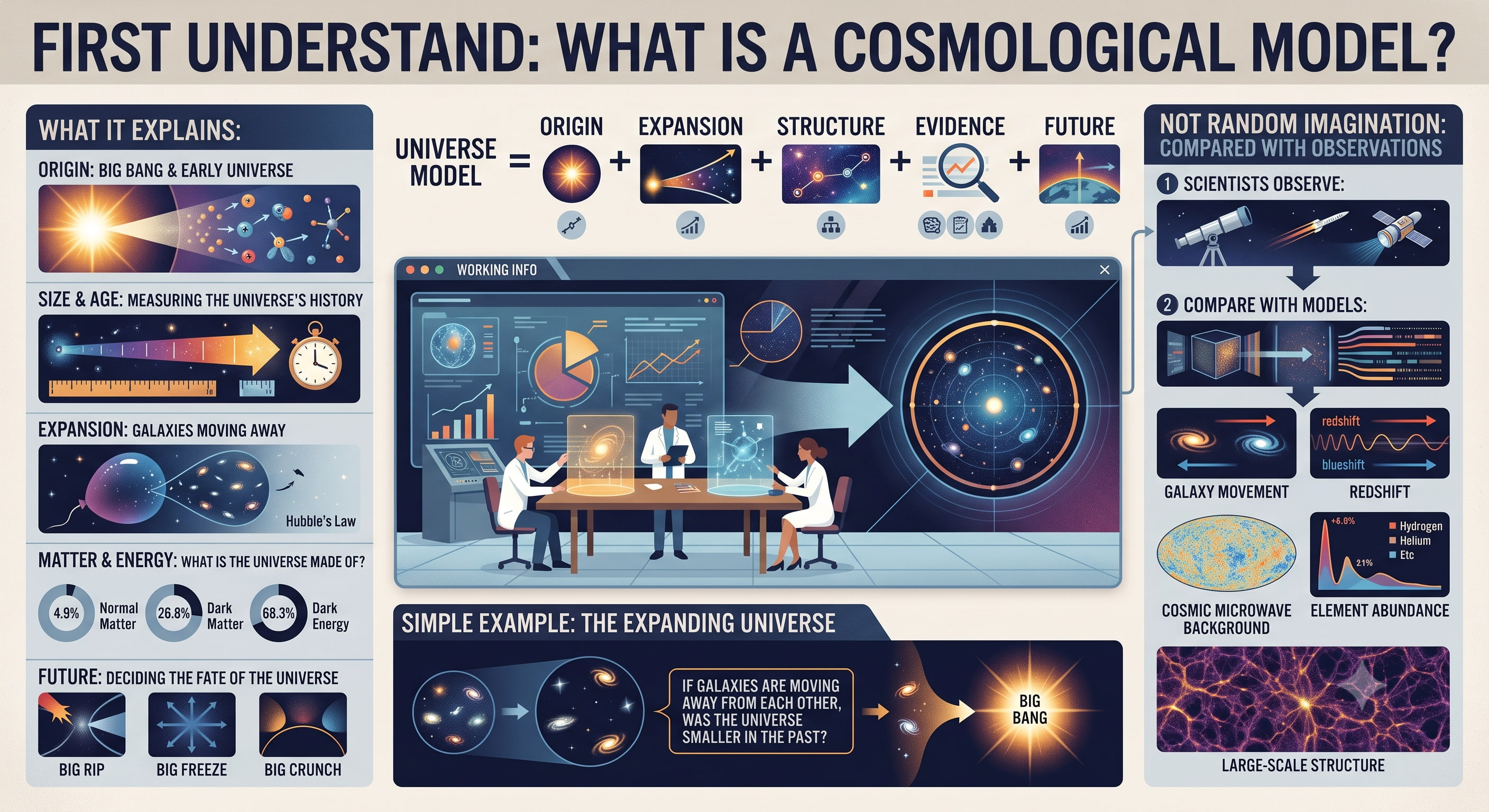
A cosmological model is a scientific model that explains the universe as a whole. It studies the origin, size, age, expansion, matter, energy and future of the universe.
These theories are not random imagination. Scientists compare them with observations such as galaxy movement, redshift, cosmic microwave background radiation, element abundance and large-scale structure.
Simple Example: If we see that all galaxies are moving away from each other, we ask: was the universe smaller in the past? This question leads us to the Big Bang idea.
2. Big Bang Theory: Most Accepted Origin Model
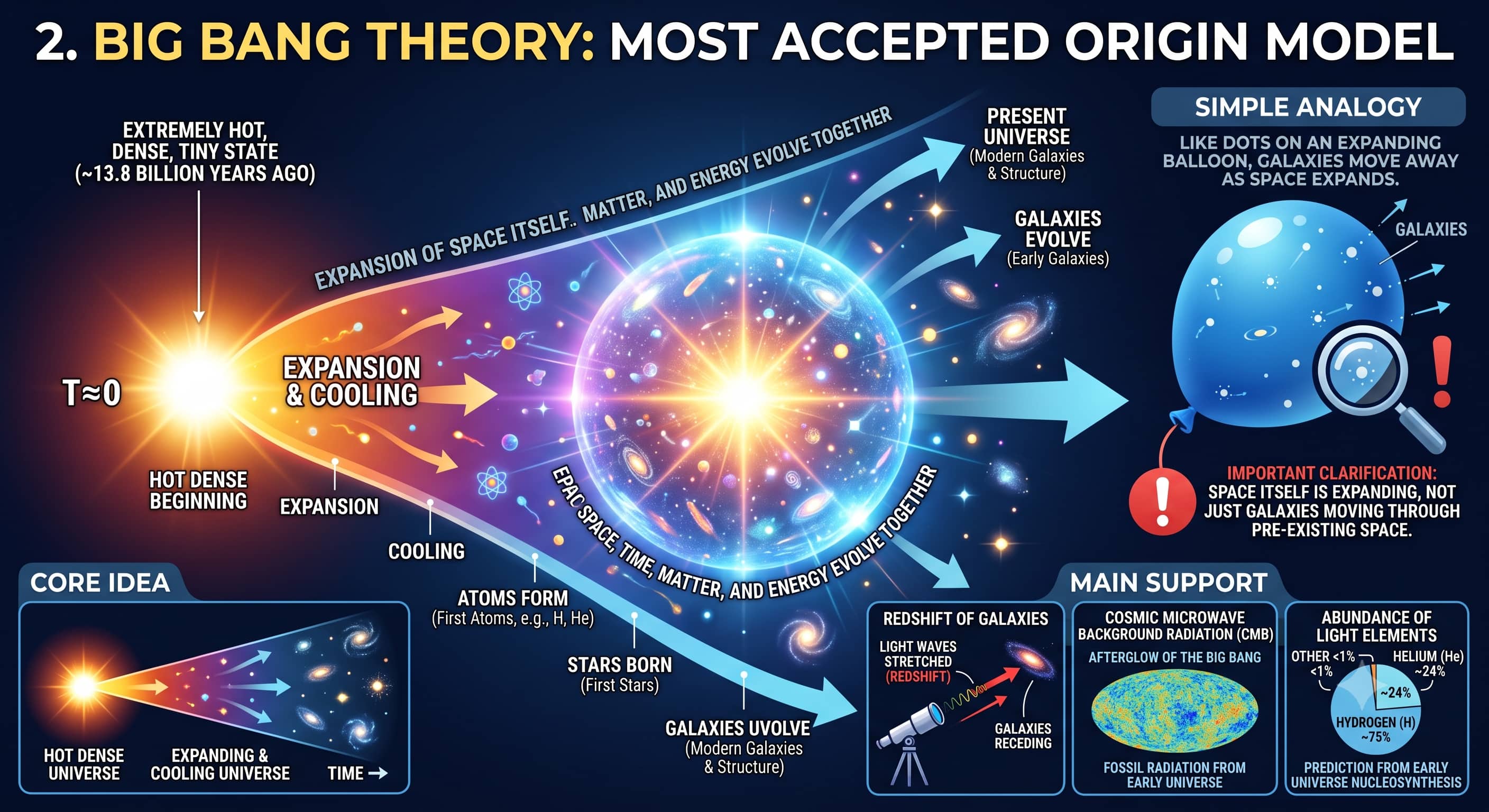
The Big Bang Theory says that the universe began around 13.8 billion years ago from an extremely hot, dense and tiny state. Since then, the universe has been expanding and cooling.
The Big Bang was not like a bomb exploding in empty space. It was the expansion of space itself. Space, time, matter and energy evolved together from the earliest state of the universe.
Core Idea
The universe was once extremely hot and dense, and it has been expanding with time.
Main Support
Redshift of galaxies, cosmic microwave background radiation and abundance of light elements.
Simple Analogy
Like dots on an expanding balloon, galaxies move away as space expands.
Important Clarification: The Big Bang does not say that galaxies are moving through pre-existing space only. It mainly says that space itself is expanding.
3. Key Evidence Supporting Big Bang Theory
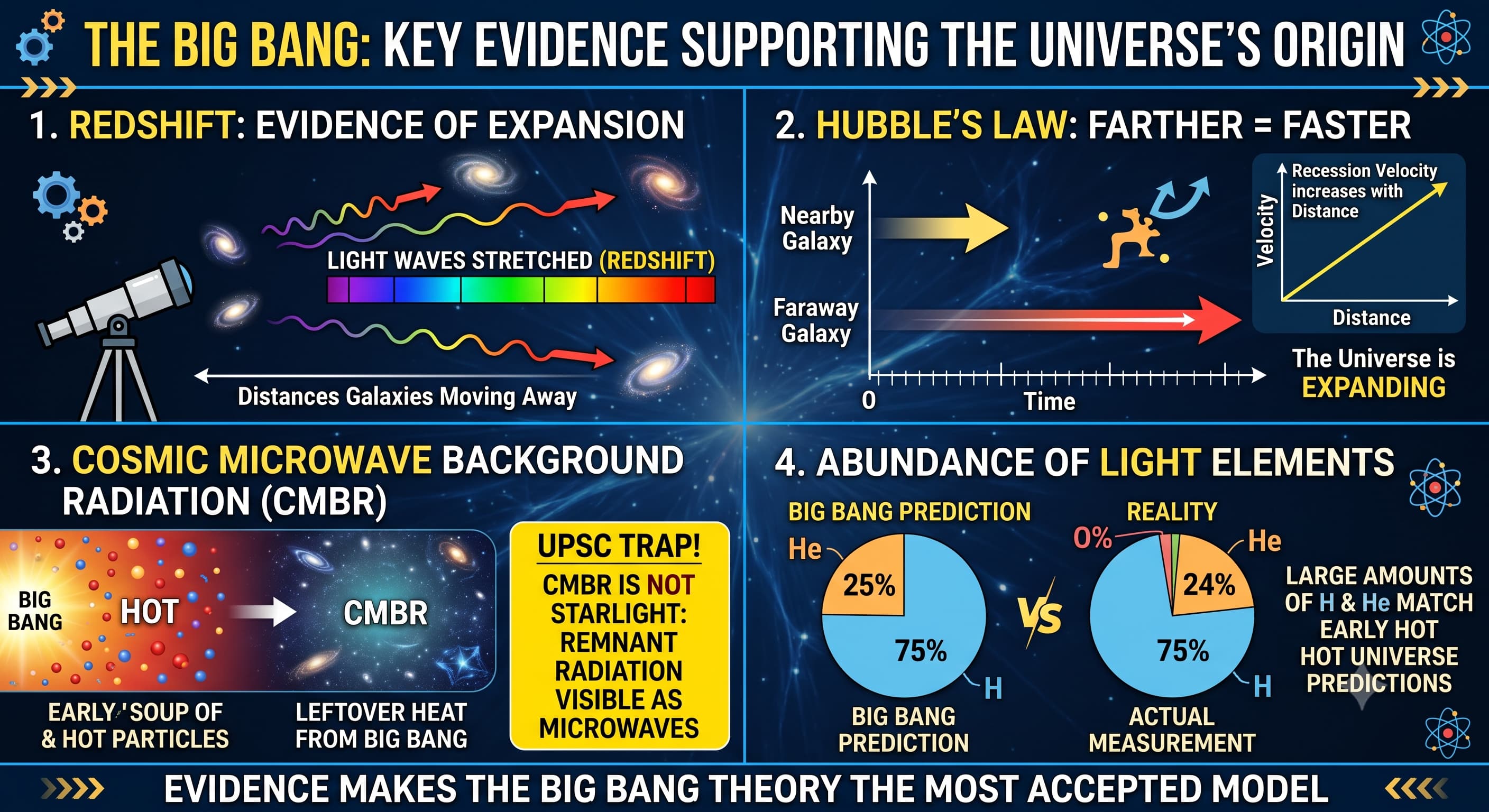
Big Bang Theory became widely accepted because several independent observations support it.
1. Redshift
Light from distant galaxies shifts toward the red end of the spectrum, showing that galaxies are moving away.
2. Hubble’s Law
Farther galaxies move away faster. This supports the idea of an expanding universe.
3. CMBR
Cosmic Microwave Background Radiation is the leftover heat of the early universe.
4. Light Elements
The large amount of hydrogen and helium matches predictions of the early hot universe.
UPSC Trap: CMBR is not light from stars. It is the faint leftover radiation from the early universe, visible today as microwave radiation.
4. Steady State Theory: Universe Without a Beginning
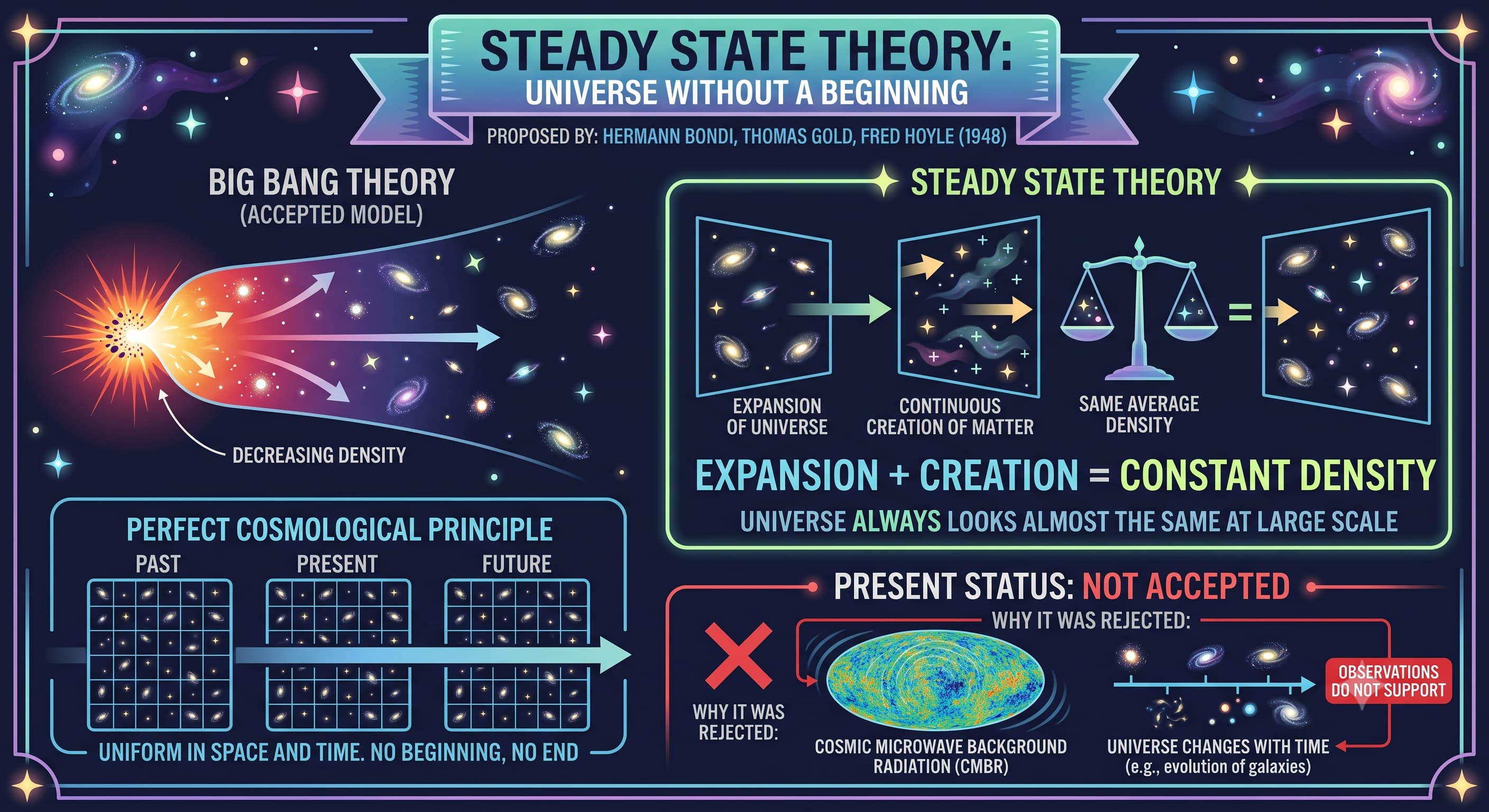
The Steady State Theory was proposed by Hermann Bondi, Thomas Gold and Fred Hoyle in 1948. It says that the universe has no beginning and no end.
According to this model, the universe is expanding, but its average density remains constant because new matter is continuously created.
Core Idea
The universe always looks almost the same at large scale, in every place and at every time.
Perfect Cosmological Principle
The universe is uniform not only in space, but also in time.
Present Status
It is not accepted as the main model today because observations do not support it.
Why It Was Rejected: Discovery of CMBR and evidence that the universe changes with time weakened the Steady State Theory.
5. Oscillating Universe Model: Universe in Cycles
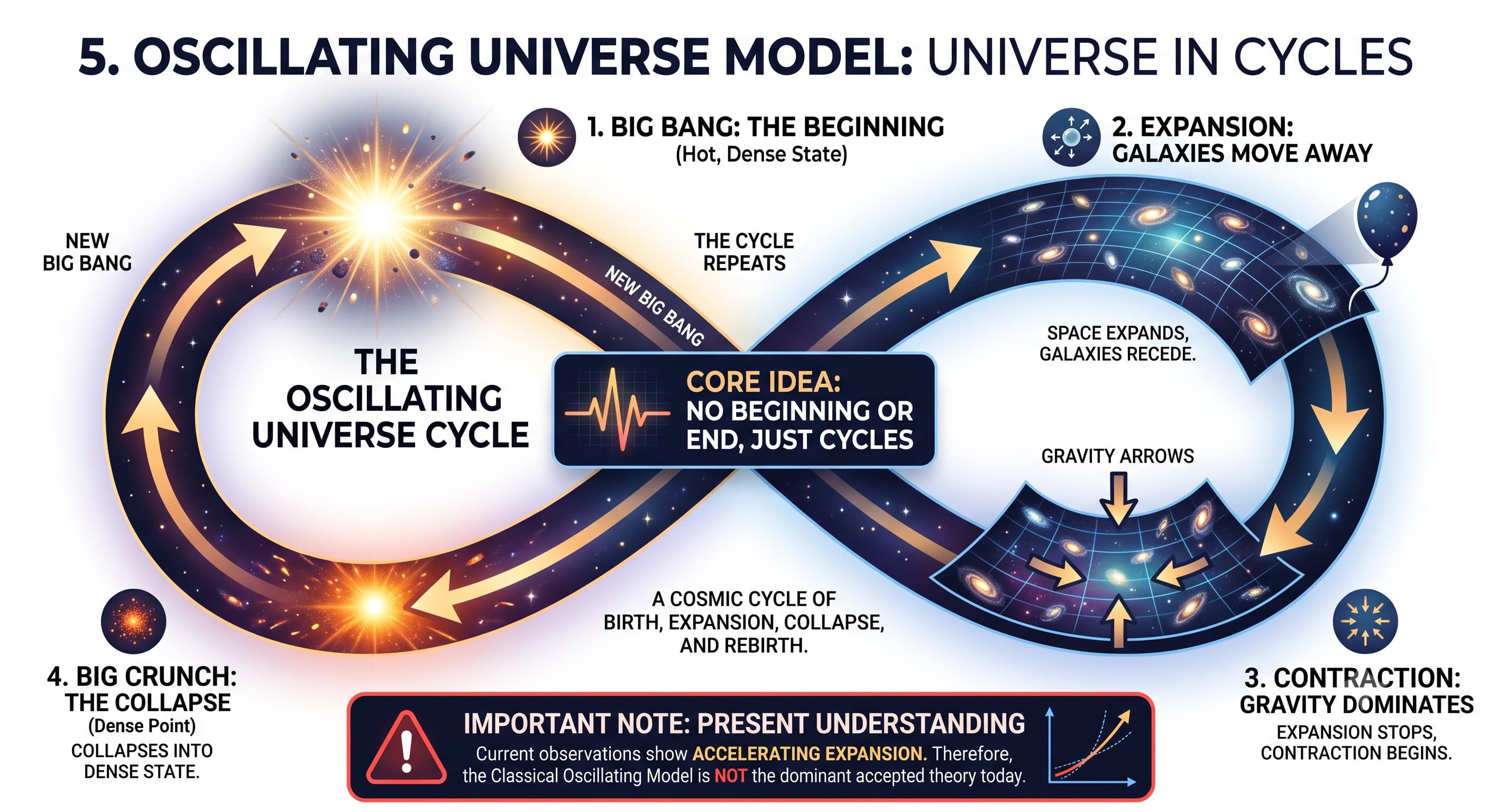
The Oscillating Universe Model says that the universe may not expand forever. It may expand for a long time, then contract due to gravity, collapse into a dense state, and then expand again.
In simple words, this model imagines the universe like a cosmic cycle of birth, expansion, collapse and rebirth.
Big Bang
Universe begins from a hot, dense state and starts expanding.
Expansion
Galaxies move away from each other as space expands.
Big Crunch
If gravity dominates, expansion may stop and the universe may collapse.
Present Understanding: Current observations show that the universe is expanding at an accelerating rate. Therefore, the classical oscillating model is not the dominant accepted model today.
6. Inflationary Model: Rapid Expansion in the Earliest Moment
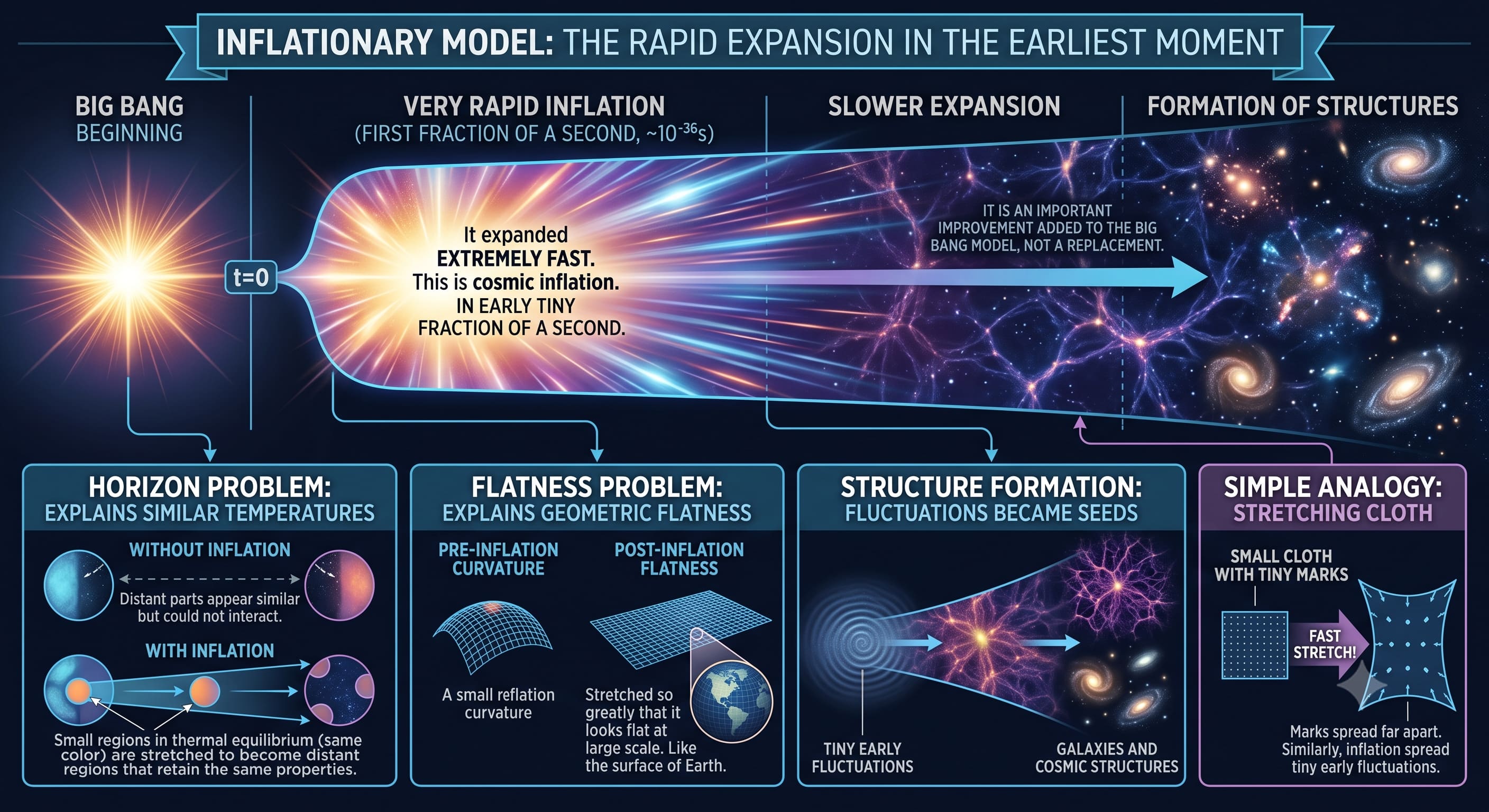
The Inflationary Model is not a replacement for the Big Bang Theory. It is an important improvement added to the Big Bang model.
It says that in the earliest tiny fraction of a second after the beginning, the universe expanded extremely fast. This rapid expansion is called cosmic inflation.
Horizon Problem
It explains why far-away parts of the universe have almost similar temperature.
Flatness Problem
It explains why the universe appears very close to geometrically flat at large scale.
Structure Formation
Tiny early fluctuations later became the seeds of galaxies and cosmic structures.
Simple Example: Imagine a small cloth with tiny marks. If it suddenly stretches very fast, the marks spread far apart. Similarly, inflation spread tiny early fluctuations across the universe.
7. Other Important Models and Related Ideas
Apart from the four major models, UPSC students should also know a few related ideas for conceptual clarity.
Static Universe Model
It assumed that the universe is unchanging and not expanding. It is not accepted today because observations show expansion.
Lambda-CDM Model
It is the present standard cosmological model combining Big Bang, cold dark matter and dark energy.
Cyclic or Ekpyrotic Ideas
These are modern cyclic ideas where the universe may pass through repeated phases, but they remain speculative.
Best UPSC Understanding: Today, the most accepted broad framework is an expanding universe explained mainly by the Big Bang model, refined by inflation and supported by the Lambda-CDM model.
8. Comparison of Major Universe Models
| Model | Main Idea | Simple Meaning | Present Status |
|---|---|---|---|
| Big Bang | Universe began from a hot, dense state and expanded. | The universe had a beginning and is evolving. | Most accepted broad origin model. |
| Steady State | Universe has no beginning or end; matter is continuously created. | Universe looks the same forever. | Rejected as main model. |
| Oscillating | Universe expands, contracts and repeats cycles. | Birth and rebirth of universe. | Classical form is not dominant today. |
| Inflationary | Very rapid expansion occurred just after the beginning. | Explains why the universe is so uniform and large. | Important refinement of Big Bang model. |
9. Possible Future of the Universe
The future of the universe depends mainly on expansion, gravity and dark energy. Scientists discuss different possibilities.
Big Freeze / Heat Death
Expansion continues; stars die out; the universe becomes cold and dark over a very long time.
Big Crunch
Expansion stops and the universe collapses back due to gravity.
Big Rip
If dark energy becomes extremely strong, it may tear apart galaxies, stars and atoms.
UPSC Note: Do not confuse future models with origin models. Big Bang explains origin and evolution; Big Freeze, Big Crunch and Big Rip explain possible futures.
10. UPSC Relevance
Prelims: Big Bang, redshift, Hubble’s Law, CMBR, cosmic inflation and dark energy can appear as conceptual statements.
Mains GS Paper I: Useful for explaining the origin and evolution of the universe in physical geography.
Science and Technology Link: Space telescopes, cosmic background radiation, galaxies and deep-space observations connect with modern astronomy.
Essay Link: Themes like scientific temper, human curiosity, origin of life and place of Earth in the universe can use these ideas.
Quick Revision
Big Bang Theory says the universe began from a hot, dense state and has been expanding.
Steady State Theory says the universe has no beginning or end, but it is not accepted today.
Oscillating Universe Model says the universe may pass through repeated expansion and contraction cycles.
Inflationary Model explains the extremely rapid early expansion after the beginning.
CMBR is the leftover radiation from the early universe and is strong evidence for Big Bang Theory.
Lambda-CDM is the present standard model involving Big Bang, dark matter and dark energy.
The universe is currently understood to be expanding at an accelerating rate.
Think Like UPSC: Do not memorize these theories as isolated facts. Compare them using four questions: Does the model explain the origin? Does it explain expansion? Does it match evidence? Does it explain the future of the universe?
ब्रह्मांड की प्रमुख सिद्धांत: बिग बैंग, स्थिर अवस्था, दोलनशील और मुद्रास्फीति मॉडल
ब्रह्मांड से जुड़े सिद्धांत तीन बड़े प्रश्नों का उत्तर देने की कोशिश करते हैं: ब्रह्मांड की शुरुआत कैसे हुई? यह कैसे बदल रहा है? और भविष्य में इसका क्या हो सकता है?
सरल शब्दों में, ये मॉडल ब्रह्मांड की उत्पत्ति, विकास, विस्तार और संभावित भविष्य की वैज्ञानिक व्याख्या करते हैं।
1. पहले समझें: कॉस्मोलॉजिकल मॉडल क्या होता है?
कॉस्मोलॉजिकल मॉडल एक वैज्ञानिक मॉडल है, जो पूरे ब्रह्मांड को समझाने का प्रयास करता है। यह ब्रह्मांड की उत्पत्ति, आकार, आयु, विस्तार, पदार्थ, ऊर्जा और भविष्य का अध्ययन करता है।
ये सिद्धांत कोई कल्पना मात्र नहीं हैं। वैज्ञानिक इन्हें आकाशगंगाओं की गति, रेडशिफ्ट, कॉस्मिक माइक्रोवेव बैकग्राउंड रेडिएशन, तत्वों की मात्रा और बड़े पैमाने की संरचना जैसे अवलोकनों से मिलाकर देखते हैं।
सरल उदाहरण: यदि हम देखते हैं कि सभी आकाशगंगाएँ एक-दूसरे से दूर जा रही हैं, तो हम पूछते हैं: क्या अतीत में ब्रह्मांड छोटा था? यही प्रश्न हमें बिग बैंग के विचार तक ले जाता है।
2. बिग बैंग सिद्धांत: उत्पत्ति का सबसे स्वीकृत मॉडल
बिग बैंग सिद्धांत के अनुसार ब्रह्मांड की शुरुआत लगभग 13.8 अरब वर्ष पहले अत्यंत गर्म, घनी और बहुत छोटी अवस्था से हुई। तब से ब्रह्मांड फैल रहा है और ठंडा हो रहा है।
बिग बैंग खाली अंतरिक्ष में हुए किसी बम विस्फोट जैसा नहीं था। यह स्वयं अंतरिक्ष के विस्तार की प्रक्रिया थी। अंतरिक्ष, समय, पदार्थ और ऊर्जा ब्रह्मांड की प्रारंभिक अवस्था से साथ-साथ विकसित हुए।
मूल विचार
ब्रह्मांड कभी अत्यंत गर्म और घना था, और समय के साथ यह फैलता गया।
मुख्य प्रमाण
आकाशगंगाओं का रेडशिफ्ट, कॉस्मिक माइक्रोवेव बैकग्राउंड रेडिएशन और हल्के तत्वों की मात्रा।
सरल उदाहरण
फैलते हुए गुब्बारे पर बने बिंदुओं की तरह, अंतरिक्ष के फैलने पर आकाशगंगाएँ एक-दूसरे से दूर जाती हैं।
महत्वपूर्ण स्पष्टता: बिग बैंग केवल यह नहीं कहता कि आकाशगंगाएँ पहले से मौजूद खाली अंतरिक्ष में चल रही हैं। इसका मुख्य अर्थ यह है कि अंतरिक्ष स्वयं फैल रहा है।
3. बिग बैंग सिद्धांत के समर्थन में प्रमुख प्रमाण
बिग बैंग सिद्धांत इसलिए व्यापक रूप से स्वीकृत हुआ क्योंकि कई स्वतंत्र अवलोकन इसका समर्थन करते हैं।
1. रेडशिफ्ट
दूर की आकाशगंगाओं से आने वाला प्रकाश स्पेक्ट्रम के लाल भाग की ओर खिसकता है, जिससे पता चलता है कि आकाशगंगाएँ दूर जा रही हैं।
2. हबल का नियम
जितनी दूर आकाशगंगा होती है, वह उतनी तेजी से दूर जाती दिखाई देती है। यह फैलते हुए ब्रह्मांड के विचार का समर्थन करता है।
3. CMBR
कॉस्मिक माइक्रोवेव बैकग्राउंड रेडिएशन प्रारंभिक ब्रह्मांड की बची हुई ऊष्मा है।
4. हल्के तत्व
हाइड्रोजन और हीलियम की बड़ी मात्रा प्रारंभिक गर्म ब्रह्मांड की भविष्यवाणियों से मेल खाती है।
UPSC Trap: CMBR तारों से आने वाला प्रकाश नहीं है। यह प्रारंभिक ब्रह्मांड की बची हुई मंद विकिरण है, जो आज माइक्रोवेव विकिरण के रूप में दिखाई देती है।
4. स्थिर अवस्था सिद्धांत: बिना शुरुआत वाला ब्रह्मांड
स्थिर अवस्था सिद्धांत को हर्मन बॉन्डी, थॉमस गोल्ड और फ्रेड हॉयल ने 1948 में प्रस्तुत किया था। इसके अनुसार ब्रह्मांड की न कोई शुरुआत है और न कोई अंत।
इस मॉडल के अनुसार ब्रह्मांड फैल रहा है, लेकिन इसका औसत घनत्व स्थिर रहता है क्योंकि नए पदार्थ का निरंतर निर्माण होता रहता है।
मूल विचार
ब्रह्मांड बड़े पैमाने पर हर स्थान और हर समय लगभग एक जैसा दिखाई देता है।
परिपूर्ण कॉस्मोलॉजिकल सिद्धांत
ब्रह्मांड केवल स्थान में ही नहीं, बल्कि समय में भी समान है।
वर्तमान स्थिति
आज इसे मुख्य मॉडल के रूप में स्वीकार नहीं किया जाता क्योंकि अवलोकन इसका समर्थन नहीं करते।
यह क्यों अस्वीकार हुआ: CMBR की खोज और यह प्रमाण कि ब्रह्मांड समय के साथ बदलता है, स्थिर अवस्था सिद्धांत को कमजोर कर गए।
5. दोलनशील ब्रह्मांड मॉडल: चक्रों में चलने वाला ब्रह्मांड
दोलनशील ब्रह्मांड मॉडल के अनुसार ब्रह्मांड हमेशा के लिए नहीं फैलता। यह लंबे समय तक फैल सकता है, फिर गुरुत्वाकर्षण के कारण सिकुड़ सकता है, अत्यंत घनी अवस्था में ढह सकता है और फिर से फैलना शुरू कर सकता है।
सरल शब्दों में, यह मॉडल ब्रह्मांड को जन्म, विस्तार, पतन और पुनर्जन्म के एक ब्रह्मांडीय चक्र की तरह समझता है।
बिग बैंग
ब्रह्मांड गर्म और घनी अवस्था से शुरू होता है और फैलना शुरू करता है।
विस्तार
अंतरिक्ष के फैलने के साथ आकाशगंगाएँ एक-दूसरे से दूर जाती हैं।
बिग क्रंच
यदि गुरुत्वाकर्षण प्रभावी हो जाए, तो विस्तार रुक सकता है और ब्रह्मांड ढह सकता है।
वर्तमान समझ: वर्तमान अवलोकन बताते हैं कि ब्रह्मांड त्वरित दर से फैल रहा है। इसलिए, शास्त्रीय दोलनशील मॉडल आज प्रमुख स्वीकृत मॉडल नहीं है।
6. मुद्रास्फीति मॉडल: सबसे प्रारंभिक क्षण में तीव्र विस्तार
मुद्रास्फीति मॉडल बिग बैंग सिद्धांत का विकल्प नहीं है। यह बिग बैंग मॉडल में जोड़ा गया एक महत्वपूर्ण सुधार है।
इसके अनुसार शुरुआत के तुरंत बाद, एक अत्यंत छोटे अंश-सेकंड में ब्रह्मांड बहुत तेजी से फैला। इस तीव्र विस्तार को कॉस्मिक इन्फ्लेशन कहा जाता है।
क्षितिज समस्या
यह समझाता है कि ब्रह्मांड के बहुत दूर-दूर स्थित भागों का तापमान लगभग समान क्यों है।
समतलता समस्या
यह समझाता है कि बड़े पैमाने पर ब्रह्मांड ज्यामितीय रूप से लगभग समतल क्यों दिखाई देता है।
संरचना निर्माण
प्रारंभिक सूक्ष्म उतार-चढ़ाव आगे चलकर आकाशगंगाओं और ब्रह्मांडीय संरचनाओं के बीज बने।
सरल उदाहरण: एक छोटे कपड़े की कल्पना कीजिए, जिस पर छोटे-छोटे निशान बने हैं। यदि वह अचानक बहुत तेजी से फैल जाए, तो निशान दूर-दूर हो जाएंगे। इसी तरह मुद्रास्फीति ने प्रारंभिक सूक्ष्म उतार-चढ़ावों को ब्रह्मांड में दूर-दूर तक फैला दिया।
7. अन्य महत्वपूर्ण मॉडल और संबंधित विचार
चार प्रमुख मॉडलों के अलावा, UPSC विद्यार्थियों को वैचारिक स्पष्टता के लिए कुछ संबंधित विचार भी जानने चाहिए।
स्थिर ब्रह्मांड मॉडल
इसमें माना गया था कि ब्रह्मांड अपरिवर्तनीय है और फैल नहीं रहा है। आज यह स्वीकार्य नहीं है क्योंकि अवलोकन विस्तार दिखाते हैं।
Lambda-CDM मॉडल
यह वर्तमान मानक कॉस्मोलॉजिकल मॉडल है, जो बिग बैंग, ठंडे डार्क मैटर और डार्क एनर्जी को जोड़ता है।
चक्रीय या एक्पाइरोटिक विचार
ये आधुनिक चक्रीय विचार हैं, जिनमें ब्रह्मांड के बार-बार विभिन्न चरणों से गुजरने की संभावना मानी जाती है, लेकिन ये अभी भी अनुमानात्मक हैं।
UPSC के लिए सर्वोत्तम समझ: आज सबसे स्वीकृत व्यापक ढांचा एक फैलता हुआ ब्रह्मांड है, जिसे मुख्य रूप से बिग बैंग मॉडल समझाता है, मुद्रास्फीति उसे और बेहतर बनाती है और Lambda-CDM मॉडल उसका समर्थन करता है।
8. ब्रह्मांड के प्रमुख मॉडलों की तुलना
| मॉडल | मुख्य विचार | सरल अर्थ | वर्तमान स्थिति |
|---|---|---|---|
| बिग बैंग | ब्रह्मांड की शुरुआत गर्म और घनी अवस्था से हुई और वह फैलता गया। | ब्रह्मांड की शुरुआत हुई थी और यह लगातार विकसित हो रहा है। | उत्पत्ति का सबसे स्वीकृत व्यापक मॉडल। |
| स्थिर अवस्था | ब्रह्मांड की न शुरुआत है, न अंत; पदार्थ का निरंतर निर्माण होता है। | ब्रह्मांड हमेशा एक जैसा दिखता है। | मुख्य मॉडल के रूप में अस्वीकार। |
| दोलनशील | ब्रह्मांड फैलता है, सिकुड़ता है और चक्रों में दोहराता है। | ब्रह्मांड का जन्म और पुनर्जन्म। | शास्त्रीय रूप आज प्रमुख नहीं है। |
| मुद्रास्फीति | शुरुआत के तुरंत बाद अत्यंत तीव्र विस्तार हुआ। | यह समझाता है कि ब्रह्मांड इतना समान और विशाल क्यों है। | बिग बैंग मॉडल का महत्वपूर्ण सुधार। |
9. ब्रह्मांड का संभावित भविष्य
ब्रह्मांड का भविष्य मुख्य रूप से विस्तार, गुरुत्वाकर्षण और डार्क एनर्जी पर निर्भर करता है। वैज्ञानिक इसके लिए अलग-अलग संभावनाओं पर चर्चा करते हैं।
बिग फ्रीज़ / हीट डेथ
विस्तार जारी रहता है; तारे समाप्त हो जाते हैं; बहुत लंबे समय बाद ब्रह्मांड ठंडा और अंधकारमय हो जाता है।
बिग क्रंच
विस्तार रुक जाता है और गुरुत्वाकर्षण के कारण ब्रह्मांड वापस सिकुड़कर ढह जाता है।
बिग रिप
यदि डार्क एनर्जी अत्यंत शक्तिशाली हो जाए, तो यह आकाशगंगाओं, तारों और परमाणुओं तक को अलग कर सकती है।
UPSC Note: भविष्य के मॉडलों को उत्पत्ति के मॉडलों से भ्रमित न करें। बिग बैंग उत्पत्ति और विकास को समझाता है; बिग फ्रीज़, बिग क्रंच और बिग रिप संभावित भविष्य को समझाते हैं।
10. UPSC में प्रासंगिकता
Prelims: बिग बैंग, रेडशिफ्ट, हबल का नियम, CMBR, कॉस्मिक इन्फ्लेशन और डार्क एनर्जी पर वैचारिक कथन पूछे जा सकते हैं।
Mains GS Paper I: भौतिक भूगोल में ब्रह्मांड की उत्पत्ति और विकास को समझाने के लिए उपयोगी।
Science and Technology Link: अंतरिक्ष दूरबीन, कॉस्मिक बैकग्राउंड रेडिएशन, आकाशगंगाएँ और डीप-स्पेस ऑब्ज़र्वेशन आधुनिक खगोल विज्ञान से जुड़ते हैं।
Essay Link: वैज्ञानिक दृष्टिकोण, मानव जिज्ञासा, जीवन की उत्पत्ति और ब्रह्मांड में पृथ्वी की स्थिति जैसे विषयों में इन विचारों का उपयोग किया जा सकता है।
त्वरित पुनरावृत्ति
बिग बैंग सिद्धांत कहता है कि ब्रह्मांड की शुरुआत गर्म और घनी अवस्था से हुई और यह फैल रहा है।
स्थिर अवस्था सिद्धांत कहता है कि ब्रह्मांड की न शुरुआत है, न अंत; लेकिन आज इसे स्वीकार नहीं किया जाता।
दोलनशील ब्रह्मांड मॉडल कहता है कि ब्रह्मांड बार-बार विस्तार और संकुचन के चक्रों से गुजर सकता है।
मुद्रास्फीति मॉडल शुरुआत के बाद हुए अत्यंत तीव्र प्रारंभिक विस्तार को समझाता है।
CMBR प्रारंभिक ब्रह्मांड की बची हुई विकिरण है और बिग बैंग सिद्धांत का मजबूत प्रमाण है।
Lambda-CDM वर्तमान मानक मॉडल है, जिसमें बिग बैंग, डार्क मैटर और डार्क एनर्जी शामिल हैं।
वर्तमान समझ के अनुसार ब्रह्मांड त्वरित दर से फैल रहा है।
UPSC की तरह सोचें: इन सिद्धांतों को अलग-अलग तथ्य के रूप में याद न करें। इन्हें चार प्रश्नों से तुलना करें: क्या मॉडल उत्पत्ति को समझाता है? क्या यह विस्तार को समझाता है? क्या यह प्रमाणों से मेल खाता है? क्या यह ब्रह्मांड के भविष्य को समझाता है?