First Elements, Composition and Future of the Universe
In the previous post, we understood the broad timeline of the early universe — from energy and particles to nuclei, atoms, first gas clouds and first stars.
In this final post of this topic, we will complete the remaining story: how the first elements formed, what the universe is made of today, and what may happen to the universe in the future.
1. Why This Post is Important
The earlier posts explained how the universe began and evolved. But three important questions are still left:
Question 1
Which elements formed first after the Big Bang?
Question 2
What is the universe made of today?
Question 3
What may happen to the universe in the future?
2. Big Bang Nucleosynthesis: Meaning in Simple Words
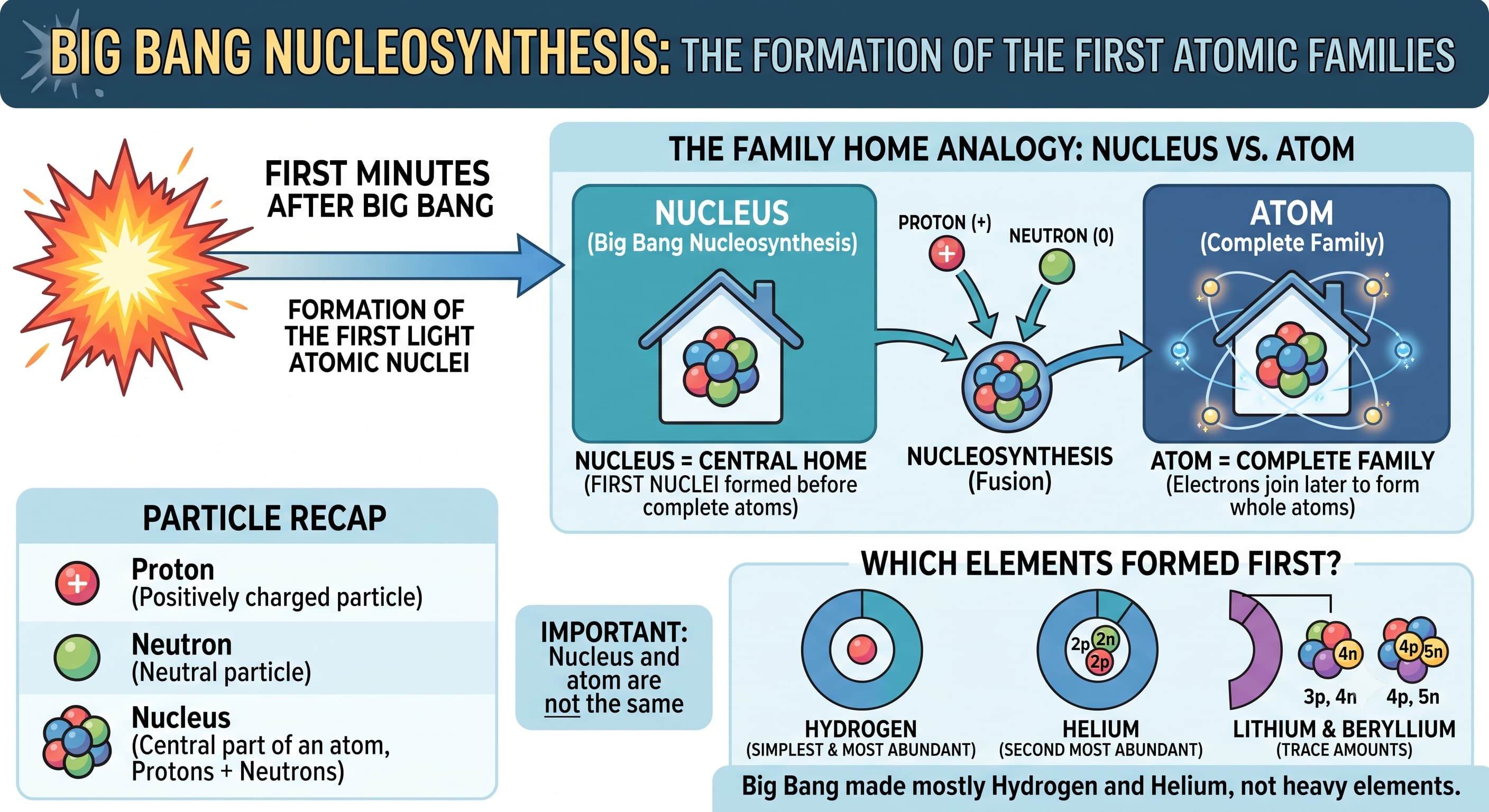
Nucleosynthesis means the formation of atomic nuclei.
Big Bang Nucleosynthesis means the formation of the first light atomic nuclei in the first few minutes after the Big Bang.
Simple Example: If an atom is like a family, then the nucleus is like the central home. Big Bang nucleosynthesis created these first central homes, but complete atoms formed later when electrons joined them.
3. Proton, Neutron and Nucleus: Short Recap
To understand first elements, we must clearly understand three terms.
| Term | Simple Meaning | Role in First Elements |
|---|---|---|
| Proton | A positively charged particle found in atomic nuclei. | One proton alone is the nucleus of hydrogen. |
| Neutron | A neutral particle found in atomic nuclei. | It helps make heavier nuclei like helium. |
| Nucleus | Central part of an atom containing protons and neutrons. | First nuclei formed before complete atoms. |
Important: Nucleus and atom are not the same. A nucleus becomes part of an atom only when electrons join around it.
4. Which Elements Formed First?
During Big Bang nucleosynthesis, mainly hydrogen and helium nuclei formed. Very tiny amounts of lithium and beryllium also formed.
Hydrogen
The simplest and most abundant element. Its nucleus is usually just one proton.
Helium
The second most abundant element. Its common nucleus has two protons and two neutrons.
Lithium and Beryllium
Formed only in trace amounts. They were much less common than hydrogen and helium.
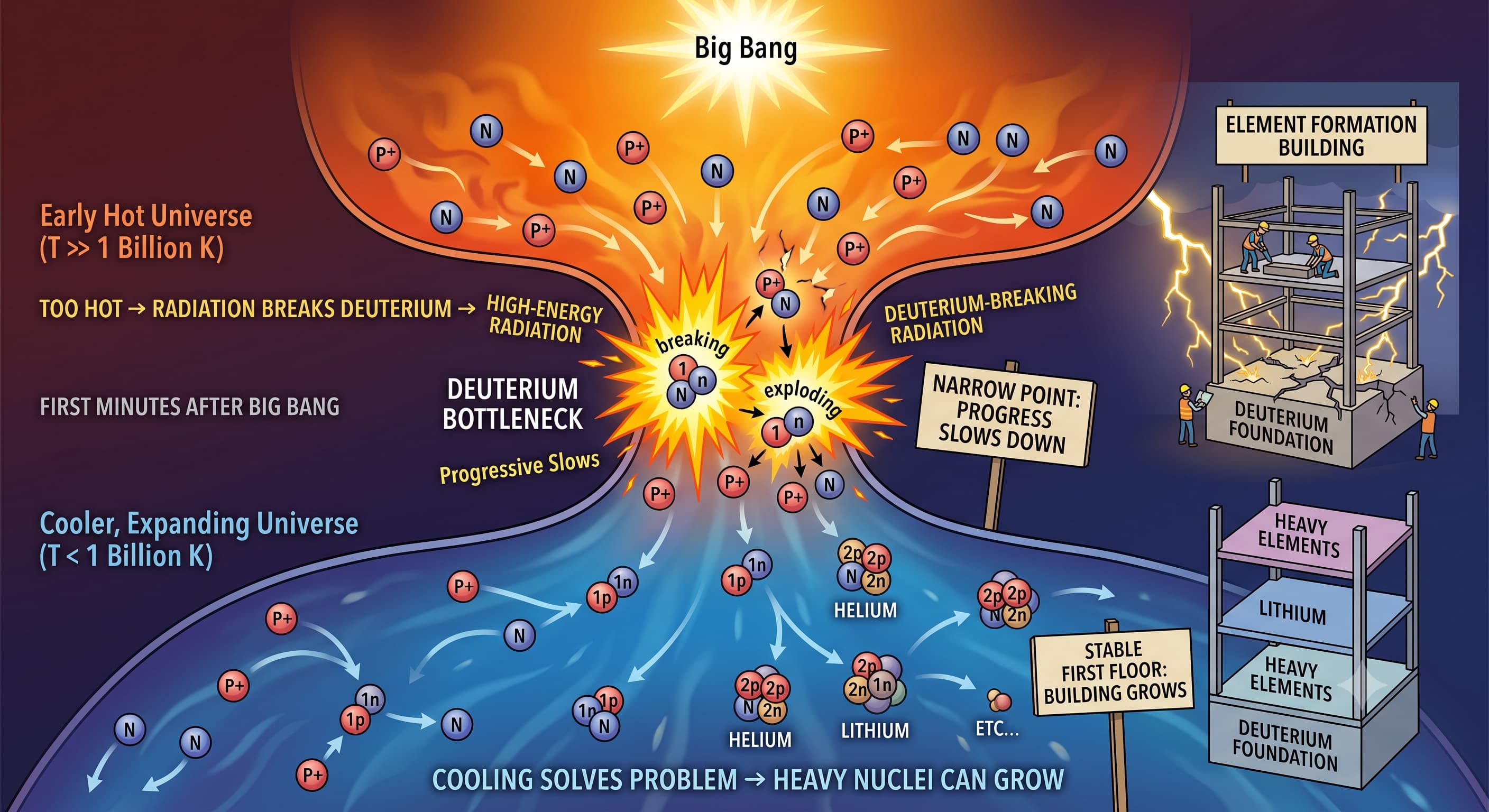
5. Deuterium Bottleneck: The First Delay in Element Formation
Deuterium is a heavier form of hydrogen. Its nucleus contains one proton and one neutron.
In the very early universe, whenever deuterium formed, high-energy radiation quickly broke it apart. So, heavier nuclei could not form immediately.
This delay is called the deuterium bottleneck. A bottleneck means a narrow point where progress slows down.
Simple Example: Imagine trying to build the second floor of a house, but the first floor keeps breaking. Until the first floor becomes stable, the building cannot grow. Deuterium was like that first floor.
6. Proton-Neutron Ratio: Why Helium Formation Was Limited
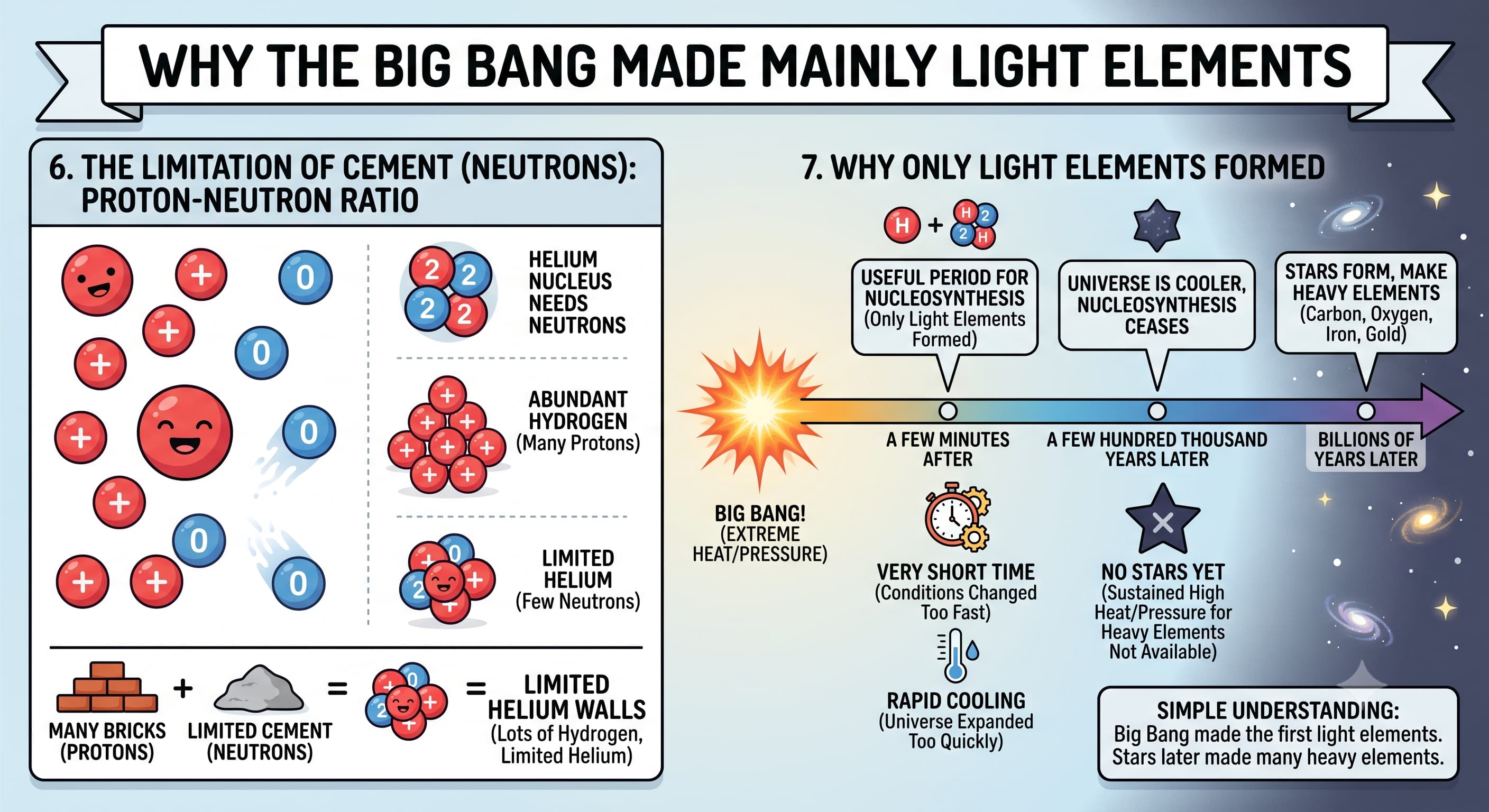
In the early universe, there were more protons than neutrons. Neutrons were fewer and some free neutrons also decayed over time.
Helium formation needs neutrons. So, the amount of helium depended strongly on how many neutrons were available.
Easy Logic: If bricks are many but cement is limited, the number of complete walls will be limited. Similarly, protons were many, but neutrons limited how much helium could form.
7. Why Only Light Elements Formed in the Big Bang
The Big Bang did not create large amounts of heavy elements like carbon, oxygen, iron or gold. It mainly created light nuclei.
Reason 1: Very Short Time
The useful period for nucleosynthesis lasted only a few minutes. There was not enough time to build many heavy nuclei.
Reason 2: Rapid Cooling
The universe was expanding and cooling quickly. Conditions changed too fast for complex nuclei to grow.
Reason 3: No Stars Yet
Heavy elements mainly need long-lasting high temperature and pressure inside stars, which did not exist yet.
Simple Understanding: Big Bang made the first light elements. Stars later made many heavy elements.
8. Big Bang Nucleosynthesis vs Stellar Nucleosynthesis
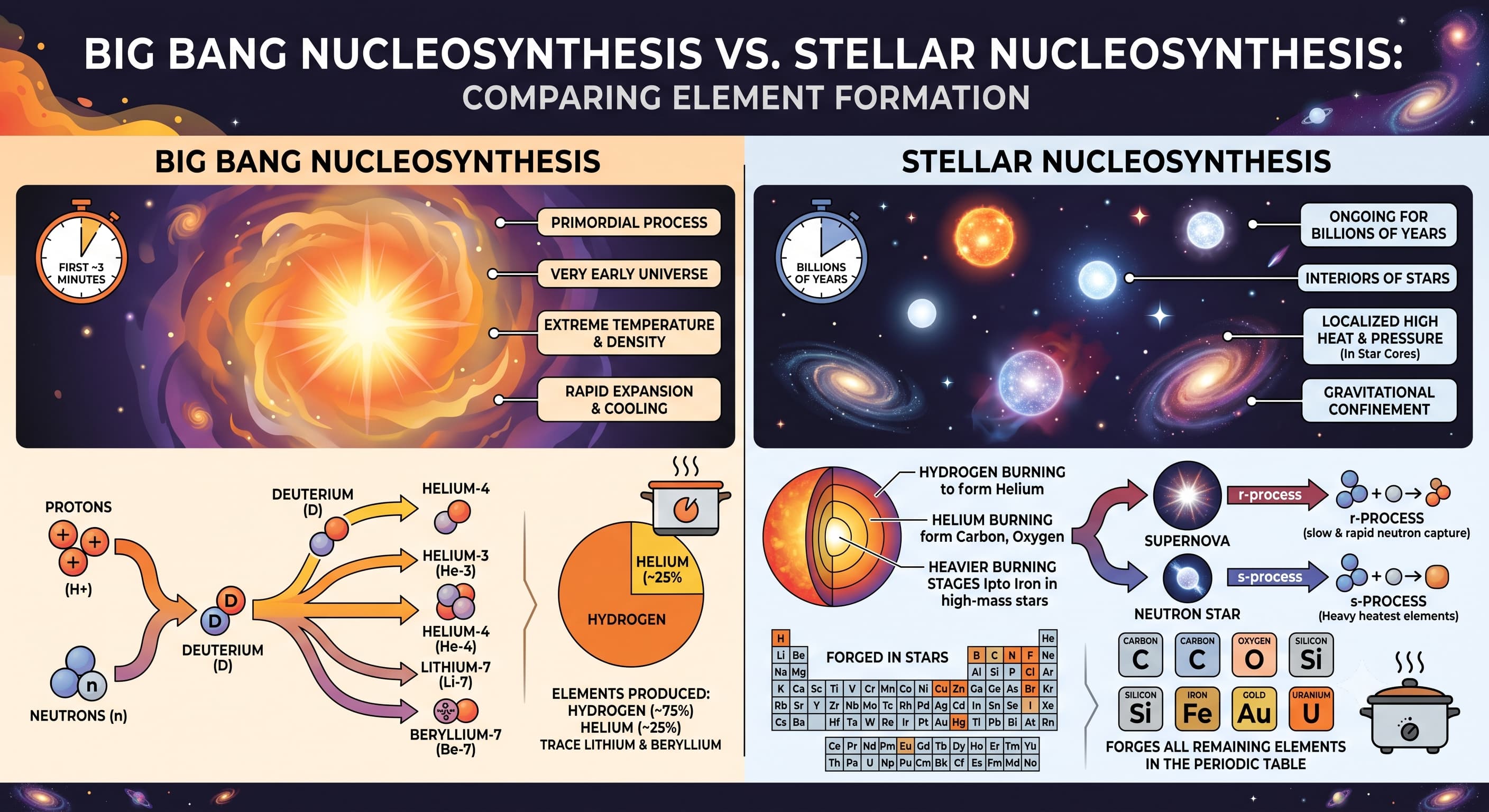
Both terms use the word nucleosynthesis, but they are not the same.
| Basis | Big Bang Nucleosynthesis | Stellar Nucleosynthesis |
|---|---|---|
| When? | First few minutes after Big Bang. | Inside stars during their lifetime. |
| Main products | Hydrogen, helium, trace lithium and beryllium. | Carbon, oxygen, silicon, iron and many heavier elements. |
| Conditions | Rapidly expanding and cooling universe. | Long-lasting heat and pressure inside stars. |
| UPSC trap | Do not say all elements formed in Big Bang. | Do not confuse it with first few minutes of universe. |
9. Hydrogen-Helium Abundance as Evidence
The universe contains a very large amount of hydrogen and helium. This matches the idea that these light elements were produced in the early hot universe.
The observed abundance of light elements is one of the important evidences supporting the Big Bang model.
Simple Example: If a factory claims it produced mostly simple bricks, and we later find those same bricks everywhere, it supports the factory’s claim. Similarly, hydrogen-helium abundance supports early universe nucleosynthesis.
10. From First Elements to Cosmic Structures: Only a Short Link
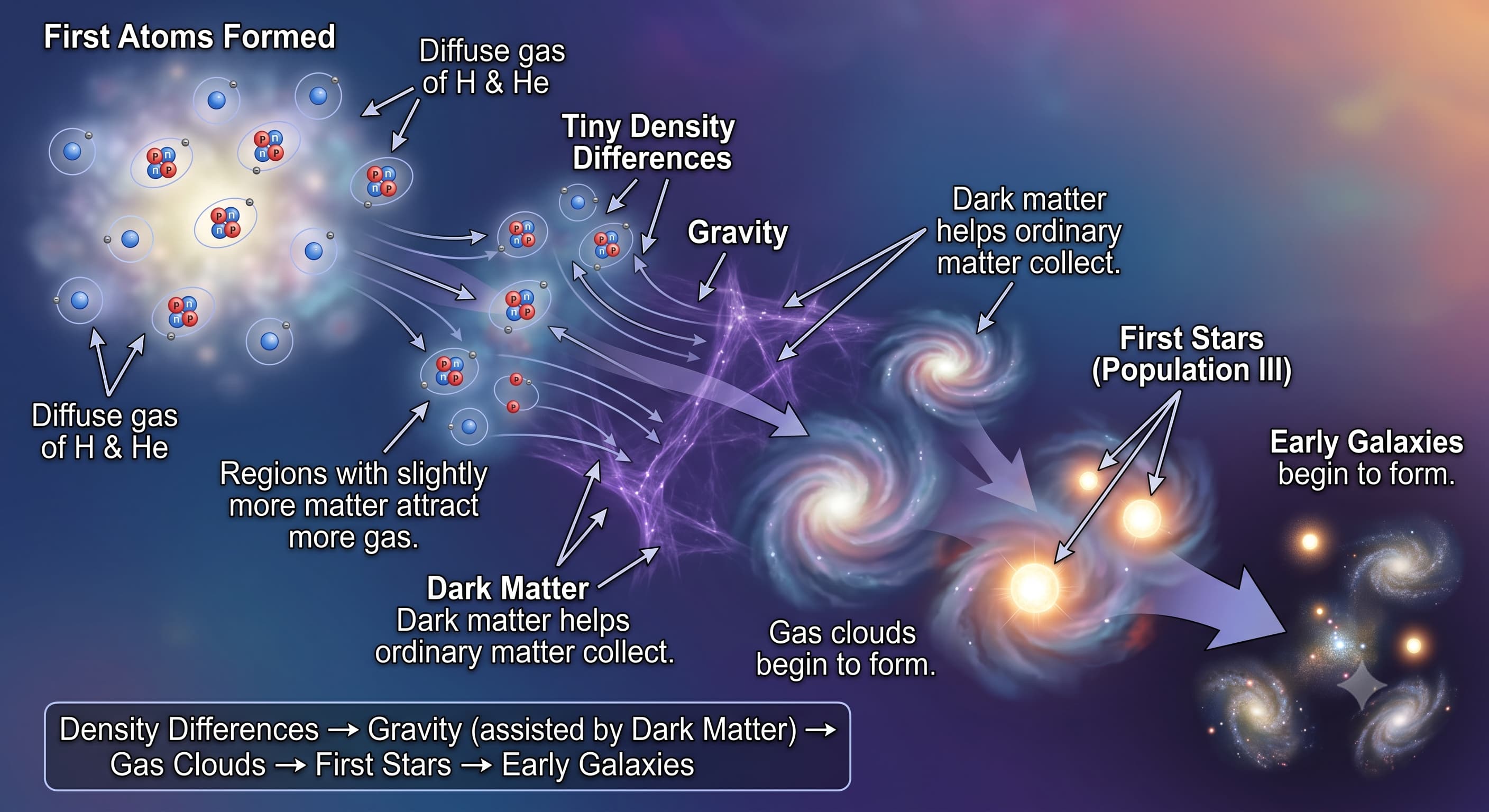
After atoms formed, matter slowly began to collect under gravity. Tiny density differences became important. Regions with slightly more matter attracted more gas.
Dark matter also helped ordinary matter collect into large structures. Over time, gas clouds, first stars and early galaxies began to form.
Note: Detailed study of galaxies, galaxy clusters and cosmic web will come in the next topic. Here we only need a bridge.
11. What is the Universe Made of Today?
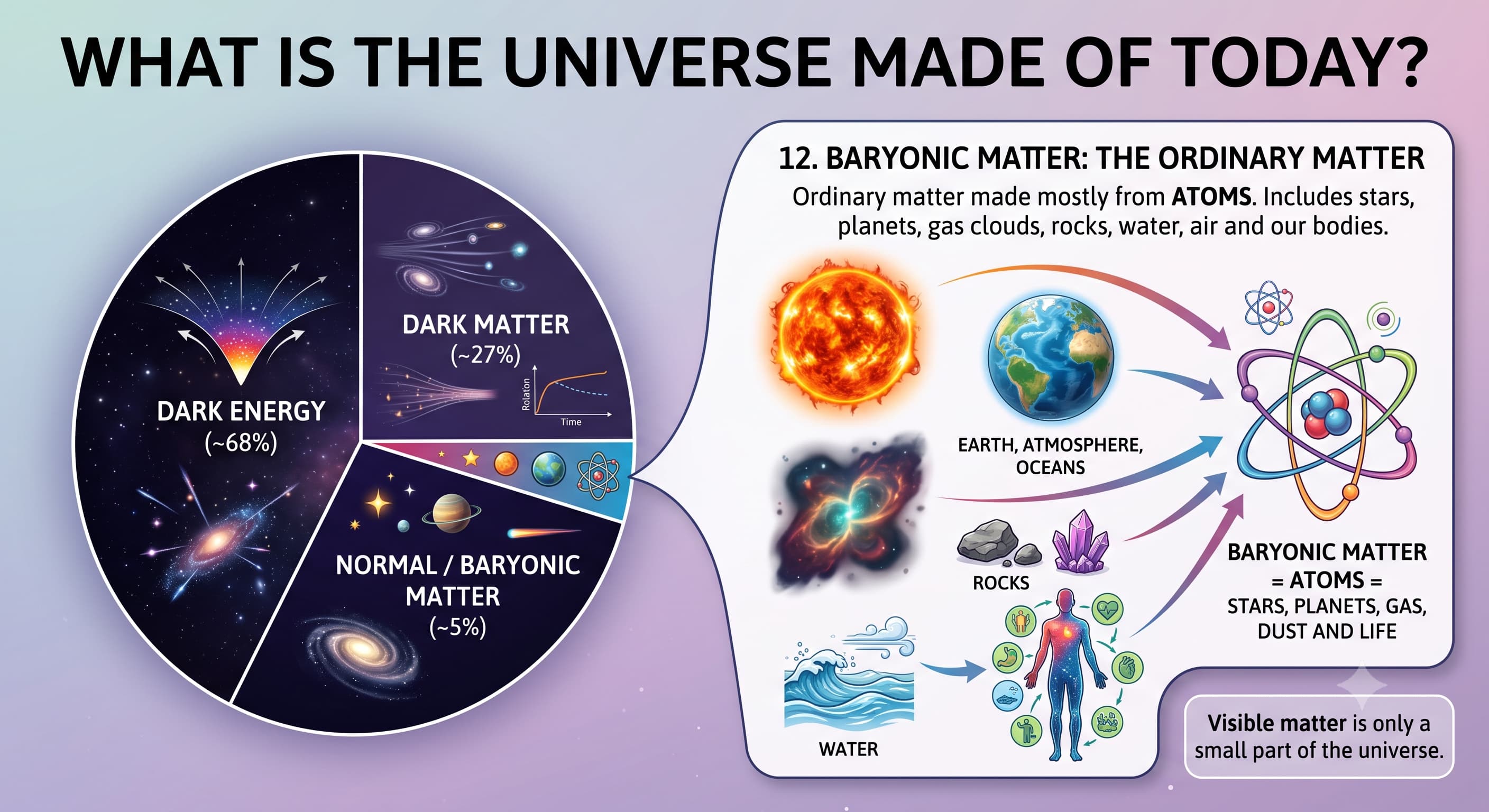
The universe today is not made only of visible stars, planets and gas. Most of the universe is made of components that we cannot directly see.
| Component | Approximate Share | Simple Meaning |
|---|---|---|
| Normal / Baryonic Matter | About 5% | Atoms, stars, planets, gas, dust and living beings. |
| Dark Matter | About 27% | Invisible matter-like component detected through gravity. |
| Dark Energy | About 68% | Mysterious component linked with accelerated expansion of the universe. |
12. Baryonic Matter: The Ordinary Matter
Baryonic matter means ordinary matter made mostly from atoms. It includes stars, planets, gas clouds, rocks, water, air and our bodies.
The word baryonic comes from baryons such as protons and neutrons. Since atoms contain protons and neutrons in their nuclei, ordinary matter is broadly called baryonic matter.
UPSC Clarity: Ordinary matter is important for geography because Earth, atmosphere, oceans, rocks and life are all made of baryonic matter.
13. Radiation: Light and Energy Moving Through Space
Radiation means energy travelling through space in the form of waves or particles. Light is one form of radiation.
The Cosmic Microwave Background is also radiation. It is the oldest light from the early universe, already discussed in earlier posts.
14. Dark Matter: Invisible but Gravitationally Important
Dark matter is called dark because it does not emit, absorb or reflect light in a way that we can directly observe.
Scientists believe dark matter exists because its gravitational effects are visible. Galaxies rotate faster than expected, galaxy clusters bend light more strongly than visible matter can explain, and large-scale cosmic structures seem to need extra gravity.
Galaxy Rotation
Galaxies rotate as if they contain more mass than what we can see.
Gravitational Lensing
Light from distant objects bends due to gravity, showing the presence of unseen mass.
Structure Formation
Dark matter helped ordinary matter collect and form galaxies and clusters.
Simple Example: We cannot see wind directly, but we know it exists because leaves move. Similarly, we cannot see dark matter directly, but we infer it from gravitational effects.
15. Dark Energy: Mystery Behind Accelerating Expansion
Dark energy is the name given to the mysterious cause behind the accelerated expansion of the universe.
Earlier, scientists expected gravity to slow down the expansion of the universe. But observations show that the expansion is speeding up. This acceleration is linked with dark energy.
Important: Dark energy is not ordinary energy like heat or light. It is a name for a deep mystery related to the expansion of space.
16. Dark Matter vs Dark Energy
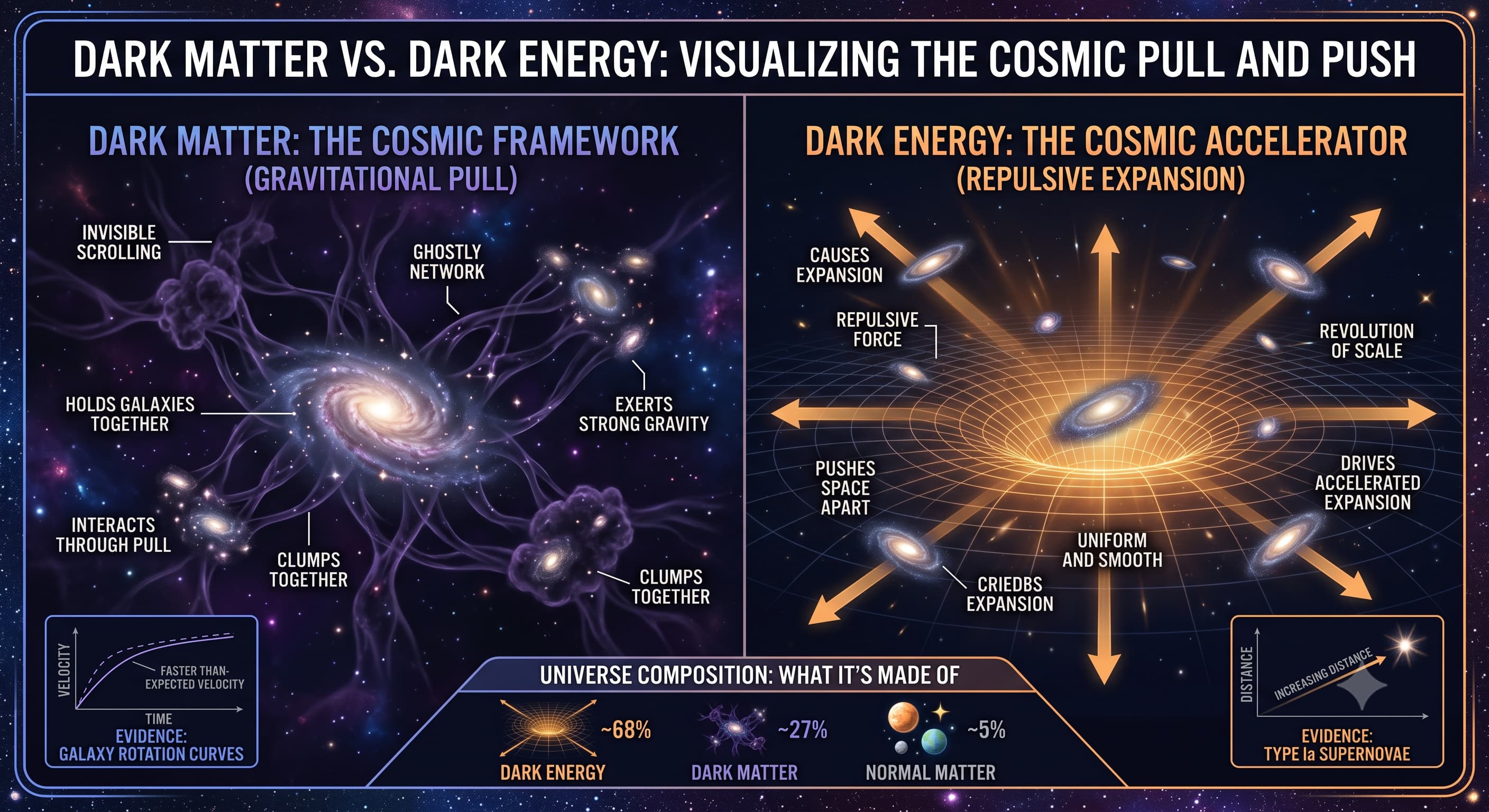
Dark matter and dark energy sound similar, but they are very different.
| Basis | Dark Matter | Dark Energy |
|---|---|---|
| Basic nature | Matter-like component. | Energy-like mystery related to space expansion. |
| Main effect | Adds gravity and helps structures form. | Accelerates expansion of the universe. |
| Scale | Important in galaxies and clusters. | Important at the largest cosmic scale. |
| Simple memory | Dark matter pulls matter together. | Dark energy pushes expansion faster. |
17. Possible Future of the Universe
The future of the universe depends mainly on expansion, gravity and dark energy. Scientists discuss different possible scenarios.
Big Freeze / Heat Death
The universe keeps expanding. Stars slowly die. The universe becomes colder, darker and less active.
Big Crunch
Expansion reverses and the universe collapses back. This is possible in theory, but current evidence does not strongly support it.
Big Rip
Expansion becomes so strong that galaxies, stars, planets and even atoms could be torn apart. This is a theoretical possibility.
Big Bounce
The universe collapses and then expands again in a new cycle. This is also a theoretical idea.
Current Understanding: Since the universe’s expansion is accelerating, Big Freeze or Heat Death is generally considered more likely than Big Crunch. But the final fate is not known with complete certainty.
18. Common UPSC Confusions
Confusion 1: Nucleus and atom are same
Wrong. Nucleus is only the central part. Atom forms when electrons join around the nucleus.
Confusion 2: Big Bang made all elements
Wrong. Big Bang mainly made light elements. Many heavy elements formed later inside stars.
Confusion 3: Dark matter means black holes
Wrong. Black holes are not the same as dark matter. Dark matter is a wider unknown component detected by gravity.
Confusion 4: Dark energy is ordinary energy
Wrong. Dark energy is not heat, light or electricity. It is linked with accelerated cosmic expansion.
Confusion 5: Big Freeze means explosion
Wrong. Big Freeze means continuous expansion, cooling and fading of cosmic activity.
Confusion 6: Dark matter and dark energy are same
Wrong. Dark matter helps structures form through gravity. Dark energy accelerates expansion.
19. UPSC Relevance
This post is important because it connects the origin of elements, composition of the universe and future cosmic possibilities.
Prelims: Big Bang nucleosynthesis, hydrogen-helium abundance, baryonic matter, dark matter, dark energy and future scenarios.
GS Paper III: Science and technology, space science and scientific understanding of the universe.
Essay: Origin of universe, limits of science, mystery of dark matter and dark energy.
Interview: Ability to explain difficult scientific concepts in simple language.
Quick Revision
Nucleosynthesis means formation of atomic nuclei.
Big Bang nucleosynthesis formed mainly hydrogen and helium nuclei, with trace lithium and beryllium.
Deuterium bottleneck delayed the formation of heavier nuclei until the universe cooled enough.
Proton-neutron ratio helped decide how much hydrogen and helium formed.
Heavy elements like carbon, oxygen and iron formed mainly later inside stars.
Hydrogen-helium abundance is an important evidence for Big Bang nucleosynthesis.
Baryonic matter means ordinary matter such as atoms, stars, planets, gas and living beings.
Dark matter is invisible but has gravitational effects.
Dark energy is linked with accelerated expansion of the universe.
Approximate composition: about 5% normal matter, 27% dark matter and 68% dark energy.
Possible futures include Big Freeze, Big Crunch, Big Rip and Big Bounce.
Because expansion is accelerating, Big Freeze or Heat Death is generally considered more likely, but final certainty is not possible yet.
Think Like UPSC: Do not study the universe as isolated facts. Connect the full journey: Big Bang created conditions, nucleosynthesis formed first light elements, stars later made heavy elements, today the universe is dominated by dark matter and dark energy, and its future depends on expansion.
पहले तत्व, ब्रह्मांड की संरचना और ब्रह्मांड का भविष्य
पिछली पोस्ट में हमने प्रारंभिक ब्रह्मांड की व्यापक समय-रेखा को समझा था — ऊर्जा और कणों से लेकर नाभिक, परमाणु, पहली गैस-मेघ संरचनाओं और पहले तारों तक।
इस विषय की अंतिम पोस्ट में हम बची हुई कहानी को पूरा करेंगे: पहले तत्व कैसे बने, आज ब्रह्मांड किससे बना है, और भविष्य में ब्रह्मांड के साथ क्या हो सकता है।
1. यह पोस्ट क्यों महत्वपूर्ण है
पिछली पोस्टों में यह समझाया गया कि ब्रह्मांड कैसे शुरू हुआ और कैसे विकसित हुआ। लेकिन तीन महत्वपूर्ण प्रश्न अभी भी बचे हुए हैं:
प्रश्न 1
Big Bang के बाद सबसे पहले कौन-से तत्व बने?
प्रश्न 2
आज ब्रह्मांड किससे बना है?
प्रश्न 3
भविष्य में ब्रह्मांड के साथ क्या हो सकता है?
2. Big Bang Nucleosynthesis: सरल शब्दों में अर्थ
Nucleosynthesis का अर्थ है atomic nuclei यानी परमाणु नाभिकों का निर्माण।
Big Bang Nucleosynthesis का अर्थ है Big Bang के बाद शुरुआती कुछ मिनटों में पहले हल्के atomic nuclei का निर्माण।
सरल उदाहरण: यदि atom को एक परिवार मानें, तो nucleus उसका केंद्रीय घर है। Big Bang nucleosynthesis ने ये शुरुआती केंद्रीय घर बनाए, लेकिन complete atoms बाद में बने जब electrons उनसे जुड़ गए।
3. Proton, Neutron और Nucleus: छोटा Recap
पहले तत्वों को समझने के लिए हमें तीन शब्दों को स्पष्ट रूप से समझना होगा।
| शब्द | सरल अर्थ | पहले तत्वों में भूमिका |
|---|---|---|
| Proton | atomic nuclei में पाया जाने वाला positively charged particle। | एक proton अकेला ही hydrogen का nucleus होता है। |
| Neutron | atomic nuclei में पाया जाने वाला neutral particle। | यह helium जैसे heavier nuclei बनाने में मदद करता है। |
| Nucleus | atom का केंद्रीय भाग, जिसमें protons और neutrons होते हैं। | complete atoms बनने से पहले पहले nuclei बने। |
महत्वपूर्ण: Nucleus और atom एक ही चीज नहीं हैं। Nucleus atom का हिस्सा तब बनता है जब electrons उसके चारों ओर जुड़ जाते हैं।
4. सबसे पहले कौन-से तत्व बने?
Big Bang nucleosynthesis के दौरान मुख्य रूप से hydrogen और helium के nuclei बने। lithium और beryllium भी बहुत ही छोटी मात्रा में बने।
Hydrogen
सबसे सरल और सबसे अधिक मात्रा में पाया जाने वाला element। इसका nucleus सामान्यतः केवल एक proton होता है।
Helium
दूसरा सबसे अधिक मात्रा में पाया जाने वाला element। इसके common nucleus में दो protons और दो neutrons होते हैं।
Lithium और Beryllium
केवल trace amounts में बने। ये hydrogen और helium की तुलना में बहुत कम थे।
5. Deuterium Bottleneck: तत्वों के निर्माण में पहली देरी
Deuterium hydrogen का एक heavier form है। इसके nucleus में एक proton और एक neutron होता है।
बहुत प्रारंभिक ब्रह्मांड में जब भी deuterium बनता था, high-energy radiation उसे तुरंत तोड़ देती थी। इसलिए heavier nuclei तुरंत नहीं बन पाए।
इस देरी को deuterium bottleneck कहा जाता है। bottleneck का अर्थ है ऐसा संकरा बिंदु जहाँ progress धीमी हो जाती है।
सरल उदाहरण: कल्पना कीजिए कि आप घर की दूसरी मंजिल बनाना चाहते हैं, लेकिन पहली मंजिल बार-बार टूट रही है। जब तक पहली मंजिल स्थिर नहीं होगी, इमारत ऊपर नहीं बढ़ सकती। Deuterium उसी पहली मंजिल की तरह था।
6. Proton-Neutron Ratio: Helium का निर्माण सीमित क्यों रहा
प्रारंभिक ब्रह्मांड में protons, neutrons से अधिक थे। Neutrons कम थे और कुछ free neutrons समय के साथ decay भी हो गए।
Helium formation के लिए neutrons की आवश्यकता होती है। इसलिए helium की मात्रा इस बात पर बहुत निर्भर करती थी कि कितने neutrons उपलब्ध थे।
आसान Logic: यदि ईंटें बहुत हों लेकिन cement सीमित हो, तो पूरी दीवारों की संख्या सीमित रहेगी। इसी तरह protons बहुत थे, लेकिन neutrons ने तय किया कि helium कितना बन सकता है।
7. Big Bang में केवल हल्के तत्व ही क्यों बने
Big Bang ने carbon, oxygen, iron या gold जैसे heavy elements बड़ी मात्रा में नहीं बनाए। उसने मुख्य रूप से light nuclei बनाए।
कारण 1: बहुत कम समय
nucleosynthesis के लिए उपयोगी अवधि केवल कुछ मिनटों तक रही। इतने कम समय में बहुत heavy nuclei बनाने का अवसर नहीं था।
कारण 2: तेज Cooling
ब्रह्मांड तेजी से expand और cool हो रहा था। conditions इतनी जल्दी बदल गईं कि complex nuclei आगे नहीं बढ़ पाए।
कारण 3: तब Stars नहीं थे
Heavy elements को सामान्यतः stars के अंदर लंबे समय तक high temperature और pressure की जरूरत होती है, लेकिन उस समय stars बने ही नहीं थे।
सरल समझ: Big Bang ने पहले हल्के elements बनाए। बाद में stars ने कई heavy elements बनाए।
8. Big Bang Nucleosynthesis vs Stellar Nucleosynthesis
दोनों terms में nucleosynthesis शब्द आता है, लेकिन दोनों एक ही चीज नहीं हैं।
| आधार | Big Bang Nucleosynthesis | Stellar Nucleosynthesis |
|---|---|---|
| कब? | Big Bang के बाद शुरुआती कुछ मिनटों में। | stars के अंदर उनके जीवनकाल के दौरान। |
| मुख्य products | Hydrogen, helium, trace lithium और beryllium। | Carbon, oxygen, silicon, iron और कई heavier elements। |
| Conditions | तेजी से expanding और cooling universe। | stars के अंदर long-lasting heat और pressure। |
| UPSC trap | यह न कहें कि सभी elements Big Bang में बने। | इसे universe के शुरुआती कुछ मिनटों से confuse न करें। |
9. Hydrogen-Helium Abundance एक Evidence के रूप में
ब्रह्मांड में hydrogen और helium बहुत अधिक मात्रा में पाए जाते हैं। यह इस विचार से मेल खाता है कि ये light elements प्रारंभिक hot universe में बने थे।
Light elements की observed abundance Big Bang model को support करने वाले महत्वपूर्ण evidences में से एक है।
सरल उदाहरण: यदि कोई factory दावा करे कि उसने अधिकतर simple bricks बनाए, और बाद में हमें वही bricks हर जगह मिलें, तो factory का दावा support होता है। इसी तरह hydrogen-helium abundance early universe nucleosynthesis को support करती है।
10. पहले तत्वों से Cosmic Structures तक: केवल एक छोटा Link
atoms बनने के बाद matter धीरे-धीरे gravity के कारण एकत्र होने लगा। छोटे-छोटे density differences महत्वपूर्ण हो गए। जिन क्षेत्रों में थोड़ा अधिक matter था, उन्होंने अधिक gas को अपनी ओर आकर्षित किया।
Dark matter ने भी ordinary matter को बड़ी structures में इकट्ठा होने में मदद की। समय के साथ gas clouds, first stars और early galaxies बनने लगे।
Note: Galaxies, galaxy clusters और cosmic web का detailed study अगले topic में आएगा। यहाँ हमें केवल एक bridge समझना है।
11. आज ब्रह्मांड किससे बना है?
आज ब्रह्मांड केवल visible stars, planets और gas से नहीं बना है। ब्रह्मांड का अधिकांश भाग ऐसे components से बना है जिन्हें हम सीधे नहीं देख सकते।
| Component | Approximate Share | सरल अर्थ |
|---|---|---|
| Normal / Baryonic Matter | लगभग 5% | Atoms, stars, planets, gas, dust और living beings। |
| Dark Matter | लगभग 27% | invisible matter-like component, जिसे gravity के प्रभाव से detect किया जाता है। |
| Dark Energy | लगभग 68% | mysterious component, जो universe की accelerated expansion से जुड़ा है। |
12. Baryonic Matter: सामान्य Matter
Baryonic matter का अर्थ है ordinary matter, जो मुख्य रूप से atoms से बना होता है। इसमें stars, planets, gas clouds, rocks, water, air और हमारे bodies शामिल हैं।
baryonic शब्द baryons जैसे protons और neutrons से आया है। चूँकि atoms के nuclei में protons और neutrons होते हैं, इसलिए ordinary matter को broad रूप से baryonic matter कहा जाता है।
UPSC Clarity: Ordinary matter geography के लिए महत्वपूर्ण है क्योंकि Earth, atmosphere, oceans, rocks और life सभी baryonic matter से बने हैं।
13. Radiation: Space में चलती हुई Light और Energy
Radiation का अर्थ है waves या particles के रूप में space में travel करने वाली energy। Light radiation का एक form है।
Cosmic Microwave Background भी radiation है। यह early universe की सबसे पुरानी light है, जिसे पहले की posts में discuss किया जा चुका है।
14. Dark Matter: अदृश्य लेकिन Gravity के लिए महत्वपूर्ण
Dark matter को dark इसलिए कहा जाता है क्योंकि यह light को ऐसे emit, absorb या reflect नहीं करता कि हम इसे directly observe कर सकें।
वैज्ञानिक मानते हैं कि dark matter मौजूद है क्योंकि इसके gravitational effects दिखाई देते हैं। Galaxies expected से अधिक तेज rotate करती हैं, galaxy clusters light को visible matter से explain होने की तुलना में अधिक bend करते हैं, और large-scale cosmic structures को extra gravity की जरूरत लगती है।
Galaxy Rotation
Galaxies ऐसे rotate करती हैं जैसे उनमें दिखाई देने वाले matter से अधिक mass हो।
Gravitational Lensing
दूर स्थित objects से आने वाली light gravity के कारण bend होती है, जिससे unseen mass की उपस्थिति दिखती है।
Structure Formation
Dark matter ने ordinary matter को collect होकर galaxies और clusters बनाने में मदद की।
सरल उदाहरण: हम हवा को directly नहीं देख सकते, लेकिन पत्तों के हिलने से जानते हैं कि हवा मौजूद है। इसी तरह हम dark matter को directly नहीं देखते, लेकिन gravitational effects से उसका अनुमान लगाते हैं।
15. Dark Energy: Accelerating Expansion के पीछे का रहस्य
Dark energy वह नाम है जो universe की accelerated expansion के पीछे के mysterious cause को दिया गया है।
पहले वैज्ञानिकों को उम्मीद थी कि gravity universe के expansion को slow करेगी। लेकिन observations दिखाते हैं कि expansion speed up हो रही है। यह acceleration dark energy से जुड़ी मानी जाती है।
महत्वपूर्ण: Dark energy heat या light जैसी ordinary energy नहीं है। यह space के expansion से जुड़े एक गहरे mystery का नाम है।
16. Dark Matter vs Dark Energy
Dark matter और dark energy सुनने में समान लगते हैं, लेकिन दोनों बहुत अलग हैं।
| आधार | Dark Matter | Dark Energy |
|---|---|---|
| Basic nature | matter-like component। | space expansion से जुड़ा energy-like mystery। |
| Main effect | gravity जोड़ता है और structures बनने में मदद करता है। | universe के expansion को accelerate करता है। |
| Scale | galaxies और clusters में महत्वपूर्ण। | सबसे बड़े cosmic scale पर महत्वपूर्ण। |
| Simple memory | Dark matter matter को साथ खींचता है। | Dark energy expansion को तेज करती है। |
17. ब्रह्मांड का संभावित भविष्य
ब्रह्मांड का भविष्य मुख्य रूप से expansion, gravity और dark energy पर निर्भर करता है। वैज्ञानिक अलग-अलग possible scenarios पर चर्चा करते हैं।
Big Freeze / Heat Death
universe expand होता रहता है। stars धीरे-धीरे समाप्त हो जाते हैं। universe ठंडा, अंधकारमय और कम सक्रिय हो जाता है।
Big Crunch
expansion reverse हो जाता है और universe वापस collapse हो जाता है। यह theory में possible है, लेकिन current evidence इसे strongly support नहीं करता।
Big Rip
expansion इतना strong हो जाता है कि galaxies, stars, planets और even atoms तक टूट सकते हैं। यह एक theoretical possibility है।
Big Bounce
universe collapse होता है और फिर नए cycle में दोबारा expand होता है। यह भी एक theoretical idea है।
Current Understanding: क्योंकि universe की expansion accelerate हो रही है, इसलिए Big Freeze या Heat Death को सामान्यतः Big Crunch की तुलना में अधिक likely माना जाता है। लेकिन final fate पूरी certainty के साथ known नहीं है।
18. Common UPSC Confusions
Confusion 1: Nucleus और atom एक ही हैं
गलत। Nucleus केवल central part है। Atom तब बनता है जब electrons nucleus के चारों ओर जुड़ते हैं।
Confusion 2: Big Bang ने सभी elements बनाए
गलत। Big Bang ने मुख्य रूप से light elements बनाए। कई heavy elements बाद में stars के अंदर बने।
Confusion 3: Dark matter का अर्थ black holes है
गलत। Black holes dark matter के समान नहीं हैं। Dark matter gravity से detect होने वाला एक wider unknown component है।
Confusion 4: Dark energy ordinary energy है
गलत। Dark energy heat, light या electricity नहीं है। यह accelerated cosmic expansion से जुड़ी है।
Confusion 5: Big Freeze का अर्थ explosion है
गलत। Big Freeze का अर्थ continuous expansion, cooling और cosmic activity का fading है।
Confusion 6: Dark matter और dark energy समान हैं
गलत। Dark matter gravity के माध्यम से structures बनने में मदद करता है। Dark energy expansion को accelerate करती है।
19. UPSC Relevance
यह पोस्ट इसलिए महत्वपूर्ण है क्योंकि यह elements की origin, universe की composition और future cosmic possibilities को जोड़ती है।
Prelims: Big Bang nucleosynthesis, hydrogen-helium abundance, baryonic matter, dark matter, dark energy और future scenarios।
GS Paper III: Science and technology, space science और universe की scientific understanding।
Essay: Origin of universe, limits of science, dark matter और dark energy का mystery।
Interview: कठिन scientific concepts को सरल भाषा में समझाने की क्षमता।
Quick Revision
Nucleosynthesis का अर्थ atomic nuclei का formation है।
Big Bang nucleosynthesis ने मुख्य रूप से hydrogen और helium nuclei बनाए, साथ में trace lithium और beryllium भी बने।
Deuterium bottleneck ने heavier nuclei के formation को तब तक delay किया जब तक universe पर्याप्त ठंडा नहीं हो गया।
Proton-neutron ratio ने यह तय करने में मदद की कि hydrogen और helium कितनी मात्रा में बने।
Carbon, oxygen और iron जैसे heavy elements मुख्य रूप से बाद में stars के अंदर बने।
Hydrogen-helium abundance Big Bang nucleosynthesis का एक महत्वपूर्ण evidence है।
Baryonic matter का अर्थ ordinary matter है, जैसे atoms, stars, planets, gas और living beings।
Dark matter invisible है, लेकिन उसके gravitational effects दिखाई देते हैं।
Dark energy universe की accelerated expansion से जुड़ी है।
Approximate composition: लगभग 5% normal matter, 27% dark matter और 68% dark energy।
Possible futures में Big Freeze, Big Crunch, Big Rip और Big Bounce शामिल हैं।
क्योंकि expansion accelerate हो रही है, इसलिए Big Freeze या Heat Death को सामान्यतः अधिक likely माना जाता है, लेकिन final certainty अभी संभव नहीं है।
Think Like UPSC: Universe को isolated facts की तरह न पढ़ें। पूरी journey को connect करें: Big Bang ने conditions बनाई, nucleosynthesis ने पहले light elements बनाए, stars ने बाद में heavy elements बनाए, आज universe dark matter और dark energy से dominated है, और इसका भविष्य expansion पर निर्भर करता है।