Redshift, Hubble Law and Expansion of Universe
The universe is not standing still. Distant galaxies show that space itself is expanding. The most important clue for this is redshift, and the most important rule connected with it is Hubble Law.
In this post, we will understand in the easiest possible language: what redshift means, why light becomes red, how Hubble Law proves expansion, and why this does not mean that Earth is at the centre of the universe.
1. The Core Curiosity: How Can Light Tell Us That the Universe is Expanding?
Galaxies are very far away. We cannot touch them, and we cannot directly measure their motion with a measuring tape. So astronomers study the light coming from galaxies.
Light carries information. When the light of a distant galaxy reaches us, it tells us whether the galaxy is moving away, coming closer, or how much space has expanded during the journey of that light.
Simple Thought: Light is like a message from a galaxy. Redshift tells us that the message was stretched while travelling through space.
2. First Understand Light: Wavelength and Colour
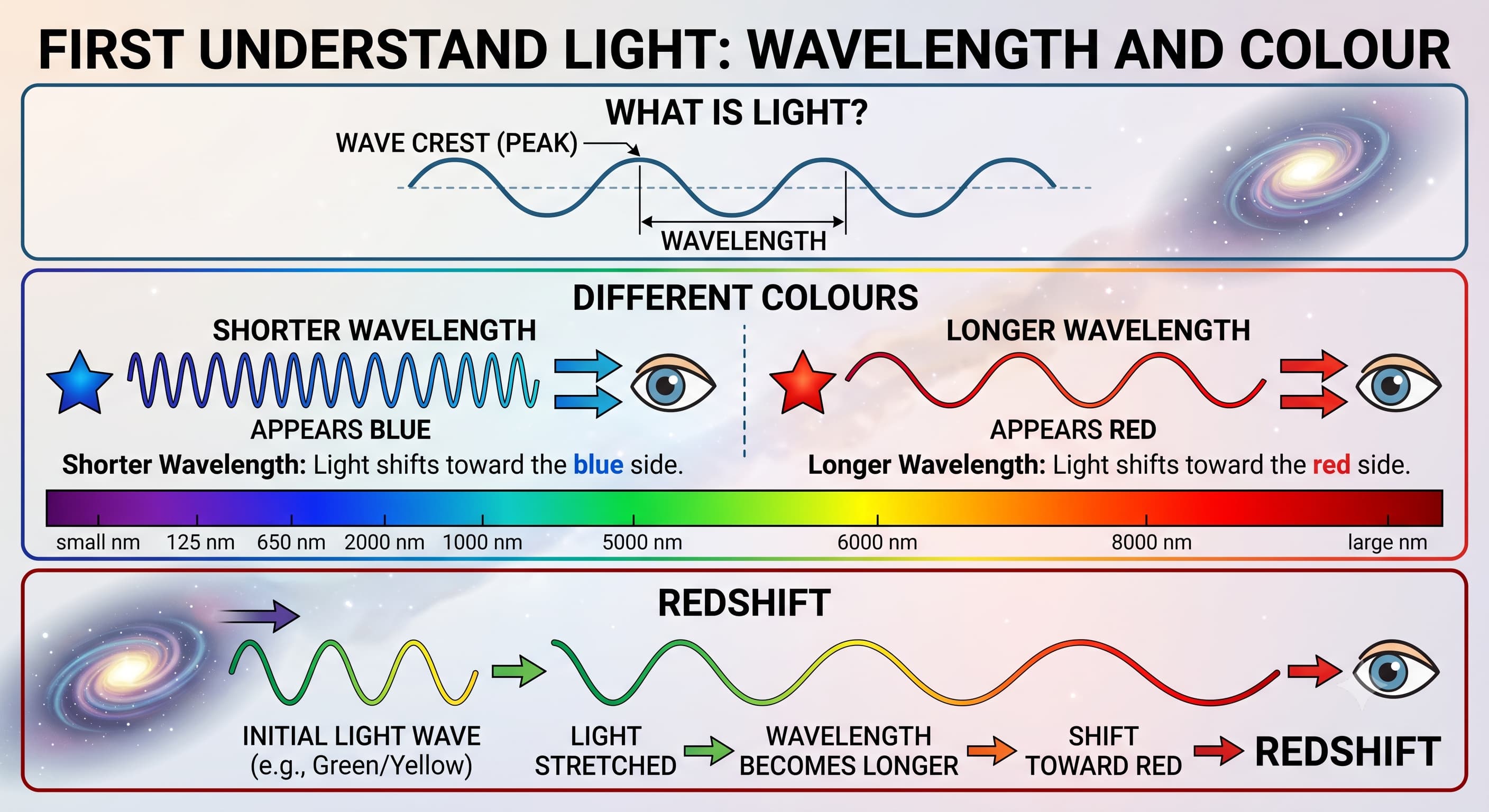
Light travels in waves. The distance between two wave peaks is called wavelength.
Different wavelengths appear as different colours to our eyes. In visible light, blue light has shorter wavelength and red light has longer wavelength.
Shorter Wavelength
Light shifts toward the blue side.
Longer Wavelength
Light shifts toward the red side.
3. What is Redshift?
Redshift means that the light coming from an object has shifted toward longer wavelengths, or toward the red side of the spectrum.
In cosmology, distant galaxies show redshift mainly because space is expanding. As light travels through expanding space, its waves get stretched.
Easy Meaning: Redshift does not mean the galaxy is actually red in colour. It means the wavelength of its light has become longer than before.
4. Why Does Light Become Red When a Galaxy Moves Away?
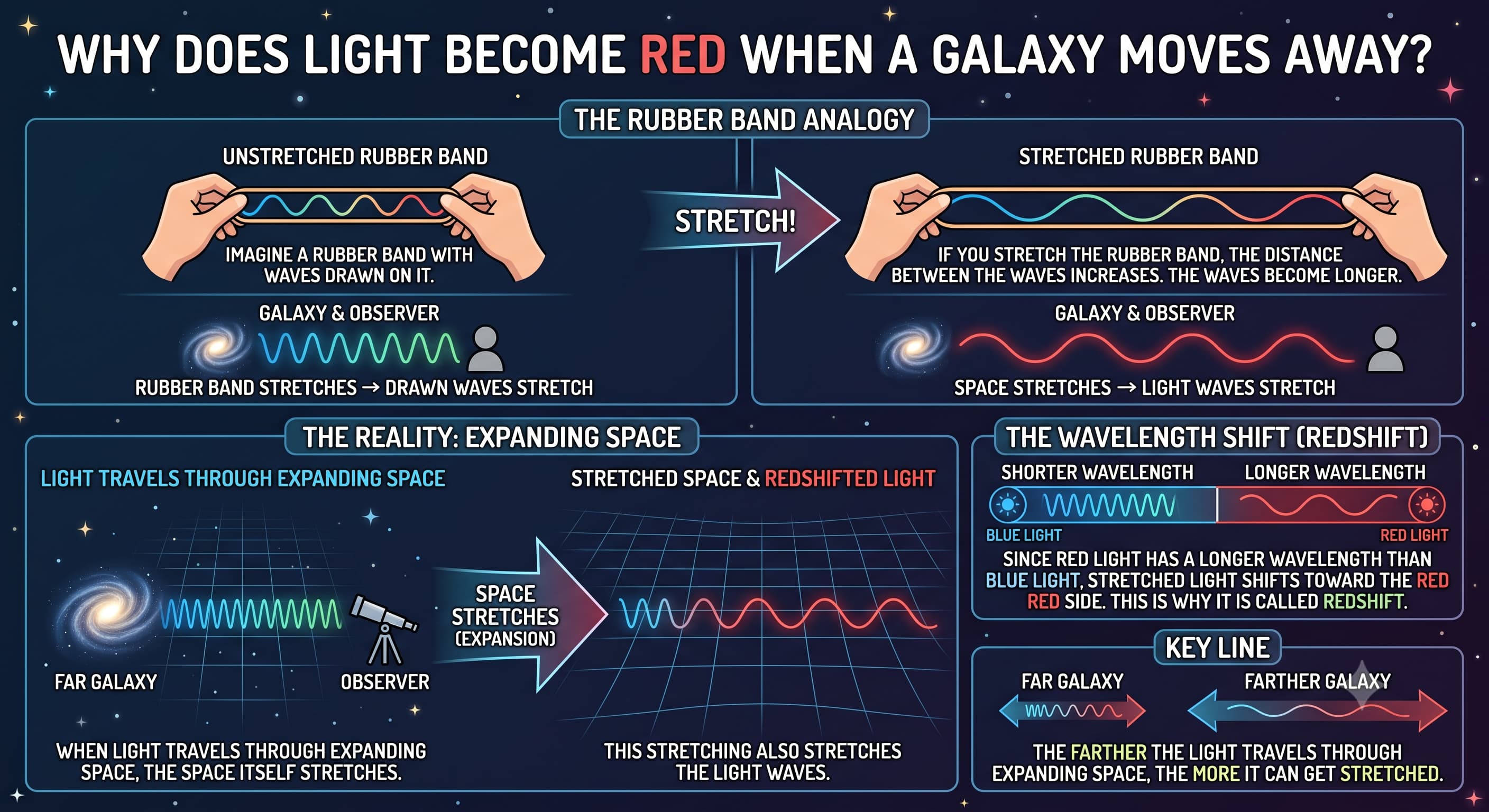
Imagine a rubber band with waves drawn on it. If you stretch the rubber band, the distance between the waves increases. The waves become longer.
Similarly, when light travels through expanding space, the space itself stretches. This stretching also stretches the light waves.
Since red light has a longer wavelength than blue light, stretched light shifts toward the red side. This is why it is called redshift.
Key Line: The farther the light travels through expanding space, the more it can get stretched.
5. Redshift and Blueshift: Moving Away or Coming Closer
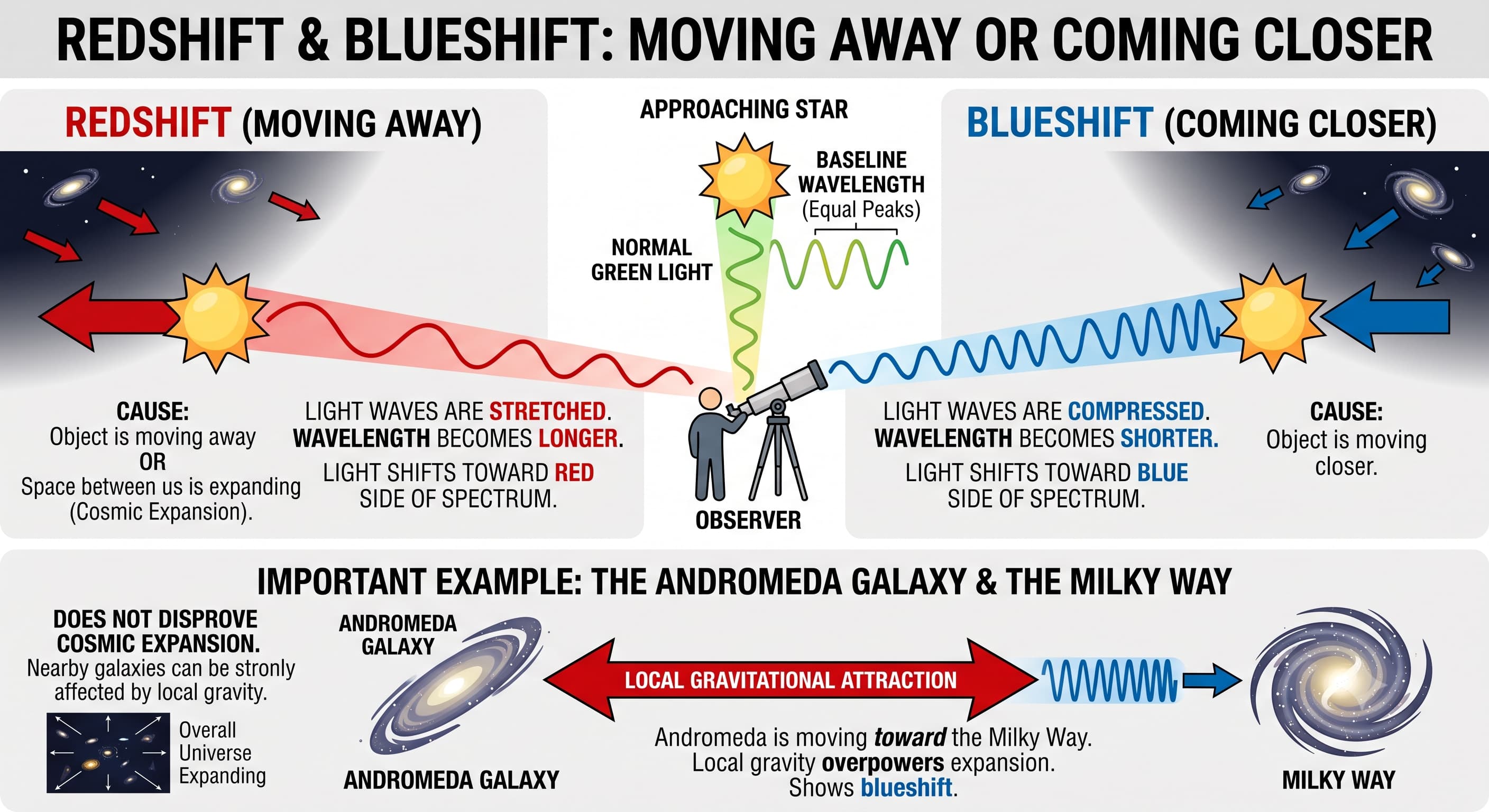
If an object is moving away, its light usually shifts toward longer wavelengths. This is called redshift.
If an object is moving closer, its light shifts toward shorter wavelengths. This is called blueshift.
Redshift
Object is moving away or space between us and it is expanding.
Blueshift
Object is moving closer, so its light shifts toward shorter wavelengths.
Important Example: Andromeda Galaxy is moving toward the Milky Way due to local gravitational attraction, so it shows blueshift. This does not disprove cosmic expansion because nearby galaxies can be strongly affected by local gravity.
6. How Do Scientists Detect Redshift?

Scientists do not simply look at a galaxy and say, “It looks red.” They study its spectrum.
A spectrum is like a rainbow of light, but it also contains dark or bright lines. These lines work like a barcode of elements present in the galaxy.
Step 1
Scientists know where certain element-lines should normally appear.
Step 2
They observe that these lines are shifted toward the red side.
Step 3
The amount of shift tells how much the light has been stretched.
Easy Analogy: If a barcode is shifted to the right, you know it has moved from its original place. Similarly, shifted spectral lines tell scientists that light has been redshifted.
7. Types of Redshift: Which One Matters Here?

Redshift can happen for different reasons. For UPSC and basic cosmology, the most important one is cosmological redshift.
Doppler Redshift
Occurs when a light source moves away through space. Similar to change in sound pitch.
Cosmological Redshift
Occurs because space itself expands while light travels through it. This is most important for distant galaxies.
Gravitational Redshift
Occurs when light escapes from strong gravity and loses energy.
For this post: When we discuss expanding universe and distant galaxies, we mainly mean cosmological redshift.
8. What Did Edwin Hubble Observe?
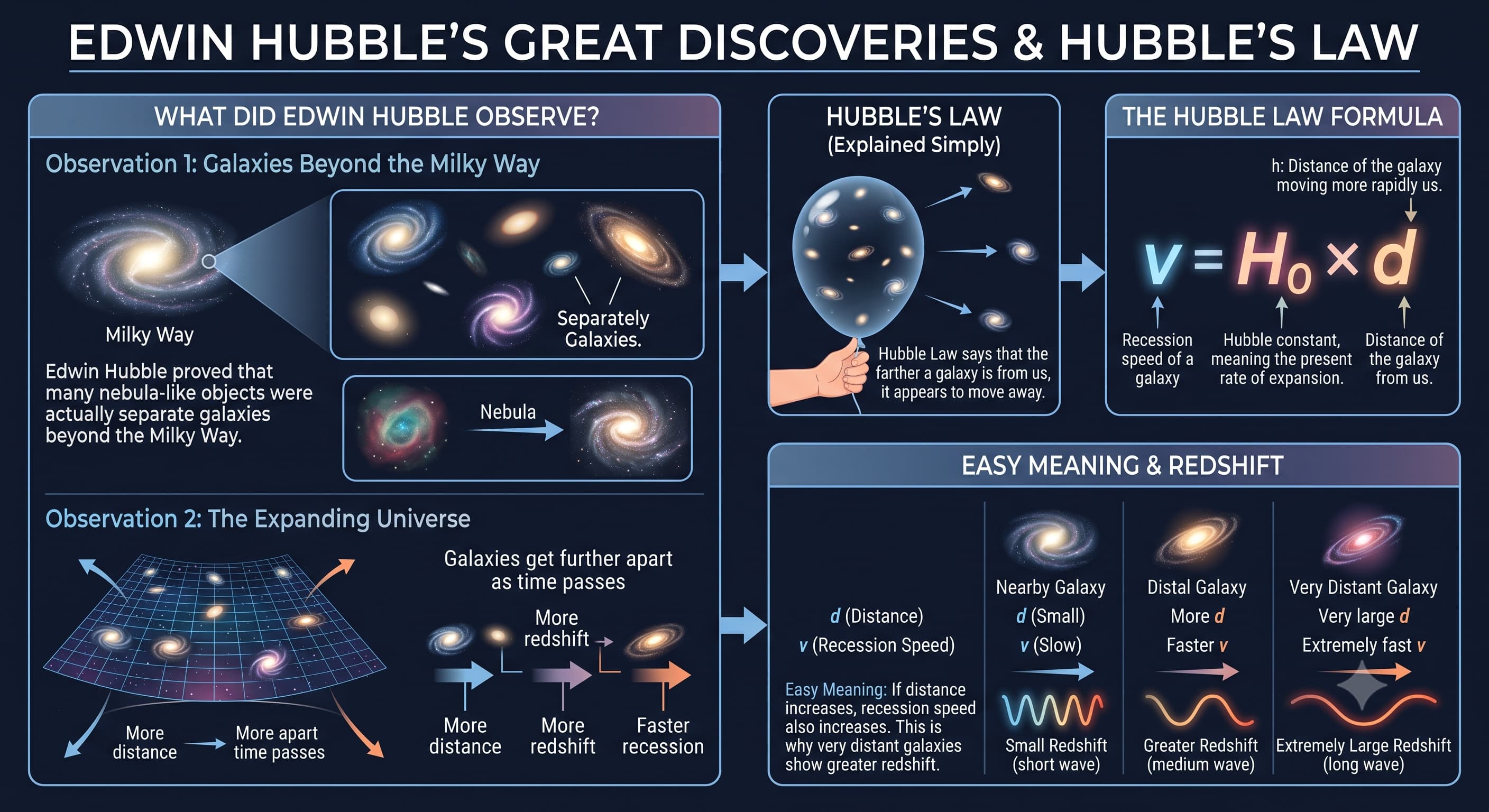
Edwin Hubble made two very important observations.
Observation 1
Many nebula-like objects were actually separate galaxies beyond the Milky Way.
Observation 2
Most distant galaxies were moving away, and farther galaxies generally moved away faster.
This relationship between distance and recession speed became known as Hubble Law.
9. Hubble Law in the Simplest Language
Hubble Law says that the farther a galaxy is from us, the faster it appears to move away.
v
Recession speed of a galaxy.
H0
Hubble constant, meaning the present rate of expansion.
d
Distance of the galaxy from us.
Easy Meaning: If distance increases, recession speed also increases. This is why very distant galaxies show greater redshift.
10. Why Do Farther Galaxies Move Away Faster?
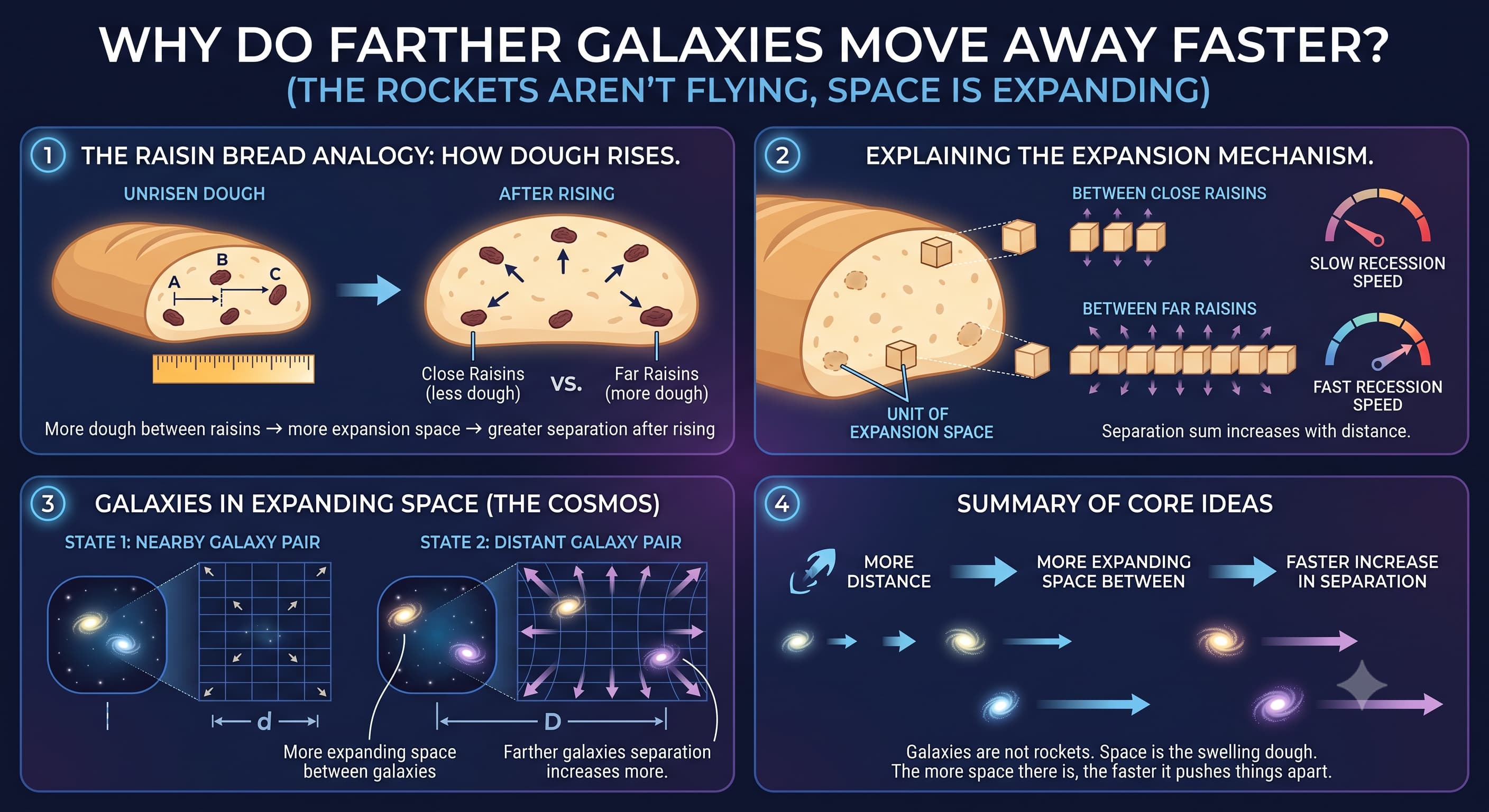
This is one of the most important doubts. Farther galaxies are not necessarily flying faster through space like rockets. The main idea is that space between galaxies is expanding.
If there is more space between two galaxies, then more space is available to expand. So the total separation increases faster for galaxies that are farther away.
Raisin Bread Example: Imagine raisins inside bread dough. As the dough rises, all raisins move away from each other. Two raisins that are farther apart have more dough between them, so their separation increases more.
11. Does Expansion Mean Earth is at the Centre?
No. This is a common mistake. If most galaxies appear to move away from us, it does not mean Earth is the centre of the universe.
In an expanding universe, every observer at a large scale would see other distant galaxies moving away. This happens because space itself is expanding everywhere.
Balloon Example: On the surface of an expanding balloon, every dot sees other dots moving away. But no dot on the surface is the centre of expansion.
12. Is the Milky Way Also Expanding?
No, the Milky Way itself is not expanding like the universe. The Solar System, stars, galaxies and galaxy clusters are held together by gravity.
Cosmic expansion is mainly observed at very large scales, between distant galaxy groups where gravity is not strong enough to keep everything tightly bound.
Small Bound Systems
Solar System, stars and galaxies are held by gravity, so they do not expand with space in the same way.
Large Cosmic Scale
Expansion is clearly seen between distant galaxies and galaxy clusters.
Easy Memory: Expansion works on the biggest cosmic scale. Gravity controls local systems.
13. Redshift Helps Us Look Back in Time
Light takes time to travel. So when we see a distant galaxy, we see it as it was in the past.
Higher redshift usually means the light has travelled from a very distant object and has taken a very long time to reach us. So high-redshift galaxies help scientists study the early universe.
Simple Example: If a galaxy is billions of light-years away, its light started travelling billions of years ago. So we are not seeing that galaxy as it is today; we are seeing its past.
14. How Redshift Supports the Big Bang Theory
Redshift shows that most distant galaxies are moving away from one another because space is expanding.
If the universe is expanding today, then in the past galaxies must have been closer together. If we go further back, the universe must have been much smaller, hotter and denser. This matches the Big Bang idea.
Important: Redshift is not the only evidence for the Big Bang. It is one major evidence. Other evidences like CMBR and light element abundance will be understood in separate posts.
15. Common Student Doubts
Doubt 1: Is redshift same as red colour?
No. Redshift means wavelength has shifted toward the red side. The object need not look red to our eyes.
Doubt 2: Are galaxies flying through space?
For distant galaxies, the main effect is expansion of space between galaxies, not rocket-like motion through space.
Doubt 3: Why is Andromeda coming closer?
Nearby galaxies can be controlled by local gravity. Andromeda and Milky Way are gravitationally attracted.
Doubt 4: Can galaxies recede faster than light?
At very large cosmic distances, space itself can expand so that separation increases faster than light speed. This does not mean a galaxy is locally moving through space faster than light.
16. Difference Between Redshift and Hubble Law
| Concept | Meaning | Simple Example | UPSC Importance |
|---|---|---|---|
| Redshift | Stretching of light toward longer wavelengths. | Rubber band waves becoming longer when stretched. | Shows that distant galaxies are receding or space is expanding. |
| Hubble Law | Farther galaxies generally recede faster. | Farther raisins separate faster in rising bread dough. | Gives observational basis for expansion of universe. |
| Expansion of Universe | Increase in large-scale distances between galaxies. | Dots moving apart on an expanding balloon. | Supports the idea that universe was smaller and denser in the past. |
17. UPSC Relevance
Prelims: UPSC may ask statement-based questions on redshift, blueshift, Hubble Law, expanding universe and Big Bang evidence.
Mains GS Paper I: Useful for explaining origin and evolution of universe under physical geography.
Science and Technology Link: Spectroscopy, Hubble Space Telescope, James Webb Space Telescope and infrared astronomy are connected with redshift studies.
Essay Link: Evidence-based science, human curiosity and cosmic perspective can be enriched through this concept.
Quick Revision
Light has wavelength; red light has longer wavelength than blue light.
Redshift means light shifts toward longer wavelengths.
Cosmological redshift occurs because space expands while light travels through it.
Scientists detect redshift by studying shifted spectral lines.
Blueshift means light shifts toward shorter wavelengths, usually when an object is approaching.
Hubble Law says farther galaxies generally recede faster.
Hubble Law is expressed as v = H0 × d.
Expansion of universe does not mean Earth is at the centre.
Solar System and Milky Way are not expanding like the universe because they are gravitationally bound.
Redshift supports Big Bang because expansion today implies a smaller, hotter and denser universe in the past.
Think Like UPSC: Redshift is the clue, Hubble Law is the pattern, and expansion of universe is the conclusion. Together, they tell us that the universe was smaller and denser in the past, supporting the Big Bang model.
रेडशिफ्ट, हबल नियम और ब्रह्मांड का विस्तार
ब्रह्मांड स्थिर नहीं है। दूर स्थित आकाशगंगाएँ दिखाती हैं कि अंतरिक्ष स्वयं फैल रहा है। इसका सबसे महत्वपूर्ण संकेत रेडशिफ्ट है, और इससे जुड़ा सबसे महत्वपूर्ण नियम हबल नियम है।
इस पोस्ट में हम सबसे आसान भाषा में समझेंगे: रेडशिफ्ट का अर्थ क्या है, प्रकाश लाल दिशा की ओर क्यों खिसकता है, हबल नियम विस्तार को कैसे सिद्ध करता है, और इसका अर्थ यह क्यों नहीं है कि पृथ्वी ब्रह्मांड के केंद्र में है।
1. मूल जिज्ञासा: प्रकाश हमें यह कैसे बताता है कि ब्रह्मांड फैल रहा है?
आकाशगंगाएँ हमसे बहुत दूर हैं। हम उन्हें छू नहीं सकते, और न ही उनकी गति को सीधे किसी मापने वाले फीते से माप सकते हैं। इसलिए खगोलविद आकाशगंगाओं से आने वाले प्रकाश का अध्ययन करते हैं।
प्रकाश जानकारी लेकर आता है। जब किसी दूरस्थ आकाशगंगा का प्रकाश हम तक पहुँचता है, तो वह बताता है कि वह आकाशगंगा दूर जा रही है, पास आ रही है, या उस प्रकाश की यात्रा के दौरान अंतरिक्ष कितना फैल चुका है।
सरल विचार: प्रकाश किसी आकाशगंगा का संदेश है। रेडशिफ्ट हमें बताता है कि यह संदेश अंतरिक्ष में यात्रा करते समय खिंच गया।
2. पहले प्रकाश को समझें: तरंगदैर्ध्य और रंग
प्रकाश तरंगों के रूप में यात्रा करता है। दो तरंग-शिखरों के बीच की दूरी को तरंगदैर्ध्य कहा जाता है।
अलग-अलग तरंगदैर्ध्य हमारी आँखों को अलग-अलग रंगों के रूप में दिखाई देते हैं। दृश्य प्रकाश में नीले प्रकाश का तरंगदैर्ध्य छोटा होता है और लाल प्रकाश का तरंगदैर्ध्य लंबा होता है।
छोटा तरंगदैर्ध्य
प्रकाश नीली दिशा की ओर खिसकता है।
लंबा तरंगदैर्ध्य
प्रकाश लाल दिशा की ओर खिसकता है।
3. रेडशिफ्ट क्या है?
रेडशिफ्ट का अर्थ है कि किसी वस्तु से आने वाला प्रकाश लंबे तरंगदैर्ध्य की ओर, यानी स्पेक्ट्रम के लाल भाग की ओर खिसक गया है।
ब्रह्मांड विज्ञान में दूरस्थ आकाशगंगाएँ मुख्यतः इसलिए रेडशिफ्ट दिखाती हैं क्योंकि अंतरिक्ष फैल रहा है। जब प्रकाश फैलते हुए अंतरिक्ष से गुजरता है, तो उसकी तरंगें खिंच जाती हैं।
आसान अर्थ: रेडशिफ्ट का मतलब यह नहीं है कि आकाशगंगा वास्तव में लाल रंग की है। इसका मतलब है कि उसके प्रकाश का तरंगदैर्ध्य पहले से लंबा हो गया है।
4. जब आकाशगंगा दूर जाती है तो प्रकाश लाल क्यों हो जाता है?
कल्पना कीजिए कि एक रबर बैंड पर तरंगें बनी हुई हैं। यदि आप रबर बैंड को खींचते हैं, तो तरंगों के बीच की दूरी बढ़ जाती है। तरंगें लंबी हो जाती हैं।
इसी तरह, जब प्रकाश फैलते हुए अंतरिक्ष से गुजरता है, तो अंतरिक्ष स्वयं खिंचता है। यह खिंचाव प्रकाश की तरंगों को भी खींच देता है।
क्योंकि लाल प्रकाश का तरंगदैर्ध्य नीले प्रकाश से लंबा होता है, इसलिए खिंचा हुआ प्रकाश लाल दिशा की ओर खिसकता है। इसी कारण इसे रेडशिफ्ट कहा जाता है।
मुख्य बात: प्रकाश जितनी अधिक दूरी फैलते हुए अंतरिक्ष में तय करता है, वह उतना अधिक खिंच सकता है।
5. रेडशिफ्ट और ब्लूशिफ्ट: दूर जाना या पास आना
यदि कोई वस्तु दूर जा रही है, तो उसका प्रकाश सामान्यतः लंबे तरंगदैर्ध्य की ओर खिसकता है। इसे रेडशिफ्ट कहते हैं।
यदि कोई वस्तु पास आ रही है, तो उसका प्रकाश छोटे तरंगदैर्ध्य की ओर खिसकता है। इसे ब्लूशिफ्ट कहते हैं।
रेडशिफ्ट
वस्तु दूर जा रही है या हमारे और उसके बीच का अंतरिक्ष फैल रहा है।
ब्लूशिफ्ट
वस्तु पास आ रही है, इसलिए उसका प्रकाश छोटे तरंगदैर्ध्य की ओर खिसकता है।
महत्वपूर्ण उदाहरण: एंड्रोमेडा आकाशगंगा स्थानीय गुरुत्वाकर्षण आकर्षण के कारण मिल्की वे की ओर आ रही है, इसलिए वह ब्लूशिफ्ट दिखाती है। यह ब्रह्मांडीय विस्तार को गलत सिद्ध नहीं करता, क्योंकि पास की आकाशगंगाएँ स्थानीय गुरुत्वाकर्षण से बहुत अधिक प्रभावित हो सकती हैं।
6. वैज्ञानिक रेडशिफ्ट का पता कैसे लगाते हैं?
वैज्ञानिक किसी आकाशगंगा को केवल देखकर यह नहीं कहते कि “यह लाल दिख रही है।” वे उसके स्पेक्ट्रम का अध्ययन करते हैं।
स्पेक्ट्रम प्रकाश के इंद्रधनुष जैसा होता है, लेकिन इसमें अंधेरी या चमकीली रेखाएँ भी होती हैं। ये रेखाएँ आकाशगंगा में मौजूद तत्वों के बारकोड की तरह काम करती हैं।
चरण 1
वैज्ञानिक जानते हैं कि कुछ तत्वों की रेखाएँ सामान्यतः कहाँ दिखाई देनी चाहिए।
चरण 2
वे देखते हैं कि ये रेखाएँ लाल दिशा की ओर खिसकी हुई हैं।
चरण 3
खिसकाव की मात्रा बताती है कि प्रकाश कितना खिंचा है।
आसान उपमा: यदि कोई बारकोड दाईं ओर खिसक गया हो, तो आप समझ जाते हैं कि वह अपनी मूल जगह से हिल गया है। इसी तरह, खिसकी हुई स्पेक्ट्रल रेखाएँ वैज्ञानिकों को बताती हैं कि प्रकाश रेडशिफ्टेड हो गया है।
7. रेडशिफ्ट के प्रकार: यहाँ कौन-सा महत्वपूर्ण है?
रेडशिफ्ट अलग-अलग कारणों से हो सकता है। UPSC और basic cosmology के लिए सबसे महत्वपूर्ण कॉस्मोलॉजिकल रेडशिफ्ट है।
डॉप्लर रेडशिफ्ट
जब कोई प्रकाश स्रोत अंतरिक्ष में दूर की ओर चलता है, तब होता है। यह ध्वनि की pitch में बदलाव जैसा है।
कॉस्मोलॉजिकल रेडशिफ्ट
जब प्रकाश यात्रा कर रहा होता है और उसी दौरान अंतरिक्ष स्वयं फैलता है, तब होता है। दूरस्थ आकाशगंगाओं के लिए यह सबसे महत्वपूर्ण है।
गुरुत्वीय रेडशिफ्ट
जब प्रकाश बहुत मजबूत गुरुत्वाकर्षण से बाहर निकलता है और ऊर्जा खोता है, तब होता है।
इस पोस्ट के लिए: जब हम फैलते हुए ब्रह्मांड और दूरस्थ आकाशगंगाओं की बात करते हैं, तो मुख्यतः कॉस्मोलॉजिकल रेडशिफ्ट की बात कर रहे होते हैं।
8. एडविन हबल ने क्या देखा?
एडविन हबल ने दो बहुत महत्वपूर्ण अवलोकन किए।
अवलोकन 1
नेबुला जैसी दिखने वाली कई वस्तुएँ वास्तव में मिल्की वे से बाहर अलग आकाशगंगाएँ थीं।
अवलोकन 2
अधिकांश दूरस्थ आकाशगंगाएँ दूर जा रही थीं, और सामान्यतः अधिक दूर आकाशगंगाएँ अधिक तेज़ी से दूर जाती दिखीं।
दूरी और दूर जाने की गति के इस संबंध को हबल नियम कहा गया।
9. हबल नियम सबसे सरल भाषा में
हबल नियम कहता है कि कोई आकाशगंगा हमसे जितनी अधिक दूर है, वह उतनी ही अधिक तेज़ी से दूर जाती हुई दिखाई देती है।
v
किसी आकाशगंगा की recession speed, यानी दूर जाने की गति।
H0
हबल स्थिरांक, अर्थात विस्तार की वर्तमान दर।
d
आकाशगंगा की हमसे दूरी।
आसान अर्थ: यदि दूरी बढ़ती है, तो दूर जाने की गति भी बढ़ती है। इसी कारण बहुत दूर स्थित आकाशगंगाएँ अधिक रेडशिफ्ट दिखाती हैं।
10. अधिक दूर आकाशगंगाएँ अधिक तेज़ी से दूर क्यों जाती हैं?
यह सबसे महत्वपूर्ण doubts में से एक है। दूर की आकाशगंगाएँ जरूरी नहीं कि रॉकेट की तरह अंतरिक्ष में अधिक तेज़ी से उड़ रही हों। मुख्य विचार यह है कि आकाशगंगाओं के बीच का अंतरिक्ष फैल रहा है।
यदि दो आकाशगंगाओं के बीच अधिक अंतरिक्ष है, तो फैलने के लिए अधिक अंतरिक्ष उपलब्ध है। इसलिए जो आकाशगंगाएँ अधिक दूर हैं, उनके बीच की कुल दूरी अधिक तेज़ी से बढ़ती है।
किशमिश-ब्रेड उदाहरण: कल्पना कीजिए कि ब्रेड के आटे में किशमिशें हैं। जैसे-जैसे आटा फूलता है, सभी किशमिशें एक-दूसरे से दूर होती हैं। दो किशमिशें जो अधिक दूर हैं, उनके बीच अधिक आटा है, इसलिए उनकी दूरी अधिक बढ़ती है।
11. क्या विस्तार का अर्थ है कि पृथ्वी केंद्र में है?
नहीं। यह एक सामान्य भूल है। यदि अधिकांश आकाशगंगाएँ हमसे दूर जाती दिखाई देती हैं, तो इसका अर्थ यह नहीं है कि पृथ्वी ब्रह्मांड के केंद्र में है।
फैलते हुए ब्रह्मांड में बड़े पैमाने पर हर observer को अन्य दूरस्थ आकाशगंगाएँ उससे दूर जाती हुई दिखाई देंगी। ऐसा इसलिए होता है क्योंकि अंतरिक्ष स्वयं हर जगह फैल रहा है।
गुब्बारा उदाहरण: फैलते हुए गुब्बारे की सतह पर हर बिंदु दूसरे बिंदुओं को दूर जाते हुए देखता है। लेकिन सतह पर मौजूद कोई भी बिंदु विस्तार का केंद्र नहीं होता।
12. क्या मिल्की वे भी फैल रही है?
नहीं, मिल्की वे स्वयं ब्रह्मांड की तरह नहीं फैल रही है। सौरमंडल, तारे, आकाशगंगाएँ और galaxy clusters गुरुत्वाकर्षण से बंधे होते हैं।
ब्रह्मांडीय विस्तार मुख्यतः बहुत बड़े पैमाने पर देखा जाता है, दूरस्थ galaxy groups के बीच, जहाँ गुरुत्वाकर्षण इतना मजबूत नहीं होता कि सबको मजबूती से बाँधकर रख सके।
छोटे बंधे हुए सिस्टम
सौरमंडल, तारे और आकाशगंगाएँ गुरुत्वाकर्षण से बंधे होते हैं, इसलिए वे अंतरिक्ष के साथ उसी तरह नहीं फैलते।
बड़ा ब्रह्मांडीय पैमाना
विस्तार दूरस्थ आकाशगंगाओं और galaxy clusters के बीच स्पष्ट रूप से दिखाई देता है।
आसान याद रखें: विस्तार सबसे बड़े ब्रह्मांडीय पैमाने पर काम करता है। स्थानीय systems को गुरुत्वाकर्षण नियंत्रित करता है।
13. रेडशिफ्ट हमें अतीत में देखने में मदद करता है
प्रकाश को यात्रा करने में समय लगता है। इसलिए जब हम किसी दूरस्थ आकाशगंगा को देखते हैं, तो हम उसे वैसा देखते हैं जैसी वह अतीत में थी।
अधिक रेडशिफ्ट का सामान्य अर्थ है कि प्रकाश बहुत दूर स्थित वस्तु से आया है और उसे हम तक पहुँचने में बहुत लंबा समय लगा है। इसलिए high-redshift galaxies वैज्ञानिकों को प्रारंभिक ब्रह्मांड का अध्ययन करने में मदद करती हैं।
सरल उदाहरण: यदि कोई आकाशगंगा अरबों प्रकाश-वर्ष दूर है, तो उसका प्रकाश अरबों साल पहले यात्रा शुरू कर चुका था। इसलिए हम उस आकाशगंगा को वैसा नहीं देख रहे जैसे वह आज है; हम उसका अतीत देख रहे हैं।
14. रेडशिफ्ट Big Bang Theory को कैसे support करता है?
रेडशिफ्ट दिखाता है कि अधिकांश दूरस्थ आकाशगंगाएँ एक-दूसरे से दूर जा रही हैं, क्योंकि अंतरिक्ष फैल रहा है।
यदि ब्रह्मांड आज फैल रहा है, तो अतीत में आकाशगंगाएँ एक-दूसरे के अधिक पास रही होंगी। यदि हम और पीछे जाएँ, तो ब्रह्मांड बहुत छोटा, अधिक गर्म और अधिक घना रहा होगा। यही Big Bang idea से मेल खाता है।
महत्वपूर्ण: रेडशिफ्ट Big Bang का अकेला प्रमाण नहीं है। यह एक प्रमुख प्रमाण है। अन्य प्रमाण जैसे CMBR और हल्के तत्वों की प्रचुरता अलग पोस्टों में समझी जाएँगी।
15. विद्यार्थियों के सामान्य Doubts
Doubt 1: क्या रेडशिफ्ट लाल रंग के समान है?
नहीं। रेडशिफ्ट का अर्थ है कि तरंगदैर्ध्य लाल दिशा की ओर खिसक गया है। वस्तु को हमारी आँखों से लाल दिखना जरूरी नहीं है।
Doubt 2: क्या आकाशगंगाएँ अंतरिक्ष में उड़ रही हैं?
दूरस्थ आकाशगंगाओं के लिए मुख्य प्रभाव आकाशगंगाओं के बीच अंतरिक्ष का विस्तार है, न कि रॉकेट जैसी गति।
Doubt 3: एंड्रोमेडा पास क्यों आ रही है?
पास की आकाशगंगाएँ स्थानीय गुरुत्वाकर्षण से नियंत्रित हो सकती हैं। एंड्रोमेडा और मिल्की वे एक-दूसरे की ओर गुरुत्वाकर्षण से आकर्षित हैं।
Doubt 4: क्या आकाशगंगाएँ प्रकाश से तेज़ दूर जा सकती हैं?
बहुत बड़े ब्रह्मांडीय distances पर अंतरिक्ष स्वयं इस तरह फैल सकता है कि separation प्रकाश की गति से अधिक तेज़ी से बढ़े। इसका अर्थ यह नहीं है कि कोई आकाशगंगा स्थानीय रूप से अंतरिक्ष में प्रकाश से तेज़ चल रही है।
16. रेडशिफ्ट और हबल नियम में अंतर
| अवधारणा | अर्थ | सरल उदाहरण | UPSC महत्व |
|---|---|---|---|
| रेडशिफ्ट | प्रकाश का लंबे तरंगदैर्ध्य की ओर खिंचना। | रबर बैंड पर बनी तरंगों का खिंचने पर लंबा हो जाना। | दिखाता है कि दूरस्थ आकाशगंगाएँ दूर जा रही हैं या अंतरिक्ष फैल रहा है। |
| हबल नियम | अधिक दूर आकाशगंगाएँ सामान्यतः अधिक तेज़ी से दूर जाती हैं। | फूलते हुए ब्रेड आटे में दूर की किशमिशों की दूरी अधिक तेज़ी से बढ़ती है। | ब्रह्मांड के विस्तार का observational basis देता है। |
| ब्रह्मांड का विस्तार | आकाशगंगाओं के बीच बड़े पैमाने की distances में वृद्धि। | फैलते हुए गुब्बारे पर बिंदुओं का एक-दूसरे से दूर जाना। | इस विचार को support करता है कि अतीत में ब्रह्मांड छोटा और अधिक घना था। |
17. UPSC Relevance
Prelims: UPSC रेडशिफ्ट, ब्लूशिफ्ट, हबल नियम, फैलते हुए ब्रह्मांड और Big Bang evidence पर statement-based questions पूछ सकता है।
Mains GS Paper I: Physical Geography के अंतर्गत ब्रह्मांड की उत्पत्ति और विकास समझाने में उपयोगी।
Science and Technology Link: Spectroscopy, Hubble Space Telescope, James Webb Space Telescope और infrared astronomy रेडशिफ्ट studies से जुड़े हैं।
Essay Link: Evidence-based science, human curiosity और cosmic perspective को इस concept से बेहतर बनाया जा सकता है।
Quick Revision
प्रकाश का तरंगदैर्ध्य होता है; लाल प्रकाश का तरंगदैर्ध्य नीले प्रकाश से लंबा होता है।
रेडशिफ्ट का अर्थ है कि प्रकाश लंबे तरंगदैर्ध्य की ओर खिसक गया है।
कॉस्मोलॉजिकल रेडशिफ्ट इसलिए होता है क्योंकि प्रकाश की यात्रा के दौरान अंतरिक्ष फैलता है।
वैज्ञानिक shifted spectral lines का अध्ययन करके रेडशिफ्ट का पता लगाते हैं।
ब्लूशिफ्ट का अर्थ है कि प्रकाश छोटे तरंगदैर्ध्य की ओर खिसकता है, सामान्यतः जब कोई वस्तु पास आ रही होती है।
हबल नियम कहता है कि अधिक दूर आकाशगंगाएँ सामान्यतः अधिक तेज़ी से दूर जाती हैं।
हबल नियम को v = H0 × d के रूप में व्यक्त किया जाता है।
ब्रह्मांड के विस्तार का अर्थ यह नहीं है कि पृथ्वी केंद्र में है।
सौरमंडल और मिल्की वे ब्रह्मांड की तरह नहीं फैलते, क्योंकि वे गुरुत्वाकर्षण से बंधे हैं।
रेडशिफ्ट Big Bang को support करता है, क्योंकि आज का विस्तार बताता है कि अतीत में ब्रह्मांड छोटा, अधिक गर्म और अधिक घना था।
Think Like UPSC: रेडशिफ्ट संकेत है, हबल नियम pattern है, और ब्रह्मांड का विस्तार conclusion है। ये मिलकर बताते हैं कि अतीत में ब्रह्मांड छोटा और अधिक घना था, जिससे Big Bang model को support मिलता है।