Active Galactic Nuclei and Supermassive Black Holes
Some galaxies have extremely bright and energetic centres. These bright centres are called Active Galactic Nuclei, or AGN.
An AGN is powered by a supermassive black hole at the centre of a galaxy. When gas and dust fall toward this black hole, huge energy is released.

1. What is an Active Galactic Nucleus?
An Active Galactic Nucleus is a very small but extremely bright region at the centre of a galaxy.
It is called active because it releases a huge amount of energy. This energy is not mainly coming from stars. It comes from matter falling toward a central supermassive black hole.
Easy Meaning: A normal galaxy shines mainly because of its stars. An active galaxy shines extra brightly because its central black hole is feeding on matter.
2. Normal Galaxy vs Active Galaxy
In a normal galaxy, most visible light comes from stars. In an active galaxy, the centre can become so bright that it may outshine the entire galaxy.
Normal Galaxy
Light mainly comes from billions of stars present in the galaxy.
Active Galaxy
The central nucleus releases huge non-stellar radiation due to black hole activity.
Non-stellar radiation: Radiation that is not mainly produced by ordinary stars. In AGN, it comes mostly from hot matter near the black hole.
3. Why is an AGN So Powerful?
The energy of an AGN does not come from nuclear fusion like stars. It comes mainly from gravity and friction.
The central supermassive black hole pulls gas, dust and sometimes stars toward itself. As this matter falls inward, it forms a fast-moving hot disk called an accretion disk.
The matter in the accretion disk becomes extremely hot. It can glow strongly in ultraviolet light and X-rays.
4. Important Technical Terms Explained Simply
Nucleus
The central region of a galaxy. In AGN, this region is extremely bright.
Supermassive Black Hole
A black hole with mass millions to billions of times the Sun’s mass, usually found at the centre of large galaxies.
Accretion
The process in which matter slowly falls toward a massive object like a black hole.
Accretion Disk
A flat, rotating disk of hot gas and dust spiralling around the black hole.
Angular Momentum
The tendency of moving matter to keep rotating. Because of this, falling gas forms a disk instead of falling straight in.
Friction
When fast-moving gas particles rub and collide, they heat up and release radiation.
5. AGN Emits Energy Across the Electromagnetic Spectrum
AGNs release energy across almost the entire electromagnetic spectrum.
The electromagnetic spectrum means the full range of radiation, from low-energy radio waves to high-energy gamma rays.
Easy Meaning: AGN does not shine only in visible light. It sends signals in many forms of radiation, so different telescopes are used to study it.
6. Size vs Power: Very Small but Extremely Bright
One surprising thing about AGN is that its power source is very compact, but its energy output is enormous.
In some cases, the central active region may be comparable to the size of our Solar System, yet it can shine brighter than a whole galaxy.
7. Energy Conversion: Why Accretion is Efficient
In stars, energy comes from nuclear fusion. In AGN, energy comes mainly from matter losing gravitational energy as it falls toward a black hole.
This accretion process can convert a large fraction of falling matter into energy. This is why AGN can be far more powerful than ordinary star-based radiation.
E = mc² in simple words: Matter and energy are connected. Under extreme conditions near a black hole, part of matter’s mass-energy can appear as radiation.
8. Anatomy of an AGN: The Unified Model
The Unified Model says that many types of AGN have the same basic structure. They look different mainly because we view them from different angles.
This idea helps us understand why quasars, Seyfert galaxies, blazars and radio galaxies may appear different even though their central engine is similar.
9. Main Parts of an AGN
1. Supermassive Black Hole
The central gravitational engine. It pulls matter inward with extreme gravity.
2. Accretion Disk
Hot rotating disk of gas and dust. It releases intense radiation as matter heats up.
3. Broad-Line Region
Fast-moving gas clouds close to the black hole. Their spectral lines appear broad because gas moves very fast.
4. Dusty Torus
A thick donut-shaped ring of dust and gas around the central region. It can block our view from some angles.
5. Narrow-Line Region
Gas clouds farther from the black hole. They move slower, so their spectral lines look narrow.
6. Relativistic Jets
Narrow beams of high-energy particles moving near the speed of light from some AGNs.
10. Spectral Lines: Broad and Narrow Lines
Astronomers study AGNs using spectra. A spectrum is like a barcode of light. It tells us what elements are present and how fast gas is moving.
Broad Lines
Made by fast-moving gas close to the black hole. Fast motion spreads the lines.
Narrow Lines
Made by slower-moving gas farther from the black hole. Lines remain thinner.
Doppler Shift: When gas moves toward or away from us, the wavelength of light changes. This helps measure gas motion near AGNs.
11. Types of AGN
AGNs are classified into different types based on their brightness, distance, jets and viewing angle.
12. Quasars: Extremely Bright and Distant AGNs
Quasar means Quasi-Stellar Radio Source. Early astronomers gave this name because quasars looked like stars through telescopes, but they were actually extremely distant active galaxies.
They are among the brightest AGNs.
They are usually very far away.
Their light can hide the host galaxy around them.
They help us study the early universe.
Easy Meaning: A quasar is like an extremely bright lighthouse in the distant universe.
13. Seyfert Galaxies: Nearby Active Galaxies
Seyfert galaxies are active galaxies that are usually closer and less luminous than quasars.
Their bright nuclei show strong emission lines, which means gas near the centre is moving and glowing strongly.
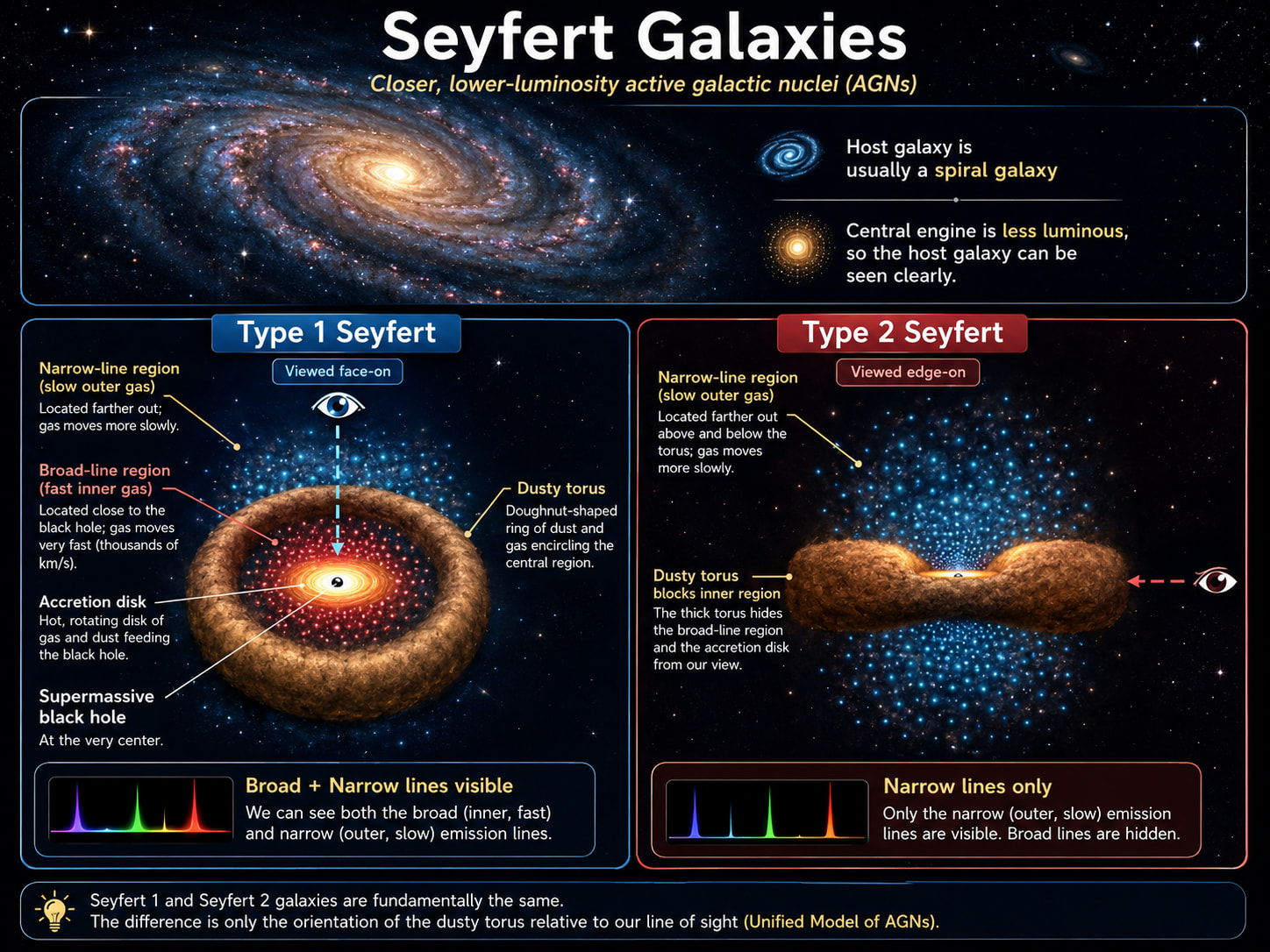
Type 1 Seyfert
Viewed more face-on. We can see both broad and narrow emission lines.
Type 2 Seyfert
Viewed more edge-on. Dusty torus blocks the inner region, so mainly narrow lines are seen.
14. Blazars: AGN Jets Pointing Toward Earth
A blazar is an AGN whose powerful jet points almost directly toward Earth.
Because the jet is aimed toward us, its radiation appears extremely strong and variable.
Relativistic beaming: When a jet moves near the speed of light toward us, its radiation appears strongly boosted.
15. Radio Galaxies: AGNs with Huge Radio Jets
Radio galaxies are active galaxies that emit very strong radio waves.
They often have powerful jets that move out from the central black hole and form huge radio-emitting regions called radio lobes.
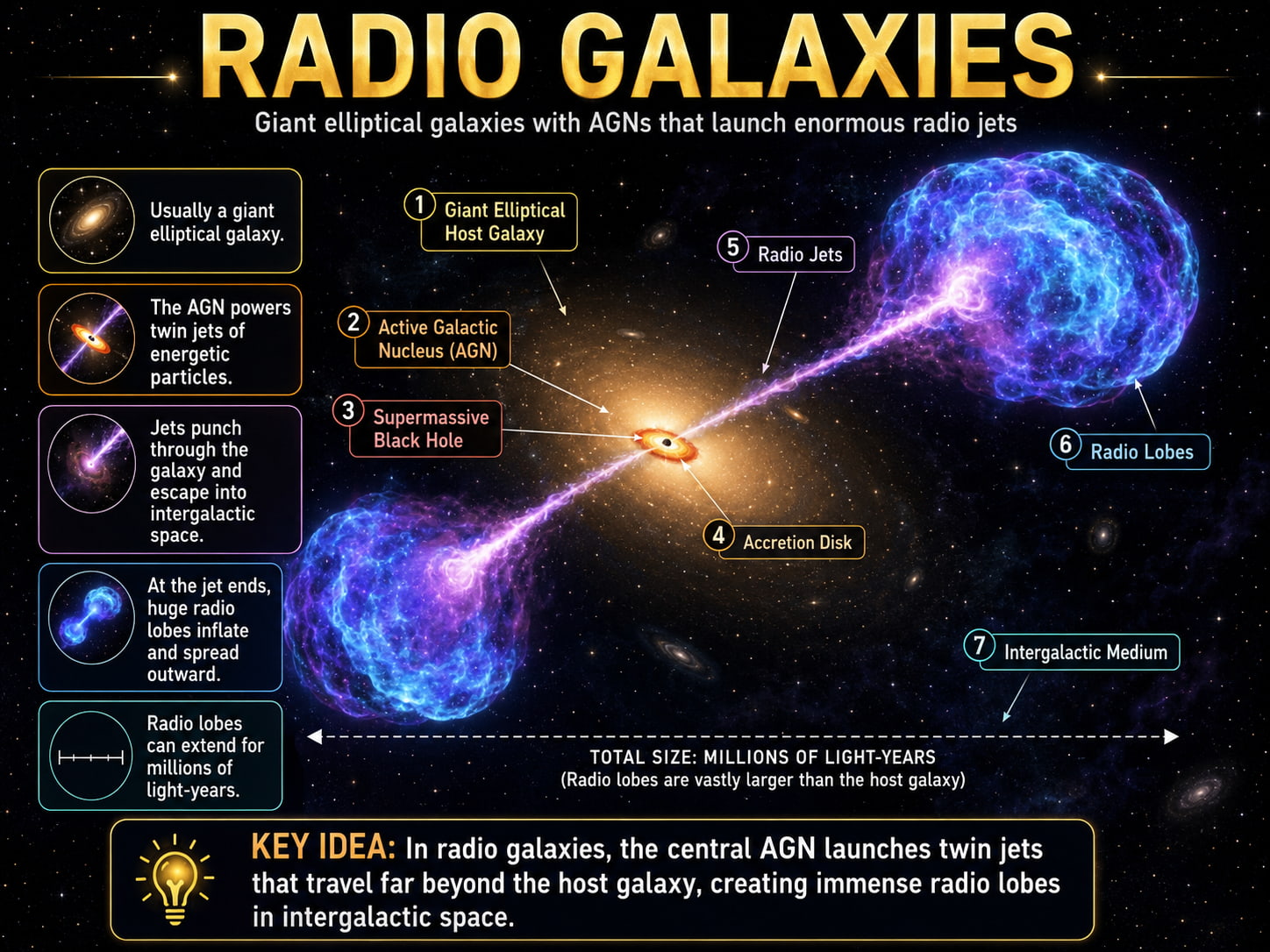
Radio lobes: Large cloud-like regions formed when jets spread energy into space around the galaxy.
16. Why Do AGNs Look Different?
According to the Unified Model, many AGNs have similar internal structure, but they look different because of our viewing angle.
Face-on View
We can see deeper into the centre. Broad lines may be visible.
Edge-on View
Dusty torus blocks the central region. Narrow lines dominate.
Jet Toward Earth
The object appears as a blazar because the jet is directed toward us.
17. Variability Argument: How Do We Know AGNs Are Compact?
Astronomers observed that some AGNs change brightness very quickly, sometimes in days or even hours.
An object cannot change its overall brightness faster than the time light takes to cross it. So, if brightness changes quickly, the source must be compact.
Example: If an AGN changes brightness in 12 hours, then the main emitting region cannot be larger than about 12 light-hours across.
18. AGN Feedback: How AGNs Affect Galaxies
AGN feedback means the effect of an active galactic nucleus on its host galaxy.
Powerful radiation, winds and jets from the AGN can heat gas or push it out of the galaxy. This can reduce or stop new star formation.
Easy Meaning: An AGN can act like a powerful central engine that changes the future growth of its galaxy.
19. Why AGNs are Important in Cosmology
Galaxy Evolution: AGNs help us understand how galaxies grow and change.
Black Hole Growth: They show how supermassive black holes gain mass by accretion.
Early Universe: Bright quasars can be seen from very far away, so they help us study the young universe.
Intergalactic Medium: Jets and radiation influence gas between galaxies.
High-Energy Astrophysics: AGNs are natural laboratories for extreme gravity, radiation and plasma physics.
Time Machine Idea: Since light from distant quasars takes billions of years to reach us, observing them is like looking into the past of the universe.
20. Common Confusions
Black Hole vs AGN
A black hole is the central object. AGN is the bright active region around it, powered by falling matter.
Galaxy vs Active Galaxy
Every galaxy has stars, but an active galaxy has an unusually bright central nucleus.
Quasar vs Blazar
A quasar is an extremely luminous distant AGN. A blazar is an AGN whose jet points almost directly toward Earth.
Radio Galaxy vs Normal Galaxy
A radio galaxy emits very strong radio waves due to powerful jets and radio lobes.
21. UPSC Relevance
Prelims: AGN, quasars, blazars, Seyfert galaxies, radio galaxies and supermassive black holes.
Science and Technology: Electromagnetic spectrum, telescopes, high-energy radiation and black hole physics.
Geography Link: Large-scale structure, cosmic hierarchy and spatial organization of matter.
Concept Building: Difference between normal galaxies and active galaxies.
Extra Concept: Dormant and Active Supermassive Black Holes
Many large galaxies have a supermassive black hole at their centre. But every supermassive black hole does not always produce an AGN.
If enough gas and dust are falling into the black hole, it becomes active and produces strong radiation. If very little matter is falling in, it remains mostly dormant or quiet.
Easy Meaning: A black hole becomes an AGN only when it is “feeding” on surrounding matter.
Quick Revision
AGN is an extremely bright active region at the centre of a galaxy.
It is powered by matter falling toward a supermassive black hole.
AGN energy comes mainly from gravity and friction, not ordinary stellar fusion.
Main AGN parts: black hole, accretion disk, broad-line region, dusty torus, narrow-line region and jets.
Quasars are extremely bright and distant AGNs.
Seyfert galaxies are nearby active galaxies with bright nuclei.
Blazars have jets pointing almost directly toward Earth.
Radio galaxies emit strong radio waves and may have huge radio lobes.
The Unified Model explains many AGN types through viewing angle.
Fast brightness variation tells us AGNs are very compact.
AGN feedback can affect star formation and galaxy evolution.
Think Like UPSC: Do not memorize AGN only as “bright galaxy centre.” Understand the full process: supermassive black hole pulls matter, accretion disk heats up, huge radiation and jets are produced, and this activity can influence the evolution of the whole galaxy.
सक्रिय आकाशगंगीय केंद्रक और अतिविशाल कृष्ण विवर/ब्लैक होल
कुछ आकाशगंगाओं के केंद्र अत्यंत चमकीले और ऊर्जावान होते हैं। इन चमकीले केंद्रों को सक्रिय आकाशगंगीय केंद्रक (Active Galactic Nuclei - AGN) कहा जाता है।
AGN को आकाशगंगा के केंद्र में स्थित अतिविशाल कृष्ण विवर/ब्लैक होल (Supermassive Black Hole) ऊर्जा देता है। जब गैस और धूल इस कृष्ण विवर की ओर गिरती है, तो बहुत बड़ी मात्रा में ऊर्जा निकलती है।
1. सक्रिय आकाशगंगीय केंद्रक क्या है?
सक्रिय आकाशगंगीय केंद्रक (Active Galactic Nucleus - AGN) आकाशगंगा के केंद्र में स्थित बहुत छोटा, लेकिन अत्यंत चमकीला क्षेत्र होता है।
इसे सक्रिय (Active) इसलिए कहा जाता है, क्योंकि यह बहुत बड़ी मात्रा में ऊर्जा छोड़ता है। यह ऊर्जा मुख्य रूप से तारों से नहीं आती। यह उस पदार्थ से आती है, जो केंद्रीय अतिविशाल कृष्ण विवर/ब्लैक होल की ओर गिरता है।
सरल अर्थ: सामान्य आकाशगंगा मुख्य रूप से अपने तारों के कारण चमकती है। लेकिन सक्रिय आकाशगंगा का केंद्र इसलिए बहुत अधिक चमकता है, क्योंकि उसका केंद्रीय कृष्ण विवर आसपास के पदार्थ को अपनी ओर खींच रहा होता है।
2. सामान्य आकाशगंगा बनाम सक्रिय आकाशगंगा
सामान्य आकाशगंगा (Normal Galaxy) में दिखाई देने वाला अधिकतर प्रकाश तारों से आता है। जबकि सक्रिय आकाशगंगा (Active Galaxy) में केंद्र इतना चमकीला हो सकता है कि वह पूरी आकाशगंगा की चमक को भी पीछे छोड़ दे।
सामान्य आकाशगंगा (Normal Galaxy)
इसका प्रकाश मुख्य रूप से आकाशगंगा में मौजूद अरबों तारों से आता है।
सक्रिय आकाशगंगा (Active Galaxy)
इसका केंद्रीय केंद्रक कृष्ण विवर की सक्रियता के कारण अत्यधिक गैर-तारकीय विकिरण (Non-stellar Radiation) छोड़ता है।
गैर-तारकीय विकिरण (Non-stellar Radiation): ऐसा विकिरण जो सामान्य तारों से मुख्य रूप से उत्पन्न नहीं होता। AGN में यह अधिकतर कृष्ण विवर के पास अत्यधिक गर्म पदार्थ से आता है।
3. AGN इतना शक्तिशाली क्यों होता है?
AGN की ऊर्जा तारों की तरह नाभिकीय संलयन (Nuclear Fusion) से नहीं आती। इसकी ऊर्जा मुख्य रूप से गुरुत्वाकर्षण (Gravity) और घर्षण (Friction) से आती है।
केंद्रीय अतिविशाल कृष्ण विवर गैस, धूल और कभी-कभी तारों को अपनी ओर खींचता है। जैसे-जैसे यह पदार्थ अंदर की ओर गिरता है, यह एक तेज़ी से घूमने वाली गर्म चकती बनाता है, जिसे अभिवृद्धि चक्र/अभिवृद्धि डिस्क (Accretion Disk) कहा जाता है।
अभिवृद्धि चक्र में मौजूद पदार्थ अत्यधिक गर्म हो जाता है। यह पराबैंगनी प्रकाश (Ultraviolet Light) और एक्स-किरणों (X-rays) में बहुत तेज़ चमक सकता है।
4. महत्वपूर्ण तकनीकी शब्द सरल भाषा में
केंद्रक (Nucleus)
आकाशगंगा का केंद्रीय क्षेत्र। AGN में यही क्षेत्र अत्यंत चमकीला होता है।
अतिविशाल कृष्ण विवर/ब्लैक होल (Supermassive Black Hole)
ऐसा कृष्ण विवर जिसका द्रव्यमान सूर्य के द्रव्यमान से लाखों से अरबों गुना अधिक हो। यह सामान्यतः बड़ी आकाशगंगाओं के केंद्र में पाया जाता है।
अभिवृद्धि (Accretion)
वह प्रक्रिया जिसमें पदार्थ धीरे-धीरे किसी बहुत भारी पिंड, जैसे कृष्ण विवर, की ओर गिरता है।
अभिवृद्धि चक्र/डिस्क (Accretion Disk)
कृष्ण विवर के चारों ओर घूमती हुई गर्म गैस और धूल की चपटी चकती। यह पदार्थ अंदर की ओर सर्पिल/घुमावदार मार्ग से बढ़ता है।
कोणीय संवेग (Angular Momentum)
घूमती हुई वस्तु की घूमते रहने की प्रवृत्ति। इसी कारण गिरती हुई गैस सीधे अंदर न गिरकर चकती बना लेती है।
घर्षण (Friction)
जब तेज़ गति से चल रहे गैस-कण आपस में रगड़ खाते और टकराते हैं, तो वे गर्म होते हैं और विकिरण छोड़ते हैं।
5. AGN विद्युतचुंबकीय वर्णक्रम में ऊर्जा छोड़ता है
AGN लगभग पूरे विद्युतचुंबकीय वर्णक्रम (Electromagnetic Spectrum) में ऊर्जा छोड़ते हैं।
विद्युतचुंबकीय वर्णक्रम का अर्थ है विकिरणों की पूरी श्रृंखला — कम ऊर्जा वाली रेडियो तरंगों से लेकर उच्च ऊर्जा वाली गामा किरणों तक।
सरल अर्थ: AGN केवल दिखाई देने वाले प्रकाश में नहीं चमकता। यह विकिरण के कई रूपों में संकेत भेजता है, इसलिए इसे समझने के लिए अलग-अलग प्रकार की दूरबीनों का उपयोग किया जाता है।
6. आकार बनाम शक्ति: बहुत छोटा, लेकिन अत्यंत चमकीला
AGN के बारे में एक आश्चर्यजनक बात यह है कि इसका ऊर्जा स्रोत बहुत छोटा और सघन होता है, लेकिन इसका ऊर्जा-उत्सर्जन बहुत विशाल होता है।
कुछ मामलों में केंद्रीय सक्रिय क्षेत्र हमारे सौरमंडल के आकार के बराबर हो सकता है, फिर भी वह पूरी आकाशगंगा से अधिक चमक सकता है।
7. ऊर्जा परिवर्तन: अभिवृद्धि इतनी प्रभावी क्यों होती है?
तारों में ऊर्जा नाभिकीय संलयन (Nuclear Fusion) से आती है। AGN में ऊर्जा मुख्य रूप से उस पदार्थ से आती है, जो कृष्ण विवर की ओर गिरते समय अपनी गुरुत्वीय ऊर्जा खोता है।
यह अभिवृद्धि प्रक्रिया गिरते हुए पदार्थ के बड़े हिस्से को ऊर्जा में बदल सकती है। इसी कारण AGN सामान्य तारकीय विकिरण की तुलना में कहीं अधिक शक्तिशाली हो सकता है।
E = mc² सरल शब्दों में: पदार्थ और ऊर्जा आपस में जुड़े हैं। कृष्ण विवर के पास अत्यधिक परिस्थितियों में पदार्थ की द्रव्यमान-ऊर्जा का कुछ हिस्सा विकिरण के रूप में दिखाई दे सकता है।
8. AGN की संरचना: एकीकृत मॉडल
एकीकृत मॉडल (Unified Model) के अनुसार AGN के कई प्रकारों की मूल संरचना समान होती है। वे हमें अलग-अलग इसलिए दिखाई देते हैं, क्योंकि हम उन्हें अलग-अलग कोणों से देखते हैं।
यह विचार हमें समझने में मदद करता है कि क्वासर, सेफर्ट आकाशगंगाएँ, ब्लेज़र और रेडियो आकाशगंगाएँ अलग क्यों दिखती हैं, जबकि उनका केंद्रीय इंजन समान हो सकता है।
9. AGN के मुख्य भाग
1. अतिविशाल कृष्ण विवर/ब्लैक होल
यह केंद्रीय गुरुत्वीय इंजन होता है। यह अत्यधिक गुरुत्वाकर्षण के कारण पदार्थ को अंदर की ओर खींचता है।
2. अभिवृद्धि चक्र/डिस्क (Accretion Disk)
गैस और धूल की गर्म घूमती हुई चकती। जैसे-जैसे पदार्थ गर्म होता है, यह तीव्र विकिरण छोड़ता है।
3. चौड़ी-रेखा क्षेत्र (Broad-Line Region)
कृष्ण विवर के पास स्थित तेज़ गति से चलने वाले गैस बादल। गैस की तेज़ गति के कारण उनकी वर्णक्रमीय रेखाएँ चौड़ी दिखाई देती हैं।
4. धूलयुक्त वलय/टोरस (Dusty Torus)
केंद्रीय क्षेत्र के चारों ओर धूल और गैस का मोटा डोनट-आकार का वलय। कुछ कोणों से यह हमारे दृश्य को रोक सकता है।
5. संकीर्ण-रेखा क्षेत्र (Narrow-Line Region)
कृष्ण विवर से अपेक्षाकृत दूर स्थित गैस बादल। ये धीरे चलते हैं, इसलिए उनकी वर्णक्रमीय रेखाएँ पतली दिखाई देती हैं।
6. सापेक्षिक जेट्स (Relativistic Jets)
कुछ AGN से निकलने वाली उच्च-ऊर्जा कणों की संकरी धाराएँ, जो प्रकाश की गति के बहुत निकट गति करती हैं।
10. वर्णक्रमीय रेखाएँ: चौड़ी और संकीर्ण रेखाएँ
खगोलविद AGN का अध्ययन वर्णक्रम (Spectrum) की सहायता से करते हैं। वर्णक्रम प्रकाश के बारकोड जैसा होता है। यह बताता है कि कौन-से तत्व मौजूद हैं और गैस कितनी तेज़ गति से चल रही है।
चौड़ी रेखाएँ (Broad Lines)
ये कृष्ण विवर के पास तेज़ गति से चलने वाली गैस से बनती हैं। तेज़ गति के कारण रेखाएँ फैलकर चौड़ी दिखती हैं।
संकीर्ण रेखाएँ (Narrow Lines)
ये कृष्ण विवर से दूर धीमी गति से चलने वाली गैस से बनती हैं। इसलिए रेखाएँ पतली या संकीर्ण रहती हैं।
डॉप्लर खिसकाव (Doppler Shift): जब गैस हमारी ओर आती है या हमसे दूर जाती है, तो प्रकाश की तरंगदैर्ध्य बदल जाती है। इससे AGN के पास गैस की गति मापने में मदद मिलती है।
11. AGN के प्रकार
AGN को उनकी चमक, दूरी, जेट्स और देखने के कोण के आधार पर अलग-अलग प्रकारों में बाँटा जाता है।
12. क्वासर: अत्यंत चमकीले और दूर स्थित AGN
क्वासर (Quasar) का अर्थ है तारे जैसा दिखने वाला रेडियो स्रोत (Quasi-Stellar Radio Source)। शुरुआती खगोलविदों ने यह नाम इसलिए दिया, क्योंकि दूरबीन से क्वासर तारों जैसे दिखते थे, लेकिन वे वास्तव में बहुत दूर स्थित सक्रिय आकाशगंगाएँ थे।
ये सबसे चमकीले AGN में शामिल होते हैं।
ये सामान्यतः बहुत दूर स्थित होते हैं।
इनकी चमक इनके आसपास की मूल आकाशगंगा को भी छिपा सकती है।
ये प्रारंभिक ब्रह्मांड का अध्ययन करने में मदद करते हैं।
सरल अर्थ: क्वासर दूरस्थ ब्रह्मांड में स्थित अत्यंत चमकीले प्रकाश-स्तंभ जैसा होता है।
13. सेफर्ट आकाशगंगाएँ: निकट स्थित सक्रिय आकाशगंगाएँ
सेफर्ट आकाशगंगाएँ (Seyfert Galaxies) सक्रिय आकाशगंगाएँ होती हैं, जो सामान्यतः क्वासर की तुलना में अधिक निकट और कम चमकीली होती हैं।
इनके चमकीले केंद्रक में मजबूत उत्सर्जन रेखाएँ (Emission Lines) दिखाई देती हैं, जिसका अर्थ है कि केंद्र के पास गैस तेज़ी से चल रही है और बहुत चमक रही है।
Type 1 Seyfert
इसे अधिक सामने से देखा जाता है। इसमें चौड़ी और संकीर्ण दोनों उत्सर्जन रेखाएँ दिखाई दे सकती हैं।
Type 2 Seyfert
इसे अधिक किनारे से देखा जाता है। धूलयुक्त टोरस अंदरूनी क्षेत्र को ढक देता है, इसलिए मुख्य रूप से संकीर्ण रेखाएँ दिखाई देती हैं।
14. ब्लेज़र: पृथ्वी की ओर मुड़े हुए AGN जेट्स
ब्लेज़र (Blazar) ऐसा AGN होता है, जिसका शक्तिशाली जेट लगभग सीधे पृथ्वी की ओर निर्देशित होता है।
क्योंकि जेट हमारी ओर होता है, उसका विकिरण अत्यंत शक्तिशाली और बदलता हुआ दिखाई देता है।
सापेक्षिक तीव्रता-वृद्धि (Relativistic Beaming): जब कोई जेट प्रकाश की गति के पास हमारी ओर आता है, तो उसका विकिरण हमें बहुत अधिक बढ़ा हुआ दिखाई देता है।
15. रेडियो आकाशगंगाएँ: विशाल रेडियो जेट्स वाली AGN
रेडियो आकाशगंगाएँ (Radio Galaxies) ऐसी सक्रिय आकाशगंगाएँ होती हैं, जो बहुत शक्तिशाली रेडियो तरंगें छोड़ती हैं।
इनमें अक्सर शक्तिशाली जेट्स होते हैं, जो केंद्रीय कृष्ण विवर से बाहर की ओर निकलते हैं और बहुत बड़े रेडियो-उत्सर्जक क्षेत्र बनाते हैं, जिन्हें रेडियो लोब (Radio Lobes) कहा जाता है।
रेडियो लोब (Radio Lobes): ये बड़े बादल जैसे क्षेत्र होते हैं, जो तब बनते हैं जब जेट्स आकाशगंगा के आसपास अंतरिक्ष में ऊर्जा फैलाते हैं।
16. AGN अलग-अलग क्यों दिखाई देते हैं?
एकीकृत मॉडल (Unified Model) के अनुसार कई AGN की आंतरिक संरचना समान होती है, लेकिन वे हमारे देखने के कोण के कारण अलग-अलग दिखाई देते हैं।
सामने से दृश्य (Face-on View)
इसमें हम केंद्र के अंदरूनी भाग को अधिक गहराई से देख सकते हैं। चौड़ी रेखाएँ दिखाई दे सकती हैं।
किनारे से दृश्य (Edge-on View)
धूलयुक्त टोरस केंद्रीय क्षेत्र को ढक देता है। इसलिए संकीर्ण रेखाएँ अधिक दिखाई देती हैं।
पृथ्वी की ओर जेट
जब जेट हमारी ओर निर्देशित होता है, तो वस्तु ब्लेज़र के रूप में दिखाई देती है।
17. चमक में बदलाव से प्रमाण: हमें कैसे पता चलता है कि AGN सघन हैं?
खगोलविदों ने देखा कि कुछ AGN की चमक बहुत तेज़ी से बदलती है — कभी-कभी कुछ दिनों या कुछ घंटों में।
कोई भी वस्तु अपनी पूरी चमक उस समय से तेज़ नहीं बदल सकती, जितना समय प्रकाश को उसे पार करने में लगता है। इसलिए यदि चमक जल्दी बदलती है, तो स्रोत छोटा और सघन होना चाहिए।
उदाहरण: यदि कोई AGN 12 घंटों में अपनी चमक बदलता है, तो उसका मुख्य प्रकाश-उत्सर्जक क्षेत्र लगभग 12 प्रकाश-घंटे से बड़ा नहीं हो सकता।
18. AGN Feedback: AGN आकाशगंगाओं को कैसे प्रभावित करते हैं?
AGN Feedback का अर्थ है — सक्रिय आकाशगंगीय केंद्रक का अपनी मूल आकाशगंगा पर प्रभाव।
AGN से निकलने वाला शक्तिशाली विकिरण, हवाएँ और जेट्स गैस को गर्म कर सकते हैं या उसे आकाशगंगा से बाहर धकेल सकते हैं। इससे नए तारों का निर्माण धीमा हो सकता है या रुक सकता है।
सरल अर्थ: AGN एक शक्तिशाली केंद्रीय इंजन की तरह काम कर सकता है, जो अपनी आकाशगंगा के भविष्य के विकास को बदल सकता है।
19. ब्रह्मांड विज्ञान में AGN क्यों महत्वपूर्ण हैं?
आकाशगंगा-विकास (Galaxy Evolution): AGN हमें यह समझने में मदद करते हैं कि आकाशगंगाएँ कैसे बढ़ती और बदलती हैं।
कृष्ण विवर की वृद्धि (Black Hole Growth): ये दिखाते हैं कि अतिविशाल कृष्ण विवर अभिवृद्धि द्वारा द्रव्यमान कैसे प्राप्त करते हैं।
प्रारंभिक ब्रह्मांड (Early Universe): चमकीले क्वासर बहुत दूर से भी दिखाई देते हैं, इसलिए वे युवा ब्रह्मांड के अध्ययन में मदद करते हैं।
अंतर-आकाशगंगीय माध्यम (Intergalactic Medium): जेट्स और विकिरण आकाशगंगाओं के बीच मौजूद गैस को प्रभावित करते हैं।
उच्च-ऊर्जा खगोलभौतिकी (High-Energy Astrophysics): AGN अत्यधिक गुरुत्वाकर्षण, विकिरण और प्लाज़्मा भौतिकी के प्राकृतिक प्रयोगशाला जैसे हैं।
टाइम मशीन जैसा विचार: दूर स्थित क्वासर का प्रकाश हम तक पहुँचने में अरबों वर्ष लेता है। इसलिए उन्हें देखना ब्रह्मांड के अतीत को देखने जैसा है।
20. सामान्य भ्रम
कृष्ण विवर बनाम AGN
कृष्ण विवर केंद्रीय पिंड है। AGN उसके आसपास का चमकीला सक्रिय क्षेत्र है, जिसे गिरता हुआ पदार्थ ऊर्जा देता है।
आकाशगंगा बनाम सक्रिय आकाशगंगा
हर आकाशगंगा में तारे होते हैं, लेकिन सक्रिय आकाशगंगा में असामान्य रूप से चमकीला केंद्रीय केंद्रक होता है।
क्वासर बनाम ब्लेज़र
क्वासर अत्यंत चमकीला और दूर स्थित AGN होता है। ब्लेज़र ऐसा AGN है, जिसका जेट लगभग सीधे पृथ्वी की ओर होता है।
रेडियो आकाशगंगा बनाम सामान्य आकाशगंगा
रेडियो आकाशगंगा शक्तिशाली जेट्स और रेडियो लोब के कारण बहुत मजबूत रेडियो तरंगें छोड़ती है।
21. UPSC के लिए उपयोगिता
Prelims: AGN, क्वासर, ब्लेज़र, सेफर्ट आकाशगंगाएँ, रेडियो आकाशगंगाएँ और अतिविशाल कृष्ण विवर।
Science and Technology: विद्युतचुंबकीय वर्णक्रम, दूरबीनें, उच्च-ऊर्जा विकिरण और कृष्ण विवर भौतिकी।
Geography Link: बड़े पैमाने की संरचना, ब्रह्मांडीय पदानुक्रम और पदार्थ का स्थानिक संगठन।
Concept Building: सामान्य आकाशगंगा और सक्रिय आकाशगंगा के बीच अंतर।
अतिरिक्त अवधारणा: निष्क्रिय और सक्रिय अतिविशाल ब्लैक होल
कई बड़ी आकाशगंगाओं के केंद्र में एक अतिविशाल ब्लैक होल यानी supermassive black hole होता है। लेकिन हर अतिविशाल ब्लैक होल हमेशा AGN यानी सक्रिय आकाशगंगीय नाभिक नहीं बनाता।
यदि पर्याप्त गैस और धूल ब्लैक होल में गिर रही हो, तो वह सक्रिय यानी active हो जाता है और शक्तिशाली विकिरण यानी radiation उत्पन्न करता है। यदि बहुत कम पदार्थ उसमें गिर रहा हो, तो वह अधिकतर निष्क्रिय यानी dormant या शांत रहता है।
आसान अर्थ: कोई ब्लैक होल AGN तभी बनता है, जब वह अपने आसपास के पदार्थ को “निगल” रहा होता है।
त्वरित पुनरावृत्ति
AGN आकाशगंगा के केंद्र में स्थित अत्यंत चमकीला सक्रिय क्षेत्र होता है।
इसे अतिविशाल कृष्ण विवर/ब्लैक होल की ओर गिरता हुआ पदार्थ ऊर्जा देता है।
AGN की ऊर्जा मुख्य रूप से गुरुत्वाकर्षण और घर्षण से आती है, सामान्य तारकीय संलयन से नहीं।
AGN के मुख्य भाग हैं — कृष्ण विवर, अभिवृद्धि चक्र, चौड़ी-रेखा क्षेत्र, धूलयुक्त टोरस, संकीर्ण-रेखा क्षेत्र और जेट्स।
क्वासर अत्यंत चमकीले और दूर स्थित AGN होते हैं।
सेफर्ट आकाशगंगाएँ निकट स्थित सक्रिय आकाशगंगाएँ होती हैं, जिनके केंद्र चमकीले होते हैं।
ब्लेज़र ऐसे AGN होते हैं, जिनके जेट लगभग सीधे पृथ्वी की ओर होते हैं।
रेडियो आकाशगंगाएँ मजबूत रेडियो तरंगें छोड़ती हैं और उनके विशाल रेडियो लोब हो सकते हैं।
एकीकृत मॉडल AGN के कई प्रकारों को देखने के कोण के आधार पर समझाता है।
चमक में तेज़ बदलाव बताता है कि AGN बहुत सघन होते हैं।
AGN Feedback तारा-निर्माण और आकाशगंगा-विकास को प्रभावित कर सकता है।
Think Like UPSC: AGN को केवल “चमकीला आकाशगंगीय केंद्र” के रूप में याद न करें। पूरी प्रक्रिया समझें: अतिविशाल कृष्ण विवर पदार्थ को खींचता है, अभिवृद्धि चक्र गर्म होता है, भारी विकिरण और जेट्स निकलते हैं, और यह सक्रियता पूरी आकाशगंगा के विकास को प्रभावित कर सकती है।