Cosmic Web, Galaxy Clusters and Superclusters
The universe is not a random collection of galaxies. Galaxies are arranged in a large pattern made of groups, clusters, superclusters, filaments and voids.
This largest pattern of the universe is called the Cosmic Web. In simple words, the Cosmic Web is the “large-scale map” of the universe.
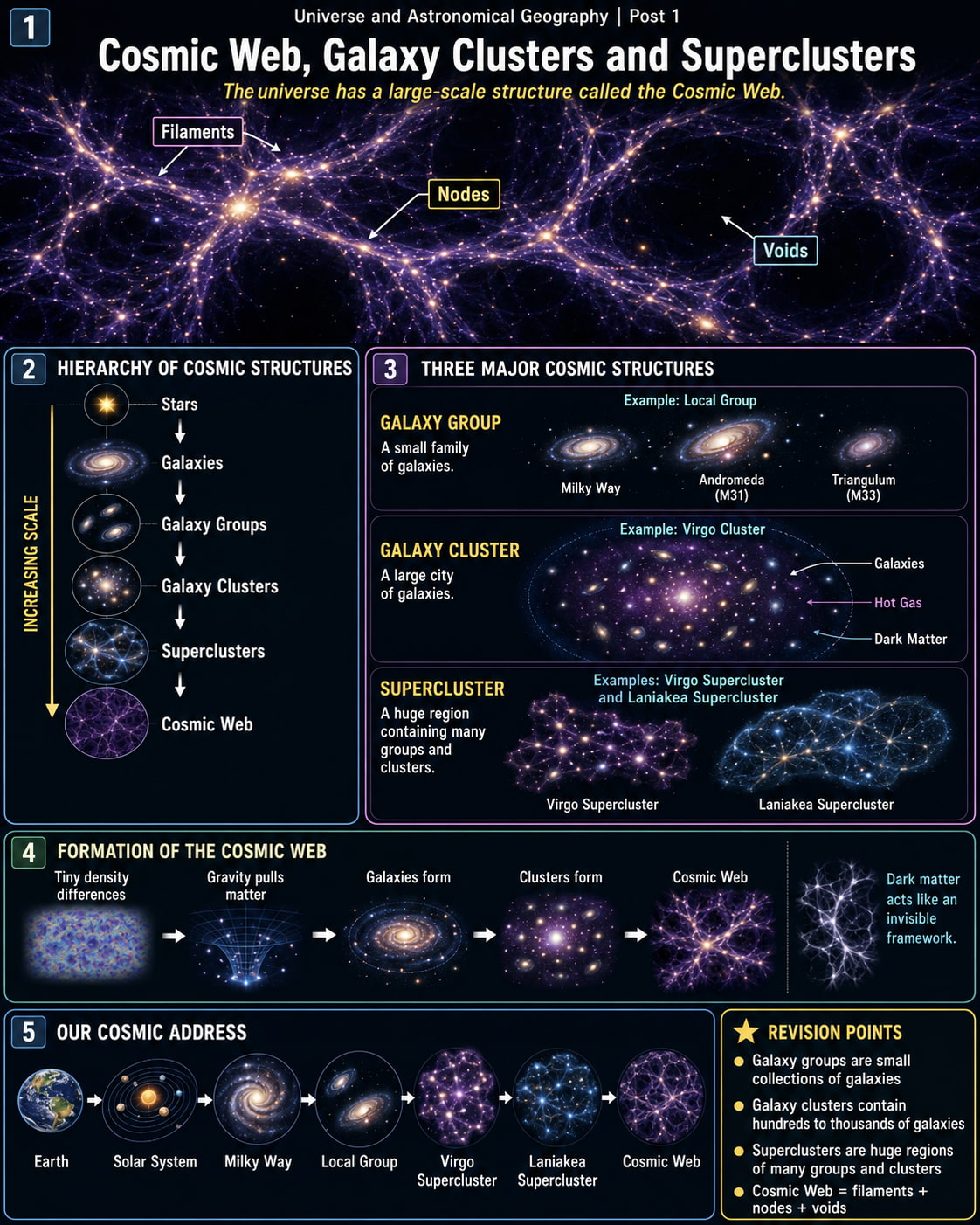
1. Big Idea: Universe Has a Structure
When we look at the universe on a very large scale, we find that galaxies are not equally spread everywhere.
Some regions have many galaxies close together, while some regions are almost empty. This happens mainly because of gravity and dark matter.
Easy Meaning: Just as cities, roads and empty fields make a pattern on Earth, galaxies, clusters, filaments and voids make a pattern in the universe.
2. What is a Cosmic Structure?
A cosmic structure means a large arrangement of matter in the universe.
These structures may contain galaxies, gas, dust, dark matter and hot plasma. They are held together mainly by gravity.
Small Scale
Stars gather to form galaxies.
Medium Scale
Galaxies gather to form groups and clusters.
Largest Scale
Clusters connect through filaments and form the Cosmic Web.
3. Hierarchy of Cosmic Structures
The universe has a simple hierarchy. Small structures combine to form bigger structures.
This hierarchy helps us understand the place of the Milky Way in the larger universe.
4. Galaxy Groups: Small Families of Galaxies
A galaxy group is a small collection of galaxies held together by gravity.
It usually contains a few to a few dozen galaxies. These galaxies move around a common gravitational centre.
Example: Local Group
Our Milky Way galaxy belongs to the Local Group. It includes the Milky Way, Andromeda Galaxy, Triangulum Galaxy and many smaller dwarf galaxies.
Easy Meaning: A galaxy group is like a small neighbourhood of galaxies.
5. Galaxy Clusters: Large Cities of Galaxies
A galaxy cluster is a much larger collection of galaxies. It may contain hundreds to thousands of galaxies.
A galaxy cluster is not just made of galaxies. It also contains large amounts of hot gas and dark matter.
Galaxies
Visible members of the cluster, each containing billions of stars.
Hot Gas
Extremely hot gas between galaxies, often detected through X-rays.
Dark Matter
Invisible matter that provides most of the gravitational mass of the cluster.
Example: Virgo Cluster
The Virgo Cluster is a nearby large galaxy cluster. It is important because our Local Group lies in the larger region influenced by the Virgo Supercluster.
Easy Meaning: If a galaxy group is a small neighbourhood, a galaxy cluster is like a large city of galaxies.
6. Superclusters: Huge Regions of Many Clusters
A supercluster is a very large region containing many galaxy groups and galaxy clusters.
Superclusters are among the largest known arrangements of matter in the universe. However, they are not always tightly bound like smaller clusters.
Virgo Supercluster
A large region that includes the Local Group and the Virgo Cluster.
Laniakea Supercluster
A much larger cosmic region that includes the Virgo Supercluster and many nearby galaxy systems.
Easy Meaning: A supercluster is like a huge state or province containing many cities of galaxies.
7. Cosmic Web: The Largest Pattern of the Universe
The Cosmic Web is the largest known structure-like pattern of the universe.
In this web, galaxies and galaxy clusters are arranged along long thread-like structures called filaments. Between these filaments are huge nearly empty spaces called voids.
Filaments
Long thread-like chains of galaxies and clusters.
Nodes
Dense meeting points where many filaments connect.
Voids
Very large empty-looking regions with very few galaxies.
8. How Did the Cosmic Web Form?
The Cosmic Web formed slowly after the early universe. In the beginning, matter was not perfectly uniform. Some places had slightly more matter than others.
Gravity pulled more matter into these denser regions. Over billions of years, small density differences grew into galaxies, galaxy groups, clusters, superclusters and filaments.
Very Simple Example: If dust on a floor is pulled into lines and piles by wind, it no longer remains equally spread. Similarly, gravity pulled matter into cosmic lines, knots and empty regions.
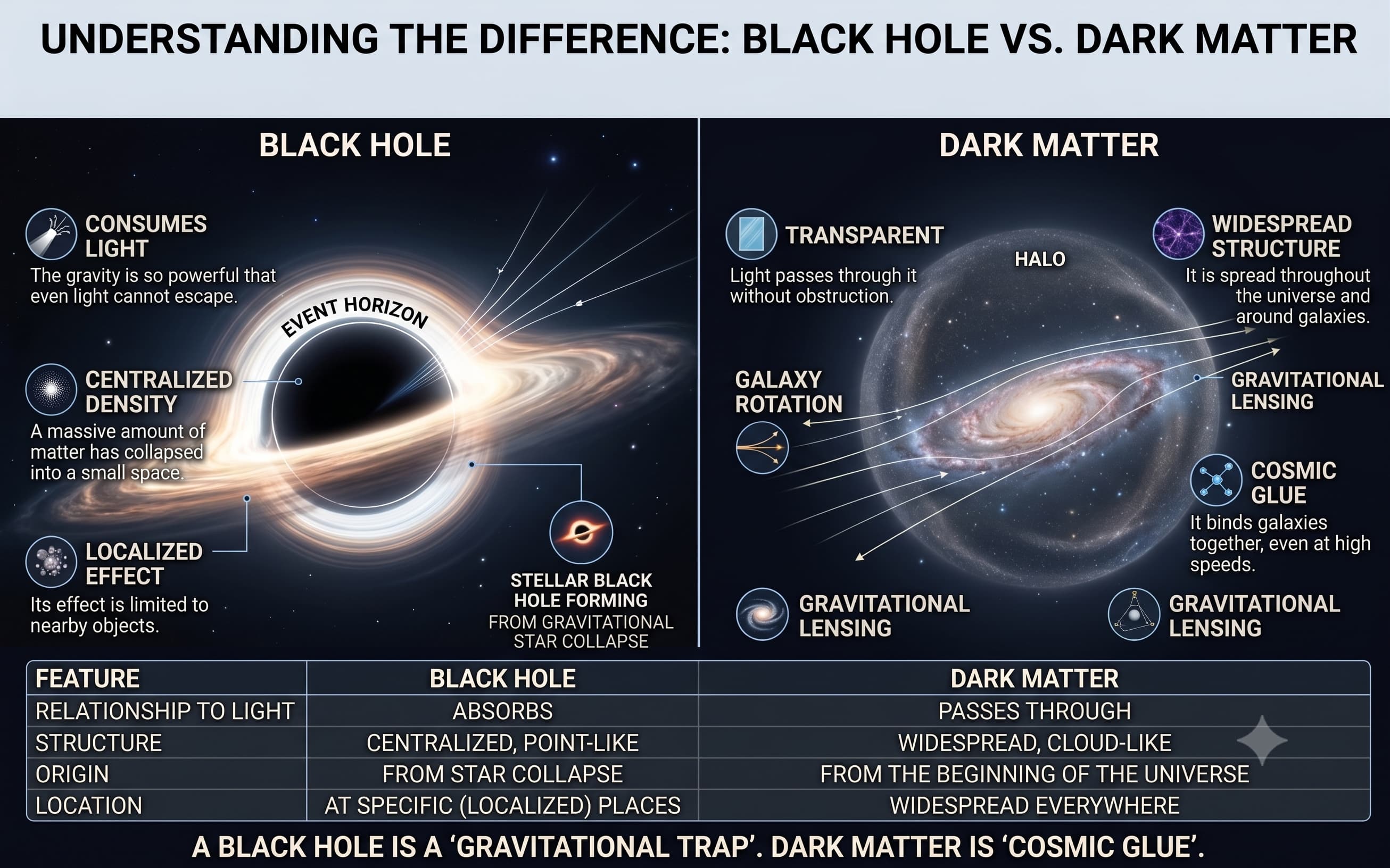
9. Role of Dark Matter in Cosmic Structures
Dark matter is invisible matter. We cannot see it directly, but we can understand its presence from its gravitational effect.
Dark matter acted like an invisible skeleton of the universe. Normal matter gathered around this invisible skeleton and later formed galaxies and clusters.
Without dark matter, it would be difficult to explain how large cosmic structures formed so efficiently.
10. Our Address in the Universe
To understand cosmic structures, it is helpful to know our cosmic address.
This shows that Earth is not isolated. It is part of a very large cosmic hierarchy.
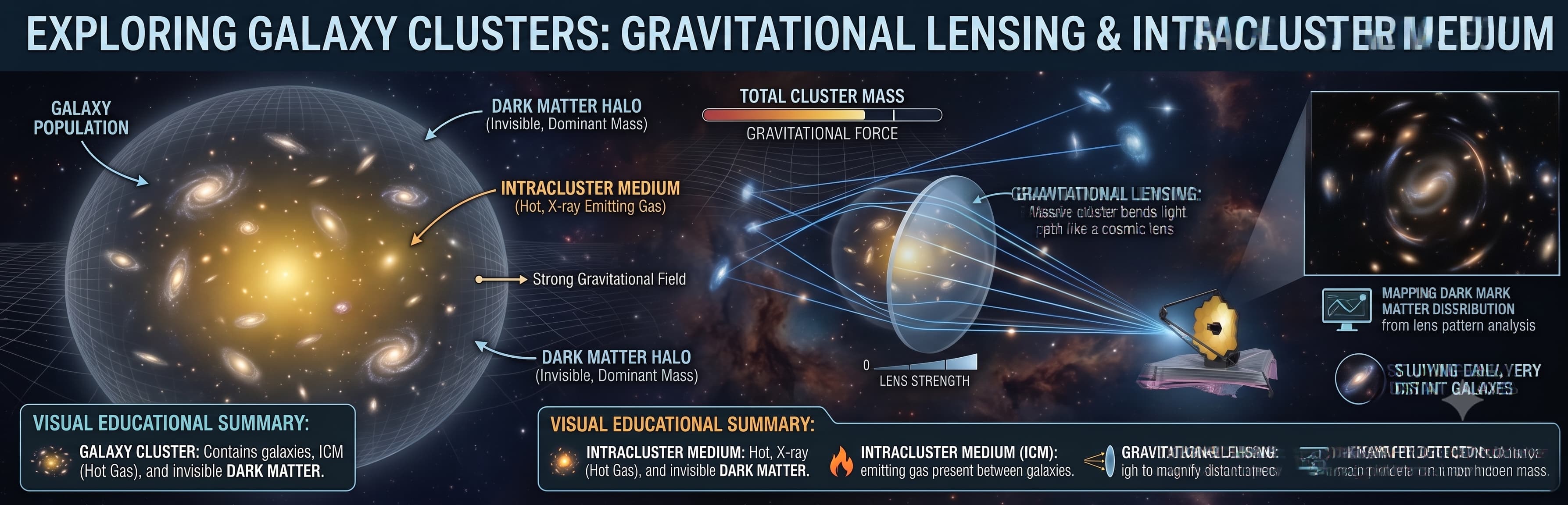
Extra Concept: Gravitational Lensing and Intracluster Medium
Galaxy clusters contain not only galaxies, but also hot gas and dark matter. The hot gas present between galaxies in a cluster is called the intracluster medium.
The gravity of a massive galaxy cluster can bend the light coming from distant galaxies behind it. This bending of light is called gravitational lensing.
Easy Meaning: A galaxy cluster can act like a natural cosmic lens. This helps scientists detect dark matter and study very distant galaxies.
11. Why This Topic is Important for Geography
Geography studies space, location, scale and distribution. Cosmic structures help us understand the largest scale of spatial organization.
It explains how matter is distributed in the universe.
It connects astronomy with the geographical idea of scale.
It helps students understand our position in the universe.
It gives background for galaxies, Milky Way and active galactic nuclei.
Quick Revision
Cosmic structures are large arrangements of matter in the universe.
Galaxy groups are small collections of galaxies.
Galaxy clusters contain hundreds to thousands of galaxies, hot gas and dark matter.
Superclusters are huge regions containing many groups and clusters.
Cosmic Web is the largest pattern of the universe, made of filaments, nodes and voids.
Dark matter provides the invisible gravitational framework for cosmic structures.
Our cosmic address: Earth → Solar System → Milky Way → Local Group → Supercluster → Cosmic Web.
Think Like UPSC: Do not memorize cosmic structures as isolated names. Understand the hierarchy: small objects combine into larger structures, and gravity with dark matter shapes the large-scale universe.
कॉस्मिक वेब, आकाशगंगा क्लस्टर और सुपरक्लस्टर
ब्रह्मांड आकाशगंगाओं का कोई बेतरतीब संग्रह नहीं है। आकाशगंगाएँ एक बड़े पैटर्न में व्यवस्थित होती हैं, जो समूहों, क्लस्टरों, सुपरक्लस्टरों, फिलामेंट्स और voids से बना होता है।
ब्रह्मांड के इस सबसे बड़े पैटर्न को कॉस्मिक वेब कहा जाता है। सरल शब्दों में, कॉस्मिक वेब ब्रह्मांड का “large-scale map” है।
1. मुख्य विचार: ब्रह्मांड की अपनी संरचना होती है
जब हम ब्रह्मांड को बहुत बड़े पैमाने पर देखते हैं, तो हमें पता चलता है कि आकाशगंगाएँ हर जगह समान रूप से फैली हुई नहीं हैं।
कुछ क्षेत्रों में बहुत सारी आकाशगंगाएँ पास-पास होती हैं, जबकि कुछ क्षेत्र लगभग खाली होते हैं। ऐसा मुख्य रूप से गुरुत्वाकर्षण और डार्क मैटर के कारण होता है।
सरल अर्थ: जैसे पृथ्वी पर शहर, सड़कें और खाली मैदान मिलकर एक पैटर्न बनाते हैं, वैसे ही ब्रह्मांड में आकाशगंगाएँ, क्लस्टर, फिलामेंट्स और voids मिलकर एक पैटर्न बनाते हैं।
2. कॉस्मिक संरचना क्या होती है?
कॉस्मिक संरचना का अर्थ है ब्रह्मांड में पदार्थ की बहुत बड़ी व्यवस्था।
इन संरचनाओं में आकाशगंगाएँ, गैस, धूल, डार्क मैटर और गर्म प्लाज्मा हो सकते हैं। ये मुख्य रूप से गुरुत्वाकर्षण के कारण एक साथ बंधे रहते हैं।
छोटा पैमाना
तारे मिलकर आकाशगंगाएँ बनाते हैं।
मध्यम पैमाना
आकाशगंगाएँ मिलकर समूह और क्लस्टर बनाती हैं।
सबसे बड़ा पैमाना
क्लस्टर फिलामेंट्स के माध्यम से जुड़ते हैं और कॉस्मिक वेब बनाते हैं।
3. कॉस्मिक संरचनाओं का पदानुक्रम
ब्रह्मांड में एक सरल पदानुक्रम होता है। छोटी संरचनाएँ मिलकर बड़ी संरचनाएँ बनाती हैं।
यह पदानुक्रम हमें बड़े ब्रह्मांड में Milky Way की स्थिति समझने में मदद करता है।
4. आकाशगंगा समूह: आकाशगंगाओं के छोटे परिवार
आकाशगंगा समूह आकाशगंगाओं का एक छोटा संग्रह होता है, जो गुरुत्वाकर्षण के कारण एक साथ बंधा रहता है।
इसमें सामान्यतः कुछ से लेकर कुछ दर्जन आकाशगंगाएँ होती हैं। ये आकाशगंगाएँ एक साझा गुरुत्वीय केंद्र के चारों ओर गति करती हैं।
उदाहरण: Local Group
हमारी Milky Way आकाशगंगा Local Group का हिस्सा है। इसमें Milky Way, Andromeda Galaxy, Triangulum Galaxy और कई छोटी dwarf galaxies शामिल हैं।
सरल अर्थ: आकाशगंगा समूह आकाशगंगाओं के छोटे मोहल्ले जैसा होता है।
5. आकाशगंगा क्लस्टर: आकाशगंगाओं के बड़े शहर
आकाशगंगा क्लस्टर आकाशगंगाओं का बहुत बड़ा संग्रह होता है। इसमें सैकड़ों से लेकर हजारों आकाशगंगाएँ हो सकती हैं।
आकाशगंगा क्लस्टर केवल आकाशगंगाओं से नहीं बना होता। इसमें बड़ी मात्रा में गर्म गैस और डार्क मैटर भी होता है।
आकाशगंगाएँ
क्लस्टर की दिखाई देने वाली सदस्य, जिनमें प्रत्येक में अरबों तारे होते हैं।
गर्म गैस
आकाशगंगाओं के बीच मौजूद अत्यधिक गर्म गैस, जिसे अक्सर X-rays के माध्यम से पहचाना जाता है।
डार्क मैटर
अदृश्य पदार्थ, जो क्लस्टर के अधिकांश गुरुत्वीय द्रव्यमान को प्रदान करता है।
उदाहरण: Virgo Cluster
Virgo Cluster पास का एक बड़ा आकाशगंगा क्लस्टर है। यह इसलिए महत्वपूर्ण है क्योंकि हमारा Local Group, Virgo Supercluster से प्रभावित बड़े क्षेत्र में स्थित है।
सरल अर्थ: अगर आकाशगंगा समूह एक छोटा मोहल्ला है, तो आकाशगंगा क्लस्टर आकाशगंगाओं का बड़ा शहर है।
6. सुपरक्लस्टर: कई क्लस्टरों के विशाल क्षेत्र
सुपरक्लस्टर एक बहुत बड़ा क्षेत्र होता है, जिसमें कई आकाशगंगा समूह और आकाशगंगा क्लस्टर शामिल होते हैं।
सुपरक्लस्टर ब्रह्मांड में पदार्थ की सबसे बड़ी ज्ञात व्यवस्थाओं में से हैं। हालांकि, वे छोटे क्लस्टरों की तरह हमेशा कसकर बंधे हुए नहीं होते।
Virgo Supercluster
एक बड़ा क्षेत्र, जिसमें Local Group और Virgo Cluster शामिल हैं।
Laniakea Supercluster
एक और बड़ा कॉस्मिक क्षेत्र, जिसमें Virgo Supercluster और कई पास के आकाशगंगा सिस्टम शामिल हैं।
सरल अर्थ: सुपरक्लस्टर एक बहुत बड़े राज्य या प्रदेश जैसा है, जिसमें आकाशगंगाओं के कई शहर होते हैं।
7. कॉस्मिक वेब: ब्रह्मांड का सबसे बड़ा पैटर्न
कॉस्मिक वेब ब्रह्मांड का सबसे बड़ा ज्ञात structure-like pattern है।
इस वेब में आकाशगंगाएँ और आकाशगंगा क्लस्टर लंबे धागे जैसी संरचनाओं के साथ व्यवस्थित होते हैं, जिन्हें फिलामेंट्स कहा जाता है। इन फिलामेंट्स के बीच बहुत बड़े लगभग खाली क्षेत्र होते हैं, जिन्हें voids कहा जाता है।
फिलामेंट्स
आकाशगंगाओं और क्लस्टरों की लंबी धागे जैसी श्रृंखलाएँ।
Nodes
घने मिलन-बिंदु, जहाँ कई फिलामेंट्स आपस में जुड़ते हैं।
Voids
बहुत बड़े खाली जैसे दिखने वाले क्षेत्र, जिनमें बहुत कम आकाशगंगाएँ होती हैं।
8. कॉस्मिक वेब कैसे बना?
कॉस्मिक वेब प्रारंभिक ब्रह्मांड के बाद धीरे-धीरे बना। शुरुआत में पदार्थ पूरी तरह समान रूप से फैला हुआ नहीं था। कुछ स्थानों पर पदार्थ थोड़ा अधिक था।
गुरुत्वाकर्षण ने अधिक पदार्थ को इन घने क्षेत्रों की ओर खींचा। अरबों वर्षों में छोटी density differences बढ़कर आकाशगंगाओं, आकाशगंगा समूहों, क्लस्टरों, सुपरक्लस्टरों और फिलामेंट्स में बदल गईं।
बहुत सरल उदाहरण: यदि फर्श पर पड़ी धूल हवा के कारण रेखाओं और ढेरों में इकट्ठी हो जाए, तो वह समान रूप से फैली नहीं रहती। इसी तरह गुरुत्वाकर्षण ने पदार्थ को कॉस्मिक रेखाओं, गांठों और खाली क्षेत्रों में खींच लिया।
9. कॉस्मिक संरचनाओं में डार्क मैटर की भूमिका
डार्क मैटर अदृश्य पदार्थ है। हम इसे सीधे नहीं देख सकते, लेकिन इसके गुरुत्वीय प्रभाव से इसकी उपस्थिति को समझ सकते हैं।
डार्क मैटर ने ब्रह्मांड के अदृश्य कंकाल की तरह काम किया। सामान्य पदार्थ इसी अदृश्य कंकाल के चारों ओर इकट्ठा हुआ और बाद में आकाशगंगाएँ तथा क्लस्टर बने।
डार्क मैटर के बिना यह समझाना कठिन होगा कि बड़ी कॉस्मिक संरचनाएँ इतनी प्रभावी ढंग से कैसे बनीं।
10. ब्रह्मांड में हमारा पता
कॉस्मिक संरचनाओं को समझने के लिए हमारा cosmic address जानना उपयोगी है।
यह दिखाता है कि पृथ्वी अलग-थलग नहीं है। यह एक बहुत बड़े कॉस्मिक पदानुक्रम का हिस्सा है।
अतिरिक्त अवधारणा: गुरुत्वीय लेंसिंग और अंतर-आकाशगंगा-गुच्छ माध्यम
आकाशगंगा-गुच्छों में केवल आकाशगंगाएँ ही नहीं होतीं, बल्कि गर्म गैस और डार्क मैटर यानी अदृश्य पदार्थ भी होता है। किसी आकाशगंगा-गुच्छ में आकाशगंगाओं के बीच मौजूद गर्म गैस को अंतर-आकाशगंगा-गुच्छ माध्यम यानी intracluster medium कहा जाता है।
किसी विशाल आकाशगंगा-गुच्छ का गुरुत्वाकर्षण उसके पीछे स्थित दूर की आकाशगंगाओं से आने वाले प्रकाश को मोड़ सकता है। प्रकाश के इस मुड़ने को गुरुत्वीय लेंसिंग यानी gravitational lensing कहा जाता है।
आसान अर्थ: कोई आकाशगंगा-गुच्छ एक प्राकृतिक ब्रह्मांडीय लेंस की तरह काम कर सकता है। इससे वैज्ञानिकों को डार्क मैटर यानी अदृश्य पदार्थ का पता लगाने और बहुत दूर की आकाशगंगाओं का अध्ययन करने में मदद मिलती है।
11. यह विषय भूगोल के लिए क्यों महत्वपूर्ण है?
भूगोल स्थान, अवस्थिति, पैमाने और वितरण का अध्ययन करता है। कॉस्मिक संरचनाएँ हमें spatial organization के सबसे बड़े पैमाने को समझने में मदद करती हैं।
यह समझाता है कि ब्रह्मांड में पदार्थ कैसे वितरित है।
यह astronomy को geography के scale वाले विचार से जोड़ता है।
यह विद्यार्थियों को ब्रह्मांड में हमारी स्थिति समझने में मदद करता है।
यह आकाशगंगाओं, Milky Way और active galactic nuclei को समझने की पृष्ठभूमि देता है।
त्वरित पुनरावृत्ति
कॉस्मिक संरचनाएँ ब्रह्मांड में पदार्थ की बड़ी व्यवस्थाएँ हैं।
आकाशगंगा समूह आकाशगंगाओं के छोटे संग्रह होते हैं।
आकाशगंगा क्लस्टर में सैकड़ों से हजारों आकाशगंगाएँ, गर्म गैस और डार्क मैटर होते हैं।
सुपरक्लस्टर ऐसे विशाल क्षेत्र होते हैं, जिनमें कई समूह और क्लस्टर शामिल होते हैं।
कॉस्मिक वेब ब्रह्मांड का सबसे बड़ा पैटर्न है, जो फिलामेंट्स, nodes और voids से बना है।
डार्क मैटर कॉस्मिक संरचनाओं के लिए अदृश्य गुरुत्वीय ढांचा प्रदान करता है।
हमारा cosmic address: पृथ्वी → सौरमंडल → Milky Way → Local Group → Supercluster → Cosmic Web.
UPSC की तरह सोचें: कॉस्मिक संरचनाओं को अलग-अलग नामों के रूप में याद न करें। पदानुक्रम को समझें: छोटी वस्तुएँ मिलकर बड़ी संरचनाएँ बनाती हैं, और गुरुत्वाकर्षण के साथ डार्क मैटर बड़े पैमाने के ब्रह्मांड को आकार देता है।