Galaxies and the Milky Way Galaxy
A galaxy is a huge family of stars, stellar remnants, gas, dust, dark matter and other celestial objects held together by gravity.
Our home galaxy is the Milky Way Galaxy. The Solar System is a very small part of this galaxy.
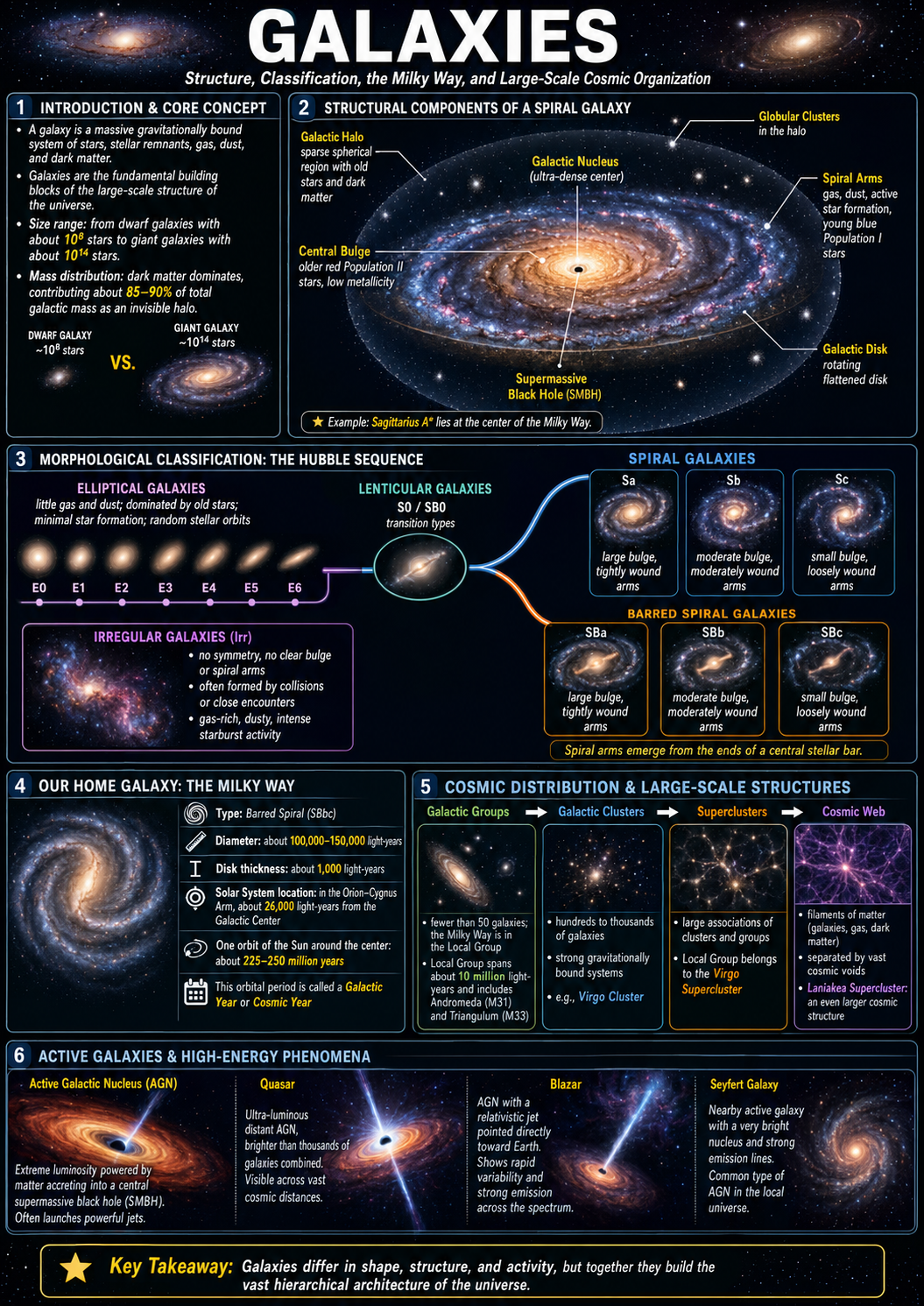
1. What is a Galaxy?
A galaxy is a massive system in space. It contains stars, stellar remnants, interstellar gas, dust and dark matter.
All these things remain together because of gravity. This is why a galaxy is called a gravitationally bound system.
Easy Meaning: A galaxy is like a huge cosmic city. Stars are like houses, gas and dust are like raw material, and gravity works like the force that keeps the city together.
2. Important Key Terms
Stellar Remnants
Objects left behind after stars die, such as white dwarfs, neutron stars and black holes.
Interstellar Gas
Gas present between stars. Hydrogen and helium are the most common gases.
Interstellar Dust
Tiny solid particles between stars. Dust helps in the formation of stars and planets.
Dark Matter
Invisible matter that does not emit light but shows its presence through gravity.
3. Scale of Galaxies
Galaxies are not of the same size. Some are small dwarf galaxies, while some are giant galaxies.
Dwarf Galaxies
Small galaxies with fewer stars. They may contain millions to a few hundred million or more stars.
Giant Galaxies
Very large galaxies may contain hundreds of billions to trillions of stars.
UPSC Note: Exact star count is not important for basic exams. What matters is that galaxies vary greatly in size and mass.
4. Mass Distribution: Why Dark Matter is Important
When we look at a galaxy, we mostly see stars and glowing gas. But most of the mass of a large galaxy is believed to be in the form of dark matter.
In simple terms, visible stars show the shape of a galaxy, but dark matter provides much of its gravitational support.
This is why galaxies are often surrounded by a huge invisible dark matter halo.
5. Structural Components of a Spiral Galaxy
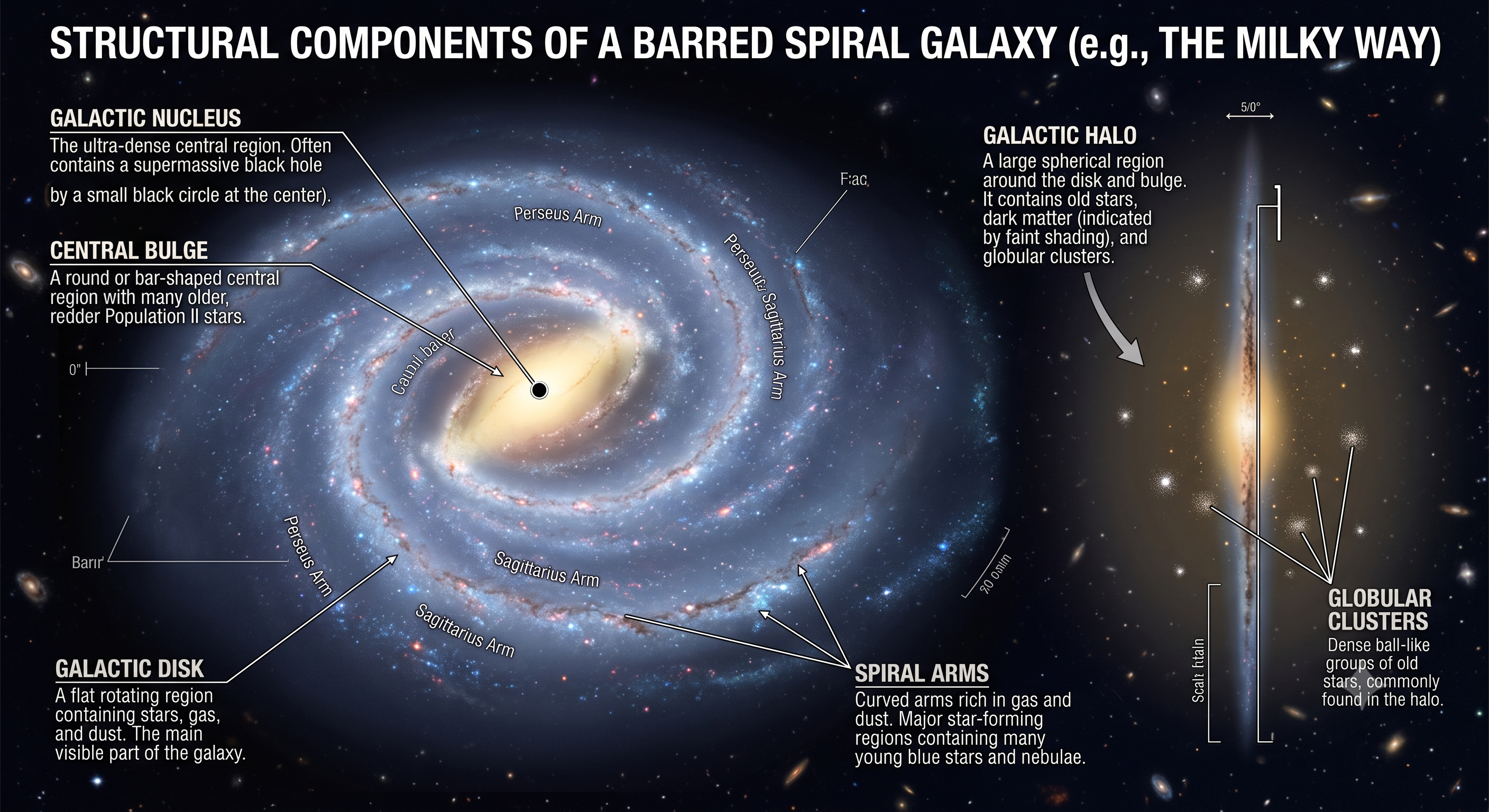
Spiral galaxies have a clear structure. The Milky Way is also a barred spiral galaxy, so these parts are important.
Galactic Nucleus
The ultra-dense central region. Many large galaxies contain a supermassive black hole at the centre.
Central Bulge
A round or bar-shaped central region with many older, redder stars. Such stars are often called Population II stars.
Galactic Disk
A flat rotating region containing stars, gas and dust. It is the main visible part of many spiral galaxies.
Spiral Arms
Curved arms rich in gas and dust. They are major star-forming regions and contain many young blue stars.
Galactic Halo
A large spherical region around the disk and bulge. It contains old stars, globular clusters and dark matter.
Globular Clusters
Dense ball-like groups of old stars, commonly found in the halo of a galaxy.
6. Population I and Population II Stars
Stars in galaxies are sometimes grouped as Population I and Population II. This helps us understand where young and old stars are found.
Population I Stars
Younger stars, often found in the disk and spiral arms. Many are blue and hot, and they contain more heavy elements.
Population II Stars
Older stars, often found in the bulge and halo. They are generally redder and have fewer heavy elements.
Metallicity: In astronomy, “metals” means elements heavier than hydrogen and helium. So, low metallicity means fewer heavy elements.
7. Hubble Sequence: Classification of Galaxies
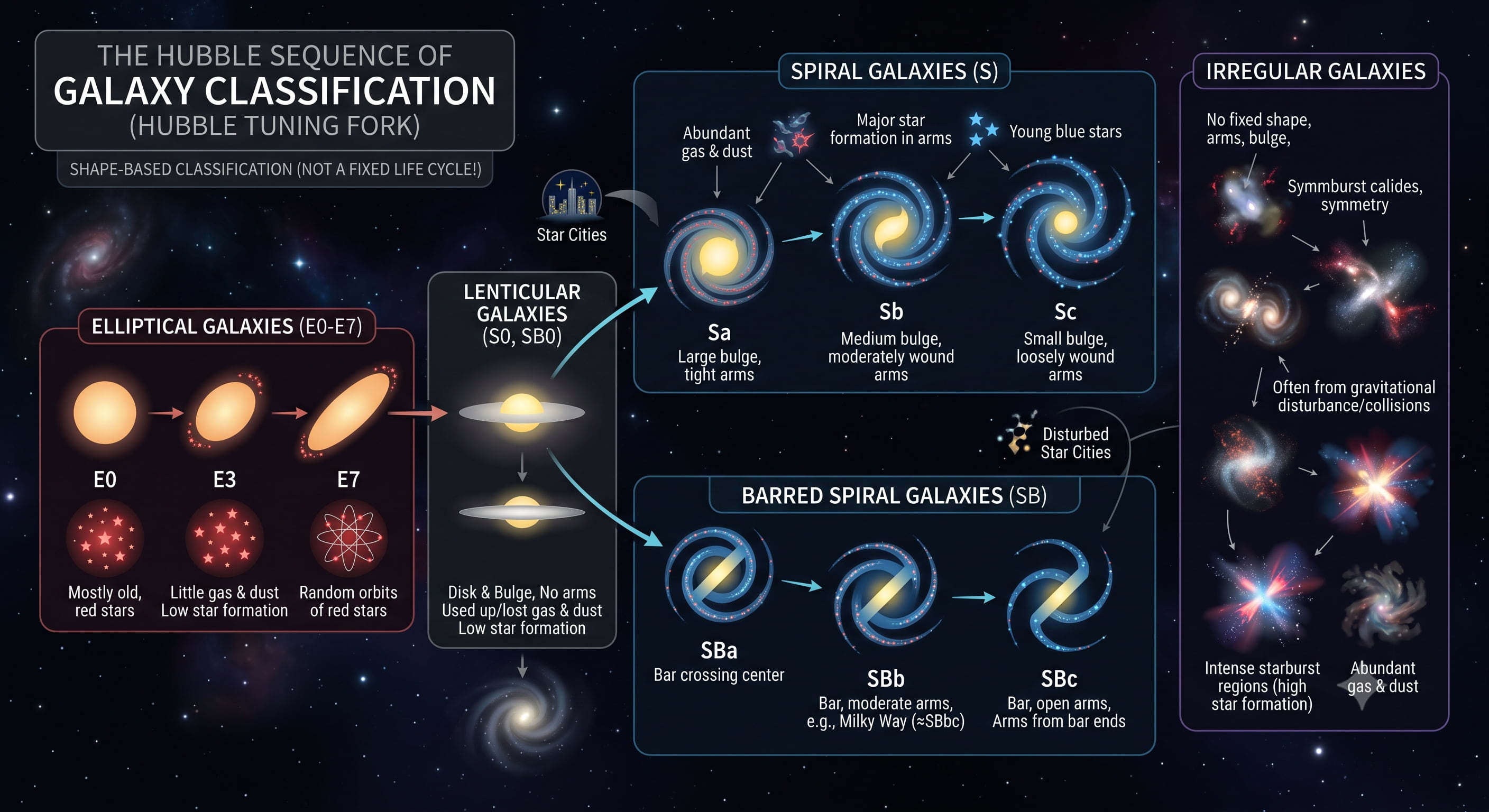
Edwin Hubble classified galaxies according to their visible shapes. This is called the Hubble Sequence or Hubble Tuning Fork.
Important: Hubble Sequence is mainly a shape-based classification. It should not be memorized as a fixed life cycle of galaxies.
8. Elliptical Galaxies
Elliptical galaxies are round or oval-shaped galaxies. They are marked from E0 to E7.
E0: almost round.
E7: highly elongated.
They contain very little gas and dust.
They have mostly old, low-mass stars.
Star formation is very low or almost absent.
Stars move in random orbits, not in a clear rotating disk.
Easy Meaning: Elliptical galaxies are like old star cities with little raw material left for new stars.
9. Spiral Galaxies
Spiral galaxies have a central bulge, a flat disk and spiral arms.
They usually contain abundant gas and dust, so star formation is common in their spiral arms.
Sa
Large bulge and tightly wound spiral arms.
Sb
Medium bulge and moderately wound arms.
Sc
Small bulge and loosely wound open arms.
10. Barred Spiral Galaxies
Barred spiral galaxies are spiral galaxies that have a bar-shaped structure of stars crossing the centre.
In these galaxies, spiral arms usually begin from the ends of the central bar, not directly from the nucleus.
SBa
Barred spiral with tight arms.
SBb
Barred spiral with moderately open arms.
SBc
Barred spiral with more open arms.
Important: The Milky Way is a barred spiral galaxy and is often classified around the SBbc type.
11. Lenticular Galaxies
Lenticular galaxies are also called S0 or SB0 galaxies.
They have a central bulge and a disk, but they do not have clear spiral arms.
They look like a middle form between elliptical and spiral galaxies.
They have used up or lost much of their gas and dust.
Their star formation rate is usually low.
12. Irregular Galaxies
Irregular galaxies do not have a fixed shape. They do not show clear spiral arms, central bulge or symmetry.
They often form due to gravitational disturbance, close flybys or galaxy collisions.
They may contain large amounts of gas and dust.
Many irregular galaxies show intense star formation.
Intense star-forming regions are sometimes called starburst regions.
Easy Meaning: Irregular galaxies are like disturbed star cities whose shape has become uneven due to gravitational interactions.
13. The Milky Way Galaxy: Our Home Galaxy
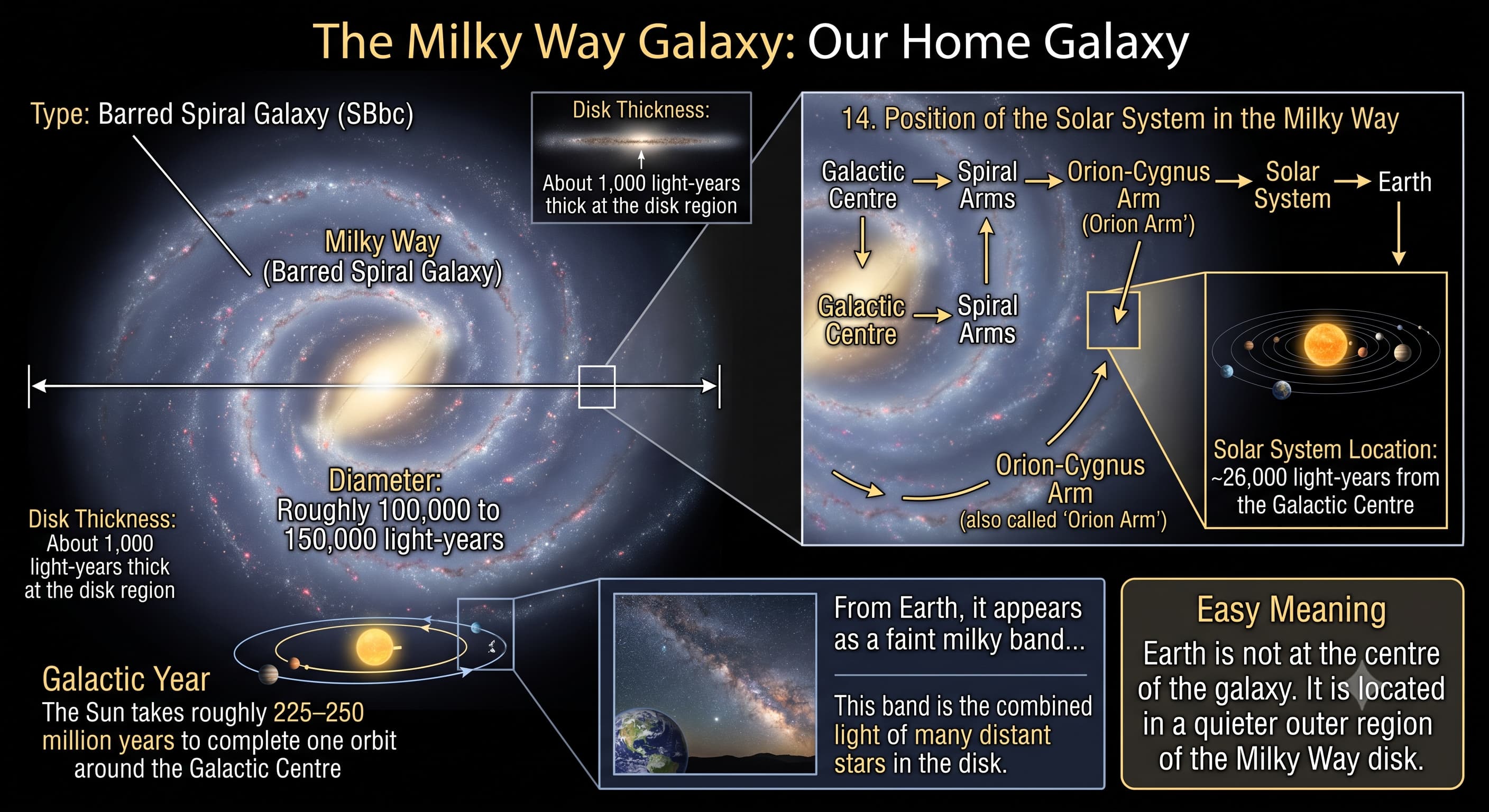
The Milky Way is the galaxy in which our Solar System is located.
From Earth, it appears as a faint milky band of light in the night sky. This band is the combined light of many distant stars in the disk of our galaxy.
| Type | Barred Spiral Galaxy, around SBbc type |
| Diameter | Roughly 100,000 to 150,000 light-years |
| Disk Thickness | About 1,000 light-years thick at the disk region |
| Solar System Location | Orion-Cygnus Arm, about 26,000 light-years from the Galactic Centre |
| Galactic Year | The Sun takes roughly 225–250 million years to complete one orbit around the Galactic Centre |
14. Position of the Solar System in the Milky Way
The Solar System is not at the centre of the Milky Way. It lies in the Orion-Cygnus Arm, also called the Orion Arm.
Easy Meaning: Earth is not at the centre of the galaxy. It is located in a quieter outer region of the Milky Way disk.
15. Local Group and Andromeda Galaxy
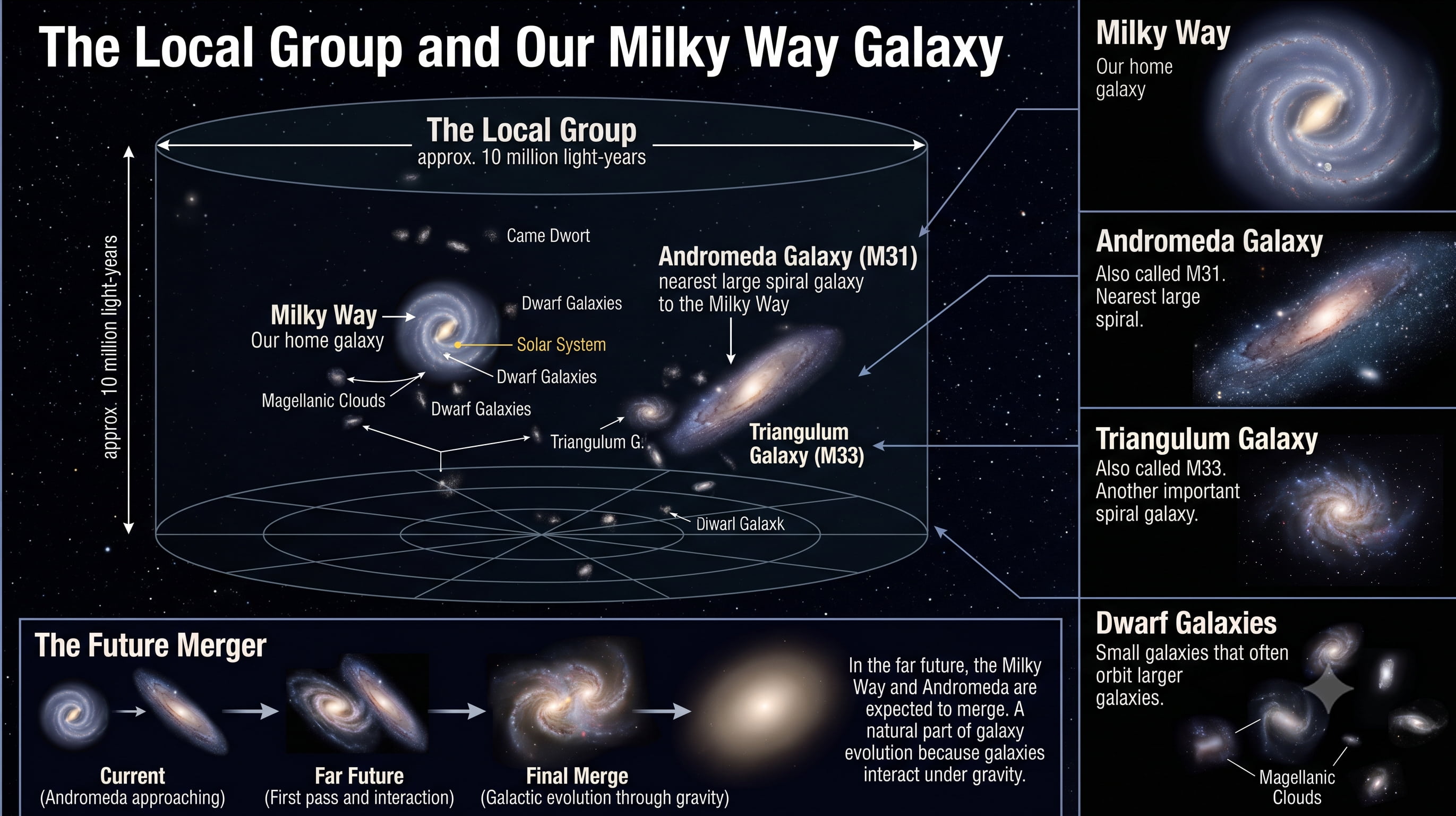
The Milky Way is not alone. It belongs to a small group of galaxies called the Local Group.
The Local Group spans about 10 million light-years and includes the Milky Way, Andromeda Galaxy, Triangulum Galaxy and many dwarf galaxies.
Milky Way
Our home galaxy.
Andromeda Galaxy
Also called M31. It is the nearest large spiral galaxy to the Milky Way.
Triangulum Galaxy
Also called M33. It is another important spiral galaxy in the Local Group.
Dwarf Galaxies
Small galaxies that often orbit larger galaxies.
In the far future, the Milky Way and Andromeda are expected to merge. This is a natural part of galaxy evolution because galaxies can interact under gravity.
16. Link with Cosmic Structures and AGN
Galaxies are not scattered randomly. They are found in groups, clusters, superclusters and the Cosmic Web. This was studied in the previous post.
Some galaxies have extremely bright centres called Active Galactic Nuclei. Their detailed study will be done in the next post, because AGN is a separate major concept.
17. Common Confusions
Solar System vs Galaxy
The Solar System contains the Sun, planets and small bodies. A galaxy contains billions of stars and many solar systems.
Galaxy vs Universe
A galaxy is one large system of stars. The universe contains all galaxies, space, matter, energy and time.
Nebula vs Galaxy
A nebula is a cloud of gas and dust. A galaxy is a much larger system containing stars, gas, dust and dark matter.
Galaxy vs Galaxy Cluster
A galaxy is one star system. A galaxy cluster is a group of many galaxies held together by gravity.
18. UPSC Relevance
Prelims: Galaxy types, Milky Way, Solar System position, Local Group and Andromeda.
Concept Building: Difference between solar system, galaxy, cluster and universe.
Science and Technology: Telescopes, black holes, star formation and cosmic observations.
Geographical Thinking: Scale, location, spatial hierarchy and distribution.
Extra Concept: Galaxy Mergers, Satellite Galaxies and Starburst Galaxies
Galaxies can grow by merging with smaller galaxies. This process is called a galaxy merger.
Small galaxies that move around a larger galaxy are called satellite galaxies. Many dwarf galaxies orbit large galaxies like the Milky Way.
Sometimes, a galaxy forms stars very rapidly. Such a galaxy is called a starburst galaxy.
Easy Meaning: Galaxies are not fixed forever. They can interact, merge, disturb each other and trigger new star formation.
Quick Revision
Galaxy is a large gravitationally bound system of stars, stellar remnants, gas, dust and dark matter.
Galaxies are fundamental building blocks of the large-scale universe.
Dark matter provides much of the gravitational support of galaxies.
Spiral galaxies have bulge, disk, spiral arms and halo.
Population I stars are younger and common in disk/spiral arms; Population II stars are older and common in bulge/halo.
Hubble Sequence classifies galaxies mainly by shape.
Main galaxy types: elliptical, spiral, barred spiral, lenticular and irregular.
The Milky Way is a barred spiral galaxy, around SBbc type.
The Solar System lies in the Orion-Cygnus Arm, about 26,000 light-years from the Galactic Centre.
One Galactic Year is about 225–250 million Earth years.
The Milky Way, Andromeda and Triangulum are major members of the Local Group.
Think Like UPSC: Do not memorize galaxies only as “spiral or elliptical.” Understand the hierarchy: Solar System is inside the Milky Way, Milky Way is inside the Local Group, and galaxies together form larger cosmic structures.
आकाशगंगाएँ और दुग्धमेखला/मिल्की वे आकाशगंगा
आकाशगंगा (Galaxy) तारों, तारकीय अवशेषों, गैस, धूल, अदृश्य पदार्थ/डार्क मैटर (Dark Matter) और अन्य खगोलीय पिंडों का एक विशाल परिवार है, जो गुरुत्वाकर्षण के कारण एक साथ बंधा रहता है।
हमारी घरेलू आकाशगंगा दुग्धमेखला/मिल्की वे आकाशगंगा (Milky Way Galaxy) है। हमारा सौरमंडल (Solar System) इसी आकाशगंगा का एक बहुत छोटा हिस्सा है।
1. आकाशगंगा क्या है?
आकाशगंगा (Galaxy) अंतरिक्ष में स्थित एक बहुत विशाल प्रणाली है। इसमें तारे, तारकीय अवशेष, तारों के बीच की गैस, धूल और अदृश्य पदार्थ/डार्क मैटर (Dark Matter) शामिल होते हैं।
ये सभी चीजें गुरुत्वाकर्षण (Gravity) के कारण एक साथ रहती हैं। इसी कारण आकाशगंगा को गुरुत्वाकर्षण से बंधी हुई प्रणाली (Gravitationally Bound System) कहा जाता है।
सरल अर्थ: आकाशगंगा एक विशाल खगोलीय शहर जैसी है। इसमें तारे घरों की तरह हैं, गैस और धूल कच्चे पदार्थ की तरह हैं, और गुरुत्वाकर्षण वह शक्ति है जो इस पूरे खगोलीय शहर को एक साथ बनाए रखती है।
2. महत्वपूर्ण प्रमुख शब्द
तारकीय अवशेष (Stellar Remnants)
तारों के जीवन के अंत के बाद बची हुई वस्तुएँ। जैसे — श्वेत बौना तारा (White Dwarf), न्यूट्रॉन तारा (Neutron Star) और कृष्ण विवर/ब्लैक होल (Black Hole)।
अंतरतारकीय गैस (Interstellar Gas)
तारों के बीच मौजूद गैस। हाइड्रोजन (Hydrogen) और हीलियम (Helium) इसमें सबसे अधिक पाए जाने वाले तत्व हैं।
अंतरतारकीय धूल (Interstellar Dust)
तारों के बीच मौजूद बहुत छोटे ठोस कण। यह धूल नए तारों और ग्रहों के निर्माण में सहायक होती है।
अदृश्य पदार्थ/डार्क मैटर (Dark Matter)
ऐसा पदार्थ जिसे हम सीधे देख नहीं सकते, क्योंकि यह प्रकाश नहीं छोड़ता। लेकिन इसका प्रभाव गुरुत्वाकर्षण के माध्यम से दिखाई देता है।
3. आकाशगंगाओं का पैमाना (Scale)
सभी आकाशगंगाएँ समान आकार की नहीं होतीं। कुछ आकाशगंगाएँ बहुत छोटी होती हैं, जिन्हें बौनी आकाशगंगाएँ (Dwarf Galaxies) कहा जाता है। कुछ आकाशगंगाएँ बहुत विशाल होती हैं, जिन्हें विशाल आकाशगंगाएँ (Giant Galaxies) कहा जाता है।
बौनी आकाशगंगाएँ (Dwarf Galaxies)
ये छोटी आकाशगंगाएँ होती हैं, जिनमें तारों की संख्या अपेक्षाकृत कम होती है। इनमें लाखों से लेकर कुछ सौ मिलियन तक तारे हो सकते हैं।
विशाल आकाशगंगाएँ (Giant Galaxies)
ये बहुत बड़ी आकाशगंगाएँ होती हैं। इनमें सैकड़ों अरब से लेकर खरबों तक तारे हो सकते हैं।
UPSC Note: Basic exams के लिए तारों की exact संख्या याद करना जरूरी नहीं है। मुख्य बात यह है कि आकाशगंगाएँ आकार और द्रव्यमान में बहुत अलग-अलग होती हैं।
4. द्रव्यमान वितरण (Mass Distribution): अदृश्य पदार्थ/डार्क मैटर क्यों महत्वपूर्ण है?
जब हम किसी आकाशगंगा को देखते हैं, तो हमें मुख्य रूप से तारे और चमकती हुई गैस दिखाई देती है। लेकिन वैज्ञानिकों के अनुसार बड़ी आकाशगंगाओं के द्रव्यमान का बड़ा हिस्सा अदृश्य पदार्थ/डार्क मैटर (Dark Matter) के रूप में होता है।
सरल शब्दों में, दिखाई देने वाले तारे हमें आकाशगंगा का आकार दिखाते हैं, लेकिन डार्क मैटर आकाशगंगा को गुरुत्वाकर्षणीय सहारा देता है।
इसी कारण आकाशगंगाओं के चारों ओर अक्सर एक विशाल अदृश्य क्षेत्र पाया जाता है, जिसे डार्क मैटर हेलो (Dark Matter Halo) कहा जाता है।
5. सर्पिल/घुमावदार आकाशगंगा (Spiral Galaxy) के संरचनात्मक भाग
सर्पिल/घुमावदार आकाशगंगाओं (Spiral Galaxies) की एक स्पष्ट संरचना होती है। हमारी दुग्धमेखला/मिल्की वे भी एक दंडयुक्त सर्पिल आकाशगंगा (Barred Spiral Galaxy) है, इसलिए इसके भागों को समझना बहुत उपयोगी है।
आकाशगंगीय केंद्रक (Galactic Nucleus)
आकाशगंगा का अत्यंत सघन केंद्रीय क्षेत्र। कई बड़ी आकाशगंगाओं के केंद्र में अत्यंत विशाल कृष्ण विवर/सुपरमैसिव ब्लैक होल (Supermassive Black Hole) होता है।
केंद्रीय उभार (Central Bulge)
आकाशगंगा के केंद्र का गोल या दंडाकार क्षेत्र। इसमें कई पुराने और लाल रंग के तारे होते हैं। ऐसे तारों को अक्सर Population II तारे कहा जाता है।
आकाशगंगीय चकती (Galactic Disk)
यह एक चपटा और घूमता हुआ क्षेत्र होता है, जिसमें तारे, गैस और धूल पाए जाते हैं। यह कई सर्पिल आकाशगंगाओं का मुख्य दिखाई देने वाला भाग होता है।
सर्पिल/घुमावदार भुजाएँ (Spiral Arms)
ये गैस और धूल से भरपूर घुमावदार भुजाएँ होती हैं। यहाँ नए तारों का निर्माण अधिक होता है, इसलिए इन्हें तारा-निर्माण क्षेत्र (Star-Forming Regions) भी कहा जा सकता है।
आकाशगंगीय प्रभामंडल (Galactic Halo)
यह चकती और केंद्रीय उभार के चारों ओर स्थित एक बड़ा गोलाकार क्षेत्र होता है। इसमें पुराने तारे, गोल तारागुच्छ और अदृश्य पदार्थ/डार्क मैटर पाए जाते हैं।
गोल तारागुच्छ (Globular Clusters)
ये पुराने तारों के घने, गेंद जैसे समूह होते हैं। ये सामान्यतः आकाशगंगा के प्रभामंडल (Halo) में पाए जाते हैं।
6. Population I और Population II तारे
आकाशगंगाओं में तारों को कभी-कभी Population I और Population II में बाँटा जाता है। इससे यह समझने में मदद मिलती है कि युवा और पुराने तारे आकाशगंगा के किन भागों में पाए जाते हैं।
Population I तारे
ये अपेक्षाकृत युवा तारे होते हैं। ये अक्सर आकाशगंगा की चकती (Disk) और सर्पिल/घुमावदार भुजाओं (Spiral Arms) में पाए जाते हैं। इनमें कई तारे नीले और गर्म होते हैं तथा इनमें भारी तत्व अधिक होते हैं।
Population II तारे
ये पुराने तारे होते हैं। ये अक्सर केंद्रीय उभार (Bulge) और प्रभामंडल (Halo) में पाए जाते हैं। ये सामान्यतः अधिक लाल रंग के होते हैं और इनमें भारी तत्व कम होते हैं।
धात्विकता/मेटैलिसिटी (Metallicity): खगोल विज्ञान में “धातु (Metals)” का अर्थ हाइड्रोजन और हीलियम से भारी तत्वों से होता है। इसलिए कम धात्विकता (Low Metallicity) का मतलब है — भारी तत्वों की कम मात्रा।
7. हबल अनुक्रम (Hubble Sequence): आकाशगंगाओं का वर्गीकरण
एडविन हबल (Edwin Hubble) ने आकाशगंगाओं को उनके दिखाई देने वाले आकार के आधार पर वर्गीकृत किया। इस वर्गीकरण को हबल अनुक्रम (Hubble Sequence) या हबल ट्यूनिंग फोर्क (Hubble Tuning Fork) कहा जाता है।
महत्वपूर्ण: हबल अनुक्रम मुख्य रूप से आकार-आधारित वर्गीकरण है। इसे आकाशगंगाओं के निश्चित जीवन-चक्र की तरह याद नहीं करना चाहिए।
8. दीर्घवृत्तीय आकाशगंगाएँ (Elliptical Galaxies)
दीर्घवृत्तीय आकाशगंगाएँ (Elliptical Galaxies) गोल या अंडाकार आकार की आकाशगंगाएँ होती हैं। इन्हें E0 से E7 तक चिह्नित किया जाता है।
E0: लगभग गोल।
E7: बहुत अधिक लंबी या खिंची हुई।
इनमें गैस और धूल बहुत कम होती है।
इनमें अधिकतर पुराने और कम द्रव्यमान वाले तारे होते हैं।
इनमें नए तारों का निर्माण बहुत कम या लगभग नहीं होता।
इनके तारे स्पष्ट घूमती हुई चकती में नहीं, बल्कि अनियमित कक्षाओं (Random Orbits) में चलते हैं।
सरल अर्थ: दीर्घवृत्तीय आकाशगंगाएँ पुराने तारों के शहर जैसी होती हैं, जहाँ नए तारे बनाने के लिए गैस और धूल जैसे कच्चे पदार्थ बहुत कम बचे होते हैं।
9. सर्पिल/घुमावदार आकाशगंगाएँ (Spiral Galaxies)
सर्पिल/घुमावदार आकाशगंगाओं (Spiral Galaxies) में केंद्रीय उभार (Central Bulge), चपटी चकती (Flat Disk) और सर्पिल भुजाएँ (Spiral Arms) होती हैं।
इनमें सामान्यतः गैस और धूल पर्याप्त मात्रा में होती है, इसलिए इनके सर्पिल/घुमावदार भुजाओं में नए तारों का निर्माण अधिक होता है।
Sa
बड़ा केंद्रीय उभार और बहुत कसकर घुमी हुई सर्पिल भुजाएँ।
Sb
मध्यम केंद्रीय उभार और मध्यम रूप से घुमी हुई भुजाएँ।
Sc
छोटा केंद्रीय उभार और अधिक खुली हुई सर्पिल भुजाएँ।
10. दंडयुक्त सर्पिल आकाशगंगाएँ (Barred Spiral Galaxies)
दंडयुक्त सर्पिल आकाशगंगाएँ (Barred Spiral Galaxies) ऐसी सर्पिल आकाशगंगाएँ होती हैं, जिनके केंद्र से तारों की एक दंडाकार/बार जैसी संरचना गुजरती है।
इन आकाशगंगाओं में सर्पिल भुजाएँ सामान्यतः केंद्रीय दंड (Central Bar) के सिरों से शुरू होती हैं, सीधे केंद्रक से नहीं।
SBa
कसकर घुमी हुई भुजाओं वाली दंडयुक्त सर्पिल आकाशगंगा।
SBb
मध्यम रूप से खुली भुजाओं वाली दंडयुक्त सर्पिल आकाशगंगा।
SBc
अधिक खुली भुजाओं वाली दंडयुक्त सर्पिल आकाशगंगा।
महत्वपूर्ण: दुग्धमेखला/मिल्की वे (Milky Way) एक दंडयुक्त सर्पिल आकाशगंगा है और इसे अक्सर SBbc प्रकार के आसपास रखा जाता है।
11. लेंसाकार आकाशगंगाएँ (Lenticular Galaxies)
लेंसाकार आकाशगंगाएँ (Lenticular Galaxies) को S0 या SB0 आकाशगंगाएँ भी कहा जाता है।
इनमें केंद्रीय उभार और चकती होती है, लेकिन स्पष्ट सर्पिल/घुमावदार भुजाएँ नहीं होतीं।
ये दीर्घवृत्तीय और सर्पिल आकाशगंगाओं के बीच की आकृति जैसी दिखती हैं।
इनमें गैस और धूल का बड़ा हिस्सा खत्म हो चुका होता है या बहुत कम बचा होता है।
इनमें नए तारों के निर्माण की दर सामान्यतः कम होती है।
12. अनियमित आकाशगंगाएँ (Irregular Galaxies)
अनियमित आकाशगंगाओं (Irregular Galaxies) का कोई निश्चित आकार नहीं होता। इनमें स्पष्ट सर्पिल भुजाएँ, केंद्रीय उभार या सममिति (Symmetry) नहीं दिखाई देती।
ये अक्सर गुरुत्वीय व्यवधान (Gravitational Disturbance), पास से गुजरने वाली आकाशगंगाओं या आकाशगंगा-टकराव (Galaxy Collision) के कारण बनती हैं।
इनमें गैस और धूल की बड़ी मात्रा हो सकती है।
कई अनियमित आकाशगंगाओं में तेज गति से नए तारों का निर्माण होता है।
जहाँ बहुत तेज तारा-निर्माण होता है, उन्हें कभी-कभी तारा-विस्फोट क्षेत्र (Starburst Regions) कहा जाता है।
सरल अर्थ: अनियमित आकाशगंगाएँ ऐसे खगोलीय शहरों जैसी हैं, जिनका आकार गुरुत्वीय खिंचाव और टकराव के कारण बिगड़ गया है।
13. दुग्धमेखला/मिल्की वे आकाशगंगा: हमारी घरेलू आकाशगंगा
दुग्धमेखला/मिल्की वे (Milky Way) वह आकाशगंगा है, जिसमें हमारा सौरमंडल स्थित है।
पृथ्वी से यह रात के आकाश में हल्की दूधिया पट्टी की तरह दिखाई देती है। यह पट्टी हमारी आकाशगंगा की चकती में मौजूद अनेक दूरस्थ तारों के संयुक्त प्रकाश से बनती है।
| प्रकार | दंडयुक्त सर्पिल आकाशगंगा (Barred Spiral Galaxy), लगभग SBbc प्रकार |
| व्यास | लगभग 100,000 से 150,000 प्रकाश-वर्ष (Light-years) |
| चकती की मोटाई | चकती वाले क्षेत्र में लगभग 1,000 प्रकाश-वर्ष |
| सौरमंडल का स्थान | ओरायन-साइग्नस भुजा (Orion-Cygnus Arm) में, आकाशगंगीय केंद्र से लगभग 26,000 प्रकाश-वर्ष दूर |
| आकाशगंगीय वर्ष (Galactic Year) | सूर्य को आकाशगंगीय केंद्र के चारों ओर एक चक्कर पूरा करने में लगभग 225–250 मिलियन वर्ष लगते हैं |
14. दुग्धमेखला/मिल्की वे में सौरमंडल की स्थिति
हमारा सौरमंडल दुग्धमेखला/मिल्की वे के केंद्र पर नहीं है। यह ओरायन-साइग्नस भुजा (Orion-Cygnus Arm) में स्थित है, जिसे ओरायन भुजा (Orion Arm) भी कहा जाता है।
सरल अर्थ: पृथ्वी आकाशगंगा के केंद्र पर नहीं है। यह दुग्धमेखला की चकती के एक अपेक्षाकृत शांत बाहरी क्षेत्र में स्थित है।
15. स्थानीय समूह (Local Group) और एंड्रोमेडा आकाशगंगा
दुग्धमेखला/मिल्की वे अकेली नहीं है। यह आकाशगंगाओं के एक छोटे समूह का हिस्सा है, जिसे स्थानीय समूह (Local Group) कहा जाता है।
स्थानीय समूह लगभग 1 करोड़ प्रकाश-वर्ष (10 Million Light-years) तक फैला है। इसमें दुग्धमेखला/मिल्की वे, एंड्रोमेडा आकाशगंगा, त्रिभुज आकाशगंगा और कई बौनी आकाशगंगाएँ शामिल हैं।
दुग्धमेखला/मिल्की वे (Milky Way)
हमारी घरेलू आकाशगंगा।
एंड्रोमेडा आकाशगंगा (Andromeda Galaxy)
इसे M31 भी कहा जाता है। यह दुग्धमेखला/मिल्की वे के सबसे निकट की बड़ी सर्पिल आकाशगंगा है।
त्रिभुज आकाशगंगा (Triangulum Galaxy)
इसे M33 भी कहा जाता है। यह स्थानीय समूह की एक और महत्वपूर्ण सर्पिल आकाशगंगा है।
बौनी आकाशगंगाएँ (Dwarf Galaxies)
ये छोटी आकाशगंगाएँ होती हैं, जो अक्सर बड़ी आकाशगंगाओं की परिक्रमा करती हैं।
बहुत दूर भविष्य में दुग्धमेखला/मिल्की वे और एंड्रोमेडा आकाशगंगा के आपस में मिलने की संभावना है। यह आकाशगंगा-विकास (Galaxy Evolution) का एक प्राकृतिक भाग है, क्योंकि आकाशगंगाएँ गुरुत्वाकर्षण के कारण एक-दूसरे से प्रभाव डाल सकती हैं।
16. ब्रह्मांडीय संरचनाओं और AGN से संबंध
आकाशगंगाएँ अंतरिक्ष में बेतरतीब तरीके से बिखरी हुई नहीं हैं। वे समूहों, गुच्छों, महागुच्छों और ब्रह्मांडीय जाल (Cosmic Web) में पाई जाती हैं। इसका अध्ययन पिछले पोस्ट में किया गया था।
कुछ आकाशगंगाओं के केंद्र अत्यंत चमकीले होते हैं। इन्हें सक्रिय आकाशगंगीय केंद्रक (Active Galactic Nuclei - AGN) कहा जाता है। इसका विस्तृत अध्ययन अगले पोस्ट में किया जाएगा, क्योंकि AGN एक अलग और महत्वपूर्ण concept है।
17. सामान्य भ्रम
सौरमंडल बनाम आकाशगंगा
सौरमंडल में सूर्य, ग्रह और छोटे पिंड होते हैं। आकाशगंगा में अरबों तारे और अनेक सौरमंडल हो सकते हैं।
आकाशगंगा बनाम ब्रह्मांड
आकाशगंगा तारों की एक बड़ी प्रणाली है। ब्रह्मांड में सभी आकाशगंगाएँ, अंतरिक्ष, पदार्थ, ऊर्जा और समय शामिल हैं।
नीहारिका बनाम आकाशगंगा
नीहारिका (Nebula) गैस और धूल का बादल है। आकाशगंगा उससे कहीं बड़ी प्रणाली है, जिसमें तारे, गैस, धूल और डार्क मैटर होते हैं।
आकाशगंगा बनाम आकाशगंगा गुच्छ
आकाशगंगा तारों की एक बड़ी प्रणाली है। आकाशगंगा गुच्छ (Galaxy Cluster) कई आकाशगंगाओं का समूह होता है, जो गुरुत्वाकर्षण से बंधा रहता है।
18. UPSC के लिए उपयोगिता
Prelims: आकाशगंगाओं के प्रकार, दुग्धमेखला/मिल्की वे, सौरमंडल की स्थिति, स्थानीय समूह और एंड्रोमेडा।
Concept Building: सौरमंडल, आकाशगंगा, आकाशगंगा गुच्छ और ब्रह्मांड के बीच अंतर।
Science and Technology: दूरबीनें, कृष्ण विवर/ब्लैक होल, तारा-निर्माण और ब्रह्मांडीय अवलोकन।
Geographical Thinking: पैमाना, स्थान, स्थानिक पदानुक्रम और वितरण।
Extra Concept: Galaxy Mergers, Satellite Galaxies and Starburst Galaxies
Galaxies can grow by merging with smaller galaxies. This process is called a galaxy merger.
Small galaxies that move around a larger galaxy are called satellite galaxies. Many dwarf galaxies orbit large galaxies like the Milky Way.
Sometimes, a galaxy forms stars very rapidly. Such a galaxy is called a starburst galaxy.
Easy Meaning: Galaxies are not fixed forever. They can interact, merge, disturb each other and trigger new star formation.
त्वरित पुनरावृत्ति
आकाशगंगा (Galaxy) तारे, तारकीय अवशेष, गैस, धूल और अदृश्य पदार्थ/डार्क मैटर की एक बड़ी गुरुत्वाकर्षण से बंधी प्रणाली है।
आकाशगंगाएँ बड़े पैमाने के ब्रह्मांड की मूल निर्माण इकाइयाँ हैं।
डार्क मैटर आकाशगंगाओं को गुरुत्वाकर्षणीय सहारा देता है।
सर्पिल आकाशगंगाओं में केंद्रीय उभार, चकती, सर्पिल भुजाएँ और प्रभामंडल होते हैं।
Population I तारे युवा होते हैं और चकती/सर्पिल भुजाओं में मिलते हैं; Population II तारे पुराने होते हैं और केंद्रीय उभार/प्रभामंडल में मिलते हैं।
हबल अनुक्रम आकाशगंगाओं को मुख्य रूप से आकार के आधार पर वर्गीकृत करता है।
मुख्य आकाशगंगा प्रकार हैं — दीर्घवृत्तीय, सर्पिल, दंडयुक्त सर्पिल, लेंसाकार और अनियमित।
दुग्धमेखला/मिल्की वे एक दंडयुक्त सर्पिल आकाशगंगा है, लगभग SBbc प्रकार।
सौरमंडल ओरायन-साइग्नस भुजा में, आकाशगंगीय केंद्र से लगभग 26,000 प्रकाश-वर्ष दूर स्थित है।
एक आकाशगंगीय वर्ष लगभग 225–250 मिलियन पृथ्वी वर्षों के बराबर होता है।
दुग्धमेखला/मिल्की वे, एंड्रोमेडा और त्रिभुज आकाशगंगा स्थानीय समूह के प्रमुख सदस्य हैं।
Think Like UPSC: आकाशगंगाओं को केवल “सर्पिल या दीर्घवृत्तीय” के रूप में याद न करें। पदानुक्रम समझें: सौरमंडल दुग्धमेखला/मिल्की वे के अंदर है; दुग्धमेखला स्थानीय समूह के अंदर है; और अनेक आकाशगंगाएँ मिलकर बड़ी ब्रह्मांडीय संरचनाएँ बनाती हैं।