COGNITOIAS | GEOGRAPHY MASTER NOTES
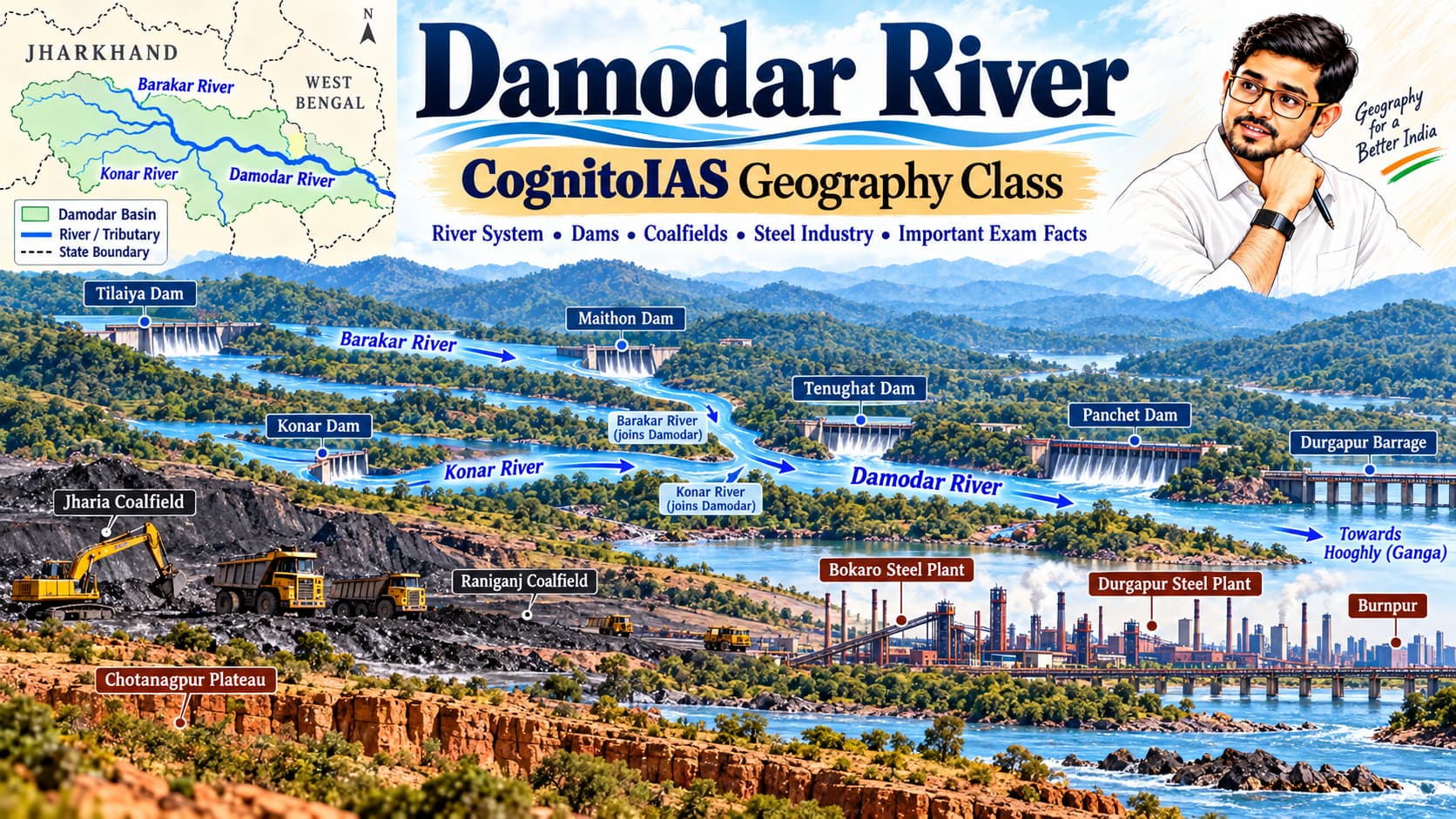
Damodar River and Valley (Damodar River System)
River system • Dams • DVC • Gondwana coal • Steel • Thermal power • History • Fact-based PYQ references
How to Study
River → Tributary → Dam → Town/Industrial Centre study these together. Small blue tags indicate that the related fact has been asked in the specified examination; no MCQ question bank is included here.
1. Geographical Introduction and Course
Origin: Khamarpat/Khamarpet hill region, Chota Nagpur Plateau, Jharkhand. Descriptions also mention the Latehar–Chandwa/Chulhapani region; place names and administrative details may vary in older reference books. 39th BPSC: Origin
States Traversed: Jharkhand → West Bengal; generally flows west to east, and southeast in the lower plains. A rain-fed river.
Geomorphological Feature: Fault/Rift Valley; associated with Gondwana sedimentary rocks and coalfields. UPSC Pre 1998 • UPPSC Pre 2019
Historical Nickname: Sorrow of Bengal; because of repeated devastating floods in the lower valley. SSC Steno 2022
Major Tributary: Barakar River.
Length: Many reference books give approximately 592 km; some government and research sources report around 541–563 km. Note this variation across sources.
Where the Damodar Ultimately Drains
In the lower valley, the Mundeswari channel is connected to the Rupnarayan river system , while the Amta/Lower Damodar channel is connected to the Hooghly . Therefore, remembering just one final confluence point is insufficient.
2. Tributaries — Correct River-System Sequence
Barakar
The most important tributary of the Damodar; Tilaiya (1953) and Maithon (1957) dams. Usri/Ushri is a tributary of the Barakar. Near Giridih, Usri Falls is situated on this river. UPSC 2022 • JPSC 2016
Konar → Damodar
The Konar originates in the Hazaribagh plateau region; Konar Dam is built on this river. The Bokaro River first joins the Konar; their combined waters subsequently join the Damodar. Do not treat both rivers as having separate direct confluences with the Damodar.
Bhera/Bhairavi
Joins the Damodar at Rajrappa in Ramgarh; site of the famous Maa Chhinnamastika Temple. JPSC 2016
Katri
A stream originating in the foothill region of Parasnath; it flows through the Dhanbad coal belt and joins the Damodar.
Shali/Sali
A right-bank tributary in the Bankura region of West Bengal.
Other tributaries/sub-tributaries: Jamunia, Haharo, Ghari, Khudia, Gowai, Ijri; in the Barakar system, also remember Barsoti .
Avoid Confusion Between River Systems
Indravati → Godavari, not the Damodar. Ajay, Mayurakshi and Dwarakeswar should not be listed as direct tributaries of the Damodar. UP BEO Pre 2019
3. Dams and Barrage — Most Important Matching Facts
Tilaiya
River: Barakar Year: 1953 — DVC's first dam; Koderma region; hydropower. JPSC Pre 2016
Konar
River: Konar Year: 1955 — On the Konar River; Hazaribagh–Bokaro region.
Maithon
River: Barakar Year: 1957 — Dhanbad region; underground hydropower station. Maithon is in Jharkhand, not Chhattisgarh. UPSC CSE Pre 2022
Panchet
River: Damodar Year: 1959 — Near Panchet Hill; a flood-control and hydropower project. UPPSC Pre 2013
Tenughat
River: Damodar Year: 1980/1985 — Under the Government of Jharkhand. An important water source for Bokaro Steel Plant; not among the original four DVC dams.
Durgapur Barrage
River: Damodar Year: 1955 — Irrigation canals in West Bengal; distinguish a barrage from a dam.
Mnemonic for the Four Original DVC Dams
Tilaiya 1953 → Konar 1955 → Maithon 1957 → Panchet 1959Their rivers, respectively: Barakar → Konar → Barakar → Damodar.
Caution Regarding the Year of Tenughat
According to the Bokaro district administration, Jharkhand, construction began in 1972 , the construction year is given as 1980 , and commissioning took place in 1985 ; some project articles mention 1978 . Do not group it with the original four DVC dams.
Belpahari / Balpahari
A proposed multipurpose dam on the Barakar River; it was also described as proposed in DVC's 2022–23 records. Do not present it as a completed dam. 45th BPSC: Historical question reference
4. Damodar Valley Corporation (DVC)
Established: 7 July 1948; Damodar Valley Corporation Act, 1948. JPSC Pre 2015
Inspired by: Tennessee Valley Authority (TVA), USA; an early multipurpose river-valley project of independent India.
Flood of 1943: It intensified discussions on flood investigation and integrated development; scientist Meghnad Saha played a role.
W. L. Voorduin: An engineer associated with the TVA; proposed 1944 an integrated development plan for the Damodar Valley in 1944.
Dr. B. R. Ambedkar: Played a role in advancing multipurpose river-valley development planning at the central level.
Objectives: Flood control, irrigation, water supply, hydropower/thermal power, soil conservation, afforestation and industrial development.
Irrigation and Canals
Durgapur Barrage gave rise to left- and right-bank main canal systems. Associate the historic Eden Canal of Bardhaman with Damodar irrigation. UPPSC Pre 2015
5. Gondwana Coalfields and Minerals
The Damodar Valley is a major industrial region of the Gondwana coal belt . It mainly contains bituminous coal as well as coking coal used in the steel industry. SSC MTS 2024 • 68th BPSC 2023
Jharia — Dhanbad; high-quality coking coal, underground coal fires and land subsidence.
Raniganj — West Bengal; 1774 early commercial coal mining began in 1774, historically associated with Sumner and Heatly.
East and West Bokaro — Gondwana coalfields; Bokaro industrial belt.
North and South Karanpura — Major coal belt associated with Chatra, Hazaribagh and Ramgarh.
Ramgarh and Giridih — Important coal/mineral areas; the Parasnath region lies near Giridih.
Tandwa — Chatra district; Piparwar, Ashok, Saradhu and Magadh are major mines in the Upper Damodar/North Karanpura region. JPSC 2021
A Key Distinction About Minerals
Damodar Valley = a coal-dominated industrial region. Raw materials for its iron and steel plants also come from mining regions outside the valley; the presence of an industry does not necessarily imply a local iron-ore mine.
6. Steel Industry and Industrial Towns
Bokaro Steel City
In Jharkhand; SAIL's integrated steel plant; Soviet Union collaboration, company formed in 1964, first blast furnace in 1972; water supplied from Tenughat. UPSC NDA-I 2025
Burnpur / Hirapur
IISCO Steel Plant (associated with SAIL); a historic iron-and-steel centre linked to the Damodar industrial region. SSC Steno 2023
Durgapur
Durgapur Steel Plant (SAIL); British collaboration, famous for railway wheels/axles; Durgapur Barrage is also located here.
Asansol–Raniganj
An important coal, steel, transport and energy industrial belt in Paschim Bardhaman.
Dhanbad
Coal Capital of India; Jharia coalfield, BCCL and IIT (ISM) Dhanbad.
Avoid Common Exam Confusion
Jamshedpur = Subarnarekha–Kharkai confluence; it is not located at the Damodar–Barakar confluence . UPSC NDA-II 2023
7. Thermal Power, Metal Smelting and Fertilisers
Patratu
Ramgarh district, Jharkhand; coal-based Patratu Thermal Power Station. Patratu/Nalkari reservoir is on the Nalkari River , not on the main course of the Damodar. Distinguish the old thermal-power complex from the new super-thermal project. UPPSC Prelims 2013 — Thermal plant–State
Tundoo
A historic metal-smelting centre in Dhanbad district. In the industry–centre matching question of UPPSC Prelims 2013, “Zinc–Tundoo” was the given answer; however, Hindustan Zinc's industrial report gives its precise name as Tundoo Lead Smelter and records it as a discontinued unit . In other words, the conventional exam pairing and the plant's technical identification are different. UPPSC Prelims 2013
Sindri
Dhanbad, Jharkhand; historic FCI fertiliser factory. The new HURL ammonia–urea plant: commissioned on 5 November 2022, commercial operations from 15 April 2023, dedicated to the nation on 1 March 2024.
Other important thermal-power centres in the Damodar Valley: Bokaro Thermal, Chandrapura, Mejia (Bankura), Koderma, Raghunathpur and the Andal–Durgapur industrial belt. Mark these on an industrial map rather than assuming each is located on a particular dam or the river's main course.
Comparison in One Line
Bokaro — Soviet collaboration | Durgapur — British collaboration | Burnpur — IISCO | Sindri — Fertilisers | Patratu — Thermal Power | Tundoo — Former Lead Smelter
8. History, Important Places and Pilgrimage Sites
Ramgarh Cantonment
53rd session of the Indian National Congress in 1940; President: Maulana Abul Kalam Azad. During the same historical period, Subhas Chandra Bose held the Anti-Compromise Conference . From a military perspective, the Sikh and Punjab Regimental Centres are also important.
Rajrappa
Damodar + Bhairavi/Bhera confluence; Maa Chhinnamastika Temple, Ramgarh. JPSC 2016
Parasnath / Shikharji
Giridih is an important hill and Jain pilgrimage region, associated with Sammed Shikharji . The Usri River originates in the Parasnath region and joins the Barakar. Parasnath is not a town situated on the Damodar's main course.
Bardhaman
In West Bengal, an important historic region of the Damodar's lower floodplain and irrigation system ; associated with the Eden Canal and the canals of Durgapur Barrage. UPPSC Pre 2015
Jharia and Raniganj — Industrial History
Coal mining promoted the development of railways, metallurgical industries, thermal power and towns in the Damodar Valley, but it also increased pollution and land subsidence.
9. Environment, Floods and Soil
Biological Desert: In historical accounts of severe industrial pollution, the Damodar was described as a Biological Desert ; this should not be taken to mean that every stretch of the river permanently has that condition today. UPPSC Pre 2012
Major pressures: Mining waste, coal washing, industrial effluents, ash from thermal-power plants, sedimentation and uncontrolled mining.
Floods: Heavy monsoon flows and the flat terrain of lower Bengal make reservoir operations and flood-control measures important to DVC.
Fusfus sandy soil: Has been asked in Jharkhand geography examinations as a sandy soil associated with the Damodar Valley. JPSC Pre 2015
10. 30-Second Quick Revision
Origin: Chota Nagpur; Khamarpat–Chandwa region
Major tributary: Barakar
Valley: Fault / Rift Valley
Nickname: Sorrow of Bengal
Dams on Barakar: Tilaiya 1953, Maithon 1957
Dam on Konar: Konar 1955
Dams on Damodar: Panchet 1959; Tenughat is a separate project
Barrage: Durgapur — Damodar
DVC: 7 July 1948; TVA model
Coal: Jharia — coking coal, Raniganj — 1774
Steel: Bokaro — Soviet, Durgapur — British, Burnpur — IISCO
Power: Patratu — Ramgarh; reservoir on the Nalkari
Metal: Tundoo — former Lead Smelter; Zinc–Tundoo in the 2013 PYQ
Fertilisers: Sindri — HURL/urea
Pilgrimage confluence: Rajrappa — Damodar–Bhairavi
History: Ramgarh session 1940, President Azad
Parasnath: Giridih; Usri → Barakar
Lower valley: Mundeswari/Rupnarayan and Amta/Hooghly
11. Selected Official Sources
These references are provided for teachers' records and updated fact-checking; no question bank is included in these notes.
Damodar Valley Corporation — Establishment and History
DVC Annual Report — Four Original Dams and Balpahari
Jharkhand Government — Tenughat
West Bengal Irrigation — Durgapur Barrage
Jharkhand Government — Patratu Dam/Nalkari
Giridih District — Usri River and Falls
Hindustan Zinc — Tundoo Lead Smelter (discontinued)
UPPSC Prelims 2013 — Industry–Location (Original Paper)
CognitoIAS Geography • Damodar River System • Revised 08 October 2026
COGNITOIAS | GEOGRAPHY MASTER NOTES
दामोदर नदी एवं घाटी (Damodar River System)
नदी तंत्र • बाँध • DVC • गोंडवाना कोयला • इस्पात • तापविद्युत • इतिहास • तथ्य-आधारित PYQ संदर्भ
अध्ययन का तरीका
नदी → सहायक नदी → बाँध → नगर/औद्योगिक केंद्र को साथ पढ़ें। नीले छोटे टैग का अर्थ है कि संबंधित तथ्य उस परीक्षा में पूछा गया है; यहाँ कोई MCQ प्रश्न-बैंक नहीं दिया गया है।
1. भौगोलिक परिचय और प्रवाह
उद्गम: खमारपाट/खमारपेट पहाड़ियों का क्षेत्र, छोटानागपुर पठार, झारखंड। लातेहार–चंदवा/चुल्हापानी क्षेत्र के विवरण मिलते हैं; पुराने ग्रंथों में स्थान-नाम और प्रशासनिक विवरण अलग हो सकते हैं। 39वीं BPSC: उद्गम
प्रवाह क्षेत्र: झारखंड → पश्चिम बंगाल; सामान्य दिशा पश्चिम से पूर्व और निचले मैदान में दक्षिण-पूर्व। वर्षा-पोषित नदी।
भू-आकृतिक पहचान: भ्रंश/रिफ्ट घाटी (Fault/Rift Valley); गोंडवाना अवसादी चट्टानों एवं कोयला क्षेत्रों से संबद्ध। UPSC Pre 1998 • UPPSC Pre 2019
ऐतिहासिक नाम: Sorrow of Bengal — बंगाल का शोक; निचली घाटी में बार-बार भीषण बाढ़ के कारण। SSC Steno 2022
मुख्य सहायक: बराकर नदी (Barakar)।
लंबाई: अनेक संदर्भ ग्रंथों में लगभग 592 किमी; कुछ सरकारी एवं शोध स्रोतों में लगभग 541–563 किमी भी। इसलिए स्रोत के अनुसार अंतर नोट करें।
दामोदर का अंतिम अपवाह
निचली घाटी में मुंडेश्वरी धारा का संबंध रूपनारायण नदी तंत्र से और आमता/लोअर दामोदर धारा का संबंध हुगली से है। इसीलिए केवल एक अंतिम संगम स्थान याद करना अपर्याप्त है।
2. सहायक नदियाँ — सही नदी-क्रम
बराकर (Barakar)
दामोदर की प्रमुखतम सहायक नदी; तिलैया (1953) एवं मैथन (1957) बाँध। उसरी/ऊषरी (Usri) बराकर की सहायक नदी है। गिरिडीह के निकट उसरी जलप्रपात इसी पर स्थित है। UPSC 2022 • JPSC 2016
कोनार → दामोदर
कोनार का उद्गम हजारीबाग पठारी क्षेत्र में; कोनार बाँध इसी नदी पर है। बोकारो नदी पहले कोनार में मिलती है; संयुक्त जल आगे दामोदर में मिलता है। इसे सीधे प्रत्येक नदी के स्वतंत्र संगम की तरह न पढ़ें।
भेड़ा/भैरवी (Bhera/Bhairavi)
रामगढ़ के रजरप्पा में दामोदर के साथ संगम; प्रसिद्ध माँ छिन्नमस्तिका मंदिर। JPSC 2016
कत्री (Katri)
पारसनाथ की तलहटी के क्षेत्र से निकलने वाली धारा; धनबाद कोयला पट्टी से गुजरकर दामोदर में मिलती है।
शाली/साली (Shali/Sali)
पश्चिम बंगाल के बांकुड़ा क्षेत्र की दायीं-तट की सहायक नदी।
अन्य सहायक/उप-सहायक धाराएँ: जमुनिया, हाहारो, घारी, खुदिया, गोवाई, इजरी; बराकर तंत्र में बारसोटी भी याद रखें।
नदी-तंत्र में भ्रम न करें
इंद्रावती → गोदावरी, दामोदर नहीं। अजय, मयूराक्षी और द्वारकेश्वर को दामोदर की प्रत्यक्ष सहायक नदियाँ न लिखें। UP BEO Pre 2019
3. बाँध और बैराज — सबसे महत्वपूर्ण सुमेलन
तिलैया (Tilaiya)
नदी: बराकर वर्ष: 1953 — DVC का पहला बाँध; कोडरमा क्षेत्र; जलविद्युत। JPSC Pre 2016
कोनार (Konar)
नदी: कोनार वर्ष: 1955 — कोनार नदी पर; हजारीबाग–बोकारो क्षेत्र।
मैथन (Maithon)
नदी: बराकर वर्ष: 1957 — धनबाद क्षेत्र; भूमिगत जलविद्युत गृह। मैथन झारखंड में है, छत्तीसगढ़ में नहीं। UPSC CSE Pre 2022
पंचेत (Panchet)
नदी: दामोदर वर्ष: 1959 — पंचेत पहाड़ी के निकट; बाढ़ नियंत्रण और जलविद्युत परियोजना। UPPSC Pre 2013
तेनुघाट (Tenughat)
नदी: दामोदर वर्ष: 1980/1985 — झारखंड सरकार के अधीन। बोकारो स्टील प्लांट के लिए महत्त्वपूर्ण जलस्रोत; मूल चार DVC बाँधों में शामिल नहीं।
दुर्गापुर बैराज
नदी: दामोदर वर्ष: 1955 — पश्चिम बंगाल में सिंचाई हेतु नहरें; बैराज को बाँध से अलग पहचानें।
चार मूल DVC बाँधों की ट्रिक
तिलैया 1953 → कोनार 1955 → मैथन 1957 → पंचेत 1959नदियाँ क्रमशः बराकर → कोनार → बराकर → दामोदर।
तेनुघाट वर्ष पर सावधानी
झारखंड के बोकारो जिला प्रशासन के अनुसार 1972 में निर्माण आरंभ, 1980 निर्माण-वर्ष और 1985 में commissioning; कुछ परियोजना लेखों में 1978 मिलता है। इसे DVC के मूल चार बाँधों के साथ न जोड़ें।
बेलपहाड़ी / Balpahari
बराकर नदी पर प्रस्तावित बहुउद्देशीय बाँध; DVC के 2022–23 अभिलेख में भी परियोजना को प्रस्तावित बताया गया है। इसे निर्मित बाँध न लिखें। 45वीं BPSC: ऐतिहासिक प्रश्न-संदर्भ
4. Damodar Valley Corporation (DVC)
स्थापना: 7 जुलाई 1948; Damodar Valley Corporation Act, 1948। JPSC Pre 2015
प्रेरणा: Tennessee Valley Authority (TVA), USA; स्वतंत्र भारत की प्रारंभिक बहुउद्देशीय नदी-घाटी परियोजना।
1943 की बाढ़: बाढ़ जाँच और समन्वित विकास की चर्चा तेज हुई; वैज्ञानिक मेघनाद साहा की भूमिका।
W. L. Voorduin: TVA से जुड़े इंजीनियर; 1944 में दामोदर घाटी का एकीकृत विकास प्रस्ताव।
डॉ. बी. आर. आंबेडकर: केंद्रीय स्तर पर बहुउद्देशीय नदी घाटी विकास की योजना को आगे बढ़ाने में भूमिका।
लक्ष्य: बाढ़ नियंत्रण, सिंचाई, जलापूर्ति, जलविद्युत/तापविद्युत, मृदा संरक्षण, वनीकरण एवं औद्योगिक विकास।
सिंचाई और नहर
दुर्गापुर बैराज से बायीं एवं दायीं मुख्य नहर प्रणालियाँ विकसित हुईं। बर्धमान की ऐतिहासिक Eden (ईडन) Canal को दामोदर सिंचाई से जोड़ें। UPPSC Pre 2015
5. गोंडवाना कोयला क्षेत्र और खनिज
दामोदर घाटी गोंडवाना कोयला पट्टी का प्रमुख औद्योगिक क्षेत्र है। यहाँ प्रायः बिटुमिनस तथा इस्पात के लिए उपयोगी कोकिंग कोयला मिलता है। SSC MTS 2024 • 68वीं BPSC 2023
झरिया (Jharia) — धनबाद; उत्तम कोकिंग कोयला, भूमिगत आग और भूमि धँसाव।
रानीगंज (Raniganj) — पश्चिम बंगाल; 1774 में प्रारंभिक वाणिज्यिक कोयला खनन—Sumner और Heatly से जुड़ा इतिहास।
पूर्वी व पश्चिमी बोकारो — गोंडवाना कोयला क्षेत्र; बोकारो औद्योगिक पट्टी।
उत्तर और दक्षिण करनपुरा — चतरा, हजारीबाग, रामगढ़ से संबंधित महत्वपूर्ण कोयला पट्टी।
रामगढ़ और गिरिडीह — महत्वपूर्ण कोयला/खनिज क्षेत्र; गिरिडीह के निकट पारसनाथ क्षेत्र।
टंडवा (Tandwa) — चतरा जिला; Piparwar, Ashok, Saradhu और Magadh ऊपरी दामोदर/उत्तर करनपुरा क्षेत्र की प्रमुख खदानें। JPSC 2021
खनिज संबंधी अंतर
दामोदर घाटी = कोयला प्रधान औद्योगिक क्षेत्र। यहाँ लौह-इस्पात उद्योग के लिए कच्चा माल कई बाहरी खनन क्षेत्रों से भी आता है; केवल उद्योग होने का अर्थ स्थानीय लौह-अयस्क खदान होना नहीं।
6. इस्पात उद्योग और औद्योगिक नगर
बोकारो स्टील सिटी
झारखंड में SAIL का एकीकृत इस्पात संयंत्र; सोवियत संघ का सहयोग, 1964 में कंपनी गठन, 1972 प्रथम ब्लास्ट फर्नेस; तेनुघाट से जलापूर्ति। UPSC NDA-I 2025
बर्नपुर / हीरापुर
IISCO Steel Plant (SAIL से संबद्ध); दामोदर औद्योगिक क्षेत्र से जुड़ा ऐतिहासिक लौह-इस्पात केंद्र। SSC Steno 2023
दुर्गापुर
Durgapur Steel Plant (SAIL); ब्रिटिश सहयोग, रेलवे पहियों/एक्सल से प्रसिद्ध; Durgapur Barrage भी यहीं।
आसनसोल–रानीगंज
पश्चिम बर्धमान की महत्वपूर्ण कोयला, इस्पात, परिवहन एवं ऊर्जा औद्योगिक पट्टी।
धनबाद
Coal Capital of India; झरिया कोलफील्ड, BCCL तथा IIT (ISM) धनबाद।
परीक्षा में भ्रम से बचें
जमशेदपुर = सुवर्णरेखा–खरकई संगम; यह दामोदर–बराकर संगम पर नहीं है। UPSC NDA-II 2023
7. तापविद्युत, धातु-प्रगलन और उर्वरक
पतरातू (Patratu)
रामगढ़ जिला, झारखंड; कोयला-आधारित Patratu Thermal Power Station। Patratu/Nalkari जलाशय नलकारी नदी पर है, दामोदर की मुख्य धारा पर नहीं। पुराना तापविद्युत परिसर और नई सुपर-थर्मल परियोजना को अलग समझें। UPPSC Prelims 2013 — Thermal plant–State
टुंडू / Tundoo
धनबाद जिले का ऐतिहासिक धातु-प्रगलन केंद्र। UPPSC Prelims 2013 के उद्योग–केंद्र मिलान में “Zinc–Tundoo” उत्तर दिया गया था; लेकिन Hindustan Zinc की औद्योगिक रिपोर्ट में इसका सटीक नाम Tundoo Lead Smelter है और यह बंद इकाई के रूप में दर्ज है। अर्थात परीक्षा का पारंपरिक सुमेलन और संयंत्र की तकनीकी पहचान अलग हैं। UPPSC Prelims 2013
सिंदरी (Sindri)
धनबाद, झारखंड; ऐतिहासिक FCI उर्वरक कारखाना। नया HURL अमोनिया–यूरिया संयंत्र: 5 नवंबर 2022 commissioning, 15 अप्रैल 2023 वाणिज्यिक संचालन, 1 मार्च 2024 राष्ट्र को समर्पित।
दामोदर घाटी के अन्य महत्वपूर्ण तापविद्युत स्थल: बोकारो थर्मल, चंद्रपुरा, मेजिया (बांकुड़ा), कोडरमा, रघुनाथपुर और अंडाल–दुर्गापुर औद्योगिक पट्टी। इन्हें किसी एक बाँध या नदी की मुख्य धारा पर स्थित समझने के बजाय औद्योगिक मानचित्र में चिह्नित करें।
एक लाइन में तुलना
बोकारो — सोवियत सहयोग | दुर्गापुर — ब्रिटिश सहयोग | बर्नपुर — IISCO | सिंदरी — उर्वरक | पतरातू — तापविद्युत | टुंडू — पुराना Lead Smelter
8. इतिहास, महत्वपूर्ण स्थान एवं तीर्थ
रामगढ़ छावनी (Ramgarh Cantonment)
1940 में भारतीय राष्ट्रीय कांग्रेस का 53वाँ अधिवेशन; अध्यक्ष मौलाना अबुल कलाम आजाद। इसी ऐतिहासिक दौर में सुभाषचंद्र बोस का Anti-Compromise Conference हुआ। सैन्य दृष्टि से सिख तथा पंजाब रेजीमेंटल केंद्र भी महत्वपूर्ण हैं।
रजरप्पा (Rajrappa)
दामोदर + भैरवी/भेड़ा संगम; माँ छिन्नमस्तिका मंदिर, रामगढ़। JPSC 2016
पारसनाथ / शिखरजी
गिरिडीह का महत्वपूर्ण पर्वतीय और जैन तीर्थ क्षेत्र; सम्मेद शिखरजी से संबद्ध। उसरी नदी पारसनाथ क्षेत्र से निकलकर बराकर में मिलती है। पारसनाथ दामोदर की मुख्य धारा पर स्थित नगर नहीं है।
बर्धमान (Bardhaman)
पश्चिम बंगाल में दामोदर की निचली बाढ़भूमि और सिंचाई का प्रमुख ऐतिहासिक क्षेत्र; ईडन नहर तथा दुर्गापुर बैराज की नहरों से संबंध। UPPSC Pre 2015
झरिया और रानीगंज — औद्योगिक इतिहास
कोयला खनन ने दामोदर घाटी में रेलवे, धातु उद्योग, तापविद्युत और नगरों के विकास को बढ़ावा दिया; साथ में प्रदूषण व भूमि धँसाव जैसी समस्याएँ भी बढ़ीं।
9. पर्यावरण, बाढ़ और मिट्टी
Biological Desert: भारी औद्योगिक प्रदूषण के ऐतिहासिक वर्णन में दामोदर को Biological Desert कहा गया; इसे वर्तमान नदी के हर स्थान की स्थायी स्थिति न समझें। UPPSC Pre 2012
प्रमुख दबाव: खदानों का अपशिष्ट, कोयला धुलाई, औद्योगिक बहिर्स्राव, तापविद्युत से जुड़ी राख, अवसादन और अनियंत्रित खनन।
बाढ़: मानसूनी अधिक जलप्रवाह तथा निचले बंगाल की समतल भूमि; इसलिए DVC में जलाशय-संचालन और बाढ़-नियंत्रण के उपाय महत्वपूर्ण हैं।
Fusfus sandy soil: झारखंड की भूगोल परीक्षाओं में दामोदर घाटी से संबंधित रेतीली मिट्टी के रूप में पूछी गई है। JPSC Pre 2015
10. 30-Second Quick Revision
उद्गम: छोटानागपुर; खमारपाट–चंदवा क्षेत्र
मुख्य सहायक: बराकर
घाटी: Fault / Rift Valley
उपनाम: Sorrow of Bengal
बराकर के बाँध: तिलैया 1953, मैथन 1957
कोनार के बाँध: कोनार 1955
दामोदर के बाँध: पंचेत 1959; तेनुघाट अलग परियोजना
बैराज: दुर्गापुर — दामोदर
DVC: 7 जुलाई 1948; TVA मॉडल
कोयला: झरिया — कोकिंग, रानीगंज — 1774
इस्पात: बोकारो — सोवियत, दुर्गापुर — ब्रिटिश, बर्नपुर — IISCO
ऊर्जा: पतरातू — रामगढ़; नलकारी पर जलाशय
धातु: टुंडू — पुराना Lead Smelter; 2013 PYQ में Zinc–Tundoo
उर्वरक: सिंदरी — HURL/यूरिया
तीर्थ-संगम: रजरप्पा — दामोदर–भैरवी
इतिहास: रामगढ़ अधिवेशन 1940, अध्यक्ष आजाद
पारसनाथ: गिरिडीह; उसरी → बराकर
निचली घाटी: मुंडेश्वरी/रूपनारायण और आमता/हुगली
11. चयनित आधिकारिक स्रोत
ये स्रोत शिक्षक-अभिलेख और अद्यतन तथ्य-जाँच के लिए हैं; प्रश्न-बैंक इस नोट्स में सम्मिलित नहीं है।
Damodar Valley Corporation — स्थापना और इतिहास
DVC Annual Report — चार मूल बाँध और Balpahari
Jharkhand Government — Tenughat
West Bengal Irrigation — Durgapur Barrage
Jharkhand Government — Patratu Dam/Nalkari
Giridih District — Usri River and Falls
Hindustan Zinc — Tundoo Lead Smelter (discontinued)
UPPSC Prelims 2013 — उद्योग-स्थल (मूल पेपर)
CognitoIAS Geography • Damodar River System • Revised 08 October 2026